

Last week, the major global influencers conference, the Concordia Summit, was held in New York. Concordia, according to its website “ is a global convener of heads of state, government officials, C-suite executives, and leaders of nonprofits, think tanks, and foundations to find cross-sector solutions that address the biggest challenges of our time. The Concordia Annual Summit is the largest and most inclusive nonpartisan forum alongside the UN General Assembly.”
One speaker billed in the weeks leading up to the Summit was Philip Morris International’s (PMI) CEO Jacek Olczak. But on the cusp of his big moment he was swiftly cancelled from the program and the text of his planned speech removed from Concordia’s website. PMI was also removed from the list of patron members. The Concordia CEO announced a “new policy of not working with any tobacco companies, starting with the 2023 Annual Summit.” PMI had been patron member since 2020.
The removal and new policy followed a history of calls by tobacco control groups for Concordia to remove Philip Morris from its program. With Tony Blair and London mayor Sadiq Khan announced as also speaking in New York, Peter Geoghegan, author of the Democracy For Sale newsletter renewed these calls on September 15. Within days PMI was shown the door and told never to darken it again. Olczak, whose company shipped more than a trillion cigarette between 2019-2021, promptly moaned on youtube about the injustice of it all. The loved ones of the two in three long term smokers who have died from their smoking would likely see it differently.
This snub was a weapons-grade, high-end humiliation by senior politicians, the world’s corporate giants, think tanks and foundations. It was an unambiguous, nose-holding “keep away from us” message to PMI. This was despite its decades-long rebirthing efforts promote itself as an ethical company supposedly now dedicated to combating with new highly addictive products the very problem (smoking caused disease) that its combustible products continue to cause at stratospheric levels.
It shows that nothing has changed since the publication of the Reputation Institute’s 2010 last place ranking of the tobacco industry as peerless reputational bottom-feeders.

This is far from the first time Big Tobacco has been internationally spurned. To give just two examples: in 2004, Ethical Corporation magazine removed PMI from a business ethics conference in Hong Kong after protests from leading ethicists and withdrawals from other speakers. In the same year Australian Public Relations and Corporate Communications Summit “de-invited” Philip Morris after protests from health leaders.
PMI says ad nauseum that it wants to end sales of its tobacco products. Really? There’s an obvious comparison to be made here between the motor vehicle industry and tobacco companies. The inexorable growth of electric vehicles because of the existential threat of climate change has seen the following companies declare dates after which they will no longer manufacture internal combustion engines.
Alfa Romeo (in Europe, North America, China) by 2027
Audi 2026
Bentley 2030
BMW 2030
Fiat 2030
Ford (in Europe) 2030
General Motors 2035
Honda 2040
Hyundi 2040
Jaguar 2025
Mercedes 2030
Mini 2026
Nissan (in Japan, China, USA, Europe) early 2030s
Renault 90% by 2030
Rolls Royce 2030
Volvo 2030
Philip Morris’ response to questions about why it refuses to name a date when it will stop manufacturing tobacco products is to argue that if it did so, other tobacco companies would simply grab its tobacco customers. This response has all the ethical weight of criminals rationalising that they may as well keep selling stolen goods or drug dealers saying they have no qualms about selling narcotics, because if they didn’t sell them, there are plenty of others who would.
This has the ethical sophistication of 5 year olds who shoot back “but he’s doing it too” when asked by a parent or teacher why they persist doing something they know they shouldn’t be doing.
PMI has two feet firmly to the global floor: one accelerating its so-called reduced risk products, and the other continuing to do all it can to keep manufacturing and selling tobacco products for as long as possible. Their business plan is obvious: they want to maximise sales of both.
The Bloomberg Philanthropies funded Expose Tobacco campaign has highlighted details from recent PMI reports to investors.
Recently, on its 2022 earnings call, PMI celebrated growth in revenues from cigarettes, saying: ‘In combustibles, we delivered a robust performance with a 3.7% growth in organic net revenues…’
The easiest way to see through PMI’s supposed “smoke-free” aspirations is to look at its thriving cigarette business. In 2022 alone, PMI shipped 621 billion cigarettes, according to its full-year results report. While cigarette shipment volume between 2021 and 2022 declined in some markets, shipments increased by nearly 5% in the Middle East and Africa, by about 2% in the Americas and by 1.5% in South and Southeast Asia. There’s nothing “smoke-free” about sending more cigarettes into these regions.
Despite claiming in its “smoke-free”-oriented corporate communications that it’s best to never start smoking, PMI continues to advertise cigarettes, including to populations that historically have low rates of smoking. A recent study of cigarette advertisements in Israeli newspapers found that 87% of the ads were targeted at the Haredi population, a group that has the lowest smoking rate in Israel.
PMI has also fought for the ability to advertise cigarettes. For example, in 2020, PMI’s Indonesian subsidiary, PT HM Sampoerna, wrote to a government official in Bali asking him to revoke a ban on outdoor cigarette advertising. The company also funded a counter-campaign in Switzerland to persuade people to vote against a tobacco advertising ban meant to protect young people. The purpose of advertising is to acquire new customers. If PMI genuinely believes it’s better for people not to smoke cigarettes, why do they continue advertising them?
In 2018, one year before it launched its global “Unsmoke” campaign PMI opened a cigarette factory in Tanzania. It’s also opening a new $30m cigarette factory in Ukraine this year, replete with full self-congratulation on its support for the war-ravaged nation. However, it still does business in Russia.
British American Tobacco hasn’t so far had the gall to say it wants to get out of tobacco. Nup, it opened a new tobacco factory in Jordan and it’s been happy to break US trade sanctions with North Korea, being fined $US635.2m this year for selling cigarettes to the bellicose hermit state via its Singapore branch.
Vaping cheer leader Alex Wodak, whom I’ve criticised many times in this blog, didn’t surprise with his reaction to the Concordia shafting of PMI. Here he is actually saying wide-eyed from his parallel universe that PMI is no longer “Old Big Tobacco [deserving] strongest condemnation” but actually deserves lots of praise.

So do we side with the authority of 182 nations which have ratified the WHO’s Framework Convention on Tobacco, with its Article 5.3 dedicated entirely to ways of preventing Big Tobacco from sabotaging tobacco control? Or do we join the applause with Wodak and his admirers in the tobacco industry, the Institute of Public Affairs, the National Party, One Nation and the NSW Greens?
Meanwhile in Seoul
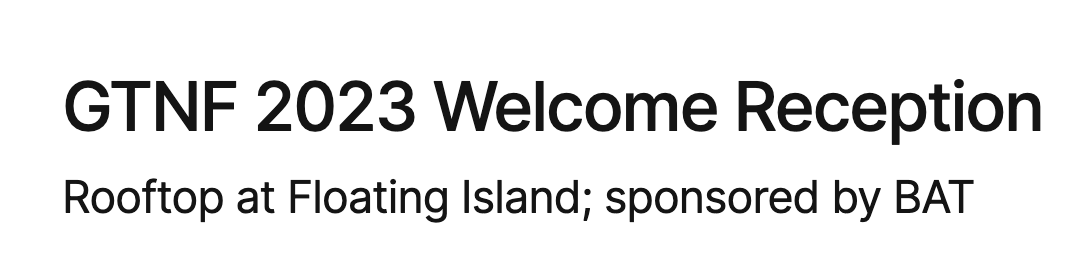
Also last week, across the other side of the world in Seoul, Big Tobacco held its annual gathering of the clan, the Global Tobacco and Nicotine Forum where it grapples with how best to short circuit effective tobacco control after wining and dining its latest little helpers at the BAT sponsored welcome reception.
This year the Australian participants included tobacco and vaping conference globe-trotter Colin Mendelsohn. Mendelsohn has long embraced vaping theologies that vaping is all but 100% benign, that it’s peerless as a quit smoking route and that there’s almost nowhere that vapes should not be sold. But Mendelsohn’s mission these days has dropped almost every pretence that he thinks any concern about vaping by kids is warranted and that nicotine is virtually a wonder drug (see two slides below from his Seoul spiel).

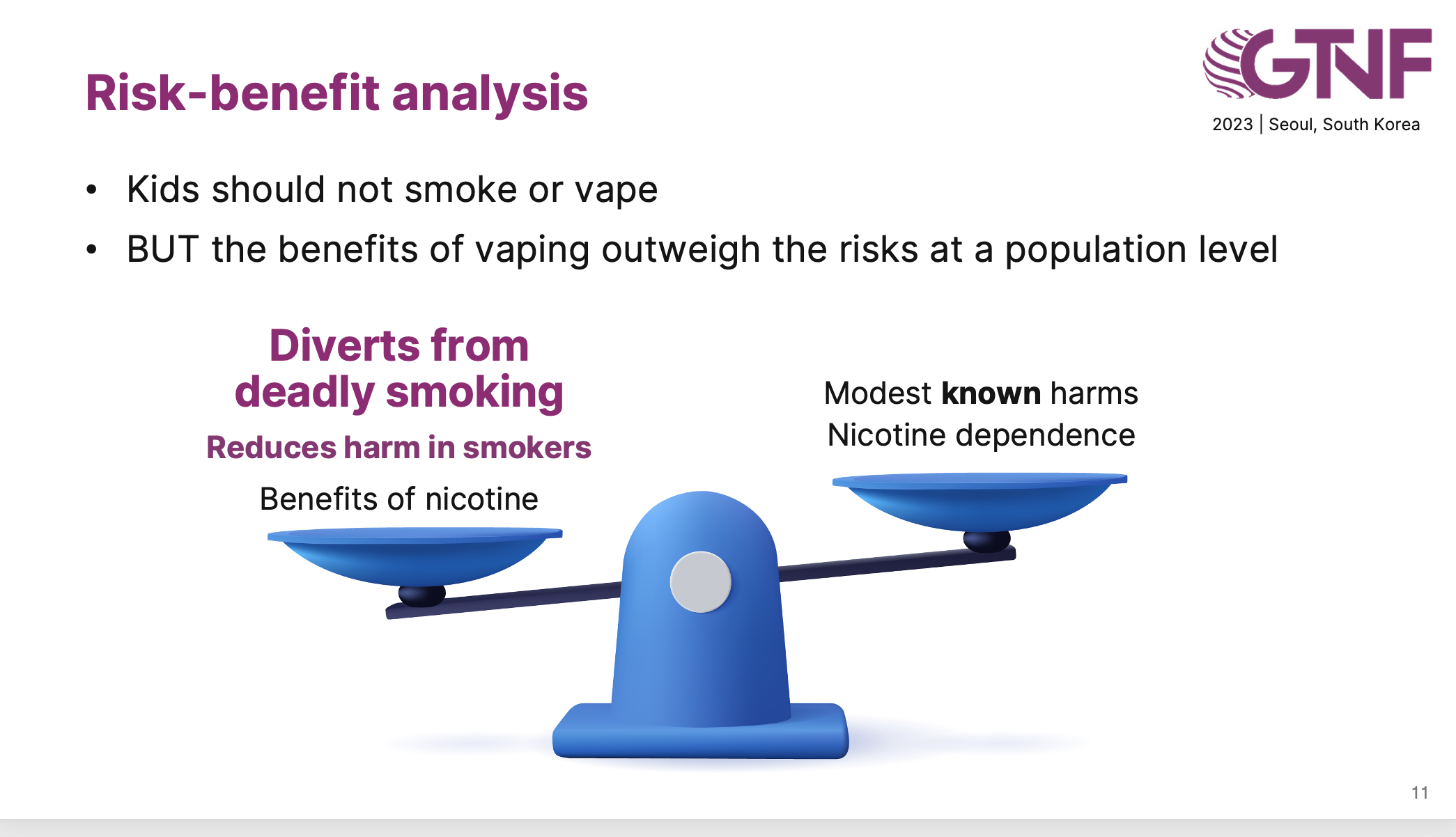
In Seoul among the big players in Big Tobacco and their extreme right libertarian acolytes, our champion reprised some of the main messages he published in August in a school education magazine article announcing his seven point la-la land plan to “address” teenage vaping.
In the magazine piece he left the very best bit until the last of his seven points, writing:
schools could consider a designated outdoor vaping area. This should ideally be out of sight, for example behind the toilets, and restricted to students who:
- Are ‘registered’ as vapers
- Are over a certain age (eg 16 years), and
- Have the written parental permission.
Vaping won’t be as appealing to teens if they are allowed to do it.
This proposal should not be seen as an endorsement of youth vaping, but as a pragmatic solution for the reality of nicotine dependence.
And not only designated vaping areas in schools. Mendelsohn wants regular vaping breaks for addicted vapers.
Some students are addicted to nicotine and need to vape at regular intervals during the day. Consider allowing addicted students to take short breaks to vape outside if needed during class hours.
All this comes after his earlier emphasis that most vaping in young people is transitory and experimental and that “most young people who try vaping do not get addicted to nicotine”. He writes “a supportive and compassionate approach is more likely to be effective and acceptable” about a problem he also says seldom is a problem.
Picture the scene every day in out-of-control classrooms when one kid after another pleads with the teacher to be compassionate and allow them to have yet another break so that they can get relief from the grip of nicotine withdrawal that, oh wait, Col has just told us is highly unlikely to be happening anyway.
With sales of nicotine vapes being illegal in Australia to anyone without a prescription, and all smoking banned on school grounds by anyone of any age, I wonder when Mendelsohn will also call for cocktail hours, and dope smoking and cocaine snorting areas in schools? All illegal too, but hey, schools need to be pragmatic and compassionate, right?
While Philip Morris and other tobacco companies continue unabated in their efforts to market tobacco products, rejoicing over any sales or profit increases in their reports to investors, their “we’re changing” charades are simply air cover for their business-as-usual of massively profiting from unspeakably deadly products.
They are like the owners of the White Star Line telling the public “we spent lots of money removing the splinters from the handrails of the Titanic.” Those who fall for this while chiming in support for the industry’s PR events are reprising a version of the age-old Faustian morality tale. And we all know how that ends.

The sinking of the Titanic as depicted in Untergang der Titanic, a 1912 illustration by Willy Stöwer
 Simon Chapman AO