• Home
  • About/CV
  • Blog
  • Vaping Research Alerts
  • Blog archive list
  • My books
  • Memoirs
  • Music, bands, films
  • Contact

Simon Chapman AO

~ Public health, memoirs, music

Simon Chapman AO

Monthly Archives: February 2019

10 questions for Philip Morris International on their “transformation”

21 Thursday Feb 2019

Posted by Simon Chapman AO in Blog

≈ 1 Comment

Like salivating foxes outside a henhouse, Big Tobacco companies like Philip Morris International and British American Tobacco are deep in global charm offensives, trying to convince the public, the corporate world, governments and public health leaders that they have changed. They want to be embraced as health promoters!

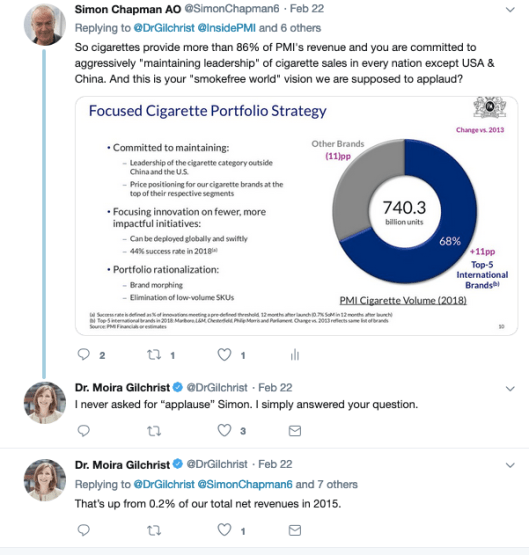
Overnight, Moira Gilchrist, Vice President at Philip Morris International, tweeted this

Screen Shot 2019-02-21 at 7.40.33 am

Here’s some news for you Moira, we’re doing very, very well in helping  smokers “who would otherwise continue smoking” to stop doing just that. It’s been going on for decades, despite your industry’s best efforts to thwart what we’ve been doing. And look at the harm we’re been able to reduce, in spite of your industry’s opposition.
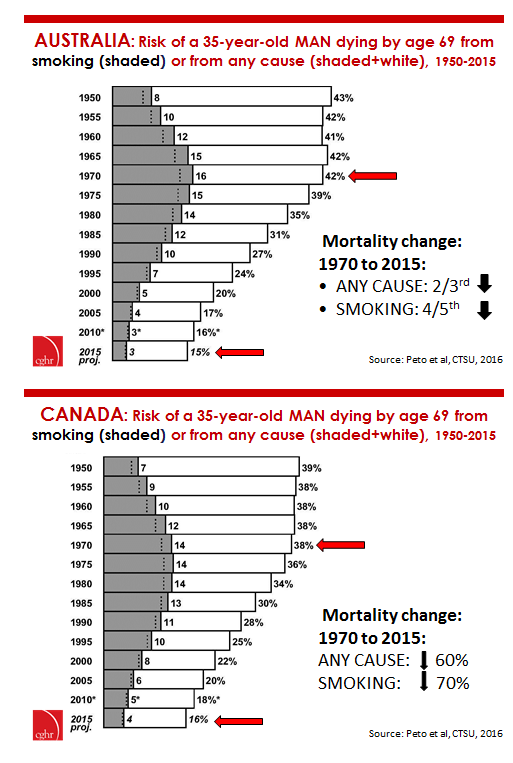
Australia mortality drops v Canada 1970-2015

Despite decades of abject failures in producing reduced harm products, they are still at it, this time with ecigarettes and heat-not-burn nicotine delivery systems.

The development of cigarette filters from the 1930s was the daddy of all harm reduction false assurances. While anyone looking at the brown gunk discolouring a cigarette filter gets it that this nasty stuff is caught in the filter and not inhaled, few appreciate that filters do not stop a lot of toxic material being inhaled.

Screen Shot 2019-02-21 at 8.07.52 am

And few are likely to appreciate that what gets inhaled deep into the lungs does not all come out when a smoker exhales, as this elegantly simple video demonstration makes very clear.

Throughout my career, journalists have often asked me for sets of questions I might suggest that they could ask visiting spin doctors from tobacco companies at conferences, press conference or during interviews.

Here’s one I put together in 2005 for David Davies, then vice president for corporate affairs for Philip Morris, when he spoke about harm reduction at Australia’s National Press Club in Canberra.
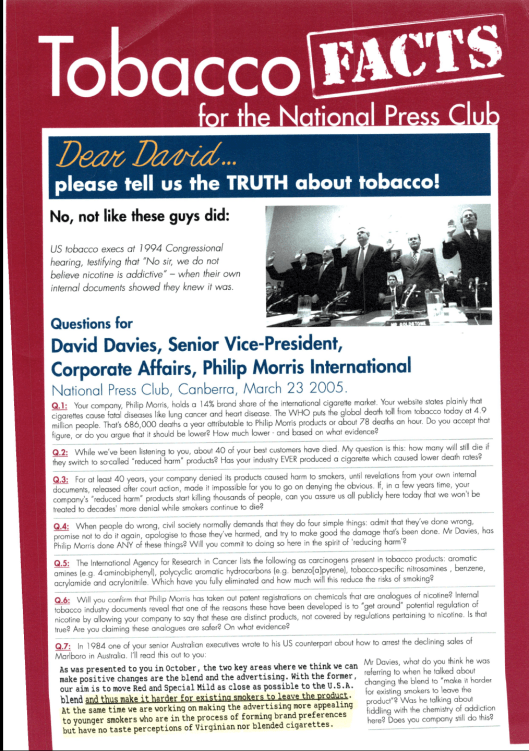
Screen Shot 2019-02-21 at 9.37.55 am

Screen Shot 2019-02-21 at 9.38.33 am

So, journalists, here are 10 questions you might like to be impertinent enough to ask a tobacco company wanting to explain to you their latest vision. And Moira, you are very welcome to answer these here. I will publish your responses, and will give you up to 2000 words to do so.

10 Questions for Philip Morris International

  1. You say you want smokers to switch to IQOS, but  Philip Morris USA (a separate company to Philip Morris International which just happens to share the words “Philip Morris” in its title) is on record recently as saying on its website that cigarettes are “our core product” and that they are working hard to keep their smokers happy with “best quality” cigarette products. Are cigarettes also PMI’s “core product’? Or asking another way, how much global revenue does PMI make from tobacco today, and how much from IQOS and what are your forecasts for these numbers in the next 10 years? Are your shareholders happy with you purposefully trying to drive south (by far) your biggest income stream?
  2. What are the KPIs (key performance indicators) for the sales, marketing and public affairs staff in your cigarette division today? Are they being asked to try and sell less cigarettes or to keep on trying to sell more? Could we all see copies of some of those please?
  3. In Indonesia, Philip Morris International owns the Sampoerna tobacco company. In 2016, Reuters reported that you were trying to get “wider reach” there via “stronger cigarettes” What do you say to those who say you are being duplicitous with all this reduced harm talk when this is what you are doing when you calculate that people in the west might not notice? Similarly, when the city of Balanga, Luzon in the Philippines wanted to implement a smokefree campus and surrounding environs, you supported the Philippine Tobacco Institute in its (successful) legal case against the proposal. So you say you want people to quit smoking, but only if they switch to IQoS, is that it? And if not you will continue fight effective tobacco control as usual?
  4. In recent years, your company has aggressively opposed tobacco control policies like graphic health warnings, plain packs, and increasing tobacco tax, all known to reduce smoking. When you do this, can you understand that many people think you are flagrantly lying when you say you want to help tobacco control?
  5. What do you say to critics who say that your business model is surely all about smoking AND vaping, not smoking OR vaping?
  6. I don’t think I’ve ever met a smoker who wanted their kids to grow up and start smoking. Do you feel the same way? Would you also hope that children would not take up vaping? If you really believe ecigs are of minimal risk, why not openly encourage kids to vape?
  7. Smoking by Australian teens is at a record low (1.9% of 15-17 year olds currently smoke) I find it hard to believe if your company had not modeled the impact of such a dire situation on your bottom line into the future if this was to continue. So what does that modelling show? And am I wrong in thinking that if your IQOS product does not attract a significant number of kids into regularly using it, then your company will wither and die within a few decades because if only smokers switch, many of those will quit and die, with no cohort of young people moving through to replace them.
  8.  The  parent company of Philip Morris USA, Altria, just invested $US12.8billon in Juul, the vaping product that has spearheaded 20% of US teens using ecigs in the last 30 days.  Are you going to tell me that this teen use of ecigs “concerns” you or that there were a lot of champagne corks popping at work when you all saw that data?
  9. The average daily vaper inhales 200 times a day and up to 600. The average daily smoker inhales about 95 times a day. Does that comparison suggest that nicotine delivered via vaping might be very, very addictive? Does that bother you?
  10. I’ve heard people very unkindly quip that it would be a good idea if all tobacco company employees were obliged to smoke or vape (in the obverse way that no cancer control agency would hire a smoker). It would be hard to imagine a senior executive in a car company who chose to not drive or own a car, but to always cycle or walk and openly declare that; or the head of a meat marketing board who was an open vegetarian, or a skin cancer prevention advocate who was deeply tanned. So why do you think your company is comfortable with some of its employees choosing not to smoke or vape? Do you smoke or vape yourself?

Follow-up (1 March 2019)

After I posted this piece a week ago, and tweeted a link to Moira Gilchrist from PMI, the following exchanges occurred (see thread here)

Screen Shot 2019-03-01 at 5.30.43 amScreen Shot 2019-03-01 at 5.31.08 amScreen Shot 2019-03-01 at 5.31.36 am

So. Thank you Moira, for partially answering the first bit of question 1 above (“Or asking another way, how much global revenue does PMI make from tobacco today, and how much from IQOS and what are your forecasts for these numbers in the next 10 years?”) and this below

Screen Shot 2019-03-01 at 5.26.00 am.png

Moira, this is clear as far as it goes, but it sits very awkwardly with all the unanswered questions I posed above about your company’s continuing efforts to attack tobacco control policies designed to get non-smokers (mostly kids) to “don’t start” (eg: high tobacco taxes, graphic health warnings, plain packs) and to motivate smokers to “quit now” (again, high taxes, graphic warnings, plain packs, plus smoke free policies like the one you helped stop recently in Balanga, Philippines).

So, no fudging please. When can we expect your answers to the questions you  publicly invited on Twitter from people like me who are (profoundly) skeptical of what we read as yet another wolf in sheep’s clothing exercise from your industry?

21 March 2019: update. Moira has posted this reply on the PMI website. Here‘s my reply

“If we stopped selling cigarettes tomorrow, someone else would take our place”.

12 Tuesday Feb 2019

Posted by Simon Chapman AO in Blog

≈ 2 Comments

Late last month, Philip Morris International tweeted one of its daily attempts to convince the world that it is now a health promotion company, firmly aligned with global public health to try and reduce the disease and death caused by tobacco use. Its mainstay, cigarettes, kill two out of every three long term users.

The company is aggressively marketing its heat-not-burn product IQOS (see footnote below) in several markets and  Altria, which owns Philip Morris USA, recently invested $US12.8 billion in the tearaway e-cigarette market leader, Juul. PMI has bankrolled the establishment of the fully “independent” Foundation for a Smokefree World with a grant of $US960 million dollars over 12 years in a classic exercise in astroturfing its messages to also come from a third party.

The Foundation has attracted incendiary criticism since it was first announced. See here, here, here, here, here and here, as just a few examples.

Last month a PMI tweet stated “If we stopped selling cigarettes tomorrow, someone else would take our place”.

Screen Shot 2019-02-12 at 1.09.45 pm

This was clearly a response to what any review of how its “we’ve changed” message is traveling would have undoubtedly identified as its most hobbling Achilles’ heels: its long-standing track record in both attacking tobacco control policies that threaten to actually reduce smoking (high cigarette tax, plain packs, graphic health warnings, smoking restrictions), and its on-going aggressive global marketing and promotion of its cigarettes.

For example, in Indonesia, the world’s fourth most populous nation where it is almost compulsory for men to smoke, the tobacco industry exploits this smokers’ paradise. A pack of cigarettes can sell for less than a small bottled water, tobacco advertising virtually wallpapers the entire country and non-smoking areas are uncommon and mostly ignored. Philip Morris owns the local manufacturer Sampoerna, which controls about one-third of the massive market there. In 2011, a Sampoerna advertisement proposed “Dying is better than leaving a friend. Sampoerna is a cool friend”. In 2015, the company began aggressively promoting its U-bold brand, a “stronger flavoured” brand, often code for higher yielding tar and nicotine brands.

Screen Shot 2019-02-12 at 10.18.31 am

In July, 2018, a legal action brought by the Philippine Tobacco Institute (PTI), representing Philip Morris and other tobacco manufacturers,  succeeded in preventing an ordinance being implemented in Balanga City, Luzon which would have banned smoking and the sale, distribution and promotion of cigarettes within the 80-hectare University Town and its kilometer radius. A press report stated that “PTI had argued that Philip Morris Philippines Manufacturing Inc. would lose P15 million in sales due to the city’s ban.”

In 2018, the company opened a new $30m cigarette factory in Tanzania

These are  hardly actions compatible with ad nauseum statements from company that it wants smokers to quit.

The tweeted admission “If we stopped selling cigarettes tomorrow, someone else would take our place” disrobes the entire charade. The “we’ve changed” emperor now quite clearly has no clothes.

Let’s pick the statement apart, one ethically bankrupt sub-text at a time.

Like a wolf outside a henhouse, Philip Morris has gushed an incontinent deluge of claims that it really, really wants smokers to switch to its alleged low risk products. But never once in all this has it set any target dates. Nowhere can we find when the company plans to actively take steps to end its own role in encouraging and promoting smoking and attacking policies known to reduce smoking. Will this happen in 5 years? 10 years? 30 years? Never?

All we know now is that it won’t happen “tomorrow”. And the great beauty of it never being tomorrow, is that tomorrow never comes.

We might think they were serious if they were to, for example, voluntarily move their cigarette products to dull plain packaging and add large pictorial warnings, or declare that they wre going to voluntarily stop all cigarette advertising in nations where it is still allowed, or axe their “Mission Winnow” sponsorship of Ferrari in the F1 Grand Prix and Ducati in the Moto GP  when Mission Winnow’s advertising livery is red and white, coincidentally we can be certain, the same colours as Marlboro.

But hell might freeze over before they did any of these things.

The company is not simply going to passively sit by and watch smoking prevalence continue to head south by taking its feet off its marketing accelerators or slamming them hard in concert with public health on the tobacco control policy brakes. It has said and done nothing to indicate that it won’t continue to do what it can to preserve and expand its cigarette sales.

PMI’s statement requires those reading it to understand that the company has been called out by critics to show that they are being serious about wanting to actively  end smoking. But by invoking the  “someone else will do bad things if we stopped” they seek to make a virtue out of knowingly and purposefully continuing to do the wrong thing.

Their pitch here is like a brazenly misbehaving 5 year old who knows he is doing something wrong, but says to the teacher “why should I stop? Why pick on me? Everyone else is doing it too!” Or a drug dealer saying to the court “yes, I was cutting my heroin with cheap adulterants that put all who used it at extra risk, but that’s what my competitors are all doing too, and I just needed to keep up with them price-wise or go under. Please sympathise with my situation!”

Screen Shot 2019-02-13 at 1.23.50 pm

As I wrote in 2014:

“My wife is a primary school teacher with 35 years experience. She has often described incidents where 5-9 year olds with poorly developed moral compasses have been caught red-handed bullying, stealing, cheating or lying but unblinkingly deny it regardless of the evidence in front of them.  More than once, she’s suggested that such a child might one day make an ideal applicant for a job in a tobacco company.

Globally, different legal, moral and religious codes tend to share basic principles when it comes to how to deal with those who have done serious wrong. Sentencing often takes note of evidence of contrition and civilized societies and judiciaries tend look for five broad pre-conditions in considering punishment”

  • Full public acknowledgement of the misdeeds and harms caused
  • apologising for these harms
  • promising never to repeat them
  • making good the damage done, and
  • undertaking some form of public penance to symbolise your changed moral status.

Like many caught-out five year olds and recidivist adult sociopaths, the tobacco industry has done none of these things. Its corrective advertising is being done reluctantly after 15 years of legal kicking and screaming, while schmoozing with the global corporate social responsibility movement, publicizing its donations to carefully selected charities and just getting on with trying to sell as much tobacco as possible, regardless of the misery it causes.

They have all the ethics of a cash register.”

At least cash registers don’t pretend to be something they are not.

Footnote: a just published report comparing the impact of  IQOS with cigarette smoke on human lung cells  concluded “IQOS exposure is as detrimental as cigarette smoking and vaping to human lung cells. Persistent allergic, smoke or environmental-triggered inflammation leads to airway remodelling/scarring through re-organisation of ECM and airway cell proliferation, and mitochondrial dysfunction plays a pivotal role in this process. These are the principal causes for airflow limitation in asthma and COPD.”

[updated 24 Jan 2020]

Cover bands: the most fun you can have

09 Saturday Feb 2019

Posted by Simon Chapman AO in Blog

≈ Leave a comment

BestBandShot
Some years ago, the ABC ran an almost continuous promotion across several weeks for The Librarians, a poke at an occupation popularly synonymous with purse-lipped, dull people who love orderliness. The promo gag centred on a gormless Kym Gyngell taking his garage cover band very seriously, and channeling a flailing Peter Garrett from Midnight Oil. Along with a lot of weekend cover band tragics, I’m afraid I just didn’t see the joke.
In 2004, the seeds of my cover band The Original Faux Pas (later rebirthed as The Bleeding Hearts), emerged from secret afternoons in our guitarist’s living room to play a handful of classics like the Swallows’ It ain’t the meat, it’s the motion and Eydie Gormé’s Blame it on the bossa nova at my wife Trish’s 50th birthday. I was the singer.
Polite friends mumbled that we weren’t too bad, so of course there was then no stopping it. Over the next 14 years, we played 42 gigs in pubs, clubs, festivals, harbour cruises, conference dinners and house parties. On election night in 2007 we renamed ourselves Howard’s End, incontestably causing conservative prime minister John Howard to lose the election to Labor’s Kevin Rudd.
We always played to raise funds for causes and charities we liked and helped raise $127,000 for causes like the UNHCR, Amnesty International, the Cancer Council, domestic violence, and the homeless charity, Missionbeat. We played two well attended gigs in Glebe’s Harold Park Hotel for Peter Greste, the journalist jailed in Egypt, and later two for a school for girls in South Sudan, as featured in Tom Zubrycki’s 2017 documentary Hope Road.
.
In 2012, I tempted ABC Sydney’s breakfast radio host Adam Spencer to play with us in two fundraisers for Somalian refugees in a massive camp at Dolo in Ethiopia. I’d heard him explaining he was learning guitar and correctly anticipated that it would be every guitar student’s ambition to be invited to sit in with an acclaimed stadium-filling band like ours. We pulled $25,000 in door money and pledges given across both nights.
We played as the final band late at night at two festivals held on our long-time keyboardist’s farm at Ourimbah on the central coast north of Sydney, to raise money for multiple sclerosis research. There were about 400 at each event who danced and cheered throughout our set.
We realised we could get up there and make lots of people have a great night and help causes at the same time. As all bands will agree, nearly everyone is oblivious to the mistakes you make every night, including once when our keyboard player Rob Heard completely forgot to play the entire critical organ solo in the middle of the Doors’ Love her madly. All was forgiven and asking a few people in the crowd later, no one but us knew. But not once in 42 gigs did we ever have a song collapse and have to start again, something you often see with pub bands.
At the other end of the scale, we played two inexplicable fizzers. Our bass player Dave Petroni, had a small farm near Bowral in the southern highlands. The publican at his local pub begged him to bring the band to Bowral one Saturday night. So, along with our $300 soundie, we made the trek down the Hume highway. I’d plugged it  across NSW that morning on ABC radio weekend’s Simon Marnie’s regular ‘what’s on’ segment. We were all anxious if security would be needed and whether we should have informed the local police to set up a traffic contraflow on the approaches to the pub.
We sound-checked at 6pm to an all but empty pub and then ordered pub food. At 6.30 the publican nervously asked when we planned to start playing. We told him about 8pm. “There won’t be anyone here by then” he told us. “They all go home by about 7.30 to watch telly.” At this point there were about 15 people in addition to us in the room. All but two were wives and friends.
The other two were an aged couple, the man in a wheelchair. They’d heard me spruiking it on the radio that morning and had driven down from Campbelltown. They left half way through our first set. So we played to ourselves, our dutiful entourage and a local gasbag who arrived late and told us he was very good mates with the shock jock Alan Jones who had a place down there. “I can get Alan to promote you guys next time you come down” he promised. The pub even messed up our name on the sign outside. Faux Pas? Paux Pas? Fox pus? Oxford/Cambridge, tomayto/tomarto?
A second doozie was raising money for a major charity, at the Grandstand at Sydney University. The charity staff gushed with enthusiasm when I approached them, but disappointingly declined to push it on their website or by direct email to their Sydney supporters. Instead, they said they would ask a bunch of students who volunteered for them to leaflet lecture theatres and bring all their friends. But somehow, the two volunteer students who arrived late, apparently had no other friends. They sheepishly assisted in barbequing a few of the half tonne of sausages that the Grandstand management had generously donated to attract hordes of students from the adjacent colleges who would be clamouring to be there. A colleague of mine and band fan had dragged her three teenage kids along. They whined from the minute they arrived and had to be taken home by their embarrassed mother. We’d convinced another superb cover band we’d played with once before to share the gig. We had door takings about $60, well short of even paying our soundie, so the charity got nothing – the only time that ever happened.
Over the years we had five different guitarists, two of whom (Paul Grogan and Bob Jones) had very extensive band experience. We also had a veteran bass player, Dave Petroni, who could knock the socks off the Who’s John Entwhistle in My Generation, our anthem to zimmer frame rock. Some of us had limited to zero time in other bands, various commitment to practising, and musical abilities.
Like all bands, we had our share of tensions. A short-lived member said soto voce to our drummer one night that if he didn’t hit the skins more softly, he would walk out. We lived in hope until he soon moved along. One of our guitarists would often stop playing mid-song at rehearsal, shouting his exasperation at others he felt were not up to scratch on a song. This happened at more rehearsals than it didn’t. He’d rapidly apologise profusely, saying “sorry, sorry, sorry” ad libitum.
One night the other guitarist said cheerily “Hey, no need to apologise. We all know you’re an arsehole. You’ve just displayed it a bit earlier than usual tonight.”
Well, he was, and he wasn’t. His talent was the absolute backbone of the band for years. Everyone I’ve ever talked with who’s been in a band will tell similar stories of the foibles and peccadillos of just about everyone they ever played with, except of course themselves.
We all understood that we promoted ourselves as a dance band, so any dance floor clearers that anyone suggested we rehearse were supposed to be assessed against that criterion first. But everyone had different preferences like blues, country, or 60s pop which they tried to insinuate into rehearsals. Compromises saw core material retained that everyone liked but many songs were on death row, executed by anyone in the band who barely tolerated it after a gig when such a song had even half a bar of problems. We all had power of veto though: I refused to ever sing Nutbush City Limits, My Sharona, Smoke on the water  or similar perennial entries on collections of best beer hall hits and ocean cruise liner request lists.
Dave, our bass player, would roll his eyes at anything remotely country, while Suzanne Plater who shared the lead vocals with me for several years was on a mission to be a white Etta James.
When Australia’s health minister, Nicola Roxon, led Australia to introduce plain tobacco packaging, Trish who was at that time doing back-up vocals, rewrote the lyrics to the Shangrila’s Leader of the Pack as a tribute to Nicola. Four of us were having dinner one night, and sang it to an iPad camera, with Trish in a lurid Julia Gillard $15 red wig. We put it up on YouTube and over the next months it had 1500 hits.
DSC_1055
Exchange Hotel, Annandale
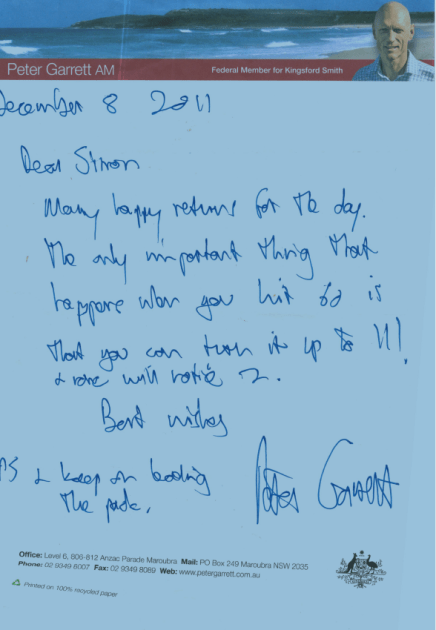
Some months later I was with a friend in a Canberra restaurant near Parliament House and in walked Nicola, soon joined by her parliamentary colleagues Jenny Macklin, Peter Garrett, Greg Combet, Kevin Rudd and Craig Emerson. We chatted to Nicola before the others arrived and then continued our dinner. As we were leaving, I heard a male voice behind me call my name. I turned and it was Peter Garrett who had followed us out. I’d never met him before. The next words of the world famous rock star turned politician were “I hear you are a world famous rock star!”
He said Nicola had sent the video link to many of her colleagues, and thought it was wonderful fun. The three of us stood on the footpath swapping early bad gig stories. A few months later, he sent me a birthday note for my 60th birthday, referencing the famous Spinal Tap scene about “turning it up to 11”.
It’s fashionable to put cover bands down, just because we get around. Several times we’ve played with earnest bands playing their often dreary ‘original material’. But when the crowd hears the ghosts of Roy Orbison with George Harrison and Tom Petty jangling out the opening to Handle with care, or the irresistible beat of T-Rex’s Get it on they are instantly on their feet. A few of the youngest head for the door, but for the rest, cover bands are a connection with a lifetime of songs that are hard-wired in our heads. The Rolling Stones’ Hey McLoud get offa my ewe has not been number one in New Zealand for 50 years for nothing.
You have to wait till page 491 of Keith Richards’ biography to read the essential lines that resonate for anyone who’s been in a band. “The real release is getting on stage. Once we’re up there doing it, it’s sheer fun and joy …feeding off the energy that we get back from an audience. That’s my fuel … I get an incredible raging glee when they get out of their seats. Yeah, come on, let it go. Give me some energy and I’ll give you double back.”
Anyone who’s had a band behind them playing the guitar power chords in Hunters and Collectors’ Holy Grail or has belted out the Young Rascals’ Good Lovin’or the Stones’ Rocks Off knows that feeling when you play to a room full of people wanting to let loose on the weekend with a loud band playing anthems from across their lives. It’s exhilarating.
Garrett note
Turn it up to 11
Now it’s true that there were some differences and similarities between us and the Stones. We had to lug our own gear and we never had a jet but some of us are nearly the same age as Keef and the rest. When I sing to the smiley one in the one row deep mosh pit that “I’m a king bee. I can buzz better baby, when your man is gone”, it may not have quite the same potential as Mick singing it. But the Canada Bay Club, where we once played to 35 mostly non-dancers, was our equivalent of the Stones’ Crawdaddy Club in Richmond south of London in the early 1960s. The barman at the Canada Bay Club who said he was the brother of a member of the original AC/DC, swore we had the same potential. He’d know, right? So we played a blinder in the second set and hit them with our rhythm sticks.
As support act at Wamberal Surf Club to some local favourites (who unforgivably played a Neil Diamond song), we were each serially approached afterwards by a drunk middle aged woman, indecently younger than most of us. But we all drove home able to say  we had attracted our first groupie. Band crowds aren’t pleased much easier than Japanese conference delegates in kimonos on a Sydney harbour cruise in summer. They stare at you for about 20 minutes, then start to pogo and go nuts. While they can make strange requests like The lady in red in the middle of a sweating dance set, I’ll have them anytime over kids who are dragooned by their parents to come and hear this great music. They look pole-axed with disdain and then leave.
Wednesday nights rehearsing at Stagedoor studios in Alexandria is the best $25 a head of fun it’s possible to have. Over the years we shared the venue with uncounted death metal thrash bands, but also silverchair, Barnsey, the Angels, the Choirboys, various Australian Idol winners and even that astute judge of talent Marcia Hines who all had booked adjacent rooms on the same nights as us to quietly pick up tips. We just walked past them and they tried to look cool, pretending not to know us.
One night we were all set to rehearse the Angels’ Take a long line until we heard the unmistakable riff seeping from beneath the soundproof door in the next studio room. It was the Angels rehearsing a comeback tour. Uh-oh. Park that one.
In my mid 50s, a sports car proved an empty illusion. When I brought a sleek black Nissan 300ZX with a sports exhaust home, my wife named it the Jeff Fenech-mobile, after the gold chain wearing Australian boxer, the Marrickville Mauler. “Why didn’t you just pick up a megaphone at a disposal store and walk down the street telling everyone you are worried about your dick? It would have been a lot cheaper” she said.
But a cover band is the real thing. After several Nellie Melba departures as a back-up singer, she soon became as addicted as the rest of us, and switched to keyboard. We had a sax player who was a senior partner in Australia’s biggest law firm. His wife said he was helpless after just a couple of gigs. Paul Grogan who played lead guitar with us for much of the period and works for a big health charity, played Brisbane pubs in the 80s and then wrote love songs for Filipino pop singers, but he could cut it like Carlos Santana on a good night.
One Christmas, I saw a band of guys in their late 60s singing crooner and 2CH hits-and-memories songs to an enraptured room at my late mother-in-law’s nursing home. One was a state parliamentarian. Not our demographic, yet. But each generation defines itself partly by the music that refuses to leave its collective heads. Cover bands will not fade away.
Here’s a collection of some of our performances

Cigarettes are sold everywhere and unregulated. So hey, let’s do that with e-cigarettes?

06 Wednesday Feb 2019

Posted by Simon Chapman AO in Blog

≈ 1 Comment

In a recent Medical Journal of Australia Insight blog on e-cigarette regulation, vaping promoter Colin Mendelsohn responded to a comment, writing “ecigs are consumer products. Medicines regulation is not appropriate. Why should they be regulated more strictly than cigarettes which can be bought at every corner shop?”

Then, without pausing for breath, in his very next sentence he goes on to tell us about how effective in smoking cessation they are, compared to nicotine replacement therapy (NRT), as one recent study reported them to be.  In case you missed it, NRT is a medicine regulated by the  Therapeutic Goods Administration, not a “consumer product” , whatever that might mean.  (see my previous blog and here for comments on the major limitations of the evidence that Mendelsohn cited)

Excitable News Corp journalist Joe Hildebrand puts it this way “How come it’s legal for me to walk into a convenience store and buy something that’s going to kill me but it’s illegal to buy the one thing that could save me?”

The one thing, eh Joe. Tell that to the 30% of Australia’s adult population who are ex-smokers who somehow managed to quit smoking without using an e-cigarette. About 5,440,800 of them, according to 2017-18 ABS data on smoking.

One problem with this trite comparison is that tobacco products are regulated in Australia in many ways that  Mendelsohn strongly opposes for ecigarettes.

  • All advertising and promotion for tobacco products has been banned since 1994. Mendelsohn wants advertising for ecigarettes allowed
  • the sale of fruit and confectionary flavoured cigarettes is prohibited in South Australia, New South Wales and Tasmania. He is strongly in favour of allowing many flavours, including those that may have high appeal to both adults and teens
  • smoking is banned in all enclosed and several crowded outdoor areas like stadiums. He wants vapers to be allowed to smoke in areas where smoking is banned because he says this will add to the appeal of vaping and cause smokers to quit. The rest of us can just put up with clouds of vape like this is bars, restaurants and cinemas, apparently. When many vapers are present (and that would never happen of course), particulate matter levels can reach and exceed those that used to be recorded when smoking was allowed in crowded bars.
  • Tobacco products are heavily taxed, depressing demand particularly among low income group and children. Mendelsohn supports reducing tax on ecigs, a policy that would make them more accessible to Australian children, of who only 1.9% smoke daily today.
  • Retail display of tobacco products is banned nationally. Ecigarettes are on open display in retailers, something he fully supports
  • All products are plain packaged, with large health warnings while packaging for ejuice is a cornucopia of beguiling images

Let’s repeat the same mistakes we made in allowing open slather sales and promotions with cigarettes

But more fundamentally, the galactic dangers of smoking were not fully understood for at least 40-50 years after mass consumption and the commerce that facilitated it had commenced in the first decades of the twentieth century. After mechanisation of cigarette production made them cheap as chips, it then took us 40 -50 years between the 1960s and today to fight for all the policies and campaign funding that have together taken smoking down to its lowest ever levels.

Out of ignorance and under sustained pressure from the tobacco industry, we began by making every regulatory mistake possible when cheap, mass produced cigarettes appeared. Our understanding of the health risks that may be posed by ecigarettes is in its early infancy, given the latency periods that apply with the development of chronic disease.

It is often said that if cigarettes were invented tomorrow, and we knew now what we didn’t know when they entered the market, no government in the world would permit their sale, let alone allow them to be sold in every convenience store.

With pharmaceutical products that save lives, treat illness and reduce severe pain, we allow only those with a 4 year pharmacy degree to sell them. And only to those with a temporary license issued by a doctor (a prescription) to use them. With cigarettes, we foolishly allow them to be sold everywhere.

Very few people (me included) are saying we should ban ecigarettes. But nearly every health and medical agency in Australia and many internationally, including the WHO, are saying that they should be strongly regulated through the TGA so that over time, as knowledge increases we could review whether looser or stronger regulation (perhaps including bans) was appropriate when that knowledge is available.

That’s the way nearly every country regulates pharmaceutical products. Strict, prescription-only regulation at first,  followed by evidence-driven loosening or tightening down the track.

Vaping advocates seem to have understood little from where we went so wrong in unleashing cigarettes and allowing them to be sold everywhere from the get-go. Today they are trying to walk on both sides of the street by insisting ecigs are not therapeutic goods, but in the next breath megaphoning claims about how good they allegedly are in helping smokers quit compared to other therapeutic goods.

Make up your minds?

This 2016  Lancet meta-analysis of smoking cessation and ecigarettes concluded that  ecigs were associated with less quitting among smokers. The 2018 report of the US National Academies of Science, Engineering and Medicine on ecigarettes concluded “Conclusion 17.1 Overall, there is limited evidence that e-cigarettes may be effective aids to promote smoking cessation.” NASEM rated limited evidence four rungs below “conclusive” evidence and just two above “no available evidence”.

Blog Stats

  • 163,470 hits

Top Posts & Pages

  • Why I’m not quitting Spotify because its owner has hugely invested in weaponry
  • Australia takes off the gloves on illegal tobacco while ‘lower the tax’ fantasists plumb new absurdities
  • About/CV
  • Vaping theology: 6 There’s nicotine in potatoes and tomatoes, so should we restrict or ban them too?
  • My books
  • Regrets … I’ve had a few. Paul Hogan and his Winfield role.
  • Thinking of keeping koi? Advice for beginners in NSW
  • Cheap illegal cigarettes save low income pack-a-day smokers over $9000 a year. So why don’t social justice champions give them full support?
  • Why Australia’s illegal tobacco and vape trade continues to flourish and what should be done about it
  • My first seen, best and worst bands 1964-2022

Blog archive

Comment Policy: No anonymous or pseudonymous posts will be published

Recent Posts

  • Australia takes off the gloves on illegal tobacco while ‘lower the tax’ fantasists plumb new absurdities
  • Egg on some faces: statisticians at 10 paces on the impact of New Zealand’s vape laws on youth smoking
  • Lowering tobacco tax to make illegal tobacco sales “disappear overnight”: at last we have a proposed figure and it’s an absolute doozie
  • Why I’m not quitting Spotify because its owner has hugely invested in weaponry
  • Should we believe Fiona Patten on vapes? Here are just a few problems

Recent Comments

Jon Krueger's avatarJon Krueger on Egg on some faces: statisticia…
Atul Kapur's avatarAtul Kapur on Should we believe Fiona Patten…
Unknown's avatarCould a national tob… on If expensive cigarettes are dr…
tahirturk1's avatartahirturk1 on Why Australia’s illegal tobacc…
malonere's avatarmalonere on Words I’ve seen, but didn’t kn…

Archives

  • December 2025
  • August 2025
  • July 2025
  • June 2025
  • May 2025
  • March 2025
  • January 2025
  • November 2024
  • October 2024
  • September 2024
  • July 2024
  • May 2024
  • April 2024
  • March 2024
  • February 2024
  • January 2024
  • December 2023
  • November 2023
  • October 2023
  • September 2023
  • August 2023
  • July 2023
  • June 2023
  • May 2023
  • March 2023
  • February 2023
  • January 2023
  • December 2022
  • November 2022
  • October 2022
  • August 2022
  • June 2022
  • April 2022
  • March 2022
  • February 2022
  • January 2022
  • December 2021
  • October 2021
  • September 2021
  • August 2021
  • June 2021
  • May 2021
  • April 2021
  • March 2021
  • February 2021
  • January 2021
  • December 2020
  • November 2020
  • October 2020
  • September 2020
  • August 2020
  • July 2020
  • June 2020
  • May 2020
  • April 2020
  • March 2020
  • February 2020
  • January 2020
  • December 2019
  • November 2019
  • October 2019
  • September 2019
  • August 2019
  • July 2019
  • June 2019
  • May 2019
  • April 2019
  • March 2019
  • February 2019
  • January 2019
  • December 2018
  • November 2018
  • October 2018
  • September 2018
  • August 2018

Categories

  • Blog

Meta

  • Create account
  • Log in
  • Entries feed
  • Comments feed
  • WordPress.com

Blog at WordPress.com.

  • Subscribe Subscribed
    • Simon Chapman AO
    • Join 198 other subscribers
    • Already have a WordPress.com account? Log in now.
    • Simon Chapman AO
    • Subscribe Subscribed
    • Sign up
    • Log in
    • Report this content
    • View site in Reader
    • Manage subscriptions
    • Collapse this bar
 

Loading Comments...