This week, Marian Salzman, Vice President for Communications at Philip Morris International, finger-jabbed the Australian government as “morally reprehensible” for its strict regulation of e-cigarettes. The irony police were believed to be on their lunch break when the Financial Times journalist reported that gem, with WHO estimating that 7 million people die each year from using the products sold by the industry Ms Salzman works for. A chihuahua which nipped an ankle would feel just as chastened if warned to stop by a rabid pit bull terrier.
Similar ethical tut-tutting has also surfaced in scholarly circles. Three Australian researchers, Wayne Hall, Kylie Morphett and Coral Gartner (hereafter HMG), recently published a paper in a bioethics journal where they slammed Australia’s current policy on e-cigarettes and those supporting it as being “based on strong interpretations of weak evidence”, as paternalistic, and embodying “an incoherent approach to managing health risks.” At the end of the paper, they make suggestions for how they believe things should change.
Below, I critically examine their arguments and proposals.
In Australia, nicotine (except when sold in tobacco products – more on this below) is regulated as either a therapeutic substance or a poison. Anyone wanting to make therapeutic claims for nicotine (such as that it has an acceptable risk profile in the doses in which it will be used, and is useful in helping smokers quit smoking) has to get Therapeutic Goods Administration approval for any products they wish to make such claims about. The TGA has long-established procedures for assessing the evidence for such claims.
E-cigarette advocates make three foundational claims for the benefits of vaping: that it is all but totally safe; that it is a very good way for smokers who are “unable” to quit smoking to do so; and that by making it easily available, there will be negligible collateral adverse effects, particularly involving seeing nicotine naïve youth who would be highly unlikely to ever become dependent on nicotine in any form, to do just that. In all this, they unavoidably veer into the domain of making therapeutic claims and so, like manufacturers of any quit smoking product in Australia, require TGA oversight and authorisation.
“Many smokers are unable to quit”
As I wrote in my last blog, the notion that there are many people who just cannot quit derives from the core assumption of the hardening hypothesis: the idea that today’s smokers are mainly those who “can’t” quit smoking. They are people who are intransigent, helpless nicotine addicts, impervious to all that tobacco control policy and programs can throw at them. We all need to accept that these people will never quit and must instead dose themselves with nicotine, perhaps forever, runs the pitch.
Unfortunately for this argument, John Hughes, one of the world’s most respected and prolific researchers on smoking cessation, recently let all the air out of the hardening hypothesis tyres in a paper in Nicotine and Tobacco Research. He reviewed 26 studies on hardening and found:
“None of the 26 studies found that conversion from current to former smoking, number of quit attempts, or success on a given quit attempt decreased over time and several found these increased over time.” He concluded “Some have argued that a greater emphasis on harm reduction or intensive treatment approaches is needed because remaining smokers are those who are less likely to stop with current methods. The current review finds no or little evidence for this rationale.”
The idea that we have reached rock-bottom and that all remaining smokers need to switch to e-cigarettes, and not quit, is not evidence-based.
“E-cigs are too important to be regulated”
Many e-cigarette advocates appear to have the missionary zeal of those who, cult-like, believe their calling to spread their gospel of good news places them above others who must line up and play by the regulatory rules. They want to highlight claims of efficacy and safety, but believe their cause is so important that they should be above regulation.
They are on a mission to save a billion lives this century (achievable with two very minor caveats, that e-cigs indeed are almost benign, and that every smoker around the world in the next 80 years will switch completely to vaping). They claim e-cigarettes have therapeutic benefits seldom seen in the history of public health. One calmly described them as “the most significant advance since antibiotics.” The subtext of this pitch is that e-cigarettes are far too important to be constrained by red-tape regulation.
Purveyors of useless and sometimes dangerous quack cures for cancer, HIV, asthma and other serious diseases cannot get endorsement for their claims unless they submit them for assessment and provide high quality evidence in support. HMG presumably would fully support such scrutiny and feel pleased to live in a country where consumers are thus protected, yet think it is unethical that e-cigarette manufacturers should have to meet the same standards. I believe it’s unethical that they shouldn’t have to.

“TGA regulations are too onerous and costly”
HMG further argue that there are major obstacles to getting therapeutic substances approved. They argue that these are so onerous and costly that no one but tobacco and pharmaceutical companies could hope to stump up the costs involved:
“The small independent companies that manufacture ENDS products do not have the funds or experience in pharmaceutical regulation to conduct clinical trials or apply to have their products registered as therapeutic goods. Only tobacco or pharmaceutical companies have had the financial resources to fund clinical trials and navigate the pharmaceutical regulatory process ..”
This is an entirely specious claim. A senior official from the Department of Health told the 2017 House of Representatives enquiry into e-cigarettes:
“I do want to correct a statement that was made to the previous hearing of this committee that the application process is onerous and really expensive. Depending on the nature of a product, a smoking cessation product could be available over the counter or if it goes into the lungs it generally would become a prescription medicine. If it is an over-the-counter medicine, for example, the maximum application registration fee is $27,000; the annual one is $1,430 a year — about the same as it costs for you to renew your car registration.
I must admit that it is difficult to see how that would be a major impost on some of the significant multinational companies involved in this area. Even as a prescription medicine — and those where the nicotine goes down into the lungs rather than absorbed in the mouth, and the oromucosal services are prescription medicine — it’s a one-off cost of about $240,000 and then I think it is $3,230 [the annual fee] again, hardly onerous for a company that is expecting to have a major market presence.”
HMG believe that small e-cigarette manufacturing businesses with low capitalisation should not be penalised from market entry. Again, we do not make this argument for garage or kitchen labs making pharmaceuticals. We very sensibly argue that quality control standards involve significant investment to guarantee that those standards are always met. GMP (Good Manufacturing Practice) certification is required, and any small company without such certification should of course be excluded. Yet, HMG appear to believe this should change and that it would ethically virtuous to allow this to happen. Shredding regulatory processes refined over many years and mirrored in most advanced nations, designed to best ensure consumer protection and the integrity of therapeutic goods administration would be deeply unethical in my book.
“The government hasn’t banned cigarettes, so it should not ban e-cigarettes”
HMG make this argument one of their centerpieces, triumphantly returning several times to what they appear to believe is its impervious “gotcha” status. Their argument here runs (1) it is self-evident that cigarettes are far more dangerous than e-cigarettes (2) cigarettes have always been sold and are not banned from sale (3) therefore, consistency and coherency demand that e-cigarettes should also be allowed to be sold in the same way because of the precedent established with cigarettes.
Their syllogism takes no account of the reasons why cigarettes are sold in the way they are today, and not in the way restricted substances like prescribed drugs are sold to consumers. Sales of cheap machine-made cigarettes burgeoned from the early twentieth century when there was no case against smoking, beyond that made by temperance groups. Tobacco control commenced more than 60 years later with the first tepid health warnings appearing in the USA in 1966. Across those years, tobacco consolidated its special exceptionalist regulatory status as being entirely exempt from ingredient controls. Even today, fully comprehensive tobacco control has been enacted in only a minority of nations.
To date, no country other than the minnow, isolated nation of Bhutan has ever contemplated banning cigarettes. Yet throughout my 40 year career, it’s been common to hear leaders in this field say “if cigarettes were invented tomorrow, when we know now what we never knew when they first appeared, no nation would allow their sale.” Aside from Brazil which bans flavouring additives , recent developments in California to ban flavoured tobacco and the nascent, glacial efforts of the US FDA to regulate tobacco products through proposals like limiting nicotine content, no nation has even taken baby steps to regulate tobacco content.
HMG are experienced enough to know that no nation will ban cigarettes any day soon. They know the legacy of cigarettes’ historical circumstances saw them (unlike pharmaceuticals, foods, beverages, cosmetics, agricultural, industrial and household chemicals) totally exempted from regulation. They know this historical legacy has tied two hands behind the backs of any thought that backwards time-travel could somehow magically allow this situation to be undone.
Importantly, they know that when proposing gold standard regulations for any product carrying serious risks, that the very last model any regulatory authority would reach for is that which applies to tobacco regulation. Yet knowing all that, they are happy to set their ethical bar to this lowest imaginable level and accuse supporters of tough regulation as being “incoherent”. We allow cigarettes to be sold everywhere, so therefore we should allow a putative less dangerous cigarette substitute to be subject to the same non-standards of regulation, they argue.
This reasoning is completely arse-up.
Instead, we should commence our comparison by saying “We made every conceivable error in the way we allowed cigarettes to be allowed into commerce, in the way we allowed it to be advertised, packaged and sold as if it was confectionary. We know that we were deceived by the tobacco industry with the harm reduction promises of filters and light/mild cigarettes. We now face a new opportunity to get regulation right with new products carrying unknown risks of daily, long-term use. Let’s learn from the disastrous history of tobacco regulation and not make the same mistakes again.”
Governments have banned leaded fuel and paint, asbestos and innumerable examples of dangerous consumer goods, all for health and safety reasons. Momentum to set endgame dates for the sale of new fossil fuel powered vehicles, new coal mines and coal-fired power stations is building fast. While Big Tobacco refuses to set target dates for stopping the sale of cigarettes, it is not inconceivable that governments will do this for them as smoking prevalence continues to fall.
“e-cigarettes are all but harmless”
The diseases caused by smoking (such as cancers, respiratory and cardiovascular diseases) typically present symptomatically several decades after chronic use commences. The famous lagged 30-50 year relationship between the rise in smoking across a population and the peak incidence of deaths caused by smoking is something that every student of public health understands (see figure below). HMG acknowledge this “ENDS have not been used for long enough, however, to assess any adverse health effects of their long-term use.” And in the finally section of the their paper where they consider what they believe are more appropriate regulatory options, they repeatedly commence their proposals with a series of “if”s – major conditional caveats that acknowledge the very core concern that as evidence accumulates about the risks of vaping, it may well turn out that they are far from benign.

Evidence is accumulating that e-cigarettes pose what may turn out to be considerable cardiovascular, stroke and respiratory risks, that nicotine is a tumour promoter and that dual users (those who some and vape, by far the biggest proportion of vapers) increase their nicotine intake and dependence, likely affecting their ability to quit either or both products.
There are many differences between smoking and vaping, and it is plausible that the disease profiles for smoking and vaping will eventually prove to have similarities as well as important differences. One obvious difference is in puff frequency. Ad libitum smoking in real world settings sees smokers inhale a mean 8.7 times per cigarette. The mean number of cigarettes smoked by daily Australian smokers today is 13.6, translating to 118 puffs a day. by contrast, vapers take an average 200 puffs a day and up to 600. It’s anyone’s guess what this level of unparalleled exposure to a vaporised cocktail of ingredients, many never approved as safe for inhalation, may lead to in decades to come. A precautionary regulatory position has never seemed more prudent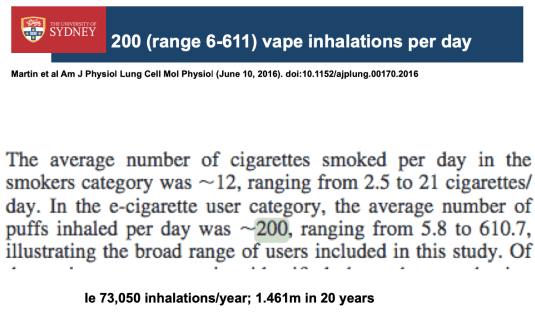
The peerless 2018 report of the National Academies of Science, Engineering and Medicine reached 47 conclusions across all areas of evidence about e-cigarettes. 28 (60%) of these were at levels of evidence rated as only moderate, limited, insufficient or non-existent. Our knowledge of most of the important questions about the risks and benefits of e-cigarettes is very far from mature. HMG appear to acknowledge this throughout their article, but perversely believe it is ethical to allow e-cigarettes to circumvent the regulatory oversight required of every other therapeutic agent.
“The precautionary principle as used in Australia is rudimentary and unspecified and based on an incomplete risk assessment”
E-cigarette juices are unlike routine pharmaceuticals in that they are not a standard product, sold in an exact formulation and dose. With users being able to personally adjust the power of their devices and the formulation of the e-liquids they use, this presents massive problems for regulators.
Attempts at modelling ranges of risks and benefits suffer from the same major problems. A recent example, with CG as an author, assumed the notorious 95% less dangerous than smoking factoid in developing its calculations. That figure derived from a paper where the authors wrote “A limitation of this study is the lack of hard evidence for the harms of most products on most of the criteria.” Apparently it is fine to turn on a green policy light when your risk assessments are unashamedly rudimentary and unspecified, but not to flash a red or amber light when you genuinely do not know what risks are posed by unprecedented inhalation exposures that will vary enormously between users.
Sales bans ignore adult smokers’ autonomy and are paternalistic
Public health policy has several examples of openly paternalistic restrictions and requirements where only the individual at risk might be prevented from harm (seat belts, motorcycle helmets, boat life jackets), and many, many more where risks to both individuals and others are involved. This is not the place to run a detailed argument about the justifications for paternalism, other than to note that it is a subject which is highly contested eg: Wilson’s Why it’s time to stop worrying about paternalism in health policy and which characteristically sees ultra-conservative players attacking foundations of public health policy as nanny statism. The entire domain of access to drugs policy sees decisions made every year about various levels and conditions of access to drugs with a wide range of risk-benefit ratios. These range from outright bans, to open access in supermarkets. The debate on e-cigarettes is very correctly located in this policy domain and not in some extreme libertarian anti-regulatory utopia prominently inhabited in Australia by members of the extreme right.
Ecigarettes may be a gateway to smoking in nicotine naïve teenagers
HMG argue that the evidence of the growth of vaping being associated with later uptake of smoking in hitherto nicotine naïve youth is equivocal. In this they are correct. In the UK there appears to be little evidence at the population level that the growth of vaping has been accompanied by any increase in teenage smoking. However Canadian data (currently under review but seen by me) on the dramatic upswing in teenage vaping also show that teenage smoking is up, something that has not occurred in 30 years.
Stand by for all manner of suggestions about how to put that genie back in its bottle.
As I have argued elsewhere, the argument that because youth smoking prevalence is down when vaping is rising, that vaping cannot possibly be causing any rise in smoking
“relies on an assumption that the population-wide net impact of any putative gateway effect of e-cigarette use would be larger than the combined net impact of all other policies, programs and factors which are responsible for reducing adolescent smoking prevalence (for example, tobacco tax and retail price, measures of the denormalisation of smoking, exposure of children to adult-targeted quit campaigns, retail display bans, health warnings and plain packaging). This is a ridiculously high bar that gateway critics demand that anyone suggesting gateway effects must jump over. It is clearly possible that significant numbers of vaping teenagers who might otherwise not have smoked could take up smoking in an environment where there was a larger preventive effect occurring in response to comprehensive efforts to reduce smoking uptake. The combined impact of such factors in preventing uptake could thereby easily mask considerable smoking uptake that might have not occurred in the absence of e-cigarettes.”
There is no evidence of any gateway effect on smoking with snus use in Sweden. Neither is there any such effect reported for NRT. But discreetly parking snus next to your gums and wearing a nicotine patch out of sight is rather different to getting your nicotine via the very public, ostentatious, semiotically dense vaping performance throughout a day. There are no snus user or NRT clubs. No one writes about the NRT or snus “lifestyle” or identifies as an NRT user in the way that many vapers do with vaping.
“Supporters of current policy have double standards in the way they use evidence”
HMG write that “Similarly, smokers’ self report of their success in quitting “cold turkey” is treated as good evidence that this is the “best way” to quit smoking; evidence from randomised controlled trials showing the superiority of drug assisted quitting to cold turkey is ignored.” Here they reference a paper I co-authored which, despite their quotation marks, nowhere contains the words “best way”. The entire argument of our paper was that unassisted quitting is, and always has been, the way that most ex-smokers finally quit. No one disputes that but many are keen that it should not be megaphoned because of the way that it might subvert the agenda of pharmaceutical and vaping companies that no quit attempt should ever proceed without one of their products.
Randomised controlled trials of drug assisted quitting do not reflect real world conditions of use. Critics have long pointed out that RCTs have many features which make them a pale shadow of how drugs are used in the real world.
RCTs often exclude people with mental illness, poor English, and no fixed address. Excluding hard-to-reach and treat participants is likely to produce more flattering results.
In the real world, people are not paid or otherwise incentivised to keep taking the drugs across the full period of the trial, so compliance is almost always far lower.
In the real world, people do not get reminder calls, texts or visits from researchers highly motivated to minimise trial drop-out. There is no “Hawthorne effect”: when trial involvement and the attention paid to participants alters the outcomes.
Nicotine-addicted people generally know very quickly if they have been allocated to the placebo arm in NRT trials because their brains feel deprived of nicotine. They invariably experience unpleasant symptoms. Knowing they have been allocated to the placebo undermines the integrity of the trial because it is important participants believe the drug might be effective.
Pots calling kettles black: selective quotations and referencing.
They say we “dismiss” observational evidence that e-cigarettes are useful in cessation, citing four references that are positive for quitting effects. This is naked pots-calling-kettles-black stuff. Might not it be equally said that they dismiss evidence that concludes that the evidence for the superiority of ecigs in cessation is poor, such as NASEM’s conclusion “Conclusion 17-1. Overall, there is limited evidence that e-cigarettes may be effective aids to promote smoking cessation.” And note that neither the US Preventive Health Services Task Force, nor the UK’s National Institute for Health and Care Excellence or Australia’s National Health and Medical Research Council, have endorsed e-cigarettes as an effective way of quitting smoking.
HMG found space after their original submission to include a supportive reference to the recent paper by Hajek et al in NEJM. They said nothing about its limitations. Selectively citing evidence that supports one’s position and accusing those who cite contradictory evidence of being unethical seems quite extreme.
They selectively quoted Prof Bruce Thompson’s evidence with Prof Anne Holland, to a Parliamentary Inquiry, given on behalf of the Thoracic Society. Thompson and Holland repeatedly stated that they could see a potential place for e-cigarettes as a smoking cessation tool subject to evidence of efficacy, safety and based on a defined product. Subjected to aggressive questioning from the Committee and its Chair, who were promoting the case for widespread availability and (presumably long-term) use, Thompson stated that it might take 10, 15 or 20 years to clarify harms. It is hard to see how this is unreasonable, given HMG acknowledge the same concern.
Their proposed regulations
HMG make two regulatory proposals with which no one would disagree (child proof e-liquid containers and safe storage (whatever that might mean in the real world). But they also argue for options that are laughably naïve. Restricting e-cig sales to vape shops and tobacconists apparently will prevent kids buying them. This works really well in England. They even suggest they could be restricted to adult (sex) shops, a lobby group with such well-known political clout in Australia that they would easily persuade government to turn their backs on all other vendors clamouring for the lucrative trade.
They suggest that “The same advertising bans could also be applied as for tobacco products” (ie ALL advertising is banned). But in the very sentence before, that “No advertising would be allowed to make claims about health benefits.” Whoops. Hang on .. I thought there would be no advertising of any sort?
Dual users would be educated to switch completely to vaping. This of course works really well in England where 56% of vapers also smoke.

If monitoring the evidence indicated that vaping was indeed of significant health concern, HMG have the solution: “these policies could be made more restrictive”. Might we ask about the details of what that very vague statement would actually mean?
They conclude by saying that there is poor justification for an e-cig sales ban to prevent uptake of smoking “when there are other less restrictive policies that could achieve the same goal.” In fact these policies the those which have seen daily smoking in Australian 15-17 year old children drop to a remarkable 1.9%, the lowest on record. It has taken us many years to achieve this result. It is a kind of invaluable public health “family silverware” that is at risk with the sort of developments being seen in Canada ringing massive alarm bells.
Everyday, I take a drug that benefits my health. I need to get a renewed doctor’s prescription four times a year to keep my supplies. I get three months supply from a pharmacy. One day, it might be rescheduled to OTC status. It’s never advertised to the public. It doesn’t come in a pretty box. I don’t walk about feeling “medicalized” or stigmatised because I have to do these things to obtain it.
If e-cig nicotine containing juices were able to satisfy TGA safety and effectiveness requirements (and after all NRT has done so, with the very, very low bar of effectiveness they had to clear) why could not they be supplied in very much the same way?
Tailpiece
There were also some inaccuracies in the paper that suggest less than careful attention to the construction of their argument.
- Early in the paper, as if to paint a theatrically draconian vista, they state that “Australian ENDS users have had their homes searched by the police and been prosecuted for possessing nicotine (e.g. [14])” The reference cited is a newspaper report describing the prosecution, not of a user, but of a man who bought nicotine liquid intending “to use the nicotine in setting up his online business selling e-cigarettes until becoming aware it wasn’t legal.” The case was dismissed by the court because of the defendant’s good record. I’m aware of no ecig users who have been subjected to such treatment in Australia.
- Their reference #44 is hopelessly mangled.



 Simon Chapman AO