
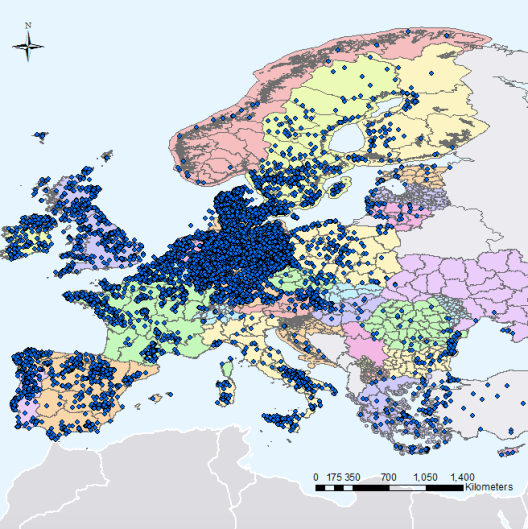
Wind farms across Europe
I’ve just returned from a three week trip northern Germany and Denmark. After a week in Berlin, my wife and I drove north to Rügen Island on the Baltic Sea, then west towards the northern-most city in Germany, Flensburg. From there we took buses up into Denmark, ending in Copenhagen where I was speaking at a conference.
Shortly after leaving the outer Berlin suburbs, we began to see wind turbines. Lots and lots and lots of them. Sometimes we’d remark that in the last hour of driving, there were only moments when we could not see any turbines. On previous European holidays I’d seen similar densities concentrated in parts of Andalusia in southern Spain, in southern Portugal and in the Minervois region of Languedoc in France. But in the north of Germany, they were ubiquitous. There were not just extensive pockets of them. They were just everywhere.
Occasionally they would be older models about as tall as a 4 to 5 story building, with towers constructed of crisscrossed, latticed steel. But far more often they would be truly gigantic modern turbines reaching over 150 metres.
We often drove off main roads and the autobahn to get a closer look and to see if we could discern anything that might suggest local policies about setback distances from houses, hamlets and towns.

While we saw plenty which were located in truly rural areas away from towns, we saw many on the periphery of towns and hamlets, sometimes a few hundred meters away and often within a kilometer or two.
We also saw uncounted hundreds of single, obviously occupied farmhouses which were sometimes very close to individual turbines.

Parking next to a vast field of dozens of the very tallest we had seen, we turned off the car engine. We wound down the windows, immediately looked at each other and involuntarily said in unison “you have GOT to be kidding!” Neither of us could hear a thing except the sound of a gentle wind in the poplar trees on the side of the road.
I got out of the car and walked over to the nearest one, about 40 metres away from the paved country road. I slowly walked around it to see if being upwind or downwind made any difference to what I might hear. I’d been similarly close to turbines in Victoria, New Zealand and on the earlier European holidays. With those, you could hear a gentle whoosh as they turned, often barely discernable within the soundscape of wind in your ears and in roadside trees or from passing cars. But with these German towers, neither of us could hear a thing.
Suddenly, as if we were being watched by CCT on some remote monitor, the turbine I’d walked around began to stop turning. When its blades became stationary we heard the sound of a mechanical alteration taking place to the shape of the curved blades. A sensor had triggered that the blade setting was sub-optimal and at least two points on each blade, we could see adjustments in process, with sections slightly pivoting to maximise the harnessing of the wind.
I’ve often asked European public health colleagues about whether they are aware of complaints being made about wind turbine noise or vibration or claims about illness being caused by exposure to sub-audible infrasound being generated by the turn of turbine blades. Their usual reply is “yes, some people don’t like them. They think they are ugly.” But when I press them on complaints about noise or health issues, I’ve never had anyone say they have ever heard of such a thing. When Fiona Crichton and I wrote our 2017 book Wind Turbine Syndrome: a communicated disease (free download), we were unable to find even a single clinical case report of “wind turbine syndrome” in the peer reviewed literature. Nothing has changed in the two years since.
From the late 1990s, a Portuguese research group has sought to describe something called “vibroacoustic disease” which they argue afflicts some in occupations where workers are exposed to various combinations of sound and vibration. They have described a single case of a boy said to have VAD because of exposure to wind turbines near his family property. I forensically eviscerated this claim in a 2013 paper and further comment in 2014.
The 50,000 watt sunlight question
But the question which shines 50,000 watts of plausibility-wilting sunlight on any claim about wind turbine audible and sub-audible noise causing health problems and upsetting people who live near them is this: if it was really the case that wind turbine noise could distress and harm people, how is it that globally, many hundreds of thousands of people have lived very near to these turbines for (collectively) millions of individual exposure years, with it never occurring to them that the inaudible or barely audible noise is even worth remarking on, let alone something that causes them to become sick?
How is it that across all of this allegedly toxic exposure over these millions of individual exposure years, that there are no records of any doctor or hospital reporting case reports of such sickness in the clinical research literature, let alone of any national public health agency or government declaring it to be real? How is it that the residents of Copenhagen can go about their ordinary lives for years, with their city surrounded by wind turbines (see pictures below). In 2017, Denmark lead the world, producing 43.4% of its total energy from wind. If the “direct causation” hypothesis had even a mere sliver of plausibility, where are all all bodies in such places?
Claims about wind turbines causing annoyance and health problems have been highly concentrated in parts of the USA, Canada (especially Ontario), Australia, UK, New Zealand and Ireland, all English-speaking nations, while being very uncommon elsewhere. Some have asked whether this is a “disease” that only speaks English.
Health arguments now binned in Australia?
On my last day in Denmark, I read that the NSW Independent Planning Commission had decided that a new batch of 23 wind turbines would not be given approval to be built near Crookwell, 25km northwest of Goulburn. The Commission based its judgement on visual amenity considerations, with objectors apparently having given up on spearheading objections based on health grounds. In accepting “we don’t like the look of them” objections, the Commission has inhabited the 2014 Joe Hockey “utterly offensive” and Tony Abbott’ “ugly, offensive, dark satanic mills”
Australia, with its vast land mass, currently ranks 16th in the world for installed wind energy capacity.
| Country | Installed capacity 2017 (mw) |
| China | 211,392 |
| USA | 96,665 |
| Germany | 59,560 |
| India | 35,129 |
| Spain | 23,484* |
| UK | 20,964 |
| France | 15,307 |
| Brazil | 14,707 |
| Denmark | 14,700 |
| Canada | 12,816 |
| Portugal | 12,300 |
| Italy | 9,388** |
| Turkey | 7,369 |
| Sweden | 7,216 |
| Poland | 5,807** |
| Australia | 5,679* |
- End of 2018 ** 2016
With comparatively geographically small nations like Denmark, Portugal, the UK, the Netherlands and Sweden dwarfing us in installed wind generated energy, it’s enough to make you sick.

 Simon Chapman AO