• Home
  • About/CV
  • Blog
  • Vaping Research Alerts
  • Blog archive list
  • My books
  • Memoirs
  • Music, bands, films
  • Contact

Simon Chapman AO

~ Public health, memoirs, music

Simon Chapman AO

Monthly Archives: February 2020

Did the Royal Australian College of General Practitioners really back vaping as a second-line therapy?

17 Monday Feb 2020

Posted by Simon Chapman AO in Blog

≈ 1 Comment

This is a guest blog from Sarah White PhD, director of Quit Victoria. Reproduced from Australian Doctor, with permission

Screen Shot 2020-02-18 at 8.44.23 am


The RACGP’s Smoking Cessation Guidelines are generally excellent.

However, I worry the e-cigarette recommendation is not pragmatic and that deliberate misrepresentation of the nuance in the recommendation risks will create a situation in which doctors are faced with an ethical dilemma.

The guidelines acknowledge the lack of approved nicotine-containing e-cigarette products and argue this is creating an “uncertain environment for patients and clinicians, as the constituents of the vapour produced by vaping have not been tested and standardized”.

They add: “However, for people who have tried to achieve smoking cessation with approved pharmacotherapies but failed, and who are still motivated to quit smoking and have brought up e-cigarette usage with their healthcare practitioner, nicotine-containing e-cigarettes may be a reasonable intervention to recommend.”

So is this the college endorsing vaping as a possible second-line therapy for doctors dealing with patients wanting to quit?

To me, the recommendations, when read in context, suggest that doctors should gently dissuade patients from using e-cigarettes through a “shared decision-making process”

It’s important to acknowledge the very real qualifications the guidelines make.

Firstly, they suggest doctors discuss the option only if brought up by the patient themselves when all else has failed.

They also say that doctors should make sure the patient is aware of the following:

  • there are no tested and approved e-cigarette products available;
  • the long-term health effects of vaping are unknown;
  • possession of nicotine-containing e-liquid without a prescription is illegal;
  • in order to maximise possible benefit and minimise risk of harms, only short-term use is recommended; and
  • dual use needs to be avoided (for example, with continued tobacco smoking).

This advice is not surprising given the current low certainty of evidence. However, more importantly, no products have been assessed as meeting basic Australian consumer safety standards, let alone having gained TGA approval.

There are literally tens of thousands of e-cigarette products available to any patient in Australia, presented by the possible combinations of multiple devices (some with adjustable temperature and electrical resistance settings) with e-liquids that can contain one (or more) of 2000+ chemical flavours, different ratios of carrier and flavouring liquids and a range of nicotine concentrations.

We don’t know which devices shed heavy metals and other chemicals from their interior or which e-liquids contain impurities or contaminants.

We don’t know the by-products created by admixture, pyrolysis and decomposition of e-liquids. Australia’s chemicals watchdog, the National Industrial Chemicals Notification and Assessment Scheme (NICNAS), set out these concerns in a comprehensive—and alarming—2019 review of a small number of non-nicotine e-liquids available for retail sale in Australia.

In my view, the e-cigarette recommendation should have been much less equivocal and based on a synthesis of evidence as it applies to the current retail and regulatory contexts in Australia.

Had this been the case, the recommendation would have been along the lines: “The RACGP is unable to recommend the use of e-cigarettes until a product has been approved by the TGA. If a patient chooses to use an e-cigarette, they should be made aware of the following issues to maximise potential benefit and to minimise potential harm….”

Naturally, inevitably, lobbyists and commercial interests (including tobacco companies) leaped to publicise the RACGP’s new guidelines, conveniently omitting the e-cigarette recommendation’s nuance.

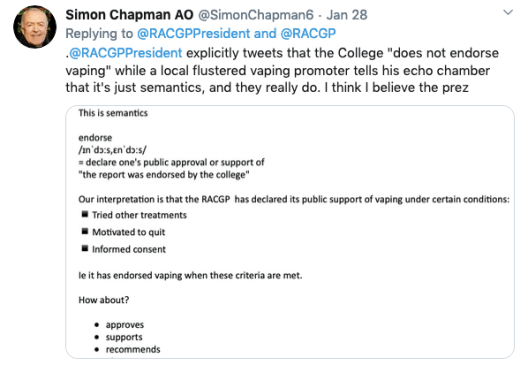
One media release appeared an impressive 35 minutes after the guidelines were issued, claiming the RACGP “endorses” e-cigarettes “in a major policy shift”.

Some hours later, RACGP president Dr Harry Nespolon was forced to tweet an unequivocal “the RACGP does not endorse vaping”.

I note these public relations efforts because I fear that doctors will start seeing patients wanting to discuss e-cigarettes because they have been told by those with vested interests that “doctors recommend them now”.

So, what is a doctor to do if a patient is adamant about trying an e-cigarette in the absence of any safety or efficacy data for a retail product?

Which device type or e-liquid(s) should be recommended? What dose of nicotine should be used? Is it a doctor’s responsibility to inform the patient how to dilute a potent neurotoxin to the right dose?

And how often should the device be used and for what duration? What is the legality of possessing liquid nicotine? (As of December 2019, nicotine possession, even with a doctor’s prescription, is illegal in the Northern Territory.)

Are doctors really going to recommend their patients pop down to the nearest high street ‘Wicked Groovy Vapes’ shop—as advocated by e-cigarette lobbyists—for the answers to these and other questions?

It seems inevitable that doctors will be forced into a choice of either refusing to provide a prescription for liquid nicotine or providing one in the full knowledge their patient could be harmed by how they use it.

To my mind, this presents an ethical dilemma that could have been avoided by a more definitive recommendation along the lines of that issued by Dr Nespolon on Twitter.

Screen Shot 2020-02-17 at 6.20.49 amScreen Shot 2020-02-17 at 6.21.59 am

Want to work for a pariah industry? Big Tobacco fears it is unable to attract top staff

15 Saturday Feb 2020

Posted by Simon Chapman AO in Blog

≈ Leave a comment

Imagine yourself as a newly-minted, honours-showered graduate from a world class business, marketing or management school. Lots of exciting career possibilities crowd your head: renewable energy, robotics, electric vehicles, affordable housing, to name just a few. You lay out company and agency profiles and analyses across the table and consider the risks and benefits of each, and the leverage an early strategic choice might have if more exciting but highly competitive priorities were unrealistic at the moment.

How likely would it be today that such a short list would include a tobacco company? How would your resumé look to other employers later if they could see you’d made the choice to work for a tobacco company?

The tobacco industry has suffered public and corporate reputational bottom-feeder status for decades.

A 1993 corporate image study prepared for Philip Morris in Australia found the company were fellow cellar dwellers with other tobacco companies, running last against all other companies in the mix:

Screen Shot 2020-02-14 at 9.17.41 am

A year later in 1994, an Australian Financial Review article quoted Nick Waterford of Michael Page Recruitment saying:

“I don’t think there’s any doubt that it’s harder to get enthusiasm for tobacco companies. There is a trend. If you have ten qualified candidates and you tell them it’s a tobacco company, five might say they don’t want the job.”

In the same piece, a former industry employee said:

“From a personal and family point of view, it just became wearing having to discuss and defend the industry at every dinner party we went to.”

In the 26 years since, things have almost certainly got a lot, lot worse.

An analysis of 5 years (1993-7) of Australian press reports mentioning the tobacco industry found routine narratives and memes of the industry as callous merchants of death, corporate leviathans, toxic pied pipers beguiling children, and blood money grant dispensers engaged in conspiracies to cover up awkward facts about death, addiction and targeting kids.

A 1999 South Australian survey on community perceptions of honesty and ethics found tobacco industry executives rated lower/very lower (73.6%) than even car salesmen (67%), the time-honoured low watermark of trustworthiness.

Screen Shot 2020-02-14 at 9.29.21 am

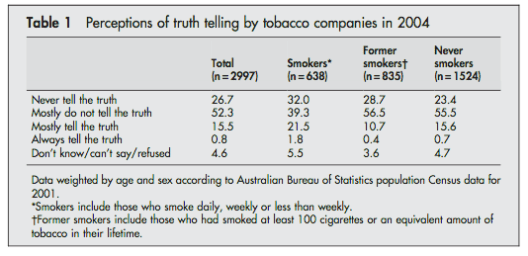
By 2004, 79% of Victorians (and even 71.3% of smokers) believed tobacco companies never or mostly don’t tell the truth. Can there be any other product where so many of its customers think those making and selling it are so dishonest?

Screen Shot 2020-02-14 at 9.55.23 am

And by 2010, the global Reputation Institute reported  “Again securing the last place [reputational] ranking [of 25 industries], the global tobacco industry’s average Pulse score dropped 4.4 points” with 51.24, against an all-industry average of 64.2. And there was daylight between the 24th place getter (diversified finance) and tobacco in last place.

Screen Shot 2020-02-14 at 10.09.35 am

No further reports have since been sighted but you could bet your house that if these had shown any upward movement by tobacco, the industry’s spinmeisters would have issued frenzied, gushing releases on the good news. But tellingly, there’s been utter silence, so go figure.

The companies love to publicly congratulate themselves on social media when they rank anywhere remotely respectable on anything other than their core business. Their pool room display cabinets are full of awards no one has ever heard of for every conceivable virtuous activity: affirmative employment action, greening policies, charitable giving, even picking up litter (where cigarettes butts are always the most common item). Yet global awards for annually causing the early deaths of two in every three of their longest, most loyal customers – more than 7 million a year — are strangely uncelebrated.

Decades of relentless, unflushable bad news like this inevitably reduces the quality of staff prepared to work for such industries. Big tobacco has become the index case for shorthanding corporate malfeasance. Just try googling “just like the tobacco industry”, and stand back while a Niagara of appalling fellow travellers pour down the screen.  The world has long calibrated corporate ugliness against the tobacco industry, although coal and other fossil fuel industries may by now be pressing their case for the most-loathed prize.

The tobacco industry has set the low watermark for corporate indecency and indifference to the consequences of its key performance indicators on the health of millions of people.  Unless they have been in a 40 year coma,  those joining the tobacco industry in 2020 do so with their eyes wide open to the toll wrought by the tobacco products which are the backbone of every tobacco company. While some staff would rationalise their decisions after a long draft of industry kool-aid about the recent embrace of ecigarettes and other putative reduced risk products, the day-to-day of working in a tobacco company for most employees remains all about selling as any cigarettes as possible.

A request I made in February 2019 to Philip Morris International for the release of typical key performance indicators of their cigarette division staff was ignored.

In 2016, before the big tobacco companies went into turbo drive to promote their “transformation” into quasi public health agencies via risk reduced products, Mike Daube and I published a collection of statements  companies had made to government corporate regulators about the risks that the companies faced, which were relevant to investors’ decisions.

Altria (Philip Morris USA’s parent company)  reported that, “Altria Group, Inc. may be unable to attract and retain the best talent due to the impact of decreasing social acceptance of tobacco usage and tobacco control actions … our strategy of attracting and retaining the best talent may be impaired by the impact of decreasing social acceptance of tobacco usage … ”

The Lorillard Tobacco Company reported that, “As a tobacco company, we may experience difficulty in identifying and hiring qualified executives and other personnel in some areas of our business. This difficulty is primarily attributable to the health and social issues associated with the tobacco industry”.

Philip Morris International report “… We may be unable to attract and retain the best global talent”.

And Reynolds American report “… Recruiting and retaining qualified personnel may be difficult given the health and social issues associated with the tobacco industry”.

These are all code for “understandably, most people aren’t rushing at the opportunity to work for a company whose addictive products cause the annual death of millions”

And today? 

So how do they see their prospects of attracting top tier staff today? At Altria the company report to the US Securities and Exchange Commission for the quarter ending  Sept 30 2019 stated:

“We cannot guarantee that any forward-looking statement will be realized … You should bear this in mind as you consider forward-looking statements and whether to invest in or remain invested in Altria’s securities …we are identifying important factors that, individually or in the aggregate, could cause actual results and outcomes to differ materially from those contained in, or implied by, any forward-looking statements made by us … These factors include the following …

  • our inability to attract and retain the best talent due to the impact of decreasing social acceptance of tobacco usage and tobacco control actions”

How many other industries and companies would make a special point like this about the calibre of their staff being a possible risk for investors? It’s unlikely that they are referring here to their cleaning staff, their janitors, their gardening, driving, factory or secretarial staff. It seems far more likely that they are alluding to planning and marketing staff employed to maximise sales; to corporate affairs and government relations staff charged with defeating, diluting and if all else fails, delaying tobacco control policy which might adversely impact on sales; and to scientific staff who know which side of optimising nicotine addiction their salary bread is buttered on. And did those at the top who signed off these statements believe they might also apply to them?

So where do these tobacco companies get the idea that the “talent” they recruit and are able to retain may not be the very best? Does it come from intelligence gathered from recruiting agencies, urged to be candid about the quality they are seeing? And frankness about how many fine applicants run out of the room when it’s revealed an anodyne job description is in fact a job in a tobacco company? Or is it from facing up to the hard reality that there has been not a single policy or piece of legislation the industry has fought and won since they first tried and failed to defeat the very early tepid pack warnings, and every generation since? That the tobacco industry is where you go if you are going to fail to stop policy that will be bad for your industry. “What did you achieve in your last job?” “Oh, we lost every battle we fought.”

When I interviewed Australia’s Nicola Roxon, the former health minister and attorney general responsible for introducing our historic plain packaging laws, for our book, I asked her why the Labor government had done it. One of the most emphatic reasons she gave, described in the book, was that “it was a no brainer politically – everyone hates the tobacco industry.” They believed, accurately, that they would be cheered on by all sides of politics (except the tiny irrelevant libertarian fringe), by the public and even by large proportions of smokers. Those we interviewed for the book often made comments about how underwhelmed they were about the staff who led the local industry and fronted for it in media advocacy.

When the companies themselves feel obligated to acknowledge this issue explicitly to corporate regulators, it would be very interesting to be a fly-on-the-wall inside the industry as they struggle to work out this seemingly intractable problem.

Blog Stats

  • 163,470 hits

Top Posts & Pages

  • Why I’m not quitting Spotify because its owner has hugely invested in weaponry
  • Australia takes off the gloves on illegal tobacco while ‘lower the tax’ fantasists plumb new absurdities
  • About/CV
  • Vaping theology: 6 There’s nicotine in potatoes and tomatoes, so should we restrict or ban them too?
  • My books
  • Regrets … I’ve had a few. Paul Hogan and his Winfield role.
  • Thinking of keeping koi? Advice for beginners in NSW
  • Cheap illegal cigarettes save low income pack-a-day smokers over $9000 a year. So why don’t social justice champions give them full support?
  • Why Australia’s illegal tobacco and vape trade continues to flourish and what should be done about it
  • My first seen, best and worst bands 1964-2022

Blog archive

Comment Policy: No anonymous or pseudonymous posts will be published

Recent Posts

  • Australia takes off the gloves on illegal tobacco while ‘lower the tax’ fantasists plumb new absurdities
  • Egg on some faces: statisticians at 10 paces on the impact of New Zealand’s vape laws on youth smoking
  • Lowering tobacco tax to make illegal tobacco sales “disappear overnight”: at last we have a proposed figure and it’s an absolute doozie
  • Why I’m not quitting Spotify because its owner has hugely invested in weaponry
  • Should we believe Fiona Patten on vapes? Here are just a few problems

Recent Comments

Jon Krueger's avatarJon Krueger on Egg on some faces: statisticia…
Atul Kapur's avatarAtul Kapur on Should we believe Fiona Patten…
Unknown's avatarCould a national tob… on If expensive cigarettes are dr…
tahirturk1's avatartahirturk1 on Why Australia’s illegal tobacc…
malonere's avatarmalonere on Words I’ve seen, but didn’t kn…

Archives

  • December 2025
  • August 2025
  • July 2025
  • June 2025
  • May 2025
  • March 2025
  • January 2025
  • November 2024
  • October 2024
  • September 2024
  • July 2024
  • May 2024
  • April 2024
  • March 2024
  • February 2024
  • January 2024
  • December 2023
  • November 2023
  • October 2023
  • September 2023
  • August 2023
  • July 2023
  • June 2023
  • May 2023
  • March 2023
  • February 2023
  • January 2023
  • December 2022
  • November 2022
  • October 2022
  • August 2022
  • June 2022
  • April 2022
  • March 2022
  • February 2022
  • January 2022
  • December 2021
  • October 2021
  • September 2021
  • August 2021
  • June 2021
  • May 2021
  • April 2021
  • March 2021
  • February 2021
  • January 2021
  • December 2020
  • November 2020
  • October 2020
  • September 2020
  • August 2020
  • July 2020
  • June 2020
  • May 2020
  • April 2020
  • March 2020
  • February 2020
  • January 2020
  • December 2019
  • November 2019
  • October 2019
  • September 2019
  • August 2019
  • July 2019
  • June 2019
  • May 2019
  • April 2019
  • March 2019
  • February 2019
  • January 2019
  • December 2018
  • November 2018
  • October 2018
  • September 2018
  • August 2018

Categories

  • Blog

Meta

  • Create account
  • Log in
  • Entries feed
  • Comments feed
  • WordPress.com

Blog at WordPress.com.

  • Subscribe Subscribed
    • Simon Chapman AO
    • Join 198 other subscribers
    • Already have a WordPress.com account? Log in now.
    • Simon Chapman AO
    • Subscribe Subscribed
    • Sign up
    • Log in
    • Report this content
    • View site in Reader
    • Manage subscriptions
    • Collapse this bar
 

Loading Comments...