• Home
  • About/CV
  • Blog
  • Vaping Research Alerts
  • Blog archive list
  • My books
  • Memoirs
  • Music, bands, films
  • Contact

Simon Chapman AO

~ Public health, memoirs, music

Simon Chapman AO

Monthly Archives: April 2020

When the COVID-19 pandemic going gets tough, the conference scammers get going

25 Saturday Apr 2020

Posted by Simon Chapman AO in Blog

≈ 1 Comment

I’ve written here before about the relentless deluge of obsequious email supplications all academics get, tempting them to part with thousands of dollars to submit their research to junk, predatory journals or to attend often shady conferences in far-off places.   To my amazement, these junk conference temptations have continued through the global COVID-19 pandemic. This week  my inbox offered jaunts to Tokyo, Amsterdam and California, all on subjects totally unrelated to my own areas of interest.

During the COVID-19 lockdowns, there are stories about of one-way, economy class passengers being asked to pay $20,000  to or from Europe. Once you arrive, you get to spend two weeks in quarantine often in a low grade hotel room and so the same  when you get back home. You get to attend a conference on a topic of zero relevance to your interest, run by scammers who sometimes forget to actually put it on after you shell out your registration fee and early-bird discounted slide packages from the other missing speakers. So what’s not to like here? Particularly when you get addressed like this.

1

But amazingly, the emails keep coming. These offers often make me try to imagine those who are suckered by these dogs-balls obvious swindles.  An email this week took me to a whole different level of audacity out there.

It started with this from an “Iris Reed”

2

My interest was piqued. Here we had a brazen pitch to sell contact details about conference attendees whom I felt certain would have all given their full permission for their private information to be flogged off like this to anyone paying up. I immediately wrote back to Iris “Dear Iris, I’m very interested in looking at this list. Where and when was the meeting held?”

Twenty six minutes later, I got a reply, not from Iris, but from her helpful top dog colleague “senior business analyst” Macie, who had a small dose of the stray apostrophes and a helpful yellow highlighter.

3

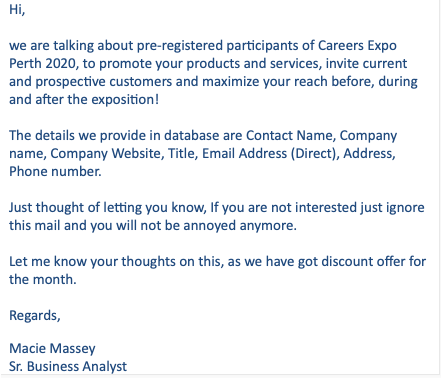
Now what a coincidence that just 26 minutes after I enquired about the pain conference attendance data, the company cancelled the conference! However, the agile Macie, perhaps anticipating my disappointment, now dangled the prospect of 10,000 names from something called a “Careers Expo” in Perth held in 2020.  But Iris had been offering 12,147+ names from the just cancelled “Pain Society 36th Annual Scientific Meeting”.

I needed to share my confusion with Macie. I wrote  “But I thought it was a Pain Society 36th Annual Scientific meeting 2020? Now it is a “Careers Expo” meeting in Perth. That sounds rather different.” I’d googled “36th annual pain scientific meeting” and found that one by that name was held in Perth, not in 2020 but in 2016. I gave Macie the link (https://www.dcconferences.com.au/aps2016/).

Twenty minutes later the indefatigable Macie was back:
4

She just wasn’t listening! So I quickly replied wrote, “No, the email I got was explicit that it was a pain conference.   That’s what I’m interested in. I will pay big money for this.”

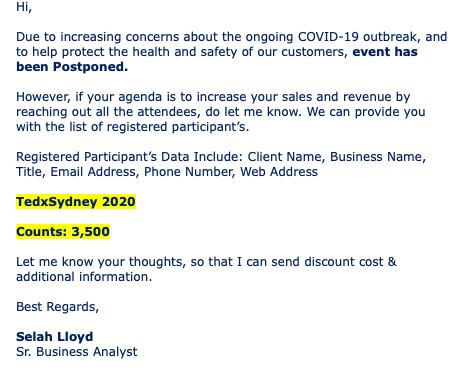
So imagine my confusion when I then heard from yet a third employee, Selah Lloyd, suffering from the exact same stray apostrophe problem as Iris:
5

So, they “reached out” to me with a pain conference (cancelled), then switched to a Careers Expo in Perth, and within two hours that one had apparently been postponed too. But now they figured I would like to get my hands on 3500 names from a TedXSydney 2020 meeting. I steeled myself in anticipation  that this one would shortly also be postponed.

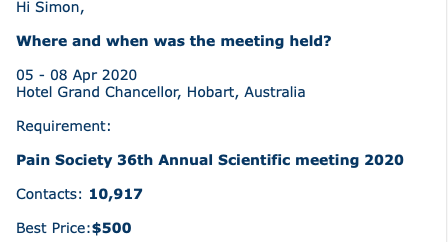
The next day, Iris was back on my case, answering my yesterday’s questions about when and where the pain conference was being held. Apparently it had just recently been held in Hobart, not Perth.
6

By now smelling the unmistakable odour of fetid bullshit, I called the Hotel Grand Chancellor in Hobart, asked for reservations and enquired whether they had recently hosted a conference with 10,917  in attendance during the COVID-19 lockdown. I could hear the receptionist spray her coffee into her headset microphone.

sprayCoffee

Having been earlier told by Iris that the pain meeting had 12,147 participants, but now reading there were only 10,917 (9 times more than could fit into the hotel’s plenary hall), it was time for some plain talking with Iris. I wrote:

“So first question. Could you please ask your manager if I can please have a 12.3% discount for the smaller number of names? That would be $438.50. I’ll round that up to $440.00 for you.

Second – and this is a little awkward for me to raise with you – but I have just spoken to the management of the Hotel Grand Chancellor in Hobart, and they said that they have not been holding any conferences there for months because of COVID.  They suggested that you are probably a scammer.

I’m sure that can’t be right. But is it true, Iris? I hope not!”

Iris now kicked this one upstairs to the top brass.

7

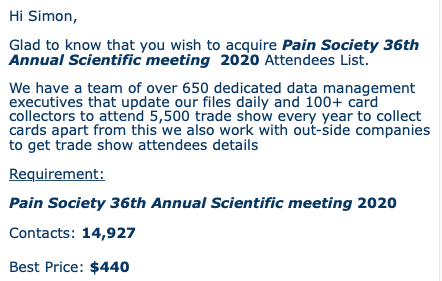
Mr Williams got back to me immediately.
8

So the 2020 pain conference in Hobart, which never took place, started out with 12,147 attendees, fell to 10,917 and then rose to 14,927, all within two days. I politely let him know I was no longer interested.

Chris’ very professional company website, said to be in Fort Worth, Texas is here  www.influxdatasolutions.com
Indelibly sear this into the national public and political DNA: evidence-based prevention saves many lives. So let’s all honour our COVID-19 heroes.

22 Wednesday Apr 2020

Posted by Simon Chapman AO in Blog

≈ 5 Comments

If we went back two months, “epidemiologist” was a word you might need occasionally to complete a crossword. But now we hear it all day long. Throughout each day, we see and hear people who with a few exceptions, have never been household names. Most prominent have been  Brendan Murphy, the chief medical officer and secretary of the Department of Health and Aging;  his deputy, Paul Kelly, as follicularly challenged as his more famous musician namesake but lately also bringing us daily salve in the form of hopeful news about falling new cases; and the peerless Norman Swan, for 35 years the presenter of ABC’s The Health Report, mandatory listening for all seriously interested in evidence-based health and medicine.

There’s also Professor Raina McIntyre from UNSW, a global expert in pandemic epidemiology; state chief health officers like NSW’s Kerry Chant, also with post graduate qualifications in public health; a phalanx of highly connected mathematical epidemic modellers; and many, many others working tirelessly in the background to fast-track testing, obtain personal protective equipment for front-line health care workers, contact tracing, record keeping, and scientists working in vaccine development.

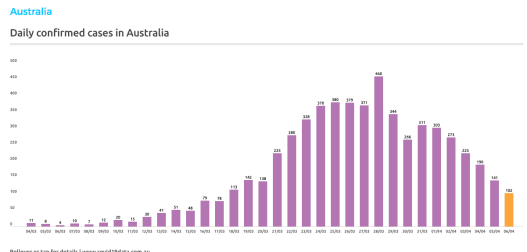
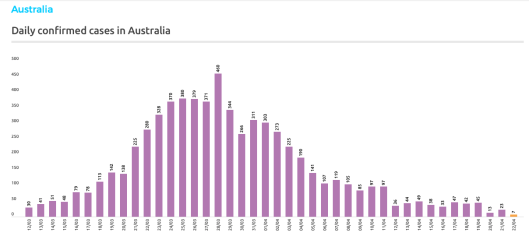
The daily ritual for many of us in checking bookmarked data sites mapping the COVID-19, pandemic has lately brought huge relief. The chart showing newly confirmed cases is the first we click on. Since hitting a peak of 450 new cases on March 28, Australia has seen almost continual daily falls, with an average of 37 a day reported in the last 10 days, a fall of 413 or 92% off the peak.

Screen Shot 2020-04-22 at 10.43.03 am

While it is very early days, and while cautions about possible upswings if we take our foot off the brake too quickly are deadly serious, these encouraging data look very much like a trend. There are key signs that we are getting on top of this thing, quite fast.

Four lessons

The decline is exactly what our newly limelighted national heroes, the public health experts advising the government and communicating with the public, would have hoped for. If it continues, and does not dramatically bounce back when isolation is eventually relaxed, it will go down in our history as a triumph of evidence-based health policy, the lessons of which deserve to be indelibly seared into the national public and political DNA.

What are some of these lessons? First, if it ever needed saying, this is a dramatic, thundering reminder that health protection and prevention can avert national catastrophes. In medicine, the “rule of rescue” has for decades dominated health care resource allocation and political urgency. This rule states that those in need of medical attention will always take primacy over vague backroom recommendations from faceless committees about how we might prevent people from needing medical attention in the first place.

Public health (health protection, prevention and education) has long been the Cinderella of the health services. Next to high tech treatment centres, it has drab offices, much less than 2% of the health care budget, and few prominent individuals to fight for its goals. Unlike treatment with its memorable patients, its waiting lists are unnamed statistical victims who will need health care in the future, if prevention fails. Prevention can often wait for the next budget. Treatment cannot. This might well change for good, thanks to COVID-19.

Second, Australia’s likely success is a reminder that Nanny State policies and interventions for public safety are politically hobbled and denigrated to our great peril. Never in anyone’s living memory have we seen more draconian measures here than we are all living with today. With each new ratcheting up of social isolation edicts, we have heard pin-drop silence from the doctrinaire civil libertarians. The National Cabinet of conservative and Labor  leaders are behaving like a socialist politburo and everyone is applauding them wildly.

Nanny is not just good for us, she is yet again saving many, many lives. Meanwhile, the libertarian right remain in the brace, foetal position, seeing their dogmas collapsing around them.

Third, the truth serum of science and evidence being force fed  to our political leaders seems likely to have lasting impacts in tempering the global creep of anti-science. As former Liberal leader John Hewson put it, the coronavirus story is a dress rehearsal for what happens if governments continue to ignore science.  Its few remaining carnival barkers in parliament have been struck a fatal blow with the political unanimity across all major parties. The last memorable time I recall this happening was when the Opposition fully supported the Gillard Labor government’s plain packaging bill way back in 2010.

And next, the widespread population-wide embrace of social isolation, and the stories of untappable  geysers of community support and care for those doing it tough may be rejuvenating communities, in many wonderful ways.  We are enduring the deprivations not just for the sake of reducing our own risk, but because suddenly we all understand that Margaret Thatcher’s infamous “no such thing as society” has deadly, dehumanising consequences. It feels very good to be living among a resurgence of such values. They will resonate well into the future with progressive policies right across government.

Australia’s achievement is simply remarkable

In 2018, Australia 158,493 people died from all causes. So far, COVID-19 has claimed 74 Australian lives, at a median age of 79 (which is around the same as all-cause life expectancy). Australia has 261 cases per million population and 3 per million deaths, while Spain – at the moment the nation worst infected on a per capita basis — currently has 4367 cases per million  people and 455 per million deaths, 17 times our per capita rate of cases and 152 times our death rate.  These are just remarkable differences.

In 1996, I wrote one of my columns in the BMJ on the paradox of prevention. I wrote:

“That’s the paradox with prevention – it works when nothing happens. People thank doctors for performing a lifesaving operation, but if they grow up without being badly injured or without taking up smoking and developing emphysema they are seldom thankful for the preventive actions of people who bore the brunt of public anger about inconvenience years ago.”

Our infectious disease prevention heroes deserve our greatest thanks and support for all they are doing. As of course do our thousands of front-line health care staff. We’re not just some lucky country. We’re a public health vanguard country, setting standards for the world.

How can we erode self-exempting beliefs about COVID-19 contagion and isolation that might subvert flattening the curve?

19 Sunday Apr 2020

Posted by Simon Chapman AO in Blog

≈ 3 Comments

Cognitive dissonance is a much-studied phenomenon concerned with a branch of the mental heuristics that people use to enable them to sustain particular beliefs or behaviours in the face of overwhelming evidence that could swing a wrecking ball at the foundations of those beliefs and behaviours. Coined by American psychologist Leon Festinger in 1957, cogntive dissonance theory suggests “we have an inner drive to hold all our attitudes and behaviour in harmony and avoid disharmony (or dissonance). This is known as the principle of cognitive consistency. When there is an inconsistency between attitudes or behaviours (dissonance), something must change to eliminate the dissonance.”

Self-exempting beliefs about smoking

Early in my career I was struck by the multitude of ways that smokers rationalised their smoking, in the face of what US Surgeon Antonia Novello noted 30 years ago that “It is safe to say that smoking represents the most extensively documented cause of disease ever investigated in the history of biomedical research.“

With others, I published two well-cited papers in the American Journal of Public Health (1993) and Preventive Medicine (2004) documenting the range and clustering of these beliefs in Australian smokers.  We called them “self-exempting” beliefs: beliefs that people cling to as psychological talismen they found useful in warding off the deluge of unsettling information about the risks of smoking.

In the first paper, we found that while 50-80% of smokers agreed that several diseases were caused by smoking, nearly half of all smokers we surveyed agreed with 5 or more of 14 different self-exempting beliefs we asked them about. So smokers could simultaneously agree that smoking caused lung cancer, but also believe that “scientists are telling us every day that all sorts of other things also cause cancer” or “I play sport every week and get the toxins out of my system”.

In the second paper, we grouped these beliefs into three clusters.

“Bulletproof” beliefs: Beliefs suggesting smokers think they have some personal immunity to the health effects of smoking. Examples:

  • Cancer mostly strikes people with negative attitudes
  • They will have found cures for cancer and all the other problems smoking causes before I am likely to get any of them
  • You can overcome the harms of smoking by doing things like eating healthy food and exercising regularly
  • I think I must have the sort of good health or genes that means I can smoke without getting any of the harms
  • I think I would have to smoke a lot more than I do to put my health at risk

“Skeptic” beliefs: Those  indicating smokers do not believe medical evidence about smoking and disease. Examples:

  • Some doctors and nurses smoke, so it cannot be all that harmful
  • The medical evidence that smoking s harmful is exaggerated
  • Smoking cannot be all that bad for you because many people who smoke live long lives
  • Smoking cannot be all that bad because some top sports people smoke and still perform well
  • More lung cancer is caused by such things as air pollution, petrol, and diesel fumes than smoking

“Jungle” beliefs: Beliefs normalizing the dangers of smoking because of the ubiquity of risks to health (‘‘life’s a jungle of risks’’) Examples:

  • If smoking was so bad for you, the government would ban tobacco sales
  • It is dangerous to walk across the street
  • Smoking is no more risky than lots of other things that people do

We found that ex-smokers adhered to far less of these beliefs than smokers. This made us wonder if some of these beliefs were porous and vulnerable to being eroded to flaccid levels of talismanic potency by strategic efforts at countering them. The NSW Cancer Institute ran a campaign called “excuses” where it targeted several common beliefs about why smokers often delayed quitting.

Self-exempting beliefs about COVID-19

With COVID-19, self-isolation and distancing are the two behaviours that all infectious disease experts agree are absolutely critical to “flattening the curve” and reducing contagion. But we have all by now heard a wide range of  self-exempting excuses for why some are taking self-isolation lightly.

Some I’ve noticed include:

  • It’s only very old people who are dying
  • 170,000 people – mainly old — die in Australia every year. Old people will die anyway from something if not COVID-19
  • I’m young and healthy, I’ll be fine
  • I’ve had the ‘flu a few times. I can live with getting that again
  • We’ve got such a low rate of cases per million population, my chances of being getting near to someone with it are negligible
  • The odds of getting it in Australia are far, far lower than the risks we take all the time – driving, flying, surfing, skiing
  • How come it’s OK to have a barber or hairdresser stand right next to you and touch your head for 30 minutes or more but not OK to go to a beach?
  • Look at all the shops that are open selling non-essentials, like some department stores, Ikea, Bunnings, Officeworks, and garden nurseries. How come lots of people can go to these, but not have a picnic in a park?
  • How come you can still take a domestic flight and sit well within 1.5 metres of other passengers?
  • Why are the distances you must keep different in different states?
  • The Bluetooth movement monitoring app they are planning is just an excuse for a surveillance state
  • It’s a conspiracy to under the cover of isolation, roll out the pernicious 5G network

Doubtless there are many more of these in circulation. Some will have a tiny number of adherents, but others will be muttered by larger swathes of the community and may be amenable to strategic efforts to render them less potent. Those in government who are planning the communication campaigns would do well to get a handle on which of these sort of beliefs are most prevalent in those who are breaching isolation. What they learn could then stimulate efforts to deflate these beliefs.

Respectful communication is critical

It is important to understand that those who are sub-optimally isolating and breaching the guidelines are not all simply stupid or willfully ignorant. Efforts through announcements and interviews to set them right with fact-based refutations will have only limited success.

At the heart of cognitive dissonance theory is the understanding that people cling to self-exempting beliefs because they make them feel comfortable and more harmonious across values and decisions they cherish. Self-exempting beliefs bring comfort and sustain these wider and deeply held beliefs and decisions. So a communication objective which sets out only to say “you’re wrong, listen to this instead” will miss the point.

Subverting false beliefs to render them unsustainable in a COVID-19 non-isolator’s top-of-mind lexicon may be an intermediary goal on the way to them changing their behavior, but it needs to be done respectfully, not combatively.

Apposite analogies

Over my four decades in public health advocacy, I’ve found analogy to be very useful in gently eroding sticky beliefs.

In gun control, resistance to gun registration was eroded by pointing out that we all understand that cars, boats and even dogs require registration for good reasons. So why not guns too? And law-abiding gun owners outraged at gun control measures which assumed every gun owner could be dangerous, is no different to assuming every driver might be alcohol affected in random breath testing. Or every airline passenger a terrorist when passing through airport security. Or every shopper a thief when bags are inspected at the checkout.

In tobacco control, resistance to the news that other people’s smoke could be harmful was memorably disarmed by analogies from cartoonists like the one below and about the urinating and non-urinating sections of public swimming pools.

non-smoking section

Peeing v non-peeing

Smokers who insisted that it was “all the additives and chemicals” in cigarettes (not tobacco smoke itself) that caused all the health problems were reasoning as if the infernos in hell might be less uncomfortable if the temperature was turned down one degree by removing additives.

And tobacco companies’ hand-on-heart efforts to tweak the toxicity of their products was like the owners of the White Star Line removing the splinters from the handrails of the Titanic.

Analogies are inherently respectful as they memorably point to equivalences between things that everyone agrees with and seed the idea that “this is just like that”.

Freedom to vs freedom from

With COVID-19, the “freedom to” imperative often dominates resistance isolation, while the “freedom from” the risk of rapid exponential growth in an untreatable, often fatal disease takes a back seat. Efforts to reframe freedom as importantly including freedom from the indelible scenes we have seen playing out in the USA, Italy, Spain and the UK are likely to provide fertile ground strengthening the already widespread view that our deprivations are helping us dodge a hideous population-wide bullet.

And the deprivations of staying at home can be flipped in the memorable words of the (unknown) creator of this  art compilation put it “Don’t count the days, make the days count.”

Screen Shot 2020-04-19 at 5.48.43 am


COVID-19 home isolation: except for food, medicine and exercise. So why are so many other stores open?

07 Tuesday Apr 2020

Posted by Simon Chapman AO in Blog

≈ 1 Comment

Ikea is open today in Sydney from 10am to 9pm. They have an online catalogue and will deliver, but yes, it’s open to us all too. My nearest Bunnings has been open since 6am, and will close 7pm. Tradies (who can keep working) need supplies, and they have cards to prove their work status. But non-tradies can go to Bunnings too and buy whatever they like, no questions about “essentials” or “necessities” asked.

If you want stationary supplies, you can get on down to Officeworks. You might want to sit a while and print some photos while you are there.

Think your garden could so with a makeover? All plant nurseries are open. And what about a haircut? No problem – many are open and your hairdresser, even if he’s Edward Scissorhands, certainly won’t be cutting your hair from 1.5 metres away.

And fancy a new pair of shoes, a shirt or dress? Off you can go to a department store. Furniture? Yep. Open as usual. A new TV to help your isolation? A hair dryer or coffee machine? Sure, go out right now and just walk in. No problems.

But meanwhile, we read stories and hear people calling into radio about being fined, warned or moved on for sitting reading or eating on a park bench or sunbaking, or simply driving – sometimes alone. Police are patrolling beaches and parks.

Yet we aren’t hearing any stories about police frisking shoppers coming out of any of the shops above and quizzing them to explain why each of the goods they have just purchased are essential. The shops haven’t been told to rope off non-essential items. It’s all for sale.

Each time we hear a government official, police spokesperson or politician summarising how we should understand home isolation and self-distancing we hear the litany of food and medicines purchasing, distanced exercising in a maximum of two people (unless in the one family) and visiting family members who live elsewhere, within the guidelines (one person only).

However, the current gazetted NSW guidelines  list of 16 “reasonable excuses” starts off with an “excuse” far wider than being out to purchase food and medicines. The first point explains that you can be “obtaining food or other goods or services for the personal needs of the household or other household purposes (including for pets) and for vulnerable persons.” [my italics]

Screen Shot 2020-04-07 at 9.42.04 am

Neither “needs” nor “purposes” are anywhere defined in the guidelines. But Prime Minister Scott Morrison told the country on March 31 that his wife had gone out to purchase jigsaws “Our kids are at home now, as are most kids, and Jenny went out yesterday and bought them a whole bunch of jigsaw puzzles. I can assure you, over the next few months we’re going to consider those jigsaw puzzles absolutely essential.”

Unless he was openly declaring family lawlessness, Morrison’s example role-modeled a process of legitimate individual  decision-making: his household regarded non-nutritious or medicinal jigsaws as “absolutely essential” and a justifiable reason for leaving their house. Others might equally regard regularly buying cut flowers, stocking up on new plants for the garden, buying hobby, art or musical instrument supplies as essential to their household “needs”.

The NSW government’s very broad guideline would seem to have been worded in the way it was to provide such latitude. But the contrast with what it states and the constant far narrower emphasis on food, medicines and exercise is stark.

Let me here be emphatic. In concert, quarantine, social isolation and distancing, and the virtual closing of Australia’s borders together appear to be to not only flattening the curve of new cases, but to be quite rapidly reducing the daily rate (see graph below).  Importantly too. as an island continent, Australia has very non-porous borders compared with the great majority of the world’s nations in Asia, Europe, Africa, and the Americas where many nations have several land borders.

Screen Shot 2020-04-06 at 5.18.47 pm

Source

The changes we have seen in the last week owe a great deal to  Australians having taken home isolation very seriously. Citymapper’s global mobility index shows people in Australian cities have dramatically decreased their movement. Sydney for example, has fallen from 121% of normal movement on March 2, to 17% on April 5.  As many infectious disease experts have warned, any rapid abandonment of current policies that saw equally dramatic rises in movement (and erosion of self-isolation) could see the fall in daily new cases reverse. And as we have seen in nations like Italy, Spain, France, Germany and the USA, this can be very, very  rapid and catastrophic.

Screen Shot 2020-04-07 at 10.59.14 am

It is beyond important that we sustain high levels of home isolation and social distancing when we need or choose to go outside.

The contradictions between the constant narrow framing of where you can go when you leave your house, reports of over-zealous policing directed at individuals engaged in very low risk activities and what the government guidelines currently say we can actually do, risk eroding trust in important government messaging.

Screen Shot 2020-04-07 at 11.36.29 am

People are not stupid. When they are told repeatedly they should only go out for food, medicine or exercise and then see the car park at Bunnings, Ikea and Officeworks chockers with cars and people pushing trolleys, they join the dots that this just doesn’t add up. Maybe the other messaging is shonky too, many will reason. Crying wolf has always been fatal for public health messaging.

Absolute transparency, as far as our current knowledge allows us to go, should be a cardinal principle of all communication in this crisis. It makes no sense that we are told to keep a minimum of 1.5 from others in the street or in shops, then read the truly bizarre “Hairdressers and barbers can continue to operate under strict new rules. The 4 square metre rule and social distancing must be observed.”

The hairdressing example may be nit-picking (sorry …) but hassling people driving or quietly reading and getting some sunshine in a park risks fomenting corrosive community conversations about other political agendas and disproportionate surveillance.

Blog Stats

  • 163,470 hits

Top Posts & Pages

  • Why I’m not quitting Spotify because its owner has hugely invested in weaponry
  • Australia takes off the gloves on illegal tobacco while ‘lower the tax’ fantasists plumb new absurdities
  • About/CV
  • Vaping theology: 6 There’s nicotine in potatoes and tomatoes, so should we restrict or ban them too?
  • My books
  • Regrets … I’ve had a few. Paul Hogan and his Winfield role.
  • Thinking of keeping koi? Advice for beginners in NSW
  • Cheap illegal cigarettes save low income pack-a-day smokers over $9000 a year. So why don’t social justice champions give them full support?
  • Why Australia’s illegal tobacco and vape trade continues to flourish and what should be done about it
  • My first seen, best and worst bands 1964-2022

Blog archive

Comment Policy: No anonymous or pseudonymous posts will be published

Recent Posts

  • Australia takes off the gloves on illegal tobacco while ‘lower the tax’ fantasists plumb new absurdities
  • Egg on some faces: statisticians at 10 paces on the impact of New Zealand’s vape laws on youth smoking
  • Lowering tobacco tax to make illegal tobacco sales “disappear overnight”: at last we have a proposed figure and it’s an absolute doozie
  • Why I’m not quitting Spotify because its owner has hugely invested in weaponry
  • Should we believe Fiona Patten on vapes? Here are just a few problems

Recent Comments

Jon Krueger's avatarJon Krueger on Egg on some faces: statisticia…
Atul Kapur's avatarAtul Kapur on Should we believe Fiona Patten…
Unknown's avatarCould a national tob… on If expensive cigarettes are dr…
tahirturk1's avatartahirturk1 on Why Australia’s illegal tobacc…
malonere's avatarmalonere on Words I’ve seen, but didn’t kn…

Archives

  • December 2025
  • August 2025
  • July 2025
  • June 2025
  • May 2025
  • March 2025
  • January 2025
  • November 2024
  • October 2024
  • September 2024
  • July 2024
  • May 2024
  • April 2024
  • March 2024
  • February 2024
  • January 2024
  • December 2023
  • November 2023
  • October 2023
  • September 2023
  • August 2023
  • July 2023
  • June 2023
  • May 2023
  • March 2023
  • February 2023
  • January 2023
  • December 2022
  • November 2022
  • October 2022
  • August 2022
  • June 2022
  • April 2022
  • March 2022
  • February 2022
  • January 2022
  • December 2021
  • October 2021
  • September 2021
  • August 2021
  • June 2021
  • May 2021
  • April 2021
  • March 2021
  • February 2021
  • January 2021
  • December 2020
  • November 2020
  • October 2020
  • September 2020
  • August 2020
  • July 2020
  • June 2020
  • May 2020
  • April 2020
  • March 2020
  • February 2020
  • January 2020
  • December 2019
  • November 2019
  • October 2019
  • September 2019
  • August 2019
  • July 2019
  • June 2019
  • May 2019
  • April 2019
  • March 2019
  • February 2019
  • January 2019
  • December 2018
  • November 2018
  • October 2018
  • September 2018
  • August 2018

Categories

  • Blog

Meta

  • Create account
  • Log in
  • Entries feed
  • Comments feed
  • WordPress.com

Blog at WordPress.com.

  • Subscribe Subscribed
    • Simon Chapman AO
    • Join 198 other subscribers
    • Already have a WordPress.com account? Log in now.
    • Simon Chapman AO
    • Subscribe Subscribed
    • Sign up
    • Log in
    • Report this content
    • View site in Reader
    • Manage subscriptions
    • Collapse this bar
 

Loading Comments...