• Home
  • About/CV
  • Blog
  • Vaping Research Alerts
  • Blog archive list
  • My books
  • Memoirs
  • Music, bands, films
  • Contact

Simon Chapman AO

~ Public health, memoirs, music

Simon Chapman AO

Monthly Archives: September 2020

House concerts: how to help your favourite musicians during COVID19

29 Tuesday Sep 2020

Posted by Simon Chapman AO in Blog

≈ Leave a comment

Photo credit: Tony Egan

Many musicians are doing it very, very hard during COVID19. With venues for gigs around the country having been either fully closed, and seven months on, open only to very limited numbers of patrons, normal full-paying performance opportunities have been as rare as rocking horse shit.

Many musicians are ineligible for Job Keeper, as they have not been in continuing employment for the required lengthy period with the one employer, earning their money from a diversity of opportunities, now nearly all unavailable. Several I know are living off meagre savings and are very depressed about the near future.

Live streaming sites like Sydney Underground Streaming Sessions provide access to gigs for a small charge, most of which goes to the acts. Some artists have done full sets (here’s the inimitable Peter O’Doherty and Reg Mombassa from Dog Trumpet doing a full 75 minute set on September 18, and Terry Serio’s Candelight Sessions, but not charged or asked for donations.

You can run the picture through your TV and turn up the sound system to live gig levels, but the experience is always a pale shell of what it’s like being at a live gig.

House concerts are a wonderful way to help musicians and get your best friends to experience an intimate performance.

Last Saturday night we hosted at out house singer-guitarist songwriter Brendan Gallagher (ex-Karma County, and current Pinks and Dead Marines band member). It was a beautiful night. I’d done it with Brendan a few years ago and had 50 people pay to come, but this time NSW regulations limited us to 20 visitors (including Brendan), in addition to me and my wife, Trish.

Here are a few tips on how to run a good house concert.

Photo credit: Tony Egan

Photo credit: Tony Egan

Pick a musician you and your friends will like

It’s best to make direct contact with the musician, rather than go through their management or a house concert organising site. Both of these will be wanting their cut, so less of the money you raise will go directly to the musician. Most musicians have web pages with contact buttons, or Facebook pages you can message. Really big name acts will cost far more than you’ll be able to pay, unless you are loaded.

Acts with multiple members will usually cost more than solo acts, which will have budgetary implications.

Negotiate the fee you’ll pay

Ask the musician what they will charge to play. They’ll quote you the minimum price that’s worth their while. You’ll then know what to charge each person. We decided to think what our friends were likely to pay for an intimate concert with dinner when you were asked to BYO drinks. We thought back from typical dinner + gig + bar price drinks for a few hours would cost for a name act like Brendan, and thought there would be little change from $50-$60 a head.

We were not wrong. The price we settled on saw 20 friends snap the tickets up in the few minutes after my group email went out.

Make sure people pay you in advance. This is important because everyone says there will always be no-shows, if it’s cash on arrival and then the kitty is caught short.

Sound gear

We had amplifiers and a microphone from our band days, but if you don’t, most musicians will have these and be happy to bring them.

Food

Finger food is strongly advised. If you try for a plated food night, there’s seating needed, the limited seats you’ll have then needing to be moved before the concert, mess to clear away, and an overloaded dishwasher. We put on homemade gourmet sausage rolls (these vanished instantly),  a big range of good cheeses and dips, sushi and shrimp toast, and lots bite-sized cakes (all whooshed up). We set up a large iced esky for people’s bottles. A few guests insisted on bringing their signature finger foods and a generous neighbour ran up mini citron tarts.

Seating

We planned to hold it in our back garden, but the night turned out to be windy and chilly, with firepit smoke whipping around. So we moved it into a large living room which comfortably took the 22 people who were there throughout the two sets. We supplemented the available lounge and dining chairs with some camping chairs. If you plan to run it outdoors, let your neighbours know they may hear some sound bleed.Ours were all totally cool with it.

The 19 friends who came were enraptured, gushing about what a great idea it has been. We’ll definitely be running more.  If you’ve held any yourself, please comment on how it went.

Here’s Brendan, backed by Trish, doing Absolutely Away
Are there really 520,000 current vapers in Australia? What’s the biggest number you can find?

21 Monday Sep 2020

Posted by Simon Chapman AO in Blog

≈ Leave a comment

[updated 23 Dec 2020 and 27 Sept, 2021 — see at end]

In July this year the Australian Institute of Health and Welfare published our most recent estimate of how many people use various drugs, alcohol and tobacco. They also looked at vaping. So how many people are vaping in Australia? If you believed the lobby group ATHRA (the 4 board members and zero membership vaping advocacy group) when they published their blog on July 22 “520,000 people were ‘current’ vapers (vaped at least once in the last year).” That equates to about 2.5% of the 14+ population or one in every 40 people.

Just let that number sit a while, and reflect if it bears any resemblance to your experience of seeing people vape in public. Vapers, with their ostentatious imitations of stream trains, seem to love proclaiming “look at me! I’m a vaper!” as they billow their clouds for all to see. But one in 40 vaping …?

The Australian Institute of Health and Welfare describes “current” vaping (in a footnote to Table 2.23) as including people who reported smoking electronic cigarettes daily, weekly, monthly or less than monthly.) So that means it includes people who might have had a toke or two at a party out of curiosity, 16-year-olds passing one around after school at the local skaters’ ramp and those who bought the vaping gear, tried it a few times and then put it in the drawer with other seemed-like-a-good-idea-at-the-time 5 day wonders.

Had I been swept up in the AIHW sample a few years ago, it also would have included me, because I once had a pull on an e-cig to see what it was like.

So are many of these 520,000 people any more meaningfully “current” vapers than I am a current Tesla or Aston Martin driver (because I’ve driven both these cars once), a current Grange hermitage drinker (I shared one with neighbours recently) or a current guest at Australian prime ministers’ houses (because I attended a fundraiser at one’s last year)?

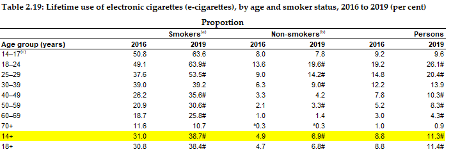
The AIHW’s Table 2.19 shows the denominator for  determining “current” vaping is the 11.3% of Australians aged 14 plus who have ever used  e-cigarettes in their lifetime.

There are 20,900,000 Australians aged 14+ years with 11.3% of them having ever used an e-cigarette, even once. AIHW Table 2.21 below  means there are around 433,000 people who vape at least monthly, a whole 16% less than 520,000.


Frequency of electronic cigarette use by people aged 14 and over who have used an electronic cigarette in their lifetime, 2019 (per cent)


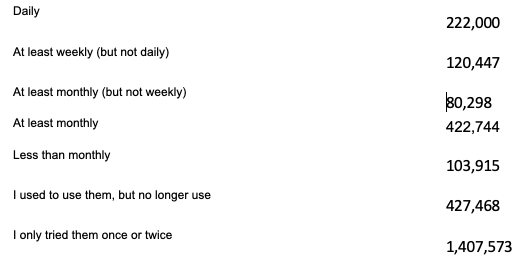
Estimated numbers of e-cigarette users by usage categories

Vaping advocates pitch their most emotional appeals for policy change around profiles of heavy smokers who they say have often tried to quit and failed, but who are now vaping. This profile could only reasonably be applied to daily vapers, not those who smoke every day and vape very occasionally, nor those who are not nicotine dependent and neither smoke not vape every day. So this means we are talking about some 222,000 Australians 14+ who daily are vapers (about 1.1%), a large proportion of whom will be dual users who continue vape and smoke.

For these,  angst-ridden “I will go back to smoking if access to vaping is tightened” threats about health minister Greg Hunt’s proposed vapable nicotine via prescription policy, are nonsense because they have never given up smoking anyway. Longitudinal cohort studies show that dual use is very often far from a transitory phase leading to exclusive vaping. Many vapers keep smoking as the table below illustrates with a 12 month follow-up. With all major transnational tobacco companies now marketing both cigarettes and vapable products, prolonged dual use and deepening nicotine addiction is of course very good business. This is why all tobacco companies selling cigarettes Australia today are lobbying hard to be allowed to sell their vapable products here too.

ATHRA seems to have little compunction in claiming all those who might have had a tentative toke on an ecig just once or twice as true current vapers whose interests they hope to champion. But when it comes to others pointing out concerns about the increase in teenage vaping either in Australia or internationally, they seem to prefer a much narrower definition when attempting to hose these concerns down. Consider these examples from a recent publication with ATHRA board member Colin Mendelsohn as an author:

Note “3 or more days in the last month”, “vaping daily”, “vaping at least weekly” and “≥20 days in the last 30 days”, are all measures of far more serious vaping than any figure that lumps in “less than monthly”.

So in summary, claims that there are more than half a million “current” vapers in Australia are wildly exaggerated. Just 1.1% of the 14+ population who vape daily, with it being very likely that a large proportion of these are people who continue to smoke and so for whom posturing about “returning to smoking” are nonsense because they’ve never stopped smoking.

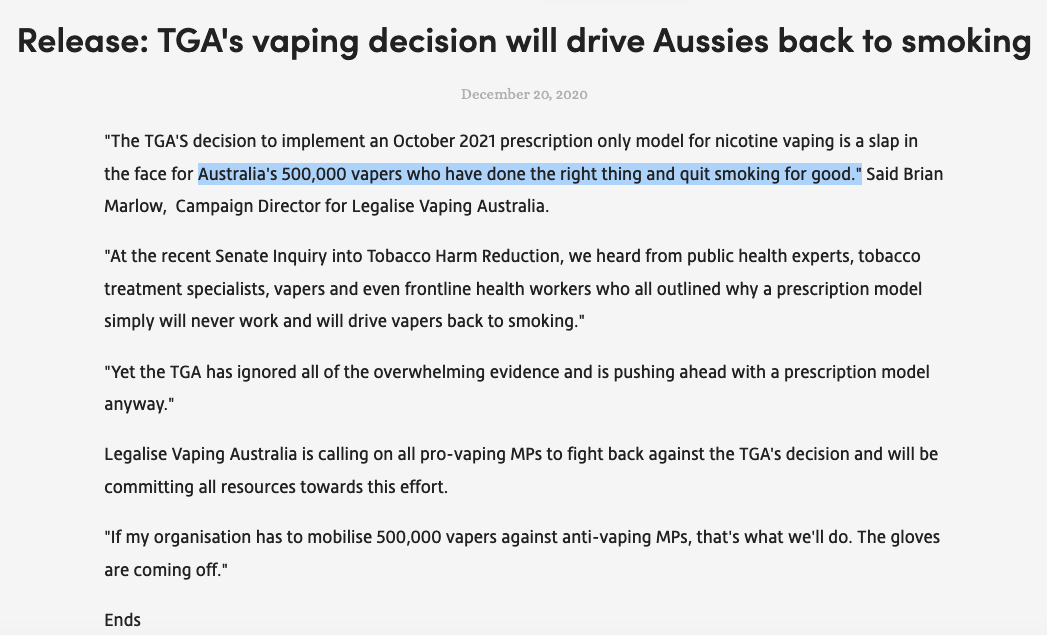
Tailpiece On 20 December, 2020, Legalise Vaping Australia, fresh from the ruins of their campaign to have the Senate Select Committee on Harm Reduction overturn the government’s plan to require a prescription to access vapable nicotine, flushed all pretense of being an evidence-respecting body down the toilet. It issued this press release claiming that 500,000 Australians who vaped had “quit smoking for good”. This is the same group which has often taunted that smoking prevalence in Australia has plateaued or stopped falling. So with there being 2.3million smokers today, and 500,000 have quit in recent years via vaping, these clowns are saying there has been an 18% fall in recent years in the numbers of Australians who smoke because of vaping. So which is it, boys?

Update 27 Sept, 2021: Colin Mendelsohn is these days claiming there are 600,000 vapers in Australia. Where has he pulled this number from? Meanwhile, the Pharmaceutical Society of Australia suggests 200,000 as the figure. (“PSA National President, A/Prof Chris Freeman, encourages pharmacists to prepare to manage these changes and support more than 200,000 Australians estimated to be using vaporised nicotine.”)

What Dr Fauci didn’t write about COVID19, but well could have

14 Monday Sep 2020

Posted by Simon Chapman AO in Blog

≈ Leave a comment

This has been doing the rounds on Facebook, incorrectly attributed to Dr Anthony Fauci (see here). But it is so good, I wish he had written it.

“Chickenpox is a virus. Lots of people have had it, and probably don’t think about it much once the initial illness has passed. But it stays in your body and lives there forever, and maybe when you’re older, you have debilitatingly painful outbreaks of shingles. You don’t just get over this virus in a few weeks, never to have another health effect. We know this because it’s been around for years, and has been studied medically for years.
Herpes is also a virus. And once someone has it, it stays in your body and lives there forever, and anytime they get a little run down or stressed-out they’re going to have an outbreak. Maybe every time you have a big event coming up (school pictures, job interview, big date) you’re going to get a cold sore. For the rest of your life. You don’t just get over it in a few weeks. We know this because it’s been around for years, and been studied medically for years.
HIV is a virus. It attacks the immune system and makes the carrier far more vulnerable to other illnesses. It has a list of symptoms and negative health impacts that goes on and on. It was decades before viable treatments were developed that allowed people to live with a reasonable quality of life. Once you have it, it lives in your body forever and there is no cure. Over time, that takes a toll on the body, putting people living with HIV at greater risk for health conditions such as cardiovascular disease, kidney disease, diabetes, bone disease, liver disease, cognitive disorders, and some types of cancer. We know this because it has been around for years, and had been studied medically for years.
Now with COVID-19, we have a novel virus that spreads rapidly and easily. The full spectrum of symptoms and health effects is only just beginning to be cataloged, much less understood.
So far the symptoms may include:
Fever
Fatigue
Coughing
Pneumonia
Chills/Trembling
Acute respiratory distress
Lung damage (potentially permanent)
Loss of taste (a neurological symptom)
Sore throat
Headaches
Difficulty breathing
Mental confusion
Diarrhea
Nausea or vomiting
Loss of appetite
Strokes have also been reported in some people who have COVID-19 (even in the relatively young)
Swollen eyes
Blood clots
Seizures
Liver damage
Kidney damage
Rash
COVID toes (weird, right?)
People testing positive for COVID-19 have been documented to be sick even after 60 days. Many people are sick for weeks, get better, and then experience a rapid and sudden flare up and get sick all over again. A man in Seattle was hospitalized for 62 days, and while well enough to be released, still has a long road of recovery ahead of him. Not to mention a $1.1 million medical bill.
Then there is MIS-C. Multisystem inflammatory syndrome in children is a condition where different body parts can become inflamed, including the heart, lungs, kidneys, brain, skin, eyes, or gastrointestinal organs. Children with MIS-C may have a fever and various symptoms, including abdominal pain, vomiting, diarrhea, neck pain, rash, bloodshot eyes, or feeling extra tired. While rare, it has caused deaths.
This disease has not been around for years. It has basically been 6 months. No one knows yet the long-term health effects, or how it may present itself years down the road for people who have been exposed. We literally do not know what we do not know.
For those in our society who suggest that people being cautious are cowards, for people who refuse to take even the simplest of precautions to protect themselves and those around them, I want to ask, without hyperbole and in all sincerity:
How dare you?
How dare you risk the lives of others so cavalierly. How dare you decide for others that they should welcome exposure as “getting it over with”, when literally no one knows who will be the lucky “mild symptoms” case, and who may fall ill and die. Because while we know that some people are more susceptible to suffering a more serious case, we also know that 20 and 30-year-olds have died, marathon runners and fitness nuts have died, children and infants have died.
How dare you behave as though you know more than medical experts, when those same experts acknowledge that there is so much we don’t yet know, but with what we DO know, are smart enough to be scared of how easily this is spread, and recommend baseline precautions such as:
Frequent hand-washing
Physical distancing
Reduced social/public contact or interaction
Mask wearing
Covering your cough or sneeze
Avoiding touching your face
Sanitizing frequently touched surfaces
The more things we can all do to mitigate our risk of exposure, the better off we all are, in my opinion. Not only does it flatten the curve and allow health care providers to maintain levels of service that aren’t immediately and catastrophically overwhelmed; it also reduces unnecessary suffering and deaths, and buys time for the scientific community to study the virus in order to come to a more full understanding of the breadth of its impacts in both the short and long term.
I reject the notion that it’s “just a virus” and we’ll all get it eventually. What a careless, lazy, heartless stance.”

Vaping has two big rugs pulled from beneath it

03 Thursday Sep 2020

Posted by Simon Chapman AO in Blog

≈ Leave a comment

Rug #1: Vaping nicotine is a very successful way of quitting smoking – much better than all other ways

Two papers just published from the US PATH (Population Assessment of Tobacco and Health Study) have pulled a giant rug out from under one of the major pillars of vaping advocates’ claims about the benefits of vaping: that they are an excellent way to quit smoking. After trying to quit unaided (cold turkey), e-cigarettes are the most common method used by American smokers trying to quit.

The PATH study is a large cohort of smokers and vapers whose smoking and vaping use was recorded at baseline in 2013 and who have been followed up each year to monitor any transitions in and out of smoking and vaping. Prospective cohort studies recruited from the general population are arguably the most powerful ways of assessing the usefulness of different ways of quitting smoking over time in real world settings, outside of the artificiality of randomised controlled trials.

Two papers from the same group lead by long time Australian US resident John Pierce from the University of California, San Diego reported on two waves of follow-up after the initial base-line questionnaire. In the first paper, daily smokers were studied to compare methods of quitting used at their last quit attempt. 23.5% used e-cigarettes, 19.3% used pharmacotherapy only (including NRT) and 57.2% used no product. Cigarette abstinence for 12+ months at Wave 3 was approximately 10% in each group (meaning 90% were still smoking). Different methods had statistically comparable 12+ month cigarette abstinence, including quitting without any aids. So much for the unending hype that e-cigs are so much better than other ways of quitting and that all stops should therefore be pulled out to ensure as many smokers as possible can get unhindered access to this new wonder drug.

In the second paper by the Pierce group published in the high ranking American Journal of Epidemiology, the authors sought to allow for possible confounders in known differences between those smokers who self-select to use e-cigarettes and those who don’t. They identified 24 such potential confounders and statistically controlled for these using “propensity matching” to match each e-cigarette user with up to two closely matched control smokers and then compared their experience with quitting smoking.

12.9% of smokers who used e-cigarettes had quit long term but that there was no statistically significant difference when matched non-e-cigarette-users’ success was compared. The authors concluded “These results suggest that e-cigarettes may not be an effective cessation aid for adult smokers, and instead may contribute to continuing nicotine dependence.”

Rug #2: Australia, with far less vaping than nations like the USA, UK, Canada and New Zealand is falling behind these nations in reducing smoking

The USA and the UK have been awash with e-cigarettes for around a decade, with Canada and New Zealand more recently legislating their widespread availability.  Australia by contrast, has always banned the domestic sale of e-juice containing nicotine. More recently, Health Minister Greg Hunt  has announced his intention to legislate that vapable nicotine be made available by prescription.

Vaping advocates’ mantras invariably include claims that without open access to nicotine for vaping, smokers are severely disadvantaged and Australia’s smoking prevalence is falling behind that of our anglophone rivals in being at the front of the world’s lowest smoking prevalence.  Given this, they argue, we should follow the policies of these other nations. The implication here is that our vaping policy is retarding our ability to reduce smoking.

So let’s look at the latest data.

In July this year, the AIHW (Australian Institute of Health and Welfare) released data from its 2019 survey of Australians’ drug use, including smoking.  Below I set out the most recent official data released by Australia, Canada, New Zealand , the UK and the USA that allow us to check the truth of the vapers’ claims that Australia has fallen behind in reducing smoking.

The latest available data on smoking prevalence from these five nations which are often compared would appear to show that the UK has 14.1% of its  ≥18 population who smoke. Canada (14%) and New Zealand (14.2%) report their data from those aged ≥15years (not ≥18), and Australia from  ≥14years (14%). But as teenage smoking prevalence is less than that of ≥18 year olds, this acts to lower their total smoking prevalence. Australia’s ≥18 prevalence in 14.7%. These are important differences in how each of these nations count smoking.

Secondly, of these five nations, only Australia, Canada and the USA include all combustible tobacco products in their data on “smoking” prevalence. Canada also includes chewing tobacco use, but unlike the other four nations, only counts recent (past 30-day) smoking. The inclusion of chewing tobacco would inflate Canada’s “smoking” prevalence figure, while its “within-30-day” limit would reduce it, compared with all other nations which also count less-than-monthly smoking in their current smoking figures.

By not including all combustible tobacco product use (cigars, pipes, shisha), the “smoking” prevalence figures from the UK and New Zealand will thus underestimate the true prevalence of “smoking” in those nations. This point has previously been made about an earlier “headline” smoking prevalence figure of 15.1% for the USA (see extract below).

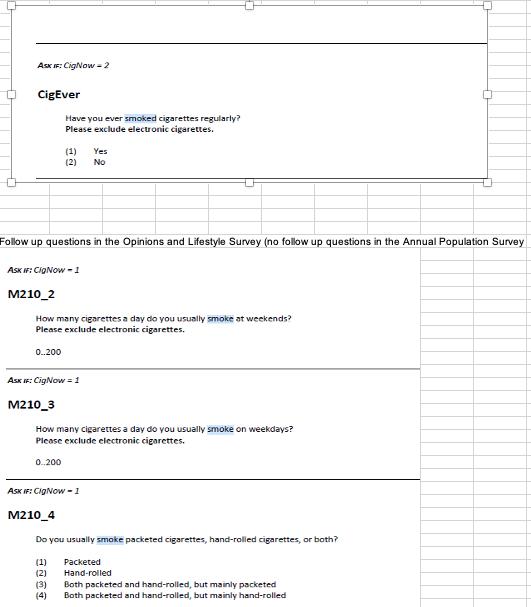
While the UK Annual Population Survey reported by the Office of National Statistics intends to cover RYO, it is possible that many respondents answering the question would not necessarily interpret it as doing so. As shown in the clips of the survey at the end of this blog, it asks specifically about cigarettes (after asking a lead in question about all tobacco products. Quite a few respondents might expect a follow up question just on RYO. If this was the case, the UK data may additionally underestimate “cigarette smoking” for this reason.

Taking into account all these factors, and noting the confidence intervals and margins of error noted in the data below, it is likely that Canada, Australia and New Zealand have almost the same smoking prevalence; that England may have slightly higher because of it not counting combustible tobacco other than cigarettes and roll-your-own tobacco, and that the USA has the highest smoking prevalence of the five nations.

  • Australia:(2019 AIHW ages ≥14 and  ≥18): (all combustible tobacco users, at any smoking frequency –people who reported smoking cigarettes daily, weekly, monthly or less than monthly) ≥14yrs: 14.0% (margin of error 0.6); ≥18 yrs: 14.7% (margin of error 0.7%) Daily smoking by 11%.
  • Canada:(2019 Canadian Tobacco and Nicotine Survey ≥15yrs  14% (Only past 30-day use of any tobacco product — including chewing tobacco)
  • New Zealand:2018 Current smoking (smoke at least monthly, and have smoked more than 100 cigarettes in their whole life time) among persons aged  ≥15): 14.2%  (CIs: 13.4-15.0) (Māori adults 34% (31.1-37.1) (cigarettes & RYO only at any smoking frequency)
  • UK:(2019 Office of National Statistics; ages  ≥ 18): 14.1%  “who smoke cigarettes nowadays”)
  • USA: (2018 NHIS ages ≥ 18): 16.5% (CIs 15.9-17.2) (all combustible tobacco users at any smoking frequency “every day or some days”

With Australia having far less vaping prevalence that the other nations, and keeping in mind the unflattering track record of vaping in smoking cessation, as shown in the two PATH papers above, it is hard to argue that Australia is losing out in the race to have the lowest prevalence of smoking because it has not liberalised access to vapable nicotine.

As leading English smoking cessation researcher Robert West told the BBC in 2016

Questions asked by UK’s UK Annual Population Survey

Blog Stats

  • 163,470 hits

Top Posts & Pages

  • Why I’m not quitting Spotify because its owner has hugely invested in weaponry
  • Australia takes off the gloves on illegal tobacco while ‘lower the tax’ fantasists plumb new absurdities
  • About/CV
  • Vaping theology: 6 There’s nicotine in potatoes and tomatoes, so should we restrict or ban them too?
  • My books
  • Regrets … I’ve had a few. Paul Hogan and his Winfield role.
  • Thinking of keeping koi? Advice for beginners in NSW
  • Cheap illegal cigarettes save low income pack-a-day smokers over $9000 a year. So why don’t social justice champions give them full support?
  • Why Australia’s illegal tobacco and vape trade continues to flourish and what should be done about it
  • My first seen, best and worst bands 1964-2022

Blog archive

Comment Policy: No anonymous or pseudonymous posts will be published

Recent Posts

  • Australia takes off the gloves on illegal tobacco while ‘lower the tax’ fantasists plumb new absurdities
  • Egg on some faces: statisticians at 10 paces on the impact of New Zealand’s vape laws on youth smoking
  • Lowering tobacco tax to make illegal tobacco sales “disappear overnight”: at last we have a proposed figure and it’s an absolute doozie
  • Why I’m not quitting Spotify because its owner has hugely invested in weaponry
  • Should we believe Fiona Patten on vapes? Here are just a few problems

Recent Comments

Jon Krueger's avatarJon Krueger on Egg on some faces: statisticia…
Atul Kapur's avatarAtul Kapur on Should we believe Fiona Patten…
Unknown's avatarCould a national tob… on If expensive cigarettes are dr…
tahirturk1's avatartahirturk1 on Why Australia’s illegal tobacc…
malonere's avatarmalonere on Words I’ve seen, but didn’t kn…

Archives

  • December 2025
  • August 2025
  • July 2025
  • June 2025
  • May 2025
  • March 2025
  • January 2025
  • November 2024
  • October 2024
  • September 2024
  • July 2024
  • May 2024
  • April 2024
  • March 2024
  • February 2024
  • January 2024
  • December 2023
  • November 2023
  • October 2023
  • September 2023
  • August 2023
  • July 2023
  • June 2023
  • May 2023
  • March 2023
  • February 2023
  • January 2023
  • December 2022
  • November 2022
  • October 2022
  • August 2022
  • June 2022
  • April 2022
  • March 2022
  • February 2022
  • January 2022
  • December 2021
  • October 2021
  • September 2021
  • August 2021
  • June 2021
  • May 2021
  • April 2021
  • March 2021
  • February 2021
  • January 2021
  • December 2020
  • November 2020
  • October 2020
  • September 2020
  • August 2020
  • July 2020
  • June 2020
  • May 2020
  • April 2020
  • March 2020
  • February 2020
  • January 2020
  • December 2019
  • November 2019
  • October 2019
  • September 2019
  • August 2019
  • July 2019
  • June 2019
  • May 2019
  • April 2019
  • March 2019
  • February 2019
  • January 2019
  • December 2018
  • November 2018
  • October 2018
  • September 2018
  • August 2018

Categories

  • Blog

Meta

  • Create account
  • Log in
  • Entries feed
  • Comments feed
  • WordPress.com

Blog at WordPress.com.

  • Subscribe Subscribed
    • Simon Chapman AO
    • Join 198 other subscribers
    • Already have a WordPress.com account? Log in now.
    • Simon Chapman AO
    • Subscribe Subscribed
    • Sign up
    • Log in
    • Report this content
    • View site in Reader
    • Manage subscriptions
    • Collapse this bar
 

Loading Comments...