• Home
  • About/CV
  • Blog
  • Vaping Research Alerts
  • Blog archive list
  • My books
  • Memoirs
  • Music, bands, films
  • Contact

Simon Chapman AO

~ Public health, memoirs, music

Simon Chapman AO

Monthly Archives: January 2021

What’s to be done about Van Morrison and Eric Clapton’s anti-lockdown antics?

19 Tuesday Jan 2021

Posted by Simon Chapman AO in Blog

≈ Leave a comment

[updated 23 Feb 2022]

In January 2021, the creepy murderer and legendary wall-of-sound record producer Phil Spector died in jail. I have a much-played boxed set of his best productions, which includes the Ronettes, the Righteous Brothers and Ike and Tina Turner’s incomparable River Deep, Mountain High. I cannot imagine ever disliking those songs, despite Spector’s odious crimes.

Then there’s good old Van and Eric. With 1 in 30 London residents currently diagnosed with COVID-19, 1700 deaths a day and British and Irish frontline hospital and ambulance staff pleading for people to obey COVID-19 control protocols,  what are we all to make of these musical icons releasing a song protesting lockdowns? I saw Morrison in London in the early 1980s, and along with about a quarter of the audience, walked out well ahead of the end when he obviously didn’t want to be there either. But now I’m wondering if I should walk away from even listening to his music.

Morrison, who gave us the languid classic Into the Mystic, the soundtrack to Kenneth Branagh’s masterpiece Belfast and many, many more wonderful songs has released three tracks protesting the British lockdown: “Born to Be Free,” “As I Walked Out” and “No More Lockdown.” The hope is that these songs will be bought and downloaded, providing funds for out-of-work musicians. Morrison and Clapton also presumably also hope that their views will become as contagious as COVID-19 and people will ignore directives.

Fantastic that they care about musicians’ livelihoods. But how to describe their concerns for the whole population?

The other night at a family dinner, a Ryan Adams track I love came on in a playlist I had running. One of my kids said “what are you playing that guy for? Don’t you know that he’s been accused of multiple counts of sexual misconduct?”## I didn’t and my heart sank. I discovered him only relatively recently and have 10 or so of his songs like this one on high rotation playlists. [##Note: Adams has apologised for his behaviour]

I love much of David Hockney’s art like his A Bigger Splash (1967). Hockney is a smoker, which is none of my  business. But he’s also been an active opponent of smoking restrictions in public spaces and putting a pox on those who want governments to do things like put gruesome pictorial health warnings on packs. So this makes his views about smoking very much all of our business, because his post-truth views that he should be allowed to smoke where he wants are beyond self-absorbed. With his celebrity megaphone he hopes to wind back policy that benefits far more than it displeases.

But, as happens when I play favourite Clapton, Morrison and Adams tracks,  I experience nothing of this in his paintings, and think I’ll always appreciate them.

Joe Jackson is another who rails against restrictions on smoking. The insipid nihilist lyrics to  his 1982 track Cancer,  (“everything gives you cancer”) could come straight from the tobacco industry’s historic playbook of trivializing the risks of smoking. They’d sit comfortably with one of today’s MAGA Trump supporters, applauding his efforts to shred environmental health standards.

I’ve watched Roman Polanski’s movies like Chinatown, Repulsion and Cul de Sac many times. But wait, there’s the problem of  Polanski’s alleged sexual abuse of women. So, do we all just relax, sit back and enjoy his cinematic artistry?

Of course these recent examples are not the first time and certainly won’t be the last that musicians, artists, writers and public figures whose work we love, will go and display weapons-grade fuck-wittery or be exposed for their reprehensible behaviour. But what are we to do when we learn this, beyond talking about how here’s yet another public figure  who’s gone down the plughole?

Then there’s travel. A few years ago I decided I wouldn’t attend a world conference in my field that was being held in a Gulf state. I had no appetite for living for a few days in the  gilded cage of a luxury hotel while outside, the government quietly facilitated the exploitation  of guest workers from impoverished countries, jailed people for adultery and did nothing to redress basic women’s rights.

I worked a lot with research colleagues in Shanghai, and loved going up there. But I became increasingly appalled by China’s treatment of minorities, evidence of organ  harvesting from prisoners and its conduct in crushing dissent in Hong Kong. So sadly, no more China for me I decided.

But I’ve also been to many other countries where widescale human rights abuses, capital punishment, rapacious environmental policies, the jailing of dissidents and blind-eyes turned to Dickensian labour conditions in sweat shops abound. At different times, these have included the US, Turkey, Pakistan, India, Uganda, Iran and Afghanistan. Should we all feel obliged to stay away from any country which implements any egregious policies and practices? Are there any such places where none of this happens? Or if we’re to be consistent in the application of consumer and traveler “woke” principles, can we ever again travel anywhere?

And then of course, I live in Australia where our government keeps asylum seekers in prison-like indefinite detention, shrugs its smug shoulders over scandals like Robodebt, Aboriginal deaths in custody, Barrier Reef die-off, land clearing, and tries to endlessly polish the turd coal to try and make it seem clean.

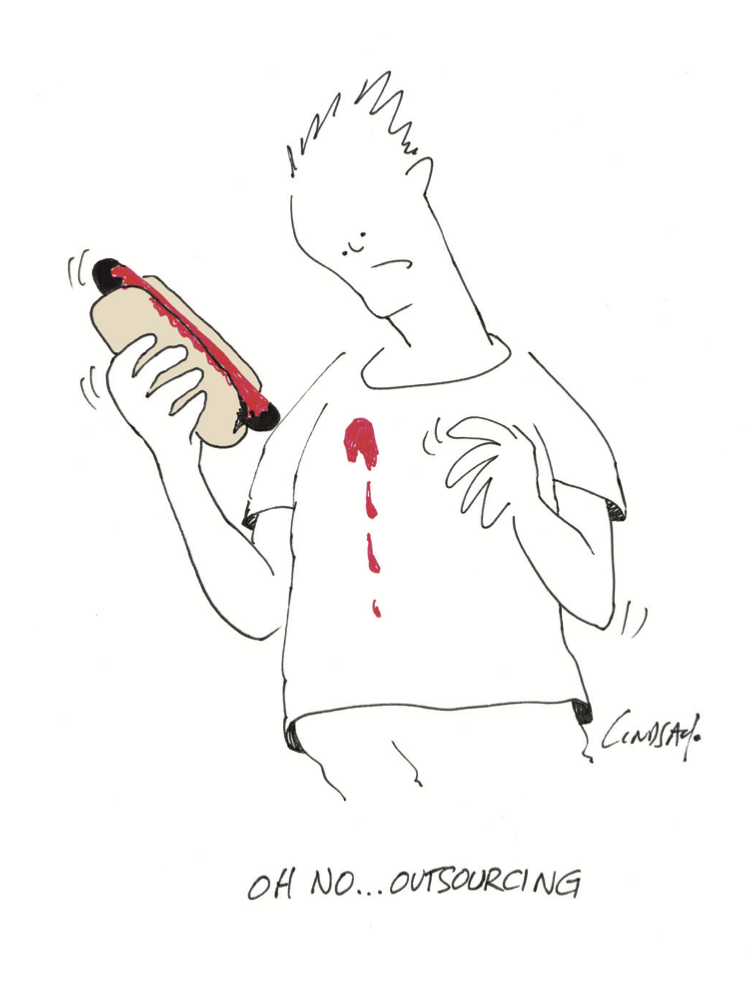
Cartoon by Lindsay Foyle

Many of us put a lot of effort into choosing products and manufacturers which tick lots of boxes  on exemplary environmental, labour and human rights records. In our house we use Choice magazine’s Cluckar app to help us buy truly free range  eggs. We buy “naked”, unpackaged fruit  and vegetables. But I don’t check the carbon footprint and labour practices of every single grocery item I put in my trolley. Each trip to the supermarket would take all day if I did that.

The perennial debate about whether we can and should separate our appreciation for someone’s creativity from their loathsome and sometimes dangerous behaviours, attitudes and beliefs seems destined to never be resolved. All of us show inconsistencies in what we make a fuss about and what we let through.

The sense of loss I feel  is palpable when I learn that an artist, musician or writer whose works I loved is another depressing cockwomble. But I haven’t and don’t intend to purge my Spotify playlists of anyone in that club. We often associate music we love with the context and times when we first heard it. What we might learn later about those who perform it seldom totally extinguishes any love for that music. Moreover, with the great majority of musicians, I’d have no idea about their politics. Is anyone saying that we should do this?

These people are diminished for me and I imagine many millions of others when we learn about their feet of clay. Knowing what they stand for has certainly inspired me to look elsewhere more and actively seek out musicians, artists and writers who I’ve found out share my values.

What do you do? Discuss.
Ten common reasons why research journal editors reject papers

14 Thursday Jan 2021

Posted by Simon Chapman AO in Blog

≈ Leave a comment

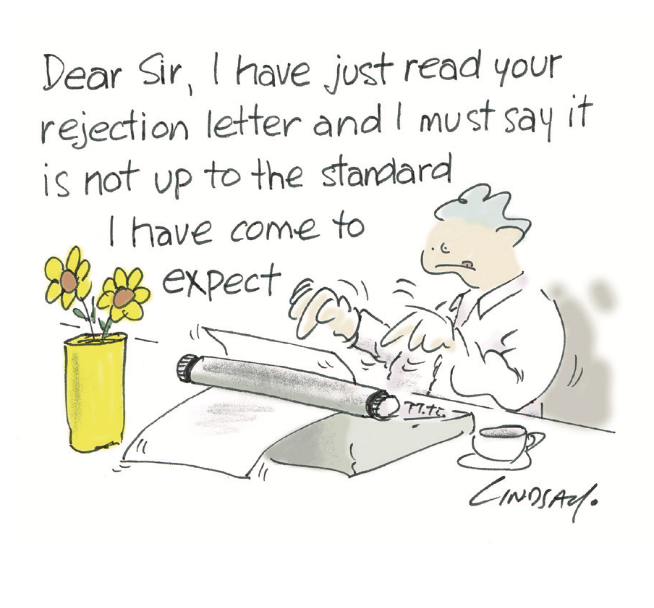
Cartoon credit: Lindsay Foyle (Sydney)

Every researcher has received rejections from journals.  I edited Tobacco Control for 17 years (7 as deputy editor, and 10 as editor). Across that time I and the other senior editors had to reject 1000s of papers. All of these were written by authors who thought their papers were important and sometimes brilliant.

There are many reasons why papers get rejected, including  many which are of an acceptable methodological and analytic standard. Here are ten of the most important:

  1. Space limits

Journal editors are given page limits for their print editions by their publishers. Editors then need to decide word limits to optimize the number of papers they can publish in each edition. If there is only room for 70 papers a year, and 700 are submitted, it’s obvious 90% will be rejected. Editors  may vary the word limits for different sorts of papers (reviews are often longer, and many submitted papers really have only one or two findings that are of any interest, and so authors are often offered brief reports or letters).

Many seem to believe that on-line only journals, not having the constraint of page limits that printed issues have, should be able to accept many more papers and not be fussed about length. But this is a misunderstanding and brings us to the next reason for rejection.

2. Budget limits

Publishers set annual budgets for journals. When I was at Tobacco Control we paid our senior editors a fee of  $US50 per allocated paper. They got this regardless of the fate of the paper. So they got the same amount if, after reading the paper (and sometimes only the abstract—see below), they rejected it without review; if it went out for review and was then rejected without offer of revision; and also if it went through review and sometimes several revisions. Finding reviewers willing to review papers is a particularly onerous task that falls to senior editors. Refusal-to-review rates run at about 1 in 3. My own personal record in soliciting reviews runs at 12 consecutive refusals. Papers from nations where English is not the first language, sometimes have many problems with expression that need many hours of editorial attention.

Senior editors generally do not attend to the numerous problems of expression, inadequate referencing and failure of authors to follow journal guidelines. Neither do they do mark up papers for publication and fix table layouts. These tasks all take lots of time and are handled either by in-house technical editors or by out-sourced editors, often in big technical editing firms overseas. On-line publishing is also often hosted by out-sourced companies, which charge by the volume of material they publish.

All this of course costs money, and so publishers insist that editors are very judicious in the volume of acceptances.

cartoon credit: Lindsay Foyle (Sydney)

3. Rapid processing

Across the 17 years I edited, there were few days when new papers, revisions or questions from authors did not arrive. If these banked up, the backlog was bad for editors’ workload, authors wanting to know the fate of a paper quickly and a journal’s reputation as a deep hole. My own worst case experience as an author myself is laid out here in its full, sorry detail.

So I encouraged all our senior editors to reject without review any papers that clearly had a snowball’s chance in hell of being accepted and which would waste everyone’s time if sent out for review. Some of the submissions that came in were unbelievable: entire theses, rants from conspiracists and crazies, papers where the authors had clearly never read the journal, and from those with near to zero familiarity with scholarly writing. If an editor leaned strongly toward reject without review, but wanted to run the reasons by others at our fortnightly editorial on-line conferences, they could bring it up there.

We used a stock email that attempted to explain our dilemma to authors: we had far, far more submissions than we could ever publish even if they were to be reviewed favourably, and so it was necessary to cull. We hoped authors would appreciate our rapid decision so they could place their work elsewhere.

One paper, in the early days of the internet, was submitted by a doctor who encouraged his patients to visit his website about smoking. He’d gone through the back-end data and written up a paper with numerous tables detailing such riveting details as the time his very modest number of patients visited his site and how many times they’d clicked through to its different pages. The assigned editor rejected it during our editorial conference. I saw the rejection come through on my email and replied to the handling editor “Congratulations! The fastest reject in the history of the journal!”. But I accidentally hit “reply all”, so my attempt at congratulating an efficient editor also went to the author who immediately replied with a white hot, incendiary blast about the arrogance of editors.

4. Impact factors

Not inciting the wrath of publishers for over-budget runs is always in the background. But there are also of course, important academic and impact considerations involved in rejection. I’ve never met a journal editor who was not intensely keen to see their journal’s impact factor rise and rise. Those who have low to homeopathic level IFs will often drone on about how unimportant these are. But those up near the top of the IF tables want everyone to know, particularly authors because many factor in IFs when submitting their most important work.

Experienced editors develop  an instinct for submissions which are likely to be highly cited by other authors after publication. One of the most common things editors on a journal say to each other in editorial conferences is “I think this paper will really attract a lot of citations”. Or the reverse. I’ll come to tell-tale signs of this below.

5. No “wow” factor

The decision to send a paper out for review rather than to reject it outright is primarily governed by judgements that a paper will attract lots of interest. Editors are chosen because they typically have a breadth of experience in the area in which a journal focuses. Their own instincts about whether a paper is important are therefore often shared by other editors in the regular editorial conferences where decisions are made  on the fate of most papers. Editors often note published papers which are being deluged with on-line clicks and being well cited. The obverse of this is that there are also categories of papers which are sleep-inducing and likely to be loved mainly by their authors.

6. Failing to “sell” your paper

I once sat next to Richard Smith, a long-time editor of the BMJ, on a train going from London to France. He had a large box-like piece of hand-luggage which was filled with paper copies of submitted papers. I watched him out of the corner of my eye as he triaged them into what I recall as three piles: instant reject, instant send out  for review, and “read further later and think about it more”.

He motored through dozens of papers in the time it took us to get to our destination. With the great majority, he read the authors’ cover letter first.  Sometimes it was the only thing he seemed to read. For others, he read the abstract as well. And with the reminder, he skimmed particular sections before deciding their fate.

We talked about this and agreed that many authors give very cursory attention to their abstracts and especially to the cover letter. The cover letter is critical to piquing the editor’s interest  and telling the story about why the paper is important, how it advances understanding of something that passes the “so what?” litmus test and ultimately of whether a paper might hold promise of attracting a lot of scholarly and hopefully public interest too.

Similarly, abstracts are often dashed off at the end of a paper’s construction by fatigued authors wanting to just get it out to a journal. Amid a plethora of findings, sometimes the most important or interesting findings are left out of an abstract, because authors have failed to view their paper as editors might view it, killing a paper’s interest.

My own way of approaching this was to rehearse how I would try to briefly describe a paper of mine when pitching it to a specialized health or medical journalist writing for a newspaper. If it was a struggle, I’d often come down to earth about where to pitch the paper.

7. International or local interest?

With international journals (as opposed to those with clear national foci), editors are keen to publish papers that will interest global readers. In the tobacco control research space, a competent study of smoking prevalence among medical students in a single university in Calathumpia will be of far less interest than one that compares the same phenomenon in a large number of countries using a standard protocol. However, if a local prevalence study is contextualized against particular policies or practices that allow consideration of what might be explaining changing prevalence, that might well interest international readers.

8. Tell-tale signs of slap-dash preparation

A paper which has been rejected, perhaps often, by other journals often has signs that do not require a degree in forensic investigation to discern. Wrong referencing styles, not using the required headings or abstract style, dated data and a focus on water-under-the-bridge events, policies etc are all often give-aways. Under the weight of abundant choices, editors can take the attitude that they will give about the same time to such pass-the-parcel submissions as the authors have given to a journal’s requirements.

9. Come clean: attach previous reviews and changes

Many papers are rejected after review. Rejection here is often not because of irreparable problems, but simply because it’s been decided that your paper does not rank highly enough against others lined up in the “potential” marshalling yard.  If yours has been rejected for other than fatal flaws, do not simply submit the same, unrevised paper to the next journal down the food-chain. Instead, address those changes that the previous journal’s reviewers suggested, and send the next journal a covering letter explaining that you had it reviewed by another journal, didn’t make the cut and include the reviews as well as a point-by-point explanation of how you addressed criticisms in your revision, now being submitted to the new journal.

I used to very much appreciate that when it happened and sometimes just used one new reviewer to assess the adequacy of the revision. I have also (quite a few times) received a paper I reviewed for one journal, from another. It has just knocked on the next door still all disheveled, looking for a bed. When authors have made no attempt to make any changes, I always advise the editor of the second journal of this and attach my old review.

10. Nominate likely reviewers

Many journals invite authors to suggest possible suitable reviewers (provided that these people have no competing interests with the authors). A surprising number of authors fail to nominate anyone.  Those who do are off to a good start with editors who have decided a paper is good enough to review. It saves them time, and in my experience is usually more likely to result in a reviewer agreeing to review as the authors may know of their interest in the focus of the paper. My usual practice was to pick 1 or 2 of the 3 required reviewers from those suggested by the authors.

Blog Stats

  • 163,470 hits

Top Posts & Pages

  • Why I’m not quitting Spotify because its owner has hugely invested in weaponry
  • Australia takes off the gloves on illegal tobacco while ‘lower the tax’ fantasists plumb new absurdities
  • About/CV
  • Vaping theology: 6 There’s nicotine in potatoes and tomatoes, so should we restrict or ban them too?
  • My books
  • Regrets … I’ve had a few. Paul Hogan and his Winfield role.
  • Thinking of keeping koi? Advice for beginners in NSW
  • Cheap illegal cigarettes save low income pack-a-day smokers over $9000 a year. So why don’t social justice champions give them full support?
  • Why Australia’s illegal tobacco and vape trade continues to flourish and what should be done about it
  • My first seen, best and worst bands 1964-2022

Blog archive

Comment Policy: No anonymous or pseudonymous posts will be published

Recent Posts

  • Australia takes off the gloves on illegal tobacco while ‘lower the tax’ fantasists plumb new absurdities
  • Egg on some faces: statisticians at 10 paces on the impact of New Zealand’s vape laws on youth smoking
  • Lowering tobacco tax to make illegal tobacco sales “disappear overnight”: at last we have a proposed figure and it’s an absolute doozie
  • Why I’m not quitting Spotify because its owner has hugely invested in weaponry
  • Should we believe Fiona Patten on vapes? Here are just a few problems

Recent Comments

Jon Krueger's avatarJon Krueger on Egg on some faces: statisticia…
Atul Kapur's avatarAtul Kapur on Should we believe Fiona Patten…
Unknown's avatarCould a national tob… on If expensive cigarettes are dr…
tahirturk1's avatartahirturk1 on Why Australia’s illegal tobacc…
malonere's avatarmalonere on Words I’ve seen, but didn’t kn…

Archives

  • December 2025
  • August 2025
  • July 2025
  • June 2025
  • May 2025
  • March 2025
  • January 2025
  • November 2024
  • October 2024
  • September 2024
  • July 2024
  • May 2024
  • April 2024
  • March 2024
  • February 2024
  • January 2024
  • December 2023
  • November 2023
  • October 2023
  • September 2023
  • August 2023
  • July 2023
  • June 2023
  • May 2023
  • March 2023
  • February 2023
  • January 2023
  • December 2022
  • November 2022
  • October 2022
  • August 2022
  • June 2022
  • April 2022
  • March 2022
  • February 2022
  • January 2022
  • December 2021
  • October 2021
  • September 2021
  • August 2021
  • June 2021
  • May 2021
  • April 2021
  • March 2021
  • February 2021
  • January 2021
  • December 2020
  • November 2020
  • October 2020
  • September 2020
  • August 2020
  • July 2020
  • June 2020
  • May 2020
  • April 2020
  • March 2020
  • February 2020
  • January 2020
  • December 2019
  • November 2019
  • October 2019
  • September 2019
  • August 2019
  • July 2019
  • June 2019
  • May 2019
  • April 2019
  • March 2019
  • February 2019
  • January 2019
  • December 2018
  • November 2018
  • October 2018
  • September 2018
  • August 2018

Categories

  • Blog

Meta

  • Create account
  • Log in
  • Entries feed
  • Comments feed
  • WordPress.com

Blog at WordPress.com.

  • Subscribe Subscribed
    • Simon Chapman AO
    • Join 198 other subscribers
    • Already have a WordPress.com account? Log in now.
    • Simon Chapman AO
    • Subscribe Subscribed
    • Sign up
    • Log in
    • Report this content
    • View site in Reader
    • Manage subscriptions
    • Collapse this bar
 

Loading Comments...