• Home
  • About/CV
  • Blog
  • Vaping Research Alerts
  • Blog archive list
  • My books
  • Memoirs
  • Music, bands, films
  • Contact

Simon Chapman AO

~ Public health, memoirs, music

Simon Chapman AO

Monthly Archives: October 2022

The very worst example of Big Tobacco mendacity I recall

27 Thursday Oct 2022

Posted by Simon Chapman AO in Blog

≈ 1 Comment

John Dollisson, CEO of Tobacco Institute of Australia 1983-87, then with Philip Morris International

I’ve often been asked by journalists, interviewers and friends what it was about tobacco control that kept me engaged and interested in it across the 45 years I’ve been active in research and advocacy for policies capable of driving down smoking and the diseases it causes. Some are probing to see if there was some road to Damascus epiphany I had early in life. The early death of a heavy smoking parent? No. Or perhaps some religious or neo-puritan calling to deny people the so-called pleasures of smoking? Hardly, I’m a very long term atheist, love wine and good whiskey, and like most people of my age, used cannabis for about half my 20s.

Some are keen to steer the conversation to what it is about working in tobacco control that “drives” me. I often wonder if people working in clinical medicine are ever asked the same question (“why have you kept working for so long as a kidney surgeon?”; “You’ve been a cardiologist for so many years, what is it that keeps you at it?”)

The answer to such questions from clinicians is self-evident. People with diseases and injuries that might be cured or alleviated are very keen to come into the orbit of specialists who can help them and are profoundly grateful when they succeed. Clinicians try to help people who want to be helped, so they are seldom asked to account for why they do what they do, unless they have somehow been exposed as behaving unethically or ineptly.

There is some common ground here with smoking. Some 90% of smokers regret ever starting; most smokers want and try to stop, sometimes often; and I’ve never met any parent who wanted their kids to smoke. “Prevention is better than cure” is regarded as a truism because prevention saves suffering from ever occurring. Everyone who has never been seriously injured in a car crash would rather this had never happened than endure surgery and rehabilitation after being injured.  Successful clinical interventions save lives one at a time while successful global public health policy can save millions of lives at a time.

Tobacco control is a multi-disciplinary pursuit. My colleagues over the years have been clinicians, epidemiologists, biostatisticians, social scientists like psychologists, economists and political scientists, pharmacologists, lawyers, mass communication specialists, agronomists, historians, investigative journalists and politicians. This has made it endlessly fine-grained and fascinating work.

But most working in it will readily agree about a factor that turns the temperature right up in motivating public health advocacy for the policies and mass reach campaigns that drive smoking down. The pinguid, dissembling types who do Big Tobacco and (today) Big Vape’s bidding. For over 70 years, the tobacco industry has been represented  by people whose goal has been to use every possible roadblock to tobacco control policies which seriously threatened tobacco sales.

Thankfully in Australia and many other countries, they have lost every single battle they ever fought.

Today, in déjà vu, we see vaping advocates currently in overdrive to cement the narrative that the health risks of ecigarettes are as benign as breathing steam in the shower and the dramatic rise of school vaping is simply a fad like hula hoops and yoyos that we should all relax about, as a leading vape promoter told the Daily Telegraph in 2021. With 13 year olds calling the Quitline for help with their vaping addiction, I may have missed it but I don’t recall yoyo or hula hoop helplines across the country.

Similarly and infamously, Big Tobacco publicly denied for decades that smoking was harmful, that nicotine was addictive and that children were in their marketing and promotional cross-hairs as essential to their present and future customer base.

In 2001, I was awarded a four year US National Cancer Institute grant and another from the National Health and Medical Research Council to sift through many millions of pages of internal tobacco industry documents made public through the 1998 Master Settlement Agreement between 46 US state governments and the tobacco industry. My research group published 38 papers from these grants, 16 here, 13 here and another 9 linked in my CV between 2001-2005 here.

The documents acted like violently emetic truth serum to the tobacco industry. Its galactic public lies across every conceivable tobacco policy area instantly stopped with the revelations about what they had long known to be the truth, now available for anyone to wave in their faces via their very own internal documents. The only one that persists today is their collective hand-on-heart denial that they slaver over the teen nicotine addiction  market, this being the sine qua non of both the smoking and vaping business models.

I’ve often been asked to nominate the very worst examples of this conduct. This recording of a debate I had with John Dollisson in 1984 on (now ABC chair) Ita Buttrose’s Sydney morning radio program on 2UE is very hard to beat. Dollisson was the Sydney-based head of and main spokesman for the fully tobacco industry funded Tobacco Institute of Australia (TIA) from 1983-87. This 2003 paper by one of my colleagues (now) Professor Stacy Carter, describes the history and activities of the TIA. Dollisson was heavily involved in trying to stop the advance of smokefree indoor areas and bans on tobacco advertising. But his bread and butter was attacking claims about smoking risks.

The full transcript of the 2UE conversation is below. The most disturbing part came when a smoker with lung cancer called in and said she believed her cancer was caused by “stress” as she was a highly nervous person, and that if she stopped smoking, she might die sooner. Dollisson told her it was “good to see you have taken an objective assessment” of her situation and that if other factors like genetics, stress, and indoor and outdoor pollution were taken into account, smoking’s role “was virtually removed”. Buttrose’s popular mid morning program would have been heard by tens of thousands of listeners.

Listen to their conversation here.

1984-dollisson-on-2ue-1Download full transcript

This figuratively and literally sickening excerpt from an ABC “Pressure Point” TV program also from 1984,  shows Dollisson and Philip Morris’ Bill Webb both faithful to the Big Tobacco script of the day. For those with the stomach, here’s the full 25 minute program.

Dollisson seems to have long moved on from tobacco. Here is his Linked In page which includes his post TIA 4 year stint with Philip Morris and their “Vice President, Corporate Affairs, World Wide”.

To my knowledge, Dollisson has never made any public statement showing any regret about his tobacco industry years. Industry employees often sign non-disclosure agreements. If he’s reading this, I’d be happy to give him space to do so.

How inexperienced are you? a game that might tell you

17 Monday Oct 2022

Posted by Simon Chapman AO in Blog

≈ 5 Comments

About 35 years ago during the Irish ‘troubles’ I flew from London to Belfast and with 40 or so others, took a chartered bus down the east coast  to a convention centre overlooking the Irish Sea. On the return journey a couple of days later, our bus was stopped by the police. There was some sort of security operation going on. It was dark and the bus stayed on the side of the road for several hours with other vehicles till we were given the OK to proceed.

Needing something to help us pass what could have been  a long time in a bus with no lights allowed on, various people told travel tales, tall stories and charades. I  proposed a game that went on for at least an hour to gales of laughter.

Here are the rules. Everyone in the group has to try and think of something they have never done, which they guess that everyone else in the room has done. Absolutely anything qualifies, with the exception of naming places, countries, cities etc where you have never been. For each nomination you make that no one else in the room has ever experienced, you get a point, with the winner the person who has the most points.

The skill is thinking about experiences that you calculate to be widely experienced that makes it likely that your innocence is unique. Not having skydived is unlikely to win you a point, but never having played scrabble may well do so. Common foods and drinks are fertile grounds, as are common sports for the non-sporting, not having read popular books, authors, or seen popular movies or TV series. 

The game can be risky because some will nominate edgy, illegal or reprehensible activities which they guess most will not own up to. The Irish bus was full of public health researchers. Oxford University’s Sir Richard Doll was on the bus with his secretary. She got a highly acclaimed point right out of the blocks by saying she was confident she was the only person on the bus who’d never been to university. I knew that this also applied to at least one other person in the group who chose to keep silent. 

Admitting you’ve never had group sex, smoked dope or gone back to a supermarket and paid for an item that was missed by the check-out staff are all probably likely to produce highly unreliable results, depending on who’s playing the game.

Here are some points I usually score on when I play the game.

Snow skiing. Never been in an ambulance or broken a bone. Never stung by a bluebottle. Not read any science fiction book. Never worn sandals as an adult. Never voted conservative. Never ordered or accepted a glass of Baileys, Chartreuse, Tia Maria or Benedictine (after having had a previous sip). Never swam in the sea in mid-winter. Never read anything by Tolkein or JK Rowling. Never seen a single episode of Friends, Dallas, Dynasty, Sex in the City, South Park, the Simpsons and a bewilderlingy long list of other US produced TV fare since the 1970s.

Sydney University awards Nick Greiner, former tobacco company chair, an honorary doctorate

12 Wednesday Oct 2022

Posted by Simon Chapman AO in Blog

≈ 2 Comments

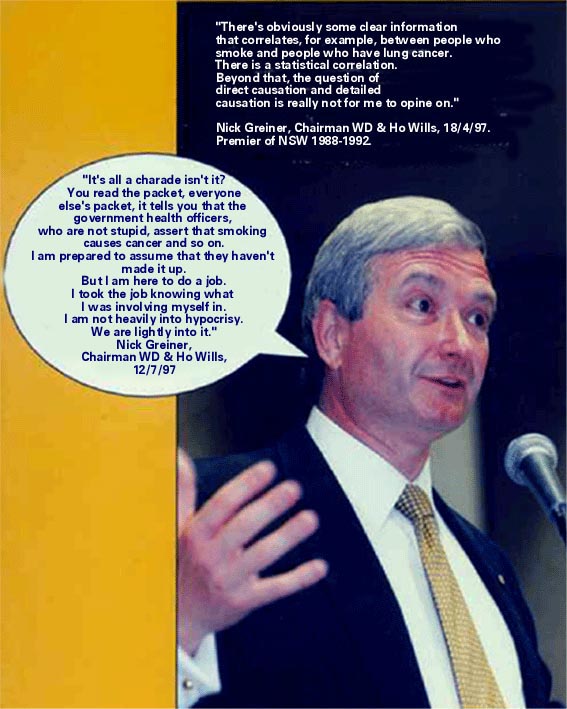
Nick Greiner on smoking and his tobacco job

My University has awarded former NSW premier Nick Greiner an honorary Doctor of Business (honoris causa) during a ceremony held in New York on  8 October, presided over by the University’s Vice-Chancellor and university President, Professor Mark Scott AO. 

“Across business and politics, Nick’s achievements are remarkable,” said Professor Scott. “Throughout his illustrious career, he has served the nation and helped the community through his work in policy and his environmental efforts. He continues to influence the next generation of leaders, the future of business and the important relationship between Australia and the United States.”

The University of Sydney’s website noted that “Mr Greiner’s achievements in business over the last 30 years have been significant. He has served as Chair or Deputy Chair of organisations including Harper & Row (Australasia), Bradken, Citigroup (Australia), Coles Myer Ltd, Rothschild (Australia), Stockland Trust, QBE Insurance and Castle Harlan Australian Mezzanine. In addition, he was Chairman of Infrastructure NSW and the European Australian Business Council.”

Significant in its absence here is that Greiner was also a board member and chair of the tobacco company WD & HO Wills (later amalgamated with Rothmans to become British American Tobacco Australia – BATA).

Greiner’s own website includes his BATA role, so it seems inconceivable that the University was unaware of this and has deliberately air-brushed Greiner’s tobacco history from its decision and communications.

In 2003, I led a group of academics and health and medical students in protesting the Greiner appointment, then chairman of BATA, to chair Sydney University’s graduate school of government. One senior paediatrician was so incensed he threatened to resign if the appointment went ahead.  I persuaded the University Senate to overturn the appointment. They agreed with me and Greiner resigned from the role. I wrote a detailed account of how this occurred as a case study in public health advocacy at the end of this paper in the BMJ’s Journal of Epidemiology and Community Health.

At the time, the then University Chancellor Kim Santow AO wrote to me that Griener’s appointment had nothing to do with his tobacco industry role but was all about his distinguished career in politics and public administration. This was a version of the Jeckyll and Hyde defense: the upstanding citizen by day, who strenuously denies his evening persona has any relevance to his overall reputation.

In 1982, Sydney University was the world’s first University to formally adopt a policy whereby neither the university, nor any staff member or student could accept any form of support, grant or scholarship from a tobacco company. This was subsequently strengthened in amendments. Careers fairs at the University have long excluded tobacco companies from pitching employment to students. Universities around the world have followed suit, including Harvard and the London School of Economics.

When Nicola Roxon, the former Australian Health Minister and Attorney General was awarded an honorary doctorate of laws in 2019, the then Vice Chancellor Michael Spence AC noted that:

“the honour was also a fitting continuation of the University’s role in tobacco control. The University of Sydney has a long history of engagement in tobacco control and was the world’s first university to implement a policy preventing staff and students from accepting grants from tobacco companies. This has been emulated by nearly all Australian universities and many others around the world.

At the University of Sydney, we share Ms Roxon’s genuine desire to build a better, healthier future for the world and we are so proud when our world-class research is used by policymakers to bring about real change”

Greiner’s parting shot at the University in 2003 was to say that “his departure points to broader problems in the university, including mismanagement.”

“It’s the ultimate sort of inmates-in-charge-of-the-asylum situation and I just didn’t think it was worth the hassle” he said.

To my knowledge, Greiner has never expressed a syllable of regret about his role with BATA. This is important. History records many prominent people who have gone out of their way to express remorse and regret about dark periods or events in their past. Civil society has codified five steps for contrition that we expect people to exhibit before society turns the page:

Greiner openly admits he worked at the very peak of a tobacco company, with his eyes wide open. But he has never taken the next four steps. Draw your own conclusions.

It has been decades since any tobacco executive has been awarded a civic honour like an Order of Australia or knighthood. For such a thing to happen today would be like a rabid dog winning London Crufts dog show. The World Health Organisation’s historic Framework Convention on Tobacco Control has been ratified by 181 nations. Its Article 5.3 precludes governments from any engagement with the industry. Two in three of the tobacco industry’s most addicted, “loyal” smokers die from tobacco caused disease. There are light years between that toll and that attributed to any other industry.

Sydney University’s gesture to Greiner might simply be a case of failed corporate memory in a new administration. Perhaps there is no one on the present Senate which would have signed off on the award who is aware of the history. Or perhaps there is and they didn’t care.

But the omission of his tobacco links from the university statement suggests this was done in full awareness. This is very regrettable.

Blog Stats

  • 163,470 hits

Top Posts & Pages

  • Why I’m not quitting Spotify because its owner has hugely invested in weaponry
  • Australia takes off the gloves on illegal tobacco while ‘lower the tax’ fantasists plumb new absurdities
  • About/CV
  • Vaping theology: 6 There’s nicotine in potatoes and tomatoes, so should we restrict or ban them too?
  • My books
  • Regrets … I’ve had a few. Paul Hogan and his Winfield role.
  • Thinking of keeping koi? Advice for beginners in NSW
  • Cheap illegal cigarettes save low income pack-a-day smokers over $9000 a year. So why don’t social justice champions give them full support?
  • Why Australia’s illegal tobacco and vape trade continues to flourish and what should be done about it
  • My first seen, best and worst bands 1964-2022

Blog archive

Comment Policy: No anonymous or pseudonymous posts will be published

Recent Posts

  • Australia takes off the gloves on illegal tobacco while ‘lower the tax’ fantasists plumb new absurdities
  • Egg on some faces: statisticians at 10 paces on the impact of New Zealand’s vape laws on youth smoking
  • Lowering tobacco tax to make illegal tobacco sales “disappear overnight”: at last we have a proposed figure and it’s an absolute doozie
  • Why I’m not quitting Spotify because its owner has hugely invested in weaponry
  • Should we believe Fiona Patten on vapes? Here are just a few problems

Recent Comments

Jon Krueger's avatarJon Krueger on Egg on some faces: statisticia…
Atul Kapur's avatarAtul Kapur on Should we believe Fiona Patten…
Unknown's avatarCould a national tob… on If expensive cigarettes are dr…
tahirturk1's avatartahirturk1 on Why Australia’s illegal tobacc…
malonere's avatarmalonere on Words I’ve seen, but didn’t kn…

Archives

  • December 2025
  • August 2025
  • July 2025
  • June 2025
  • May 2025
  • March 2025
  • January 2025
  • November 2024
  • October 2024
  • September 2024
  • July 2024
  • May 2024
  • April 2024
  • March 2024
  • February 2024
  • January 2024
  • December 2023
  • November 2023
  • October 2023
  • September 2023
  • August 2023
  • July 2023
  • June 2023
  • May 2023
  • March 2023
  • February 2023
  • January 2023
  • December 2022
  • November 2022
  • October 2022
  • August 2022
  • June 2022
  • April 2022
  • March 2022
  • February 2022
  • January 2022
  • December 2021
  • October 2021
  • September 2021
  • August 2021
  • June 2021
  • May 2021
  • April 2021
  • March 2021
  • February 2021
  • January 2021
  • December 2020
  • November 2020
  • October 2020
  • September 2020
  • August 2020
  • July 2020
  • June 2020
  • May 2020
  • April 2020
  • March 2020
  • February 2020
  • January 2020
  • December 2019
  • November 2019
  • October 2019
  • September 2019
  • August 2019
  • July 2019
  • June 2019
  • May 2019
  • April 2019
  • March 2019
  • February 2019
  • January 2019
  • December 2018
  • November 2018
  • October 2018
  • September 2018
  • August 2018

Categories

  • Blog

Meta

  • Create account
  • Log in
  • Entries feed
  • Comments feed
  • WordPress.com

Blog at WordPress.com.

  • Subscribe Subscribed
    • Simon Chapman AO
    • Join 198 other subscribers
    • Already have a WordPress.com account? Log in now.
    • Simon Chapman AO
    • Subscribe Subscribed
    • Sign up
    • Log in
    • Report this content
    • View site in Reader
    • Manage subscriptions
    • Collapse this bar
 

Loading Comments...