• Home
  • About/CV
  • Blog
  • Vaping Research Alerts
  • Blog archive list
  • My books
  • Memoirs
  • Music, bands, films
  • Contact

Simon Chapman AO

~ Public health, memoirs, music

Simon Chapman AO

Monthly Archives: March 2023

Vaping theology 15: The government’s prescription vape access scheme has failed. So let’s “regulate” and reward illegal sellers for what they’ve been doing!

27 Monday Mar 2023

Posted by Simon Chapman AO in Blog

≈ 4 Comments

Imagine the consequences if a huge pharmacy chain, in intense competition with its rivals for the multi-billion dollar prescription drug market was to say “Ahh bugger it, let’s just ignore the need for a prescription and supply prescription-only medicines to anyone asking for anything.” Anyone wanting antibiotics, codeine, statins, steroids, anti-hypertensive drugs … you name it … could walk in, hand over their money and walk out with whatever drugs they wanted.

The reaction would be swift and iron-fisted, as shown here and here in cases where pharmacists were investigated and disciplined over missing scheduled drugs.

Yet this is in effect what has been happening in Australia since Oct 1, 2021, the date when the only local legal access to nicotine vaping products (NVPs) became via a prescription legally needing to be dispensed at pharmacies.  But as is by now blindingly obvious, only a tiny proportion of people who vape – estimates put this at below 4% — are today getting their vapes in this way. The rest are still buying them openly online, from shops brazenly signed with “Vapes sold here” or from many hundreds of market stalls. Corner shops, petrol stations and an army of on-line sellers are openly defying the law.

So how did we get to this point?

On the tenth anniversary of the eve of the introduction of the implementation of plain packs (Nov 30 2022) health and aged care minister Mark Butler held a press conference in parliament house to announce plans to introduce a raft of reforms to Australia’s already stellar tobacco control policies.

Symbolically, the room purposefully chosen was that used by former health minister in the Rudd government, Nicola Roxon, when launching Australia’s pioneering plain packs implementation, since adopted by 28 countries.

Butler was junior health minister to Roxon for two and a half  years. She attended the Nov 30 press conference. The centrepiece of Butler’s announcement focussed on the exponential rise of vaping in children and teenagers. Butler gave credit to his predecessor Greg Hunt in the Morrison government for trying to take bold action on vapes. Hunt announced  that the government was considering a weapons-grade pincer movement that would simultaneously see (1) nicotine vapes continue being only legally available through pharmacies to those issued with a prescription (2) a ban on personal importation of all nicotine vaping products including liquids.

Within days of Hunt’s announcement, a letter signed by 28 LNP backbenchers opposing Hunt’s plan saw it scuppered in the party room. The initiative was led by the coal lobby’s favourite senator Matt Canavan and signatories included luminaries like Hollie Hughes (“[British America Tobacco] They’re a cigarette company. They don’t define themselves as Big Tobacco. They’re a cigarette company and a tobacco company.”), Tim Wilson. Eric Abetz, George Christensen, Alex Antic, Andrew Laming, Bridget McKenzie, James Paterson, Gerrard Rennick, Amanda Stoker, Dave Sharma and Barnaby Joyce.

Many of the 28 are no longer in parliament. And those who are, are political eunuchs unable to block any bill or gut any policy that has support of the Labor government, the Greens and progressive independents.  These 28 are the people who allowed the floodgates to open on vaping in Australia. If your child vaping today, these people collectively bear huge responsibility for making it so much easier for them.

Enter Big Tobacco

Every transnational tobacco company is now heavily invested in vaping in addition to cigarettes. British American Tobacco (Australia) is backing an initiative called Responsible  Vaping Australia, although you will struggle hard to find its name on the RVA website.

The National Party is the only major political party in the parliament which still accepts tobacco industry funding ($55,000 in 2022 from Philip Morris Limited). Many of the 28 signatories who garroted Hunt’s plan were Nationals, but today they are politically neutered and can only fly their tattered flag of gestured support to Philip Morris.

Under threat of resignation, Greg Hunt was allowed to implement the prescription access side of his plan. But without closing the gate on the ability of people to easily access NVPs almost anywhere, the plan was bound to fail. Why bother getting a prescription if you can walk into a convenience store, a petrol station or make a few clicks on Facebook marketplace after searching for “fruit” and get whatever cheap, sickly sweet flavoured, throw-away vapes you want? The Canavan-led backbench revolt was large enough to sink one entire side of Hunt’s plan while leaving the prescription side’s viability with the gaping hole of removing the ban on imports.

Convenience stores: not the problem, the solution!

Today, the vested interests which loathe and despise the prescription scheme are now in full blown panic mode that they are about to lose their lucrative brazen illegal trade.  They have decided their best bet is to appropriate the caring, concerned, faux outraged narrative of how terrible it is that kids can so easily buy vapes from the heinous “black market”; vapes that are dangerous to kids because they might come from seedy bathtub and kitchen sink chemical workshops in China! Not like the nice clean ones from Big Tobacco.

They have tried to characterise the evil black market as those retailers which have been selling illegal vapes, including to kids. They contrast those retailers with legitimate, law-abiding retailers who would no sooner sell vapes to children as sell their grandmothers for pet food. They are now standing in their sanctimonious ill-fitting white knight hats in the front line of reform advocacy which would see any retailer who puts their hand up to be a “licensed vape retailer” able to sell.

Holding loud hailers, they are chorusing “the prescription model has been a huge failure! It’s now time to properly regulate vapes as a legitimate consumer good and let it be sold  … well, everywhere by responsible retailers just like us.”

The sheer, galactic gall in all of this is, of course, that many of these white hats have been openly breaking the law for years. They now want everyone to have massive amnesia about this and see convenience stores as not the problem, but the solution. They have openly broken the law at industrial levels but are now wanting governments to believe that there could be no better candidates for responsible, law-abiding vape retailing than them. We would just never sell to children, they chorus.

Big Tobacco wrote the playbook for all of this. For years it ran massive PR campaigns expressing how terrible it was that some bad apple retailers sold cigarettes to kids. But did it ever hand back all that unwanted profit it earned from underage smoking? Ermm … no. (see case study here)

The retail nirvanas of those wanting open availability of vapes are nations which have declared vapes to be ordinary “consumer goods”  The UK usually stands on the winner’s podium when vaping advocates want to point to the best model for vaping policy. But today its parliament is voting on a bill to ban all flavoured disposable vapes as vaping by kids goes up and up. There’s a similar story in New Zealand.

Legal threat

In February, lawyers acting for the Australian Association of Convenience Stores tried to intimidate me with the threat of legal action because I had the temerity to point out all this in a Melbourne breakfast radio interview. I stated what anyone who’d not been asleep in a cave for five years knows, that a huge number convenience stores and tobacconists openly sell illegal vapes, including those containing nicotine falsely labelled as being nicotine free.

The next day the head of the AACS, Theo Foukarre, was interviewed by James Valentine on ABC Sydney radio. At one point this exchange occurred:

Valentine: Do you or your association get support from tobacco companies?

Foukkare: So, we represent retailers who sell tobacco …. We have over 100 manufacturers, suppliers of which of three [presumably tobacco manufacturers] are members. They just pay a membership fee and that’s it!

Valentine: You don’t receive any extra funding from tobacco suppliers to put this line that you’re putting?

Foukkare: No. We are representing legitimate retailers like 711, Ampol, Caltex, EG, you name it. All of the reputable retailers. We do not represent the interests of the tobacco industry. We do not represent all of the dodgy retailers that are selling these products illegally. [My italics for emphasis]

After the interview I tweeted “Head of Australian Association of Convenience Stores just told @abcsydney James Valentine that they are not supported by tobacco industry. NOT true. https://tobaccotactics.org/wiki/australian-association-of-convenience-stores/

Tobacco Tactics is a highly regarded research project located at the University of Bath, UK. Since 2011, it has provided fully referenced profiles of individuals and bodies around the world which work with the tobacco industry to further its interests. Its page on the AACS was published in 2022 and last updated on Nov 18, 2022.

The Tobacco Tactics link contains details of the history of tobacco industry support of the AACS beyond their payment of membership fees, so was entirely relevant to the italicised sections of the interview above. So it is indeed not true that the only funding support AACS receives from the tobacco industry is their annual membership fees. Foukkare explicitly denied this (“No.”) in the interview when asked and then had his lawyers demand that I delete the tweet and apologise. I of course refused.

Nationals and NSW Greens adopt tobacco industry friendly policy

Being the only political party still taking tobacco industry donations, the dinosaurs in the National Party have predictably adopted a policy that would see “responsible” retailers allowed to sell vapes. Amazingly, the NSW Greens have also adopted a similar policy, thereby lining up with the company shown on the right of the table below.
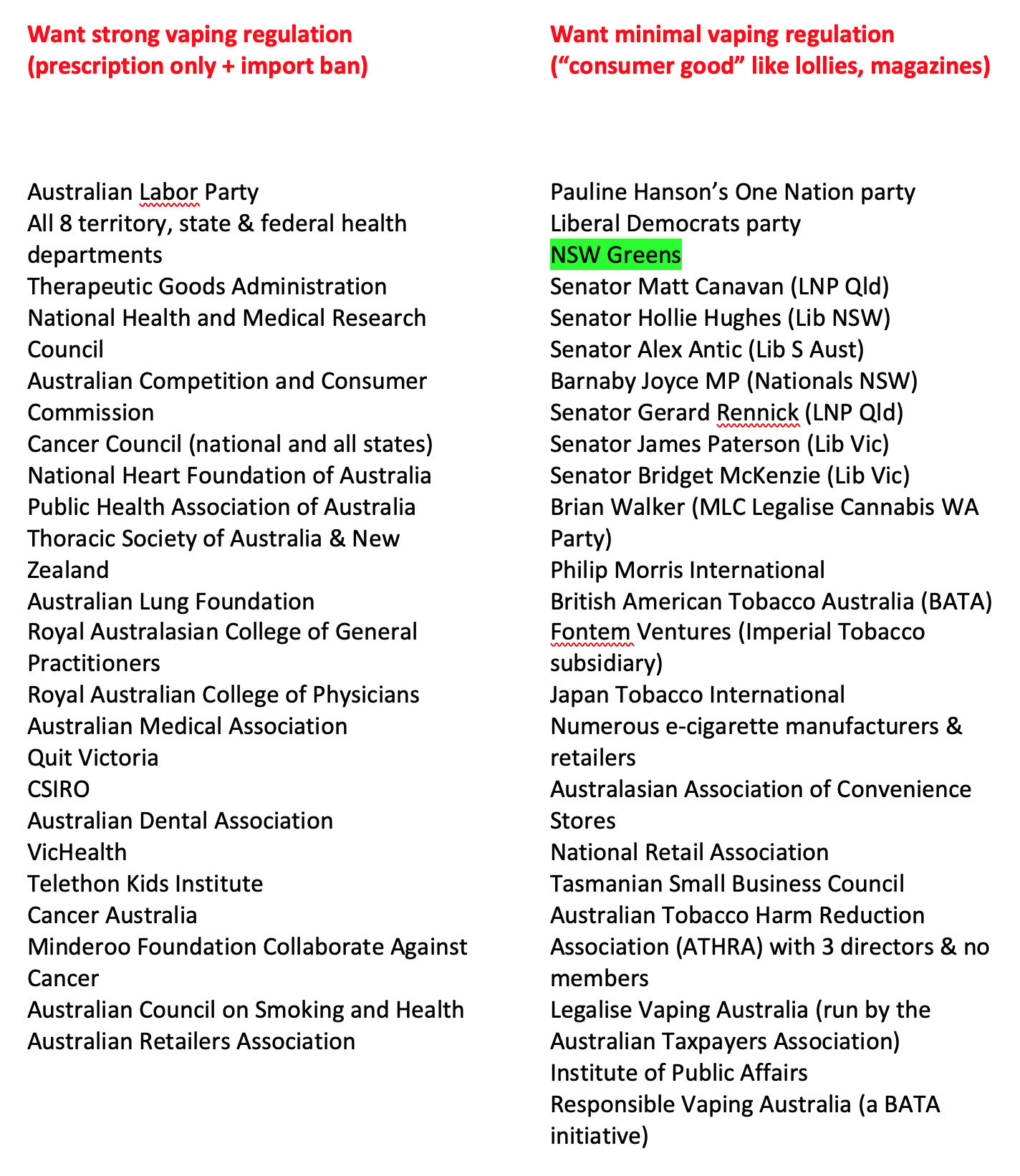
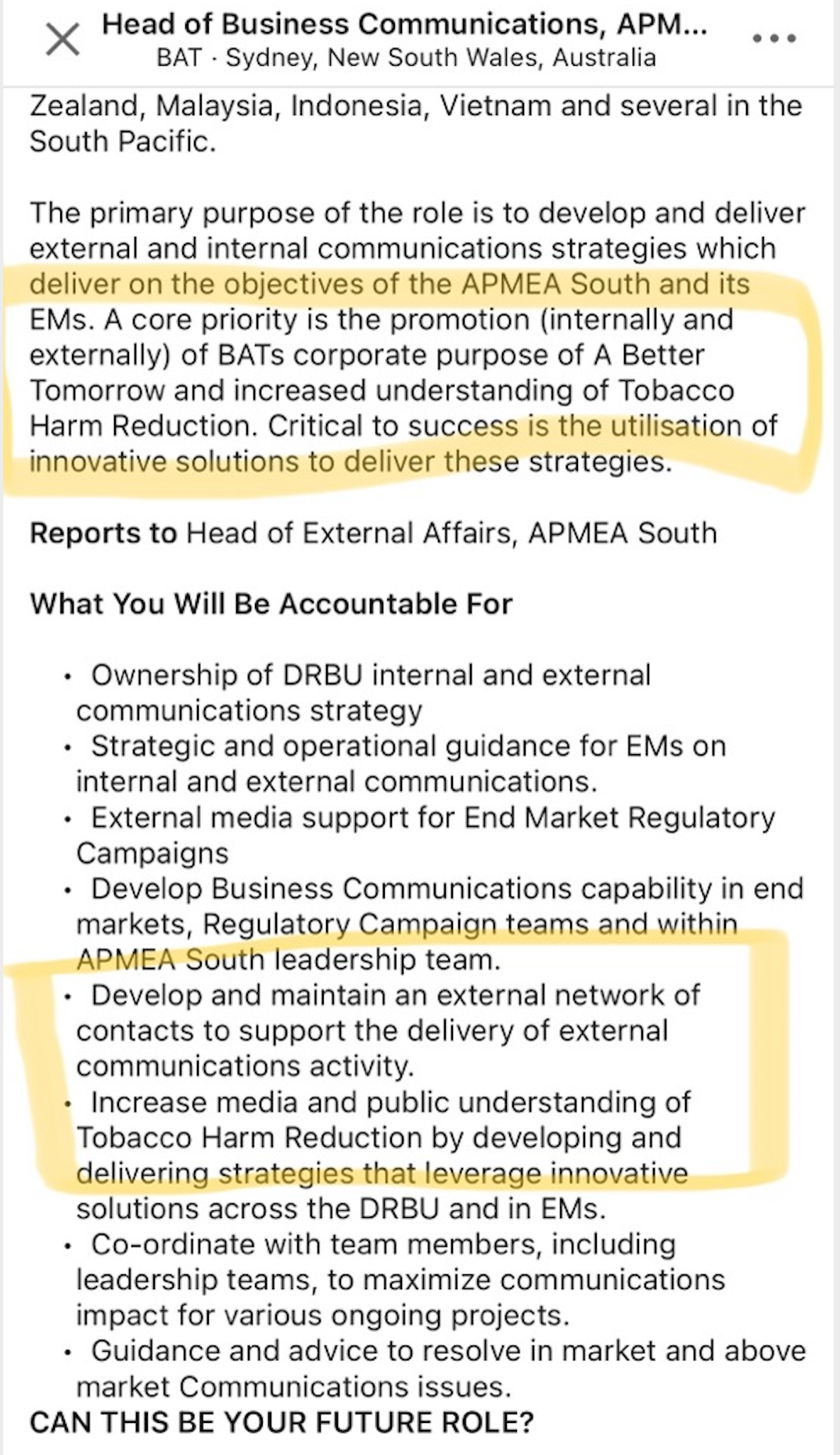
BATA is currently looking for a head of business communications who will have the duties  shown below. Understandably, tobacco companies have long struggled to attract top quality staff. The NSW Greens would do well to think about how aligned their new policy is with BAT’s objectives.
Mark Butler requested the Therapeutic Goods Administration to consult with the public over options for reform of the prescription access scheme. Their report on this consultation is now with the government. Butler said publicly in late February

“At the end of the day the Commonwealth will have to act, including potentially on the borders. My predecessor Greg Hunt tried to put an important control regulation in place on this but a range of his colleagues in his party room overturned that regulation within a couple of weeks. So, we have to consider controls at the borders, we have to consider health regulations. I know my state and territory colleagues realise there’s going to have to be some policing resources put into this as well because it is just rampant through the community.”

What needs to happen

First, the federal government can quickly and easily declare all nicotine vaping products prohibited imports. This could be done without legislation in the way that this list of prohibited imports is regularly amended. Significantly, tobacco is included on that list unless imported by those licensed to do so such as tobacco companies.

The government should also add non-nicotine vapes to the list on the grounds that they are being widely used a Trojan horse for nicotine vapes to be retailed by nudge-nudge-wink-wink  “I had no idea” retailers. So-called non-nicotine vapes are widely sold with deceptive labelling that they are nicotine free. But many do contain nicotine. The costs involved in widespread testing for nicotine is one factor inhibiting prosecutions by state health departments. This ruse could therefore be easily avoided by declaring all vapes prohibited.

Second, fines for selling illegal vapes are derisory. This is a emphatically state responsibility, which can similarly be rapidly amended. For example In NSW, the maximum penalty for illegally selling NVPs is 6 months in prison and/or  a maximum of $1600. In the 11 quarters from Jan 1, 2020 to Sept 30, 2022 NSW Health seized 220,322 vapes after inspecting retail outlets and completed just 25 successful prosecutions. Fifty two percent of all illegal vapes seized were removed in the three quarters since Jan 1, 2022.

Any retailer offering illegal vapes for sale today has an almost homeopathically small chance of being prosecuted, and if they were, they would wear even the maximum fine knowing it was just an occasional minor irritating cost in making lots of money from openly breaking the law.

But if fines were significantly ramped up to levels that would give major pause to even the largest tobacconist and convenience franchises selling vapes, many smaller operators would hoist the white flag. 

The TGA has fines that are definitely in that ballpark with fines as high as $106,560 having been issued for alleged illegal advertising of vapes. In November 2022, the TGA fined a NSW medical practitioner $2664 for alleged unlawful advertising of a nicotine vaping product on social media. Now, I wonder who that might have been!

Taiwan last week banned vapes and set fines for selling US$330,000 – US$1.65 million. Such fines would see a stampede out of the market by players across all levels.

Today anyone can text any one of a huge number  of on-line suppliers, pay and have vapes delivered or given a pick-up address. Suppliers phone numbers could be traced, the delivery couriers questioned and  bank accounts used to trace those involved. If kids find it childs’ play to buy vapes, Health Department investigators should have little trouble either. Reserve armies of parents and school principals who know who are supplying kids will fast track this information.

It cannot be emphasised enough that both the commonwealth and state governments need to work in concert on all this. If any state is glacial in significantly upping fines and failing to blitz retailers (and publicise these prosecutions) there will be many players who will continue to sell illegally.

Labor governments have nearly always been in the forefront of Australia’s world-renowned tobacco control policies. The Whitlam government introduced the bill to ban direct tobacco advertising in broadcast media that was implemented in 1976. The Rudd and Gillard governments were global pioneers in plain packaging legislation.

Many said these things and other policies like smokefree workplaces, bars, restaurants and airlines were la la land ideas. But they have been normal now for decades in many countries.

If the Albanese government is the first to ensure that a workable prescription access scheme for vapes is allowed to work by declaring vapes a prohibited import, it will again lead the way globally on a path that Greg Hunt conceived but was thwarted. Many countries which are  being flooded with vapes and seeing a new generation of nicotine dependent kids growing by the month, are very interested in what may happen in the next few months.

Other blogs in this series

Vaping theology: 1 The Cancer Council Australia takes huge donations from
cigarette retailers. WordPress  30 Jul, 2020

Vaping theology: 2 Tobacco control advocates help Big Tobacco. WordPress 12 Aug, 2020

Vaping theology: 3 Australia’s prescribed vaping model “privileges” Big Tobacco WordPress Feb 15, 2020

Vaping theology: 4 Many in tobacco control do not support open access to vapes because they are just protecting their jobs. WordPress 27 Feb 2021

Vaping theology: 5 I take money from China and Bloomberg to conduct bogus studies. WordPress 6 Mar, 2021

Vaping theology: 6 There’s nicotine in potatoes and tomatoes so should we restrict or ban them too? WordPress 9 Mar, 2021

Vaping theology: 7 Vaping prohibitionists have been punished, hurt, suffered and damaged by Big Tobacco WordPress 2 Jun, 2021

Vaping theology: 8 I hide behind troll account. WordPress 29 Jun, 2021

Vaping theology: 9 “Won’t somebody please think of the children”. WordPress 6 Sep, 2021

Vaping theology: 10: Almost all young people who vape regularly are already smokers before they tried vaping. WordPress 10 Sep, 2021

Vaping theology: 11 The sky is about to fall in as nicotine vaping starts to require a prescription in Australia. WordPress 28 Sep, 2021

Vaping theology: 12 Nicotine is not very addictive WordPress 3 Jan 2022

Vaping theology 13: Kids who try vaping and then start smoking,would have started smoking regardless. WordPress 20 Jan, 2023

Vaping theology 14: Policies that strictly regulate vaping will drive huge
numbers of vapers back to smoking, causing many deaths. WordPress 13 Feb, 2023

Vaping theology 15: The government’s prescription vape access scheme has failed, so let’s regulate and reward illegal sellers for what they’ve been doing. WordPress 27 Mar 2023

Vaping theology 16: “Humans are not rats, so everybody calm down about nicotine being harmful to teenage brains”. WordPress 13 Jul, 2023

Vaping theology 17: “Vaping advocates need to be civil, polite and respectful” … oh wait. WordPress 3 Oct, 2023

Vaping theology 18: Vaping is a fatally disruptive “Kodak moment” for smoking. WordPress Oct 30, 2023

Vaping theology 19: Vaping explosions are rare and those who mention them are hypocrites. WordPress 17 Nov, 2023

Vaping theology 20 : Today’s smokers are hard core nicotine dependent who’ve tried everything and failed – so they need vapes. WordPress 14 Dec, 2023

Vaping theology 21: Australia’s prescription vapes policy failed and saw rises in underage vaping and smoking. WordPress 10 Jan, 2024

Vaping theology 22: “Prohibition has never worked at any point for any other illicit substance”. WordPress 17 Mar 2024

Vaping theology 23: “84% of the Australian public are opposed to the way the government will regulate vapes” WordPress 2 Apr, 2024

Vaping Theology 24: “Tobacco control advocates are responsible for vape retail store fire bombings and murders. WordPress 27 May, 2024
30 years of teaching public health advocacy planning

23 Thursday Mar 2023

Posted by Simon Chapman AO in Blog

≈ Leave a comment

One of the early milestones in my public health career was -with others – to succeed in having the Rothmans tobacco company banned from continuing to use the comic actor Paul Hogan (later of Crocodile Dundee fame) in Winfield advertising. It had been the biggest and most successful tobacco advertising campaign in Australian commercial history and we ended it overnight.

Because we had no money, the campaign we ran was conducted in the news media. The newsworthiness of what we were attempting was a re-telling of the David and Goliath moral tale. I quickly became a media and political go-to person for tobacco control.

I soon realized that advocacy for policy change and changing the way that health issues were perceived both publicly and politically was accorded very little analysis in research nor training in public health education. I set out to try and upgrade the academic respectability of both.

So in 1991 I established and started teaching what was only the world’s second university course unit in public health advocacy (I believe the first was started at Berkeley in California by Larry Wallack and Lori Dorfman). The unit was offered at the University of Sydney’s School of Public Health in the Masters of Public Health degree. It became immensely popular, with non-degree students flying in over the years from Iceland, UK, Spain, Netherland, New Zealand, USA, Canada, China, Singapore, Indonesia and all round Australia. Since my retirement in 2014, it has been taught by Becky Freeman who has specialised in advocacy and social media.

I published two text books for the course in 1994 and 2006 which are still returning sales royalties. In the 30 years between 1991-2021 I ran advocacy training courses and sessions in 14 countries on all continents but South America.

My course was primarily focused on media advocacy and gave particular emphasis to understanding news values, framing and reframing, news routines and cultures and the importance of strategic planning of media advocacy, rather than just instinctively running at the mouth when an opportunity presented itself. Researchers typically carefully plan and rehearse conference presentations they might give to 100 people in a room. But few plan interview strategy when given an opportunity to speak to sometimes millions on national television, including politicians able to make a needed policy change.

Problem-based learning

Over the years I’ve had many requests for teaching notes on public health advocacy.  Below is an outline of the approach  I took to both teaching and assessment.  I hope you will find it useful in your own teaching and staff development.

After a day of lectures and inspirational talks from public health advocates and journalists, our in-class discussions for a full day of the course were problem-based. I wrote trigger scenarios based on actual or hypothetical “this is happening now” problems. Here are five examples

1. ALCOHOL ADVERTISING AND CONSUMPTION

A glossy booklet is distributed by  a transnational liquor company has to every doctor, politician and mass media outlet in your country. The main message is that alcohol advertising does not influence aggregate (total) demand for alcohol and that restrictions on advertising beyond those which currently exist are unjust and unwarranted. The booklet also details the company’s history of commitment to funding rehabilitation and responsible drinking education programs.

2. FOOD LABELLING DEREGULATION

The new Unit established within the government to examine ways of reducing the effect of regulation on business activity publishes a report that shows that 95% of the population claim never or seldom to read grocery content labels; and that 99% of those sampled could not name any of the food additives corresponding to the numbered system on a randomly chosen set of common grocery items. The report recommends that content and additive labelling be made voluntary, arguing that the present system is an unnecessary and costly burden to industry which serves little purpose.

3. TOBACCO SPONSORSHIP

The Health Minister issues exemptions allowing tobacco sponsorship for an international  women’s golf tournament. The program will feature an internationally renowned golfer, who having had breast cancer, is a prominent advocate for breast screening. She will donate 10% of her winnings to the national breast cancer campaign.

4. ENVIRONMENTAL HEALTH

The local government of a suburb three kilometres from the central business district of your city announces that a deal is to be struck with the state government to use a large, long-disused ugly factory site as a car park linked to the city by a light rail system. The scheme will take 5000 cars out of the city and provide lucrative rental revenue to the local government. The site for the car park is in the middle of a high density, low income residential area. There are no parks or open spaces in a two kilometre radius of the site. A local resident group (which has an active core of about 10 people with another 40 or so who sometimes help out with local projects) wants the site to be turned into a recreation park for local residents.

5. DOMESTIC VIOLENCE

A right wing popularist politician is elected to parliament on a platform that includes reviewing the Family Court to investigate why women are awarded child custody far more than men. It will also take evidence from men accused of domestic violence to their partners who believe they have been “set up” and not given a fair hearing in the Family Court. The politician names three leaders of a “men’s action network” who he says should be on the review.

Students would select one such scenario (or write their own) and then work in small groups across the day to answer the following questions, which were then presented and discussed with the full class.

  1. WHAT DOES THIS SCENARIO MEAN TO PUBLIC HEALTH? What are the possible adverse consequences for public health that arise from this scenario? (ie: why is it of concern?) THEREFORE, WHAT ARE YOUR PUBLIC HEALTH OBJECTIVES? Define your public health objectives: what do you want to achieve by any advocacy initiatives you might take in response?
  • “FRAME” THIS OBJECTIVE AS A SIMPLE COMMUNICATION OBJECTIVE.
  • WHAT ARE THE PRINCIPAL SUB-TEXTS OF YOUR OPPOSITION’S POSITION HERE? What values and strengths do these bring to your opposition’s position (and by implication, what do these suggest about anyone like you who opposes this position?) Think about how this might need to be addressed in your planned strategy.
  • DO YOU BELIEVE THAT A MEDIA ADVOCACY STRATEGY WILL BE CRITICAL TO ACHIEVING YOUR PUBLIC HEALTH OBJECTIVE? What changes in public or political awareness and attitudes do you want to achieve via a media advocacy strategy?
  • ARE THERE OTHER (NON MEDIA) ADVOCACY STRATEGIES THAT WILL BE IMPORTANT IN MEETING YOUR PUBLIC HEALTH GOALS? List these
  • ACCESS & FRAMING STRATEGIES: What creative initiatives are likely to both give you maximum coverage (framing for access) and frame the issue in ways that will advance your goals (framing for content)? Are there any analogies that might be used which will assist in your framing efforts? Brainstorm. Don’t stop at one or two – you can always discard the less brilliant ideas later! Are there IMAGES, METAPHORS, AND “PAINTING A PICTURE” STRATEGIES you can utilise here to good effect?’
  • CREATIVE EPIDEMIOLOGY/STRATEGIC RESEARCH: Are there “killer facts”, perspectives and comparisons that you would like to use in your response? Where might you obtain these if you haven’t got them?
  • MEDIA BITES: A reporter phones. He/she wants a comment from you about this issue. Frame a “media bite” (about 30 words or 15 seconds) that will advance your goals. If you have time, come up with several.

Assessment

In every year I taught the MPH course, I set the same two choices of assessment questions (below)

  1. Collect all press cuttings (try the Factiva database) you can gather or TV or radio tapes on a current public health issue. Analyse the media coverage of this issue for the dominant sub‑textual themes, rhetorical devices and ideologies that make this issue newsworthy. Discuss possible implications of the way this issue has been “framed” for public health policy and practice.

or

2. Select a current public health problem which is being either neglected or adversely framed by the media. Analyse the likely reasons why this subject is attracting the press (or lack of press) it currently suffers. Outline (and argue for) an advocacy strategy designed to re‑frame this issue in such a way that it will attract media and/or political attention more conducive to advancing it in a positive direction vis a vis public health.

Suggested length up to 2000 words (more if you want, but much less than 1500 will probably mean you have prepared a reasonably superficial treatment).  NB: Do not spend more than a couple of paragraphs describing the epidemiology or impact of the problem you select. This essay is NOT about how well you can describe a health problem, but about how well you can understand how it is or is not being depicted in the media as a health issue, and what you might do to change or further this.

I was privileged to read many highly sophisticated papers and over the years to see many course graduates go on to become potent advocates across a wide range of public health issues.

This paper, which highlights 10 cardinal lessons for public health advocates and young researchers, may also be useful.

See also:

Chapman S. Advocacy in public health: roles and challenges. Int J Epidemiol 2001;30:6:1226–32

Chapman S. Public health advocacy: a primer. J Epidemiol Comm Health 2004;58:361–5

China bans vape flavours, requires its exporters to “comply with the regulations of the destination country”

20 Monday Mar 2023

Posted by Simon Chapman AO in Blog

≈ 2 Comments

In 1992, I spoke at what was then the largest conference ever held in Africa on tobacco control. Delegates from 16 nations met in  Harare, Zimbabwe to discuss policies that could reduce tobacco use across the continent.

Zimbabwe’s health minister Dr Timothy Stamps’ talk was met with incredulity when he  commented that Zimbabwe’s huge export earnings from tobacco leaf was not inconsistent with the country’s own efforts to reduce smoking among its own people. Local lung cancer was bad, but OK elsewhere seemed to be the message.

I was reminded of this when reading official Chinese government communiques on its current internal efforts to reduce the appeal of vaping for Chinese citizens and its policies about controlling exports from Chinese vaping manufacturers to nations which have banned or strictly controlled vapes. Unlike Zimbabwe in the early ‘90s, China’s internal and export policies are consistent.

First, some context.

The major source of the tsunami of illegal nicotine vapes flooding Australia is China. The flood is dominated by cheap disposable vapes, hugely attractive to children. They are priced to make them highly accessible to anyone on a low income, including kids. With illegal importers able to buy single vapes providing up to 7000 puffs  in bulk amounts for as low as $1, and on-sell them for $15-30, massive profits can be made. They are mostly brought in by importers willing to buy in large volumes for wholesaling to retailers. But retailers, groups of vapers or individuals are also bringing them in.

Unless an order is placed with a doctor’s prescription, importation of nicotine vapes has been  illegal since October 1, 2021. Bulk imports, even if ordered with a prescription, are clearly illegal. Entering “importing vapes China” shows many ways of doing it.

Those openly importing and selling these illegal vapes reason that the probability of being caught whether via Border Security intercepts or when retailing them online or in any sort of retail outlet is vanishingly small. Many shops advertise on their front windows that they sell vapes and many openly display them on charts showing brands, flavours and puff volumes, with the actual vapes generally stored out of sight.

Data show that in the 11 quarters from Jan 1, 2020 to Sept 30, 2022 NSW Health seized 220,322 vapes after inspecting retail outlets and completed just 25 successful prosecutions. Fifty two percent of all illegal vapes seized were removed in the three quarters since Jan 1, 2022.

Health minister Mark Butler foreshadowed at a Parliament House press conference on Nov 30, 2022 that active consideration is being given to restoring and strengthening his predecessor Greg Hunt’s addition of vapes to the prohibited import list. States will need to lift fines for selling from the derisory maximum of $1600 (in NSW for example) to seriously deterrent amounts in the ballpark of those being handed out by the Therapeutic Goods Administration to those found advertising illegal vapes.

A letter signed by 28 LNP backbenchers opposing Hunt’s plan  scuppered it in the party room. The initiative was led by the coal lobby’s favourite senator Matt Canavan and signatories included luminaries like Hollie Hughes (“[British America Tobacco] They’re a cigarette company. They don’t define themselves as Big Tobacco. They’re a cigarette company and a tobacco company.”), Tim Wilson. Eric Abetz, George Christensen, Alex Antic, Andrew Laming, Bridget McKenzie, James Paterson, Gerrard Rennick, Amanda Stoker, Dave Sharma and Barnaby Joyce.

Many of the 28 are no longer in parliament. And those who are, are political eunuchs unable to block any bill or gut any policy that has support of the Labor government, the Greens and progressive independents, so hopes are high that Labor will continue its historic leadership in tobacco control.

Chinese government policy

In 2021 and 2022 the Chinese government began publishing  details about its emerging policies on vapes. From May 1 ,2022 China’s Tobacco Monopoly Administration prohibited the sale of “flavored e-cigarettes, other than tobacco flavors, and e-cigarettes to which users can add their own atomized substances.”

When it comes to exporting vapes from China, National Law Review summarises it this way:

“China’s Management  Rules for e-cigarettes require that e-cigarette solely for export must comply with the regulations of the destination country; when there is no relevant regulations and standards in the destination country, the product must comply with China’s regulations and standards”.

These local standards are set out here. Here is a site where you can see the names of all vape manufacturing companies operating in China with a government license and therefore subject to the regulations described. Warning 31 pages of them!

So how seriously will China actively police its rules?

I’ve been in China many times in the past 15 years working with colleagues in government and major universities like Fudan and Zhejiang. My scepticism that there might be gaps between what China says it’s doing evaporated fast when seeing how smoking bans on Chinese taxis, buses and trains were very strictly observed. I used the Beijing underground railway many times and saw teeming  millions pf people use it across weeks, but never once saw anyone smoking. This article describes China’s record in tobacco control.

Australian government officials in the health, trade and foreign affairs portfolios should clearly communicate the current illegal status of nicotine vapes in Australia to their Chinese counterparts, noting the positive developments in Chinese law. 

Lijiang, Yunnan province

Blog Stats

  • 163,470 hits

Top Posts & Pages

  • Why I’m not quitting Spotify because its owner has hugely invested in weaponry
  • Australia takes off the gloves on illegal tobacco while ‘lower the tax’ fantasists plumb new absurdities
  • About/CV
  • Vaping theology: 6 There’s nicotine in potatoes and tomatoes, so should we restrict or ban them too?
  • My books
  • Regrets … I’ve had a few. Paul Hogan and his Winfield role.
  • Thinking of keeping koi? Advice for beginners in NSW
  • Cheap illegal cigarettes save low income pack-a-day smokers over $9000 a year. So why don’t social justice champions give them full support?
  • Why Australia’s illegal tobacco and vape trade continues to flourish and what should be done about it
  • My first seen, best and worst bands 1964-2022

Blog archive

Comment Policy: No anonymous or pseudonymous posts will be published

Recent Posts

  • Australia takes off the gloves on illegal tobacco while ‘lower the tax’ fantasists plumb new absurdities
  • Egg on some faces: statisticians at 10 paces on the impact of New Zealand’s vape laws on youth smoking
  • Lowering tobacco tax to make illegal tobacco sales “disappear overnight”: at last we have a proposed figure and it’s an absolute doozie
  • Why I’m not quitting Spotify because its owner has hugely invested in weaponry
  • Should we believe Fiona Patten on vapes? Here are just a few problems

Recent Comments

Jon Krueger's avatarJon Krueger on Egg on some faces: statisticia…
Atul Kapur's avatarAtul Kapur on Should we believe Fiona Patten…
Unknown's avatarCould a national tob… on If expensive cigarettes are dr…
tahirturk1's avatartahirturk1 on Why Australia’s illegal tobacc…
malonere's avatarmalonere on Words I’ve seen, but didn’t kn…

Archives

  • December 2025
  • August 2025
  • July 2025
  • June 2025
  • May 2025
  • March 2025
  • January 2025
  • November 2024
  • October 2024
  • September 2024
  • July 2024
  • May 2024
  • April 2024
  • March 2024
  • February 2024
  • January 2024
  • December 2023
  • November 2023
  • October 2023
  • September 2023
  • August 2023
  • July 2023
  • June 2023
  • May 2023
  • March 2023
  • February 2023
  • January 2023
  • December 2022
  • November 2022
  • October 2022
  • August 2022
  • June 2022
  • April 2022
  • March 2022
  • February 2022
  • January 2022
  • December 2021
  • October 2021
  • September 2021
  • August 2021
  • June 2021
  • May 2021
  • April 2021
  • March 2021
  • February 2021
  • January 2021
  • December 2020
  • November 2020
  • October 2020
  • September 2020
  • August 2020
  • July 2020
  • June 2020
  • May 2020
  • April 2020
  • March 2020
  • February 2020
  • January 2020
  • December 2019
  • November 2019
  • October 2019
  • September 2019
  • August 2019
  • July 2019
  • June 2019
  • May 2019
  • April 2019
  • March 2019
  • February 2019
  • January 2019
  • December 2018
  • November 2018
  • October 2018
  • September 2018
  • August 2018

Categories

  • Blog

Meta

  • Create account
  • Log in
  • Entries feed
  • Comments feed
  • WordPress.com

Blog at WordPress.com.

  • Subscribe Subscribed
    • Simon Chapman AO
    • Join 198 other subscribers
    • Already have a WordPress.com account? Log in now.
    • Simon Chapman AO
    • Subscribe Subscribed
    • Sign up
    • Log in
    • Report this content
    • View site in Reader
    • Manage subscriptions
    • Collapse this bar
 

Loading Comments...