
Updated Jun 4, 2024; 24 Sep 2024; 7 Dec 2024; 11 May 2025;19 Nov 2025, 28 Feb 2026; 13 March 2026
I’ve recently returned from a three-day meeting in Europe where the entire focus was on vaping and other novel ways of increasing nicotine addiction. There was no-one in the large room with participants from some 40 nations who did not want to know all about Australia’s move to outlaw all vape sales other than those transacted via a doctor’s prescription.
It reminded me of the fervid interest in plain tobacco packaging which Australia pioneered in 2012. Twenty-eight nations have now fully implemented or legislated for plain packaging with 16 more considering action.
In the Abbott-Turnbull-Morrison years, Australian vaping advocates were on speed dial with go-to right wing political supporters to tap for favours. After the 2022 federal election conservative bloodbath, many of those supporters are now political feather dusters (Abetz, Wilson, Falinski, Sharma, Laming, Stoker, Zimmerman, McMahon) or political eunuchs like Matt Canavan and the unforgettable Hollie Hughes.

Above: Liberal Senator Hollie Hughes gets a squeeze from Legalise Vaping Australia’s Brian Marlow.
Australia’s vaping advocates are politically friendless, yet like the spectacle of the Black Knight in Monty Python’s Search for the Holy Grail, despite mortal wounds we see them gamely want to fight on against the heinous Labor government’s prescription access policy. But their ranks today are very thin indeed.

So here’s a quick look through those who’ve come and gone, and those not showing any vital signs.
Institute of Public Affairs
The IPA’s embrace of tobacco industry interests and its funding goes way back. In 1996 it flew out the late fake-credentialed Canadian tobacco industry consultant John Luik for a lecture tour trying to discredit the science of passive smoking in a small book the IPA published (below).

The IPA spawned the political careers of staffers Tim Wilson and the funereal James Paterson. Wilson made an absolute goose of himself by writing a report which argued that if the Rudd government succeeded in introducing plain tobacco packs, courts would order the government to compensate the tobacco industry by $3billion every year afterwards (see the full saga in my book here at p144). Big Tobacco was comprehensively smashed in all three cases it brought against the Australian government over plain packs.
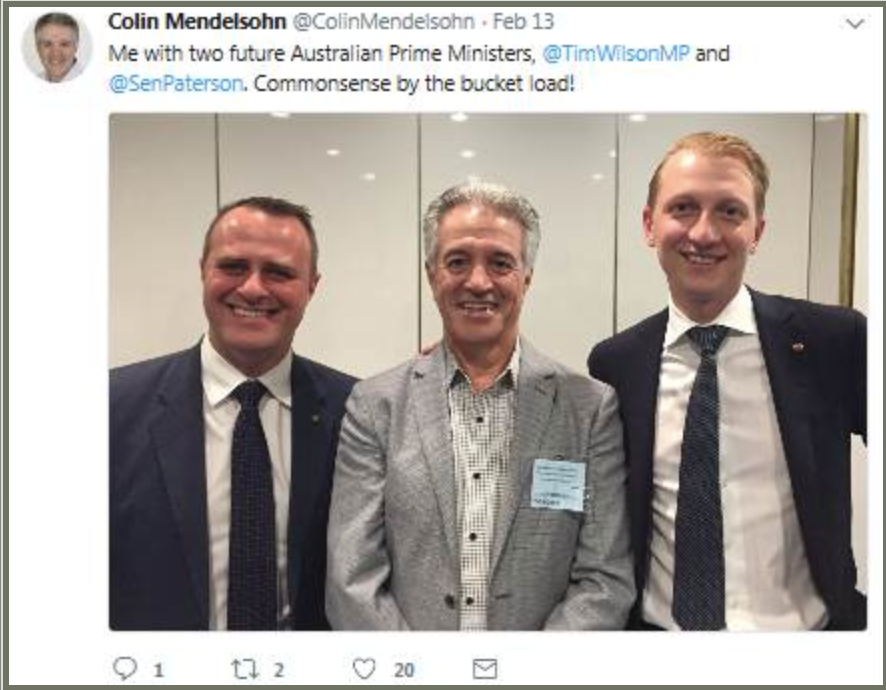
Vaping promoter Colin Mendelsohn fawned over Wilson and Paterson in what was surely one of the more heroic political predictions in the current century. The IPA have been very quiet on vaping, but they are to be taken seriously: in January 2014 they named me in the IPA Review as one of “The Dirty Dozen” all-time Australian “opponents of freedom”
New Nicotine Alliance Australia (NNAA) Started a Twitter account in November 2017 with vapers Charles Yates (president) and Andrew Thompson (board member). Dr Attila Danko was also involved. He delivered this fire and brimstone rant at the 2015 Global Forum on Nicotine meeting in Warsaw. In 2024 the Victorian Civil and Administrative Tribunal made findings in a case brought by the Medical Board of Australia that Danko had engaged “in a treating relationship with a patient, a person with whom he had a personal relationship and pursued an intimate and sexual relationship, in circumstances that were avoidable, and making uninvited physical and sexual contact with a patient” and that he offered “to prescribe cannabidiol to the Patient, and prescribing Schedule 4 medications to a patient with whom he had a personal relationship, in circumstances that were avoidable.” In 2025 the Medical Board announced that Danko’s medical registration had been cancelled and that he may reapply after 12 months. NNAA announced it was closing in September 2019. The twitter page today shows 988 followers. No record of NNAA having made even a small impression in a soft cushion.
The Progressive Public Health Alliance Set up in October 2019 in Melbourne with a current twitter (X) following of 175, and their most recent tweet on June 26, 2021, nearly three years ago. Ran a webinar on vaping in September 2020 with Alex Wodak, but no new seminars planned for its 50 dedicated subscribers.
Australian Vaping Association Started up in June 2020 and managed 80 tweets until Oct 15, 2020 to its 146 followers. Never sighted since.
The Vaping Association Australia. Last post on its Facebook page March 21, 2024 “today’s the day we fifght”. Hmm.. looks like they were knocked out?
Australian Smokefree Alternatives Consumer Association The newest kid on the block thronging with all of 548 followers since Oct 2021 and not a tweet since May 2024. Not shaking the world. Website https://asaca.org.au/
A.L.I.V.E (Australia Let’s Improve Vaping Education Set up in May 2024 by Pippa Starr (pictured below) who is ready and willing to do media interviews! 100 twitter (X) followers at June 4, 2024. That account closed then rebirthed as ALIVEadvocacy in the same month, now bursting with 493 followers as at 11 May 2025. Its battle cry is “The truth is coming to get you”. That truth appears to be that a homeopathically small proportion of Australian vapers is interested enough in all this to even make a mouse click to “follow”.
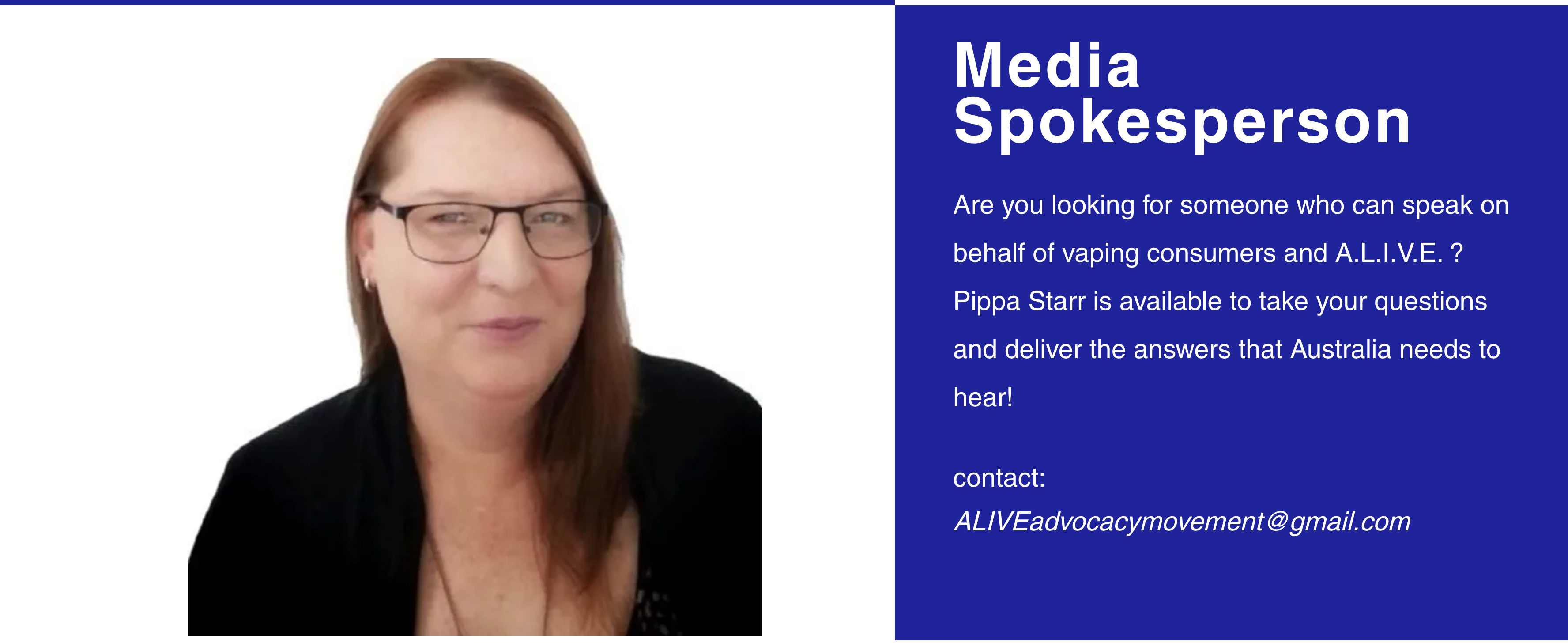
Pippa had earlier offered to represent Australian vapers in the media and to politicians.

In May 2025, after dramatic music Pippa breathlessly announced to the world on youtube that ALIVE had set up the “Colin Mendelsohn Medal Award”, although they seemed unsure of the spelling of his name. The award went to one of its stalwarts, Alan (Al) Gore the public name of vaper, advocate and submission writer Alan Gorley. Pippa described the award as “an amazing thing for you to wear around your neck, proudly … an unbelieveable and prestigious award.”

Responsible Vaping Australia (RVA)
Set up by British American Tobacco Australia, RVA’s goal in life is to sell the idea that there are many retailers out there who would never dream of selling vaping products to children or stocking heinous unsafe vapes sourced from suppliers with bathtub and kitchen sink chemical laboratories where the vape juice is mixed.
No-sir-ee, RVA’s members do not see themselves as criminal, law-breakin’ “black market” vape suppliers. They want to be card-carrying ‘regulated’ suppliers who only sell premium quality nicotine mixed with any of the tens of thousands of flavouring chemicals never passed by any regulatory body anywhere in the world as safe for inhalation.
RVA wants the dedicated health-conscious staff from tobacconists, vape shops, petrol stations and convenience stores to sell vapes. As we all know, such outlets have zero track record over decades of selling cigarettes illegally to kids, so what chance that they would sell vapes to them too? How very, very awkward it must have been for LVA when the TGA recently published notice of massive fines to three TSG stores for allegedly importing illegal vapes. Stay tuned for more awkward moments.

Legalise Vaping Australia (LVA)
LVA appeared in 2017 out of the swamp of far-right libertarian boutique causes under the umbrella of the incestuous Australian Taxpayers Alliance (ATA), which in 2020 held out its begging bowl for funding to the Koch Foundation.
On September 16, 2018 ABC-Online ran a piece about LVA’s lobbying campaign to legalise e-cigarettes. Michael Black’s report had LVA’s Brian Marlow saying “his organisation had been making [claims about e-cigarettes] for years”. Well, perhaps for two years. LVA’s Twitter account was set up on September 20, 2016 and the Wayback Machine’s earliest record of LVA’s website dates from July 1, 2017.

Above: Australian Taxpayers Alliance President Brian Marlow looking tres presidential
When Marlow referred to “his organisation”, he was likely talking about the Australian Taxpayers Alliance (ATA), where he was a member of the “team” before taking the reins as its “president”. LVA is just one of several campaigns run under the umbrella of the ATA. As shown in this tweet posted just after the death of right-wing cartoonist Bill Leak in 2016, identical tweets were posted by five ATA-affiliated groups.

This incestuous arrangement has also seen one group (@MyChoiceAust) replying supportively to a tweet from LVA. Nothing like having those in the same office talking to each other or perhaps one person to him or herself using different account names?

So who funded them?
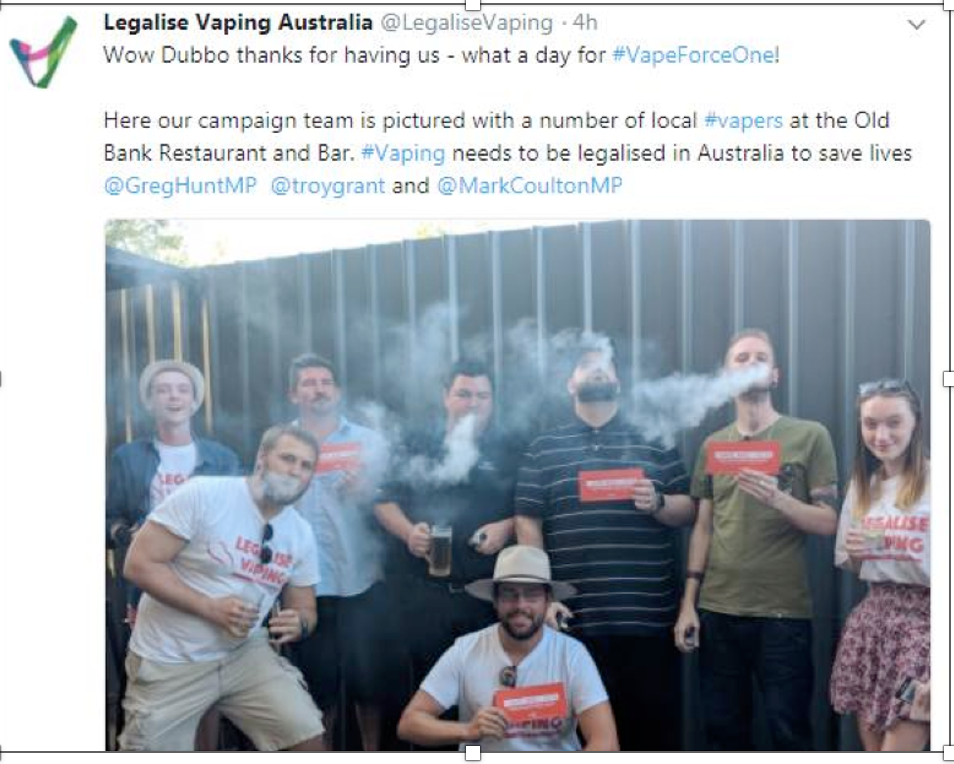
In January 2018, amid much fanfare, LVA launched the portentous “Vape Force One” tour of NSW, Southern Queensland and Victoria where a large Winnebago visited 28 towns. The purchase or hire, signage and running costs of the van and any food and accommodation costs of the seven volunteers involved would have not been insubstantial. I wonder who picked up the tab for all that?
The tour launch, held in Primrose Park in Sydney’s Cremorne, looked like being bigger than Ben Hur, with LVA’s website showing 367 guests having registered to attend, but rather fewer turning up.

Above: Unprecedented crowd of supporters at launch of Vape Force One (subtract cricketers waiting to bat)
Their Facebook events page showed single-digit numbers registering interest in 9 of the 28 stops listed, with a whole 0 at the Byron Bay event. Throughout the month of the tour, LVA tweeted its best photos of the crowds which besieged the Vape Force One van. Local politicians were invited to come down and get informed. I may have missed seeing how many took up those invitations.
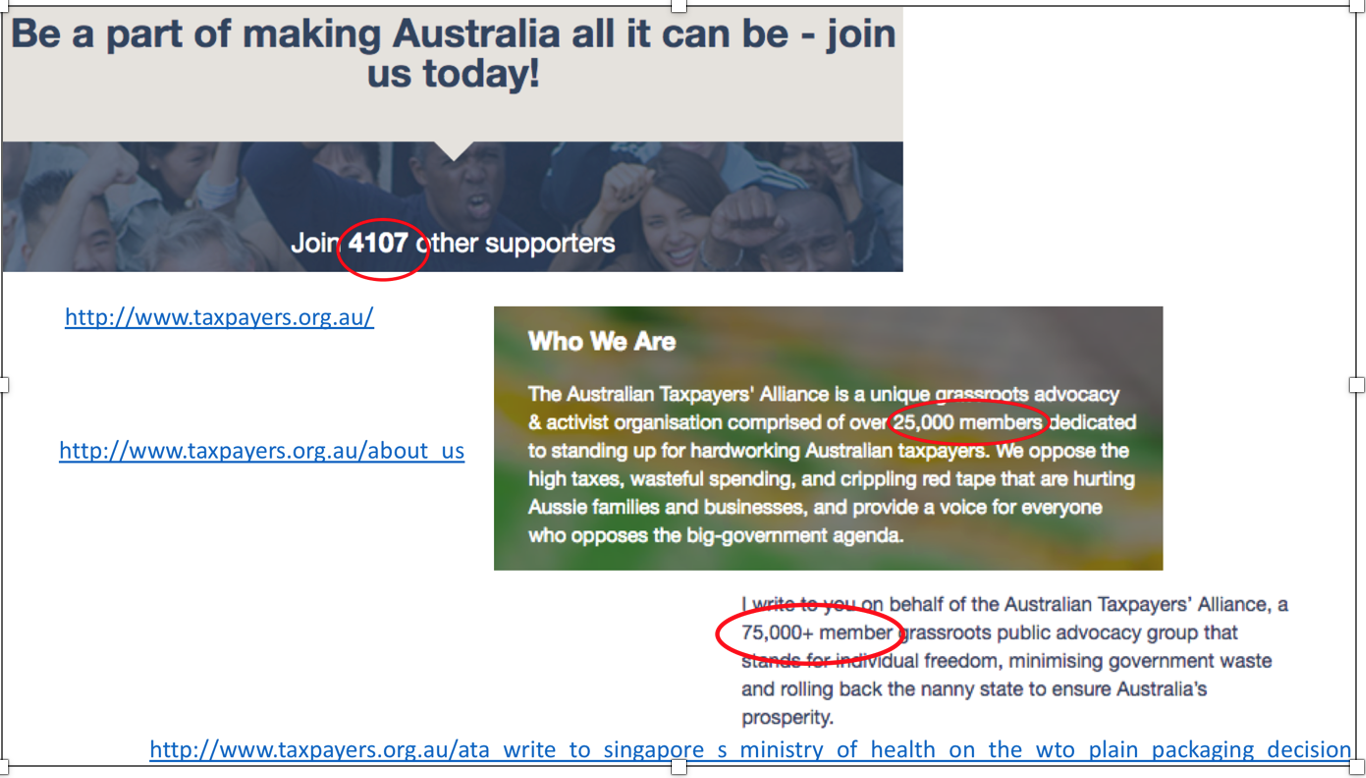
The size of the ATA’s support base appears to be rather fluid. Its website on 17 September 2018 showed 4,186 “supporters”. But one click away on its “who we are” page we see it reports “over 75,000 members”, a mere 17.9 times more. My public request to the ATA to clarify these differences was never answered.
Apart from appeals for donations, neither the ATA or the LVA website provide any information about funding sources. This is standard practice with far-right bodies who try to make a virtue out of their lack of transparency, arguing that their goals, policies and arguments owe no provenance to those with vested interests who might provide financial and in-kind support.
The ATA boasts “academic fellows” as if it was some sort of credentialed research institution. But all academics at legitimate research institutions know that a fundamental tenet of research and publication ethics is full disclosure of all relevant competing interests.
The LVA and the ATA have made cute little awards to political supporters who support the LVA’s efforts. These include David Leyonhjelm (whose Liberal Democrats party had a record of accepting funding from the tobacco industry), Cory Bernardi, Eric Abetz, and Tim Wilson (former Institute of Public Affairs staffer), Andrew Laming and Peter Phelps (NSW parliament). Anyone discern any political complexion among this group? It’s an interesting phenomenon how e-cigarettes have become a signature policy for some in the far-right of Australian politics.

Above: The sartorially elegant LVA crew rubbing shoulders with politicians Tim Wilson and James Paterson, with Colin Mendelsohn along for the fun. Brian, didn’t your mum tell you should take your hat off indoors?
In 2018 federal by-elections LVA campaigned to support the election of Liberal Democrat candidates and an Australian Conservative (in Victoria), where these candidates secured the desultory primary votes shown below, sourced from the Australian Electoral Commission.
Batman, Victoria: Australian Conservatives: 6.41%
Longman, Qld: Liberal Democrats: 1.99%
Braddon, Tas: Liberal Democrats: 1.32%
Mayo, SAust: Liberal Democrats: 0.91%
Perth, WAust: Liberal Democrats: 6.69% (note: no Liberal Party candidate ran).
Fremantle. WAust: Liberal Democrats: 14.1% (note: no Liberal Party candidate ran).
It’s held poorly attended rallies in Perth, Melbourne and Sydney.
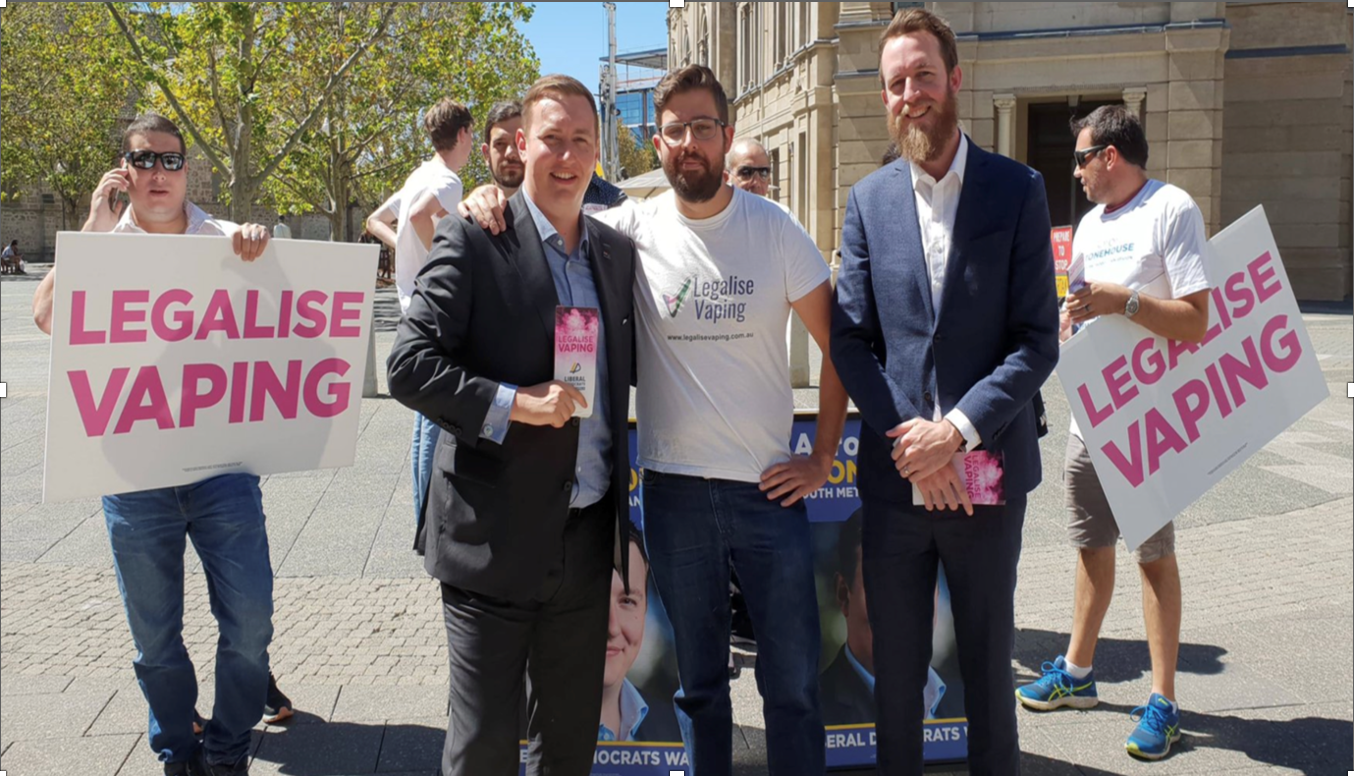
Above: Crowd control not needed at Perth supporters rally
In December 2020 Marlow claimed, without ever showing a data source or any calculations, that 500,000 Australian smokers had “quit smoking for good” by vaping. Strangely, neither the Australian Bureau of Statistics nor any health agency specialising in tobacco control have noticed anything remotely like this had occurred. Such a fall would have been the largest ever recorded in any nation’s smoking prevalence.

Marlow seemed very confused about what message he wanted to send on vaping and COVID. Noting that ATHRA had claimed there was “No evidence that vaping increases the risk of COVID-19” Marlow then spelled this out as meaning “It is important to know vaping increases the severity of #COVID19 in vapers or bystanders” (see below) Whoops!

In February 2021, Neil Chenoweth put the LVA and its director Brian Marlow’s “colourful” background in real estate under the blowtorch in the Australian Financial Review.
On 30 November 2022, the Therapeutic Goods Administration invited public comment on its proposed regulations for vaping, allowing 48 days until submissions would be closed. LVA apparently had so little to contribute that it made no submission.
In May 2023, Marlow announced the formation of “the first political party dedicated to the rights of vapers” the Legalise Vaping Party. But the party never ran a single candidate in May 2025 elections.

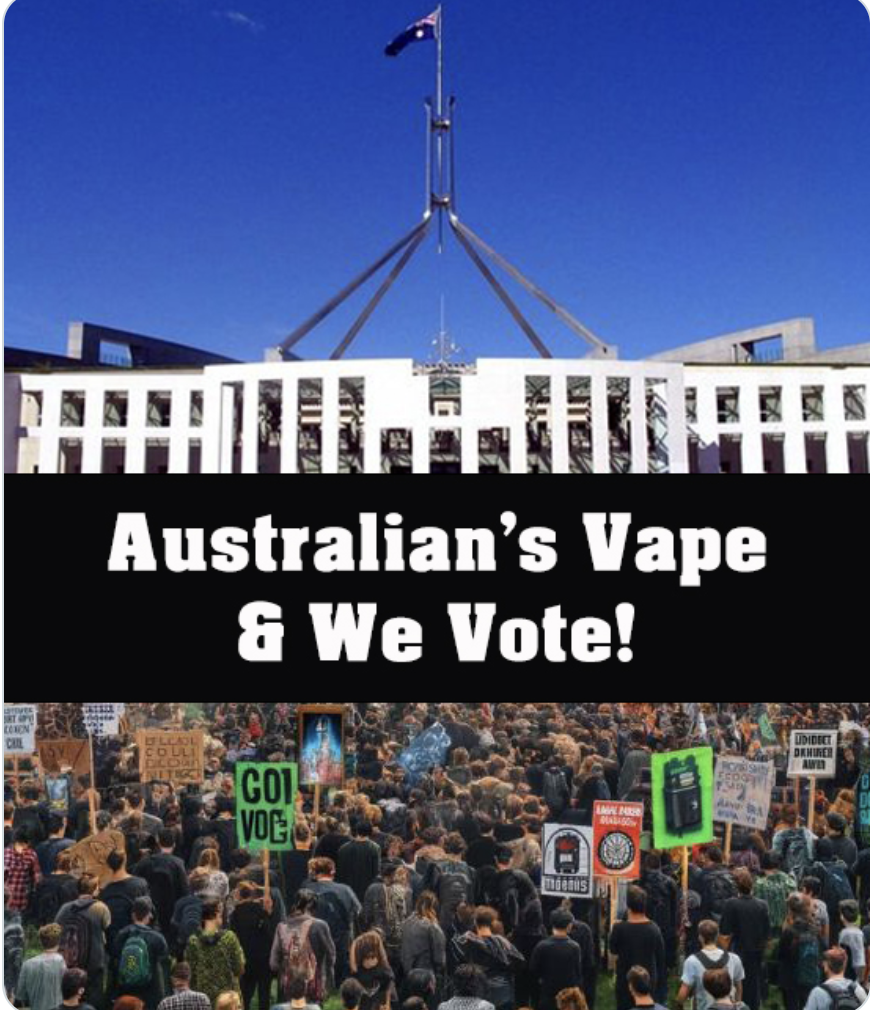
Pippa Starr from ALIVE reminded us on X that “Australian’s vape and we vote!” and pointed to political candidates who opposed Australia’s vaping laws. The election saw the biggest victory ever to Labor, architects of the loathed pharmacy access policy, with ARISE-approved parties like the Libertarians attracting a trickle of votes.
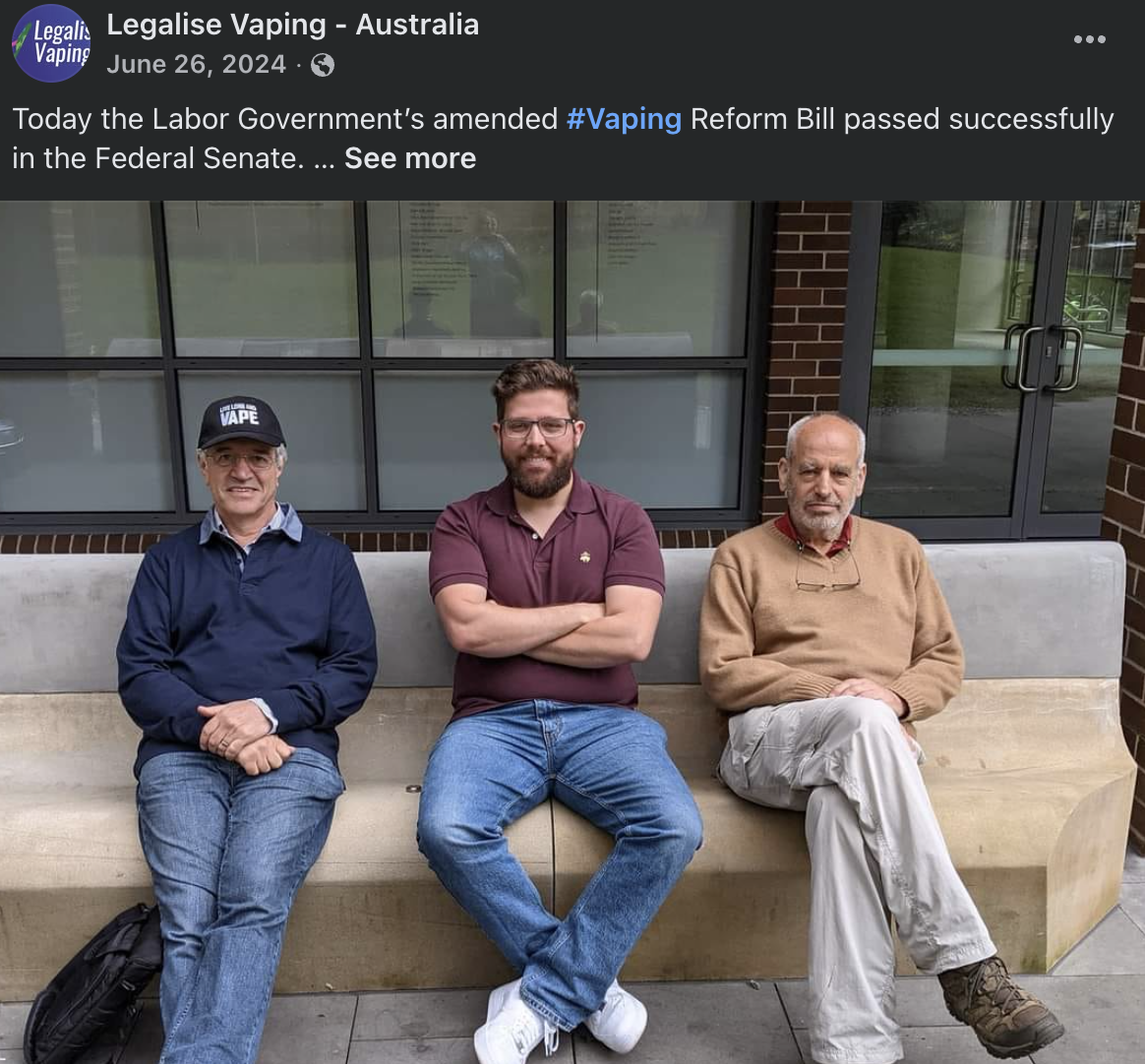
Legalise Vaping Australia last tweeted on March 6, 2025 (nearly a year ago, as this update is added). The latest before that was July 19. 2024. Did anyone notice? Its Facebook page died earlier, with the last post dated June 26, 2024 showing old mates Mendelsohn, Wodak and Marlow, the three unsaddled horsemen of the Australian vaping revolution apocalypse.
Australian Tobacco Harm Reduction Association (ATHRA)
ATHRA was registered on October 12, 2017 as an “advancing health” charity with the government’s Australian Charities and Not-for-Profits Commission.
ATHRA has no staff and when it folded on Dec 1, 2024 (below) , three board members: Perth GP Joe Kosterich (with the grandee title of “chairperson”), Dr Alex Wodak and Ean Alexander, a Perth businessman with interests in the medicinal cannabis industry. Kosterich is Medical Adviser to Little Green Pharma cannabis company. In 2022, the company was fined $372,960 by the Therapeutic Goods Administration for 28 instances of alleged “unlawful advertising of medicinal cannabis products on their websites and social media platforms”.

From at least 7 December, 2021 ATHRA’s website has stated (below) that its Board consisted of three “medical practitioners”. Director Ean Alexander’s background is not supplied nor his photograph shown. However, he is not a medical practitioner, so this statement is false and has been so for at least 20 months.

Kosterich informed a 2019 Western Australian parliamentary select committee on Personal Choice and Community Safety to which he gave evidence that “ATHRA has no members”. Its website has provision for “supporters” to register, but curiously does not appear to have released any data on the size of this supporter group. We might expect that if this support was large, ATHRA would have likely told us about this many times.
In 2019, ATHRA ran a Go Fund Me fundraiser to support an “Aussie Vape Day’ to try and piggyback the often massive publicity received by the annual World No Tobacco Day. It set a fund target of $15,000, with ATHTA board member Colin Mendelsogn kicking it off with $500. It received a paltry $1845 by the campaign end from just 37 other donors.
Dr Colin Mendelsohn was the founding chairman of ATHRA (the Australian Tobacco Harm Reduction Association) from 2017. He then resigned from the ATHRA board, taking effect from Jan 4, 2021 according to ASIC records. He thereafter referred to himself many times as being “the founding chairman of the Australian Tobacco Harm Reduction Association” often without adding that he was no longer on the board.
After doing a “Nellie Melba” and announcing his retirement from vaping advocacy in Dec 2023 only to soon rescind it, he again announced a retirement in November 2024.

ATHRA spokespeople have long campaigned for nicotine vaping products (NVPs) to be designated a minimally regulated “consumer product”, available from almost any outlet. They are implacably opposed to the medical prescription approach. In this, they are in lockstep with all tobacco companies which manufacture NVPs and almost the entire vaping industry.
This has not stopped vaping advocates repeatedly making the argument that the prescription access model will benefit the tobacco industry and that those supporting the prescription model are “helping big tobacco”. So, if you support the prescription model, you are nothing but a useful idiot greasing the wheels for the tobacco industry: the very same industry which is inexplicably lobbying tooth and nail against this model. So how does all that work?
ATHRA’s recent inactivity on social media
ATHRA has a twitter account which has not published anything since 28 June, 2022. It also has a website which includes a section on media releases and a blog, The most recent media release visible on its current website is dated March 6, 2020, over three years ago.
The most recent ATHRA blog is dated May 28, 2021 (although there is a promotion for Mendelsohn’s book posted Dec 10, 2021. The book was published by the pay-to-publish Aurora House. Check out their many other fascinating titles here.
Now flying solo, Mendelsohn has recently had a bumpy ride with the media. In December 2022, 2GB’s Ben Fordham pushed back hard on Mendelsohn’s claims that “there’s a lot of panic [about teen smoking] which is exaggerated”. Western Australia’s radio 6PR has given him some coverage in the past, but in February 2023 he was savaged by respected journalist Gary Adshead when he defended the Philip Morris funded Foundation for a Smokefree World.
Television Channel 7’s Sunday night current affairs program Spotlight interviewed Mendelsohn on May 28, 2023 where the compare advised viewers at 25m55 that they were “about to see why he is a friend of Big Tobacco”.
Like LVA, neither ATHRA nor any of its current directors made any submissions to the 2022-2023 Therapeutic Goods Administration’s call for submissions on proposed vaping regulations, the biggest policy change to have happened with vaping in Australia.
ATHRA would appear to be comatose, showing no vital signs.


 Simon Chapman AO