
In recent months Alex Wodak, a frequently professed doyen of polite, respectful debate about vaping policy, has ratcheted up his nastiness meter to 11. He’s pointed his finger at the root cause of the gang warfare and growing fire bombings of mostly Victorian shops, as well as three murders. He says the cause of all this is the galactic folly of the prescription access vape model implemented by the Morrison government from Oct 1, 2021. More precisely, it is various individuals inside and outside government who supported or reported on this model and are playing hard today inside his head (see examples below).
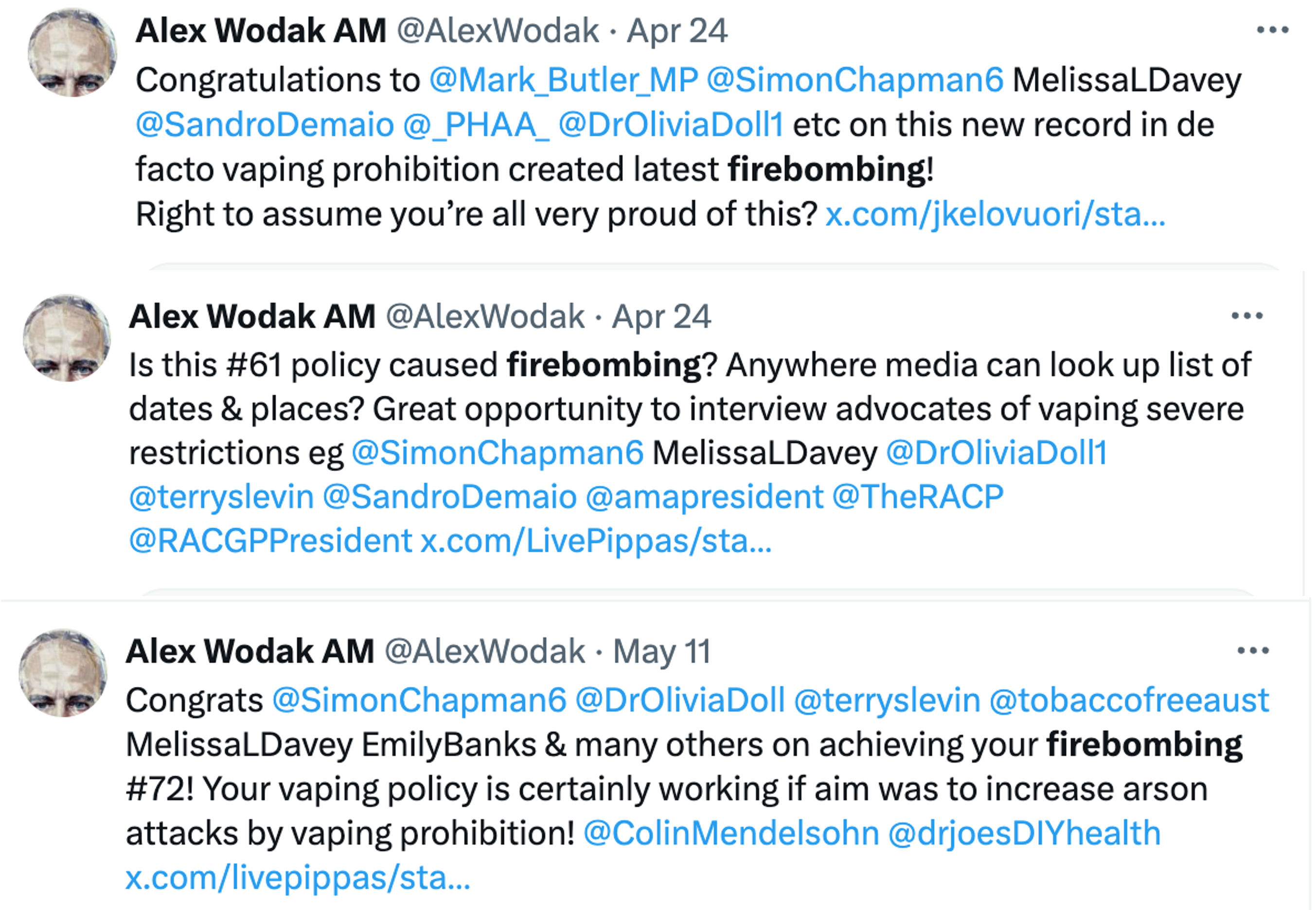
Wodak’s inane and offensive reasoning here is that those who supported former health minister Greg Hunt’s prescription policy would be proud and delighted by these serious crimes and are cheering them on in ghoulish delight at what they have reaped. He apparently seriously believes none of this would be happening had he and his vape promoting mates not failed in their advocacy for open access to vapes via the government classifying them as “consumer products”. This would have allowed them to be sold by (for example) tobacconists and convenience stores, those upstanding stalwarts of public health who of course never sold tobacco to kids across the decades.
Former long-time employee of British American Tobacco and now head honcho at the Australian Association of Convenience Stores (which received tobacco industry support over two decades and has helped industry campaigns) Theo Foukkare, trained his Exocet far more narrowly in the Herald Sun on May 8 – “Health Minister Mark Butler is solely to blame for Australia’s youth vaping crisis and the rampant black market that he has created, which has already resulted in over 70 firebombings and multiple homicides throughout our communities.”
Someone who knows a thing or two about crime data is a former head of the NSW Bureau of Crime Statistics, Prof Don Weatherburn. He called out this puerile garbage recently in an amusing exchange on Twitter:
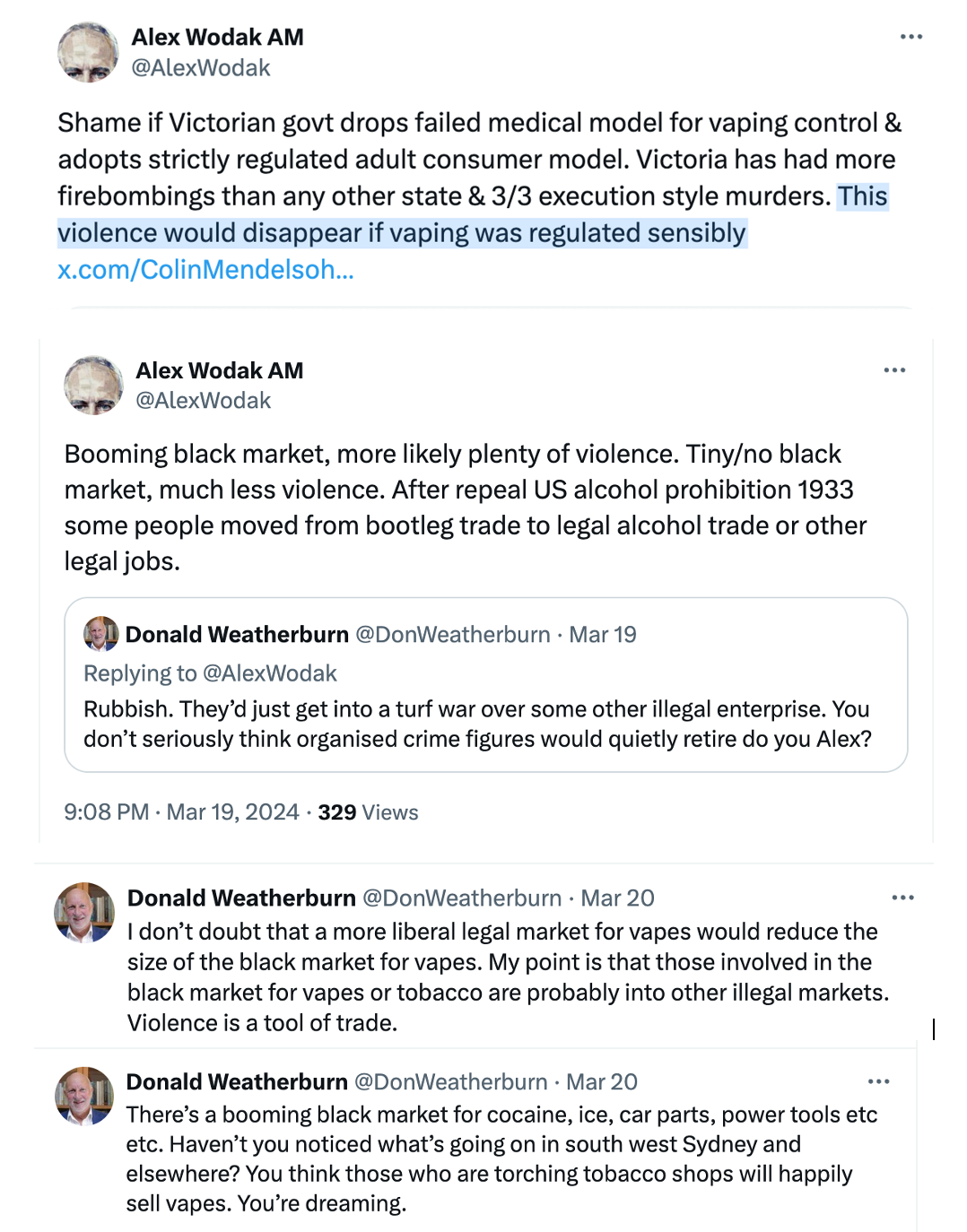
Wodak and Foukkare both seem to have conveniently forgotten that criminal involvement in tobacco supply in Australia has been going on long before vaping became widespread. And just a reminder that “sell anywhere” tobacco supply is the very model that they both want for vapes. Here’s a small selection of examples:
2005 murder of an illicit tobacco dealer
2008 documentation of crime gangs, illegal tobacco syndicate, of middle eastern origin
2009 Police corruption in tobacco trade
2010 Corrupt dock workers, outlaw motorcycle gangs in smuggling
2011 Three unsolved murders, illicit tobacco
2014 27 arrests middle eastern crime gangs
2016 Links ofmiddle eastern crime gangs to funding of Hezbollah
These sprays about the claimed architects of prescription access seem designed to distract
attention away from how it actually happened that illegal vapes flooded the market in Australia in recent years.
In any blame game about the booming illegal vapes trade in Australia, the obvious dramatis
personae with the lead roles are the pots now calling public health and political kettles black. In 2020, a Liberal National backbench revolt by 28 backbenchers led by the National’s Senator Matt Canavan was responsible for intimidating the Morrison government into destroying one of the two complementary pillars of its health minister Greg Hunt’s policy when it quietly scrapped Hunt’s ban on vape imports in late 2020. Ten thousand watt green lights were then turned on to light the way for vape importers who instantly figured correctly “why would anyone bother getting a prescription for vapes when you can pick them up almost anywhere?”
To the delight of Big Tobacco, which is unified in implacably opposing prescription access, pulls strings on a seemingly “independent” well-funded campaign and pours funding at the yokels in the National Party, the backbench plotters left the prescription component intact. They then bought front row seats to watch the whole policy collapse, pausing now and then for solemn obligatory statements about how no one wants to see children vape.
Chain-sawing Greg Hunt’s policy in half and thereby chocking open the floodgates to industrial scale criminal importation of vapes was always going to have the obvious outcome. Sabotaging the import ban left the prescription access pillar bereft of any complementary incentive that would have driven lots of vapers to get a prescription.
“Nicotine free vapes”
Any hesitancy by retailers to sell vaping stock obtained from these importers was then doused by a brilliant deception. The massive loophole that it remained legal to sell vapes which did not contain nicotine saw millions of vapes flooding Australia mostly in ditzed-up boxes obligingly added by Chinese exporters for their Aussie importing customers. These falsely stated that the vapes did not contain nicotine. “M’lud! Hand-on-heart, I truly thought I was selling legal, nicotine-free vapes! You’d understand that I don’t do chemical analyses of the groceries I sell to check whether they conform to their labelling either.”
Health Department inspectors were required to submit any seized vaping stock to accredited labs to test if it did indeed contain nicotine. And even if they tested positive for nicotine, a retailer could argue that they had sold them in good faith as nicotine-free. I was in a meeting in Adelaide in 2023 called by the South Australian Health Minister Chris Picton. A senior Health official there explained that testing each batch of suspect vapes cost thousands of dollars as no mass testing facility was available locally.
The result was that seizures and testing were fatally hamstrung and occurred at homeopathically small rates. Those illegally retailing understood this perfectly well and knew that the probability of them ever being fined was beyond remote. So under-the-counter surreptitious sales morphed into open displays with neon lights outside shops, all in plain sight of kids and legally impotent health inspectors.
Enablers of the vape black market
So who then were the true enablers of the tsunami of “black market vapes” that turbo-charged around Australia from the beginning of 2021 and the violent criminality that went with it? The 28 Liberal National politicians led by Queensland National Matt Canavan and NSW’s freshly turfed Hollie Hughes are obvious. They sought and succeeded in gutting Hunt’s policy from inside the LNP, to the certain delight of their tobacco industry donors.
But who got in their ears? Who were the go-to interest groups who were the consultant architects of the policy rubble that came to pass and turbo-charged all we are reaping today: skyrocketing increases in current vaping by 14-17 year olds (from 1.8% in 2019 to 9.7% in 2022-23) and fire bombings of retailers, presumably by those intent on maximally cashing in on such growth?
I think we all know the answer here. All those who were implacably opposed to prescription access cosied up to anyone who might help their cause, mostly from the far right of politics. So who is it today who is gloating that their work managed to wreck the prescription vapes model for a few years? Who is it saying “look over there at those who hatched the original policy (but please don’t look at those of us who wrecked it and saw the predictable boom in kids vaping because access was so easy)” And who is so panicked that Mark Butler’s resurrected scheme looks like passing into law with a few sensible amendments clarifying personal vs commercial possession, that they are having daily apoplexy.
“Cigarettes are sold everywhere, so should be vapes”
A related tenet of vaping theology has received a huge workout in Australia. This is the argument that because cigarettes can be sold literally through any retail outlet which (in most states) has a tobacco retail licence, vapes should enjoy no less freedom of access.
Their argument here runs: (1) cigarettes are more dangerous than e-cigarettes (2) cigarettes have always been sold and are not banned from sale (3) therefore, consistency and coherency demand that e-cigarettes should also be allowed to be sold at very least in the same way because of the precedent established by cigarettes.
This deeply flawed syllogism takes no account of the reasons why cigarettes are sold in the way they are today, and not in the way restricted substances like prescribed drugs are sold to consumers. Sales of cheap machine-made cigarettes burgeoned from the early twentieth century when there was no case against smoking, beyond that made by temperance groups. Tobacco control commenced more than 60 years later with the first tepid health warnings appearing in the USA in 1966. Across those years, tobacco consolidated its special exceptionalist regulatory status as being entirely exempt from ingredient controls. Even today, fully comprehensive tobacco control has been enacted in only a minority of nations.
To date, no country other than the minnow, isolated nation of Bhutan has ever contemplated banning cigarettes. Yet throughout my 45 year career, it’s been common to hear leaders in this field say “if cigarettes were invented tomorrow, when we know now what we never knew when they first appeared, no nation would allow them to be sold.” Those pointing this out know that no nation will ban cigarettes any day soon. They know the legacy of cigarettes’ historical circumstances saw them (unlike pharmaceuticals, foods, beverages, cosmetics, agricultural, industrial and household chemicals) totally exempted from regulation. They know this historical legacy has tied two hands behind the backs of any thought that backwards time-travel could somehow magically allow this situation to be
undone.
Importantly, they know that when proposing gold standard regulations for any product carrying serious risks, the very last model any regulatory authority would reach for is that which applies now to tobacco regulation. Yet knowing all this, those calling for vapes to enjoy the same open slather access regulations that tobacco does, are happy to set their ethical bar to this lowest imaginable level and accuse supporters of tough regulation as being “incoherent”. We allow cigarettes to be sold everywhere, so therefore we should allow a putative less dangerous cigarette substitute to be subject to the same non-standards of
regulation, they argue.
This reasoning is completely arse-up.
Instead, we should commence our comparison by saying “We made every conceivable error in the way we allowed cigarettes to be allowed into commerce, in the way we allowed it to be advertised, packaged and sold as if it was confectionery. We know that we were deceived by the tobacco industry with the harm reduction false promises of filters and light/mild cigarettes. We now face a new opportunity to get regulation right with new nicotine delivery products carrying unknown risks from daily, long-term use. Let’s learn from the disastrous history of tobacco non-regulation and not make the same mistakes again.”
Governments have banned leaded fuel and paint, asbestos and innumerable examples of dangerous consumer goods, all for health and safety reasons. In Australia and New Zealand pure caffeine was swifty banned from September 2019, following the tragic death of 21 year old Lachlan Foote, the son of friends of mine.
But vapes are not being banned in Australia, any more than antibiotics and all prescribed drugs are “banned”. Vaping advocates’ trivialisation of nicotine and vaping as a drug and a practice deserving the same regulatory oversight as caffeine is where their rubber meets the road. A huge amount of early evidence is now emerging about particularly the cardiovascular, respiratory and DNA damaging effects of vaping, which as occurs with smoking and asbestos exposure, features latency periods lasting decades before disease is clinically diagnosed.
Lessons from prescription drug access
No one in all this seems to have asked a very obvious question. With there being massive demand for a huge range of (not) “banned” prescribed drugs (315 million PBS and RPBS prescriptions in 2020-2021), why has the prescription model of drug access been flourishing for many decades in all but lawless or chaotic nations where you can often pick up almost any drug you want without a prescription?
Why have not Australian “criminal gangs” decided that here was a golden opportunity to supply any of the 925 PBS drugs to people wanting them without the hassle of getting a prescription? Why are we not seeing pharmacies torched by criminal gangs?
In Australia, there are black markets for products including anabolic steroids, some new and expensive weight-loss drugs and erectile dysfunction drugs. A BBC report details criminal gangs diverting a range of prescribed drugs in England. Black markets do exist for prescribed drugs but the size of these are a tiny fraction of those which operate via prescription access.
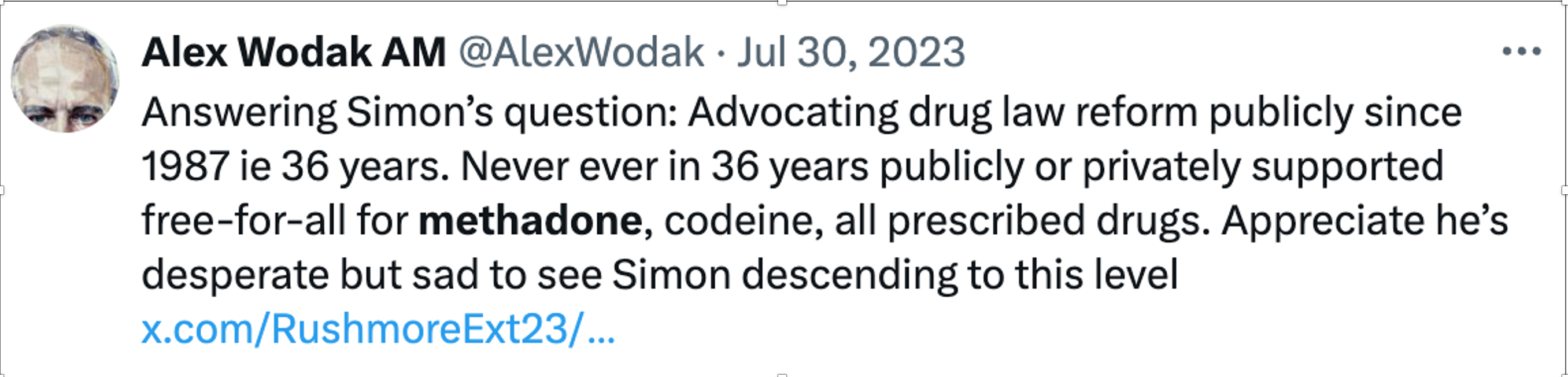
And no one, not even Alex Wodak (see below), wants to see dependence producing drugs available on prescription being sold across the counter in shops. But dependence producing nicotine vapes, full of flavouring and coolant chemicals never approved by any drug regulatory system anywhere in the world for inhalation? No problem for Wodak: available at your corner store now, right next to the bubble gum.
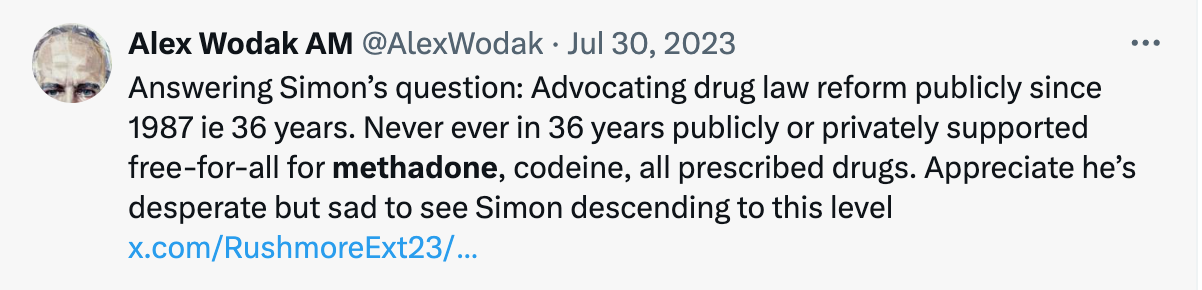
In this blog series on vaping theologies, I’ll give the last apposite word to Don Weatherburn’s characterisation of Wodak:

Also in this series
Vaping theology: 1 The Cancer Council Australia takes huge donations from
cigarette retailers. WordPress 30 Jul, 2020
Vaping theology: 2 Tobacco control advocates help Big Tobacco. WordPress 12 Aug, 2020
Vaping theology: 3 Australia’s prescribed vaping model “privileges” Big Tobacco WordPress Feb 15, 2020
Vaping theology: 4 Many in tobacco control do not support open access to vapes because they are just protecting their jobs. WordPress 27 Feb 2021
Vaping theology: 5 I take money from China and Bloomberg to conduct bogus studies. WordPress 6 Mar, 2021
Vaping theology: 6 There’s nicotine in potatoes and tomatoes so should we restrict or ban them too? WordPress 9 Mar, 2021
Vaping theology: 7 Vaping prohibitionists have been punished, hurt, suffered and damaged by Big Tobacco WordPress 2 Jun, 2021
Vaping theology: 8 I hide behind troll account. WordPress 29 Jun, 2021
Vaping theology: 9 “Won’t somebody please think of the children”. WordPress 6 Sep, 2021
Vaping theology: 10: Almost all young people who vape regularly are already smokers before they tried vaping. WordPress 10 Sep, 2021
Vaping theology: 11 The sky is about to fall in as nicotine vaping starts to require a prescription in Australia. WordPress 28 Sep, 2021
Vaping theology: 12 Nicotine is not very addictive WordPress 3 Jan 2022
Vaping theology 13: Kids who try vaping and then start smoking,would have started smoking regardless. WordPress 20 Jan, 2023
Vaping theology 14: Policies that strictly regulate vaping will drive huge
numbers of vapers back to smoking, causing many deaths. WordPress 13 Feb, 2023
Vaping theology 15: The government’s prescription vape access scheme has failed, so let’s regulate and reward illegal sellers for what they’ve been doing. WordPress 27 Mar 2023
Vaping theology 16: “Humans are not rats, so everybody calm down about nicotine being harmful to teenage brains”. WordPress 13 Jul, 2023
Vaping theology 17: “Vaping advocates need to be civil, polite and respectful” … oh wait. WordPress 3 Oct, 2023
Vaping theology 18: Vaping is a fatally disruptive “Kodak moment” for smoking. WordPress Oct 30, 2023
Vaping theology 19: Vaping explosions are rare and those who mention them are hypocrites. WordPress 17 Nov, 2023
Vaping theology 20 : Today’s smokers are hard core nicotine dependent who’ve tried everything and failed – so they need vapes. WordPress 14 Dec, 2023
Vaping theology 21: Australia’s prescription vapes policy failed and saw rises in underage vaping and smoking. WordPress 10 Jan, 2024
Vaping theology 22: “Prohibition has never worked at any point for any other illicit substance”. WordPress 17 Mar 2024
Vaping theology 23: “84% of the Australian public are opposed to the way the government will regulate vapes” WordPress 2 Apr, 2024
Vaping Theology 24: “Tobacco control advocates are responsible for vape retail store fire bombings and murders. WordPress 27 May, 2024




 Simon Chapman AO