• Home
  • About/CV
  • Blog
  • Vaping Research Alerts
  • Blog archive list
  • My books
  • Memoirs
  • Music, bands, films
  • Contact

Simon Chapman AO

~ Public health, memoirs, music

Simon Chapman AO

Monthly Archives: January 2019

What are the limitations of the randomised controlled trial of ecigs v NRT, just published in NEJM?

31 Thursday Jan 2019

Posted by Simon Chapman AO in Blog

≈ 4 Comments

[updated 27 March, 2020]

Since I published this blog this time last year, I’ve seen a further critique written by  Prof Matthew Peters, a respiratory specialist from Sydney’s Concord Hospital and former chair of Action on Smoking and Health Australia.  Here it is, with the original blog following below)

Electronic cigarettes vs NRT for smoking cessation – the sting is in the tale.

In February 2019, Hajek and others published results of a randomised trial of nicotine replacement therapy (NRT n=446) vs use of a second-generation refillable e-cigarette device (n=438) in the New England Journal of Medicine. Subjects were all self-selecting attenders at U.K. National Health Service stop-smoking services.

The  paper attracted considerable attention as it was a randomised study with an active control arm and used modern e-cigarette (EC) devices. Compared to the few previous randomised trials which used earlier generation ECs, it had a substantially greater effect size with relative risk of 1.75-1.84, (depending on adjustments and exclusion of certain subjects) for the primary outcome variable of continuous abstinence at 52 weeks. In media discussions since, this  effect was commonly rounded up to a doubling of smoking cessation compared to NRT.

Three other smoking cessation outcomes were also reported or calculable from data in the paper and the associated supplement. 

  1. Intention to treat (ITT) allocation to EC was not associated with reduced risk of relapse beyond 4 weeks after the target quit date. This was so even though EC use continued at a rate of 40% vs 4% for NRT.
  2. The relative risk (RR) for 7 days point-prevalence abstinence at 52 weeks was 1.52 for EC vs NRT
  3. The RR for continuous abstinence and being smoke and nicotine free at 52 weeks was approximately 0.5 for EC vs NRT. The ITT e-cigarette arm had 14 (3.1% smoke-free/nicotine free subjects compared to 31(6.9%) in the NRT arm.

If the beneficial effect is based on factors within the first 4 weeks, it is critical to exclude biases in the administration of the intervention and control treatments and to consider whether there may have been participant biases. Here, it is a problem that the control intervention was poorly applied. In the first 4 weeks, only 10% reported use of NRT daily vs 53% for those randomised to e-cigarettes. 25% of the NRT subjects used it on 19 or fewer days.

The investigators sought per protocol to exclude potential participants who may not have been equally disposed to one or other treatment but probably did not succeed. 91 NRT subjects did not complete 4-week follow-up compared with only 63  with e-cigarettes and these were counted as continuing or relapsed smokers as is standard practice in trials. Reinforcing the probability that the participating subjects were more favourably disposed to EC than NRT, crossover from NRT to e-cigarettes occurred around three times more often than e-cigarettes to NRT. In contrast, there was no difference for varenicline.

Critically, a statistical oddity underpins the high relative risk for continuous abstinence at 52 weeks. Continuous (CA) or prolonged abstinence and CO-confirmed 7-day point prevalence abstinence (PPA) are equally valid, highly correlated smoking cessation study end-points. CA cannot, by definition, exceed PPA. Hughes and others found a ratio of 0.74 from a systematic review of smoking cessation intervention studies. Viewing consolidated data from the paper and supplement in one table provides the best insight into the problem.

  PPA- EC (n) CA-EC(n) CA/PPA Ratio PPA-NRT(n) CA-NRT(n) CA/PPA Ratio RR for PPA

(unadjusted)

RR for CA

(unadjusted)

4 weeks 195 192 .985 136 134 .985 1.46 1.45
26 weeks 158 155 .981 115 112 .974 1.39 1.40
52 weeks 146 79 .541 98 44 .449 1.52 1.83

(Primary comparison)

Abbreviations used: CA continuous abstinence; PPA point prevalence abstinence; RR relative risk

What is clear that a dramatic fall at 52 weeks in CA/PPA for e-cigarettes and an even greater fall for NRT were required to achieve the headline relative risk for continuous abstinence with both ratios being well outside Hughes’ mean estimate. It is possible that the standard for continuous abstinence (not more than 5 cigarettes after quit date) contributed to CA/PPA being so different at 52 weeks compared to 26 weeks but this does not explain why the decline for NRT was so much greater.

Until this anomaly is explained, we are left with the more solid smoking cessation data being 7-day point prevalence CO-confirmed abstinence. That figure of about 1.5 at 52 weeks could still suggest that high nicotine delivery systems outperform older generation e-cigarettes for cessation outcomes but this finding would still need to be considered in the light of sharp differences in the application of e-cigarettes and NRT control in the critical first 4 weeks.

Behavioural support

Importantly, all trial participants also received “weekly behavioural support for at least 4 weeks”, with the authors noting in their conclusion that “E-cigarettes were more effective for smoking cessation than nicotine-replacement therapy, when both products were accompanied by behavioral support.”. This support “involved weekly one-on-one sessions with local clinicians, who also monitored expired carbon monoxide levels for at least 4 weeks after the quit date.” Eighty one percent of participants received 4 or 5 support sessions.

However, in real world use of either NRT or ecigs for smoking cessation, only a very small proportion of smokers would receive such support. Important questions therefore arise about the relative contributions of NRT and ecigs, to that of the support which all received. A study of a national English prospective cohort of 1560 smokers found “the adjusted odds of remaining abstinent up to the time of the 6-month follow-up survey were 2.58 (95% CI, 1.48-4.52) times higher in users of prescription medication in combination with specialist behavioral support”. However “The use of NRT bought over the counter was associated with a lower odds of abstinence (odds ratio, 0.68; 95% CI, 0.49-0.94).” This suggests that real world use of NRT without support may be ineffective.

Serious adverse events

The notion that new-generation e-cigarettes would be able to deliver more of the “good stuff”, nicotine, and not more of the bad stuff – toxic products of superheated vehicle solvents and flavourants was always questionable. This study reports numerically more serious adverse events in the e-cigarette arm than the NRT arm – 27 vs 22. Excluding malignancies, there were 7 potentially smoking related serious adverse events (SAEs) – one fatal- in the e-cigarette arm and 4 in the NRT group even though smoking rates remained higher in the NRT arm. Of the 5 respiratory events with e-cigarettes (vs 1 with NRT), the investigator concluded in each case that e-cigarette use was unrelated. The risk disparity 1.1% vs 0.2% was in the authors’ published conclusion – “likely a chance event”. This would suggest that there is a lack of objectivity and/or openness to emerging risks of e-cigarettes.

These safety findings are consistent with the failure of e-cigarette use, whether as complete or partial substitution for smoking, to reduce potential smoking-related disease or to meaningfully improve general health in a 4-year prospective study. Here with no reduction in potentially smoking related serious adverse events and an imbalance in respiratory SAE’s, serious doubts are created in relation to claims that use of latest generation e-cigarettes is 95% safer than smoking; if it is safer at all.

********************************************************************************

Original blog

The New England Journal of Medicine has just published the results of a randomised controlled trial on the relative efficacy of e-cigarettes v nicotine replacement therapy.

Here are the results and conclusions from the abstract (the full article is paywalled).

Results A total of 886 participants underwent randomization. The 1-year abstinence rate was 18.0% in the e-cigarette group, as compared with 9.9% in the nicotine-replacement group (relative risk, 1.83; 95% confidence interval [CI], 1.30 to 2.58; P<0.001). Among participants with 1-year abstinence, those in the e-cigarette group were more likely than those in the nicotine-replacement group to use their assigned product at 52 weeks (80% [63 of 79 participants] vs. 9% [4 of 44 participants]). Overall, throat or mouth irritation was reported more frequently in the e-cigarette group (65.3%, vs. 51.2% in the nicotine-replacement group) and nausea more frequently in the nicotine-replacement group (37.9%, vs. 31.3% in the e-cigarette group). The e-cigarette group reported greater declines in the incidence of cough and phlegm production from baseline to 52 weeks than did the nicotine-replacement group (relative risk for cough, 0.8; 95% CI, 0.6 to 0.9; relative risk for phlegm, 0.7; 95% CI, 0.6 to 0.9). There were no significant between-group differences in the incidence of wheezing or shortness of breath.

Conclusions E-cigarettes were more effective for smoking cessation than nicotine-replacement therapy, when both products were accompanied by behavioral support.

This study is already causing the predicted outbreak of gushing hyperbole from e-cigarette interests and their urgers.

Professor Martin McKee, from the London School of Hygiene and Tropical Medicine, has shared the following comments about the paper that are very useful.

“The subjects were people who had already decided to attend a stop smoking service. Then, randomisation only began after they had set a quit date. In other words, they were very far from a random sample of smokers. They also excluded existing dual users. [note dual e-cig and cigarette use is by far the most common way that e-cigarettes are used].

Outcome was self-reported use of less than 5 cigarettes from 2 weeks post enrollment to 1 year, and validated, but only by 1 biochemical (CO) test at 1 year, which would only capture very recent smoking.

Among those who did give up, 80% in the e-cig group were still using them, but only 9% of the NRT group were using NRT. Given evidence from other studies, such as the US PATH study, that over longer periods quite a lot of e-cig users relapse, it will be important to look at longer term follow up. (The authors say 80% is “fairly high”!)

They say “Provided that ongoing e-cigarette use has similar effects to long-term NRT…” but then refer to 1988 study. And they say nothing about health risks of e-cigs.

Finally, as they note, this study is inconsistent with 3 previous ones.

So, in summary, I would say:

“This study differs from previous ones in finding that e-cigarettes do seem to be better than NRT at maintaining abstinence, at least for one year, in a highly selected group of people who have already decided to quit and have taken steps to get help with it. Of course, the vast majority of those who quit do so unaided, but, nonetheless, these findings are interesting, although it will be important to see what happens in the longer term. It is, however, important to recognise that it only relates to those who are using e-cigarettes when linked to face-to-face support from a smoking cessation service. It tells us nothing about their use in the wider population of smokers, which is where many of the concerns lie.”

Here’s another comment

“E-cigarettes may be better than the nicotine replacement alternative in the [NEJM] study — but they only helped a minority of participants in the vaping group quit. “In spite of the concerted effort and encouraging findings, it is still disappointing,” said David Liddell Ashley, the previous director of the office of science in the Center for Tobacco Products at FDA [Food & Drug Administration]… So this randomized controlled trial might — and probably should — encourage health professionals to consider e-cigarettes, at least the type shown to be effective in the study, as a tool for their smoking patients. But it also shows e-cigarettes are far from the panacea some suggest they might be.” [Julia Belluz. Study: Vaping helps smokers quit. Sort of. Vox] 

Behavioural support: little real world relevance

To this I would emphasie that the participants in the trial received not only e-cigarettes or NRT, but they self-selected to attend a quit smoking service and received “behavioural support”.  This means these subjects were very different to random e-cigarette or NRT users in the English community, the great majority of whom do not elect to attend such services.

In Australia, despite the quitline phone number being on  every cigarette pack and it being hammered in many quit smoking campaign ads, only 3.6% of smokers ever called the quitline over a year. Far fewer are interested in attending “behavioural support” sessions. So this paper has very important limitations in its relevance for debates about whether e-cigarettes (or NRT) can assist people to quit under conditions of real world use.

We know from recent real world longitudinal studies of people who vape in the USA that e-cigarette users actually do worse with quitting than those who use other forms of smoking cessation aids, and particularly those who quit unaided. I covered this in an earlier blog here.

We also know that over-the-counter NRT, used without support in the normal way that nearly all users use it, is not effective. See for example here  (“The use of NRT bought over the counter was associated with a lower odds of abstinence (odds ratio, 0.68; 95% CI, 0.49-0.94).). In other words, using NRT like this might actually prevent quitting. Big Tobacco, now with major investments in e-cigs and heat-not-burn products, will be praying the same thing is true for e-cigs. And if they are wise investors, also very confident that the net effect of e-cigarette proliferation will be to keep far more people in smoking than are tipped  out of it, and that it will provide nicotine addiction training wheels to many children who have never smoked and probably never would have.

Is the Darling River dead fish clean-up just porcine aviation?

29 Tuesday Jan 2019

Posted by Simon Chapman AO in Blog

≈ 1 Comment

This week’s Menindee fish kill is third major kill in the upper Darling River  in five weeks. It reportedly involves hundreds of thousands of fish, coming on top of an estimated “up to a million” three weeks ago. On January 15, the ABC reported that contractors would start  the next week on the task of cleaning up the fish carcasses and that they had a window of five days to remove them before most would have sunk to the bottom to rot.

With the wait that occurred to appoint the contractors, it is plain that huge numbers would have sunk into the mud where the bacteria that causes putrefaction would have massively added to the oxygen depleted water problem initially caused by algal blooms. Ecosystem disaster language is being used without exaggeration.

A Central Darling Shire Council spokesman said that there were “very few contractors with the resources to deal with a problem of this scale.”  But the task they would face with a million floating dead fish is of galactic proportions.

Removing a million fish in five days before they sink means 200,000 a day. If contractors worked eight hours a day at the task, that would require 25,000 per hour or 417 a minute. If the average fish weighed 2kg, that would mean 50 tonnes per hour would need to be hauled in from drag nets, then removed into dump trucks and transported to landfill.

The figure of a “million” dead fish has been repeated in nearly every news report of the biggest kill. It remains a guesstimate because no one knows with any accuracy how many fish are actually in our rivers. It could be less, but with many thousands of fish having already sunk, it may well have been even more.

Drag netting a river as narrow as the Darling, with its river bank vegetation, tree roots and dead wood often blocking your way is a totally different proposition to unimpeded ocean net fishing where massive numbers can be scooped up quickly. The disruptions and entanglements this would cause would mean untold thousands of fish will need to be painstakingly removed with scoops and gaff hooks where nets can’t be used.

screen shot 2019-01-29 at 5.03.57 pmSource: Sydney Morning Herald

If this Armageddon scale clean-up was in fact proceeding on schedule, embattled politicians would have surely lost no time in having the flotilla of boats, the armies of workers, the convoys of dump trucks laden with carcasses and the squadrons of bulldozers burying the bodies shown on every news bulletin, just like we saw with the unforgettable pictures of the 1996 gun buyback.  So where are they? “Porcine aviation” is a likely apposite comparison.

These unplanned incidents should give us alarming pause at the still-active plans to release carp herpes virus into Australian rivers in the hope that this will eradicate these maligned river rabbits. Championed by Barnaby Joyce, the National Carp Control Plan has not yet been abandoned, despite its leader resigning last year  The same blithe assurances we have just seen with the Menindee mass kills have also been given about clean-up teams whisking away the millions of dead carp.

Yet in all that has been said about the herpes release plan, no detail has been provided about clean-up, beyond vague talk about paying local Dad’s Army groups to remove and dispose of dead fish. The task here would be more than daunting. The Lachlan river is 1,440 kilometres long, the Murrumbidgee 1,600 and the Murray-Darling, 2,507km.  Huge stretches of these are sparsely populated.

The unplanned clean-up “death rehearsal” in real world conditions we are now seeing shows that herpes cure for the carp problem may well be far worse that the concerns it now poses. To cap off the folly, last November, aquatic zoologists from the University of Sydney concluded that the carp virus plan would not work anyway, saying there was little evidence to suggest that repeated carp virus outbreaks would recur at a magnitude to counter the reproductive potential of surviving, resistant carp.

Disclosure: I am patron of the Australian Koi Association. See previous writing on this issue here:

Chapman S. Plan to kill carp with herpes could prove as foolish as the cane toad. Sydney Morning Herald 2018; May 4.

Chapman S. Carpageddon is coming, but we’re not prepared. Sydney Morning Herald 2017 Apr 11

Chapman S. Stinking dead fish portend major problem with carp herpes release. The Conversation 2017; Jan 18.

Chapman S. Should we release the deadly carp virus into our rivers and water supplies? The Conversation April 18, 2016

Whack-a-mole: Knocking the “mobile phones cause cancer” claim on the head

23 Wednesday Jan 2019

Posted by Simon Chapman AO in Blog

≈ 3 Comments

giphy

The first mobile phone in Australia was switched on in 1987. Since then, their use has grown to become almost universal among teenagers and adults for 15 years. There are millions of Australians who have used the phones many times daily since the mid 1990s (24 years). WiFi has been spreading massively in Australia since 2002 (17 years).  If I look at the WiFi neighbourhood networks visible to my home computer, there are 13. If you do the same in a Hong Kong hotel room, pages and pages of network addresses point to a EMR bath you are living in.

If mobile phones really caused brain cancer, today we are in a very good position to test that hypothesis because of the massive numbers who have been exposed, the duration of that exposure and the very high reliability of the outcome endpoint: brain cancer incidence.

If you are diagnosed with any cancer (including brain cancer) in Australia (and many high income nations) your doctors have long been legally obliged to notify cancer registries of the fact. It is not like a diagnosis of  back pain, a bad cold, or migraine where your medical records will contain that information, but only sampling studies of such records can be used to estimate national incidence.

In 2016, three colleagues and I published a study designed to test the proposition that the proliferation of mobile phones and transmitter towers since the late 1980s, as well as  WiFi, cordless phones, Bluetooth and smart meters, may have been “causing” an increased incidence of brain cancer. Brain cancer is the usual focus of alarmist groups pointing the finger at the alleged risks of these devices.

We found no increases for any age group except the very oldest age group, and that increase commenced before mobile phones were even available in Australia, and so clearly could not be explained by their introduction. It was almost certainly due to the introduction of advanced medical diagnostic scanning equipment which likely saw some events once diagnosed as cerebrovascular, reclassified as brain cancers.

Where are all the bodies?

So the teensy-weensy problem-ette with mobile phone alarmists central claim is that there has been no increase in brain cancer incidence (ie: the age-adjusted rate of newly diagnosed cases per 100,000 population) in Australia since cancer registry records began being kept in 1982. This has now been the exclusive focus of two papers: ours plus a 2018 reworking of the same data to also consider sub-types of brain cancer.  Similar results have been reported for England, the USA, the Nordic countries  and New Zealand.

The most elementary test of the hypothesis that your mobile phone and other appliances may give you brain cancer has now repeatedly fallen at the first and most obvious hurdle. If they cause brain cancer, where are all the bodies?

When the 2018 paper was published, we saw some of the same usual suspects reprising their favourite arguments on social media. Several of these were thrown at out 2016 paper, which we rebutted  here (reader warning: barely restrained academic bloodsport).

Mobile phone alarmists are a relentless (small) lobby group who are risk-phobic about almost every new form of communication. Every time there’s a new generation of cell phone or electronic technology, they crank out the same fear-mongering stuff.  Cult-like, they wake every morning, to spread the word about the deadly rays they believe are being foisted on the world by the evil telecommunications industry. They follow in the hallowed footsteps of those in history who raised health alarms about railway travel, electric light, ordinary phones, radio, TV, electric blankets, computers, microwave ovens, wind turbines and solar roof cells etc. Some are also anti-vaccination (eg: this is one of their US queen bees).

The most amusing example was the terrifying prediction published in 2006, that by 2017, half of the entire world’s population would be struck down with “electrosensitivity” caused by exposure to electrical equipment and power lines.

They often are associated with formal sounding agencies or networks which are nothing but lobby groups of like-minded electrophobics.

The most common  “yes, but…” card dealt by these people to studies showing no rise in brain cancer is that “it is too soon to know .. the tidal wave of brain cancer is a few years off yet.” They often use the 30-40 latency period between onset of smoking and lung cancer as an analogy. But this is simply a case of these people trying to walk on both sides of the street. As we wrote in our response:

” Further, we are perplexed that on the one hand, Bandara [one of our critics] argues that this association needs to be studied for “several decades until common use would accumulate decades of exposure comparable to long latency periods of brain tumours”, while in Morgan’s paper (written by 3 out of 4 authors affiliated with the Environmental Health Trust with which she [Bandara] is also affiliated) excess relative risks between mobile phone use and brain cancer are argued as occurring following exposures of as little as between 5 and 10 years of mobile phone use. Morgan et al. even suggest that the INTERPHONE study may suggest a “promotion effect” with use as few as 1–4 years (see their Table 2).”

With any cancer, we see latency periods between exposure onset and peak new incidence of the cancer of concern. But in the years and decades before that maximum incidence rate is reached, we see evidence of a slowly rising incidence.

For example, smoking prevalence grew rapidly from the late nineteenth century, following dramatic price falls when cigarette manufacturing became mechanised. In 1971, Alton Oschner. a renowned US surgeon, reflected on his first encounters with a lung cancer case in 1919 and the slow-burn rise in the incidence of the disease in the decades that followed.

“Bronchogenic carcinoma, which was an extremely rare disease until the mid 1930’s, is increasing faster than any other cancer in civilized countries. In 1919, its incidence was so rare that when I was a junior medical student in Washington University, the two senior classes were asked to witness the autopsy of a man having died of carcinoma of the lung because Dr. George Dock, Professor of Medicine, thought we might never see another such case as long as we lived. Being young and impressionable, this impressed me very much. It was not until 1936, 17 years later, that I saw my next case of bronchogenic cancer, and in a period of six months

I saw nine cases. Having been impressed with the rarity of the condition in 1919, this seemed indeed an epidemic. Because all the patients were men, heavy smokers, and had begun smoking at the beginning of the first World War, and after determining that the consumption of cigarettes was relatively low in the United States until the first World War, when there was a tremendous increase, I had the temerity to predict that cigarette smoking was responsible for the increased incidence.”

With the brain cancer-mobile phone claim, we are not seeing even an upward trickle in incidence despite many millions of person-years exposure.

As it dawns on these cultists that the evidence from whole population cancer incidence studies is not allowing them to win this argument, some start trying to blame all sorts of problems on the exposure using the fallacy “after, therefore because of”.  Health problems that are increasing include autism and depression.  And so is mobile phone use. Ergo,  mobile phones are probably causing these problems, runs the next phase in their argument.

A recent determined emailer asked me, knowingly: “If someone repeated your study with respect to the incidence of depression since the introduction of mobile phones, instead of with respect to brain cancer, I wonder what they would find. The following graph suggests that depression is on the rise with ever higher rates at earlier ages in every new generation.”

When I was teaching in my university’s Master of Public Health program I used to set my more wide-eyed students a question to try and get them to understand the difference between association and causation: “95% of people involved in car crashes on the way to work are found to have eaten breakfast in the 90 minutes before. Eating breakfast causes car crashes. Discuss.”  Mobile phone phobics might learn something from thinking about that question. But I doubt it.


Declaration: mobile phone opponents often ask if I have any competing interests in this issue (ie support from the mobile phone industry). In 1997 (22 years) ago, I had a small grant ($23,895) from the  Australian Mobile Telephone Association (AMTA) to conduct a national survey of mobile phone use in emergency situations. None of that money benefited me or my co-author personally but paid for the conduct of the survey. We published this paper: Chapman S, Schofield WN. Lifesavers and samaritans: emergency use of cellular (mobile) phones in  Australia. Accident Anal Prev 1998;30:815-9.

Most research grant agencies and journals have policies that competing interests extinguish after (typically) 3-5 years from the end of the grant. I have never received any support for my work on mobile phones and cancer, and could not name a single employee of AMTA or any telecommunications company.


How good are ecigarettes at helping smokers quit?

09 Wednesday Jan 2019

Posted by Simon Chapman AO in Blog

≈ 6 Comments

Any radio discussion of ecigarettes inevitably attracts evangelical callers wanting to tell their story of the miracle they have experienced:

  • “As a fortunate survivor of extended tobacco addiction, 40 years of a pack a day, I have not smoked a single bit of tobacco since I started vaping 5 months ago. I was able to finally give up tobacco after failed attempts at cold turkey, patches, and gum as NRT”
  • “I know about 200 people in our small town of 3000 that vape, and only about 3 of those still smoke some cigarettes, and those that do have cut consumption by about 90%.” [note here that a recent English analysis concluded “If use of e-cigarettes and licensed NRT while smoking acted to reduce cigarette consumption in England between 2006 and 2016, the effect was likely very small at a population level.”)

As I’ve previously summarised, there are many reasons why such testimonial statements are considered the weakest form of evidence in answering questions about whether ecigs are serious new entrants in the population-wide game of helping smokers to quit.

The obvious problems with individual testimonies are self-selection bias (people with a success story are far more likely to want to enthusiastically proselytise their story than the many who try and fail); lead time bias or “borrowing from the future” (some people who quit would have quit weeks or months later anyway, perhaps on their own or using another approach, thus artificially inflating the apparent importance of the method they used when they quit); and relapse.

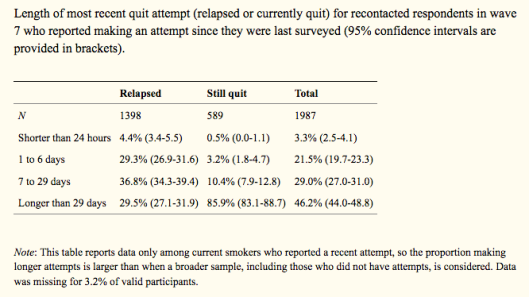
Relapse is a major, much studied sequalae to quit attempts. Far more smokers relapse than quit permanently. Across all methods, relapse dominates, with the maximum rates occurring in the first month after an attempt (eg: see table below).

1. screen shot 2019-01-08 at 4.26.59 pmSource

This means that cross-sectional (“snap-shot”) surveys which report findings on what people’s smoking status is on the day they answered the survey questions have major limitations. Many people have inaccurate recall of their smoking and quit attempt histories and many people who report being ex-smokers on the day they answered the question would answer that they had returned to smoking if asked the same question a few weeks or months later.

For example, this study proposed that by 2014, 6.1m Europeans had quit smoking by vaping. But such “big” numbers often do not withstand scrutiny. The 6.1 million number comes from a cross-sectional survey where ex-smokers reported they used to smoke, then used e-cigarettes and now don’t smoke. Were it only that simple. This critique makes the key point that the survey questions would have allowed those who quit for only a short period to say they had stopped, when relapse is a major phenomenon and demands a longer-term view.

The critics also asked:

“… how many of those who claim that they have stopped with the aid of e-cigarettes would have stopped anyway, and how many of those who used an e-cigarette but failed to stop would have stopped had they used another method?”

Randomised controlled trials?

Well conducted randomised controlled trials are considered high quality evidence, but have major problems that make them difficult to generalise to “real world” settings. If you volunteer to participate in a trial, you are likely to have a disposition to want to help science and so will probably be very positive and diligent about following the study protocol – unlike the way many in real world conditions forget to take their drugs or relapse. Trial participants are regularly contacted by study organisers trained in  cohort retention strategies. This regular contact can result in trialists wanting to please “the lovely research assistant who calls me up each week” and can artificially increase study group retention rates, again unlike real world use where no such influences occur.

And if you are heavily dependent on nicotine, enrolled in an RCT  and allocated to a study arm with placebo nicotine, guess what? Your withdrawal symptoms will quickly let you know that you are not getting any nicotine, so your belief that the nicotine replacement (NRT or ecigs) you hope you are using might do the trick will instantly be in tatters, with undermining consequences for your quit attempt.

For all these (and several other) reasons, the most important forms of evidence about how people quit smoking are longitudinal cohort studies which use high quality participant selection protocols to best ensure that those being interviewed are a representative sample of the smoking population. With smoking cessation, the endemic problem of high relapse back to smoking makes it vital that we take a helicopter view across time of how long transitions in and out of smoking last, long term and permanent quitting, being the ultimate outcome of interest. The large body of evidence we have about relapse heavily underlines that “persistent abstinence” is of far more importance than a former smoker’s smoking status on a particular day, which can change quickly.

In 2018, two particularly important papers were published by US researchers using the longitudinal PATH ( Population Assessment of Tobacco and Health) data set.

Let’s take a close look at what they found.

Coleman B et al, Tob Control 2018;0:1–10. doi:10.1136/tobaccocontrol-2017-054174

This important report on transitions in the vaping and smoking status of a nationally representative cohort of American  adults  aged 18+ who use electronic cigarettes (EC) provides rich data that greatly advances our understanding of the natural history of EC use.

If we examine the report’s data and consider the net impact of vaping on the critical goals of having vapers stopping smoking and vaping non-smokers not starting to smoke, the findings are very sobering and should give strong reason for pause among those advocating e-cigarettes as a game-changing way of stopping smoking.

The study reported on transitions between participants’ responses at Wave 1 and Wave 2, obtained 12 months later. At Wave 2, of the cohort of 2036 dual users (EC + smoking) only 104 (5.1%) had transitioned to exclusively using ECs and another 143 (7%) had quit both EC and smoking for a combined total of 247 (12.1%) who had persistently quit smoking. Of the 896 exclusive EC users at Wave 1, 277 (30.9%) had stopped vaping at Wave 2.

So together, 524 out of the 2932 EC users (17.9%) followed from Wave 1 might be considered to have had positive outcomes at Wave 2 (ie: quitting smoking and/or quitting EC).

The other side of the coin however, shows that of the 2036 dual users at Wave 1, 886 (43.5%) relapsed to using cigarettes exclusively. In addition, among the 896 exclusive ECusers from Wave 1, 109 (12.2%) had stopped vaping and were now smoking, with another 121 having resumed smoking as well as using EC (i.e. became dual users). Importantly, 502 of 896 (56%) exclusive e-cigarette users were those who had never been established smokers prior to using e-cigarettes. Alarmingly, of these 502 adults, 120 (23.9%) progressed from using only e-cigarettes to either dual use (54 or 10.8%) or smoking only (66 or 13.2%).

Taken together, 886 dual users in Wave 1 relapsed to become exclusive cigarette smokers in Wave 2, and 230 exclusive vapers in Wave 1 took up cigarette smoking in Wave 2 (dual use or exclusively cigarettes). Undoubtedly, these should be considered as negative outcomes.

The table below shows that for every person vaping at Wave 1 who benefited across 12 months by quitting smoking, there were 2.1 who either relapsed to or took up smoking. Most disturbingly, in this adult cohort nearly one in four of those who had never been established smokers took up smoking after first using EC. Concern about putative gateway effects of ECs to smoking have been dominated by concerns about youth. These data showing transitions from EC to smoking in nearly a quarter of exclusive adult EC users with no histories of established smoking should widen this debate to consider adult gateway effects too.

(2018) ColemanTransitionsSummary.png

By far the largest proportion of those with negative outcomes are those dual users who relapsed to smoking (886 or 43.5% of dual users). As the authors noted in their discussion, many of these were infrequent EC users, possibly involved in transitory experimentation at Wave 1. If we add the 902 who were still dual using at Wave 2, then 1788 of 2036 dual users (87.8%) in this sample might be said to have been held in smoking (dual using or exclusive smoking) 12 months later compared to 12.1% dual users who may have benefited by using ECs.

Commercial interests in both the tobacco and EC industries would be more than delighted with these findings. However, from public health harm reduction perspective these results argue against EC being a revolutionary effective harm reduction strategy, and point to their far stronger potential to both recruit smokers and hold many smokers in smoking.

Benmarhnia T et al American Journal of Epidemiology 2018 DOI: 10.1093/aje/kwy129

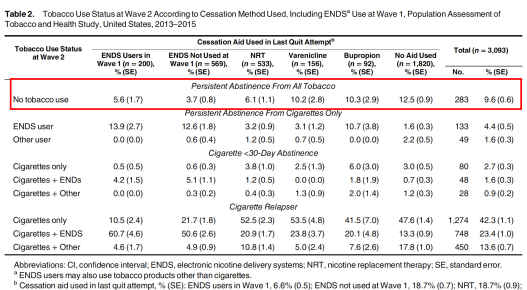
In a second paper using the PATH data, the authors considered persistent abstinence (not using tobacco for more than 30 days). The red highlighted section of the table below shows that those smokers who used ecigs (called ENDS in the table) had the worst persistent abstinence all-tobacco quit rates of any group in the cohort (5.6% of those who were vaping at the Wave 1 survey  and 3.7% of those who too up vaping between Wave 1 and Wave 2). By far the most successful all-tobacco quit rate was for “no aid used” (ie cold turkey or unassisted cessation) with 12.5%.

When we multiply these quit rates by the numbers of smokers using each quit method, the yield of persistent quitters is even starker (see the second table below derived from the data in the table immediately below).

blog table

screen shot 2019-01-09 at 1.37.45 pm

So in this major national cohort of US smokers, not only did EC use produce the lowest rate of persistent abstinence from tobacco use after one year compared to all other quit methods, but EC’s contribution to population-wide tobacco abstinence was utterly dwarfed by all other methods (10.9% v 89.1%). The much-denigrated and neglected unassisted cessation approach quietly ploughed on, continuing  its massive historical dominance of how most ex-smokers quit, contributing 1.5 times more quitters than all other methods combined.

Blog Stats

  • 163,470 hits

Top Posts & Pages

  • Why I’m not quitting Spotify because its owner has hugely invested in weaponry
  • Australia takes off the gloves on illegal tobacco while ‘lower the tax’ fantasists plumb new absurdities
  • About/CV
  • Vaping theology: 6 There’s nicotine in potatoes and tomatoes, so should we restrict or ban them too?
  • My books
  • Regrets … I’ve had a few. Paul Hogan and his Winfield role.
  • Thinking of keeping koi? Advice for beginners in NSW
  • Cheap illegal cigarettes save low income pack-a-day smokers over $9000 a year. So why don’t social justice champions give them full support?
  • Why Australia’s illegal tobacco and vape trade continues to flourish and what should be done about it
  • My first seen, best and worst bands 1964-2022

Blog archive

Comment Policy: No anonymous or pseudonymous posts will be published

Recent Posts

  • Australia takes off the gloves on illegal tobacco while ‘lower the tax’ fantasists plumb new absurdities
  • Egg on some faces: statisticians at 10 paces on the impact of New Zealand’s vape laws on youth smoking
  • Lowering tobacco tax to make illegal tobacco sales “disappear overnight”: at last we have a proposed figure and it’s an absolute doozie
  • Why I’m not quitting Spotify because its owner has hugely invested in weaponry
  • Should we believe Fiona Patten on vapes? Here are just a few problems

Recent Comments

Jon Krueger's avatarJon Krueger on Egg on some faces: statisticia…
Atul Kapur's avatarAtul Kapur on Should we believe Fiona Patten…
Unknown's avatarCould a national tob… on If expensive cigarettes are dr…
tahirturk1's avatartahirturk1 on Why Australia’s illegal tobacc…
malonere's avatarmalonere on Words I’ve seen, but didn’t kn…

Archives

  • December 2025
  • August 2025
  • July 2025
  • June 2025
  • May 2025
  • March 2025
  • January 2025
  • November 2024
  • October 2024
  • September 2024
  • July 2024
  • May 2024
  • April 2024
  • March 2024
  • February 2024
  • January 2024
  • December 2023
  • November 2023
  • October 2023
  • September 2023
  • August 2023
  • July 2023
  • June 2023
  • May 2023
  • March 2023
  • February 2023
  • January 2023
  • December 2022
  • November 2022
  • October 2022
  • August 2022
  • June 2022
  • April 2022
  • March 2022
  • February 2022
  • January 2022
  • December 2021
  • October 2021
  • September 2021
  • August 2021
  • June 2021
  • May 2021
  • April 2021
  • March 2021
  • February 2021
  • January 2021
  • December 2020
  • November 2020
  • October 2020
  • September 2020
  • August 2020
  • July 2020
  • June 2020
  • May 2020
  • April 2020
  • March 2020
  • February 2020
  • January 2020
  • December 2019
  • November 2019
  • October 2019
  • September 2019
  • August 2019
  • July 2019
  • June 2019
  • May 2019
  • April 2019
  • March 2019
  • February 2019
  • January 2019
  • December 2018
  • November 2018
  • October 2018
  • September 2018
  • August 2018

Categories

  • Blog

Meta

  • Create account
  • Log in
  • Entries feed
  • Comments feed
  • WordPress.com

Blog at WordPress.com.

  • Subscribe Subscribed
    • Simon Chapman AO
    • Join 198 other subscribers
    • Already have a WordPress.com account? Log in now.
    • Simon Chapman AO
    • Subscribe Subscribed
    • Sign up
    • Log in
    • Report this content
    • View site in Reader
    • Manage subscriptions
    • Collapse this bar
 

Loading Comments...