• Home
  • About/CV
  • Blog
  • Vaping Research Alerts
  • Blog archive list
  • My books
  • Memoirs
  • Music, bands, films
  • Contact

Simon Chapman AO

~ Public health, memoirs, music

Simon Chapman AO

Monthly Archives: August 2019

We (also) deny targeting kids: your free guide to playing Big Vape/Tobacco bingo

28 Wednesday Aug 2019

Posted by Simon Chapman AO in Blog

≈ Leave a comment

For decades the tobacco industry publicly denied that it was intensely interested in promoting smoking by children and teenagers. Any first year undergraduate in marketing  of course understands that any industry professing to have no interest in grooming those who were not yet using its products, but might well do so, would need its commercial head read.

Imagine a Volkswagen executive explaining that VW’s business plan was entirely built on persuading existing car owners to stay with VW or switch to it from their current make of car, and then going out of his way to explain that his company had not the slightest interest in selling cars to first-time car buyers, many of whom would be newly licensed. Major shareholders would run such a person out of the building.

But this has been the stock response always given by the tobacco industry for decades whenever accused of targeting kids. The shaming power of the predatory Piped Piper metaphor, where malevolent figures play beguiling (marketing) tunes to impressionable children, causing them to follow the Piper to their deaths, has always seen the industry, hand-on-heart deny any interest in kids in what is the longest-running lie in the commercial world.

With the tsunami of many millions of internal tobacco industry documents that were released under the terms of the 1998 Master Settlement Agreement, the farcical denials by the tobacco industry about its salivating interest in children came to a public end for more than a decade, when the industry took the decision to rarely speak in public anymore. Instead it lobbied privately and via third party acolytes knowing it would be humiliated publicly by the production of countless of its internal documents that showed it was knowingly lying.

These internal documents were a potent, undeniable truth serum that the industry never expected to be forced to drink in public.

Screen Shot 2019-08-28 at 3.06.27 pm

But today, they are again back in the denial game as they mount a new white horse of harm reduction that they unsucessfully rode in the past with filters, “lights and milds” and “reduced carcinogen” cigarettes. Despite the core twin pitches of ecigarette hype  (that they are all but of benign risk, and that they are spectacularly effective at helping smokers quit), ecig manufacturers still can’t bring themselves to stop saying that ecigs are only for adult consumption.  Along with the independent vaping industry (which is predictably being steadily hoovered up by Big Tobacco companies), we are seeing a near-complete reprise of the oleaginous public   “these are not for children” declarations from Big Tobacco and its new apologists. The only difference is that today it’s the same fake arguments being applied to  ecigarettes.

There was a huge amount of research published about denials about designs on kids in the early 2000s. This powerpoint set of 72 slides by Stacy Carter, originally published on the Tobacco Control journal’s website, is probably the single best catalogue of industry duplicity about kids and smoking that I know of.

Look through it and keep it handy the next time you hear industry employees or stooges assuring interviewers that children vaping is the furthest thing from their minds.  See how many bingo points you can score by matching today’s lies with those the tobacco industry used in public prior to 1998.

Here is a selection of some of these papers on youth by a research group who worked with me on a four year US National Institutes of Health grant (2001-2004) looking at industry document revelations about youth smoking in Australia and Asia.

  1. Assunta N, Chapman S. A mire of highly subjective and ineffective voluntary guidelines: tobacco industry efforts to thwart tobacco control in Malaysia. Tobacco Control 2004;13 (Suppl) 2):ii43–50
  2. Assunta M, Chapman S. Industry sponsored youth smoking prevention programme in Malaysia: a case study in duplicity. Tobacco Control 2004; 13 (Suppl 2):ii51–57.
  3. Knight J, Chapman S. “Asian yuppies … are always looking for something new and different”: creating a tobacco culture among young Asians. Tobacco Control 2004; 13 (Suppl 2): ii22–29.
  4. Knight J, Chapman S. “A phony way to show sincerity, as we all well know”: tobacco industry lobbying against tobacco control in Hong Kong. Tobacco Control 2004; 13 (Suppl 2): ii13–21.
  5. Tofler A, Chapman S. “Some convincing arguments to pass back to nervous customers”: the role of the tobacco retailer in the Australian tobacco industry’s smoker reassurance campaign, 1953–1978. Tobacco Control 2003;12 (Suppl 3): iii7–iii12.
  6. Carter SM. From legitimate consumers to public relations pawns: the tobacco industry and young AustraliansTobacco Control 2003; 12 (Suppl 3):

Abortion in NSW in 1971: a personal account

20 Tuesday Aug 2019

Posted by Simon Chapman AO in Blog

≈ 1 Comment

This week’s debate in the NSW parliament on decriminalising abortion, brought back memories for me of my experience with my first wife Annie in 1971 when she became pregnant at just 19.

We were childhood sweethearts from Bathurst#. We’d both moved to Sydney after finishing school, and having lots of furtive sex, were doing all we could to keep it from her disapproving Catholic parents. Annie had been sent away to boarding school in Moss Vale when a deputation of school nuns intercepted my unrestrained teenage love letters and paid her parents a visit.  Annie was close to her mother and despite school being over, felt it would hugely upset her mother if our carnality came out in the open.

I was a second year undergraduate, living in a $5 a week room in a ramshackle Glebe terrace with four friends. I worked as a car park attendant at Wynyard Travelodge at weekends to get a little money to live on. We got our weekly fruit and vegetables at the market at closing time when they were almost being given away##. I had virtually no money in the bank. Annie was working in temporary typing and shorthand jobs, still living at home.

The tailor-made pill

On campus one day in 1971, I saw a poster advertising a talk about “the tailor-made pill” which would be given by Professor Harvey Carey (1917-1989), Head of the School of Obstetrics and Gynaecology at the University of New South Wales and an early pioneer in the development of the oral contraceptive pill which had first become available in Australia in 1962. He was recruiting women for his work involved trialing changing doses with a focus on adverse side effects and contraceptive effectiveness as the outcomes of interest. The pitch was that he’d tailor-make a pill for each woman that was effective and would minimize any side-effects. Here (from 24m38s) is an extended interview with him.

Annie and I both went along to the talk, hoping to put condoms behind us. We felt lucky to be able to be in the hands of a leading researcher. It would also be free, a big consideration for us in our penury. Annie signed up and was on the pill for most of 1971.

Marriage

In November that year, we got married. We were both only 19, full of plans for finishing university at the end of 1972 and then setting out to explore the world. Her parents were very comfortably off and while we felt we were ridiculously young to be getting married, it was likely that a decision to live together would deeply anger them (mine were counselling that we should just live together, something I found out late in life they had always done – they never married). Her father was a self-made, determined man and we thought it possible he might even disown her, and break her mother’s heart. A decision to marry, we thought, might also see some sort of leg-up gift to help us out for a few years until we started earning.

We were married in the registry office opposite St Mary’s catholic cathedral in Sydney at 11am. In keeping with the haut couture of the time, I’d bought a dapper three piece suit and purple shirt and tie and at 9am had gone to a fashionable Italian barber in the Menzies Arcade to have my 1970s hippie tresses washed and blow-dried (picture). Our parents, siblings and her aunt and uncle adjourned to solemn, mostly unsmiling lunch at the Wentworth Hotel in Phillip Street. It felt a little like a funeral, more than a wedding.

CCI20082019_3

Mid-afternoon we went up to the hotel room her parents had bought for us for the night and, quite bizarrely, her father took a photograph of us standing next to the bed.

When he left, we began to get into bed but then Annie realized that her supply of the pill had finished. She had bad tonsillitis with a slight temperature, so called up Carey’s clinic at the Royal Women’s Hospital in Paddington to see if it was OK if I could go up and collect a renewal. So on my wedding day, I splashed out and caught a bus up to Paddington, sat in the waiting room till the tailored pill supply was put together, and then caught the bus back to the honeymoon suite. I’d proudly told the receptionist that it was my wedding day.

Annie took one look at the strip of pills I’d been given and immediately said they were the wrong ones. The colours of the pills, or their sequence was not the same as those she had been using all year. She called up the clinic, but it was too late. They had closed for the day.

A couple of months later, Annie became pregnant. The changed colours of the pills suddenly took on a different meaning. Annie recalled telling the receptionist some months earlier that she was getting married in September. The receptionist took interest in this. Annie recalls her asking about the wedding date and noting it on her file. I had mentioned it when I fetched the new supply on the wedding day.

Carey’s work was very much about finding evidence about threshold doses that effectively prevented conception. He “developed the ‘Roman Catholic pill’ which did not suppress ovulation but rather regulated it to a particular time in the ovulation cycle”, so may have had connections to the church. We heard publicity about this at the time and wondered whether he had taken a decision to vary Annie’s dose from the time that her file would have flagged that her status was now changed to married. If this is what occurred, it was never discussed with her. And of course would have never had her consent.

Getting an abortion in 1971

Barely being out of childhood ourselves, we had no interest in having a child at 19, while still at university, with no jobs, an imminent one-bedroomed rented flat in a Randwick shack, even with $5000 in the bank (the wedding present). We were not remotely ready to have a child, which was why we used contraception. In those days, to get an abortion you had to be assessed by a doctor, an obstetrician and a psychiatrist who together would certify whether there was any threat to the health of the mother. As expected,  the doctor and the obstetrician both said there was no evidence that Annie could not have a baby. So the psychiatrist’s report was going to be critical.

We made contact with a network of feminists who recommended a psychiatrist known to be sympathetic to women seeking abortions. Annie went to see him and explained the circumstances of the pregnancy and our situation, but mostly to simply explain that we wanted to make the decision when we would have a child. The psychiatrist, a man, listened to this and then said “I’m sorry but nothing you have told me would allow me to make any recommendation that your mental health was at risk by a pregnancy”.

At this Annie became upset and cried. The psychiatrist then said “ah, that’s what I need. I can now see that you are very upset.” He provided a recommendation and Annie had the abortion soon afterwards. This humiliating farce was what women who were able to connect with such agents had to go through if they wanted a termination. Many without such connections would have had dangerous backyard abortions.

The women we had spoken to were very keen that we raise hell about what had happened. We declined, being apprehensive about the consequences of going public in those very different days. But we later told our story in a program on the social history of the Pill screened in  an ABC documentary series, Timeframe (1997 Episode 12).

Our fully planned and much loved son Joe was born in 1982 (pictured with Annie and my late parents in 1983).

(1984) Mum,dad,Joe,Annie

footnotes: # See memoir of my first 18 years here. ## See several short stories of my early work and travel experiences (with Annie) from pp12-38 here

Regrets … I’ve had a few. Paul Hogan and his Winfield role.

14 Wednesday Aug 2019

Posted by Simon Chapman AO in Blog

≈ 1 Comment

ABC TV’s Australian Story, will soon run a profile of Paul Hogan best known for his three Crocodile Dundee films, his eponymous television program  that ran from 1973-1984, and for fronting Rothmans’  Winfield cigarette campaign in Australia from  July 1972 until May 1980.

Hogan was spotted by Rothmans’ advertising  agency Hertz Walpole when appearing on Channel 9’s New Faces talent show in 1971. Here’s his first and most famous ad that appeared on Australian television (tobacco advertising on TV and radio was banned from September 1976).

With its budget price and Hogan’s “Anyhow, have a Winfield” sign-off, the brand rocketed to clear market leader. The campaign was revered in the advertising industry as the most successful tobacco advertising campaign ever. The “anyhow …” was a brilliant talisman that worked on multiple levels: (“unemployed or got a dead-end job, no social life, depressed, lonely, worried about all the talk about smoking and disease? Anyhow … have a Winfield”).

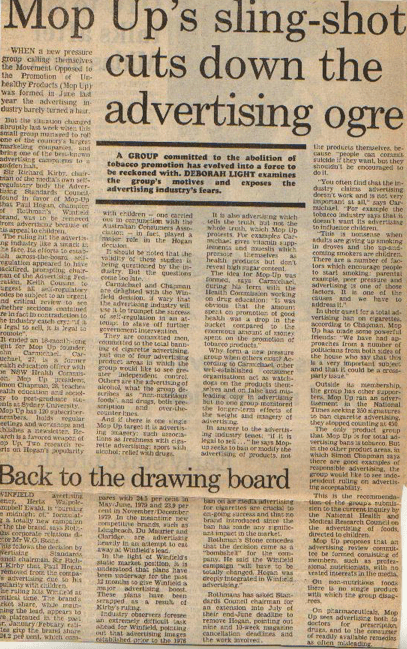
Very early in my career, I worked with several others in a public interest group MOP UP (Movement Opposed to the Promotion of Unhealthy Products) to test the tobacco advertising self-regulation system’s willingness to actually regulate itself. We submitted a complaint that the industry’s own voluntary code should have precluded Hogan’s involvement in the Winfield campaign because he had “major appeal to children”, something explicitly forbidden by the code. We’d seen audience data that his TV program was proportionately more popular with children than with adults.

After a saga that lasted 18 months, in May 1972 Sir Richard Kirby who headed the industry’s Advertising Standards Council ruled in our favour, agreeing with our arguments and leaving Rothmans little choice but to pull Hogan from its spectacularly successful campaign.

I wrote up a detailed account of the saga here. The Australian newspaper headlined our victory as “MOP UP’s slingshot cuts down the advertising ogre”

Screen Shot 2019-08-13 at 2.06.34 pm

The late Vernon Brink, then head of Rothmans, also attended Kirby’s judgement. I found myself with him in an adjacent ante-room before entering the room where the judgement was delivered at Sydney’s Wentworth Hotel. We made small talk but after a few moments said to me, cryptically “It’s such pity that you didn’t come and sit down with us and discuss all of this before we got to this point. I’m sure we could have come to some sort of arrangement.”

Regrets, they’ve had a few

On a visit to Australia in 2013, Hogan told the Sunday Herald Sun that one “campaign in the 1970s caused a lot of regret – his advertisement for Winfield cigarettes (“Anyhow… have a Winfield”)”.

Hogan was reported as saying: “Yeah, we were encouraging people to smoke. At the time, 1971 or something, they used to say: ‘Doctors recommend …’ or ‘Nine out of 10 smokers prefer…’ We were all being conned. When they put the medical warning in there I said, ‘I’m going to get out of this.'” He also said  “Young ones were taking up smoking and all going for Winfield. It was a staggering success but I was a drug dealer. But who knew then?” (my emphasis)

His business partner John Cornell said much the same in an interview in The Age “For both Paul and I (the Anyhow campaign) is the sole dismay of our professional lives … when we were selling cigarettes none of the evidence was out about how bad they were and how addictive they might be. When you find that out …” (my emphasis)

The first health warning appeared on Australian cigarette packs from January 1973, just  six months after Hogan fronted his first Winfield advertisement.  He continued in Winfield advertising until May 1980,  nearly seven years after the health warnings appeared. So if Hogan indeed wanted to ”get out of this”  he certainly took his time. The advertising industry magazine Advertising News, reported that there were in fact plans for a major relaunch which had to be scrapped after the Kirby judgement.

“Who knew then?” “None of the evidence was out?”

In fact it had long been common knowledge that smoking was deadly. The first major epidemiological studies were published more than 20 years earlier in 1950 in the British Medical Journal and the Journal of the Amercican Medical Association. The Royal College of Physicians of London (1962)  and the US Surgeon General (1964) published reviews of the evidence. News media gave this evidence huge coverage, motivating many millions of people  to quit. I have a huge folder thick with photocopies of Australian press articles highlighting this information from the 1950s into the 1980s.

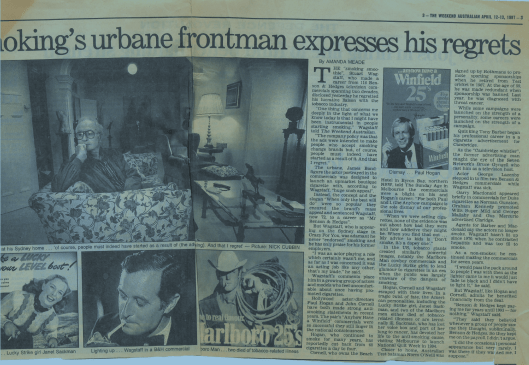
Hogan was not the only Australian celebrity to help promote cigarettes and then express regret. The late urbane actor Stuart Wagstaff helped Benson & Hedges with the “when only the best will do” pitch to frame the premium brand as way that wannabes could signal their aspirations after outlaying a few dollars.

Wagstaff told the Weekend Australian’s Amanda Meade in 1997 “One thing that concerned  me deeply in light of what we know today is that I might have been instrumental in people starting smoking.” But he said he never “endorsed” smoking and added that he continued to be paid for his advertising work for the brand until the early 1990s, long after the campaign ended.

Screen Shot 2019-08-14 at 10.54.19 am

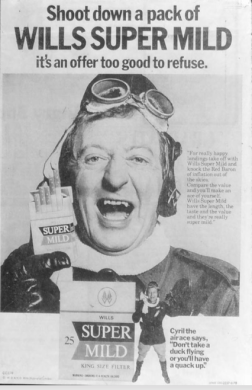
Comic Grahame Kennedy advertised Wills Supermilds, and Tony Barber advertised Cambridge cigarettes before getting his big TV break with Sale of the Century.

Screen Shot 2019-08-12 at 1.12.51 pmScreen Shot 2019-08-14 at 10.22.14 am


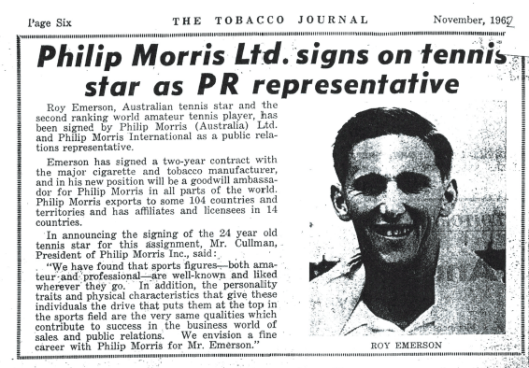
Sportspeople in on the act included tennis player Roy Emerson (1960s), and then many cricket, rugby league, and motor racing identities who willingly allowed themselves to be used to promote Winfield and Benson & Hedges and speak out against any calls for banning tobacco sports sponsorship before it was finally banned in 1992.

Screen Shot 2019-08-12 at 1.15.49 pm

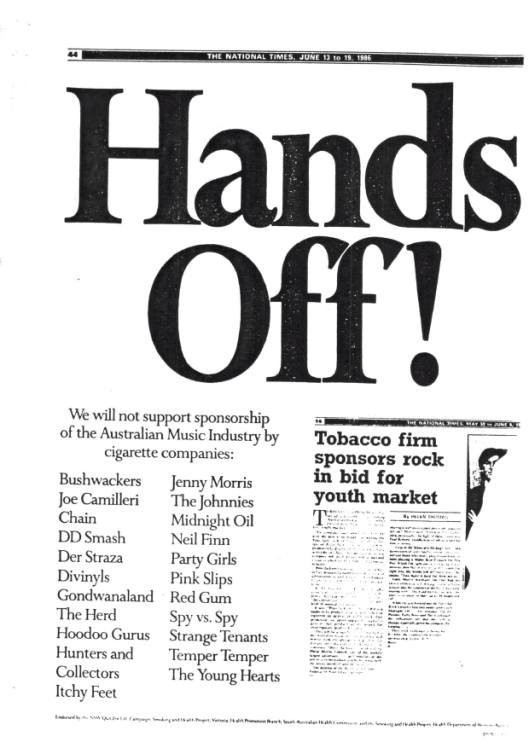
Rock musicians got in on the act too, playing on Philip Morris’ 1986 Peter Jackson Rock Circuit before bands like Midnight Oil, the Diviynls, the Hoodoo Gurus, and Hunters and Collectors showed leadership by boycotting it and explaining loudly why. The promotion was rapidly axed.

Screen Shot 2019-08-13 at 2.41.22 pm

“While money doesn’t talk, it swears

Obscenity, who really cares

Propaganda all is phony”

Bob Dylan: It’s all right, ma (I’m only bleeding)

Blog Stats

  • 163,470 hits

Top Posts & Pages

  • Why I’m not quitting Spotify because its owner has hugely invested in weaponry
  • Australia takes off the gloves on illegal tobacco while ‘lower the tax’ fantasists plumb new absurdities
  • About/CV
  • Vaping theology: 6 There’s nicotine in potatoes and tomatoes, so should we restrict or ban them too?
  • My books
  • Regrets … I’ve had a few. Paul Hogan and his Winfield role.
  • Thinking of keeping koi? Advice for beginners in NSW
  • Cheap illegal cigarettes save low income pack-a-day smokers over $9000 a year. So why don’t social justice champions give them full support?
  • Why Australia’s illegal tobacco and vape trade continues to flourish and what should be done about it
  • My first seen, best and worst bands 1964-2022

Blog archive

Comment Policy: No anonymous or pseudonymous posts will be published

Recent Posts

  • Australia takes off the gloves on illegal tobacco while ‘lower the tax’ fantasists plumb new absurdities
  • Egg on some faces: statisticians at 10 paces on the impact of New Zealand’s vape laws on youth smoking
  • Lowering tobacco tax to make illegal tobacco sales “disappear overnight”: at last we have a proposed figure and it’s an absolute doozie
  • Why I’m not quitting Spotify because its owner has hugely invested in weaponry
  • Should we believe Fiona Patten on vapes? Here are just a few problems

Recent Comments

Jon Krueger's avatarJon Krueger on Egg on some faces: statisticia…
Atul Kapur's avatarAtul Kapur on Should we believe Fiona Patten…
Unknown's avatarCould a national tob… on If expensive cigarettes are dr…
tahirturk1's avatartahirturk1 on Why Australia’s illegal tobacc…
malonere's avatarmalonere on Words I’ve seen, but didn’t kn…

Archives

  • December 2025
  • August 2025
  • July 2025
  • June 2025
  • May 2025
  • March 2025
  • January 2025
  • November 2024
  • October 2024
  • September 2024
  • July 2024
  • May 2024
  • April 2024
  • March 2024
  • February 2024
  • January 2024
  • December 2023
  • November 2023
  • October 2023
  • September 2023
  • August 2023
  • July 2023
  • June 2023
  • May 2023
  • March 2023
  • February 2023
  • January 2023
  • December 2022
  • November 2022
  • October 2022
  • August 2022
  • June 2022
  • April 2022
  • March 2022
  • February 2022
  • January 2022
  • December 2021
  • October 2021
  • September 2021
  • August 2021
  • June 2021
  • May 2021
  • April 2021
  • March 2021
  • February 2021
  • January 2021
  • December 2020
  • November 2020
  • October 2020
  • September 2020
  • August 2020
  • July 2020
  • June 2020
  • May 2020
  • April 2020
  • March 2020
  • February 2020
  • January 2020
  • December 2019
  • November 2019
  • October 2019
  • September 2019
  • August 2019
  • July 2019
  • June 2019
  • May 2019
  • April 2019
  • March 2019
  • February 2019
  • January 2019
  • December 2018
  • November 2018
  • October 2018
  • September 2018
  • August 2018

Categories

  • Blog

Meta

  • Create account
  • Log in
  • Entries feed
  • Comments feed
  • WordPress.com

Blog at WordPress.com.

  • Subscribe Subscribed
    • Simon Chapman AO
    • Join 198 other subscribers
    • Already have a WordPress.com account? Log in now.
    • Simon Chapman AO
    • Subscribe Subscribed
    • Sign up
    • Log in
    • Report this content
    • View site in Reader
    • Manage subscriptions
    • Collapse this bar
 

Loading Comments...