Update: since I published this blog 12 days ago, I’ve learned that the Singapore government has implemented GPS monitoring of its citizens who are required to self-isolate. This news report and the illustration below describes the process which involves daily texts sent to those in isolation requiring them to send their GPS coordinates.
As at 22 March 2020, Singapore has recorded 432 cases of COVID19 and 2 deaths, in a population of 5.7 million (74 cases per million population). This compares with Australia’s tally of 1072 cases and 7 deaths (42 cases per million).

On March 8, ABC News reported that a Tasmanian man who was awaiting his COVID-19 test results and had been asked to self-isolate until the results were known, ignored this and worked several shifts at a Hobart hotel.

Self-isolation or self-quarantining at home is a core infectious disease containment strategy which can see forced isolation and strong penalties apply when a person fails to self-isolate. For example Queensland Health advises:
What happens to those who do not comply with self-quarantine orders?
“The health and wellbeing of Queenslanders is our top priority, and we know Queenslanders are always supportive of measures that protect the community.
Queensland Health is issuing notices to people who have travelled to at-risk areas, or who have been in contact with a confirmed case, that requests them to voluntarily quarantine themselves.
If a person is suspected to have breached the notice they had voluntarily agreed to, we’ll initially work closely with the person to ensure they not only understand their obligations, but also the importance and seriousness of self-quarantine under the current global circumstances.
There are additional compliance measures available to Queensland Health under the Public Health Act 2005, and any further failure to comply may be subject to enforced quarantine and receiving fines of up to $13,345 and other penalties.”
The British Medical Association’s ethics manager, Julian Sheather, has written this excellent summary of the ethical issues that arise in the decision of a state to coerce citizens into quarantine. He writes of the rights and duties of citizens, and of the key considerations of proportionality and government reciprocity when it requires the serious restrictions on individual liberty in quarantine:
“But where restrictions are justified, another critical principle comes in to play: reciprocity. Where individual rights are limited, the state accrues additional duties. These include ensuring that any burdens imposed are as limited as possible. Basic amenities such as food, water and medical care must be met. Compensation for lost income should be given. Priority access to novel treatments should be considered. Experience from Ebola suggests that without these guarantees, people will be imaginative in dodging restrictions.”
Here’s what the Australian Health Department means about isolation

As I write today, there are an estimated 50 million people in China’s Hubei province in lockdown, and 16 million in Northern Italy. [breaking: Italy has just declared the whole country to be in lockdown]. In Australia in the early days of the epidemic, those with Australian passports returning from China were asked to self-isolate. This has been extended to those coming from Iran and Korea with those arriving from northern Italy being carefully checked.
On seeing the ABC breaking news item above, I tweeted
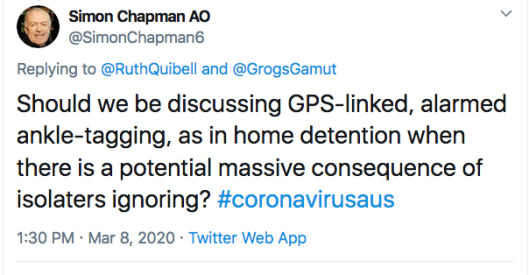
The Tasmanian case struck me as highly unlikely to be unique. With a high proportion of COVID-19 positive cases experiencing mild symptoms, particularly in younger age groups, it seemed very likely that many being asked to stay fully at home for 14 days would self-diagnose that, hey, I’m not feeling too ill, and self-exempt themselves from isolation, thereby risking infecting others in the community. If hundreds or thousands were to do this should the epidemic accelerate as it did in Hubei and is now doing in Italy and Iran, the consequences could be catastrophic.
Quarantine has been used around the world for centuries as a major strategy to try and contain outbreaks of deadly, highly infectious diseases like smallpox, plague, leprosy and TB (before the advent of effective drugs). Quarantinable diseases today include smallpox, cholera, diphtheria, plague, yellow fever, TB, Marburg and Ebola.
Courts have long used home detention in lieu of prison custodial sentences for those deemed suitable. Home detention is far less expensive than detaining someone in prison. It keeps families intact, avoids immersing some without previous criminal records in brutalising prison incarceration, keeps offenders away from the public in consideration of public safety and serves as a punishment. Wearable GPS-linked monitors like Fitbits are today inexpensive and in extremely widespread use particularly for personal activity and journey tracking, monitoring of those with dementia, and by parents wanting to track where their kids are. Programing them to signal when a person has moved out of a prescribed area is a basic capability. Making them non-removable without activating a signal is also the way they have long operated in custodial use.
The comparative costs of combining 14 day self-isolation of COVID-19 people with cost free, state-supplied, returnable mandatory wearable and non-removable monitors, against the stratospheric costs to lives and the economy of rapidly spreading COVID-19 is a no brainer.
Negative responses
My tweet set off several hours of extremely negative responses, all of which were highly case-in-point relevant to my assumption that the failure of self-isolation without monitoring would be anything but rare.
Here’s a sample of what I received. Stu opened the batting with:

Another agreed:
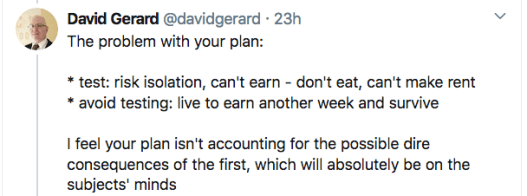
This of course, is an objection to quarantine per se, when those quarantined are not able to draw on employment sick leave benefits, nor compensated (almost never the case).
Ian seemed to think I was extremely wealthy and by raising monitoring for discussion, was offering to fund it!
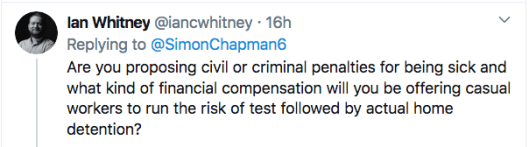

Note the host of assumptions with all of these: that some ordered to self-isolate, particularly those with hand-to-mouth incomes, in the casualised or gig economy workforce with no sick or holiday leave entitlements, will put economic necessity, hunger and shelter ahead of any concern that they might infect others; that quarantine “criminalises” and stigmatises people who are sick (when silly me thought it was all about trying to control a rapidly spreading disease with no cure or vaccine that could kill many, many people); that because China was engaging in quarantine, this is all we needed to know: it is a totalitarian state strategy (conveniently overlooking that every nation has quarantine laws and practices, Australia’s dating from the arrival of the first fleet); and that quarantine was somehow a knee-jerk authoritarian solution being proposed instead of every other possible strategy (rather than being just one vitally important component).

In late February I’d tweeted in anticipation of employers trying to shaft their staff, and especially causal workforces, who may have little to no sick leave to fall back on, that legislation should make it illegal for any employer to not pay an employee in isolation, or caring for child from a shut-down school, for example.

No one tweeting against the monitoring idea who invoked the impact of short term quarantine on the most vulnerable workers seemed to have thought about the consequences on those same workers if COVID-19 became very widespread and devastated economies. Many industries employing casual staff would suffer badly with many casual staff laid off. So such objections seem very myopic.
Remarkably, those making these arguments were actually using them as arguments against fully complying quarantining, or perhaps didn’t understand that ordered self-isolation was already happening. They argued that there will be significant recalcitrance, pointed to the numbers who have “gone underground” in previous epidemics and implied that therefore because all won’t comply with its conditions, it should be abandoned.
But no public health and safety regulation has 100% compliance, and this is usually not a sensible argument for abandoning liberty curtailing policies like random breath testing or speed limits. When I asked a few if they therefore did not support quarantine, interestingly none answered.
Just like HIV/AIDS
Some also castigated me for my alleged ignorance in not understanding the lessons from the HIV/AIDS epidemic, where coerced isolation (for example with HIV positive sex workers who kept working without condoms, needle sharing drug users) was only rarely used with just 5 cases of forced quarantine in the USA. If it didn’t need to be used with HIV/AIDS, it doesn’t need to be used for this new disease, ran the argument.

But there are of course immense differences between deliberate attempts to not avoid HIV transmission by knowingly positive people via sex, needle sharing and blood donation and the unintentional way that COVID-19 is spreading around the world (eg: skin contact, sneezing and contact with everyday surfaces that harbour live virus).
Importantly, there is a large body of research showing that social distancing is an effective way of slowing contagion of infectious diseases (eg: see here, here, here and here). A very recent paper with eye-watering modelling the of the comparative impact of quarantining and active monitoring of COVID-19 contacts concluded:
“individual quarantine may contain an outbreak of COVID-19 with a short serial interval (4.8 days) only in settings with high intervention performance where at least three-quarters of infected contacts are individually quarantined.”
Epidemic waning in China
The graph below compiled from WHO data by the University of NSW’s global biosecurity group shows how dramatically the Hubei epidemic is waning, following lockdown. Today, China reported zero new cases outside of Hubei for the third day in a succession. Few countries will be willing or able to enforce lockdowns or self-isolation in the manner China has been able to do (recall the ghastly, dramatic scenes from the recent Four Corners program where highly distressed COVID-19 positive people were being forcibly dragged into detention by authorities and doors of apartments were shown being welded shut to keep sick people inside).
In Australia, GPS monitoring of confined people over the two-week period of isolation may be a reasonable and far more humane way of minimising the spread of COVID-19. Some would very understandably have the instinctive reaction that a requirement to wear a GPS monitor for two weeks would be frankly insulting and a sign that the government did not trust them. For this reason, it may frighten policymakers off.
But against this, there are quite obviously many who already do not trust governments, very many who very sadly say they do not trust science and medicine (while relying on and benefit from it in practically all they do every day) and many who give little concern to infection control when they have colds, influenza and other communicable diseases.
People won’t like it
This is an idea that will have many practical, cost and social acceptability implications. Many will not like it, as Anthony below suggested.
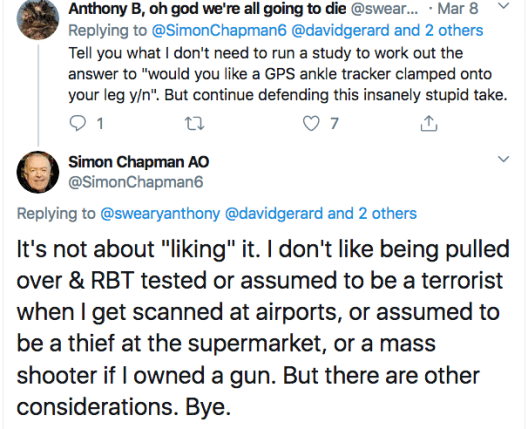
For debate.





 Simon Chapman AO