• Home
  • About/CV
  • Blog
  • Vaping Research Alerts
  • Blog archive list
  • My books
  • Memoirs
  • Music, bands, films
  • Contact

Simon Chapman AO

~ Public health, memoirs, music

Simon Chapman AO

Monthly Archives: July 2020

Vaping theology: 1 The Cancer Council Australia takes huge donations from cigarette retailers

30 Thursday Jul 2020

Posted by Simon Chapman AO in Blog

≈ Leave a comment

It seems that Dr Alex Wodak doesn’t like the Cancer Council Australia very much. Along with the agencies, authorities and  government departments all shown below, the Cancer Council supports strong regulation of ecigarettes in Australia, including health minister Greg Hunt’s plan to enforce the current ban on open retail sale of nicotine containing e-juice by making it only available on prescription from 2021.  This sets them apart from ATHRA who want to see ecigarettes available as widely as possible, with some advertising allowed,  lots of flavours (regardless of whether these appeal to children), and vaping allowed in smokefree areas.

Wodak is one of three directors of ATHRA (Australian Tobacco Harm Reduction Association). ATHRA appears to have no members but accepts donations from supporters. We don’t know how many supporters there are, or how supportive they are. But  in 2019 it sought to raise $15,000  but raised only $1,345 from 38 people, falling 88% short of its modest target.

However, in Wodak’s description, ATHRA received two “piddling” donations from two vaping companies at establishment in 2017  totaling $17,500.

ATHRA also received another presumably equally piddling $8,000 “unconditional” support from KAC (Knowledge Action Change), a private British agency. KAC is awash with  millions in funding from the Foundation for a Smoke-free World, the “fully independent” agency that happens to be solely funded by Philip Morris International. (KAC has also previously received grants from British American Tobacco’s offshoot Nicoventures.)

If Wodak thinks these donations were piddling, I wonder how he describes the rather more modest donations ATHRA gets from its supporters?

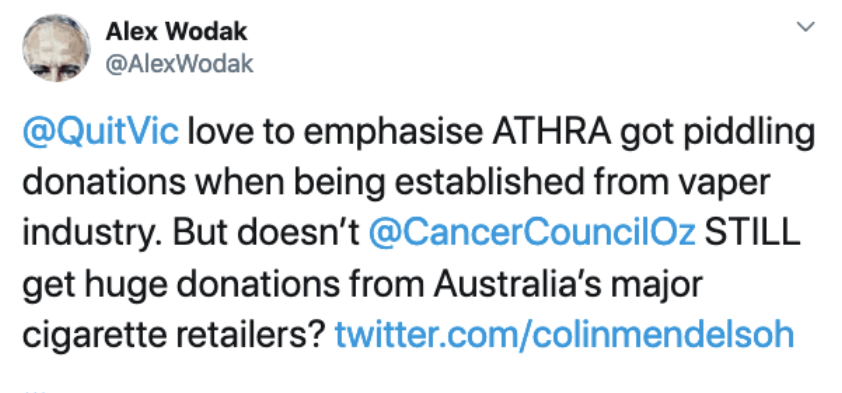
Perhaps smarting at journalists who frequently (and appropriately) question potential commercial influences on ATHRA’s policy positions, Wodak has been busy claiming on Twitter that the Cancer Council takes “HUGE donations from major national retailers of cigarettes”. He also retweeted this claim that Woolworths alone had donated $2m. In fact, he has tweeted references  to the Cancer Council takes money from tobacco and alcohol retailers six times in the last nine days.

These allegations of outrageous hypocrisy (“double standards”) sounded extraordinary to me. So I asked the Cancer Council if this was true. Here’s what they told me. All supermarkets except Aldi sell cigarettes, but the funding the Cancer Council received in the past from these chains has not been given by the supermarkets as a slice of their income that included tobacco sales. Instead it has been from in-store fundraising collections and the sale of Cancer Council fundraising daffodil pins, supermarket staff donations, the use of in-store community benefit shopping cards and the sale of Cancer Council sunscreen. All of these sources of fund raising have absolutely nothing to do with tobacco sales, as Wodak implies.

They wrote:

“Cancer Council does not take money directly from industries associated with carcinogen production including the tobacco and alcohol industries. We also avoid any donations that might imply or seem to pressure Cancer Council into adopting policy positions in their favour, such as the pharmaceutical industry, as we value our independent voice on health matters. Cancer Council, like most charities, has accepted fundraising via supermarket networks. In Coles, for example, collections bins for Daffodil Day have raised donations from the public but these donations do not come directly from the supermarkets.”

In 2009 Ritchies IGA supermarkets also donated $1.4m provided by its customers via its Ritchies Community Benefit Card charity initiative.

Perhaps though, Wodak is alluding to some impurity of association in these donations? Is he arguing that the mere fact that the supermarkets, with their hands dirty from selling cigarettes, have metaphorically handled the money obtained from in-store collection boxes or pin sales, making these transfers dirty tobacco money?

If so, every time that he or I or anyone buys anything at a supermarket or fill our cars with fuel from Caltex (Woolworths) or Shell (Coles) or buy liquor from Dan Murphy’s or BWS (Woolworths) or Liquorland, Vintage Cellars or First Choice (Coles) are we also somehow soiled with tobacco associations?

By the same logic Wodak uses here, there is no person in Australia who is not in receipt of benefits partly paid for by tobacco sales. The Commonwealth’s estimate of tobacco excise receipts for 2020-21 is $15.61 billion. This represents 3.2% of expected total government revenue of $490.036 billion.  Tobacco tax goes into consolidated revenue along with all government revenue which is used to pay for government expenditure. So every time we all drive on a public road, use a public hospital, send our kids to school, or use any government funded infrastructure, a portion of the cost of those goods and services is funded by smoking. When we get a Medicare rebate payment of say $50, it might even be said that $1.60 of each transfer into our bank comes from tobacco sales.

It does not follow from this that we should all cry and tear out our hair in a moral heap that we are all getting tobacco money. Tobacco tax of course is known to be a powerful factor in driving tobacco consumption down. This 2019 Treasury paper shows  (below) the recent historical relationship between excise going up and cigarette sales going down.  Because of that, I’m more than fine with tobacco tax: it drives consumption down and provides money for essential infrastructure and government expenditure, as it does in every country.

All this is of course far different to an organisation taking funding directly from vaping companies, or from a third party which distributes money from an agency which receives it all from a tobacco company. Which is what ATHRA has done. 

Wodak spent most of his career employed in drug and alcohol services at Sydney’s St Vincent’s Hospital. St Vincent’s Health Australia operates the health and hospital services of the Roman Catholic Sisters of Charity and is part of Mary Aikenhead Ministries. The Catholic church in Australia and globally has of course been the focus of enormous criticism for its record with paedophile priests, for its policies and practices on contraception, abortion, opposition to same-sex marriage and the ordination of women.

On the assumption that Wodak shares the concerns that many have about the Catholic church’s  problems, would anyone seriously argue that he therefore had “double standards” in working for a hospital connected with the church, even though the hospital’s drug and alcohol services have nothing to do with any of those policies?

ATHRA’s objectives are anti-smoking as well as pro-vaping (although you will search for a long time before finding any supportive contribution to anything but vaping on their website).  I may have missed it (although I don’t think I have), but I’ve not seen ATHRA nor Wodak shaming other charities that the major tobacco supermarket retailers support and calling them out for being in receipt of retail tobacco sourced donations. These include OzHarvest, Foodbank, White Ribbon, Redkite, Children’s Hospitals, Ovarian Cancer Australia, Hummingbird House to name a few. Would a little consistency be too much to ask for?

Wodak has often called for civility in the debate about ecigarettes. Vaping advocates have been frequently far more than odious in all this (see this large collection). If he is sincere in this, he should stop and retract his ill-informed and reputationally damaging accusations about the Cancer Council.

The Cancer Council has a very strong reputation with the Australian public as measured by the 2019 Charity Reputation Tracker scoring over 80%. Cancer Council is the most loved brand in the general charity category measured by Kantar and is also highest in terms of trust by the public. The Cancer Council consistently scores in the top three most trusted charities in Australia in the annual Reader’s Digest Awards alongside Guide Dogs Australia and the RSPCA.

I have seen tweets where vapers have talked about urging people to not donate to the Cancer Council. There is apparently no evidence that this is happening but the consequences of reductions in community support for the amazing work that the Cancer Council has done for many decades in prevention, research and patient support would be frankly appalling.


Tailpiece: one month after this blog was published, Wodak was back on his sad, deflated case, replying to a tweet from someone making another easily checked false statement that “the government” provides most of the Cancer Council’s funding. It doesn’t. It comes from community donations. Plus ça change, plus c’est la même chose.

Declaration: I was an honorary board member of the Cancer Council NSW from 1997-2006

[Edit]

Other blogs in this series

Vaping theology: 1 The Cancer Council Australia takes huge donations from
cigarette retailers. WordPress  30 Jul, 2020

Vaping theology: 2 Tobacco control advocates help Big Tobacco. WordPress 12 Aug, 2020

Vaping theology: 3 Australia’s prescribed vaping model “privileges” Big Tobacco WordPress Feb 15, 2020

Vaping theology: 4 Many in tobacco control do not support open access to vapes because they are just protecting their jobs. WordPress 27 Feb 2021

Vaping theology: 5 I take money from China and Bloomberg to conduct bogus studies. WordPress 6 Mar, 2021

Vaping theology: 6 There’s nicotine in potatoes and tomatoes so should we restrict or ban them too? WordPress 9 Mar, 2021

Vaping theology: 7 Vaping prohibitionists have been punished, hurt, suffered and damaged by Big Tobacco WordPress 2 Jun, 2021

Vaping theology: 8 I hide behind troll account. WordPress 29 Jun, 2021

Vaping theology: 9 “Won’t somebody please think of the children”. WordPress 6 Sep, 2021

Vaping theology: 10: Almost all young people who vape regularly are already smokers before they tried vaping. WordPress 10 Sep, 2021

Vaping theology: 11 The sky is about to fall in as nicotine vaping starts to require a prescription in Australia. WordPress 28 Sep, 2021

Vaping theology: 12 Nicotine is not very addictive WordPress 3 Jan 2022

Vaping theology 13: Kids who try vaping and then start smoking,would have started smoking regardless. WordPress 20 Jan, 2023

Vaping theology 14: Policies that strictly regulate vaping will drive huge
numbers of vapers back to smoking, causing many deaths. WordPress 13 Feb, 2023

Vaping theology 15: The government’s prescription vape access scheme has failed, so let’s regulate and reward illegal sellers for what they’ve been doing. WordPress 27 Mar 2023

Vaping theology 16: “Humans are not rats, so everybody calm down about nicotine being harmful to teenage brains”. WordPress 13 Jul, 2023

Vaping theology 17: “Vaping advocates need to be civil, polite and respectful” … oh wait. WordPress 3 Oct, 2023

Vaping theology 18: Vaping is a fatally disruptive “Kodak moment” for smoking. WordPress Oct 30, 2023

Vaping theology 19: Vaping explosions are rare and those who mention them are hypocrites. WordPress 17 Nov, 2023

Vaping theology 20 : Today’s smokers are hard core nicotine dependent who’ve tried everything and failed – so they need vapes. WordPress 14 Dec, 2023

Vaping theology 21: Australia’s prescription vapes policy failed and saw rises in underage vaping and smoking. WordPress 10 Jan, 2024

Vaping theology 22: “Prohibition has never worked at any point for any other illicit substance”. WordPress 17 Mar 2024

Vaping theology 23: “84% of the Australian public are opposed to the way the government will regulate vapes” WordPress 2 Apr, 2024

Vaping Theology 24: “Tobacco control advocates are responsible for vape retail store fire bombings and murders. WordPress 27 May, 2024



The ethics of shaming prominent COVID-19 mask opponents

26 Sunday Jul 2020

Posted by Simon Chapman AO in Blog

≈ Leave a comment

A couple weeks ago, Oregon haematologist-oncologist, patient advocate and author of Malignant: How Bad Policy and Bad Evidence Harm People with Cancer Vinay Prasad tweeted this

His thread continued: “No physician would dare shame a person who died of lung cancer by sharing a photo of that person smoking in an effort to curb cigarette use It would be despicable, loathsome, & worse; no matter the ‘cautionary lesson’ and yet somehow this idea has vanished for covid19”

And then:

“I understand many are anxious or concerned, and many believe a variety of interventions make sense. But please, doctors do not blame our patients for disease. And, don’t reply to this thread saying ‘this is different’”

Sixteen responded, nearly all agreeing with his views, including some who used his tweet to pile-on the World Health Organization for not having recommended masks earlier than they did.

I posted this in response:

Prasad never responded to me nor to any others. So a few days later I tried again:

Again, no reply. So let’s explore the issues that his tweet raised for me. The argument that a person dead or dying from any disease or trauma should not be shamed or blamed for being a victim of that disease or injury has some obvious ethical and humane merits. But those merits can be parsed.

We rarely if ever see instances of blaming or shaming when the disease involved has important genetic components, when there is an absence of accepted modifiable risk factors for a disease (eg: brain, ovarian, pancreatic cancer), when in the case of traumatic injury deaths, the victim played no part in causing the injurious event, or when the cause of death multi-factorial, with a constellation of contributory issues.

We often though, see comments about the blood alcohol level of someone killed in a motor vehicle, or that someone was not wearing a seat belt. I wrote this piece about the death of Joe Cocker, a heavy smoker, at the age of 70, writing “Confused calls for a cone of “respectful” silence about smoking’s role in cancer and other tobacco-caused disease and for euphemisms about deaths following ‘a long illness’ are forged by the same mentality that thinks tobacco packs should not have graphic health warnings because they might remind people too well about what smoking can do.”

Prasad’s message was directed at his fellow doctors. It was also stimulated by something another doctor had written about someone. If he meant it to apply to all of us as well, he didn’t say so. But it’s worth considering whether the ethical standard he argues for doctors should be any different for all.

His invocation of decency and compassion as reasons for physicians never shaming those who have died go to the widely understood values that it is wrong to speak ill of the dead or to suggest that they had any agency in their fate. The memory of the dead, particularly for those who knew and loved them, should never be desecrated by attempts at shaming them with considerations that they contributed to their own demise.  Irony about a person getting their comeuppance from something that in life they went out of their way to avoid, embrace or proclaim drags in widely invoked metaphors about fools’ errands, tempting fate, hubris and the fall of Icarus for flying too near the sun.

The dead are beyond being harmed by shaming or black humour about them “getting what was coming to them”, but those grieving them are blameless and so we show compassion for their loss and not speak ill of the dead. The idea that those who make the effort to shame the dead are “dancing on their graves” in callous disregard for their loved ones’ grief adds a further dimension to the indecency here.

There is also a further consideration. There are very few causes of death which do not display an inverse socioeconomic gradient: the lower the socioeconomic status, the higher the incidence of disease and deaths. Analysts of this have long agreed that this is explained by social, economic and educational disadvantage. If you are little educated and poor, there will be many choices you cannot make as easily as those who are better educated and can afford many options in diet, housing, transport and occupation.

So if those less educated make more unhealthy and dangerous lifestyle choices, much of this can be explained as a consequence of intergenerational poverty and disadvantage. If most people in their families smoke and eat poor diets, an individual growing up in such an environment lives through more unhealthy influences than wealthier, more educated people. If they have little understanding of how to assess quack claims or rubbish being promoted about health risks, they may be far more likely to suffer the consequences. Shaming people in such circumstances can be deplorable victim blaming.

So the ethical imperative to leave the dead in peace enjoys widespread support, particularly when those who died are ordinary, little or unknown people. Those seeking to use their ill fate to advance various public health messages, are seen as vulture-like, runs the argument.

Is it different if you are a public figure who megaphones dangerous nonsense?

But as I read Prasad’s tweet, I immediately thought of many instances of powerful and prominent people who have made pernicious, life-endangering contributions to public health. All of these people have faced widespread incendiary criticism whenever they megaphoned their dangerous and irresponsible views. Think of anti-vaccinationists, politicians enabling the tobacco, fossil fuel, gambling and alcohol industries. Think of those actively trivialising COVID-19 risk, opposing social distancing policies and masks. There is a very long list of such people who have used their prominence in these ways, often undermining public trust in science, thwarting policy and legislation that could save uncountable lives.

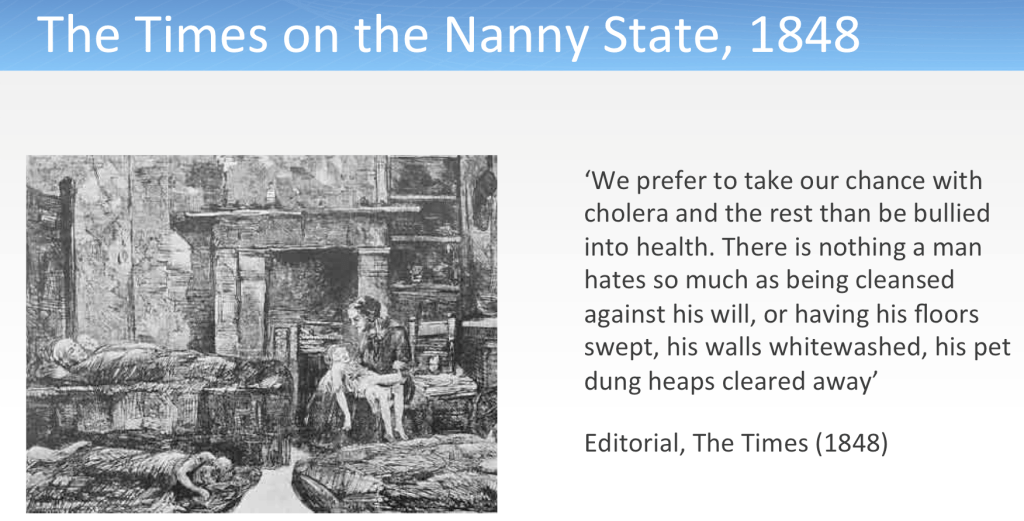
Just as anopheles mosquitoes are vectors for malaria, it has long been argued that the corporations and senior executives of tobacco companies are vectors for the diseases caused by smoking predicted to kill a billion people this century. Those currently aggressively opposing the mandatory wearing of masks in crowded areas are today’s equivalents to the editorial writer at The Times in London in 1848 who fulminated against public hygiene efforts to prevent the spread of cholera

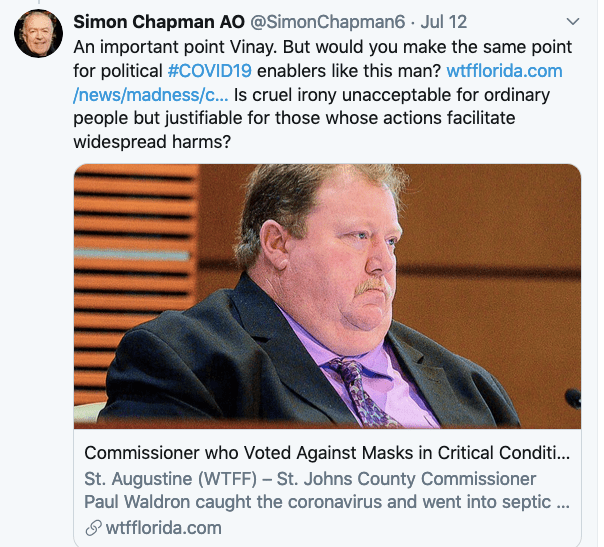
My question to Prasad was whether we should extend the same compassion to influential public figures who might suffer cruel ironies as we would to some unknown individual such as the young person that stimulated his tweet. Brazil’s president Bolsonaro reportedly mocked mask wearing with the homophobic slur that they were “for fairies” prior to acquiring COVID-19 himself. Would Prasad argue that these two facts should go unremarked out of a sense of decency for Bolsonaro and his family?

Brazil has had 2,348,200 COVID-19 cases with 85,385 deaths. It ranks second worst in the world for total cases numbers after the USA. Is it unethical to use Bolsonaro’s illness to highlight cases of  people like Bolsonaro as COVOD-19 super spreaders because of their policies and statements like the one above, or should  doctors (and everyone) stifle any criticism of him because he has acquired the deadly disease his policies have enabled the spread of and is thereby off limits?

I’m in no doubt that in such cases, the power of cruel irony can instantly and powerfully be penny-drop moments in public understanding. This in turn might play a role in (here) accelerating mask adoption and social distancing, self-evidently good things.

In 1982, the late Nigel Gray AO, a pioneer of Australian and global tobacco control, told two tobacco industry executives on national Australian television “I actually think that the responsible policy makers in the  tobacco industry should smoke a lot. I think that would be good for society.” (the link shows him making that statement)

This was both an amazingly cruel but also powerful way of pointing to a core hypocrisy that abounds in the tobacco industry where many senior employees and directors do not smoke but spend their days devising promotions and appeals to get as many people as possible to do so. Doubtless they would argue that they choose not to smoke. While the male head of a lingerie company would not be expected to “choose” to wear women’s underwear, smoking is a choice open to all. It is scarcely imaginable that the chairman of Ford would drive a Toyota or the head of the Meat Marketing Board would be a vegetarian. Such lack of personal confidence in their products would probably see them not long in their jobs. The tobacco industry does not seem to mind such an irony.

As Nigel Gray did in that interview,  there are times when we should rub the faces of such people in these ironies.

Why vapable nicotine juice via prescription is sensible public health policy

02 Thursday Jul 2020

Posted by Simon Chapman AO in Blog

≈ 2 Comments

Australia’s Health minister Greg Hunt has deferred the introduction by six months of his decision to prohibit the personal importation of vapable nicotine and to make nicotine containing vape juice available in Australia only by doctor’s prescription. The original decision was announced on June 19 , 2020 and was to be implemented from July 1 – just 11 days later.  This was always going to be far too soon to put in place the key mechanisms of the plan, and adequately advise vapers, GPs and pharmacists of the details of the scheme which are summarised here.

But Hunt’s plan has been very welcomed by everyone in public health I’ve discussed it with.  Here’s why it’s a very smart and responsible move.

  1. Open access to tobacco has been one of the biggest disasters in public health history

When cigarette production moved from being individually hand-rolled to being made in factories by machines that today can produce some 20,000 cigarettes per minute, the price fell dramatically facilitating access by those on even the lowest of incomes. Smoking sky-rocketed in the early years of the twentieth century, pausing only in the great depression and during the two world wars because of scarcity.

As lung cancer rose to become  (by far) the leading cause of cancer death (see graph below), controls on tobacco commenced. These began in the 1960s with early tepid health warnings and public awareness campaigns, from the 1970s by advertising restrictions and then bans, in the 1980s by smoke free public space legislation and tax policy, and in this century by graphic heath warnings, plain packaging and retail display bans.

But across all this time, tobacco and access to it has remained an entirely  unregulated product. Unlike pharmaceuticals, food and drink which are regulated for safety and efficacy (in the case of pharmaceuticals), cigarettes and roll-you-own tobacco have always been unencumbered by any regulatory standards, for the obvious reason that they would instantly fail any imaginable test and never be allowed to be sold.

When post WWII smoking prevalence reached 60-70% of men and 30% of women, and the bad news about smoking and disease began pouring in from the 1950s, any thoughts of governments banning tobacco were entertained only by those in political cloud-cuckoo land. In a 45 year career in tobacco control, I have never until recently heard any serious person ever advocate a set date for a ban on the sale of tobacco. This essay is the most coherent and important expression of where debate on phasing out the sale of combustible tobacco sits today.

But why regulate nicotine?

2. Nicotine is regulated as a poison in Australia. It is not as “safe as coffee”

Vaping interests have long been engaged in a global effort to rehabilitate nicotine’s reputation. They are usually fine in agreeing that it is addictive, but bend over backwards to promote it as being all-but-benign – “as risky as coffee” is the usual trivialising comparison used. Many seem to regard it as having an almost vitamin-like status. 

The late addiction specialist Michael Russell in 1976 that “People smoke for nicotine but they die from the tar”. This has become a talismanic mantra for vapers against nicotine regulation, rarely absent from any discussion. But in fact across the 44 years since Russell wrote those words, a large research literature has emerged on concerns about nicotine’s likely role as a cancer promoter (if you have a few hours, browse through lots of this research that I gathered together in this earlier blog), as a vasoconstrictor with major implications for cardiovascular disease , as a disruptor of cognitive development and as a possible cause of psychosis.

For these reasons, and because of nicotine’s in e-cigs strong addictive potential, Australia’s TGA continues to sensibly regulate nicotine as a poison or a therapeutic substance.

Vaping advocates are fond of arguing that because nicotine is freely available in tobacco products, it follows that nicotine for vaping should enjoy at least, if not more accessibility and be freely sold almost anywhere. This argument has all the integrity of a chocolate teapot. Cigarettes were given their unregulated commodity status  at the beginning of last century, long before the evidence accumulated about two in three long term users dying from smoking.  Vaping advocates insisting that e-cigs should share a regulatory playing field with cigarette accessibility seem happy to risk repeating the Sisyphean task we have faced with tobacco of trying to reduce the damage that 120 years of non-regulation has caused. It’s been 55 years since health warnings first appeared on tobacco packs and tobacco control commenced. The power of the tobacco industry has ensured that the legislative drag has nearly always been glacial.

3. We regulate and restrict access to many addictive drugs. Nicotine should not be exempted.

Every new therapeutic substance first available to consumers is regulated in all but politically chaotic nations where almost anything can be bought over the counter. Vaping advocates seem to believe their virtuous mission should exempt e-cigarettes and vapable nicotine from regulation, despite their every second sentence extolling the therapeutic virtues of vaping in cessation and harm reduction, thus catapulting it into the ambit of therapeutic regulation.

Vaping advocates messianically proclaim that vaping will save a billion lives (an estimated 1 billion smokers will die this century). This cavalier claim would require that all smokers quit or switch to e-cigs and that there are negligible health consequences of people pulling a cocktail of vapourised flavouring chemicals, nicotine and propylene glycol deep into their lungs an average of 172 times a day (62,823 times a year). Both are highly dubious propositions, to say the least.

When nicotine replacement therapy (NRT) first became available the 1980s in gum form, it was scheduled as a prescription-only drug. No one thought this was anything other than sensible and normal for a new drug. When nicotine patches, lozenges and inhaler sprays later appeared, they too were prescription-only. Over the years, as use of NRT proliferated and some ex-smokers used it for many years with only minor apparent adverse effects, NRT access was liberalized through rescheduling. The maximum doses however, have remained small through concerns about toxicity.

Drug scheduling can work the other way too. The very useful opiate, low dose codeine was available across-the-counter in Australia in a variety of pain-relieving medications until February 2018. Following accumulating evidence of abuse, it was then rescheduled to prescription-only access.

Dr Alex Wodak, an unswerving advocate for open access to nicotine vaping juice, argued recently that “Vaping is to smoking what methadone is to street heroin.” Correct. But curiously Wodak failed to note that methadone is only available via special prescription authority, dispensed at some pharmacies and clinics. In 2011, 46,446 patients were being prescribed methadone by 1,444 doctors across Australia. Greg Hunt’s plan will make nicotine vape juice available in the same way.

I’ve not aware of Wodak advocating that methadone should be available to whoever wants to buy it from any retailer wanting to sell it, in just the way that cigarettes can be sold. But if he does hold such views, good luck in selling that argument.

4. Prescribed access will greatly reduce teenage access to e-cigarettes

Smoking rates in Australian teenagers have never been lower, a phenomenon also seen in other nations like the USA, Canada and the UK which like Australia, also have had comprehensive tobacco control policies for decades. Like the tobacco industry, the business model for the vape industry (which includes all major tobacco companies) is not just about promoting its products to current adult smokers. Just as any car company which ignored young first car buyers would need its head examined, all tobacco and vaping companies are well aware of the critical role that new (read “young”) nicotine addicts have in their long term commercial prospects.  45% of US vaping retailers and 39% of English shops sell to underage customers.

Vaping advocates  are usually sensitive to the reception that any expressed complacency about teenage vaping will cause, and so concentrate talk about their mission on helping smokers switch. But as the evidence about youth vaping uptake has accumulated and become undeniable, they fall back to “well, isn’t it better that they vape than smoke?”  

The wider-than-Sydney-harbour-heads problem here is that many totally nicotine naïve youth are now regularly – not just experimentally – vaping. In the USA “The significant rise in e-cigarette use among both student populations has resulted in overall tobacco product use increases of 38 percent among high school students and 29 percent among middle school students between 2017 and 2018, negating declines seen in the previous few years.”

In Canada where e-cigarettes are openly accessible, there is now rising alarm at not only the rapid growth in regular vaping by young people, but in smoking rates having risen in this group for the first time in 30 years.

Longitudinal studies of e-cigarette use by teenagers have found strong evidence that, compared with those who have never vaped, later cigarette uptake is much higher in those who have (see studies from Taiwan, Italy, Scotland and USA here, here & here and a meta -analysis of 17 studies “There was strong evidence for an association between e-cigarette use among non-smokers and later smoking (OR: 4.59, 95% CI: 3.60 to 5.85)”).

These studies are routinely dismissed by vaping advocates with shallow slogans like “kids who try stuff, will try stuff” dignified by arguments about “common liability theory” or “propensity to use nicotine”. I’ve previously critiqued these often shallow arguments here and here.

With future access to vapable nicotine tied to prescription, shopping around by Medicare number traceable triggering alerts for multiple prescriptions being possibly used for  on-selling to kids, and retail vape shops not allowed to sell nicotine under threat of major fines,  it’s highly likely that teenage access will greatly diminish. Which is what the “official” vape industry message will of course wildly applaud …. Oh wait…

5. Banning personal imports will greatly reduce access to sub-pharmaceutical standard e-juice

When vapers or retailers import nicotine from overseas, they run risks of purchasing preparations manufactured in conditions that are far from the standards set for pharmaceutical grade drugs. This US study found bacterial and fungal endotoxins in vape juice. This study of German sourced e-juice found ethylene glycol as the dominant compound in five products. Ethylene glycol is associated with markedly enhanced toxicological hazards. The kitchen sink and bathtub amateur “labs” cooking up juice to supply the personal import trade are understandably highly anxious about Hunt’s plan.

6. The evidence of likely significant harms from vaping is mounting

The respiratory, cardiovascular and cancer harms caused by smoking rarely manifest clinically in the short term. Instead they take years to first appear as symptoms because of lagged effects. This is why they these diseases are called chronic rather than acute health problems. However, rarely a week passes when new studies or reviews of early markers for these diseases are published.

At the foot of this blog is a small selection of such recent papers in my files. You’re unlikely to find mention of these in the highlights of vaping blogs and chat rooms.

With such uncertainty about the diseases that e-cigs might reap, continuing to treat nicotine e-juice as a hands-off, unregulated commodity is recklessly irresponsible.

7. Fines for non-licensed importing are appropriate

Finally, there’s been much hysteria and melodrama about the $222,000 fines available for convictions for the illegal importation of nicotine. The fine has undoubtedly been set at that level to deter criminals from bringing in commercial quantities of nicotine. No one without an agenda seriously believes that anything but a very small fraction of that would be leveled at individuals chancing their luck by importing personal quantities.  Fining importers of commercial quantities a few hundred or thousand dollars would be treated with contempt – just a small impost on the costs of doing business. Major fine possiblities will be critical in deterrence.

8. But will Australian doctors be willing to prescribe nicotine?

The elephant in the room with this scheme is the possibility that only few doctors will be interested in prescribing access to nicotine juice. At present, less than 10 doctors out of over 122,000 registered medical practitioners have apparently been doing this, with an unknown number of prescriptions being issued as a result of their actions. This hugely underwhelming participation rate may be explained by the current ability of vapers and others to easily import nicotine juice, making going to a doctor to get an authority to buy nicotine from a compounding chemist uncompetitive. When this importing ability stops in 2021, more Australian doctors may be willing to prescribe. But is possible that with nicotine continuing to have what the TGA calls “unregistered status” as a drug, that many doctors will remain uninterested. Challenging legal issues may arise in the event of an adverse reaction or health problems arising from vaping nicotine. It is conceivable that such patients may seek redress from doctors who issued the authorities for them to use such an unregistered substance.

Recent studies on harms from e-cigarettes

ECIG aerosols are harmful to living cells in vitro and in vivo.

Chung S, Baumlin N, Dennis JS, et al. Electronic cigarette vapor with nicotine causes airway mucociliary dysfunction preferentially via TRPA1 receptors. Am J Respir Crit Care Med 2019. doi: 10.1164/rccm.201811-2087OC.

Ganapathy V, Manyanga J, Brame L, et al. Electronic cigarette aerosols suppress cellular antioxidant defenses and induce significant oxidative DNA damage. PLoS One 2017;12(5):e0177780. doi: 10.1371/journal.pone.0177780.

Madison MC, Landers CT, Gu B, et a. Electronic cigarettes disrupt lung lipid homeostasis and innate immunity independent of nicotine. J Clin Invest 2019; doi: 10.1172/JCI128531. Epub 2019 Sep 4.

Raez-Villanueva S, Ma C, Kleiboer S, Holloway AC. The effects of electronic cigarette vapor on placental trophoblast cell function. Reprod Toxicol 2018;81:115-121. doi: 10.1016/j.reprotox.2018.07.084.

Shaito A, Saliba J, Husari A, et al. Electronic cigarette smoke impairs normal mesenchymal stem cell differentiation. Sci Rep 2017;7(1):14281. doi: 10.1038/s41598-017-14634-z.

Zahedi A, Phandthong R, Chaili A, Leung S, Omaiye E, Talbot P. Mitochondrial stress response in neural stem cells exposed to electronic cigarettes. iScience. 2019;16:250-269. doi: 10.1016/j.isci.2019.05.034.

Evidence for ECIG harm to users.

Antoniewicz L, Brynedal A, Hedman L, Lundbäck M, Bosson JA. Acute effects of electronic cigarette inhalation on the vasculature and the conducting airways. Cardiovasc Toxicol 2019. doi: 10.1007/s12012-019-09516-x.

Carnevale R, Sciarretta S, Violi F, et al. Acute impact of tobacco vs electronic cigarette smoking on oxidative stress and vascular function. Chest 2016;150:606-12. doi: 10.1016/j.chest.2016.04.012.

Ghosh A, Coakley RC, Mascenik T, et al. Chronic e-cigarette exposure alters the human bronchial epithelial proteome.  Am J Respir Crit Care Med 2018;198(1):67-76. doi: 10.1164/rccm.201710-2033OC.

King JL, Reboussin BA, Wiseman KD, et al. Adverse symptoms users attribute to e-cigarettes: Results from a national survey of US adults. Drug Alcohol Depend 2019;196:9-13. doi: 10.1016/j.drugalcdep.2018.11.030.

Li D, Sundar IK, McIntosh S, et al. Association of smoking and electronic cigarette use with wheezing and related respiratory symptoms in adults: cross-sectional results from the Population Assessment of Tobacco and Health (PATH) study, wave 2. Tob Control 2019. doi: 10.1136/tobaccocontrol-2018-054694.

Moheimani RS, Bhetraratana M, Peters KM, et al. Sympathomimetic effects of acute e-cigarette use: role of nicotine and non-nicotine constituents. J Am Heart Assoc 2017;6. doi: 10.1161/JAHA.117.006579.

Reidel B, Radicioni G, Clapp PW, et al. E-cigarette use causes a unique innate immune response in the lung, involving increased neutrophilic activation and altered mucin secretion. Am J Respir Crit Care Med 2018;197:492-501. doi: 10.1164/rccm.201708-1590OC.

Blog Stats

  • 163,470 hits

Top Posts & Pages

  • Why I’m not quitting Spotify because its owner has hugely invested in weaponry
  • Australia takes off the gloves on illegal tobacco while ‘lower the tax’ fantasists plumb new absurdities
  • About/CV
  • Vaping theology: 6 There’s nicotine in potatoes and tomatoes, so should we restrict or ban them too?
  • My books
  • Regrets … I’ve had a few. Paul Hogan and his Winfield role.
  • Thinking of keeping koi? Advice for beginners in NSW
  • Cheap illegal cigarettes save low income pack-a-day smokers over $9000 a year. So why don’t social justice champions give them full support?
  • Why Australia’s illegal tobacco and vape trade continues to flourish and what should be done about it
  • My first seen, best and worst bands 1964-2022

Blog archive

Comment Policy: No anonymous or pseudonymous posts will be published

Recent Posts

  • Australia takes off the gloves on illegal tobacco while ‘lower the tax’ fantasists plumb new absurdities
  • Egg on some faces: statisticians at 10 paces on the impact of New Zealand’s vape laws on youth smoking
  • Lowering tobacco tax to make illegal tobacco sales “disappear overnight”: at last we have a proposed figure and it’s an absolute doozie
  • Why I’m not quitting Spotify because its owner has hugely invested in weaponry
  • Should we believe Fiona Patten on vapes? Here are just a few problems

Recent Comments

Jon Krueger's avatarJon Krueger on Egg on some faces: statisticia…
Atul Kapur's avatarAtul Kapur on Should we believe Fiona Patten…
Unknown's avatarCould a national tob… on If expensive cigarettes are dr…
tahirturk1's avatartahirturk1 on Why Australia’s illegal tobacc…
malonere's avatarmalonere on Words I’ve seen, but didn’t kn…

Archives

  • December 2025
  • August 2025
  • July 2025
  • June 2025
  • May 2025
  • March 2025
  • January 2025
  • November 2024
  • October 2024
  • September 2024
  • July 2024
  • May 2024
  • April 2024
  • March 2024
  • February 2024
  • January 2024
  • December 2023
  • November 2023
  • October 2023
  • September 2023
  • August 2023
  • July 2023
  • June 2023
  • May 2023
  • March 2023
  • February 2023
  • January 2023
  • December 2022
  • November 2022
  • October 2022
  • August 2022
  • June 2022
  • April 2022
  • March 2022
  • February 2022
  • January 2022
  • December 2021
  • October 2021
  • September 2021
  • August 2021
  • June 2021
  • May 2021
  • April 2021
  • March 2021
  • February 2021
  • January 2021
  • December 2020
  • November 2020
  • October 2020
  • September 2020
  • August 2020
  • July 2020
  • June 2020
  • May 2020
  • April 2020
  • March 2020
  • February 2020
  • January 2020
  • December 2019
  • November 2019
  • October 2019
  • September 2019
  • August 2019
  • July 2019
  • June 2019
  • May 2019
  • April 2019
  • March 2019
  • February 2019
  • January 2019
  • December 2018
  • November 2018
  • October 2018
  • September 2018
  • August 2018

Categories

  • Blog

Meta

  • Create account
  • Log in
  • Entries feed
  • Comments feed
  • WordPress.com

Blog at WordPress.com.

  • Subscribe Subscribed
    • Simon Chapman AO
    • Join 198 other subscribers
    • Already have a WordPress.com account? Log in now.
    • Simon Chapman AO
    • Subscribe Subscribed
    • Sign up
    • Log in
    • Report this content
    • View site in Reader
    • Manage subscriptions
    • Collapse this bar
 

Loading Comments...