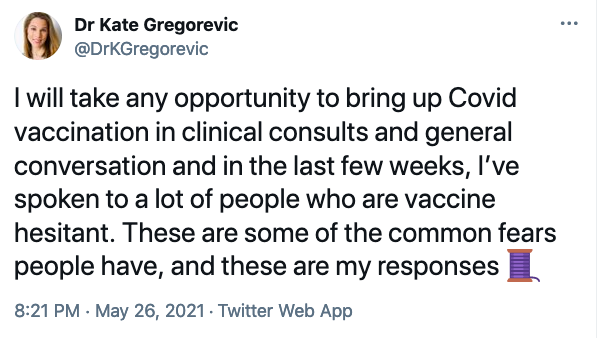
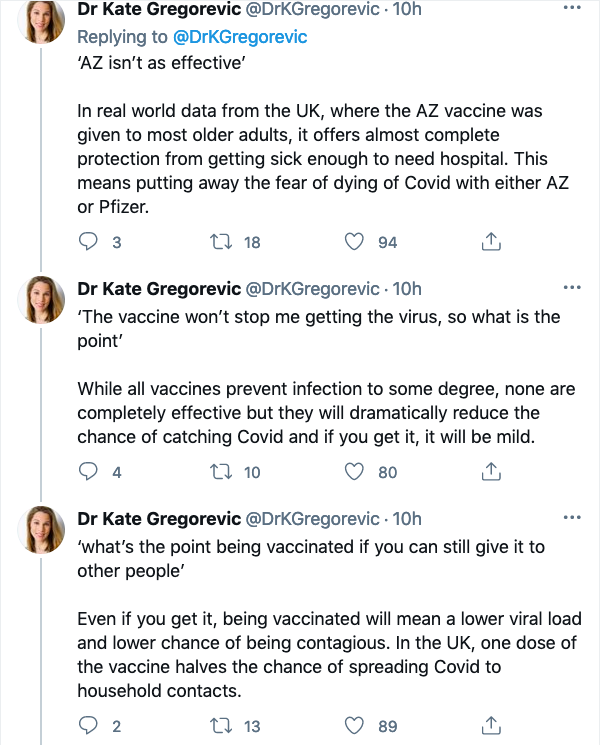
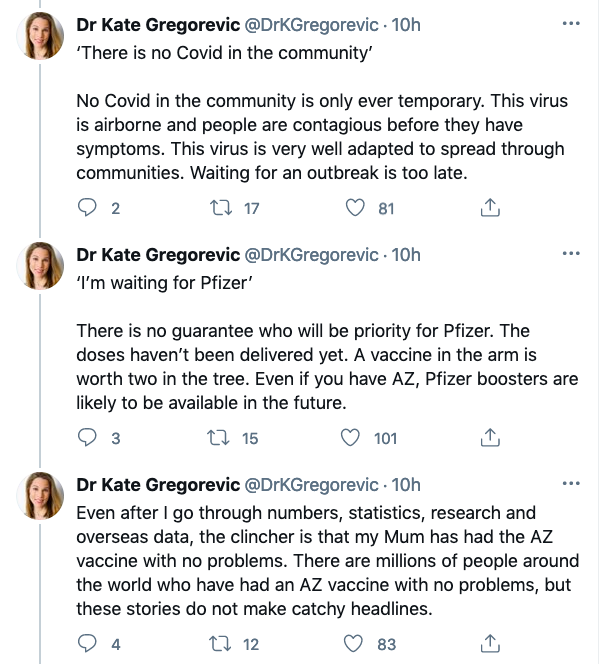
Geriatrician Kate Gregorevic has tweeted a very useful thread of 8 common fears and excuses she has heard from those who are vaccine hesitant, together with her responses. These are so useful. Please copy to those in your life who may benefit from reading these.
By now most of us will have seen risk comparisons like the one below coursing through social media. The message is that, yes, there are risks of clotting from the AstraZeneca vaccine, but they are almost homeopathically small when compared with other blood clotting risks from things that millions do every day (take oral contraceptives, smoke) and especially if any of us were to acquire COVID19.
The idea is that rational people will compare these risks and suddenly any vaccination hesitancy will evaporate when it dawns on the anxious that they are being ridiculously risk averse.
If only it were so simple. The trouble is, that risk perception and communication researchers have long known that such comparisons do little to assuage anxious people’s concerns. Instead, people unconsciously reach for a variety of heuristics or mental shortcuts that ease the cognitive load of making decisions about issues where we often lack any scientific detailed and relevant knowledge. We all use these rules of thumb to interpret and make sense of risks in everyday life.
The traditional approach to assessing environmental risks has been to characterise the hazard, quantify the frequency, duration and magnitude of exposure, and to evaluate the risks in a rigorous model with estimation expressed as a probability of an adverse health consequence. This is the classic scientific approach to assessing environmental risks, but it differs radically from the approach taken by ordinary people when reacting to or ignoring risky situations. The public does not generally assess risky situations using scientific methods, but reacts to specific perceptual components of hazards that are often poorly correlated with their consequences for health.
Rutgers University’s Peter Sandman has probably done more than anyone else to deconstruct how this applies to a large range of health scares. He argues that the idea of risk needs to be reconceptualised to take account of the relationship between the risky situation or agent (which he names the “hazard”) and the strength of people’s responses to these situations. These responses are mediated by the extent to which these agents or situations “outrage” communities. Risk is thus a product of the actual hazard plus a community’s outrage at their perception of that hazard. He argues:
Experts focus on hazard and ignore outrage. They therefore systematically overestimate the risk when the hazard is high, and underestimate it when the hazard is low. The public focuses on outrage and ignores hazard, and thus overestimates the risk when the outrage is high, and underestimates it when the outrage is low. Hazard and outrage are quite independent concepts, poorly correlated, which share a name: risk.
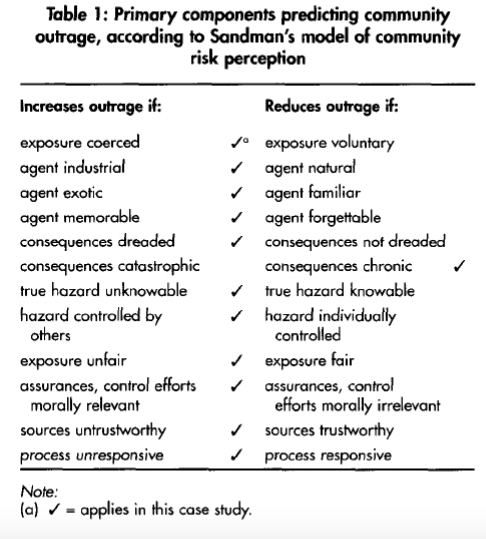
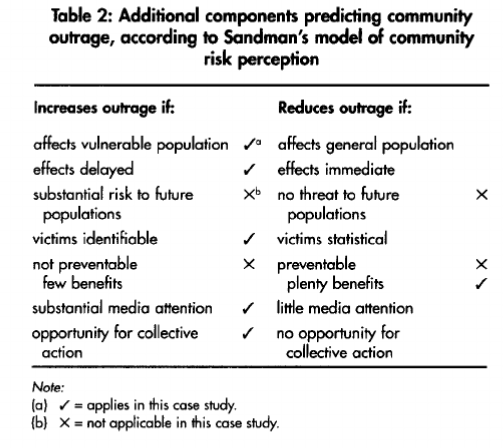
Building on the work of others including Paul Slovic, Sandman has delineated principal outrage components that influence whether or not a situation is perceived as acceptably safe or unacceptably risky. No problem will tick all of the boxes shown in the tables below, but all will tick some of them which will go a long way to helping understand the real causes of people being anxious and upset.
In 1997, with a colleague, the late Sonia Wutzke, I applied Sandman’s outrage matrix to claims which were being made at the time about the dire consequences ahead for us all that would occur with the rollout of mobile phone transmission towers. Despite the radio frequency radiation from the towers being barely detectable by nearby monitoring equipment, some people were having none of it. Here’s a TV newsreel from the time showing local anxiety in Harbord, on Sydney’s northern beaches, with the local MP Tony Abbott milking it hard. Our paper in the Australian and New Zealand Journal of Public Health, had the two tables below where we applied the factors in Sandman’s model to the case of mobile phone transmission towers.
It is rare today to encounter any concerns about mobile phone towers like this woman is expressing here. This is largely because none of the dire predictions made by electrophobic activists have come to pass. While mobile phones and WiFi have been ubiquitous for decades, the incidence of brain cancer (the disease most often mentioned) has flatlined across the same time. The same has happened with the non-disease of wind turbine syndrome where complaints across Australia have now dwindled to a trickle, mostly coming from anxious people in areas where wind farms have not even been built, but are just being discussed.
Sandman has recently featured in a podcast talking about how such an analysis can be applied to COVID vaccine hesitancy. It is well worth a listen and should be mandatory for those in the government’s communication divisions who are briefing spokespeople and advising on public messaging.
I got vaccinated a couple of days ago and I was very surprised that they didn’t give me a pin. They didn’t give me a button. They didn’t give me an armband. They gave me nothing that I could wear or put on a doorpost or something to signal that I got vaccinated and whey oy can, you should too. Because that’s the kind of bandwagon we should be encouraging. I would pay far more attention to the people who want to be vaccinated than to the people who don’t yet.
Looking over the tables above, several factors seem very obvious in the way they are influencing those hesitating to get vaccinated”. Here are just a few
COVID19 is still an unfamiliar disease, unlike the other more familiar vaccine preventable disease
Some may feel they are being almost socially coerced into being vaccinated, rather than doing it entirely voluntarily
The consequences (potentially fatal blood clots) are probably perceived as catastrophic, and not a mild adverse effect
With disrespect for politicians being rampant, they and those working for governments may be seen as untrustworthy. Big pharmaceutical companies, likewise.
Lots of media coverage about the adverse reactions
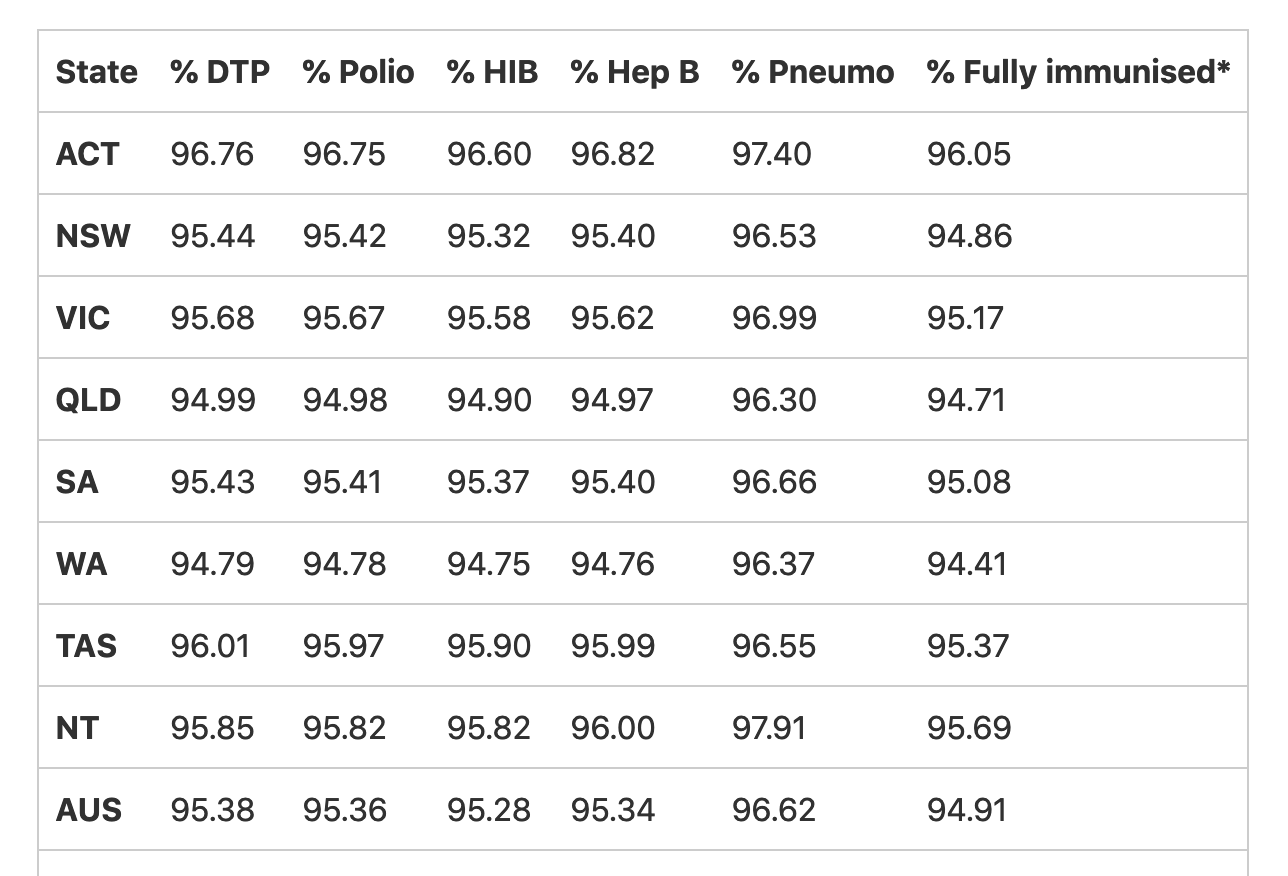
The table below shows vaccination rates in Australia today for children at 12 months for diseases that compared to COVID, have “been around” for a long time.
Like clotting with the AstraZeneca COVID19 vaccine, each of the above produce rare adverse reactions in a tiny number of people who receive these vaccines. This report on measles vaccination for example, shows 11 children had allergic reaction; 1 anaphylaxis; 1 encephalopathy; and 4 seizures. Yet 94.91% of children are fully immunized in Australia today and all of these diseases are as a result very uncommon.
Sandman’s website has rich pickings on risk perception, communication and how to reduce outrage in ways that may be highly relevant accelerating vaccine uptake in Australia and around the world. Highly recommended.
About a third of Australians currently say that are either unsure they will get vaccinated for COVID19 or are firm that they won’t.
It is impossible to overstate how important it is that this dire situation is turned around fast and large proportion get fully vaccinated. The proportion of people needing to be vaccinated to see herd immunity established is not known. For measles it is 95% and for polio 80%. COVID19 is unlikely to be somehow any less than those figures. So we have a mountain to climb.
Low vaccination rates will greatly increase the probability of further outbreaks and keep the door locked on opening our borders, with all the devastation that will flow to all the industries that depend on travel and tourism and much more again.
One’s vaccinated status does not declare itself to others in the way that other health related behaviours can do. We see people wearing sun-smart hats and clothing. Smoking near others has become hugely unacceptable so we seldom experience it and don’t see it much. Many of us take reusable shopping bags with us when we shop. Coffee keepcup use is spreading. Jogging, walking and cycling are very public activities which can have contagious, normative effects on others.
So how can we spread the word that soon millions of us will be vaccinated for COVID19, in the hope that the same normative contagion might start turbo-charging in Australia and impact on the hesitant and the anti-social?
Many people wear lapel pins & ribbons for a variety of causes. Others put stickers on rear car windows. We do this to share ‘tribal’ values among our peers who recognize they are next to someone who acres about the same issues they do. We also hope our mobile mini billboards will be noticed by lots of others, start a few conversations and hopefully accelerate change.
On Cancer Daffodil Day, who hasn’t felt a little awkward when most people in the office are wearing a supportive pin but you’ve forgotten to put your hand in your pocket?
So why not get national momentum up on wearing a pin, badge or special ribbon that says simply “I’ve been vaccinated for COVID19”?
When I had my first shot this week (Astra Zenica) I tweeted about it and just now I see it’s had nearly 11,000 Twitter impressions. There is a COVID vax selfie thing happening too. Health Minister Greg Hunt is urging people to share them on social media.
But a pin or ribbon you wear everywhere for the rest of this year could become highly contagious. Those without them would (and should!) feel conspicuous by not wearing one in the same way that the minority of people who refused to wear masks did. Questions would be asked and conversations would invariably be started –some heated — as happened to me early in the pandemic when I wore a mask into a cake shop and got a spray from a maskless customer.
When prominent mask refusniks made their views public, many were shamed. Many of those who are quietly refusing to get vaccinated or freeriding on those of us who have got it done would probably also feel the heat.
The government has the address of every person who has already had a COVID shot. We could all be sent a few badges to wear and every authorized vaccination provider given as many badges as they are sent vaccine doses into the future. The government also has most of our addresses because they from time to time send us bin-worthy fridge magnets, as they did in 2003. Why not do this for something useful?
Mandatory vaccination?
If you work in some health care settings, mandatory vaccination has long been the case for a variety of diseases. No one questions this. We all understand completely that we do not want to catch these diseases from someone who is looking after us. And nor do we want to transmit any infectious diseases we might have to those who care for us. That ethical reciprocity is a no-brainer which is not debated beyond fruitcake circles.
I’m old enough to remember having to carry the official yellow vaccination status card when traveling overseas. When I went overland by public transport from London to Calcutta in 1974, I had to be vaccinated for smallpox, cholera, typhoid and even bubonic plague. If you didn’t have the card they wouldn’t let you cross a border. Those objecting to vaccination just couldn’t travel. That knowledge was part of their decision-making.
Thanks to the vaccine, smallpox was eliminated in late 1975 when a 3 year old Bangladeshi girl was the last person to catch the disease in the wild. We are a long, long way from that with COVID19, with many knowledgeable people saying it will likely never be eliminated.
But as we have done with so many of the other vaccine preventable diseases, widespread uptake of vaccines has made some of these like measles and polio rare. We must do all we can to raise COVID vaccination rates. Making vaccine uptake something to be proud of, and refusal something that has consequences is unavoidable.
And please put this emoji 💉on all your social media handles.
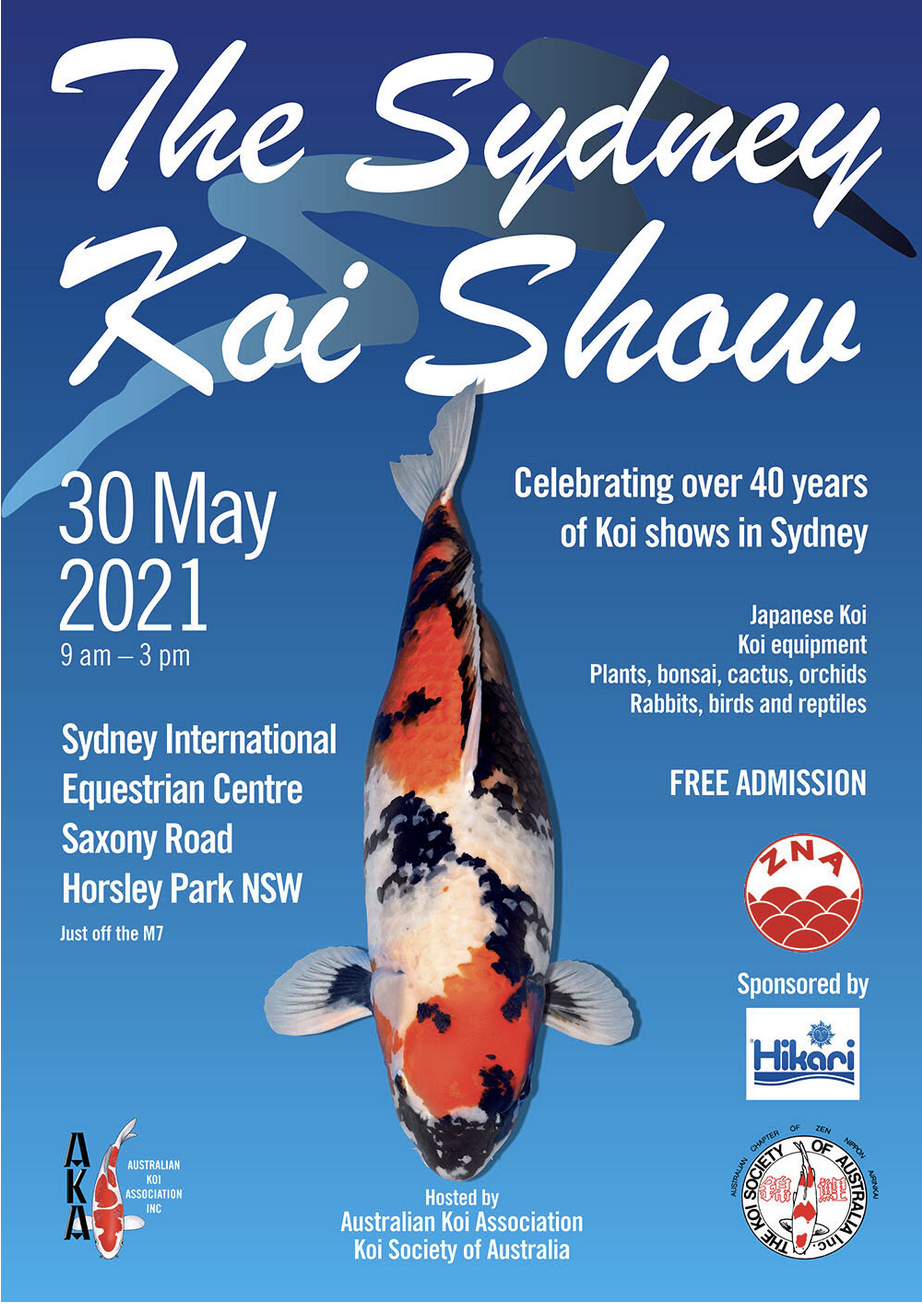
On Sunday 30 May, 2021, NSW’s two koi clubs, the Australian Koi Association and the Koi Society of Australia are holding their combined annual koi show at the Sydney International Equestrian Centre, Horsley Park in Sydney’s western suburbs from 9am-3pm.
At the “Easter Show” of koi exhibition and competition in NSW, internationally accredited koi judges will select champions across a large range of koi varieties, as well as grand champion and other outstanding awards. Anyone curious about seeing the very best koi in NSW, will find no better opportunity than to spend a few hours looking at the hundreds of fish on display.
I’ve kept koi in our backyard pond for 21 years. Friends who come to our place are often spellbound by the beauty of what we have developed over the years. They tend to ask very similar questions about what’s involved in keeping koi, the costs, the problems as well as the sheepish perennials: do I give them names like cats and dogs (no), and do I ever eat them (no, but carp are one of the most eaten fresh water fish in the world, particularly in Eastern Europe).
With the show coming up, I thought I’d set out to answer questions I am most often asked about keeping koi.
How did you build your pond?
When my father Alec died in 1999 at 89, my share of his estate was just $26,000. Instead of just paying a soon-to-be-forgotten tranche off our mortgage, we decided to landscape our garden with a koi pond in his memory. We’d been mesmerized by one in a garden shop in Terry Hills which had been made in a Japanese style, with wooden bridges, large rocks, stone lanterns and a waterfall. It was unforgettably beautiful.
With our kids, we spent a couple of weekends digging out a large hole, and piling the soil at one end against a brick wall to create a mound on which to create a waterfall that would cascade into the pond. After about half a metre we struck our sewage pipes, so that defined the maximum depth of the pond we could build. Most ponds are deeper than ours, with many converting unwanted swimming pools.
There were three choices of pond liner in which the water sits: concrete, moulded fibreglass or a thick rubber sheet liner, cut to size to cover the floor of the pond, its sides and an overlap above the sides that would be anchored with rocks and soil. We went with the easiest option with the rubber and 21 years later it’s never sprung a leak.
A landscaper who’d never built a pond before but who came highly recommended fitted the rubber, landscaped the surrounds and the waterfall and constructed the essential filtration system that, driven by a 400watt 0.5 horsepower pool pump recycles water from the pond through a 250 litre bioball filter and back into the water, oxygenating it via the waterfall and a venturi. You cannot keep koi successfully in water that is not oxygenated nor filtered. Don’t even think about it. And keeping koi in an aquarium tank is both cruel and something that will be short-lived as they rapidly grow too big.
What did the pond cost to build and run?
Our pond has a very irregular shape, so its precise dimensions are hard to give accurately. My estimate is that it’s about 5000-6000 litres. 21 years ago, the combined cost of the large rubber pond liner, the biofilter, pump, four large fake fibreglass “rocks” on the waterfall that channel four water outlets into the pond, perhaps 2 tonnes of bush rocks, all the filter plumbing and plant landscaping around the pond and the labour was about $24,000. The required childproof fencing in glass was another $4000.
Most koi keepers run their filtration systems 24x7x365, so there is always the electricity cost of that which will depend on the size of your pond and pump. I have a timer on my pump which I set off during the peak electricity period (3pm-9pm) to save cost. During that time a timer turns on an 80w aerator ($100) which sends air bubbles to three points in the pond. We have a 5kw solar rooftop system on the roof which has reduced our total electricity bill, pond included, from about $2400 to $700 per year.
We direct rainwater runoff from the back of our house into the pond which saves on water top-up costs. It’s important to do periodic partial water changes to ensure water quality. That adds some cost, but I’ve never fainted on seeing our water bill.
There are also not very expensive costs involved in buying water quality testing chemicals for issues like PH, ammonia and nitrates. If water becomes too acidic, this is easily rectified by throwing in liberal quantities of bicarbonated soda. A 25kg bag can be bought for $33 from agricultural suppliers.
Food costs
The staple food I feed our koi is protein pellets. I buy a 25kg bag about twice a year from a contact who sources it from a wholesaler who sells it principally to commercial fish farms. I pay $120 per bag. Koi are voracious eaters in summer, but eat perhaps 10% of their summer feed during colder winter months when they tend to slow down and are not as active in the pond.
Food at reasonable prices is sold at the koi auctions. But I never buy food from pet shops, eBay or even online so-called bulk suppliers where quite extortionate prices are charged for small packages.
I supplement the pellets with worms from our worm farm, maggots from the compost bin, stale bread, garden snails and slugs (we never use poisons), and left over cooked rice. In summer, throwing any of this in the pond causes piranha-like frenzied feeding. They also nibble algae from the sides of the pond and rocks and eat any mosquito larvae which find their way into the water.
Where can you buy koi in NSW?
I get my koi exclusively from two sources: koi auctions held 10 months of each year by rotation between the two clubs. Since March this year they have been held at Fairfield Showground on the Saturdays shown on the two clubs’ websites (links earlier in this blog).
About 125 bins containing either single or multiple koi are sold at each auction. Prices vary enormously according to quality and whether a particular bin attracts bidders willing to keep the price rising. The most expensive fish I’ve ever seen sold went for $2400 (to gasps and cheers) and the cheapest for $20. At each auction, there’s usually a few bins that go for over $500, but the great majority sell from about $70-$400. I’ve never seen a bin fail to sell. Even the ugliest of fish that only a mother could love will sell. “Catfood” is sometimes heard whispered.
Many koi keepers put word out to other collectors that they are looking for a particular variety. Word filters back that someone has a variety that you are looking for, particularly six months after a breeding session has produced hundreds of fish that can’t be kept by the breeder. I’ve acquired some of my best fish this way.
Breeding?
Female koi spawn in Spring, and there’s lots of folklore among breeders about when you can predict the exact spawning period will be. Moon phases, water and air temperature and storms are some of the factors you hear people swear by. Just as happens with horse, dog and cat breeders, koi breeders plan which variety pairings they will try to get together.
Not all who keep koi breed them. My impression is that most do not because to do so, you need a “bridal suite” tank where the selected male and female are placed together in the for a week or so in the hope that they will get to know one another. After spawning and fertilisation by the ardent male, the two adult fish are then removed. The fertilized eggs cling to simulated water plants (mop heads are often used) and then food, at first in powdered form and later in tiny pellets, is fed to the tiny fry. As they grow many with imperfections are culled and the rest are grown-on.
All this requires multiple ponds or large tanks which many do not have room nor inclination for. Me included.
There are also a small number of commercial koi suppliers that can be found on-line. Before I discovered the auctions, I bought from some of these but soon stopped. In my experience, their stock is massively over-priced and in some cases, the quality quite abject.
Varieties of koi
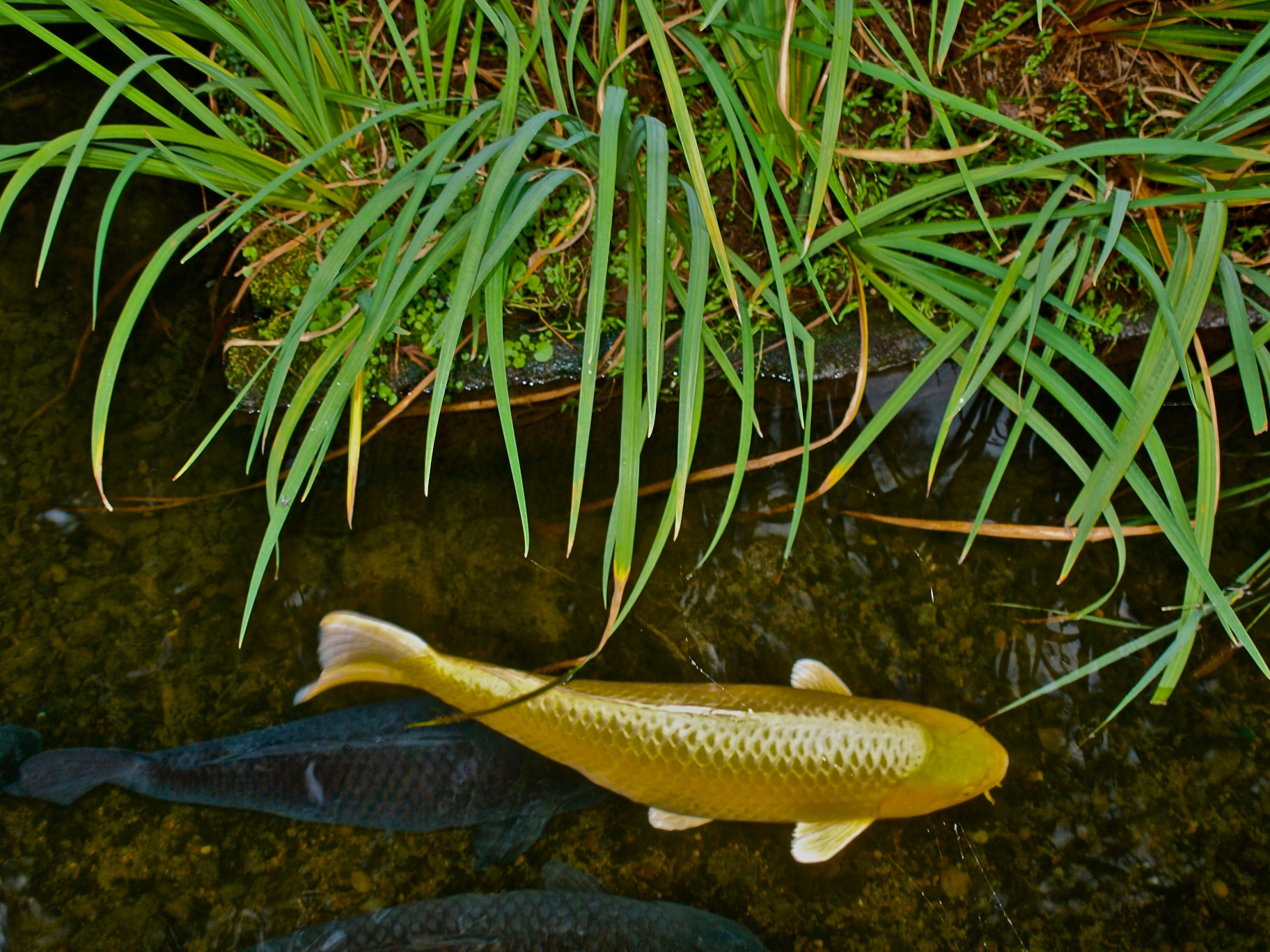
Koi is the Japanese word for carp. So if you hear someone saying “koi carp”, they are actually saying “carp carp”. There are many varieties and sub-varieties of koi, all bearing Japanese names. Youtube has many videos showing all the varieties like this one and this. All can breed with each other which is how different varieties emerged. Sub-varieties include metallic, gin rin (fish of all varieties which have silver scales which reflect sunlight), and doitsu and ‘leatherskin’ fish (those with few or no scales).
Most domestic koi usually grow toabout 38 cm (15 inches) long. Jumbo sized koi can grow up to 92cm (36 inches) but these are seldom seen in Australia. Koi can live for 25-35 years.
A metalic yamabuki ogon, with 2 ochibas below
Problems
I’ve had three disasters with my koi in 22 years. The first was when my pond became infected with a virulent outbreak of Aeromonas bacteria which causes nasty skin ulcers, often fatal. The first death occurred while I was away and the person staying in the house missed seeing the floating dead fish which putrefied and infected others. When I returned about half my fish died within days, with others being saved by having an experienced koi keeper come over, catch and inject the sick fish with an antibiotic.
The second occurred when my pump died sometime between 6pm and 8am when I next looked at it. This caused oxygen levels to fall badly in the pond and I woke to find 12 fish, including many of my best, dead in the water.
The third incident occurred a few months ago when a tap topping up the pond was left on for several hours, causing lots of chlorinated water to enter the pond. Eight fish – again mostly my best – were floating dead. Chlorine is fatal to koi and significant tap water top-ups need to be accompanied by the addition of sodium thiosulphate salts or liquid, again purchasable inexpensively at the auctions.
A common problem with keeping koi is overcrowding. There is no strict formula for how many fish you can safely keep in a given body of water, because the different size of fish, the rate of filtration and the quality of your water will all be relevant. But always consider whether you already have too many fish before you buy more.
Join a koi club
If you are thinking of starting to keep koi, a very smart thing to do is to join one or both of the two koi clubs in NSW. There is a wealth of experience among koi keepers who range from very serious keepers with massive ponds and filtration systems, to people like me with modest sized ponds, and about 15 fish.
I have learned an awful lot, had to filter and research what to do when given conflicting information, met some great friends and immersed myself in a sub-culture and hobby that has given me thousands of hours of pleasure.
Sitting beside our pond on a warm summer’s evening with a gin and tonic, watching the fish glide under the wooden bridge, through the waterfall and around potted water plants is to have a world of serenity at your backdoor. Koi require maintenance and careful watching. I have favourites, but when they have died or been sold after getting too big for the pond, you don’t miss them like you would a dog in your life. They enhance a garden like nothing I’ve ever experienced before. Highly, highly recommended.
Selected photos
Gin rin ochibas
Simon Chapman is patron of the Australian Koi Association.







 Simon Chapman AO