• Home
  • About/CV
  • Blog
  • Vaping Research Alerts
  • Blog archive list
  • My books
  • Memoirs
  • Music, bands, films
  • Contact

Simon Chapman AO

~ Public health, memoirs, music

Simon Chapman AO

Monthly Archives: September 2023

The united nations of house guests

27 Wednesday Sep 2023

Posted by Simon Chapman AO in Blog

≈ Leave a comment

When our three children were growing up, we had a cavalcade of house guests who stayed for a few days and sometimes longer. I invited all of them, despite the first one badly overstaying his welcome and Trish chasing me around the house with murderous intent saying “don’t you ever do that again!”

My motivation was always an entirely do-unto-others thing. When I heard about someone I knew who was arriving in Sydney and needed a place to stay for a while, I ‘d think “well, I know just how they’d be feeling. They’ll be in a strange city, know no one, and will jump at an offer of short term accommodation until they find their feet and get a suitable place.”

I remembered how lucky I’d felt staying with an aunt and uncle in London the first time I travelled overseas. I’ve stayed at friends homes in San Francisco, Edinburgh, Washington DC, Istanbul and Tokyo. Having locals guide you around, explain how things like the subway worked, finding cheap good restaurants and telling you about tourist traps to avoid is a godsend. And the opportunity to immerse yourself in the routines of a family who speak a different language is almost always unforgettable.

I often think of the people who hosted me, their sincere joy and pride in showing me around their cities and their ease in appearing disheveled at breakfast time in the kitchen making breakfast with someone they had only known from conferences and email chat. I thought that putting my hand up first to signal to new guests that we were the sort of people who liked this stuff ourselves, so we’ve got your back in a new city, was the right thing to do.

So how did it all work out?

Geoffreyopoulos from Greece

Our first guest was a very old friend, Geoffrey. He’s been a neighbour in the early 1970s, and had turned his back on the usual grinding trajectory of job promotions and left a career in civil engineering to become a peripatetic resident of whatever port his 35 foot yacht found him in. I’d stayed with him in Rhodes harbour and stayed on his boat for a week with Trish in Dominica in the Caribbean’s Windward Islands (see Volcanoes, tsunamis, storms and near-death experiences in the Caribbean at p74 here ). He was one of the greatest raconteurs I’d ever known. I always called him Geoffreyopoulos because he’d lived so long in the Greek Islands.

Geoffrey had a house in Paddington and lived on the rent it provided. Every five years or so he’d be back in Sydney to do repairs, get medical attention for things like his eyes and catch up with old friends. So one day there was a tap on the door, completely out of the blue and there stood my old friend with his dilapidated backback. Geoffrey had almost no possessions, picked up cast off clothes and shoes in recycling shops and had no taste for the baubles of success.

“Could I stay for a little while?” he asked. Of course, we said. Nothing so proprietarily bourgeoise as “and for how long might that be for” ever crossed our minds.

Looking back, I imagine we thought maybe a week or two. But he left for Europe after three months.

Geoffrey was what Trish calls “a real man”. He could fix anything that needed fixing, and knew where to get second had parts to avoid being gouged. So in the first few weeks he fixed some loose roofing and guttering and rehung some wonky doors and supervised buying us a second car, helping us avoid some money traps. He’d often come home with a bottle of wine that was from the very lowest shelf in a wine shop. He’d help with the washing up and run small errands when we were at work.

We had many dinners late into the night where his inexhaustible supply of amazing tales from the Baltic, to Ireland, sailing solo several times solo across the Atlantic, North Africa and the Caribbean enthralled all who were there.

He had a teenage daughter who also lived on a boat in Cornwall. Every Friday night at the same time, he would use our phone to call a phone booth near her boat. They would speak for at least an hour. Let me know the cost when the bill comes, he said.

On the week he was due to leave, he said he’d like to take us out to dinner. And pay. This would be something. We went to a wonderful Shanghai dumpling shop in Ashfield where the bill for the three of us was all of $30. At the end of the meal, he was embarrassed to say that he’d accidentally left his wallet at home.  It can happen to anyone.

We covered it. On the  day he left we arrived home from work to find a note explaining that he’d worked out he’d spent more than the $30 farewell dinner he owed us on some fittings for our roof. We shrugged it off. But then a month later, we got a phone bill which was off the charts. Many hundreds of dollars. But Geoffrey’s ship had sailed.

Xisca from Barcelona

A close colleague from Barcelona contacted me with a small favour. His longtime cleaning lady’s daughter Xisca was coming to Sydney as the jumping off point for an Australian working holiday. She was only 19 and had never travelled abroad. Her mum was worried that she might be all at sea here, having only schoolgirl English. Would it be possible that she might stay with us for a short time to find her feet? Could we give her some tips about  getting casual work?

Sure. We’d just love to do that. So on the day of her arrival we opened the door to a petite, raven-haired pretty Spanish girl with a thick accent and a backpack. It would be remiss of me not to note that she also had very large breasts with unavoidable cleavage.

So our two sons, then aged 13 and 15 had their eyes popping out of their heads from the moment she came through the door. They would nearly knock each other over trying to get to her first to help with a question or advice on the Sydney night life they’d never experienced but were of course fully expert about.

Within days Xisca began arriving back home at 2am or later.  One night we peered out the window and saw her get out of a top end black Mercedes convertible driven by a man of Mediterranean or Middle Eastern appearance, as crime reports always like to phrase it.

This happened very regularly to the young woman we felt we’d been entrusted to chaperone by her anxious mother whom we’d never met. But was it any of our business? Did we want to start behaving like her mother and interrogating her about what she was going out late most nights? Should we ask her about the nice gentleman in the drug dealer type car who seemed to be seeing a lot of her? Nah, no. We suggested that she might like to find a nice share house. 

Indira from India

Indira was a young researcher I knew from India. She was coming to Sydney to study. She stayed with us for over a month, sleeping on a mattress in the lounge room. She cooked wonderful Tamil food and was polite and friendly to a fault. But there was one problem. At that time, we had one bathroom including a toilet that needed to be used by two adults and three teenagers, plus Indira.

We quickly discovered  that when she went into the bathroom, she rarely emerged for at least 30 minutes. We would hear the toilet flush, and we would hear the sound of the shower on the tiles. And then the shower would stop. There’d then be silence and then the shower would start up again. After the first time this happened, we explained that we all needed to use the bathroom in the morning before leaving the house, so would she mind being the last one to use it? This generally worked, but in lieu of a roll-call about whether everyone else had finished with the bathroom, there were often people missed who then had to wait for her bathroom marathons.

I and the two boys would go outside to fertilise the garden, but Trish and our daughter would be pacing up and down hoping she was nearly finished. No explanation was ever given. Did she have some body-oiling, washing and re-oiling ritual? Did she have major bowel  problems she wanted to keep private? Was there some sort of silent prayer thing happening in there? We didn’t feel we could ask.

David from Canada

David was a younger colleague from Canada. I’d met him a few times at conferences overseas. He was coming to Sydney for a sabbatical and asked if he, his wife and an infant child could stay with us for a short while when they had a gap between rents. They did and they were lovely.

A few years later he emailed asking if he might stay a few nights. He was a huge fan of the US band Wilco and had bought tickets for two of their Australian gigs. Sure, no problem. On the first night he took a shower. Sydney was having water shortages and David apparently thought having a shower meant staying in there for weeks.

Trish kept on coming up to me saying “he’s STILL in there! What the fuck is he doing!” These observations rose in intensity until she could bear it no longer and went up to the bathroom door and said “David, sorry mate but we have serious water shortages in Sydney. We only have very quick showers here.”

He was suitably sheepish when he emerged, so Trish took the opportunity to ask him to please also turn the lights off in the house before he left for the day. We’d noticed lots of people regarded lights as a free good, kindly donated by the government.  On the night he went to a Wilco concert, we heard him come in about midnight. About 2am Trish woke and said to me “Bloody David has left the lights on in the living room!!”.  She got out of bed naked and went down there to turn them off. David was lying on the lounge reading and copped a full gawk at his tormentor.

Mary from Canada

An old Canadian colleague emailed to ask if we might look after her daughter who had recently graduated. Mary wanted to live in Sydney for a bit to see how she liked it and whether she might later enrol in the graduate medical degree at Sydney University where I was in the faculty. “No worries! Our place is used to visitors. We love it!”

So Mary arrived. She was chatty and vivacious, and again, our boys thought they had won the lottery. Like others before her, she stayed and stayed. And paid no rent or keep.

One day she came home from Bondi Beach with a tale of how a photographer had chosen her to pose in her bikini holding a surfboad. It was for some high-end fashion magazine and as payment, she would get a pair of Manolo Blahnik shoes which we were all supposed to know were worth well over $1000. This seemed as likely as pigs flying. But it turned out  to be totally true. She clopped around the house in her terribly expensive shoes, with the magazine duly being published with a rear view of Mary in a bum-floss string bikini bottom lasciviously caressing a surfboard. The boys snuck it to school to show their mates evidence of the debauched life they led at home.

Aunt Rose from the Isle of Wight

When my dad was in his 80s and sliding slowly into dementia, we decided it would be a nice idea to fly his slightly younger sister Rose out from England to stay for a few months. She lived in the Isle of Wight and had never been abroad, except to Calais and back for the day.

When she arrived, it was summer. We explained that our then only bathroom was being renovated and it would take several weeks before it was ready. We showed her how we had rigged up a hose to the kitchen water tap. The hose went out to the back garden where it hung over a tree branch, with the water falling from a showerhead. We’d all been enjoying hot water outdoor showers in the privacy of the back garden. The rest of the family would all remain in the front of the house, we assured her. “When you holiday in Bali, you  pay extra for the luxury of a private garden shower”we told her.

But she went ashen, soon taking Trish aside and saying that she simply could not bring herself to shower like this. Or even think about it. So for the first month of her visit she moved in with my sister in a nearby suburb until out bathroom was complete.

We noticed that she enjoyed a sweet white wine with dinner. One night we went with my sister’s family and Rose to a local Vietnamese restaurant. My brother-in-law Paul was extremely attentive with topping up Rose’s glass. So much so, that she needed to be helped out of the restaurant and into the car afterwards. I doubt if she had ever drunk so much, even across a month. Back at the house, the room began spinning around and Trish had to sit for an hour mopping her forehead with a wet flannel, with a bucket beside the bed.

Her visit was wonderful for dad, He came over often from his nursing home and they would sit talking lucidly about their childhood and the war years before he immigrated to Australia. His long term memory was in fine shape.  She came out again once before he died in 2000.

When we recount these and many other stories to friends, they often say “I really couldn’t do that.” For some the sanctity of a home is inviolate. While we groan when we retell some of these stories, the net effect was undeniably  positive for the family. They have all been inveterate travelers themselves, all love food from all over the world and I think are all richer for the experience.

This week we are having a man from  Timbuktu in Mali and now living in Canberra staying for the weekend. I met him at an African festival recently. We talked music and realised we are going to the same gig. Come and stay I said.

Two parallel universes for Big Tobacco

26 Tuesday Sep 2023

Posted by agatamontoya in Blog

≈ Leave a comment

Last week, the major global influencers conference, the Concordia Summit, was held in New York. Concordia, according to its website “ is a global convener of heads of state, government officials, C-suite executives, and leaders of nonprofits, think tanks, and foundations to find cross-sector solutions that address the biggest challenges of our time. The Concordia Annual Summit is the largest and most inclusive nonpartisan forum alongside the UN General Assembly.”

One speaker billed in the weeks leading up to the Summit was Philip Morris International’s (PMI) CEO Jacek Olczak. But on the cusp of his big moment he was swiftly cancelled from the program and the text of his planned speech removed from Concordia’s website. PMI was also removed from the list of patron members. The Concordia CEO announced a “new policy of not working with any tobacco companies, starting with the 2023 Annual Summit.” PMI had been patron member since 2020.

The removal and new policy followed a history of calls by tobacco control groups for Concordia to remove Philip Morris from its program. With Tony Blair and London mayor Sadiq Khan announced as also speaking in New York, Peter Geoghegan, author of  the Democracy For Sale newsletter renewed these calls on September 15. Within days PMI was shown the door and told never to darken it again. Olczak, whose company shipped more than a trillion cigarette between 2019-2021,  promptly moaned on youtube about the injustice of it all. The loved ones of the  two in three long term smokers who have died from their smoking would likely see it differently.

This snub was a weapons-grade, high-end humiliation by senior politicians, the world’s corporate giants, think tanks and foundations. It was an unambiguous, nose-holding “keep away from us” message to PMI. This was despite its decades-long rebirthing efforts promote itself as an ethical company supposedly now dedicated to combating with new highly addictive products the very problem (smoking caused disease) that its combustible products continue to cause at stratospheric levels.

It shows that nothing has changed since the publication of the Reputation Institute’s 2010 last place ranking of the tobacco industry as peerless reputational bottom-feeders.

 This is far from the first time Big Tobacco has been internationally spurned. To give just two examples: in 2004, Ethical Corporation magazine removed PMI from a business ethics conference in Hong Kong after protests from leading ethicists and withdrawals from other speakers. In the same year Australian Public Relations and Corporate Communications Summit “de-invited” Philip Morris after protests from health leaders.

PMI says ad nauseum that it wants to end sales of its tobacco products. Really? There’s an obvious comparison to be made here between the motor vehicle industry and tobacco companies. The inexorable growth of electric vehicles because of the existential threat of climate change has seen the following companies declare dates after which they will no longer manufacture internal combustion engines.

Alfa Romeo (in Europe, North America, China) by 2027

Audi 2026

Bentley 2030

BMW 2030

Fiat 2030

Ford (in Europe) 2030

General Motors 2035

Honda 2040

Hyundi 2040

Jaguar 2025

Mercedes 2030

Mini 2026

Nissan (in Japan, China, USA, Europe) early 2030s

Renault 90% by 2030

Rolls Royce 2030

Volvo 2030

Philip Morris’ response to questions about why it refuses to name a date when it will stop manufacturing tobacco products is to argue that if it did so, other tobacco companies would simply grab its tobacco customers. This response has all the ethical weight of criminals rationalising that they may as well keep selling stolen goods or drug dealers saying they have no qualms about selling narcotics, because if they didn’t sell them, there are plenty of others who would.

This has the ethical sophistication of 5 year olds who shoot back “but he’s doing it too” when asked by a parent or teacher why they persist doing something they know they shouldn’t be doing.

PMI has two feet firmly to the global floor: one accelerating its so-called reduced risk products, and the other continuing to do all it can to keep manufacturing and selling tobacco products for as long as possible.  Their business plan is obvious: they want to maximise sales of both.

The Bloomberg Philanthropies funded Expose Tobacco campaign has highlighted details from recent PMI reports to investors.

Recently, on its 2022 earnings call, PMI celebrated growth in revenues from cigarettes, saying: ‘In combustibles, we delivered a robust performance with a 3.7% growth in organic net revenues…’

The easiest way to see through PMI’s supposed “smoke-free” aspirations is to look at its thriving cigarette business. In 2022 alone, PMI shipped 621 billion cigarettes, according to its full-year results report. While cigarette shipment volume between 2021 and 2022 declined in some markets, shipments increased by nearly 5% in the Middle East and Africa, by about 2% in the Americas and by 1.5% in South and Southeast Asia. There’s nothing “smoke-free” about sending more cigarettes into these regions.

Despite claiming in its “smoke-free”-oriented corporate communications that it’s best to never start smoking, PMI continues to advertise cigarettes, including to populations that historically have low rates of smoking. A recent study of cigarette advertisements in Israeli newspapers found that 87% of the ads were targeted at the Haredi population, a group that has the lowest smoking rate in Israel.

PMI has also fought for the ability to advertise cigarettes. For example, in 2020, PMI’s Indonesian subsidiary, PT HM Sampoerna, wrote to a government official in Bali asking him to revoke a ban on outdoor cigarette advertising. The company also funded a counter-campaign in Switzerland to persuade people to vote against a tobacco advertising ban meant to protect young people. The purpose of advertising is to acquire new customers. If PMI genuinely believes it’s better for people not to smoke cigarettes, why do they continue advertising them?

In 2018, one year before it launched its global “Unsmoke” campaign  PMI opened a cigarette factory in Tanzania. It’s also opening a new $30m cigarette factory in Ukraine this year, replete with full self-congratulation on its support for the war-ravaged nation. However, it still does business in Russia.

British American Tobacco hasn’t so far had the gall to say it wants to get out of tobacco. Nup, it opened a new tobacco factory in Jordan and it’s been happy to break US trade sanctions with North Korea, being fined $US635.2m  this year for selling cigarettes to the bellicose hermit state via its Singapore branch.

Vaping cheer leader Alex Wodak, whom I’ve criticised many times in this blog, didn’t surprise with his reaction to the Concordia shafting of PMI. Here he is actually saying wide-eyed from his parallel universe that PMI is no longer “Old Big Tobacco [deserving] strongest condemnation” but actually deserves lots of praise.

So do we side with the authority of 182 nations which have ratified the WHO’s Framework Convention on Tobacco, with its Article 5.3 dedicated entirely to ways of preventing Big Tobacco from sabotaging tobacco control? Or do we join the applause with Wodak and his admirers in the tobacco industry, the Institute of Public Affairs, the National Party, One Nation and the NSW Greens?

Meanwhile in Seoul

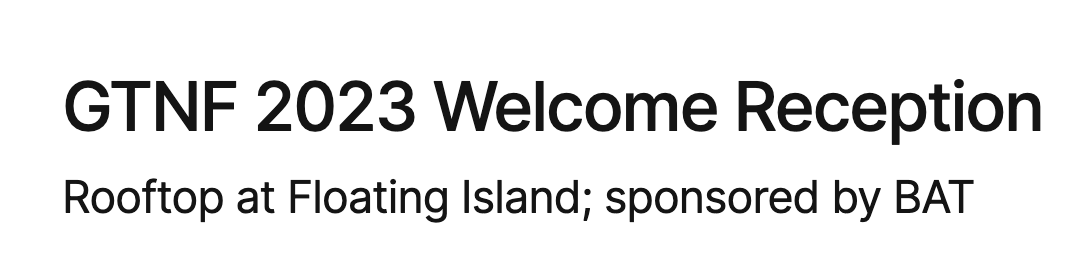
Also last week, across the other side of the world in Seoul, Big Tobacco held its annual gathering of the clan, the Global  Tobacco and Nicotine Forum  where it grapples with how best to short circuit effective tobacco control after  wining and dining its latest little helpers at the BAT sponsored welcome reception.

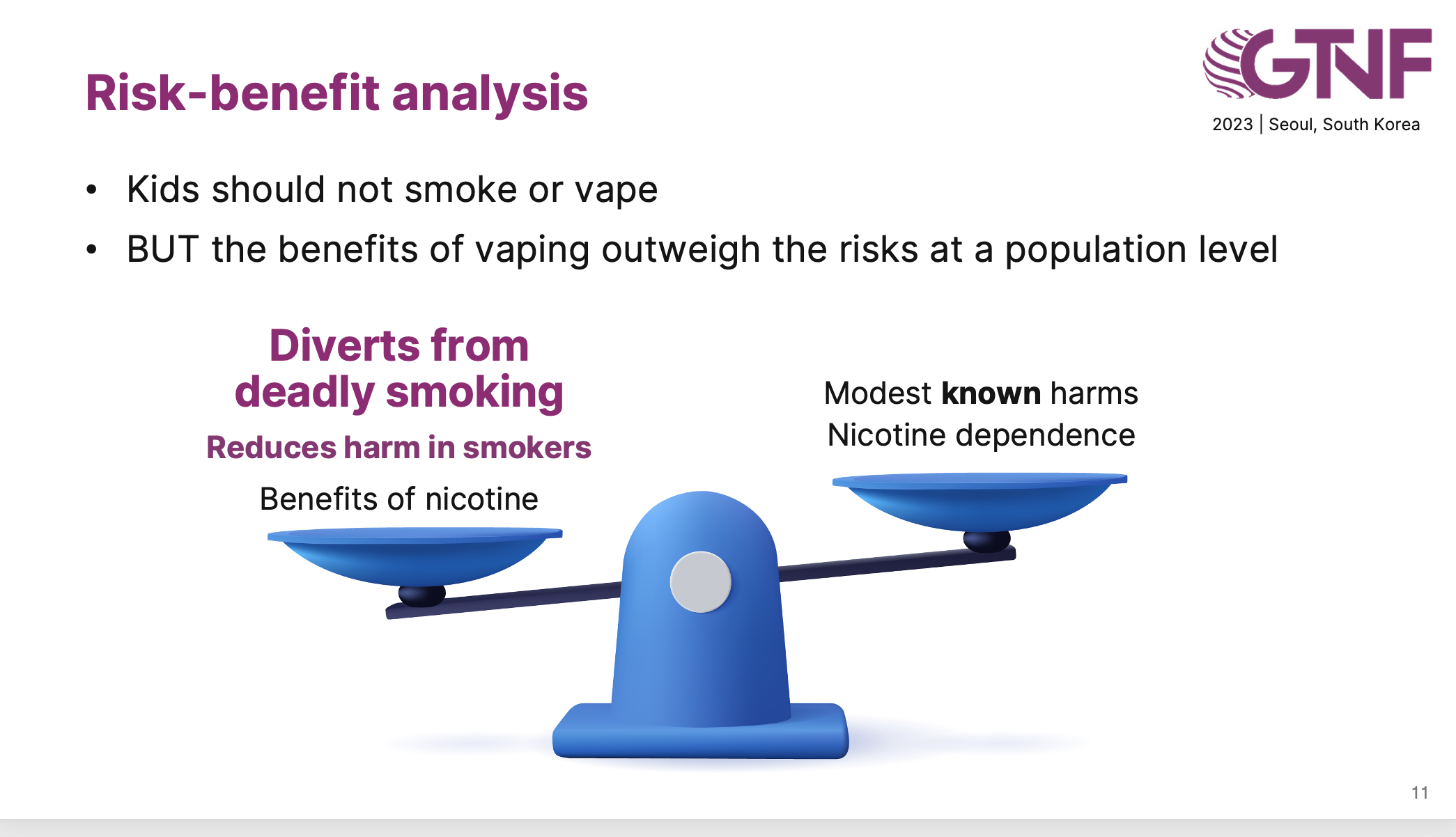
This year the Australian participants included tobacco and vaping conference globe-trotter Colin Mendelsohn.  Mendelsohn has long embraced vaping theologies that vaping is all but 100% benign, that it’s peerless as a quit smoking route and that there’s almost nowhere that vapes should not be sold.  But Mendelsohn’s mission these days has dropped almost every pretence that he thinks any concern about vaping by kids is warranted and that nicotine is virtually a wonder drug (see two slides below from his Seoul spiel).

In Seoul among the big players in Big Tobacco and their extreme right libertarian acolytes, our champion reprised some of the main messages he published in August  in a school education  magazine article announcing his seven point la-la land plan to “address” teenage vaping.

In the magazine piece he left the very best bit until the last of his seven points, writing:

schools could consider a designated outdoor vaping area. This should ideally be out of sight, for example behind the toilets, and restricted to students who:

  • Are ‘registered’ as vapers
  • Are over a certain age (eg 16 years), and
  • Have the written parental permission.

Vaping won’t be as appealing to teens if they are allowed to do it.

This proposal should not be seen as an endorsement of youth vaping, but as a pragmatic solution for the reality of nicotine dependence.

And not only designated vaping areas in schools. Mendelsohn wants regular vaping breaks for addicted vapers.

Some students are addicted to nicotine and need to vape at regular intervals during the day. Consider allowing addicted students to take short breaks to vape outside if needed during class hours.

All this comes after his earlier emphasis that most vaping in young people is transitory and experimental and that “most young people who try vaping do not get addicted to nicotine”.  He writes “a supportive and compassionate approach is more likely to be effective and acceptable” about a problem he also says seldom is a problem.   

Picture the scene every day in out-of-control classrooms when one kid after another pleads with the teacher to be compassionate and allow them to have yet another break so that they can get relief from the grip of nicotine withdrawal that, oh wait, Col has just told us is highly unlikely to be happening anyway.

With sales of nicotine vapes being illegal in Australia to anyone without a prescription, and all smoking banned on school grounds by anyone of any age, I wonder when Mendelsohn will also call for cocktail hours, and dope smoking and cocaine snorting areas in schools? All illegal too, but hey, schools need to be pragmatic and compassionate, right?

While Philip Morris and other tobacco companies continue unabated in their efforts to market tobacco products, rejoicing over any sales or profit increases in their reports to investors, their “we’re changing” charades are simply air cover for their business-as-usual of massively profiting from unspeakably deadly products.

They are like the owners of the White Star Line telling the public “we spent lots of money removing the splinters from the handrails of the Titanic.”  Those who fall for this while chiming in support for the industry’s PR events are reprising a version of the age-old Faustian morality tale. And we all know how that ends.

The sinking of the Titanic as depicted in Untergang der Titanic, a 1912 illustration by Willy Stöwer

Blog Stats

  • 163,470 hits

Top Posts & Pages

  • Why I’m not quitting Spotify because its owner has hugely invested in weaponry
  • Australia takes off the gloves on illegal tobacco while ‘lower the tax’ fantasists plumb new absurdities
  • About/CV
  • Vaping theology: 6 There’s nicotine in potatoes and tomatoes, so should we restrict or ban them too?
  • My books
  • Regrets … I’ve had a few. Paul Hogan and his Winfield role.
  • Thinking of keeping koi? Advice for beginners in NSW
  • Cheap illegal cigarettes save low income pack-a-day smokers over $9000 a year. So why don’t social justice champions give them full support?
  • Why Australia’s illegal tobacco and vape trade continues to flourish and what should be done about it
  • My first seen, best and worst bands 1964-2022

Blog archive

Comment Policy: No anonymous or pseudonymous posts will be published

Recent Posts

  • Australia takes off the gloves on illegal tobacco while ‘lower the tax’ fantasists plumb new absurdities
  • Egg on some faces: statisticians at 10 paces on the impact of New Zealand’s vape laws on youth smoking
  • Lowering tobacco tax to make illegal tobacco sales “disappear overnight”: at last we have a proposed figure and it’s an absolute doozie
  • Why I’m not quitting Spotify because its owner has hugely invested in weaponry
  • Should we believe Fiona Patten on vapes? Here are just a few problems

Recent Comments

Jon Krueger's avatarJon Krueger on Egg on some faces: statisticia…
Atul Kapur's avatarAtul Kapur on Should we believe Fiona Patten…
Unknown's avatarCould a national tob… on If expensive cigarettes are dr…
tahirturk1's avatartahirturk1 on Why Australia’s illegal tobacc…
malonere's avatarmalonere on Words I’ve seen, but didn’t kn…

Archives

  • December 2025
  • August 2025
  • July 2025
  • June 2025
  • May 2025
  • March 2025
  • January 2025
  • November 2024
  • October 2024
  • September 2024
  • July 2024
  • May 2024
  • April 2024
  • March 2024
  • February 2024
  • January 2024
  • December 2023
  • November 2023
  • October 2023
  • September 2023
  • August 2023
  • July 2023
  • June 2023
  • May 2023
  • March 2023
  • February 2023
  • January 2023
  • December 2022
  • November 2022
  • October 2022
  • August 2022
  • June 2022
  • April 2022
  • March 2022
  • February 2022
  • January 2022
  • December 2021
  • October 2021
  • September 2021
  • August 2021
  • June 2021
  • May 2021
  • April 2021
  • March 2021
  • February 2021
  • January 2021
  • December 2020
  • November 2020
  • October 2020
  • September 2020
  • August 2020
  • July 2020
  • June 2020
  • May 2020
  • April 2020
  • March 2020
  • February 2020
  • January 2020
  • December 2019
  • November 2019
  • October 2019
  • September 2019
  • August 2019
  • July 2019
  • June 2019
  • May 2019
  • April 2019
  • March 2019
  • February 2019
  • January 2019
  • December 2018
  • November 2018
  • October 2018
  • September 2018
  • August 2018

Categories

  • Blog

Meta

  • Create account
  • Log in
  • Entries feed
  • Comments feed
  • WordPress.com

Blog at WordPress.com.

  • Subscribe Subscribed
    • Simon Chapman AO
    • Join 198 other subscribers
    • Already have a WordPress.com account? Log in now.
    • Simon Chapman AO
    • Subscribe Subscribed
    • Sign up
    • Log in
    • Report this content
    • View site in Reader
    • Manage subscriptions
    • Collapse this bar
 

Loading Comments...