Following the development of a cluster of COVID-19 cases in late December 2020 in Sydney’s northern beaches region, the NSW government introduced a requirement for mandatory mask use on all public transport, retail shops, cinemas and theatres from midnight on January 2, 2012. Fines ranged from $200 for individuals, $1000 for small businesses and $5000 for corporations.
With the ebbing of cases, this requirement was narrowed a few weeks later, with masks remaining mandatory on public transport and in close-contact occupational settings like hair salons, barbers, massage parlours and nail bars.
Throughout 2020, the government had resisted extensive and often impassioned calls from many public health experts, the state political opposition and many members of the public for masks use to be mandatory in public indoor settings and public transport.
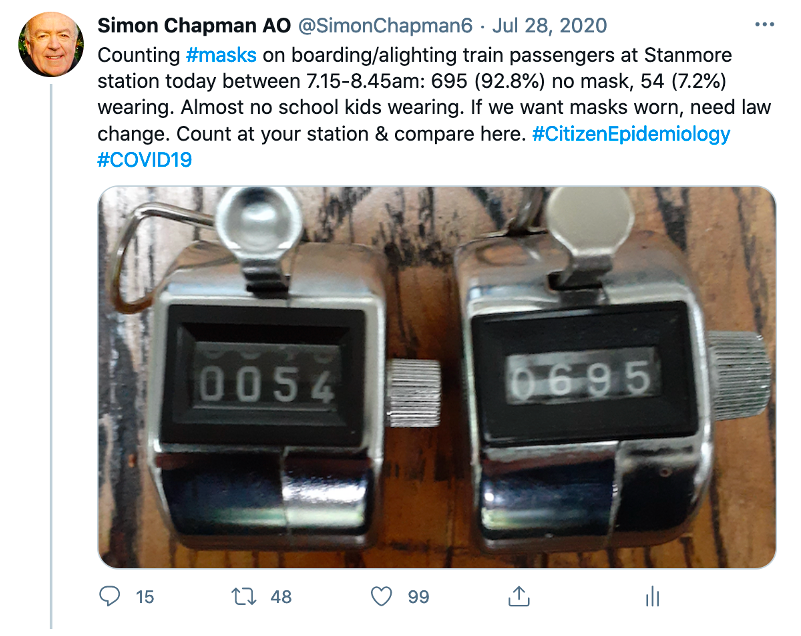
Well before masks were mandated, on July 28, 2020 I spent 90 minutes on the platform of my local railway station between 7.15am-8.45am observing the prevalence of mask use. I used two mechanical thumb tally clickers to count both use and non-use on people on the platforms both waiting to board and alighting. With mask use being voluntary, I found 54 (7.2%) wearing masks and 695 (92.8%) not.
On February 3, 2021 after 17 consecutive days in NSW without a locally acquired COVID case and when the law still required those aged 12 years and older to wear masks on platforms and in trains, I repeated these observations for two and a half hours between 7.00am-9.30am on a platform of Town Hall station, one of Sydney’s busiest stations located in the downtown central shopping district. From an unobtrusive seated observation point, I counted all use and non-use in those on three clearly visible railway platforms, those visible in the stopped carriages immediately adjacent to my observation point and on two stairwells leading onto the platforms. I did not count any children in school uniform as discerning their age was likely to be unreliable.
Across the two hours, I counted 2758 people with masks (96.6%) and 96 without (3.4%).
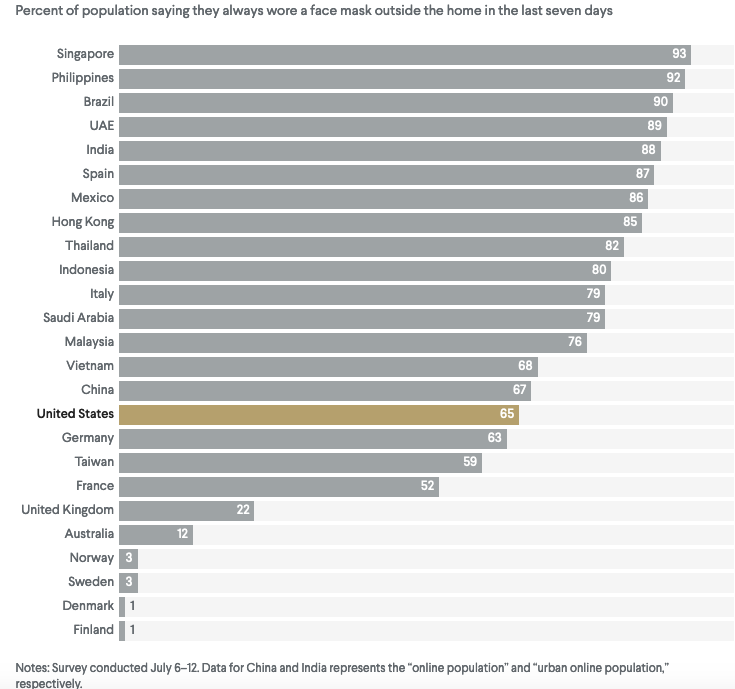
The Council on Foreign Relations reported in August 2020 that “more than half” the world’s nations had mandated either total public space mask use or use in certain areas or circumstances. In view of this, I searched PubMed and remarkably, was unable to find a single observational report of mask use prevalence for any nation or region, post the advent COVID-19, with usage data reports being based on self-report (for example here). Given the volatility of the debate about mandatory mask use in some nations, social desirability bias is likely to cause reliability problems in self-reports of mask use.
These “citizen epidemiological” easily conducted and unambiguous observations of mask use are possibly the first time the impact of legislation on mask use has been reported by actual counting of mask use. Masks are accessible, cheap and most critically, a vital component on COVID-19 risk reduction recommended by the World Health Organization. The data in this small observational study should encourage those advocating for masks to be made mandatory in relevant crowded circumstances.
Having traveled often on public transport during January, the counts I tallied are consonant with my experiences of seeing almost everyone masked during this time. Future research could examine whether my tallies are also occurring across the greater Sydney rail network at different times and days of the week.
At different times during the COVID-19 pandemic, Australian states and territories have mandated mask wearing in various public settings. As I write this on Feb 1 2021, my own state of NSW currently mandates masks in the Greater Sydney region (including the Blue Mountains and Northern Beaches), the Central Coast and Wollongong). Masks must be worn on public transport, for staff in hospitality settings (bars, restaurants, cafes), in hairdressing salons and barbers, beauty parlours and nail bars, massage parlours, tanning salons, on planes and in airports, and at places of indoor worship, weddings and funerals.
Those breaching these rules can be fined $200 (individuals), $1000 for small business owners not enforcing mask use and $5000 for corporations.
During most of January, this list also included all shops. The future may see changes to these rules, depending on infection rates and locations.
Health workers and many citizens were vociferous advocates for masks to be made mandatory from the early days of the pandemic. But without their use being mandatory, voluntary rates of adoption were depressingly low. In late July 2020, out of curiosity I took myself off to my local railway station for 90 minutes in the morning commute period with two hand counters, clicking with one hand all those boarding or alighting wearing masks, and with the other, those not wearing masks. Nearly 93% were maskless.
When Sydney’s northern beaches experienced a significant cluster which threatened to spread beyond the locked down peninsula, the state government relented and rapidly mandated masks in all indoor settings and on public transport from midnight on January 2, 2021.
It was obvious to all that there was an immediate, almost 100% compliance that lasted until the relaxation announced several weeks later.
As I blogged earlier, this was almost entirely predictable, mirroring the 100% compliance with a restaurant indoor smoking ban when it was first introduced in time for the Sydney Olympics in 2000, compared with the situation in Melbourne which at time still allowed smoking in restaurants.
There is a huge, unassailable lesson in this. Public information and persuasion campaigns designed to motivate people, manufacturers and the service sector to voluntarily adopt behaviours or changes in the way they manufacture or provide good and services will get you only so far.
When you face deadly serious threats to large numbers of people, and voluntary appeals are not translating into widespread adoption, legislation backed with fines can make a huge, sometimes instant difference. Harvard University’s David Hemenway documented many examples of this in the injury and violence prevention in his 2009 book While we were sleeping: success stories in injury and violence prevention.
I could scarcely believe what I was reading as I made my way through their painstaking analysis and synthesis conducted between July-December 2020. They gathered studies examining how “interventions” affected changes in hand hygiene, avoiding touching the ‘T-Zone’, catching droplets in tissues face mask use disinfecting surfaces and maintaining physical distancing.
Here, I’ll just focus on their mask wearing results. They located just 12 studies examining what happened when people are exposed to interventions intended to increase mask use. Their conclusions? “mixed results, with three studies reporting positive effects, two studies reporting no difference, one study reporting negative effects and six studies with indeterminate results.”
And their concluding implications? The few and often low quality of the studies suggest “a missed opportunity for harnessing techniques indicated by relevant behaviour change theory and evidence. We encourage policymakers and healthcare practitioners to work collaboratively with behavioural scientists to incorporate techniques that theory or evidence predicts are effective for enabling personal protective behaviours, such as techniques targeting motivational or self-regulatory processes.”
So all clear, are we, about what behavioural change research offers policy makers hungry for information about how to increase mask use?
It appears that the authors made a rod for their own back by limiting what “interventions” they should include in their review. Call me picky, but to my mind a law requiring everyone to wear a mask at risk of a fine, combined with the massive news reportage that invariably accompanies the introduction of such laws, ubiquitous posters reminding people about masks and frequent railway station platform announcements, might just count as an intervention a tad more important than some little study of what happens when some university students were sent free masks to prevent acquiring influenza.
In an August 2020 publication by the Council on Foreign Relations, “more than half” the world’s nations had mandated either total public space mask use or use in certain areas or circumstances. A graph in the report (below) showed very wide differences across nations in those self-reporting that they had worn a mask outside the home on the last seven days. Self-reported data on an issue like masks that attracts sometimes significant opposition is unlikely to have high reliability, compared with direct observation of mask wearing rates.
It is likely that there are widespread cultural differences that are highly relevant to mask use, which go beyond simple questions of whether masks are mandatory or not. Many Asian cultures have a long standing tradition for those with respiratory symptoms to wear masks. Differences in enforcement rates will also be important, as will those in a nation’s overall tendency in its citizenry to obey public laws.
This law in NSW produced a blindingly obvious, nearly universal uptake in mask wearing in all areas which required it. So the absence in this review of even a mention of such massive impacts on mask use was startling.
I searched PubMed for studies on the prevalence of mask wearing during COVID. I found many papers reporting and reviewing experimental evidence on the reduction of aerosol from mask wearers, and some papers comparing COVID 19 incidence rates in states and districts which mandated masks compared with those which didn’t (see here for example). But I found no papers showing time-series data comparing the prevalence of mask wearing before and after the introduction of mask laws.
Observational data like this are commonly collected and published in the monitoring and evaluation of the impact of a wide variety of public health laws and regulations like restaurant smoking, car roadworthiness, seat belt and infant restraint use in cars, blood alcohol and cannabis levels in drivers, helmet wearing by motorcyclists and cyclists, cockroach and rodent infestation in restaurant kitchens, and indoor air quality in workplaces. These are just a few examples.
If I’m right that there are few or no studies of mask uptake after the passage of laws mandating this, the researchers whose paper I described above could be forgiven for not including any in their review. COVID-19 is the largest health threat that all alive today have ever faced. All governments urge their citizens to wear masks, yet many still do not mandate it. Data clearly in plain sight for all of us to see that mandatory masks massively increase mask use could very easily be “upgraded” in evidence status by properly conducted surveillance studies. Such data would be invaluable in levering tardy governments into mandating their use.
In January 2021, the creepy murderer and legendary wall-of-sound record producer Phil Spector died in jail. I have a much-played boxed set of his best productions, which includes the Ronettes, the Righteous Brothers and Ike and Tina Turner’s incomparable River Deep, Mountain High. I cannot imagine ever disliking those songs, despite Spector’s odious crimes.
Then there’s good old Van and Eric. With 1 in 30 London residents currently diagnosed with COVID-19, 1700 deaths a day and British and Irish frontline hospital and ambulance staff pleading for people to obey COVID-19 control protocols, what are we all to make of these musical icons releasing a song protesting lockdowns? I saw Morrison in London in the early 1980s, and along with about a quarter of the audience, walked out well ahead of the end when he obviously didn’t want to be there either. But now I’m wondering if I should walk away from even listening to his music.
Morrison, who gave us the languid classic Into the Mystic, the soundtrack to Kenneth Branagh’s masterpiece Belfast and many, many more wonderful songs has released three tracks protesting the British lockdown: “Born to Be Free,” “As I Walked Out” and “No More Lockdown.” The hope is that these songs will be bought and downloaded, providing funds for out-of-work musicians. Morrison and Clapton also presumably also hope that their views will become as contagious as COVID-19 and people will ignore directives.
Fantastic that they care about musicians’ livelihoods. But how to describe their concerns for the whole population?
The other night at a family dinner, a Ryan Adams track I love came on in a playlist I had running. One of my kids said “what are you playing that guy for? Don’t you know that he’s been accused of multiple counts of sexual misconduct?”## I didn’t and my heart sank. I discovered him only relatively recently and have 10 or so of his songs like this one on high rotation playlists. [##Note: Adams has apologised for his behaviour]
But, as happens when I play favourite Clapton, Morrison and Adams tracks, I experience nothing of this in his paintings, and think I’ll always appreciate them.
Joe Jackson is another who rails against restrictions on smoking. The insipid nihilist lyrics to his 1982 track Cancer, (“everything gives you cancer”) could come straight from the tobacco industry’s historic playbook of trivializing the risks of smoking. They’d sit comfortably with one of today’s MAGA Trump supporters, applauding his efforts to shred environmental health standards.
I’ve watched Roman Polanski’s movies like Chinatown, Repulsion and Cul de Sac many times. But wait, there’s the problem of Polanski’s alleged sexual abuse of women. So, do we all just relax, sit back and enjoy his cinematic artistry?
Of course these recent examples are not the first time and certainly won’t be the last that musicians, artists, writers and public figures whose work we love, will go and display weapons-grade fuck-wittery or be exposed for their reprehensible behaviour. But what are we to do when we learn this, beyond talking about how here’s yet another public figure who’s gone down the plughole?
Then there’s travel. A few years ago I decided I wouldn’t attend a world conference in my field that was being held in a Gulf state. I had no appetite for living for a few days in the gilded cage of a luxury hotel while outside, the government quietly facilitated the exploitation of guest workers from impoverished countries, jailed people for adultery and did nothing to redress basic women’s rights.
I worked a lot with research colleagues in Shanghai, and loved going up there. But I became increasingly appalled by China’s treatment of minorities, evidence of organ harvesting from prisoners and its conduct in crushing dissent in Hong Kong. So sadly, no more China for me I decided.
But I’ve also been to many other countries where widescale human rights abuses, capital punishment, rapacious environmental policies, the jailing of dissidents and blind-eyes turned to Dickensian labour conditions in sweat shops abound. At different times, these have included the US, Turkey, Pakistan, India, Uganda, Iran and Afghanistan. Should we all feel obliged to stay away from any country which implements any egregious policies and practices? Are there any such places where none of this happens? Or if we’re to be consistent in the application of consumer and traveler “woke” principles, can we ever again travel anywhere?
And then of course, I live in Australia where our government keeps asylum seekers in prison-like indefinite detention, shrugs its smug shoulders over scandals like Robodebt, Aboriginal deaths in custody, Barrier Reef die-off, land clearing, and tries to endlessly polish the turd coal to try and make it seem clean.
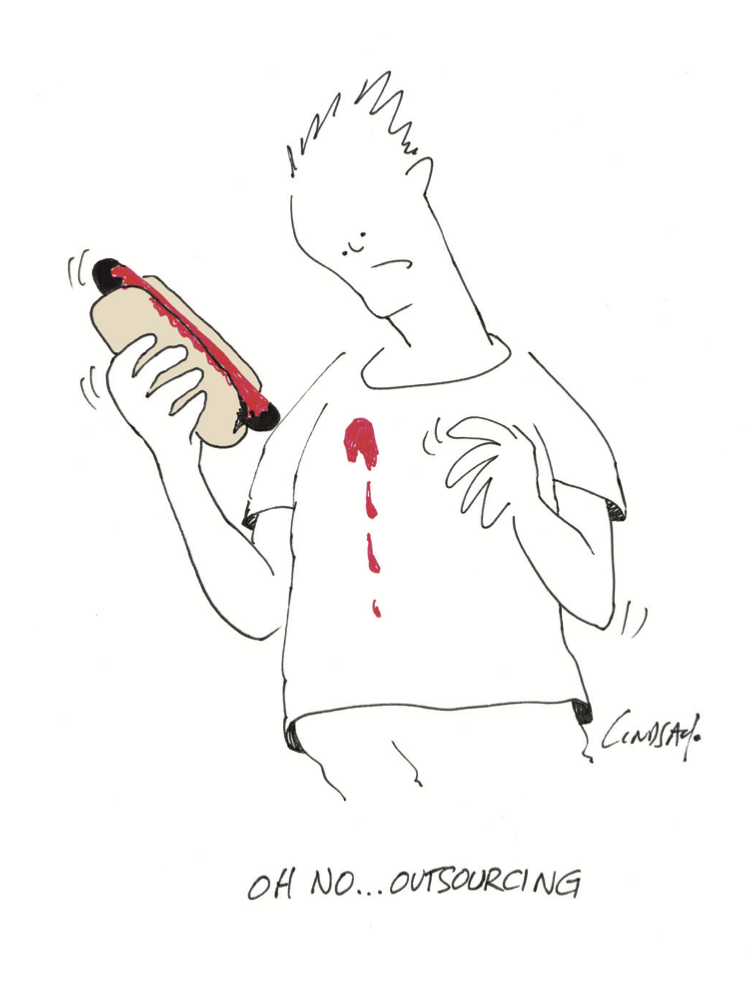
Cartoon by Lindsay Foyle
Many of us put a lot of effort into choosing products and manufacturers which tick lots of boxes on exemplary environmental, labour and human rights records. In our house we use Choice magazine’s Cluckar app to help us buy truly free range eggs. We buy “naked”, unpackaged fruit and vegetables. But I don’t check the carbon footprint and labour practices of every single grocery item I put in my trolley. Each trip to the supermarket would take all day if I did that.
The perennial debate about whether we can and should separate our appreciation for someone’s creativity from their loathsome and sometimes dangerous behaviours, attitudes and beliefs seems destined to never be resolved. All of us show inconsistencies in what we make a fuss about and what we let through.
The sense of loss I feel is palpable when I learn that an artist, musician or writer whose works I loved is another depressing cockwomble. But I haven’t and don’t intend to purge my Spotify playlists of anyone in that club. We often associate music we love with the context and times when we first heard it. What we might learn later about those who perform it seldom totally extinguishes any love for that music. Moreover, with the great majority of musicians, I’d have no idea about their politics. Is anyone saying that we should do this?
These people are diminished for me and I imagine many millions of others when we learn about their feet of clay. Knowing what they stand for has certainly inspired me to look elsewhere more and actively seek out musicians, artists and writers who I’ve found out share my values.
Every researcher has received rejections from journals. I edited Tobacco Control for 17 years (7 as deputy editor, and 10 as editor). Across that time I and the other senior editors had to reject 1000s of papers. All of these were written by authors who thought their papers were important and sometimes brilliant.
There are many reasons why papers get rejected, including many which are of an acceptable methodological and analytic standard. Here are ten of the most important:
Space limits
Journal editors are given page limits for their print editions by their publishers. Editors then need to decide word limits to optimize the number of papers they can publish in each edition. If there is only room for 70 papers a year, and 700 are submitted, it’s obvious 90% will be rejected. Editors may vary the word limits for different sorts of papers (reviews are often longer, and many submitted papers really have only one or two findings that are of any interest, and so authors are often offered brief reports or letters).
Many seem to believe that on-line only journals, not having the constraint of page limits that printed issues have, should be able to accept many more papers and not be fussed about length. But this is a misunderstanding and brings us to the next reason for rejection.
2. Budget limits
Publishers set annual budgets for journals. When I was at Tobacco Control we paid our senior editors a fee of $US50 per allocated paper. They got this regardless of the fate of the paper. So they got the same amount if, after reading the paper (and sometimes only the abstract—see below), they rejected it without review; if it went out for review and was then rejected without offer of revision; and also if it went through review and sometimes several revisions. Finding reviewers willing to review papers is a particularly onerous task that falls to senior editors. Refusal-to-review rates run at about 1 in 3. My own personal record in soliciting reviews runs at 12 consecutive refusals. Papers from nations where English is not the first language, sometimes have many problems with expression that need many hours of editorial attention.
Senior editors generally do not attend to the numerous problems of expression, inadequate referencing and failure of authors to follow journal guidelines. Neither do they do mark up papers for publication and fix table layouts. These tasks all take lots of time and are handled either by in-house technical editors or by out-sourced editors, often in big technical editing firms overseas. On-line publishing is also often hosted by out-sourced companies, which charge by the volume of material they publish.
All this of course costs money, and so publishers insist that editors are very judicious in the volume of acceptances.
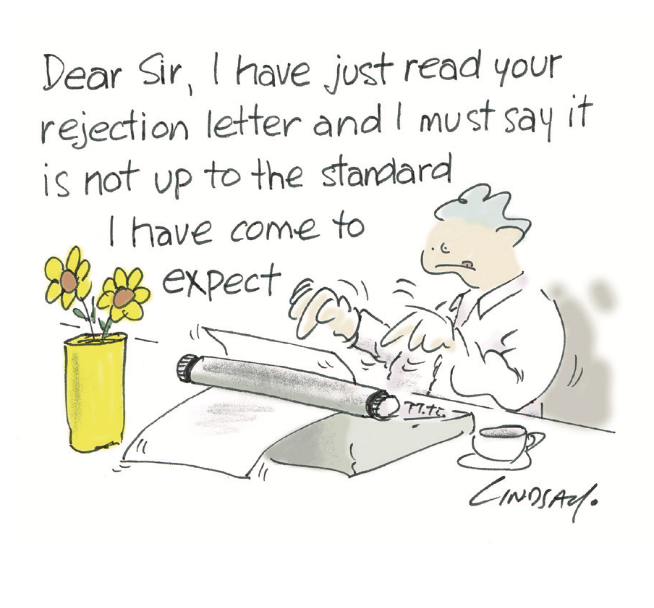
cartoon credit: Lindsay Foyle (Sydney)
3. Rapid processing
Across the 17 years I edited, there were few days when new papers, revisions or questions from authors did not arrive. If these banked up, the backlog was bad for editors’ workload, authors wanting to know the fate of a paper quickly and a journal’s reputation as a deep hole. My own worst case experience as an author myself is laid out here in its full, sorry detail.
So I encouraged all our senior editors to reject without review any papers that clearly had a snowball’s chance in hell of being accepted and which would waste everyone’s time if sent out for review. Some of the submissions that came in were unbelievable: entire theses, rants from conspiracists and crazies, papers where the authors had clearly never read the journal, and from those with near to zero familiarity with scholarly writing. If an editor leaned strongly toward reject without review, but wanted to run the reasons by others at our fortnightly editorial on-line conferences, they could bring it up there.
We used a stock email that attempted to explain our dilemma to authors: we had far, far more submissions than we could ever publish even if they were to be reviewed favourably, and so it was necessary to cull. We hoped authors would appreciate our rapid decision so they could place their work elsewhere.
One paper, in the early days of the internet, was submitted by a doctor who encouraged his patients to visit his website about smoking. He’d gone through the back-end data and written up a paper with numerous tables detailing such riveting details as the time his very modest number of patients visited his site and how many times they’d clicked through to its different pages. The assigned editor rejected it during our editorial conference. I saw the rejection come through on my email and replied to the handling editor “Congratulations! The fastest reject in the history of the journal!”. But I accidentally hit “reply all”, so my attempt at congratulating an efficient editor also went to the author who immediately replied with a white hot, incendiary blast about the arrogance of editors.
4. Impact factors
Not inciting the wrath of publishers for over-budget runs is always in the background. But there are also of course, important academic and impact considerations involved in rejection. I’ve never met a journal editor who was not intensely keen to see their journal’s impact factor rise and rise. Those who have low to homeopathic level IFs will often drone on about how unimportant these are. But those up near the top of the IF tables want everyone to know, particularly authors because many factor in IFs when submitting their most important work.
Experienced editors develop an instinct for submissions which are likely to be highly cited by other authors after publication. One of the most common things editors on a journal say to each other in editorial conferences is “I think this paper will really attract a lot of citations”. Or the reverse. I’ll come to tell-tale signs of this below.
5. No “wow” factor
The decision to send a paper out for review rather than to reject it outright is primarily governed by judgements that a paper will attract lots of interest. Editors are chosen because they typically have a breadth of experience in the area in which a journal focuses. Their own instincts about whether a paper is important are therefore often shared by other editors in the regular editorial conferences where decisions are made on the fate of most papers. Editors often note published papers which are being deluged with on-line clicks and being well cited. The obverse of this is that there are also categories of papers which are sleep-inducing and likely to be loved mainly by their authors.
6. Failing to “sell” your paper
I once sat next to Richard Smith, a long-time editor of the BMJ, on a train going from London to France. He had a large box-like piece of hand-luggage which was filled with paper copies of submitted papers. I watched him out of the corner of my eye as he triaged them into what I recall as three piles: instant reject, instant send out for review, and “read further later and think about it more”.
He motored through dozens of papers in the time it took us to get to our destination. With the great majority, he read the authors’ cover letter first. Sometimes it was the only thing he seemed to read. For others, he read the abstract as well. And with the reminder, he skimmed particular sections before deciding their fate.
We talked about this and agreed that many authors give very cursory attention to their abstracts and especially to the cover letter. The cover letter is critical to piquing the editor’s interest and telling the story about why the paper is important, how it advances understanding of something that passes the “so what?” litmus test and ultimately of whether a paper might hold promise of attracting a lot of scholarly and hopefully public interest too.
Similarly, abstracts are often dashed off at the end of a paper’s construction by fatigued authors wanting to just get it out to a journal. Amid a plethora of findings, sometimes the most important or interesting findings are left out of an abstract, because authors have failed to view their paper as editors might view it, killing a paper’s interest.
My own way of approaching this was to rehearse how I would try to briefly describe a paper of mine when pitching it to a specialized health or medical journalist writing for a newspaper. If it was a struggle, I’d often come down to earth about where to pitch the paper.
7. International or local interest?
With international journals (as opposed to those with clear national foci), editors are keen to publish papers that will interest global readers. In the tobacco control research space, a competent study of smoking prevalence among medical students in a single university in Calathumpia will be of far less interest than one that compares the same phenomenon in a large number of countries using a standard protocol. However, if a local prevalence study is contextualized against particular policies or practices that allow consideration of what might be explaining changing prevalence, that might well interest international readers.
8. Tell-tale signs of slap-dash preparation
A paper which has been rejected, perhaps often, by other journals often has signs that do not require a degree in forensic investigation to discern. Wrong referencing styles, not using the required headings or abstract style, dated data and a focus on water-under-the-bridge events, policies etc are all often give-aways. Under the weight of abundant choices, editors can take the attitude that they will give about the same time to such pass-the-parcel submissions as the authors have given to a journal’s requirements.
9. Come clean: attach previous reviews and changes
Many papers are rejected after review. Rejection here is often not because of irreparable problems, but simply because it’s been decided that your paper does not rank highly enough against others lined up in the “potential” marshalling yard. If yours has been rejected for other than fatal flaws, do not simply submit the same, unrevised paper to the next journal down the food-chain. Instead, address those changes that the previous journal’s reviewers suggested, and send the next journal a covering letter explaining that you had it reviewed by another journal, didn’t make the cut and include the reviews as well as a point-by-point explanation of how you addressed criticisms in your revision, now being submitted to the new journal.
I used to very much appreciate that when it happened and sometimes just used one new reviewer to assess the adequacy of the revision. I have also (quite a few times) received a paper I reviewed for one journal, from another. It has just knocked on the next door still all disheveled, looking for a bed. When authors have made no attempt to make any changes, I always advise the editor of the second journal of this and attach my old review.
10. Nominate likely reviewers
Many journals invite authors to suggest possible suitable reviewers (provided that these people have no competing interests with the authors). A surprising number of authors fail to nominate anyone. Those who do are off to a good start with editors who have decided a paper is good enough to review. It saves them time, and in my experience is usually more likely to result in a reviewer agreeing to review as the authors may know of their interest in the focus of the paper. My usual practice was to pick 1 or 2 of the 3 required reviewers from those suggested by the authors.
Early in the COVID-19 pandemic, I went to a cakeshop in a nearby suburb, wearing a mask. A man in his 50s was being served. As he turned to leave, he saw my mask and asked why I was wearing it. “COVID … obviously” I replied. He then launched into a tirade, asking me “do you think it’s healthy to re-breath your exhaled breath?” “Why do you think your lungs want to get rid of it?” and suggesting that I read some basic medical science.
So I asked him why he thought it was that operating theatre staff always wore masks, sometimes for marathon surgical operations lasting many hours. He turned and left, saying nothing.
Masks are of course a basic component of COVID-19 control. With aerosol transmission being now understood as the main way the virus is spread, masks are dogs balls obvious critical to reducing transmission. The NSW chief health officer Kerry Chant is always wearing one until she begins speaking in daily press conferences. Premier Gladys Berejiklian can barely finish three sentences without imploring people to wear a mask when in crowded situations like shops or using public transport.
An infectious disease doctor or scientist who is not urging governments to make masks mandatory in public settings is a rare as proverbial rocking horse poo. Victoria, which until today went two full months without a locally acquired case, made masks mandatory as an important part of reaching that achievement.
Gladys has surely now exhausted the thesaurus of asking us nicely. She’s urged, requested, enjoined, called on, entreated, pleaded, beseeched and nearly begged us all to wear masks. But she will not yet order us to.
Her trusty lieutenant Brad Hazzard has told us that the government doesn’t want to make it compulsory on public transport because bus drivers don’t want to have to act like policemen. How lame is this? Bus drivers always “acted like policemen” when they wouldn’t let passengers on a bus in the days when they sold tickets. I’ve often seen bus drivers tell people to stop smoking, to refuse to move off the bus stop until people move down the back of the bus when the aisle was crowded, and to refuse boarding to people when buses are too full. And we also have inspectors, remember.
And then let’s not forget that bus drivers would number among the most exposed workers of all to COVID. Failure to protect their health is indefensible.
With her team having to embarrassingly writhe in public like this, what is the problem here. Why can’t the government just require it?
Across my career I’ve seen a huge number of laws and regulations passed in the service of public safety. Entire fields of occupational and environmental health, building and food standards, food service standards, pharmaceutical regulation, consumer good safety standards, health care worker competency standards and road safety are all neck deep in requirements that you often don’t find in the world’s most impoverished nations, but which are taken-for-granted in advanced nations like ours.
Public heath ethics has green-lighted all of this since the time of John Stuart Mill’s articulation in his nineteenth century writings on liberty of when it’s ethically justifiable to curtail freedoms (basically when someone’s actions may harm others). There are hundreds of ways that the nanny state is good for us.
There are also examples where governments allow and enforce laws that restrict freedoms even when the nasty consequences only affect the person concerned and not others. Car seat belts and crash helmets are two obvious examples.
Mask wearing during highly infectious pandemics is clearly an example of where the consequences of not wearing a mask can elevate the risk of harm to both self and others. Indeed, to the whole community.
Laws greatly increase compliance
There is massive evidence across all fields of public health that laws greatly increase compliance. Take smoking in restaurants as an example. Before Australia’s state governments began dominoing bans on smoking in restaurants, we saw truly bizarre efforts to stop tobacco smoke reaching the lungs of those who didn’t choose to breathe it in. There was an era when you couldn’t smoke withing two metres of a bar. It was OK at 2.01 metres, but not at 2m. This made perfect sense to the smoke which unsurprisingly couldn’t read the signs.
A non-smoking section in a bar or restaurant was like a non-urinating section of public swimming pool.
In the weeks immediately after the 2000 Sydney Olympics, I was funded by NSW Health to compare restaurant smoking rates in Sydney (where the Carr Labor government had legislated a restaurant smoking ban) and Melbourne (where the Bracks Labor government had not).
In Melbourne, across 154 hours of observations in 81 restaurants, we saw 176 people smoking out of 2014 diners. In Sydney, we saw no one smoking among 2646 diners in 78 restaurants over 156 hours.
Political urging will get us only so far with mask wearing. Making them mandatory in all shops, malls, crowded footpaths and on public transport will instantly up rates of use.
There’s plainly some visceral ideological biliousness within the NSW Liberal ranks about regulating personal behaviour. Just before I sat down to write this, I went to my local shopping mall. About 80% of women, and 60% of men were voluntarily wearing masks. Good for them and all of us. The others have had 10 months of imploring and are still ignoring it.
It’s unimaginable that a theatre nurse or surgeon would pull the civil liberties card out of their pocket to argue that they shouldn’t have to wear a mask on the job. While COVID-19 threatens nations, it should be equally unimaginable that any government should try to make the same excuses.
Later today Australia’s Senate Select Committee on Tobacco Harm Reduction will release its report to the Senate. The Committee was chaired by Senator Hollie Hughes (Liberal NSW), who has often been openly supportive of vaping. Others on the Committee were Matt Canavan (Liberal National Queensland), who has also embraced vaping; Tony Sheldon (Labor, NSW), Anne Urquhart (Labor, Tasmania), Sarah Henderson (Liberal, Victoria), and Sterling Griff (Centre Alliance, South Australia). Rachel Siewert (Greens, Western Australia) was a participating member who asked many important questions of witnesses in the two days of public hearings.
While the committee had terms of reference and took evidence on a wide range of issues to do with vaping, the main focus was always on the proposal that the Therapeutic Goods Administration would allow doctors to prescribe time-limited access to nicotine juice to be used in vaping, and that those issued with such prescriptions would have them filled at pharmacies. To make this work, the government would have to prohibit the personal importation of nicotine and continue to outlaw its sale through specialist vape shops and any other retailer who wanted to profit from its sale (Ampol aka Caltex put in an enthusiastic submission wanting to do just that).
The TGA itself will be publishing a report by the end of the month on its own deliberations about the proposal for prescription access.
Four memorable moments
There were some memorable moments in the two day hearings. On day 1, the Committee chair Hollie Hughes declared that Colin Mendelsohn, the irrepressible vaping advocate, was her doctor. “The first thing I’d like to say, as a declaration, is that Dr Mendelsohn is actually my doctor. He’s helping with my smoking cessation. Just so it’s clear, I do have a professional relationship with Dr Mendelsohn, whom I saw 60 days ago, which was the last time I had a cigarette.”
No show witness
Hughes also blew a public birthday kiss to the head of the Legalise Vaping Australia campaign, Brian Marlow, who is capital E-D Executive Director of the Australian Taxpayers Alliance, which has long been shy about its funding. LVA’s agenda was at all costs, to stop the ban on personal importation of nicotine and to see off the Greg Hunt/TGA prescription proposal. It looks like they have failed again.
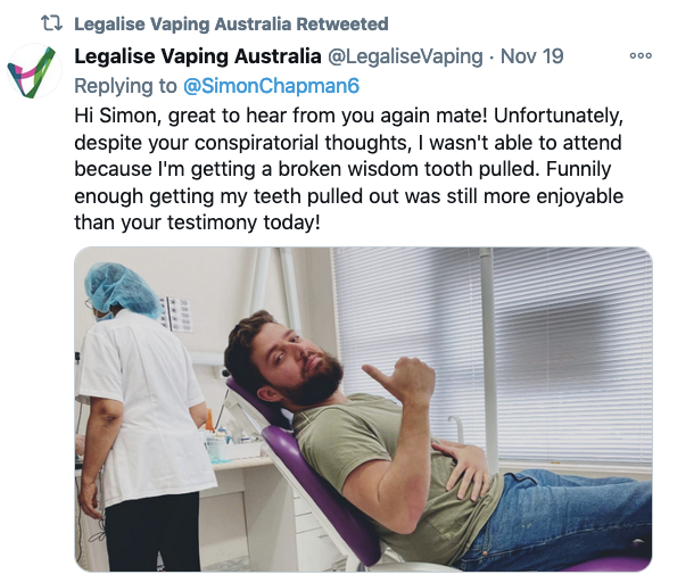
All those giving evidence to the Committee were asked to declare under oath whether they were now or had ever received support from the tobacco, vaping or pharmaceutical industry. One group due to give evidence was the lobby group Legalise Vaping Australia. But at the last minute, they withdrew.
I tweeted wondering if their decision might have had anything to do with avoiding answering under oath questions about support received from vaping or tobacco interests. LVA’s Brian Marlow explained that he had to have an emergency dental procedure.
My 32 page submission (with professors Mike Daube and Matthew Peters) can be downloaded here.
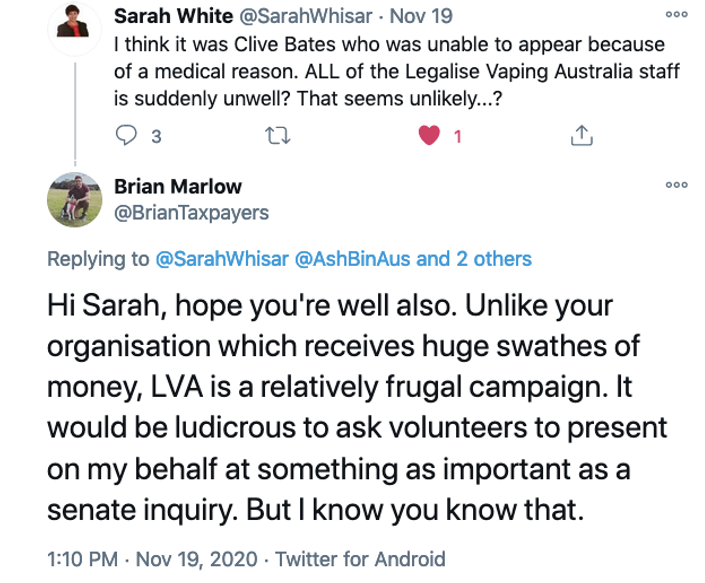
Dr Sarah White from Quit Victoria wondered why Marlow didn’t ask one of the staff he executively directs to sub for him. Marlow replied that it was all too important a matter to delegate to volunteers.
So while all witnesses had to answer questions on competing interests under oath, Legalise Vaping Australia avoided doing so.
“Simon Chapman just lied under oath”
On the morning I gave evidence, I was asked early on by Senator Sheldon “Do you receive, or have your organisation ever received, direct or indirect support from the pharmaceutical industry, including travel, attendance at conferences or event sponsorship, including from manufacturers of nicotine replacement therapies?”
Minutes later a vaping activist from Queensland who was watching the session live, tweeted to Hughes and Canavan “Simon Chapman just lied under oath. 2013 Simon Chapman was on the board of the Cancer Council and took money from Pfizer. Proof “(with a link to a Pfizer document about its charitable donations.
Toward the end of my evidence, Hughes who had not left the room during my evidence and so must have been reading her tweets or getting texts from a staffer who was, asked me if I had been on the Cancer Council board in 2013. As I’d served on the board of the Cancer Council NSW from 1997-April 2006, I thought it was an odd question and replied that no, I was not. I’d also never taken any funding from Pfizer and the “proof” was that Pfizer had given a small donation to a fun run and another to a meeting of people helping to counsel those with cancer.
Everything in the tweet except the spelling of my name was completely wrong and defamatory.
After the session I saw the tweet and demanded it be removed, and an apology be pinned to her twitter feed for a year. She did.
Clive Bates on flavours
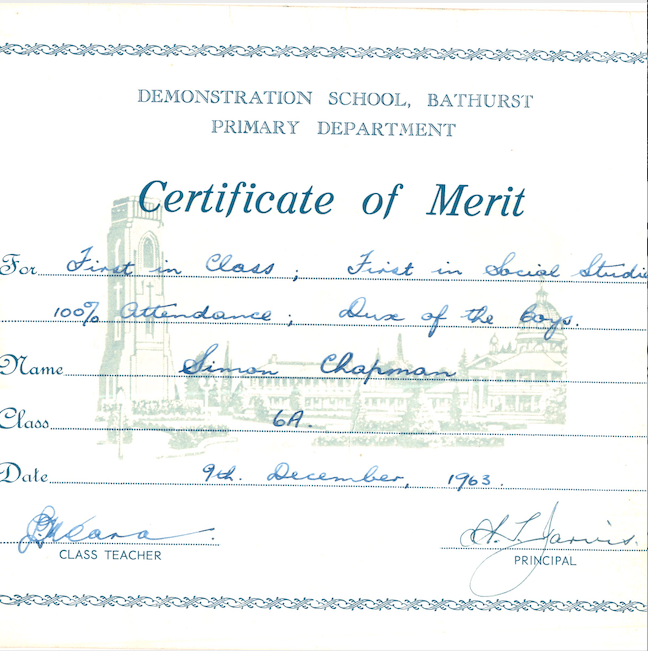
Then there was the total owning of the venerable Clive Bates by Senator Anne Urquhardt. Bates, as he likes to remind people with amusing regularity, headed England’s Action on Smoking and Health way back between 1997-2003, 17 years ago. Since Clive thinks that’s a cutting edge credential today, I guess I may as well also declare that in 1963, I was awarded both a Good Camper’s Certificate and was dux of my primary school. Both, you’ll all agree, are important and timely bits of information.
Today Bates is a darling of the vaping cult and welcomed at tobacco industry meetings. Since 2014, he has attended every Global Tobacco and Nicotine Forum, the global tobacco industry’s annual Chatham House rules get together. But he apparently always pays his own way to these and other events, because he made a declaration to the Senate (see #60) on questions about any competing interests and support received.
Earlier in the day, I had made a point that no asthma inhaler drugs (which save lives) use flavours to make the puffer experience more palatable. I also wrote about this here. I wanted the Committee to reflect on why that might be. The answer is that no pharmaceutical regulatory agency in the world would allow drugs to be sold with inhalable flavours because none have been passed as safe to inhale (while many have been passed as safe to ingest in food and drinks). This is apparently not seen as a problem by vaping advocates.
Senator Urquhart put this issue to Bates for comment, asking “There are about 2.7 million asthmatics in Australia. Many of them inhale asthma medication up to five times a day, roughly. None of those are flavoured, because of those safety concerns that Senator Griff raised. If e-cigarettes were regulated as medicines, I assume it would be unlikely that flavours would be approved. Can you just step me through your view? Why is it sensible to not allow asthma puffing drugs to be flavoured but okay to allow vapers to inhale flavours on an average of, I think, 173 times a day?”
After a few squirming attempts to evade the question he finally relented, conceding “But you’re perfectly correct; most of the flavours have not been evaluated as safe for inhalation.” There are now about 15,000 of these.
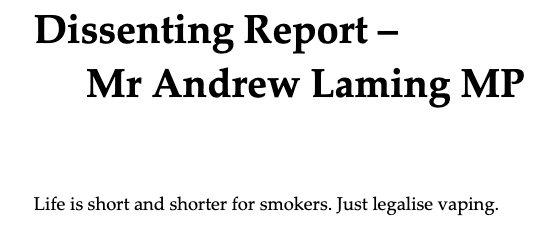
The Australian Senate Select Committee on Tobacco Harm Reduction’s calls for submissions and its two full public hearing days have concluded with transcripts published, and replies to questions on notice published. This Committee follows the 2018 report from the House of Representatives Standing Committee on Health, Aged Care and Sport on Report on the Inquiry into the Use and Marketing of Electronic Cigarettes and Personal Vaporisers in Australia. That report saw the pro-vaping committee chair Trent Zimmerman and Liberal member Tim Wilson embarrassingly forced to publish a minority report when they were rolled by a majority of the committee. Another minority report from the Liberal member Andrew Laming, a doctor, received a fraction more attention that the time it took to read it.
Australia’s vaping interests think Laming is the bee’s knees and gave him their prestigious award which undoubtedly went straight here.
The Senate Committee is due to publish its report later this month, with some predicting another minority report outcome. This will probably be pleasing to the Health Minister Greg Hunt, whose proposed scheme to ban personal importation of nicotine for vaping and to encourage the Therapeutic Goods Administration to introduce prescribed access to some e-cigarettes with nicotine, was supported by the submissions and evidence of nearly all Australian health and medical agencies which made submissions. This was the position I took in my submission, written with Prof Mike Daube (Curtin University) and Prof Matthew Peters (respiratory medicine, Concord Hospital).
Hey backward Aussies … listen up!
One of the interesting aspects of this enquiry has been the publication of many submissions from overseas. Some of these were apparently solicited by the Committee, but many appear to be unsolicited. It’s understandable that international commercial vaping interests would want to take every opportunity to try and cement some bricks in the wall of a future market, so submissions from tobacco companies like BAT, Philip Morris and Imperial Brands and their acolytes, plus Juul and vaping minnow companies were predictable. But I was surprised to see a good many submissions from individuals in British, US and New Zealand public health.
I’ve asked around my colleagues to see if they are in the habit of – off their own bat – sending submissions to UK, US or New Zealand parliamentary enquiries. None (myself included) can ever recall doing this unless requested to do so, and all agreed that it is an unusual and peculiar form of arrogance that disinhibits people from other countries to try and tell Australia’s politicians where the advice they are getting from their own experts is all wrong.
Australia has always been a global pioneer in tobacco control policy and campaigning. As you can read in our submission, we have comparable-to-better smoking prevalence than each of those three nations, achieved without being awash with e-cigarettes. The tobacco and vaping industries have a lot of skin the game of wrecking Australia’s global reputation as a vanguard nation in tobacco control, setting agendas for others. We were first nation to introduce plain packaging, and one of the first to put tobacco stock out-of-sight in shops. We banned tobacco advertising and stopped smoking in pubs and restaurants way before the UK (the USA will probably never fully ban tobacco advertising), introduced graphic health warnings earlier, and have the world’s highest priced tobacco.
So as a banana republic still on the nursery slopes of public health and tobacco control, we naturally appreciate advice from these other nations. Our approach to e-cigarette regulation is consistent with recommendations from the WHO and many other expert agencies and our record in other aspects of public health – such as COVID19 isn’t too bad either (new cases yesterday USA 202,780; UK 16,578; Australia 8)
Four English tobacco control experts Ann McNeill, Jamie Brown, Lion Shahab and Robert West read our evidence and wrote to the Committee. We were invited to reply. Here’s what we wrote.
Response to letters from Professors Brown, Shahab and West and Professor McNeill
Emeritus Professor Simon Chapman AO, Emeritus Professor Mike Daube AO, Professor Matthew Peters AM
We thank the Committee for the opportunity to respond to the letters from Professors Brown, Shahab and West, and McNeill.
Professors Brown, Shahab and West’s brief letter entitled “Impact of e-cigarettes on smoking in England” provides different conclusions from the data on the impact of e-cigarettes on smoking prevalence in England. They claim these as “the correct analyses”. We would however note that:
“With quit attempts at 32.5% of eight million smokers (2.6 million) in 2015, and prevalence of e-cigarette use in quit attempts at 36% in that year, this equates to 54288 additional short to medium term quitters in 2015 compared with no use of e-cigarettes in quit attempts. We would expect up to two thirds of these individuals to relapse at some point in the future, so we would estimate that e-cigarettes may have contributed about 18000 additional long term ex-smokers in 2015. This figure is similar to that estimated indirectly using the estimated effect size of e-cigarettes and the numbers using them. Although these numbers are relatively small, they are broadly similar to previous estimates, and are clinically significant because of the huge health gains from stopping smoking. A 40 year old smoker who quits permanently can expect to gain nine life years compared with a continuing smoker. This number of additional quitters is unlikely to produce a detectable effect on smoking prevalence in the short term, but might be picked up over a period of several years.” (our emphases)
“that 845,152 smokers used e-cigarettes in quit attempts; this equates to 50,700 … additional past-year smokers who report that they are no longer smoking as a consequence of e-cigarette use in a quit attempt in 2017. This is broadly similar to the estimate which we reported for 2015.”
We note that in the Addiction paper, the authors did not discount that figure by two thirds relapsing in the future, as they did in their BMJ paper. Applying that discount to the 845,152 smokers who used e-cigs in a quit attempt (50,700 who were not smoking in 2017 x 0.33) we get 16,731 (3.1%) who by the authors’ 2015 assumptions, would have quit in the long term. Expressed differently, 96.9% of smokers using e-cigs in quit attempts in England in a year are estimated to not quit in the long term. This is a proportion very close to the quit rate (4%) for quit attempters allocated to no quitting support arms in the recent Cochrane trials update.
“This number of additional quitters is unlikely to produce a detectable effect on smoking prevalence in the short term”.
So 16,731 of 7 million English smokers were additional long term quitters in one year because of e-cigarettes: 1 in 418 of all English smokers. We heartily concur with Professors Brown, Shahab and West that “This number of additional quitters is unlikely to produce a detectable effect on smoking prevalence in the short term”. 16,000 -18,000 is not well expressed as “tens of thousands a year”, so we remain curious about why they believe our interpretation of their data is incorrect.
Brown et al’s BMJ paper states that there were 8 million smokers in England in 2015 and their Addiction paper says this had fallen to 7 million in 2017 (a fall of approximately 12.5% or 6.25% per annum). If we assume there were 3 full years encompassed in the 2015-2017 period, there were 3 years of ~17,000 estimated additional long term quitters between 2015-17, then some 51,000 (5.1%) of the extra 1 million who were not smoking in 2017 might be attributable to e-cigarette use. The other 949,000 fewer smokers would be attributable to deaths of smokers, cessation by smokers other than via e-cigarettes and increasing numbers of never smokers thanks to prevention policies and programs.
With England seeing major declines in the use of varenicline, bupropion and NRT use while vaping soared, it is likely that some of those 51 000 would have been smokers who might otherwise have quit using those methods.
This positive figure—however large it actually is when the additional cessation forgone from other evidence-based medications no longer being used is netted out—needs to be contextualised against concerns that e-cigarettes may be holding many smokers in smoking who might otherwise have quit. There is considerable international evidence that this is occurring.
“Cigarette use was persistent, with 89.7% (95% CI 89.1% to 90.3%) of exclusive cigarette users and 86.1% (95% CI 84.4% to 87.9%) of dual users remaining cigarette users (either exclusive or dual) after any one year.”
and
“Among all W1 (Wave 1 or baseline) daily smokers, there were no differences in discontinued smoking between daily smokers who vaped (concurrent users) and exclusive daily smokers”
A just-published paper from the ITC-4CV four country (Australia, USA, UK, Canada) cohort survey found that after 18 months:
“smokers with established concurrent use [smoking and vaping] were not more likely to discontinue smoking compared to those not vaping … it is clear that the rates of transitioning away from smoking remain unacceptably low, and perhaps current vaping tools at best bring the likelihood of quitting up to comparable levels of less dependent smokers. The findings of our international study are consistent with the findings of the US PATH transition studies, and other observational studies, in that most smokers remain in a persistent state of cigarette use across time, particularly the daily smokers.”
A preliminary report of a Swiss study (“E-cigarette Use for Smoking Reduction and Cessation in a Four-year Follow-up Study Among Young Swiss Men: Some may Benefit, but they are Few.”) is available as a not-yet peer reviewed preprint here
This study included over 5,000 young Swiss men. It found that, at the general population level, EC use had no beneficial effects on reducing or ceasing smoking. Non-smokers (never- and ex-) and smokers at baseline were more likely to be smokers 4 years later if they subsequently had initiated use of ECs. The authors conclude that “Some smokers may have benefitted from using ECs, but they were few. At the general population level, ECs are not predominantly used in a way, which might optimise reducing or ceasing smoking. Therefore, the public health effect on the general population of using ECs may be questionable, as may policy measures to facilitate EC use.”
We note in Brown et al’s Addiction paper the fall in the proportion of smokers making quit attempts, from almost 40% in 2013 to about 34% in 2017.
The definitions of quit attempts differ somewhat between the surveys used in different countries and it is acknowledged that quit rates will fall after periods when large numbers of smokers have already successfully quit (for instance immediately following large tax increases).
If the proportion of smokers trying to quit in England was 50% rather than 30%, an additional 1.4m additional smokers would be making quit attempts each year, with an additional 56,000 likely to succeed even assuming no additional cessation support. The challenge for tobacco control in both our countries is to simultaneously increase both the numerator of quit successes and the denominator of quit attempts.
All major companies in the global tobacco industry are now promoting putative harm reduced products, while continuing to aggressively promote cigarettes. It is clearly in the industry’s interests to sell as much of both types of product as possible. If e-cigarettes put quitting in a prolonged holding pattern for many smokers and relapse to smoking is widespread, vaping may be holding many in smoking who might otherwise have quit.
Response to Professor McNeill’s letter is entitled “Additional Comment to the Australian Select Committee on Tobacco Harm Reduction”
We would note the comments below.
Point 1: Here, we would refer the Committee and Professor McNeill to our response above to Professors Brown, Shahab and West.
Point 2: Referring to our submission on page 10, where we write “Relapse to smoking is very prevalent. (A UK 15 month follow‐up of vapers found that overall 39.6% had relapsed to smoking, with those using tank systems faring worst (45.6%).)”, Professor McNeill claims that this is misleading in a number of ways.
“Rather than go into the details, I copy here the conclusions of the study (Brose et al, 2019), but would be happy to provide further information if required: “In a group of ex‐smokers who had stopped smoking for at least 2 months, relapse to smoking during a 15‐month follow‐up period was likely to be more common among those who at baseline vaped infrequently or used less advanced devices”.
As an author on the Brose paper, Professor McNeill knows that daily vapers had almost exactly the same risk of relapse as those who had never vaped. (34.5% vs 35.9%). The clear messages from that paper are that vaping does not prevent relapse and that even daily vaping is barely different from not vaping in preventing relapse.
Professor McNeill is also an author on a recent analysis of 4 Country ITC study data which concluded not only that “Among all W1 (Baseline) daily smokers, there were no differences in discontinued smoking between daily smokers who vaped (concurrent users) and exclusive daily smokers” but that “Most ex-smokers remained abstinent from smoking, and there was no difference in relapse back to smoking between those who vaped and those who did not.”
“A limitation of this study is the lack of hard evidence for the harms of most products on most of the criteria”
Point 3: Prof McNeill attempts to defend her position on EC safety that is unchanged since 2014 in the face of the substantial new evidence, particularly on respiratory and cardiovascular risk. She asks the Committee to believe that using separate and undefined methodology she as an individual, her academic collaborators and associated organisations have arrived at precisely the same 95% less harmful figure as the group assembled by Nutt in 2013 – a group that noted with a now notoriously sweeping caveat that there was no clear basis for selection of its members and that had very little in the way of data to rely on (“A limitation of this study is the lack of hard evidence for the harms of most products on most of the criteria”).
This 2020 paper from the American Journal of Public Health is highly critical of the continued use of this “95%” figure, or indeed of any ballpark figure stated without the provision of even rudimentary calculations about the long term consequences of using an extremely wide category of ENDS products.
“Trust us. We have considered it.”
Professor McNeill draws the Committee’s attention to a statement authored by herself and Professor Hajek explaining the 95% in more detail which was published as an addendum to the 2015 PHE report.
We agree that the Committee should give this statement its close attention because it actually provides nothing remotely approaching any worked calculations for detailed analysis of any risk comparing cigarettes and e-cigarettes. Like the Nutt report, and Professor McNeill’s reference to reports planned for publication in 2021 and 2022, it basically says “Trust us. We have considered it.”
In their explanatory memorandum, McNeill and Hajek state, firstly:
“Our review aimed to assess whether studies that have recently been widely reported as raising new alarming concerns on the risks of e-cigarettes changed the conclusions of the previous independent review (Britton and Bogdanovica, 2014) and other reassuring reviews.”
“Despite some manufacturers’ claims that electronic cigarettes are harmless there is also evidence that electronic cigarettes contain toxic substances, including small amounts of formaldehyde and acetaldehyde, which are carcinogenic to humans, and that in some cases vapour contains traces of carcinogenic nitrosamines, and some toxic metals such as cadmium, nickel and lead. Although levels of these substances are much lower than those in conventional cigarettes, regular exposure over many years is likely to present some degree of health hazard, though the magnitude of this effect is difficult to estimate.”
Nowhere in this review is any estimate made of relative safety and 95% as an estimate is not anywhere mentioned, let alone calculations provides for any comparison with cigarettes.
Underpinning the unreliability of any academic estimate of relative harm is this statement also made in the Britton and Bogdanovica review:
“The world literature on harm reduction practice is extremely limited. Such data as is available on the content and emission characteristics of products currently on the UK market has been produced almost entirely by independent researchers, not by suppliers. Absorption characteristics are virtually unknown. However, this is data that can and should be required of manufacturers or suppliers, and will be as a result of medicines or TPD regulation, but for up to three years will not be required. While a clearly important area of research, it seems inappropriate to use scarce public research funding to provide this data. This responsibility should be placed, as soon as possible, on suppliers.”
McNeill and Hajek in their 2015 report state:
“We concluded that these new studies do not in fact demonstrate substantial new risks and that the previous estimate by an international expert panel (Nutt et al, 2014) endorsed in an expert review (West et al, 2014) that e-cigarette use is around 95% safer than smoking, remains valid as the current best estimate based on the peer-reviewed literature.”
The West et al report was a submission to a UK All-party Parliamentary group. This report does make that statement that ECs are much less harmful but provides no evidence and defines no process for which a harm determination could be made. Specifically, within the West report, the only estimate of 95% safer is referenced to the Nutt report. It does not endorse that figure – it only states that this is an estimate. Indeed, it states that “the precise harm from long-term use is not known” A careful examination of the documentary trail for evidence supporting the 95% (or any) figure calls into considerable question the argument put by Professor McNeill to the Committee.
[updated 10 Jan, 2021.Note that the Ioannidis database has subsequently been updated till 2020. I have not gone through the updated rankings to adjust the list below, so this list is valid only for the date on which I last updated it]
The Ioannidis group used Scopus to analyse the output and citations of 6,880,389 authors who had published at least 5 papers during the 22 years Jan 1996-Dec 31 2017, the latest date when full data were available. In this paper they report on the top 100,000 of these 6.88 million authors (in fact on 105,026). Two searchable supplementary excel tables can be downloaded, one for all 22 years and the other for the single year of 2017.
They ranked the top 105,026 authors across all scientific fields “based on their ranking of a composite indicator that considers six citation metrics (total citations; Hirsch h-index; co-authorship adjusted Schreiberhm-index; number of citations to papers as single author; number of citations to papers as single or first author; and number of citations to papers as single, first, or last author).” The authors argue that this database “provides a measure of long-term performance [and] also reflects their career-long impact or is a very good approximation thereof.”
I spent a couple of hours searching for authors who I know have made substantial research contributions in the tobacco control field.
The list below shows 100 names that I found in the list of the highest ranked 105,026 authors. Some of these published almost exclusively in the tobacco field, while others published more widely, including in the tobacco area (these I have italicised below).
If you know of others who should be in this top 100, please let me know via the comment button on this blog and I’ll check their details on the link above and add their names.
Several things stand out for me:
huge male dominance (just 21 of the 100 are women)
a near total dominance (90%) by anglophone nation authors (61 USA, 16 UK, 7 Australia, 4 New Zealand, 2 Canada)
most of those on the list are older authors, reflecting their outputs across 22 years
several are deceased
Many highly productive and influential authors I looked for were not shown in the 105,206 highest ranked. Many of these are younger people who have been publishing for fewer years. One, Geoff Fong from the University of Waterloo in Canada, was not on the list which stunned me. Geoff’s work has had 30,794 cites and he has an H index of 83. I find it incredible that such an output would not catapult him high in any world ranking, yet his name does not appear.
Ranking of authors with exclusive or major contributions in tobacco control related publications 1996-2017 (denominator 6,880,389 authors across all areas of scholarship who had published at least 5 papers)
This week’s much discussed Four Corners program examining the extra-marital sexual relationships with staff of two Australian cabinet ministers had a giant blind spot.
Relationships between people who work together have always been extremely common. While social media are today the most common way that couples in long term relationships meet, hooking up with someone you meet at work remains one of the most common replies we get when we ask a couple “so how did you two meet?”
Sometimes workplace relationships are between those with equal or similar employment status. And here, in discussions I’ve had with several groups of friends this week, there seems to be consensus that this is acceptable. Yes, things can get awkward when the relationship fails and you have to continue working with a former lover. Those wisdoms in hindsight power age-old sexist axioms like “don’t dip your pen in the company ink” and the more gender neutral “don’t get your meat where you get your bread”.
But workplace affairs and later permanent couplings also often involve asymmetrical power and status. In four couples I’ve discussed this with since Monday’s program, three started their relationships at work. One was between two who worked in the same small business in a county town, in different roles, with no line authority over each other, and on similar pay. Another was a male boss of a very small company who started having a relationship with a female employee which led to them now living together for several years, very happily.
The third was me and my wife. Trish was my son’s teacher in primary school. I was separated, she married. A casual remark I made to one of her colleagues who asked if I was seeing anyone, about how attracted I was to her was passed on the same day. Trish cornered me the next morning saying “I hear you’ve been saying nice things about me”. We got together that weekend and have been a couple for 30 years.
At the time there were several pinch-faced parents in the school who found all this outrageously salacious and improper. I was, of course, apparently only trying to get my son higher marks by having it on with his teacher. When he was made school captain five years later, Trish had obviously arranged that and rigged the voting with the full collusion of all the staff and students.
I’d not be surprised if there is a formal HR policy in the school system that makes it clear that teachers must not have sexual relationships with parents in their school. Perhaps Trish could have been transferred or sacked had any of the tongue-waggers taken it upstairs. But even if that was the case, should we feel guilty and unethical about our relationship today? Should I have “kept it in my pants” and she have “kept her knickers on”, in the parlance of the morally virtuous that got a spirited airing on the ABC’s Q&A panel program after Four Corners screened? Should we be perpetually yoked by the weight of an understanding that our coming together was “wrong” and that we were entitled to no ethical agency in navigating how we decided to conduct ourselves?
The bitter feelings of the ex-lover of Alan Tudge were framed by the program as a woman humiliated and hurt by the ways she perceived she had been treated as someone with far less power than her ministerial lover. The sub-text waving a very big flag was “it is always unethical for people with different levels of power in a workplace to have sex.” As neither Tudge nor Porter were interviewed, we had no opportunity to contextualise her account with his.
But given the countless numbers of couples over time who have met at work and begun affairs that didn’t end badly, this doctrinaire framing of office sex as almost always wrong doesn’t pass my pub test. There will be as many reading this who have lived that experience positively as those for whom lived to regret it.
I was left feeling that here was yet another chapter in the endless morality tale of public virtues vs private vices. If you make a virtue out of family values with your political megaphone, but are living your life rather differently, that’s fair and important game. And I’m also sympathetic to the view that honey or stud muffin traps which might compromise national security are a proper focus for elected officials to give very serious consideration. So Malcolm Turnbull’s bonk ban was understandable, if wildly optimistic.
But none of the asthma drugs which are inhaled come in flavours which might make them more palatable. And respiratory medicine colleagues tell me that many users do not enjoy the medicinal taste. So you’d imagine that the manufacturers of inhaled medicines would jump at the opportunity to have flavours available if this would encourage more people to use their puffers when needed.
Here’s an example of someone enquiring to an on-line forum about whether puffer flavours are available. The advice back? “We still do not know the long-term consequences of inhaling concentrated flavourants, but I suspect that many are pretty bad for you… Also, many aromas (perfumes) are known to induce asthma attacks in people who are sensitive. So all-in-all probably not the best idea for people who are already at risk of reduced lung function.”
People who use puffers are advised that it’s safe to use them 4-6 times a day maximum. Contrast this with the number of times that the average vaper fills their lungs with propylene glycol, nicotine and flavouring chemicals, all vaporised from the liquid that is heated by the metal coil heated by the e-cigarette battery.
This recent study monitored people vaping and found those who were exclusive vapers pulled this cocktail deep into their lungs 173 times a day — a mere 63,188 times a year. Those who were dual users (ie who smoked and vaped) took 72 lung-basting inhalations. The average 12 a day smoker takes about 96 puffs.
So the average exclusive vaper is inhaling vaporised flavours into their lungs at a rate some 35 times more than a person with asthma takes a blast from their puffer. And that’s before we even begin to count the secondhand vape that vapers (and the rest of us) also get when they vape around others.
Way back in 2014, there were 7764 unique vaping flavour names available online. It is likely there are many, many more in 2020. So these flavouring agents have all been cleared as safe to inhale, right?
Errrm .. no, actually.
The peak flavour manufacturers association in the USA Flavor and Extracts Manufacturers Association (FEMA) stated earlier this year:
1. There is no apparent direct regulatory authority in the United States to use flavors in e-cigarettes. In this context, it is important to note that the “generally recognized as safe” (GRAS) provision in Section 201(s) of the Federal Food, Drug, and Cosmetic Act (FFDCA) applies only to food as defined in Section 201(f) of the Act.
2. None of the primary safety assessment programs for flavors, including the GRAS program sponsored by the Flavor and Extract Manufacturers Association of the United States (FEMA), evaluate flavor ingredients for use in products other than human food. FEMA GRAS status for the uses of a flavor ingredient in food does not provide regulatory authority to use the flavor ingredient in e-cigarettes in the U.S
3. E-cigarette manufacturers should not represent or suggest that the flavor ingredients used in their products are safe because they have FEMA GRAS status for use in food because such statements are false and misleading.
So in summary, flavouring chemicals likely to be used in e-juice may have been assessed as safe to injest, but not to inhale.
Vaping advocates argue that regulators should keep their hands away from flavours because they are a major factor attracting smokers to try and keep vaping. Those worried about the dramatic rises in regular vaping by teens in several nations which have opened the e-cigarette access floodgates should get their priorities right, apparently.
By contrast, the pharmaceutical industry, which almost certainly would like to flavour its inhalable asthma drugs, has not gone down that road. One of the big reasons for this is undoubtedly that its asthma products have to go through therapeutic goods regulation. The two considerations there are efficacy (does a drug do what it is supposed to do? Answer with vaping: very, very poorly) and safety. The pharmaceutical industry knows it would struggle to demonstrate that inhaling flavours are acceptably safe.
This is why the vaping industry and its urgers are desperate to avoid therapeutic regulation and instead have its products avoid the safety standards that they would try in vain to demonstrate.
People living with asthma don’t abandon their unflavoured puffers in great numbers because they don’t taste the best. But undoubtedly, many who vape would not do so if they could not get flavoured e-juice.
But it is very wrong to imply that all who are vaping today are former and current smokers who are vaping to quit smoking and need support. The just-published paper from the ITC-4CV four country (Australia, USA, UK, Canada) cohort survey found that “among smokers who also vaped, 46% planned to quit smoking within 6 months, 30% planned to quit in the future, but beyond 6 months, with the remaining 24% reporting that they did not know or did not plan on quitting, suggesting low motivation to quit smoking among many of the concurrent [both smoking and vaping] users.”
Many dual users who vape are not at all desperate to quit smoking. Regulatory policy which fails to appreciate this and puts the flavour experimenting interests of vapers with no interest in quitting ahead of policies that keep beguiling flavoured vapes totally out of the reach of the great majority of kids, needs strong opposition. The Greg Hunt prescription access barrier is an obvious way to ensure this.







 Simon Chapman AO