• Home
  • About/CV
  • Blog
  • Vaping Research Alerts
  • Blog archive list
  • My books
  • Memoirs
  • Music, bands, films
  • Contact

Simon Chapman AO

~ Public health, memoirs, music

Simon Chapman AO

Category Archives: Blog

Australia’s new vaping policy flailed by New Zealand vaping advocate. How did he go?

10 Wednesday May 2023

Posted by Simon Chapman AO in Blog

≈ 2 Comments

New Zealand’s  on-line publication Stuff today published  an agricultural swoosh at Australia’s recently announced new vaping regulations written by Ben Youdan, director of ASH, Action for Smokefree 2025.

If a Martian wanted an explanation of “sophistry”, Youdan’s article would be very useful. Let’s take a look through it, line by line.

Youdan: Vaping is far less harmful than smoking and is helping millions worldwide to quit the deadly habit.

Response: Oh really? Is that why 16 reviews, meta-analyses  and consensus statements published since 2017 about the evidence on vaping in quitting uses language as “inconclusive, insufficient, weak or inadequate” to describe that research? And when it comes to “less harmful” what are we to make of the 2021 words of 15 former presidents of the Society for Research on Nicotine and Tobacco who stated “High-quality clinical and epidemiological data on vaping’s health effects are relatively sparse. There are no data on long-term health effects, reflecting the relative novelty of vaping and the rapid evolution of vaping products. Determining even short-term health effects in adults is difficult because most adult vapers are former or current smokers.” (my emphasis)

Youdan: The Australian ban is the worst kind of policy making, and lacks empathy for the 2.2 million Aussie adults who smoke.

Response: Ninety percent of smokers regret ever starting. Large percentages of smokers strongly support tough tobacco control like tax and smoking bans. Most smokers quit without any assistance with a surprising proportion describing it as much easier than expected.  There is now overwhelming evidence that those still smoking are not “hardened” smokers who all need extra help. No parent ever hoped their child would take up smoking or vaping.  Empathy?

Youdan: It will reduce their access to much less harmful alternatives. Especially when good access to alternatives are genuinely helping people, and likely reducing the future death toll of tobacco.

Response: Access to vapes will be available through any of 4,168 pharmacies through a prescription able to be issued by any of Australia’s 31,000 GPs.

Youdan: The bottom line is that this policy will prolong the life of the tobacco industry in Australia and shorten the life of the smoking population that will likely increase. This is not a policy we should adopt.

Response: So if it will prolong the life of the tobacco industry, please explain why it was that every tobacco company attacked the Australian prescription policy and wanted the “consumer” access model you have in Aotearoa/New Zealand? What do they know that you don’t know Ben?

Youdan: In Aotearoa between 2018 and 2021, smoking rates fell by an unprecedented 30%, and an almost unbelievable 40% for wāhine Māori.

The reason for such a large shift was a huge switch to vaping, as addicted smokers ditched cigarettes for good.

Our smoking rates fell below Australia’s for the first time in 2018, and since then the rate at which smoking is declining here is double theirs. It’s the same story for youth smoking.

There is no doubt that this huge impact on adult smoking in Aotearoa has been because people can get vapes where they get cigarettes; vaping is cheaper, better promoted and easier to buy than cigarettes.

Response: It’s obviously great that Aotearoa/New Zealand has seen these declines. But smoking rates in Australia fell faster than in Aotearoa/New Zealand in earlier periods when we often shared similar policies. So simplistic attribution of changes to single policies rather than to the synergistic historic interplay of all policies is tempting but is fraught with problems. Demographic and cultural differences in smoking especially make such comparisons difficult. Is Youdan suggesting that only vaping is responsible? What about Aotearoa/New Zealand having the world’s second most expensive cigarettes?

Here’s a salutary graph from Britain on the same issue.

Youdan: Australia, on the other hand, has just proposed a policy that essentially bans the sale of vapes outside a medical prescription model – but at the same time leaves cigarettes in every petrol station, supermarket, dairy and convenience store.

Could the tobacco industry ask for any better gift than a government-sanctioned monopoly for cigarettes, by far the deadliest nicotine products.

Response: Again, how very odd then that every transnational tobacco company is implacably opposed to Australia’s prescription access scheme. If it was going to be such a gift to them, they would all be cheering it on, surely?

Youdan: For the thousands of Australian vapers who have quit smoking, their access to safer products is about to be cut off, leaving them surrounded only by cigarettes.

Response: Cut off? Just like all other prescribed drugs are cut off to all Australians who in 2020-2021 got 314.6 million scripts filled?

Youdan: It will be a miracle if smoking rates don’t increase In Australia.

People celebrating this pro-smoking policy argue that prescription-only access to vapes works as a safer way to access treatments. This assumes that we live in a fair world and ignores the reality that smoking rates are highest in low-income populations, rural populations and especially in Aboriginal and Torres Strait Islander communities.

These groups are already under-prescribed for existing drugs, and most likely to be failed by the new proposals.

Response: Smoking rates are higher in disadvantaged groups in every nation. We don’t ignore that at all. Indigenous tobacco control leaders in Australia who advocated for the new policies have praised the government’s new plan.

Youdan: In Australia and New Zealand, we are worried about the number of kids taking up vaping, and the Australian government justifies their approach as protecting kids.

Response: Now why would ASH be worried about kids taking up vaping when it argues that kids’ vaping is driving down their smoking and that vaping is near enough as benign as inhaling steam in a shower? Do they think that possible vaping harms occur to the under 18s, but that once you turn 18, our bodies are just fine getting an average 500 point-blank chemical vapour bastings a day, year after year?

Youdan: However, policies of prohibition don’t work. Despite having banned nicotine vapes in Australia since 2021, a recent report has suggested almost 14% of 15-17 year-old Australians vape regularly, the same as New Zealand.

These young vapers are already using illicit products, as they mostly vape nicotine despite it being illegal.

Response: And how has this situation arisen?  If vapes are to be “prohibited” in Australia, then by the same reasoning all prescribed drugs are also prohibited. You know that makes sense. The “ban” since 2021 was gutted by the actions of conservative politicians, egged on by pro-vaping groups and Big Tobacco, by overturning the original ban on vape imports. These groups now regularly talk about Australia’s failed prescription policy when their opposition to it assisted that failure.

Youdan: The vapes they use lack quality standards, or clear provenance. A situation that is already more harmful than in a legitimate vape market like Aotearoa.

Response: This is eerily reminiscent of a card often played by Big Tobacco about smuggled cigarettes: they are much more deadly than our “pure” factory made cigarettes. You know, the ones that kill only 2 in 3 long term users.

Youdan: Australian campaigners have claimed that there is a generation of kids addicted to nicotine in vapes. In which case where will these young people turn to cope when this ban happens? Unlucky for them, Australia’s Government is making sure cigarettes can still be sold everywhere.

Response: Most nicotine addicts don’t need to “turn to” anyone when they finally quit. They quit unaided. Those who really struggle can try prescribed meds … or has ASH NZ now walked away from them?  “Making sure …” Yes that’s why every single tobacco control policy fought and won in Australia since the early 1970s was deeply opposed by Big Tobacco. They just love what Australian governments have done to them across  50 years. But yes, Australian tobacco control agencies are very envious of Aotearoa/New Zealand’s policies of dramatically reducing tobacco access, true nicotine delivery and the eventual phase out of sales. We’d be very happy to copy those policies.

Youdan: As much as we don’t want kids to vape – we really don’t want them to smoke. To date we’ve seen no evidence youth vaping leads to smoking, but the Australian proposals might change that.

Response: There are none so blind as those who will not see. There is huge evidence that kids who vape are much more likely to smoke later, even when well known predictors of propensity to smoke are controlled for in analyses.

Youdan: More people are quitting smoking than ever before in Aotearoa, nudged by progressive anti-smoking policy, and given the availability of vaping as a more accessible and cheaper way to manage nicotine withdrawal.

Our youth vaping rates increased a lot until 2021, when the Government finally put some regulation and rules in place around vaping.

Since then, the rate of increase has slowed, and the number who have tried vaping has even decreased. The problem with New Zealand’s policy is not that it’s too permissive, but that it came too late.

We can reverse the trend, and in 2022 we saw the first decrease in youth vaping recorded in the ASH year 10 survey.

Response: Ben seems to have overlooked this inconvenient bit from ASH’s own report:

“Daily vaping increased a statistically significant amount for Māori participants (19.1% in 2021 to 21.7 in 2022), in particular for Māori girls (21.3% to 25.2%). There were no statistically significant changes in daily vaping rates for other groups when analysed by ethnicity and by ethnicity & gender.” (bolding my emphasis)

If ASH are worried about health inequalities, they should be deeply alarmed by this evidence from their own survey.

Youdan: We need to do more though. ASH urges the government to step up and resource evidence-based approaches around youth education, support to quit vaping, and to help schools battling at the front line with little or no help.

We’d also like to see better enforcement of sales to minors, an increase of the selling age to 21, reduced appeal of vape marketing, and cessation of the rapid rise of disposables.

Response: Oh dear. Ben would know well that terribly concerned statements about children smoking or vaping and calls for more education, crackdowns on selling to minors, and calls for marketing that can magically be seen by adults but not by children are all cynical, fingers-crossed calls from the Big Tobacco and Big Vape advocacy playbooks. These are industries whose long term survival and business models depend on robust uptake of smoking and vaping by kids.

Why not stock vapes in school tuck shops if they are so harmless and wonderful at reducing smoking? Are you not telling us something here Ben?

Youdan: We have decades of experience in drug education and harm reduction with kids, and lessons about what works and what doesn’t.

We need to apply this experience, not follow the Australians swinging wildly in the dark and hoping to hit the target.

Response: Australia has no experience in effective tobacco control? Oh please …

Youdan: It will reduce their access to much less harmful alternatives. Especially when good access to alternatives are genuinely helping people, and likely reducing the future death toll of tobacco.

Response: It will dramatically reduce access to vapes by kids and by “recreational” vapers – many who have never smoked or are smokers who are not trying to quit. Death rates from tobacco caused disease have been dramatically reducing since the 1980s, thanks to the “wild swinging in the dark” Australia and others nations have engaged in.

The bottom line is that this policy will prolong the life of the tobacco industry in Australia and shorten the life of the smoking population that will likely increase. This is not a policy we should adopt.

Response: The tobacco industry is on life support in Australia, with the switch off not far away. All tobacco growing and manufacturing has long gone and long ago the industry described Australia “as one of the darkest markets in the world”. The global tobacco industry is climbing over itself to stop innovations like plain packs that started here. They are now doing the same with prescription vaping access. What should that tell us all?

Vaping theology 15: The government’s prescription vape access scheme has failed. So let’s “regulate” and reward illegal sellers for what they’ve been doing!

27 Monday Mar 2023

Posted by Simon Chapman AO in Blog

≈ 4 Comments

Imagine the consequences if a huge pharmacy chain, in intense competition with its rivals for the multi-billion dollar prescription drug market was to say “Ahh bugger it, let’s just ignore the need for a prescription and supply prescription-only medicines to anyone asking for anything.” Anyone wanting antibiotics, codeine, statins, steroids, anti-hypertensive drugs … you name it … could walk in, hand over their money and walk out with whatever drugs they wanted.

The reaction would be swift and iron-fisted, as shown here and here in cases where pharmacists were investigated and disciplined over missing scheduled drugs.

Yet this is in effect what has been happening in Australia since Oct 1, 2021, the date when the only local legal access to nicotine vaping products (NVPs) became via a prescription legally needing to be dispensed at pharmacies.  But as is by now blindingly obvious, only a tiny proportion of people who vape – estimates put this at below 4% — are today getting their vapes in this way. The rest are still buying them openly online, from shops brazenly signed with “Vapes sold here” or from many hundreds of market stalls. Corner shops, petrol stations and an army of on-line sellers are openly defying the law.

So how did we get to this point?

On the tenth anniversary of the eve of the introduction of the implementation of plain packs (Nov 30 2022) health and aged care minister Mark Butler held a press conference in parliament house to announce plans to introduce a raft of reforms to Australia’s already stellar tobacco control policies.

Symbolically, the room purposefully chosen was that used by former health minister in the Rudd government, Nicola Roxon, when launching Australia’s pioneering plain packs implementation, since adopted by 28 countries.

Butler was junior health minister to Roxon for two and a half  years. She attended the Nov 30 press conference. The centrepiece of Butler’s announcement focussed on the exponential rise of vaping in children and teenagers. Butler gave credit to his predecessor Greg Hunt in the Morrison government for trying to take bold action on vapes. Hunt announced  that the government was considering a weapons-grade pincer movement that would simultaneously see (1) nicotine vapes continue being only legally available through pharmacies to those issued with a prescription (2) a ban on personal importation of all nicotine vaping products including liquids.

Within days of Hunt’s announcement, a letter signed by 28 LNP backbenchers opposing Hunt’s plan saw it scuppered in the party room. The initiative was led by the coal lobby’s favourite senator Matt Canavan and signatories included luminaries like Hollie Hughes (“[British America Tobacco] They’re a cigarette company. They don’t define themselves as Big Tobacco. They’re a cigarette company and a tobacco company.”), Tim Wilson. Eric Abetz, George Christensen, Alex Antic, Andrew Laming, Bridget McKenzie, James Paterson, Gerrard Rennick, Amanda Stoker, Dave Sharma and Barnaby Joyce.

Many of the 28 are no longer in parliament. And those who are, are political eunuchs unable to block any bill or gut any policy that has support of the Labor government, the Greens and progressive independents.  These 28 are the people who allowed the floodgates to open on vaping in Australia. If your child vaping today, these people collectively bear huge responsibility for making it so much easier for them.

Enter Big Tobacco

Every transnational tobacco company is now heavily invested in vaping in addition to cigarettes. British American Tobacco (Australia) is backing an initiative called Responsible  Vaping Australia, although you will struggle hard to find its name on the RVA website.

The National Party is the only major political party in the parliament which still accepts tobacco industry funding ($55,000 in 2022 from Philip Morris Limited). Many of the 28 signatories who garroted Hunt’s plan were Nationals, but today they are politically neutered and can only fly their tattered flag of gestured support to Philip Morris.

Under threat of resignation, Greg Hunt was allowed to implement the prescription access side of his plan. But without closing the gate on the ability of people to easily access NVPs almost anywhere, the plan was bound to fail. Why bother getting a prescription if you can walk into a convenience store, a petrol station or make a few clicks on Facebook marketplace after searching for “fruit” and get whatever cheap, sickly sweet flavoured, throw-away vapes you want? The Canavan-led backbench revolt was large enough to sink one entire side of Hunt’s plan while leaving the prescription side’s viability with the gaping hole of removing the ban on imports.

Convenience stores: not the problem, the solution!

Today, the vested interests which loathe and despise the prescription scheme are now in full blown panic mode that they are about to lose their lucrative brazen illegal trade.  They have decided their best bet is to appropriate the caring, concerned, faux outraged narrative of how terrible it is that kids can so easily buy vapes from the heinous “black market”; vapes that are dangerous to kids because they might come from seedy bathtub and kitchen sink chemical workshops in China! Not like the nice clean ones from Big Tobacco.

They have tried to characterise the evil black market as those retailers which have been selling illegal vapes, including to kids. They contrast those retailers with legitimate, law-abiding retailers who would no sooner sell vapes to children as sell their grandmothers for pet food. They are now standing in their sanctimonious ill-fitting white knight hats in the front line of reform advocacy which would see any retailer who puts their hand up to be a “licensed vape retailer” able to sell.

Holding loud hailers, they are chorusing “the prescription model has been a huge failure! It’s now time to properly regulate vapes as a legitimate consumer good and let it be sold  … well, everywhere by responsible retailers just like us.”

The sheer, galactic gall in all of this is, of course, that many of these white hats have been openly breaking the law for years. They now want everyone to have massive amnesia about this and see convenience stores as not the problem, but the solution. They have openly broken the law at industrial levels but are now wanting governments to believe that there could be no better candidates for responsible, law-abiding vape retailing than them. We would just never sell to children, they chorus.

Big Tobacco wrote the playbook for all of this. For years it ran massive PR campaigns expressing how terrible it was that some bad apple retailers sold cigarettes to kids. But did it ever hand back all that unwanted profit it earned from underage smoking? Ermm … no. (see case study here)

The retail nirvanas of those wanting open availability of vapes are nations which have declared vapes to be ordinary “consumer goods”  The UK usually stands on the winner’s podium when vaping advocates want to point to the best model for vaping policy. But today its parliament is voting on a bill to ban all flavoured disposable vapes as vaping by kids goes up and up. There’s a similar story in New Zealand.

Legal threat

In February, lawyers acting for the Australian Association of Convenience Stores tried to intimidate me with the threat of legal action because I had the temerity to point out all this in a Melbourne breakfast radio interview. I stated what anyone who’d not been asleep in a cave for five years knows, that a huge number convenience stores and tobacconists openly sell illegal vapes, including those containing nicotine falsely labelled as being nicotine free.

The next day the head of the AACS, Theo Foukarre, was interviewed by James Valentine on ABC Sydney radio. At one point this exchange occurred:

Valentine: Do you or your association get support from tobacco companies?

Foukkare: So, we represent retailers who sell tobacco …. We have over 100 manufacturers, suppliers of which of three [presumably tobacco manufacturers] are members. They just pay a membership fee and that’s it!

Valentine: You don’t receive any extra funding from tobacco suppliers to put this line that you’re putting?

Foukkare: No. We are representing legitimate retailers like 711, Ampol, Caltex, EG, you name it. All of the reputable retailers. We do not represent the interests of the tobacco industry. We do not represent all of the dodgy retailers that are selling these products illegally. [My italics for emphasis]

After the interview I tweeted “Head of Australian Association of Convenience Stores just told @abcsydney James Valentine that they are not supported by tobacco industry. NOT true. https://tobaccotactics.org/wiki/australian-association-of-convenience-stores/

Tobacco Tactics is a highly regarded research project located at the University of Bath, UK. Since 2011, it has provided fully referenced profiles of individuals and bodies around the world which work with the tobacco industry to further its interests. Its page on the AACS was published in 2022 and last updated on Nov 18, 2022.

The Tobacco Tactics link contains details of the history of tobacco industry support of the AACS beyond their payment of membership fees, so was entirely relevant to the italicised sections of the interview above. So it is indeed not true that the only funding support AACS receives from the tobacco industry is their annual membership fees. Foukkare explicitly denied this (“No.”) in the interview when asked and then had his lawyers demand that I delete the tweet and apologise. I of course refused.

Nationals and NSW Greens adopt tobacco industry friendly policy

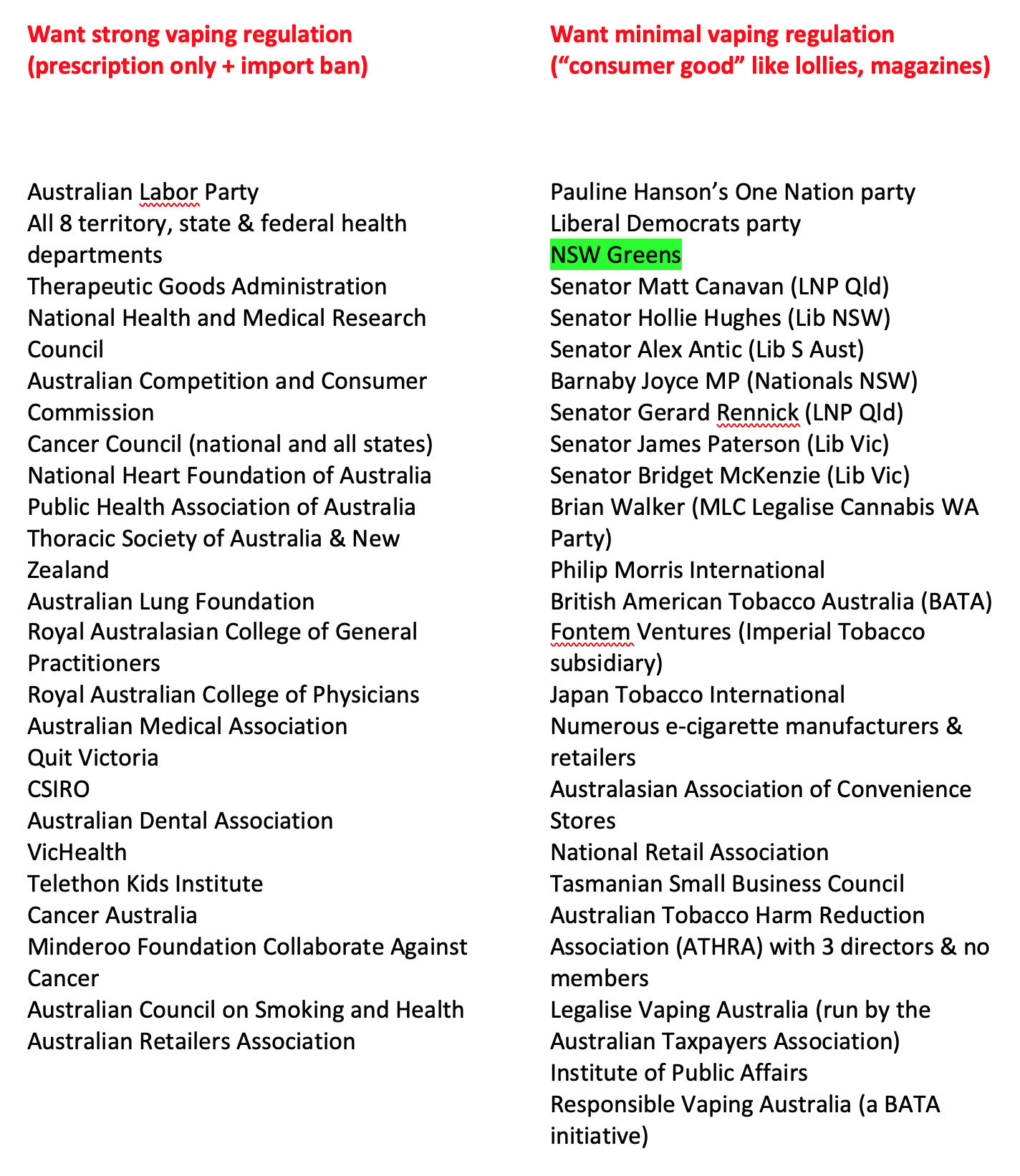
Being the only political party still taking tobacco industry donations, the dinosaurs in the National Party have predictably adopted a policy that would see “responsible” retailers allowed to sell vapes. Amazingly, the NSW Greens have also adopted a similar policy, thereby lining up with the company shown on the right of the table below.

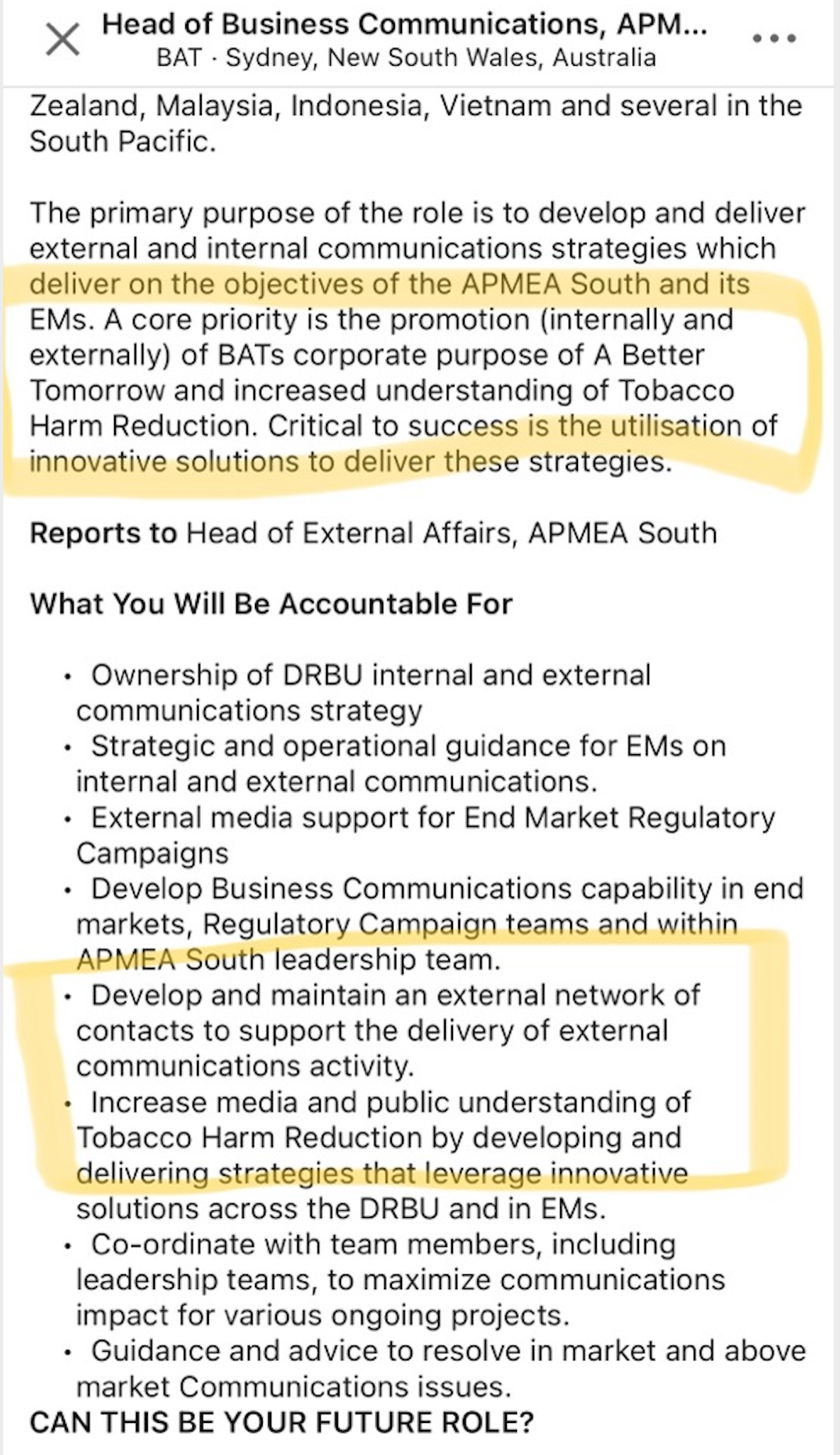
BATA is currently looking for a head of business communications who will have the duties  shown below. Understandably, tobacco companies have long struggled to attract top quality staff. The NSW Greens would do well to think about how aligned their new policy is with BAT’s objectives.

Mark Butler requested the Therapeutic Goods Administration to consult with the public over options for reform of the prescription access scheme. Their report on this consultation is now with the government. Butler said publicly in late February

“At the end of the day the Commonwealth will have to act, including potentially on the borders. My predecessor Greg Hunt tried to put an important control regulation in place on this but a range of his colleagues in his party room overturned that regulation within a couple of weeks. So, we have to consider controls at the borders, we have to consider health regulations. I know my state and territory colleagues realise there’s going to have to be some policing resources put into this as well because it is just rampant through the community.”

What needs to happen

First, the federal government can quickly and easily declare all nicotine vaping products prohibited imports. This could be done without legislation in the way that this list of prohibited imports is regularly amended. Significantly, tobacco is included on that list unless imported by those licensed to do so such as tobacco companies.

The government should also add non-nicotine vapes to the list on the grounds that they are being widely used a Trojan horse for nicotine vapes to be retailed by nudge-nudge-wink-wink  “I had no idea” retailers. So-called non-nicotine vapes are widely sold with deceptive labelling that they are nicotine free. But many do contain nicotine. The costs involved in widespread testing for nicotine is one factor inhibiting prosecutions by state health departments. This ruse could therefore be easily avoided by declaring all vapes prohibited.

Second, fines for selling illegal vapes are derisory. This is a emphatically state responsibility, which can similarly be rapidly amended. For example In NSW, the maximum penalty for illegally selling NVPs is 6 months in prison and/or  a maximum of $1600. In the 11 quarters from Jan 1, 2020 to Sept 30, 2022 NSW Health seized 220,322 vapes after inspecting retail outlets and completed just 25 successful prosecutions. Fifty two percent of all illegal vapes seized were removed in the three quarters since Jan 1, 2022.

Any retailer offering illegal vapes for sale today has an almost homeopathically small chance of being prosecuted, and if they were, they would wear even the maximum fine knowing it was just an occasional minor irritating cost in making lots of money from openly breaking the law.

But if fines were significantly ramped up to levels that would give major pause to even the largest tobacconist and convenience franchises selling vapes, many smaller operators would hoist the white flag. 

The TGA has fines that are definitely in that ballpark with fines as high as $106,560 having been issued for alleged illegal advertising of vapes. In November 2022, the TGA fined a NSW medical practitioner $2664 for alleged unlawful advertising of a nicotine vaping product on social media. Now, I wonder who that might have been!

Taiwan last week banned vapes and set fines for selling US$330,000 – US$1.65 million. Such fines would see a stampede out of the market by players across all levels.

Today anyone can text any one of a huge number  of on-line suppliers, pay and have vapes delivered or given a pick-up address. Suppliers phone numbers could be traced, the delivery couriers questioned and  bank accounts used to trace those involved. If kids find it childs’ play to buy vapes, Health Department investigators should have little trouble either. Reserve armies of parents and school principals who know who are supplying kids will fast track this information.

It cannot be emphasised enough that both the commonwealth and state governments need to work in concert on all this. If any state is glacial in significantly upping fines and failing to blitz retailers (and publicise these prosecutions) there will be many players who will continue to sell illegally.

Labor governments have nearly always been in the forefront of Australia’s world-renowned tobacco control policies. The Whitlam government introduced the bill to ban direct tobacco advertising in broadcast media that was implemented in 1976. The Rudd and Gillard governments were global pioneers in plain packaging legislation.

Many said these things and other policies like smokefree workplaces, bars, restaurants and airlines were la la land ideas. But they have been normal now for decades in many countries.

If the Albanese government is the first to ensure that a workable prescription access scheme for vapes is allowed to work by declaring vapes a prohibited import, it will again lead the way globally on a path that Greg Hunt conceived but was thwarted. Many countries which are  being flooded with vapes and seeing a new generation of nicotine dependent kids growing by the month, are very interested in what may happen in the next few months.

Other blogs in this series

Vaping theology: 1 The Cancer Council Australia takes huge donations from
cigarette retailers. WordPress  30 Jul, 2020

Vaping theology: 2 Tobacco control advocates help Big Tobacco. WordPress 12 Aug, 2020

Vaping theology: 3 Australia’s prescribed vaping model “privileges” Big Tobacco WordPress Feb 15, 2020

Vaping theology: 4 Many in tobacco control do not support open access to vapes because they are just protecting their jobs. WordPress 27 Feb 2021

Vaping theology: 5 I take money from China and Bloomberg to conduct bogus studies. WordPress 6 Mar, 2021

Vaping theology: 6 There’s nicotine in potatoes and tomatoes so should we restrict or ban them too? WordPress 9 Mar, 2021

Vaping theology: 7 Vaping prohibitionists have been punished, hurt, suffered and damaged by Big Tobacco WordPress 2 Jun, 2021

Vaping theology: 8 I hide behind troll account. WordPress 29 Jun, 2021

Vaping theology: 9 “Won’t somebody please think of the children”. WordPress 6 Sep, 2021

Vaping theology: 10: Almost all young people who vape regularly are already smokers before they tried vaping. WordPress 10 Sep, 2021

Vaping theology: 11 The sky is about to fall in as nicotine vaping starts to require a prescription in Australia. WordPress 28 Sep, 2021

Vaping theology: 12 Nicotine is not very addictive WordPress 3 Jan 2022

Vaping theology 13: Kids who try vaping and then start smoking,would have started smoking regardless. WordPress 20 Jan, 2023

Vaping theology 14: Policies that strictly regulate vaping will drive huge
numbers of vapers back to smoking, causing many deaths. WordPress 13 Feb, 2023

Vaping theology 15: The government’s prescription vape access scheme has failed, so let’s regulate and reward illegal sellers for what they’ve been doing. WordPress 27 Mar 2023

Vaping theology 16: “Humans are not rats, so everybody calm down about nicotine being harmful to teenage brains”. WordPress 13 Jul, 2023

Vaping theology 17: “Vaping advocates need to be civil, polite and respectful” … oh wait. WordPress 3 Oct, 2023

Vaping theology 18: Vaping is a fatally disruptive “Kodak moment” for smoking. WordPress Oct 30, 2023

Vaping theology 19: Vaping explosions are rare and those who mention them are hypocrites. WordPress 17 Nov, 2023

Vaping theology 20 : Today’s smokers are hard core nicotine dependent who’ve tried everything and failed – so they need vapes. WordPress 14 Dec, 2023

Vaping theology 21: Australia’s prescription vapes policy failed and saw rises in underage vaping and smoking. WordPress 10 Jan, 2024

Vaping theology 22: “Prohibition has never worked at any point for any other illicit substance”. WordPress 17 Mar 2024

Vaping theology 23: “84% of the Australian public are opposed to the way the government will regulate vapes” WordPress 2 Apr, 2024

Vaping Theology 24: “Tobacco control advocates are responsible for vape retail store fire bombings and murders. WordPress 27 May, 2024

30 years of teaching public health advocacy planning

23 Thursday Mar 2023

Posted by Simon Chapman AO in Blog

≈ Leave a comment

One of the early milestones in my public health career was -with others – to succeed in having the Rothmans tobacco company banned from continuing to use the comic actor Paul Hogan (later of Crocodile Dundee fame) in Winfield advertising. It had been the biggest and most successful tobacco advertising campaign in Australian commercial history and we ended it overnight.

Because we had no money, the campaign we ran was conducted in the news media. The newsworthiness of what we were attempting was a re-telling of the David and Goliath moral tale. I quickly became a media and political go-to person for tobacco control.

I soon realized that advocacy for policy change and changing the way that health issues were perceived both publicly and politically was accorded very little analysis in research nor training in public health education. I set out to try and upgrade the academic respectability of both.

So in 1991 I established and started teaching what was only the world’s second university course unit in public health advocacy (I believe the first was started at Berkeley in California by Larry Wallack and Lori Dorfman). The unit was offered at the University of Sydney’s School of Public Health in the Masters of Public Health degree. It became immensely popular, with non-degree students flying in over the years from Iceland, UK, Spain, Netherland, New Zealand, USA, Canada, China, Singapore, Indonesia and all round Australia. Since my retirement in 2014, it has been taught by Becky Freeman who has specialised in advocacy and social media.

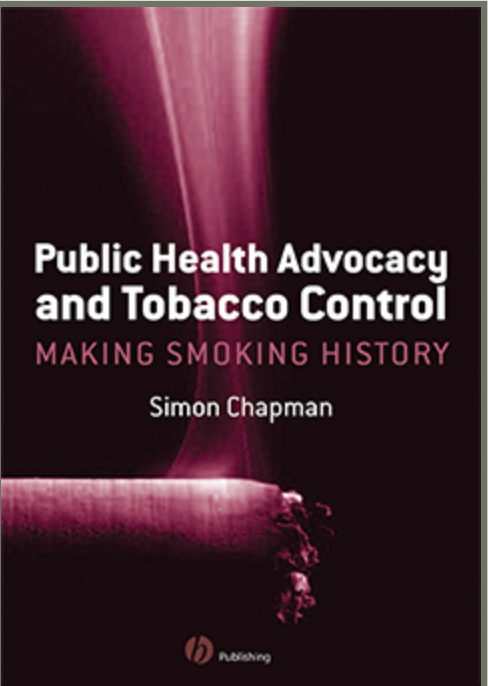
I published two text books for the course in 1994 and 2006 which are still returning sales royalties. In the 30 years between 1991-2021 I ran advocacy training courses and sessions in 14 countries on all continents but South America.

My course was primarily focused on media advocacy and gave particular emphasis to understanding news values, framing and reframing, news routines and cultures and the importance of strategic planning of media advocacy, rather than just instinctively running at the mouth when an opportunity presented itself. Researchers typically carefully plan and rehearse conference presentations they might give to 100 people in a room. But few plan interview strategy when given an opportunity to speak to sometimes millions on national television, including politicians able to make a needed policy change.

Problem-based learning

Over the years I’ve had many requests for teaching notes on public health advocacy.  Below is an outline of the approach  I took to both teaching and assessment.  I hope you will find it useful in your own teaching and staff development.

After a day of lectures and inspirational talks from public health advocates and journalists, our in-class discussions for a full day of the course were problem-based. I wrote trigger scenarios based on actual or hypothetical “this is happening now” problems. Here are five examples

1. ALCOHOL ADVERTISING AND CONSUMPTION

A glossy booklet is distributed by  a transnational liquor company has to every doctor, politician and mass media outlet in your country. The main message is that alcohol advertising does not influence aggregate (total) demand for alcohol and that restrictions on advertising beyond those which currently exist are unjust and unwarranted. The booklet also details the company’s history of commitment to funding rehabilitation and responsible drinking education programs.

2. FOOD LABELLING DEREGULATION

The new Unit established within the government to examine ways of reducing the effect of regulation on business activity publishes a report that shows that 95% of the population claim never or seldom to read grocery content labels; and that 99% of those sampled could not name any of the food additives corresponding to the numbered system on a randomly chosen set of common grocery items. The report recommends that content and additive labelling be made voluntary, arguing that the present system is an unnecessary and costly burden to industry which serves little purpose.

3. TOBACCO SPONSORSHIP

The Health Minister issues exemptions allowing tobacco sponsorship for an international  women’s golf tournament. The program will feature an internationally renowned golfer, who having had breast cancer, is a prominent advocate for breast screening. She will donate 10% of her winnings to the national breast cancer campaign.

4. ENVIRONMENTAL HEALTH

The local government of a suburb three kilometres from the central business district of your city announces that a deal is to be struck with the state government to use a large, long-disused ugly factory site as a car park linked to the city by a light rail system. The scheme will take 5000 cars out of the city and provide lucrative rental revenue to the local government. The site for the car park is in the middle of a high density, low income residential area. There are no parks or open spaces in a two kilometre radius of the site. A local resident group (which has an active core of about 10 people with another 40 or so who sometimes help out with local projects) wants the site to be turned into a recreation park for local residents.

5. DOMESTIC VIOLENCE

A right wing popularist politician is elected to parliament on a platform that includes reviewing the Family Court to investigate why women are awarded child custody far more than men. It will also take evidence from men accused of domestic violence to their partners who believe they have been “set up” and not given a fair hearing in the Family Court. The politician names three leaders of a “men’s action network” who he says should be on the review.

Students would select one such scenario (or write their own) and then work in small groups across the day to answer the following questions, which were then presented and discussed with the full class.

  1. WHAT DOES THIS SCENARIO MEAN TO PUBLIC HEALTH? What are the possible adverse consequences for public health that arise from this scenario? (ie: why is it of concern?) THEREFORE, WHAT ARE YOUR PUBLIC HEALTH OBJECTIVES? Define your public health objectives: what do you want to achieve by any advocacy initiatives you might take in response?
  • “FRAME” THIS OBJECTIVE AS A SIMPLE COMMUNICATION OBJECTIVE.
  • WHAT ARE THE PRINCIPAL SUB-TEXTS OF YOUR OPPOSITION’S POSITION HERE? What values and strengths do these bring to your opposition’s position (and by implication, what do these suggest about anyone like you who opposes this position?) Think about how this might need to be addressed in your planned strategy.
  • DO YOU BELIEVE THAT A MEDIA ADVOCACY STRATEGY WILL BE CRITICAL TO ACHIEVING YOUR PUBLIC HEALTH OBJECTIVE? What changes in public or political awareness and attitudes do you want to achieve via a media advocacy strategy?
  • ARE THERE OTHER (NON MEDIA) ADVOCACY STRATEGIES THAT WILL BE IMPORTANT IN MEETING YOUR PUBLIC HEALTH GOALS? List these
  • ACCESS & FRAMING STRATEGIES: What creative initiatives are likely to both give you maximum coverage (framing for access) and frame the issue in ways that will advance your goals (framing for content)? Are there any analogies that might be used which will assist in your framing efforts? Brainstorm. Don’t stop at one or two – you can always discard the less brilliant ideas later! Are there IMAGES, METAPHORS, AND “PAINTING A PICTURE” STRATEGIES you can utilise here to good effect?’
  • CREATIVE EPIDEMIOLOGY/STRATEGIC RESEARCH: Are there “killer facts”, perspectives and comparisons that you would like to use in your response? Where might you obtain these if you haven’t got them?
  • MEDIA BITES: A reporter phones. He/she wants a comment from you about this issue. Frame a “media bite” (about 30 words or 15 seconds) that will advance your goals. If you have time, come up with several.

Assessment

In every year I taught the MPH course, I set the same two choices of assessment questions (below)

  1. Collect all press cuttings (try the Factiva database) you can gather or TV or radio tapes on a current public health issue. Analyse the media coverage of this issue for the dominant sub‑textual themes, rhetorical devices and ideologies that make this issue newsworthy. Discuss possible implications of the way this issue has been “framed” for public health policy and practice.

or

2. Select a current public health problem which is being either neglected or adversely framed by the media. Analyse the likely reasons why this subject is attracting the press (or lack of press) it currently suffers. Outline (and argue for) an advocacy strategy designed to re‑frame this issue in such a way that it will attract media and/or political attention more conducive to advancing it in a positive direction vis a vis public health.

Suggested length up to 2000 words (more if you want, but much less than 1500 will probably mean you have prepared a reasonably superficial treatment).  NB: Do not spend more than a couple of paragraphs describing the epidemiology or impact of the problem you select. This essay is NOT about how well you can describe a health problem, but about how well you can understand how it is or is not being depicted in the media as a health issue, and what you might do to change or further this.

I was privileged to read many highly sophisticated papers and over the years to see many course graduates go on to become potent advocates across a wide range of public health issues.

This paper, which highlights 10 cardinal lessons for public health advocates and young researchers, may also be useful.

See also:

Chapman S. Advocacy in public health: roles and challenges. Int J Epidemiol 2001;30:6:1226–32

Chapman S. Public health advocacy: a primer. J Epidemiol Comm Health 2004;58:361–5

China bans vape flavours, requires its exporters to “comply with the regulations of the destination country”

20 Monday Mar 2023

Posted by Simon Chapman AO in Blog

≈ 2 Comments

In 1992, I spoke at what was then the largest conference ever held in Africa on tobacco control. Delegates from 16 nations met in  Harare, Zimbabwe to discuss policies that could reduce tobacco use across the continent.

Zimbabwe’s health minister Dr Timothy Stamps’ talk was met with incredulity when he  commented that Zimbabwe’s huge export earnings from tobacco leaf was not inconsistent with the country’s own efforts to reduce smoking among its own people. Local lung cancer was bad, but OK elsewhere seemed to be the message.

I was reminded of this when reading official Chinese government communiques on its current internal efforts to reduce the appeal of vaping for Chinese citizens and its policies about controlling exports from Chinese vaping manufacturers to nations which have banned or strictly controlled vapes. Unlike Zimbabwe in the early ‘90s, China’s internal and export policies are consistent.

First, some context.

The major source of the tsunami of illegal nicotine vapes flooding Australia is China. The flood is dominated by cheap disposable vapes, hugely attractive to children. They are priced to make them highly accessible to anyone on a low income, including kids. With illegal importers able to buy single vapes providing up to 7000 puffs  in bulk amounts for as low as $1, and on-sell them for $15-30, massive profits can be made. They are mostly brought in by importers willing to buy in large volumes for wholesaling to retailers. But retailers, groups of vapers or individuals are also bringing them in.

Unless an order is placed with a doctor’s prescription, importation of nicotine vapes has been  illegal since October 1, 2021. Bulk imports, even if ordered with a prescription, are clearly illegal. Entering “importing vapes China” shows many ways of doing it.

Those openly importing and selling these illegal vapes reason that the probability of being caught whether via Border Security intercepts or when retailing them online or in any sort of retail outlet is vanishingly small. Many shops advertise on their front windows that they sell vapes and many openly display them on charts showing brands, flavours and puff volumes, with the actual vapes generally stored out of sight.

Data show that in the 11 quarters from Jan 1, 2020 to Sept 30, 2022 NSW Health seized 220,322 vapes after inspecting retail outlets and completed just 25 successful prosecutions. Fifty two percent of all illegal vapes seized were removed in the three quarters since Jan 1, 2022.

Health minister Mark Butler foreshadowed at a Parliament House press conference on Nov 30, 2022 that active consideration is being given to restoring and strengthening his predecessor Greg Hunt’s addition of vapes to the prohibited import list. States will need to lift fines for selling from the derisory maximum of $1600 (in NSW for example) to seriously deterrent amounts in the ballpark of those being handed out by the Therapeutic Goods Administration to those found advertising illegal vapes.

A letter signed by 28 LNP backbenchers opposing Hunt’s plan  scuppered it in the party room. The initiative was led by the coal lobby’s favourite senator Matt Canavan and signatories included luminaries like Hollie Hughes (“[British America Tobacco] They’re a cigarette company. They don’t define themselves as Big Tobacco. They’re a cigarette company and a tobacco company.”), Tim Wilson. Eric Abetz, George Christensen, Alex Antic, Andrew Laming, Bridget McKenzie, James Paterson, Gerrard Rennick, Amanda Stoker, Dave Sharma and Barnaby Joyce.

Many of the 28 are no longer in parliament. And those who are, are political eunuchs unable to block any bill or gut any policy that has support of the Labor government, the Greens and progressive independents, so hopes are high that Labor will continue its historic leadership in tobacco control.

Chinese government policy

In 2021 and 2022 the Chinese government began publishing  details about its emerging policies on vapes. From May 1 ,2022 China’s Tobacco Monopoly Administration prohibited the sale of “flavored e-cigarettes, other than tobacco flavors, and e-cigarettes to which users can add their own atomized substances.”

When it comes to exporting vapes from China, National Law Review summarises it this way:

“China’s Management  Rules for e-cigarettes require that e-cigarette solely for export must comply with the regulations of the destination country; when there is no relevant regulations and standards in the destination country, the product must comply with China’s regulations and standards”.

These local standards are set out here. Here is a site where you can see the names of all vape manufacturing companies operating in China with a government license and therefore subject to the regulations described. Warning 31 pages of them!

So how seriously will China actively police its rules?

I’ve been in China many times in the past 15 years working with colleagues in government and major universities like Fudan and Zhejiang. My scepticism that there might be gaps between what China says it’s doing evaporated fast when seeing how smoking bans on Chinese taxis, buses and trains were very strictly observed. I used the Beijing underground railway many times and saw teeming  millions pf people use it across weeks, but never once saw anyone smoking. This article describes China’s record in tobacco control.

Australian government officials in the health, trade and foreign affairs portfolios should clearly communicate the current illegal status of nicotine vapes in Australia to their Chinese counterparts, noting the positive developments in Chinese law. 

Lijiang, Yunnan province

14 unforgettable meals

19 Sunday Feb 2023

Posted by Simon Chapman AO in Blog

≈ 1 Comment

At 71, I’ve rarely missed an evening meal. Until I was about 20, I had almost no experience with superb cooking, as did most who grew up in the 1950s-60s in Australia. Impoverished student days in the early 1970s were mostly spent eating pasta, stews, sausages and even lean meat offcuts our local butcher sold to greyhound owners (see sordid story at p12 here). But as I moved though the next decades, cooking and eating out became some of the greatest pleasures. Across over 18,000 evening meals and many thousands of lunches across 50 years, here, in no special order, are fourteen I will never forget.

With most, I’ve of course long forgotten exactly what I ate: it was much more about the total experience  — the food, the wine, the setting, the company, and  in the case of a night out in Istanbul (#14 below), what happened very unexpectedly.

Tetsuya’s Rozelle When I met my wife Trish in 1990, my heart melted. She was my 7 year old son Joe’s school teacher and parent-teacher interviews were a challenge for our concentration. I lived near Tetsuya’s first eponymous restaurant in Rozelle, Sydney and took her there not once but twice for their fabled degustation dinner. She’s small, beautiful inside and out and mesmerising. And so were each of the dishes we ate those nights, especially the confit of ocean trout, shown here. Tetsuya has now long been in Kent Street in the city. Here’s his history. It was very expensive then, and hideously so today. So we very rarely eat out at that level. But Tetsuya’s is unforgettable and compulsory in this selection.

M on the Bund ,Shanghai I was a staff-elected fellow of the governing Senate at the University of Sydney for two terms when Marie Bashir was Chancellor. I travelled to Shanghai with a party of senior academics for a graduation ceremony and meetings with Fudan University contacts. One night, a small party of us booked a balcony table with views across and down the Huangpu river. I sat next to Marie and well remember our conversation but little of what we ate other than it was utterly exquisite from start to finish. If you are ever in Shanghai, just go there.

Photo by Darren Nunis on Unsplash

Monoprix, Ledru Rollin, Paris We have a close friend who owns an apartment in Paris, near Bastille. We’ve stayed there twice when she’s back in Sydney. On our second trip, we arrived from the airport mid-morning. I went immediately to a huge Monoprix supermarket across the street and bought for lunch fresh peaches, baguette, porc rillette, an amazing saucisson with peppercorns, Lou Perac sheep’s cheese and a bottle of St Emilion grand cru. All for under 40 euro. You can eat like this all over France. Heaven.

My stewed rabbit in Chianti with porcini

When our three kids were in their early teens, we all flew to Rome, hired a car at the airport and drove for a month up to Paris. In Tuscany we rented a stone cottage from a Mr Botticelli about 10km outside of Poggibonsi. A Dutch couple had an adjacent cottage with the woman sunbathing topless for hours in full view of our captivated adolescent boys.

I drove to the nearest supermarket and found they had lots of skinned rabbit (coniglio). I bought two and using total guesswork without a cookbook or internet reception, seared them in butter, sage and onion, then stewed them in decent Chianti and fresh porcini mushrooms. The entire family, including me, was gobsmacked at the result. It’s been a signature dish in the years since. Three days later we ran into the Dutch couple in a street in Florence and had dinner with them in a restaurant right on the Arno. I ordered fegato (calf liver) with spinach. Unbelievably wonderful after a childhood of dry, overcooked liver.

Reykjavik, Iceland

I went to Iceland in 2003 to give some talks to local health workers. My host, Thor, was a prolific Icelandic author, a former member of the Icelandic football team, my counterpart in the Department of Health and an Icelandic god. He took me to a restaurant and I asked him to order for me. Here’s an excerpt from a travel short story I wrote (see p86).

“At lunch the next day, after I’d given a couple of talks to researchers and health department people, Thor asked me what I’d like to eat. “What you eat in Iceland” I told him. “Something local”, imagining herring pickled or cooked in an Icelandic way or smoked local meats preserved for the long winters. He took me to a small restaurant with a view over the sea and ordered several dishes while we talked about our lives and families. The first dish arrived. It was a small spread of thin strips of a dark meat, cooked in a light vinegary sauce, a little thicker than a carpaccio cut. It was as tender a flesh as I’d ever eaten. “So what is it?” he played with me. I guessed it might have been a prime cut of reindeer backstrap or fillet. No. Perhaps the dark meat of a local goose? No.

It was …. wait for this … puffin, those impossibly cute, small gull-like seabirds with their beautiful half-moon red and black striped beaks and wise little eyes. I’d assumed that they would be protected and that people would all recoil from killing and eating them because of their iconic beauty and cuteness. Well not at all, sunshines. It turned out they are commonly eaten in Iceland and on restaurant menus, listed as lundi, all over the country.

A few dishes later, a decent-sized steak arrived. It was as succulent as I’d ever tasted and assumed it must have been prime local beef. But no. It was whale. I thought Iceland might have been a signatory to some global treaty against whaling as I knew it had progressive social and environmental policies. Thor confirmed this, explaining that entrepreneurs anticipating the ban had stored tonnes of whale meat in refrigerated containers which were being very slowly consumed in the years since, as we had just done. If ever I’d experienced true, deep ambivalence, this was the moment.”

Hotel Windsor, Lake Toya, Hokkaido Japan

In September 2009, I went to Sapporo to give the opening address to the all-Japan conference on tobacco control. The entire meeting was in Japanese, with me being translated. I was keen to get back to Tokyo when my talk ended as I would understand little of what other speakers would be talking about. But the woman appointed by the conference to help me around, quietly advised that this would cause considerable offence and that the conference head, a leading surgeon, planned to show me the sights of Hokkaido. I decided I should stay.

And well I did. We travelled to the north west of the Island by train and were then driven from the station to the most luxurious hotel I could ever imagine, let alone stay in: The Windsor. It had hosted the 34th G8 meeting in 2008 and overlooked the volcanic Lake Toya through silent autumn mists. A Russian string quartet played discretely in the lobby throughout the day. On its top floor, there was a Michelin 3 star French restaurant to which the surgeon invited me and a Seventh Day Adventist from Tasmania who had also been at the conference, along with our interpreter.

The Adventist of course didn’t smoke. But neither did he drink alcohol, eat meat or drink tea or coffee, poor fellow. While we moved from a stunning Pouilly-Fuisse to a grand cru Haut Medoc, he sipped water. My wagyu steak was beyond words. The Adventist’s salad and mushrooms looked pretty good too.

Photo credit: Wotif

Margot Jervies, next door

We’ve lived next to a couple for over 20 years, Margot Jervies and Wayne Wilkinson. The day they bought the house, I quietly asked the real estate agent who our new neighbours would be. “Oh a lovely couple! He’s an engineer and she works for British American Tobacco!” This will be interesting, I thought.

Things were polite and chatty for many years and then began to rapidly thaw after we both retired. You could not wish for better neighbours. Margot won an ABC radio cooking quiz about 10 years ago. We often could smell her dreamy cooking in our garden. When I later saw a whole room in their house with cookbooks from floor to ceiling on every wall, I knew that here was a very serious cook. And then the texts commenced “I’ve just made a big batch of passata [or duck confit, or rillette, or gravlax or baba ganoush &c], if you come to the back gate I’ve put some in a box for you”

There is nothing … nothing  Margot cannot cook that doesn’t leap into pole position for the “best I’ve ever had of that” prize.

When COVID first hit in 2020, the isolation was truly dispiriting. I hit on the idea that a few neighbours might meet in the back lane on late Sunday afternoon when we took out the bins. We would dress up fully for the nostalgia of fine dining, using our wheelie bins as tables to rest a few bottles of wine and bring a few horses’ doovers to share. All at strict distancing.

Wayne & Margot, sommelier & chef extraordinaire

Margot and Wayne took this to the next level when COVID restrictions changed to allow small numbers to come to houses. They put on  four hour plus le grand bouffe meals for a few of us. Margot’s food brough gasps from all around the table and Wayne, a very serious wine collector, always shares wonderful wines.

They’ve just been away for seven weeks. We’ve been counting the days.

Trish Kirby’s famous chicken and leek pie

Trish has always loved cooking and people who come here swoon at what she can do, especially with cakes. Our family often does a roundtable where we say “if you were going to have your last meal cooked by Trish, what would it be?” The unanimous verdict, across three generations, is always her chicken and leek pie.

A long-time close friend in Newtown had been nursing her aged mother at home for several weeks who was dying from breast cancer.  Trish baked a large pie and took it down for respite eating for our exhausted friend and her partner. 

The friend phoned the next day and said “you’ll never guess. Mum hadn’t eaten a thing in many days. But when she smelled your chicken and leek pie she asked for some and ate the lot!”

Her mother died the next day.

Kazkazuri, San Sebastian

In September 2016, I’d been running an advocacy course for four days at an old quarantine station on Menorca, in Spain’s Balearic Islands. When it was over we flew to Basque country to revisit San Sebastian where I’d last stayed in a decrepit dormitory hostel  in 1972. On a rainy Friday night we threw a dart at the list of the many restaurant recommendations friends and locals had given us. We chose the Kazkauri on the waterfront. It said 25 euro a head for three courses. Yeah, sure. Unlike the chaos of pintxos bars, this one had a sober, rather sterile interior, white napkins and obsequious waiters. And yes, the menu said 25 euro, including wine, water, bread, coffee.

We expected mediocre food and rubbish wine. Trish asked for the blanco, me the tinto, expecting a glass each. But two full bottles of very good white and  red arrived, crianza vintage. We then commenced a near-perfect three courses, both starting with stewed cod in rice. I moved to Iberian pork in a sherry sauce and señora chose roast duck. The dessert was an astonishing coconut pudding with chocolate, which was west of heaven.

Trish’s stewed cod in rice, Kazkazuri, San Sebastian, Spain

Pippi spaghetti

When our three kids were little, we’d go most years for a week or two down the south coast of NSW in months when you could swim in warm water. We loved the vast uncrowded beaches, dolphins and (once upon a time, long ago) cheap oysters. We went to Manyana, Culburra, Geroa and Bendalong, sometimes with other families.

Most afternoons, all of us would go down to the beach with a bucket looking for pippis, the common surf clam mainly used by fishers for bait. To find them, low tide is best particularly at tidal estuaries where the shellfish feed on micro organisms that wash down rivers and out to sea. Tell tale signs of  good spots include seeing them being rolled in the sand by the waves and quick strikes when you twist, Chubby Checker style, in the sand reaching down for them when you feel them underfoot.

Pippis are a wonderful but under-rated alterative for vongole, a seafood staple in Italian restaurants in pasta dishes. We’d try and get about half a bucket full to allow enough to feed our daily group of five. Once home, you put the live pippis in fresh water, which is supposed to cause them to spit out any sand.  This was never successful, so the served product was always a little gritty causing variable protests from the more Princess-and-the-pea members of the family.

You cook them up in white wine, with a base of garlic, lemon and olive oil, or a standard tomato base. A big bowl goes in the centre of the table for the spent shells.

This meal is imprinted in the childhood memories of all our kids, as well as two grandchildren. The photo shows Florence, aged about seven, jubilant at finding lots of shells after being knocked over fully clothed by a wave seconds after starting.

There’s something wonderful about collecting the food you want to eat and seeing everyone enjoy it so much.

Rhodes harbour café  In the 1980s one summer I stayed a few nights on a friend’s modest yacht in Rhodes harbour, once overlooked by the Colossos of Rhodes, the largest statue in the ancient world until it fell into the harbour in an earthquake in 226 BC. We talked and drank with other yachties till about 11pm and then decided it was time to eat. A small harbourside café produced bottles of the local white wine to go with plates of fried marida (whitebait) and the sweet barbouni (red mullet) with lemon. Still hungry, the only food left was BBQ’d quails, so a plate of them with ouzo was produced. We got back to the boat about 2am and slept till midday

Photo by Alexander Serzhantov on Unsplash

Ristorante Vecchia Urbino, Marche, Italy

Kenneth Clarke’s Civilisation TV series has been etched into my memory for years, especially the episode on Raphael who painted at Urbino in Italy’s Marche region in the northeast. So on a trip to Italy, we looped from Umbria to Urbino, then on to Bologna, Parma and Milan. The one night we planned to stay in Urbino took us to a potluck choice of a restaurant a few streets off the main drag through the small town.

There was a central table covered in a huge selection of top drawer antipasto. Our waiter asked us for our wine selection. We’d had a superb glass of a local white, verdicchio, at lunch. Trish was very keen to have it again. I like both red and white, but prefer red. The waiter gave me an understanding look but brought the verdicchio.

When he bought our mains, mine was a glorious bistecca. He put it in front of me and returned with a steak knife and a huge glass of red. I said “oh, sorry I didn’t order that”. He replied “I know that you like red wine, so please have this one with our compliments.” He’d also brought us about five small bowls with different olive oil in them to soak with bread, all gratis.

And at the end of the meal, when we thought we’d need a forklift to get us out of our seats and declined dessert, he insisted and brought those as well, also gratis with several dessert wines.

The entire meal was perfect in every way and we drove the next today to Bologna feeling that we had been blessed to have lucked that choice and that we might not eat such a meal again for a very long time.

Ten minutes from the end of the 170km trip down the autostrada to Bologna, Trish asked me for my passport to get ready for the hotel registration. Ahh. I’d forgotten to collect it from reception at the Urbino hotel. Like groundhog day, we turned the car around, drove back to the hotel, booked in again and ate again that night at the perfect restaurant. Some shine was missing the second time, but still 9 out of 10.

Linda’s on King, Newtown

I’d walked past this small restaurant many times but never noticed it. It’s on lower King St – the St Peters end —  and right next to the European Grill, a Macedonian grill which is a carnivore’s eating orgy temple. Linda’s had been recommended by Newtown friends. I’d never even heard of it. But after our first meal there, I knew I would be a regular.

Linda cooks and her partner does all the front of house. The food is French. Well, modern French I guess. You can bring your own wine (although their list has some very good selections at reasonable markups). The last time I ate there I had a superb home made pork terrine of very generous proportions, followed by a perfectly cooked eye fillet steak with bearnaise sauce and perfect fritte, then a perfect vanilla pannacotta, mango sorbet, lychee granita and macadamia praline. Perfect, perfect. Sorry, but there was no other word for it all.  Here’s the current menu. Astonishing value.

Istanbul. The mesmerising item not on the menu

I leave the most unforgettable to last. It happened in Istanbul’s Taksim district one evening in 2014 when, as a wonderful Turkish meal got into full swing, something happened that took the attention of every diner in the restaurant. Full details here.

Vaping theology 14: Policies that strictly regulate vaping will drive huge numbers of vapers back to smoking, causing many deaths

13 Monday Feb 2023

Posted by Simon Chapman AO in Blog

≈ 1 Comment

This meme has long been in the very top drawer of many vaping cultists. It proposes that any policy short of allowing nicotine vaping products to be openly sold and promoted without any regulatory encumbrance whatsoever will see untold thousands of vapers switch back permanently to smoking. Unlike vaping they say, this will kill many of them from smoking-caused diseases.

That last claim rests entirely on an assumption that the long term health consequences of  deeply inhaling 570 times a day (208,193 times a year) an unregulated cocktail of nicotine, propylene glycol and any number of thousands of unapproved for inhalation flavouring chemicals will be all but benign. Fifteen former presidents of the Society for Research on Nicotine and Tobacco stated in 2021 “High-quality clinical and epidemiological data on vaping’s health effects are relatively sparse. There are no data on long-term health effects, reflecting the relative novelty of vaping and the rapid evolution of vaping products. Determining even short-term health effects in adults is difficult because most adult vapers are former or current smokers.” [my emphases]

If the government and the Therapeutic Goods Administration proceed with their preferred options and make nicotine vapes a prohibited import (unless destined for the prescription-only pharmacy access route), vaping advocacy hysterics forecast a migration back to  smoking that would make the annual African wildebeest migration look like a geriatric dawdle.

Instead of  doing what Australians do 314 million times a year when they need a prescription-only drug, nearly all vapers will “go back to smoking”. “Bwahhhh! We want flavoured nicotine!” they’ll scream, all forgetting for the moment that the cigarettes they will allegedly stampede back to are also nearly all unflavoured too.

But there’s another little problem with this forecast In Australia, in 2019, 53% of e-cigarette users were also smokers (“dual users”), 31% were past smokers and 16% had never smoked.

So most vapers also still smoke or never smoked. Do you see the wee problem here: how can someone who is still smoking be driven to smoke?

Among people aged 18-24 (where we see by far the highest vaping prevalence), half of all current e-cigarette users had never smoked. They are not vaping to quit cigarettes because they never smoked. Vaping theologists implacably repudiate the gateway hypothesis that vaping can lead to smoking, so presumably none of them are going to publicly argue that never-smokers who vape will start smoking.  

So combined, we have 69% of vapers who can’t migrate back to smoking because they are already smoking or never smoked.

More  recent national data available (2020-21) show the same picture. By far the largest group of people who have vaped in Australia are those who “formerly” tried vaping (1.428m) compared to those who currently vape  (442,800 – which includes a majority who also smoke). And all this returning to smoking happened before the prescribed access policy was even introduced.

The main driver of the government’s proposed plan to restrict vaping access to those with a prescription is the out-of-control rise in teenage addiction to nicotine vapes, regularly belittled by vaping theologians as no big deal and mocked with “won’t somebody please think of the children” self-absorbed me-me-me values.

The UK, a nirvana for our local vape advocates, is now desperately struggling with an unprecedented spike in vaping by kids and has a bill in parliament like Australia to ban disposable, flavoured vapes.

Mark Butler and the TGA’s reforms could not come at a more critical time.

Other blogs in this series

Vaping theology: 1 The Cancer Council Australia takes huge donations from
cigarette retailers. WordPress  30 Jul, 2020

Vaping theology: 2 Tobacco control advocates help Big Tobacco. WordPress 12 Aug, 2020

Vaping theology: 3 Australia’s prescribed vaping model “privileges” Big Tobacco WordPress Feb 15, 2020

Vaping theology: 4 Many in tobacco control do not support open access to vapes because they are just protecting their jobs. WordPress 27 Feb 2021

Vaping theology: 5 I take money from China and Bloomberg to conduct bogus studies. WordPress 6 Mar, 2021

Vaping theology: 6 There’s nicotine in potatoes and tomatoes so should we restrict or ban them too? WordPress 9 Mar, 2021

Vaping theology: 7 Vaping prohibitionists have been punished, hurt, suffered and damaged by Big Tobacco WordPress 2 Jun, 2021

Vaping theology: 8 I hide behind troll account. WordPress 29 Jun, 2021

Vaping theology: 9 “Won’t somebody please think of the children”. WordPress 6 Sep, 2021

Vaping theology: 10: Almost all young people who vape regularly are already smokers before they tried vaping. WordPress 10 Sep, 2021

Vaping theology: 11 The sky is about to fall in as nicotine vaping starts to require a prescription in Australia. WordPress 28 Sep, 2021

Vaping theology: 12 Nicotine is not very addictive WordPress 3 Jan 2022

Vaping theology 13: Kids who try vaping and then start smoking,would have started smoking regardless. WordPress 20 Jan, 2023

Vaping theology 14: Policies that strictly regulate vaping will drive huge
numbers of vapers back to smoking, causing many deaths. WordPress 13 Feb, 2023

Vaping theology 15: The government’s prescription vape access scheme has failed, so let’s regulate and reward illegal sellers for what they’ve been doing. WordPress 27 Mar 2023

Vaping theology 16: “Humans are not rats, so everybody calm down about nicotine being harmful to teenage brains”. WordPress 13 Jul, 2023

Vaping theology 17: “Vaping advocates need to be civil, polite and respectful” … oh wait. WordPress 3 Oct, 2023

Vaping theology 18: Vaping is a fatally disruptive “Kodak moment” for smoking. WordPress Oct 30, 2023

Vaping theology 19: Vaping explosions are rare and those who mention them are hypocrites. WordPress 17 Nov, 2023

Vaping theology 20 : Today’s smokers are hard core nicotine dependent who’ve tried everything and failed – so they need vapes. WordPress 14 Dec, 2023

Vaping theology 21: Australia’s prescription vapes policy failed and saw rises in underage vaping and smoking. WordPress 10 Jan, 2024

Vaping theology 22: “Prohibition has never worked at any point for any other illicit substance”. WordPress 17 Mar 2024

Vaping theology 23: “84% of the Australian public are opposed to the way the government will regulate vapes” WordPress 2 Apr, 2024

Vaping Theology 24: “Tobacco control advocates are responsible for vape retail store fire bombings and murders. WordPress 27 May, 2024

Finding gold in an op-shop: Caroline Chisholm’s Female Immigration (1842)

03 Friday Feb 2023

Posted by Simon Chapman AO in Blog

≈ Leave a comment

In the early 1970s, I lived for a year in Surry Hills. My then wife Annie and I were undergraduate students. I worked in the Wynyard Travelodge on weekends as a carpark attendant (see short story here at page 20) and Annie did secretarial work. We were so broke that we would go to Paddy’s market in the Haymarket just before closing time where you could buy the dregs of unsold fruit and vegetables for next to nothing.

Annie loved searching opportunity shops for cheap crockery and bric-à-brac. There was one in Albion Street near where we lived that she would frequent.

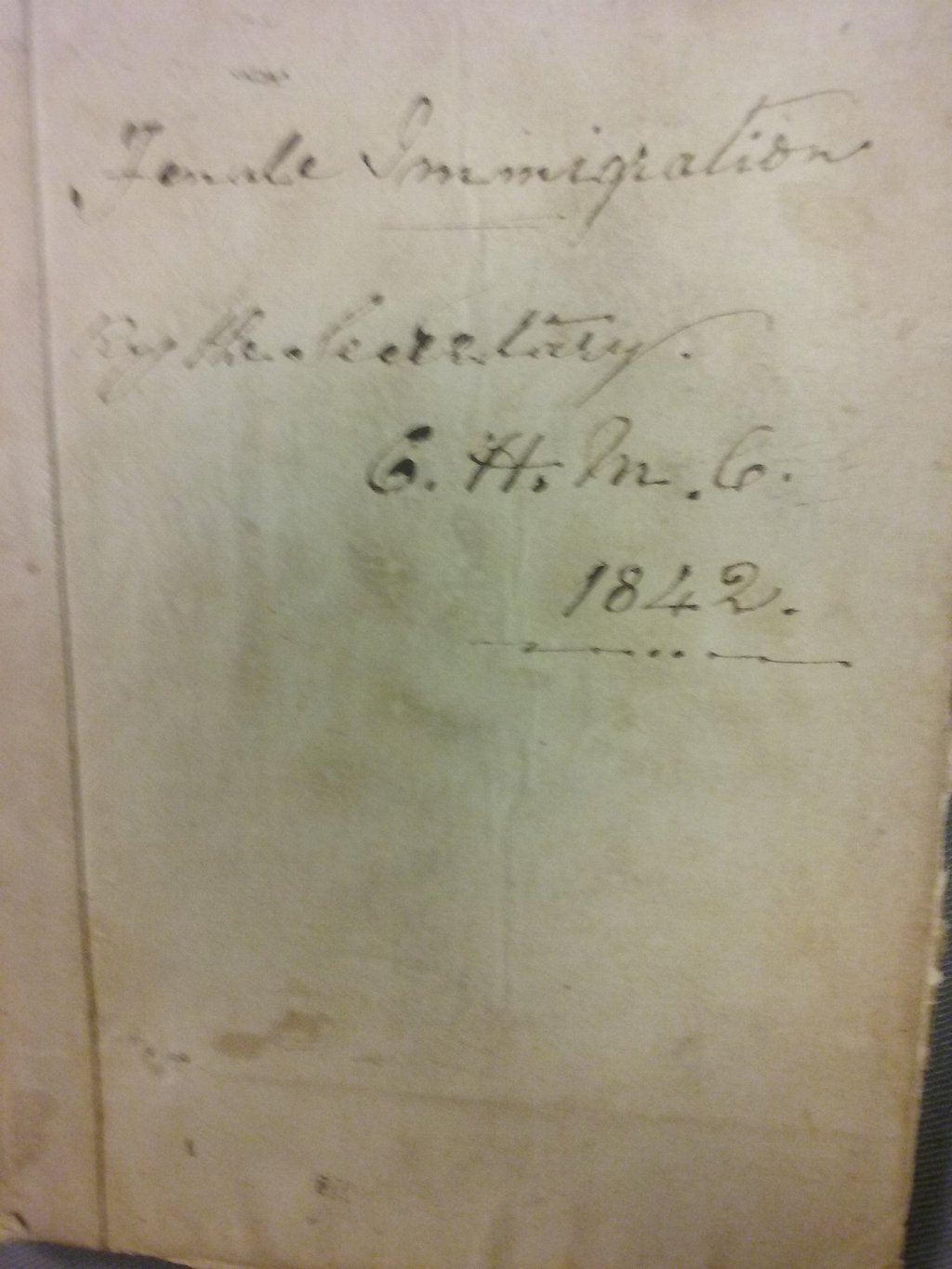
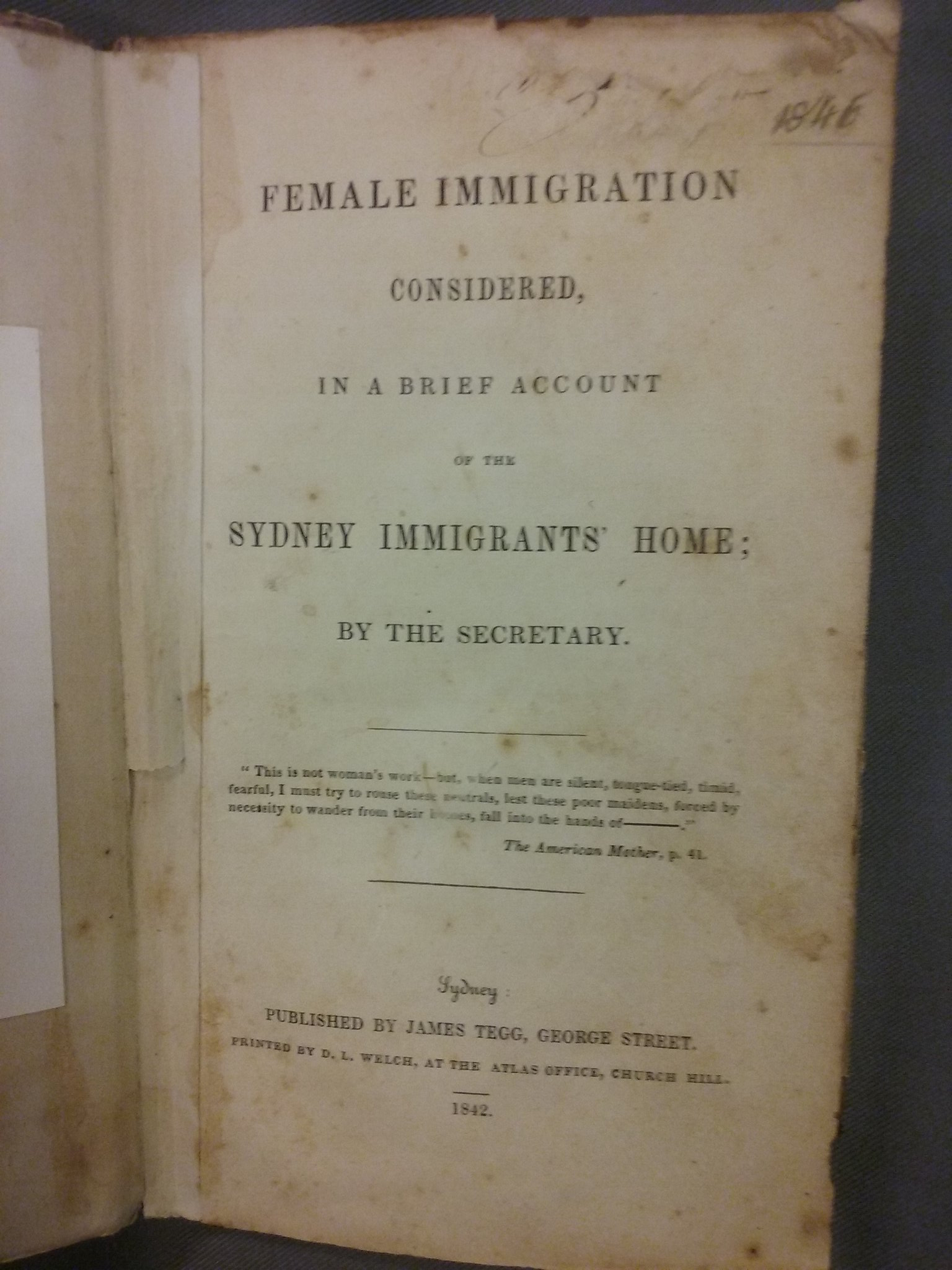
One day she arrived home with an ancient little book that someone many years ago had pasted over with now long-faded white paper. She’d bought it for 20 cents. To our amazement, it was an 1842 book by Caroline Chisholm, Australia’s first advocate for humanitarian rights for immigrants, especially young women, titled Female Immigration, Considered in a Brief Account of the Sydney Immigrants’ Home. 

A friend, the late Gary Simes, was an English scholar and bibliophile. He suggested we take the book to a man who was said to know more about rare books than anyone else in Sydney. I’m pretty sure he worked out of an office crowded with books in an old building in Foveaux St near central railway. I’d value his name from anyone who may recall him.

I took it down without an appointment and passed it to him across his large crowded desk. He immediately knew what it was I’d handed him and became quite excited. He looked it up in a giant catalogue of rare books and listed off libraries in Australian and overseas which had a copy. I think he said there were something like five known copies.

“What do you plan to do with this” he asked. “You know it would be worth a lot of money to a collector”. He mentioned several well-endowed US libraries that might pay something like $5000. In the early 1970s this was an unthinkably large amount of money.

He said repeatedly that he hoped we would do our best to keep it in Australia. I had no hesitation in agreeing.

After discussing it with Annie, we took it to the University of Sydney’s Fisher Library and asked what they might be able to pay us. They offered $300 which we accepted in a blink. I think we might have had a slap-up Greek dinner at the fabled Diethnes in Pitt Street that night with a bottle of white demestica, an under-rated retsina sadly no longer available.

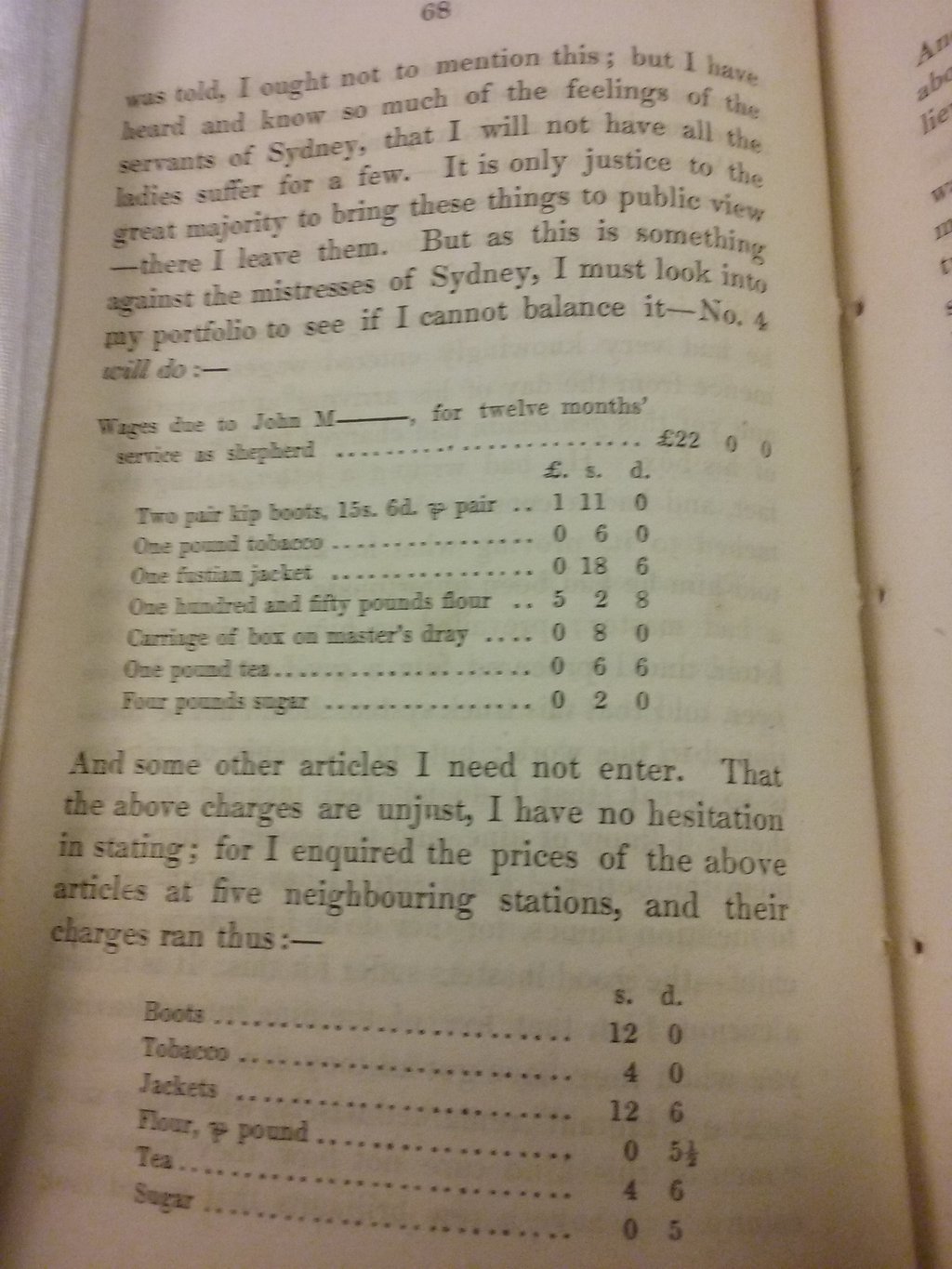
A few years ago I was walking past the rare books section in the Fisher building and on a whim went to the desk and asked if I might see the book. It was brought out to a reading desk in full view of the staff. I had to put on thin white gloves to browse the book. I took a few photos, including those above and this one showing the price of a pound of tobacco in 1842: three times the cost of a pound of sugar!

You can read the digitised book here

Tobacco and vaping industry leaders’ deep concern about health risks

30 Monday Jan 2023

Posted by Simon Chapman AO in Blog

≈ Leave a comment

Over the years, I’ve collected some glorious examples of the tobacco industry’s efforts to promote health and hose down public concern about the risks of smoking. There was Philip Morris’s effort in Australia in the 1980s to sell a sunscreen to protect us all from skin cancer. They thought it was a great idea to give it the same brand name as another of their products, Peter Jackson cigarettes, which like all cigarettes kill two in three of their long term users. Lung cancer prevention = bad; melanoma prevention = good. All got that? It was quietly and swiftly withdrawn when this little problem given some sunlight.

Then there was the time in 1999 that Philip Morris  listed itself in a corporate promotional brochure as sponsoring the Red Nose Day Foundation, Australia’s largest research charity supporting research on sudden infant death syndrome (SIDS). Sleeping in the prone position and exposure to tobacco smoke are the two most important, known risk factors for SIDS. The glossy brochure, resplendent with photographs of the company’s products including cigarettes, identified the charity as among “recipients of support or sponsorship from Philip Morris and its operating companies in Australia”. Red Nose Day organisers had obtained, for fundraising purposes, two giant Toblerone chocolate bars from Philip Morris’s Kraft corporate arm, not realising the then connection with the tobacco parent company.

On learning that Philip Morris was using the Toblerone donation as part of its efforts to promote its corporate image, the executive director of the Foundation complained that its name and cause had been misused and announced that the money raised would be returned as unwanted to Philip Morris.

World wide Philip Morris had aggressively disputed evidence that environmental tobacco smoking is harmful. Anne Jones, director of Action on Smoking and Health (Australia) commented at the time that Philip Morris claiming to support SIDS research was “about as offensive as Slobodan Milosovic donating to Kosovar refugee relief”

Promoting “light” cigarettes

When Philip Morris owned Kraft (Kraft has had no affiliation with Philip Morris or its spinoff Altria since 2007) its tobacco division was globally busy inculcating the idea that some cigarettes were less deadly than others. “Lights” was one of the magic words they and other tobacco companies branded these cigarettes with, until regulators outlawed it as misleading and deceptive and heavily fined them for knowing this for many years. There was no evidence “lights” were less deadly than any other cancer stick.

Before the curtain fell heavily on this deceptive conduct, Philip Morris used Kraft to help its efforts. Here’s an ad showing how “light” was used to directly imply healthy. Just the trick to use to imply the same healthier claims for cigarettes.

Smoking? Well what about …?

Tobacco companies have a long history of trying to mine research and expressions of public alarm about various risks to health to foment public confusion that “everything gives you cancer these days”, so why worry about just one risk, smoking? Perhaps the most florid example of this was a 20 page A-Z dossier of health risks from 1984. This was designed to be used as a crib sheet for tobacco industry employees to spray examples around in media interviews when the troublesome issue of the dire risks of smoking arose. Here’s a sample. You can read the rest via the link.

Cell phone tower electromagnetic radiation angst

Paul Adams (pictured above) was the chief executive of British American Tobacco’s head office in London for seven years until he retired in 2011. Adams presided over one of the world’s largest tobacco companies whose products today contribute to the global total tobacco death toll of 8 million smokers a year. We can safely assume he knew an awful lot about the health impact of his company’s business across his years at BAT. But in December 1993 he was very worried about another alleged health risk: electromagnetic radiation from a proposed transmission mast in his community and sent a personal protest letter to his local district health council.

Health risks from mobile phone towers or the phones themselves have never been demonstrated across the decades. It would be highly improbable that Adams did not use a mobile phone himself. Phones don’t work without transmission towers.

WiFi and Bluetooth

And in 2019, we come to Josh Fett, British American Tobacco’s Senior Regulatory Engagement and Campaigns Manager for Asia Pacific and Middle East. Fett tweeted two telcos “trying to figure out” if it was safe to use WiFi/Bluetooth around babies in the home.

Sarah White’s (then CEO of Quit Victoria) pertinent question below to Fett unfortunately went unanswered.

WiFi began being offered by communication providers from 2002 and by 2014 was being used in 25% of houses worldwide. Bluetooth began its rapid rise in popularity from 2004, going through seven different upgrades by 2016 as its provision and use became almost standard in lots of electrical equipment.

So across this time, hundreds of millions of neonates, infants, children and adults have received up to 17 years exposure by the time Fett asked his question.

Vertical integration of smoking and death

In 2019, Philip Morris International set up a life insurance company. As a next step in its business model, this was just masterly! Sell highly addictive, lethal tobacco products to your customers and at the same time, get them to also pay you a life insurance premium. I couldn’t resist adding a few more suggestions in the tweet below. So many ways for one of the world’s largest and longest purveyors of cigarettes to get a place at health industry tables and representative groups!

You’re in the health care industry!

But I save the best for last. Below we see the UK’s Vaping Industry Association (UKVIA) proudly megaphoning the message given to its 2022 conference by UK Conservative MP Adam Afriyie. Afriyie was a member of the All Party Parliamentary Group for Vaping which  both received funding from UKVIA and  from November 2016 until 2020, even had UKVIA operating  as the Secretariat for the APPG for vaping. Afriyie wanted vape manufacturers and retailers to get it into their heads that they were not in the tobacco industry, not in the nicotine addiction industry but, yes, in the healthcare industry.

That would be the vaping industry whose products are now sounding all the health alarms you see in reviews like those shown here.

George Orwell would be having a field day if he was alive today.

Vaping theology 13: “Kids who try vaping and then start smoking,would have started smoking regardless”

20 Friday Jan 2023

Posted by Simon Chapman AO in Blog

≈ Leave a comment

Like all cultists, those who live and breathe vaping by telling everyone at every opportunity that it has saved them, embrace a set of fervent beliefs. Vaping theology is a set of sacrosanct, inviolable beliefs that all adherents repeat regularly at risk being cast out of the vaping temple by other true believers.

At the end of this blog are another 23 of these creeds, with many more in preparation. This one looks at a belief that is never far from the lips of those who patrol policy debates on vaping where proposals or evidence threaten in any way to inhibit their mission.

Common liability theory

The garlic-encrusted crucifix hoisted high at the first syllable of any vampire-like suggestion that vaping might act as training wheels for children and teenagers to take up smoking is known as the “common liability hypothesis”.  The hypothesis first gained modest prominence in debates about the “gateway hypothesis” in drug uptake research where crude post hoc ergo propter hoc (after, therefore because of)  reasoning has often insisted that  (for example) that those who try cannabis and then later start using narcotics because they first smoked dope

We all appreciate that if one thing follows another it often does not mean the first thing caused the second. Breast milk is often followed by infant formula, water, then by fruit juice and clamour for carbonated drinks, then later by alcoholic drinks.  So can we say meaningfully that breast feeding causes Coke and alcohol consumption? Obviously not.

But there are plenty of examples of where one thing very much does greatly elevate the probability of another, satisfying several causal criteria. Prison incarceration is followed so frequently by reoffending on release that responsible legal sentencing practice tries to avoid imprisonment whenever reasonable to prevent crime. Intoxication and speeding so greatly increase the odds of motor vehicle crashes that deterrence and penalties are set high in most governments’ policies.

The current national concern about untrammeled betting advertising is seeing huge concern about the Pied Pipers of betting trying to lure starting punters into seemingly benign little flutters whiile turbo-charing promotions for multi betting. A classic example of gateway engineering.

Yes, there are always confounding factors that can be highlighted in such examples, but these seldom exonerate the critical role of an earlier variable (eg incarceration, drinking before driving).

When it comes to vaping and smoking, there are some entirely relevant observations. Both involve inhaling and exhaling nicotine through cylindrical delivery systems. Both involve the often rapid onset of signs of nicotine dependence in users. Both share a word (cigarette/e-cigarette) that seems to point to a similarity. Both involve repeated hand-to-mouth movements and a richly semiotic repertoire of holding and gesturing. Both see clouds of smoke or vapour billowing from their users, sometimes in clever displays. Both very frequently start in early teenage years. For some, both are important accoutrements of the passage from childhood to early adulthood, richly signifying and often peer group reputationally rewarding rebellion against parental controls and school rules.

With vaping and smoking, the common liability hypothesis posits that those children who vape and then subsequently start smoking would have mostly taken up smoking even if vaping had never been invented. It argues that kids who smoke in today’s smoking denormalised social environments have a propensity to be rebellious and so are also likely to take other risks: they vape, they smoke, try illicit drugs, have sex early, miss school, graffiti walls and so on. With the vaping “leading to” smoking debate, common liability adherents point to these propensities for kids who vape to be more likely to smoke simply because smoking is one of a constellation of adult-disapproved behaviours that bring peer status and petty prestigious notoriety to those seeking such distinction.

Nobel prize winning (2000) neuroscientist  Eric Kandell and his wife have described a molecular basis for nicotine being a gateway drug whereby nicotine in one form primes the brain to make it more susceptible to using other forms of nicotine. 

As a schoolboy, I smoked, got older kids to buy me alcohol, got suspended from school for buying beer on a school drama tour in year 11 and was the first in my year to have sex. I would have probably scored high on any scale of risk-taking a social psychologist might have pushed in front of me.

There have now been at least four systematic reviews/meta-analyses of the fast-emerging research literature on whether vaping increases the likelihood of taking up smoking.

Soneji et al (2017) JAMA Pediatrics: (9 studies) “The pooled probabilities of past 30-day cigarette smoking at follow-up were 21.5% for baseline past 30-day e-cigarette users and 4.6% for baseline non-past 30-day e-cigarette users.” (ie 4.7 times higher)

Baenziger et al (2021) BMJ Open (25 studies) “comparing e-cigarette users versus non-e-cigarette users, among never-smokers at baseline the OR for smoking initiation was 3.19 (95% CI 2.44 to 4.16, I2 85.7%) and among non-smokers at baseline the OR for current smoking was 3.14 (95% CI 1.93 to 5.11, I2 91.0%). Among former smokers, smoking relapse was higher in e-cigarette users versus non-users (OR=2.40, 95% CI 1.50 to 3.83, I2 12.3%).”

O’Brien et al (2021) BMC Public Health (14 studies) “our meta-analysis calculated a 4.06 (95% confidence interval (CI): 3.00-5.48, I2 68%, 9 primary studies) times higher odds of commencing tobacco cigarette smoking for teenagers who had ever used e-cigarettes at baseline, though the odds ratio were marginally lower (to 3.71 times odds, 95%CI: 2.83-4. 86, I2 35%, 4 primary studies) when only the four high-quality studies were analysed.”

Chan et al (2021) Addiction (11 studies) “a significant longitudinal association between vaping and smoking [adjusted odds ratio (aOR) = 2.93, 95% confidence interval (CI) = 2.22, 3.87]. Studies with sample sizes < 1000 had a significantly higher odds ratio (OR = 6.68, 95% CI = 3.63, 12.31) than studies with sample sizes > 1000 (OR = 2.49, 95% CI = 1.97, 3.15).”

All of the above reviews found that non-smoking children who had vaped at baseline had significantly increased odds of smoking cigarettes at follow-up, compared with those who had not vaped.

Yet in a recent editorial in Addiction, Pesko et al say that the public and health-care professionals pointing to the evidence in these reviews must be “confused”, writing:

“significant evidence now exists that this association between vaping and smoking is not causal, which is a source of confusion for the lay public and health-care professionals. Survey data show youth cigarette use declining steadily despite vaping increasing. When past-30-day youth e-cigarette use rates were as high as 32.9% in 2019, youth smoking rates should have been rising if the SG’s statement that ‘e-cigarette use is associated with the use of other tobacco products’ represents a causal relationship. Instead, by 2021 the youth cigarette use rate fell to a record low 1.9%.”

So why not settle the question with a randomised controlled trial?

All the studies reviewed in the four reviews above were observational longitudinal studies. In the first week of epidemiology training, every student is required to write out 1000 times at pain of death that “association does not equal causality” and play the sport of finding unwarranted causal inferences in observational study reports like those reviewed above.  It’s only in randomised controlled trials that authors are  given a gold pass to start suggesting causality.

Randomised controlled trials (RCTs) are venerated in medical and behavioural science because an important goal of randomisation is to disperse biases randomly across trial participants. Randomisation  theoretically eliminates confounding factors that may play dominant roles in determining outcomes, even ahead of the influence of the key intervention variables of interest (eg vaping vs NRT or unassisted cessation in evaluating the effectiveness of ways of quitting).

Because variables like age, sex, education, smoking in one’s family and peers, or personality traits like determination, self-efficacy or parenting styles are seen as likely to be important in how a person traverses decisions to smoke, drink or take drugs, randomisation — particularly in large trials — is designed to randomly spread the allocation of such variables across different arms of a trial (ie those receiving  an active drug – here, nicotine vapes – and those not vaping), in theory thus eliminating their influence.

But of course there will never be a randomised trial of vaping in children. No research ethics committee is ever likely to consent to such a trial because it would mean that researchers would be requiring randomised trial volunteer minors to start using highly addictive nicotine vapes. With smoking rates in early teens fast approaching zero in some nations like the USA, Canada, Australia, the UK and New Zealand,  imagine the outcry if a research group wanted to risk addicting nicotine naïve children to nicotine.

Imagine further, the unlikely event that a study group was able to recruit a large number of parents who would give their full consent to their children being given vapes like this. Not even in the most totalitarian of political regimes would we find such behaviour condoned.

Knowing this, those who stridently insist that the available data on transitions to smoking in young vapers is associative but not causal, know that they will always be able to use this policy fire extinguisher and train their “association” hoses on the worrying fires of gateway claims. This is a devious game intended to perpetually dismiss concern about collateral damage to kids arising from policies that allow them very easy access to vapes.

Controlling for “propensity to smoke”

With RCTs out of the question (just as they are for example, with randomising drivers to get intoxicated to see if they really do have more crashes in real world conditions than those who’ve not consumed alcohol), the next best evidence available is when researchers control their analyses for the very ‘propensity to smoke’ factors gateway critics say are the real determinants of smoking uptake.

Here we have several studies which have set out to do just that. Let’s take two recent examples.

Using US PATH study data, Berry et al (2019) looked at 2 years follow-up of 12-17 year old non-smokers who were vaping and those who were neither vaping nor smoking.

They found that current e-cigarette users (cigarette non-current users) at baseline were 5 times more likely to become regular cigarette smokers at 1-year follow-up than non-vapers. However, this association was not significant at the second year of follow-up. In reaching this conclusion, the authors controlled  for variables known to be associated with progression to smoking in youth.

A second example is  a 2021 paper on the UK’s  huge Millennium Cohort. It found:  

“Among youth who had not smoked tobacco by age 14 (n = 9,046), logistic regressions estimated that teenagers who used e-cigarettes by age 14 compared with non-e-cigarette users, had more than five times higher odds of initiating tobacco smoking by age 17 and nearly triple the odds of being a frequent tobacco smoker at age 17, net of risk factors and demographics.” [my emphasis]

Most importantly, the paper also deflated the glib ‘kids who try stuff, will try stuff’ common liability theory dismissal of the concern that vaping acts as training wheels for later smoking uptake. In their analysis, the authors controlled for a rich constellation of ‘propensity’ factors that have been suggested to predict smoking uptake in youth. These included parental low educational attainment and employment status; parental reports of each child’s behaviour during the prior 6 months using the Strengths and Difficulties Questionnaire, with indicators of externalizing behaviours (i.e. conduct problems, hyperactivity, inattention; and internalizing behaviours (i.e. emotional symptoms, peer problems) parental smoking; whether a child spent time ‘most days’ after school and at weekends hanging out with friends without adults or older children present. Children, via confidential self-reports, indicated whether they had ever drunk alcohol (more than a few sips), ever engaged in delinquency (e.g. theft, vandalism) and whether their friends smoked cigarettes.

In a huge blow to common liability adherents the authors concluded:

“we found little support that measured confounders drove the relationships between e-cigarettes and tobacco use, as the age 14 e-cigarette and tobacco cigarette estimates barely changed with the inclusion of confounders or in matched samples. Furthermore, early e-cigarette users did not share the same risk factors as early tobacco smokers, as only half the risk factors distinguished e-cigarettes users from non-users, whereas age 14 tobacco smokers were overrepresented on almost all the antecedent risk factors. If there was a common liability, we would expect similar over-representation for users of both forms of nicotine.”

Pesko et al didn’t reference these inconvenient papers either.

Pesko et al’s paper was an editorial, not a systematic review, It cited none of the above reviews nor indeed any of the papers in those reviews, instead basing its glib dismissal of that evidence as “based on statistical association rather than clear evidence of causality”.

Instead it enlisted another old chestnut: that the gateway hypothesis conclusions are simply incompatible with the fall in smoking prevalence in youth when their vaping is rising. (“youth smoking rates should have been rising if the Surgeon General’s statement that ‘e-cigarette use is associated with the use of other tobacco products’ represents a causal relationship. Instead, by 2021 the youth cigarette use rate fell to a record low 1.9%”

This argument is frankly very feeble. I dealt with it in a 2018 paper with two colleagues in Nicotine & Tobacco Research. It relies on an assumption that the net population impact of any putative gateway effect of e-cigarette use would be larger than the combined net impact of all other policies, programs and factors which are responsible for reducing adolescent smoking prevalence (e.g. tobacco tax and retail price, measures of the denormalisation of smoking, exposure of children to adult-targeted quit campaigns, retail display bans, health warnings and plain packaging) and the important synergies between all of these.

Many nations have seen pleasing and continuing falls in adolescent smoking commence well before the advent of widespread vaping. Vaping is thus far from being the only factor responsible for declining smoking.

But this is the ridiculously  high bar that gateway critics demand that anyone suggesting gateway effects needs to jump over. If smoking is falling, the suggestion is that the uptake of vaping is causative. Note here too the ease with causal attribution from ecological data is invoked when it suits one’s purpose.

The combined impact of the abovementioned factors in preventing smoking uptake could easily mask considerable smoking uptake that might not have occurred in the absence of e-cigarettes. That uptake may not be big enough to reverse net falls in smoking prevalence which has seen hundreds of thousands of children and adolescents not take up smoking in nations where it has happened.

But the undeniable consistency in observational cohort studies, almost without exception, shows that if you don’t smoke and do vape, you are far more likely to smoke later, even when “propensity to smoke” factors are adjusted in studies which have done this.

To keep repeating these discredited slogans (“kids who try stuff, will try stuff”, “kids who are going to smoke, will smoke”) dignified by high-falutin’ hypotheses  like “common liability” that don’t survive first pass adjustment for their assumptions, discredits those who continue this narrative.

Other blogs in this series

Vaping theology: 1 The Cancer Council Australia takes huge donations from
cigarette retailers. WordPress  30 Jul, 2020

Vaping theology: 2 Tobacco control advocates help Big Tobacco. WordPress 12 Aug, 2020

Vaping theology: 3 Australia’s prescribed vaping model “privileges” Big Tobacco WordPress Feb 15, 2020

Vaping theology: 4 Many in tobacco control do not support open access to vapes because they are just protecting their jobs. WordPress 27 Feb 2021

Vaping theology: 5 I take money from China and Bloomberg to conduct bogus studies. WordPress 6 Mar, 2021

Vaping theology: 6 There’s nicotine in potatoes and tomatoes so should we restrict or ban them too? WordPress 9 Mar, 2021

Vaping theology: 7 Vaping prohibitionists have been punished, hurt, suffered and damaged by Big Tobacco WordPress 2 Jun, 2021

Vaping theology: 8 I hide behind troll account. WordPress 29 Jun, 2021

Vaping theology: 9 “Won’t somebody please think of the children”. WordPress 6 Sep, 2021

Vaping theology: 10: Almost all young people who vape regularly are already smokers before they tried vaping. WordPress 10 Sep, 2021

Vaping theology: 11 The sky is about to fall in as nicotine vaping starts to require a prescription in Australia. WordPress 28 Sep, 2021

Vaping theology: 12 Nicotine is not very addictive WordPress 3 Jan 2022

Vaping theology 13: Kids who try vaping and then start smoking,would have started smoking regardless. WordPress 20 Jan, 2023

Vaping theology 14: Policies that strictly regulate vaping will drive huge
numbers of vapers back to smoking, causing many deaths. WordPress 13 Feb, 2023

Vaping theology 15: The government’s prescription vape access scheme has failed, so let’s regulate and reward illegal sellers for what they’ve been doing. WordPress 27 Mar 2023

Vaping theology 16: “Humans are not rats, so everybody calm down about nicotine being harmful to teenage brains”. WordPress 13 Jul, 2023

Vaping theology 17: “Vaping advocates need to be civil, polite and respectful” … oh wait. WordPress 3 Oct, 2023

Vaping theology 18: Vaping is a fatally disruptive “Kodak moment” for smoking. WordPress Oct 30, 2023

Vaping theology 19: Vaping explosions are rare and those who mention them are hypocrites. WordPress 17 Nov, 2023

Vaping theology 20 : Today’s smokers are hard core nicotine dependent who’ve tried everything and failed – so they need vapes. WordPress 14 Dec, 2023

Vaping theology 21: Australia’s prescription vapes policy failed and saw rises in underage vaping and smoking. WordPress 10 Jan, 2024

Vaping theology 22: “Prohibition has never worked at any point for any other illicit substance”. WordPress 17 Mar 2024

Vaping theology 23: “84% of the Australian public are opposed to the way the government will regulate vapes” WordPress 2 Apr, 2024

Vaping Theology 24: “Tobacco control advocates are responsible for vape retail store fire bombings and murders. WordPress 27 May, 2024

New Zealand’s gloves-off smoking policies should see smoking fall dramatically

16 Friday Dec 2022

Posted by Simon Chapman AO in Blog

≈ 1 Comment

On December 13, 2022 the Aotearoa (New Zealand) parliament passed amendments to  the Smokefree Environments and Regulated Products (Smoked Tobacco) Amendment Bill,  making three major changes:

  • reducing the amount of nicotine that is allowed in smoked tobacco products
  • decreasing the numbers of retailers that sell tobacco
  • making sure tobacco is not sold at all to anyone born on or after 1 January 2009.

In doing so, Aotearoa -New Zealand vaulted itself into clear international policy leadership in tobacco control policies likely to drive tobacco smoking to near extinction over the next 20-30 years as fewer smokers start, more quit and inevitably, higher smoking caused death rates continue in the fewer remaining smokers.

However, some important questions of implemention remain when the new legislative rubber meets the road of real life.

Reduced retail outlets

The law will see a maximum 600 licensed tobacco retailers by the end of 2023, down from the present 6000.  The thinking here is that many small retailers such as “dairies” (small mixed businesses which often sell tobacco) will stop selling tobacco, reducing access and “spontaneous” purchases. Smokers will need to plan their purchases to align with visits to the fewer outlets which will be selling tobacco.

New Zealand has no floor price on retail tobacco, so price discounting competition still occurs (eg: https://www.discountt.co.nz/Price+List/Cigarettes+Price+List+2022.html) The tobacco industry has long fought tax increases, knowing what higher prices do to sales. In 2011 a CEO of British American Tobacco told an Australian Senate hearing under oath “What I do believe is that . . . if the objective is to reduce consumption then you would move towards areas which have been evidence based not only in this country but in others around the world –…We understand that the price going up when the excise goes up reduces consumption. We saw that last year very effectively with the increase in excise. There was a 25 per cent increase in the excise and we saw the volumes go down by about 10.2 per cent; there was about a 10.2 per cent reduction in the industry last year in Australia. “

In Australia liquor discount chains like Dan Murphy’s  (owned by the Endeavour Group) and First Choice (owned by the Coles Group) have radically changed the face of liquor retailing via both offering massive product range and significant price discounting. My local Dan Murphy’s this morning advertised 24 330ml Peroni beers for $51.99 while one of the few remaining independent liquor outlets in the same suburb had them at $58.99, 13.7% more.

The sheer buying power of major players in effective retail duopolies drives customers away from small retailers who can’t compete. I’ve yet to read a persuasive argument why the same thing won’t happen by concentrating tobacco retailing when not done within the constraints of parallel floor pricing policy.  Someone retuning to Australia today after being away 15-20 years would find it startling how fewer liquor outlets there are in suburbs and towns. But they would not notice any obvious decrease in drinking. Will the same happen with tobacco retailing?

 No sales to anyone born after Jan 1, 2009

This change in the law will mean that with each year that passes, the minimum age at which it will be legal to purchase tobacco products will rise by a year. For example, by January 1, 2040, you will be need to be over 31 to buy cigarettes legally. Penalties will apply to those who sell, not those who buy.

Minimum age for tobacco purchasing of course  has applied in many nations, often for a long time. In Australia it has been illegal to sell tobacco to minors in NSW (1903), South Australia (1904), Queensland (1905), Victoria (1906) and Western Australia (1917).  But these laws have rarely seen retailers who sell to minors prosecuted or prevented from again selling tobacco. In tobacco control circles, to call for the “strict enforcement” of bans on selling tobacco or vapes to minors is to label yourself a very naïve new kid on the block (or a cynical mouthpiece for the vaping and tobacco industries which also routinely call for such enforcement, hand-on-heart).

It is illegal now to sell cigarettes and vapes to those aged under 18, yet smoking remains widespread as the graph below from ASH New Zealand shows. In 2008, one third of New Zealand kids who smoked purchased their cigarettes, with no change in this pattern since 2000.

So why will New Zealand’s 600 tobacco retailers at the end of 2023 behave any differently than the 6000 do today, with illegal sales to kids being common?

However there is a way that tobacco sales could always be conditional on being linked to an official proof-of-age card. The way prescribed drugs are dispensed shows how this could easily happen. No pharmacist would ever think of selling a prescribed drug to a person without a prescription. To do so would see the wrath of both the pharmacy industry and the government end such a pharmacist’s license to practice.

Every antibiotic, every oral contraceptive, every blood pressure medication, every prescribed drug ever sold is always linkable to a prescription with a named individual with a Medicare record including date of birth. This is used by governments to oversee prescribing patterns including doctor shopping by those trying to stockpile drugs for personal or on-selling purposes,

In this 2012 PLoS Med paper and this 18 minute video, I set out in detail how selling tobacco could be very easily be managed through the introduction of simple swipe card (or these days through a phone app) that linked to an official date-of-birth record. We would not simply leave it to an honour system like those utter joke “are you over 18?” self-declaring barriers to entering on-line tobacco and vape shops.

Trace levels of nicotine

In my view, the absolute towering elephant in the room is the effective de-nicotinisation of cigarettes. With reducing nicotine levels to trace (non-addictive) levels, implementation will be easiest. Since 2020, all manufactured loose tobacco and cigarettes have been  imported into New Zealand, with all importers long having been required to provide  government with full details of the nicotine yields (plus all other additives) of each brand being imported and retailed. It is unimaginable that one of the Big Tobacco importing companies would try to falsify this information or import products which did not match the yield data they had provided the government. This would risk their importer rights and be further catastrophic for their already bottom-of-the-barrel business ethics status.

But critically here, cigarettes with insignificant nicotine to satisfy cravings are likely to be experienced as pointless by most smokers and quickly fade from commerce. So this policy has immense potential to see smokers abandon smoking in large numbers, making the above considerations of price discounting and verifying legal age of purchase all “after the event” of smokers turning right off the only cigarettes which will be legally available. If they won’t want to buy nicotine-tepid cigarettes, few will be bothered looking for price-discounted brands. You can’t put lipstick on a pig.

New Zealand will then need to face the challenges of vast numbers of kids who would have never used nicotine in any form were it not for vaping being addicted to nicotine vapes. Those who have trivialised the health risks and sloughed off people puffing on vapourised nicotine, unregulated flavouring chemicals and glycol 500 times a day may have a lot to answer for as the evidence of health risks mounts.

We are all hoping that New Zealand will boot smoking right out of the park, just as we are excited about Australian Health Minister Mark Butler’s Nov 30 announcement of radical reforms to tobacco and vaping policy in Australia (see his speech here -sorry about the amateur camerawork!)

Very happy to publish and information or civil responses relevant to the concerns above.

← Older posts
Newer posts →

Blog Stats

  • 163,660 hits

Top Posts & Pages

  • Why I’m not quitting Spotify because its owner has hugely invested in weaponry
  • Readers or royalties? why now I make my books open access
  • Vaping theology: 6 There’s nicotine in potatoes and tomatoes, so should we restrict or ban them too?
  • My first seen, best and worst bands 1964-2022
  • Oh what a party it was that night, what a party it was ...
  • About/CV
  • Regrets … I’ve had a few. Paul Hogan and his Winfield role.
  • Wind turbine syndrome: the non-disease that only speaks English
  • NSW elections: the three political parties intent on shredding Australia’s gun laws
  • Thinking of keeping koi? Advice for beginners in NSW

Comment Policy: No anonymous or pseudonymous posts will be published

Recent Posts

  • Australia takes off the gloves on illegal tobacco while ‘lower the tax’ fantasists plumb new absurdities
  • Egg on some faces: statisticians at 10 paces on the impact of New Zealand’s vape laws on youth smoking
  • Lowering tobacco tax to make illegal tobacco sales “disappear overnight”: at last we have a proposed figure and it’s an absolute doozie
  • Why I’m not quitting Spotify because its owner has hugely invested in weaponry
  • Should we believe Fiona Patten on vapes? Here are just a few problems

Recent Comments

Jon Krueger's avatarJon Krueger on Egg on some faces: statisticia…
Atul Kapur's avatarAtul Kapur on Should we believe Fiona Patten…
Unknown's avatarCould a national tob… on If expensive cigarettes are dr…
tahirturk1's avatartahirturk1 on Why Australia’s illegal tobacc…
malonere's avatarmalonere on Words I’ve seen, but didn’t kn…

Archives

  • December 2025
  • August 2025
  • July 2025
  • June 2025
  • May 2025
  • March 2025
  • January 2025
  • November 2024
  • October 2024
  • September 2024
  • July 2024
  • May 2024
  • April 2024
  • March 2024
  • February 2024
  • January 2024
  • December 2023
  • November 2023
  • October 2023
  • September 2023
  • August 2023
  • July 2023
  • June 2023
  • May 2023
  • March 2023
  • February 2023
  • January 2023
  • December 2022
  • November 2022
  • October 2022
  • August 2022
  • June 2022
  • April 2022
  • March 2022
  • February 2022
  • January 2022
  • December 2021
  • October 2021
  • September 2021
  • August 2021
  • June 2021
  • May 2021
  • April 2021
  • March 2021
  • February 2021
  • January 2021
  • December 2020
  • November 2020
  • October 2020
  • September 2020
  • August 2020
  • July 2020
  • June 2020
  • May 2020
  • April 2020
  • March 2020
  • February 2020
  • January 2020
  • December 2019
  • November 2019
  • October 2019
  • September 2019
  • August 2019
  • July 2019
  • June 2019
  • May 2019
  • April 2019
  • March 2019
  • February 2019
  • January 2019
  • December 2018
  • November 2018
  • October 2018
  • September 2018
  • August 2018

Categories

  • Blog

Meta

  • Create account
  • Log in
  • Entries feed
  • Comments feed
  • WordPress.com

Blog at WordPress.com.

  • Subscribe Subscribed
    • Simon Chapman AO
    • Join 198 other subscribers
    • Already have a WordPress.com account? Log in now.
    • Simon Chapman AO
    • Subscribe Subscribed
    • Sign up
    • Log in
    • Report this content
    • View site in Reader
    • Manage subscriptions
    • Collapse this bar
 

Loading Comments...