The life you (don’t) choose

In the next weeks, I’ll be publishing 20 short stories on work and travel experiences I’ve had. I’ll be publishing several in advance here. Here’s one as fresh as if it happened yesterday.

In 1973, at the ripe old age of 22, my then wife Annie and I took the fabled overland trip from London to Australia. We’d been living in London, where I worked as an accessions clerk in the library of the Natural History Museum and Annie worked temping as a typist.

After getting the ferry to Dieppe, in France, we hitchhiked to Brindisi in southern Italy,  took a ferry to the Peloponnese in Greece, a bus up to Athens, a cheap flight from Athens to Istanbul, and then got local buses through Turkey, where we spent nights with monstrous bed bugs in Sivas and Erzurum in the east of the country. The buses then continued all the way across Iran, Afghanistan and Pakistan, with third class unreserved trains from Amritsar to Delhi, Agra and then to Calcutta in India. After losing perilous amounts of weight to travelers’ diarrhoea, we surrendered to a cheap flight to Perth and took a bus across the Nullabor plain to Sydney, our home.

We were  adopted by a beaming Iranian girl, Farah, on a bus in Turkey, returning from au pair work in Germany. She insisted we stay with her family in Tehran. It was  during Ramadan.  On the first full day with them, they prepared vast quantities of food for us and watched us eat lunch. We repaid them by blocking their squat toilet with toilet paper, necessitating the arrival of a plumber and an assembly of curious neighbours. We traveled down to Isfahan to marvel at the turquoise mosaic covered mosques. We lived on pomegranates, pistachios, lamb kebab and pilaf, crossing the vast Iranian plains toward the magnetism of Afghanistan, a place that had fascinated me as a boy. We were warned by police to not go into the very fundamentalist Mashed, so changed into another bus at a station on its outskirts and then moved onto the border with Afghanistan.

We had arrived at the Iranian side of the border about 2pm. It would close at 4pm. With about ten minutes to go, baksheesh negotiated and eventually extracted by the border guards, we were let through and into the no-man’s land between the Iranian and Afghan border.  Because the Afghan side of the border also closed at 4pm, this meant we were obliged to stay in the only hotel in the no man’s land. This cosy arrangement, presumably benefiting all parties concerned, was known to every traveler on the route. The travel writer Paul Theroux, wrote about it in his 1975 book, The Great Railway Bazaar. (see extract below)

Boys who looked about 10 swarmed all over us offering palm-sized black hashish for a dollar. While we had both smoked dope in Sydney and London, we were wary enough to avoid it here. We had crossed the border with some German guys and a Yugoslav woman about our age. They had all immediately bought hash and sat in the garden smoking it before dinner. Shortly after, the boy who had sold it to then arrived with several Afghan border guards, pointing them out. They confiscated the Germans’ passports, saying that they would be returned after they paid ten per cent of the amount of money each border crosser had been obliged to note in their passport as we crossed on the Iranian side of the border.

The Yugoslav woman was taken away by the guards to a nearby garrison building. When the Germans went over to buy back their passports, they saw she was being raped by the men from the garrison. We were all helpless. We didn’t even know her name. There were no phones, no Yugoslav or Australian embassy in Kabul (which was weeks away for us) and the rapists seemed to be a mixture of border guards and soldiers who might have been the only authorities to contact. God knew what might have passed for police in such a place.

Welcome to Afghanistan.

Screenshot 2025-01-11 at 4.23.39 pm

Extract from Paul Theroux’s 1975 book The Great Railway Bazaar, describing the no-mans-land hotel

The next day we went onto Herat, 300km from the border. It was a dusty town with tree lined streets. We stayed for a week, the start of a month in that unforgettable country, then still a kingdom.  Our hotel had no bathroom, but there was a pit squat toilet that smelt so rank, you had to hyperventilate before going inside so that you could hold your breath for the minute needed. With the state of our bowels, that was easily time enough. There was a public bathhouse in the main street that had a women’s night once a week. However, the boss man there allowed Annie and I to go in together on a men’s night and have a private room that you could lock from the inside. We scoured the walls and door for any peepholes, but found none. The water was hot and the floor tiled. It was bliss.

We also stayed a week in Kandahar, a place that would decades later headquarter the Taliban. One afternoon and policeman told us to turn away from the market we were heading for. “Tribal people are there. They will cut your throat”, he told us. The capital Kabul, with its Chicken Street mecca for western travelers, sold lapis lazuli jewellery, wolf skin fur coats and leather horsemen’s knee boots.

This was in the days well before the internet, cell phones, fax machines and credit cards. You carried cash and travelers’ cheques, and picked up mail poste restante  at the post office. Some sold their blood at local hospitals, where you were invited to push your arm through an elasticised hole so they could take whatever they wanted. We gave that a miss.

Part of the adventure was to do it all as cheaply as possible. An old diary I found shows what we paid for transport from Istanbul to when we entered India: about $25 each in 1974 prices (see table below). A mud floor and wall ‘hotel’ in Herat in western Afghanistan cost 15 Afghani a night, with rats, a horsehair and straw paillasse  mattress, and complimentary hashish or opium, usually smoked with the hotel owners who liked to play the travelers at chess.  There were 40 Afghani to the US dollar.  The decrepit buses we traveled in regularly broke down, till the driver’s clanking under the bonnet for an hour got them going again.

(1974)Herat(1974)Kandahar

Herat street scene                                              Kandahar

Journey Duration Cost per person
Istanbul-Erzerum 24h 85 Turkish lira
Erzerum-Iran border 8h 30 lira
Border=Tehran 14h 350 Iranian rials
Tehran-Mashed 24h 200 rials
Mashed-Afghan border 14h 100 rials
Border- Heart 4.5h 50 Afghani
Herat-Kandahar 7h 25 Afghani
Kandahar-Kabul 14h 25 Afghani
Kabul -Peshawar 8h 400 Afghani
Peshawar-Lahore 9.5h 18.5 Pakistan rupees
Lahore-Indian border 2.25h 1.75 rupees
Border-Ferozopore 0.5hr 0.4 rupees

We finally we took a bus from Kabul through to Jalalabad, then through the Khyber Pass and into the even more lawless North West Frontier region of Pakistan. All day long we saw wild looking Pashtun men on small horses and camels, swathed in bullet belts with ancient looking rifles slung on their backs. Urchins and mangy dogs ran alongside the bus. When we stopped, small crowds would gather around in silence, utterly expressionless, staring at us without ever smiling or trying to touch or speak with us. It was unsettlingly eerie.

Peshawar is the first city you come to in Pakistan after passing through the Khyber Pass. The Australian cricket team played a test match and one day game there in 1998, but security has since stopped further international cricket there.  It was an unprepossessing place with a chaotic, unmemorable downtown area with shops selling the same cheap plastic junk, cloth and drab furniture that held no interest. After an hour or so of wandering about and being stared at still more, we were persuaded by a taxi driver to spend the rest of the day with him for about $3 in his deteriorated Morris Ambassador. He would show us the sights, where the people lived and some nice countryside near the town.

It was all dreary beyond imagination, with more unremitting staring all day, few trees and people eking out a living sitting all day next to a rag in the dirt displaying a few onions, fly infested goat meat or metal bric a brac, like locks, buckets and engine parts.

Late in the afternoon we unexpectedly came upon a circus tent pitched in a dry, featureless park.  In the hour that followed, I saw what my life might have been.

We got out of the taxi and made our way to a series of wagoned cages constructed of iron and hardwood. They looked like pieces out of a Frederico Fellini set from Satyricon in ancient Rome. Some housed monkeys and depressed, mangy bears, but one  had a liger, the result of a male lion mating with a female tiger to produce some of the biggest large cats known. But it was the young foreign couple who were the most exotic creatures to what rapidly built to another silent crowd of well over 100 men and boys who surrounded us, all utterly expressionless. No women were to be seen anywhere.

Within minutes we saw a  turbaned Sikh making his way through the crowd to us. He carried a splendid carved walking stick topped with gaudy coloured cut glass. He introduced himself as the circus owner and invited us to his personal tent for tea. There was no refusing. The crowds parted before the exotic entourage.

Glasses of tea and sweets were brought and we answered his enthusiastic questions about where we were from, what our occupations were (we had long learned to not say that we had no jobs or were students, which brought either consternation or obvious thoughts that we must have very rich parents). We were ‘teachers’. Then a litany of calibrating questions came about the price of various  goods in Australia, and the inevitable benchmark question: “how much does an engineer earn in your country?”

It was then that the conversation changed. I remember every word. It went like this.

“Do you know modern dancing?”

Modern dancing?  We looked at each other. What did he mean?

“You know, like cha-cha-cha?”

Well, yes, we did. I’d had a particularly progressive teacher who took dancing at school and daringly went beyond the barn dance and the Pride of Erin.

“And do you have bathing costume?”

Well, yes, we had those too. This was very much the right answer.

“Well, I am making proposal for you to join our very good, most famous circus. The best in all Pakistan. We travel all over the country including to the most famous and beautiful Swat Valley!”

We would have our own tent and we would dance the cha-cha-cha in our bathing costumes at each performance. This would be to audiences that we didn’t need to ask about but who would be all staring, silent Muslim men.

I had instant visions of my rapid disappearance, with Annie becoming the exotic consort of the sikh or traded to a local warlord in some valley in the ungoverned north of the northwest frontier.

We said that he had given us much to think about and we would need to contact our families and employers in Australia before committing to this tempting offer. We would send him a telegram with our answer as soon as we heard.

The next morning we got the bus to Lahore, where a solicitous, effusive businessman seeing us studying a town map, insisted on taking us to a cinema where an English language cowboy film was being shown. In the darkness he surreptitiously began to start his grope at Annie’s breasts. We got up and left, with the man following us back to our sub- one star hotel where he tried to force himself into our room.

Dancing in my swimming trunks in a traveling circus in Pakistan was not the life for me.

* the 20 short stories have now been completed and are here

Are e-cigarettes really the seatbelts and condoms of tobacco-caused disease prevention?

Dr Joe Kosterich, a Perth GP and a director of the Australian Tobacco Harm Reduction Association, recently argued in WA Today that e-cigarettes should be seen as  no-brainer, common-sense harm-reducing equivalents of seat belts or condoms for smokers. And we should not dither around: there were no randomised controlled trials needed when car seat belts were made mandatory nor for condoms when they were put in the forefront of HIV/AIDS prevention, he argued.

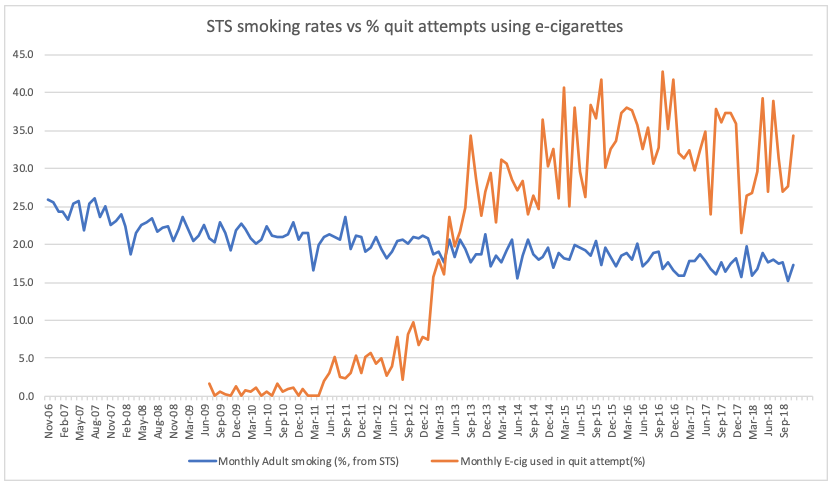
He repeated the factoid that e-cigarettes reduce harm by 95%, said there was “absolutely no evidence” of e-cigarettes being  gateways to later uptake of smoking in teenagers and boldly claimed that “dual use [smoking as well as vaping) is still better than only smoking”. And he claimed that the fall in smoking has stagnated in Australia, while falling faster in nations where vaping is widespread.

Each of these claims is highly contestable. Let’s go through them.

Seatbelts and condoms for smokers?

Seat belts and condom use prevent unwanted adverse outcomes from driving and sex, but do e-cigarettes do the same by reducing harm?

The fact is we do not know. The average vaper bastes their mouth, throat and lungs with vaporised nicotine and chemical flavouring nano-particles and propylene glycol 200 times a day – over 73,000 times a year. Diseases caused by smoking typically take 30-40 years to be diagnosed. Yet vaping has only been in common use in some nations for barely 10 years.  So if we are comparing the health risks of smoking with vaping we have no direct evidence of what might lie down the track. This is why the prestigious US National Academies of Science, Engineering and Medicine (NASEM) declared in its door-stopper 680 page review of the evidence on e-cigarettes in January 2018 that “There is no available evidence whether or not e-cigarette use is associated with intermediate cancer endpoints in humans. This holds true for e-cigarette use compared with use of combustible tobacco cigarettes and e-cigarette use compared with no use of tobacco products.”

A 2017 review of the emerging evidence on pulmonary effects caused by e-cigarette use provides many causes for concern:

Screen Shot 2018-08-07 at 11.07.49 am

Source: https://www.ncbi.nlm.nih.gov/pmc/articles/PMC5582932/


Are e-cigs 95% safer?

This figure started out as simply a guess made by a group of 12 people hand-picked for a process led by huge fan of e-cigarettes, David Nutt, who has since declared publicly that e-cigs are the most significant advance in medicine since antibiotics.

Public Health England has also used the 95% figure as a robust estimate of comparative risk, with Prof John Newton of PHE telling an Australian parliamentary committee that We say what really matters is that evidence underlying this figure came from the Nutt report.”

However, the Nutt group’s report made the extraordinarily frank statement that  “A limitation of this study is the lack of hard evidence for the harms of most products on most of the criteria.” Limitations don’t get much more fundamental than that.

There were no randomised controlled trials for seat belts or condoms

Correct. And neither were there for parachutes  saving lives of people jumping from planes. Indeed, there are another 50 routine and important medical interventions where no RCTs have ever been conducted, for good reasons. But these are the exceptions: there are an estimated 80,000 medical interventions which have been trialed and evaluated.

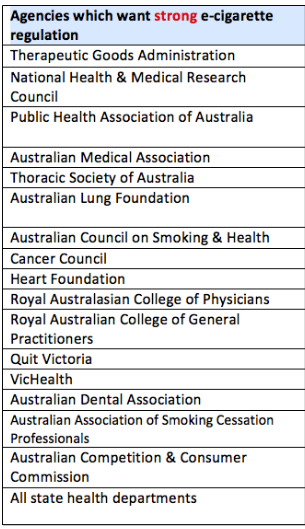
If someone megaphoned they had a new substance that cured cancer, asthma or HIV and argued it was simply too important to tie their miraculous new breakthrough up in regulatory red tape and that they should be allowed to sell and promote it everywhere immediately, they would be laughed out of the room and told firmly to do what all drug manufacturers have to do: have their claims evaluated through official, independent drug regulation schemes like we do in Australia with the Therapeutic Goods Administration. What have vaping manufacturers to fear from the normal regulatory processes if their products are as safe and effective as they say?

Is dual use better than just smoking?

In England today where vaping is widespread, 61.3% of adults who vape also smoke (see slide 8 in Powerpoint set dated 10 Apr 2018 here).  If you smoke 20 a day and reduced to 10 a day, it’s beyond argument, surely, that you will have reduced your risk? Sorry, but that’s not what the evidence shows. A Norwegian cohort of 51,210 people followed from the 1970s until 2003 found “no evidence that smokers who cut down their daily cigarette consumption by  more than 50% reduce their risk of premature death significantly”. There are several more large longitudinal studies showing the same counter-intuitive outcome. Stopping smoking altogether is the only sure way to reduce risk. We do not know if reducing smoking by also vaping reduces long term health risk.

But emerging evidence already suggests it’s unlikely to. This graph from a 2018 study in JAMA shows dual users (smokers who also vape) had a higher prevalence of six pulmonary symptoms than smokers who did not vape.

Screen Shot 2018-08-07 at 11.26.20 am

There’s no evidence of gateway effects with kids

Kosterich was unimpressed with a health minister’s statement “The overwhelming medical advice and evidence is that it’s likely to lead to the uptake of smoking…”.  He called it “disgraceful” that the minister  should have been “so badly advised”, stating “There is absolutely no evidence anywhere in the world that vaping leads to the uptake of smoking.”

Apparently in all seriousness, Kosterich also argued  that “The public understands international data better than the medical establishment.” 

We can take Joe Kosterich’s word for this, or we can read and acknowledge what the US  NASEM report expert panel concluded about the evidence here:There is  substantial evidence that e-cigarette use increases risk of ever using combustible tobacco  cigarettes among youth and young adults” and “moderate evidence that e-cigarette use increases the frequency and intensity of subsequent combustible tobacco  cigarette smoking.”

Has the fall in smoking stalled in Australia?

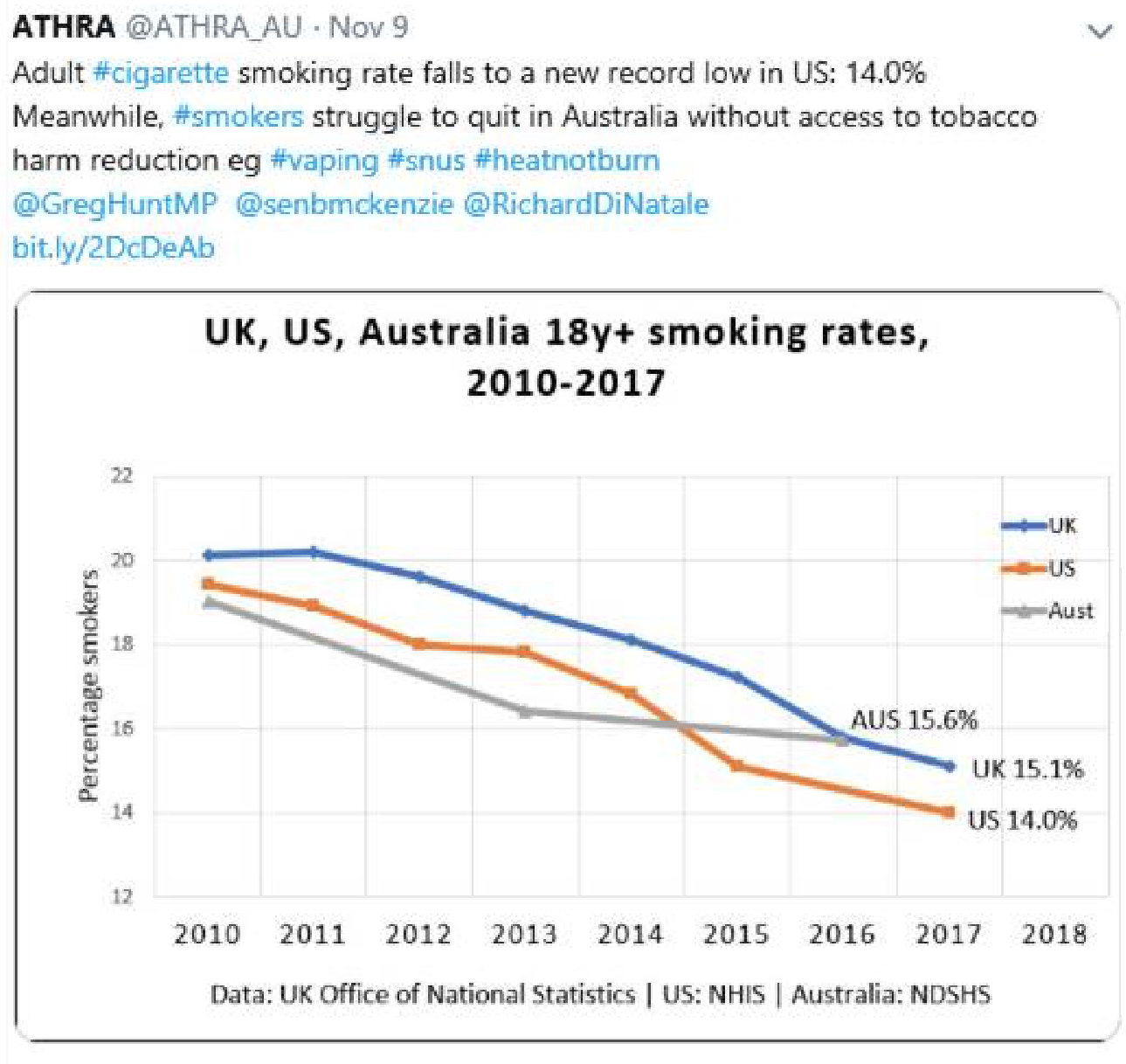
Vaping advocates keep claiming that the fall in smoking in Australia has stalled, as a pretext for declaring it’s time to open the floodgates to e-cigs here. They base this on the fall  between just two data points (2013 and 2016) not reaching statistical significance in national survey by the Australian Institute of Health and Welfare (AIHW). But they are silent on the largest and longest running survey of smoking in Australia which shows nothing of the sort. The Roy Morgan Research company has collected monthly data on smoking rates around the country since 1974 (see Figure 1.3.3 here), selling this information to tobacco companies. Each year, over 50,000 people are interviewed for these surveys and the latest available data from August 2017 show a rolling average below 15% for Australians aged 18 for every month of 2017, compared to the latest data from the UK where 15.1% smoke and vaping widespread.

Like all population surveys, the AIHW data on smoking prevalence in Australia often cited by vaping advocates  has margins of error. The AIHW’s table of relative standard errors and margins of error indicates for example, that the prevalence of daily smoking among people aged 18 years and over in 2016 was somewhere between 12.2% and 13.4%.

Very recently, Philip Morris International’s 2018 second quarter report stated:

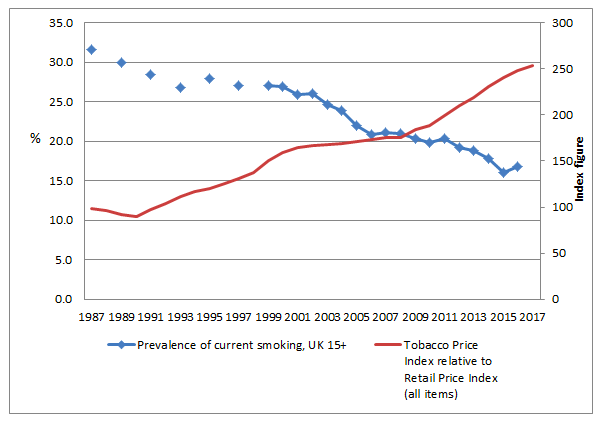
“The estimated total market in … Australia decreased, notably due to the impact of increased tobacco tax and retail prices:

  • Australia, down by 11.7%, primarily reflecting the impact of excise tax-driven retail price increases in 2017 and in the first quarter of 2018; [my emphasis]”

Kosterich told a conference in Poland recently that “It is in some respects a game that we are playing … we are not actually playing a scientific game. If it was about the science, there’d be no debate. There would be no debate. But there is a debate because it’s not about the science. It is an ideological warfare and particularly in Australia.”

The NASEM report reached 46 conclusions about the available evidence on e-cigarette safety, effectiveness and uptake. In 29 of these 46 conclusions (63%), NASEM labelled this evidence moderate, limited, insufficient or non-existent. This is not remotely a situation where there is “no debate” about the science, as Kosterich asserted to his audience.

Finally, his statement “there was one case where an e-cig exploded” sits awkwardly with data reviewed by the US Fire Administration which found 195 cases between 2009-2016. They noted  “The combination of an electronic cigarette and a lithium-ion battery is a new and unique hazard. There is no analogy among consumer products to the risk of a severe, acute injury presented by an e-cigarette” . For those not squeamish, here is a showreel of some e-cigarette explosion incidents.

We all know that genies are hard to put back in their bottles. If they are good, benevolent genies, they can be a force for good, but if they turn out to be evil genies, letting them out can be disastrous. That happened with cigarettes. We need to learn from past mistakes and take a precautionary response with e-cigarettes, as all Australian governments are doing.