• Home
  • About/CV
  • Blog
  • Vaping Research Alerts
  • Blog archive list
  • My books
  • Memoirs
  • Music, bands, films
  • Contact

Simon Chapman AO

~ Public health, memoirs, music

Simon Chapman AO

Monthly Archives: September 2018

An unforgettable dinner in Istanbul

20 Thursday Sep 2018

Posted by Simon Chapman AO in Blog

≈ Leave a comment

Istanbul has wonderful nightlife, although Erdogan’s agenda may soon end much of that. I’ve been there four times and been showered with famous Turkish hospitality. My oldest and best friend there is a senior professor who, last time I was there in 2014, was running a conference at which I was speaking. There was always going to be a great dinner sometime that week. But this one would be unforgettable.

She invited her best friends at the conference to a restaurant about 400 metres from the conference centre in the Taksim district. It was in a quite narrow, newish high rise building of about 10 floors, cheek-by-jowl between other similar anodyne structures. We caught the lift from street level up several floors. There were ten of us: several locals, a French woman, me and my wife Trish, and others I can’t remember. There were three men among the ten. I landed at a part of the table with great conversationalists.

There was feverish talk about the mess Turkey was in. All the Turks at the table were incendiary about the creeping erosion of the secular state under Erodgan. Angry accounts were given about daughters having to wear headscarfs for university entrance interviews or be instantly rejected. About jailed journalists and academics and the small-mindedness of those in power. The women were feisty feminists with commanding jobs in a male dominated culture. They all drank alcohol and bossed the waiters around.

About an hour into the meal, the restaurant was full and people were loose and enjoying themselves. The two women opposite me suddenly said emphatically “Oh. My. God.” They were staring past our side of the table and looking through the restaurant windows into the building next door.

There, not five metres away, was a room with the lights on. A gossamer thin white curtain had been drawn, but with the lights on inside, we could see everything in the room. The curtain presumably prevented them from looking out clearly. A very overweight middle aged naked man and a considerably younger, large breasted and full-bodied woman, also naked, had entered the room, perhaps from the bathroom. They set about their tasks. The quick consensus was that she was a prostitute he had called out to his hotel. If we were wrong about this, the man was punching well above his weight if this was his wife or girlfriend.

Our table had the box seat for the spectacle, but there was no hiding what they were up to from almost every vantage point in our restaurant. Very quickly those on other tables got up, brought their drinks with them and crowded round behind our table to get the next best view. Young couples, small dinner groups, a few elderly couples and the staff all joined the throng.

Every new phase of the performance drew gales of laughter. When she took him in her mouth, some cheered and roared. “It’s a wonder she can locate it under all the fat!” “Ah, the first course is now being taken”. When the missionary position changed to rear entry and we saw the man’s thin little bottom gamely pounding away below his considerable back, there were lots of eewws and “oh my gods!” and goodness knows what else being said in Turkish.

This was the first time I had ever watched live sex in a room full of mostly strangers. Or actually, in any context.

I had these thoughts.

First, I’m confident that, presented with a questionnaire on what we would do in such a hypothetical context, nearly everyone in our group would have not hesitated to affirm that, of course, they would have asked for the restaurant curtain to be drawn, or dispatched a waiter into the next building to tell the occupants to please turn off their lights. But presented as we were with the opportunity to watch proceedings – unknown to the performers – no one could look away. The asymmetry of consent between the watching and the watched just flipped the ethical compass for everyone. “They don’t know they’re being watched. We don’t know who they are. We’ll never see them again, What’s the harm?” would have run the rationalisations.

Far more than that, everyone just roared at the spectacle. Far from there being any awkwardness, everyone instantly decided this was spectacular luck we’d chanced on. No one seemed to spend a nanosecond surreptitiously checking non-verbally with others how they should behave. It was uncontrollable, communal, bawdy unity that had been instantly let off its leash.

I wondered too about whether the reaction of the room would have been any different had the performers in our hotel window theatre looked very different. What if we had decided that they were two young honeymooners, with the bridal gown draped over a chair? Or a sweet, long-married couple from the Turkish countryside, in town for a short holiday having saved up for months? Or elderly tourists, lovingly pleasuring each other in the privacy of a hotel room during a holiday? What if the man had been lithe, muscular and handsome instead of fat and out of shape? What if their ages had been similar? Would any of this have changed our response?

It struck me that the essence of the hilarity went something like this: hiring a prostitute is a private and generally clandestine, knowingly shame worthy activity, nearly always done by men with the power to hire women to do something that many people routinely experience as a mutually exchanged gift from someone with love and affection for them. It’s something the man would have probably been hugely embarrassed about, had he known of the audience. Embarrassed about his cover being blown and about his less than film-star like body. So the laughter here was about the combination of the shattering of the man’s hopes to keep his private vices private and the sort of mirth occasionally experienced when we experience or see the wind or a wardrobe malfunction expose body parts in an everyday situation.

His innocent misjudgement about the lighting had transformed him from a man with the power and means to buy sex to an unwitting public cuckold, providing entertainment to a roomful of diners.

Most of our only experiences of watching others having sex is via filmed pornography, occasionally almost unavoidable to anyone using a computer. There, unless the acts are filmed and uploaded without the consent of those involved, the performances are consumed as inauthentic and clearly commercial: they are doing-it-for-money, or purposefully, consensually exhibitionist, in the case of amateur uploaded porn. But here we witnessed a couple in action who were quite unaware that their private, transacted intimacy in fact had an audience.

So public virtues, as might be expressed in a serious-minded conversation about respect for privacy, the ethics of the right thing to do in everyday life or of the case for prostitution took a running jump against the power of private vices – here, the temptation of force-fed voyeurism, of a box-seat on what goes behind closed doors.

I’ve told the story dozens of times, and have even had friends say “I hear that you had an amazing dinner in Istanbul once”, wanting to hear the details for themselves. It seems there’s a little voyeur in most of us.

The dinner group

25 of 12,000 Geological Society fellows challenge climate change science consensus

05 Wednesday Sep 2018

Posted by Simon Chapman AO in Blog

≈ 2 Comments

At a recent dinner, a senior scientific colleague unexpectedly bristled at a comment about anthropogenic global warming, commenting that the world had often seen similar changes to those now being experienced. Four of us in earshot pushed back with attempted jets of cold water, with one saying aghast “you’re sounding like Tony Abbott”.

We all quickly agreed that none of us were expert in all the relevant areas of knowledge and understanding. But this is of course a position that everyone  finds themselves  in daily in regard to any claim in which they are not trained.

So what we all tend to do is to fall in with rule-of-thumb heuristics or cognitive biases that help us make sense of the world. Perhaps the most ubiquitous is confirmation bias  where we seek out, retain and advance facts and assessments  which support our current beliefs.

Screen Shot 2018-09-05 at 6.23.33 am

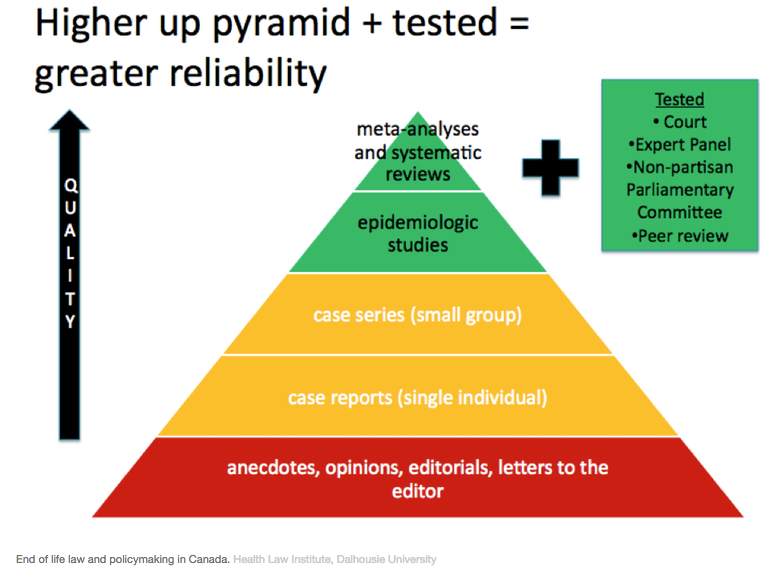
Anyone with even some elementary scientific background agrees too, that in the evidence pyramid of weakest to strong, the plural of anecdote and opinion does not equal evidence. But when that plurality of opinion manifests as expert consensus, its value is elevated as we see below: here it is reasonable and important to ask how experts across relevant fields view evidence.

Evidence pyramid

Our AGW sceptic that night was convinced he held the knockout punch and the next day sent us a June 2018 swingeing  open letter signed by 25 current Geological Society of London AGW skeptical fellows out of some 12,000, plus another 8 former fellows (with no denominator available to allow a calculation of the proportion). Twenty five of 12,000 is a tiny proportion, heading toward homeopathic territory: 1 in every 480 fellows of the Society. The open letter also referenced a  2010 Royal Society letter of complaint about the RS’s “unscientific” public statements on global AGW. That letter was signed by 43 Royal Society fellows (out of 1600 – 2.7%).

Those derisory proportions don’t say to me that AGW skepticism has much traction in those two most august of scientific communities. Clearly those collecting the signatures would have made efforts to build their lists, yet these small numbers are all they came up with.

In 2015, 76 Nobel Prize winners from across scientific disciplines signed or later fully supported the Mainau Declaration on climate change, which emphasised AGW. The potential Nobel Prize signatory denominator is a much smaller pool, given that the prizes tend to be awarded later in life  and that there are only three categories of scientific prize (physics, chemistry, and physiology or medicine) awarded annually.

Without any apparent self-satire,  the  Geological Society signatories stated “As this letter makes clear [my emphasis] it is not true that 97% of scientists unreservedly accept that AGW theory is fixed, or that carbon and CO2 are ‘pollutants’ and their production should be penalised.” The authors also asked “how can the primary nutrient in photosynthesis be a pollutant?”  It beggars belief that they could write this when clearly the argument is about the impact of massive rises in CO2, not CO2 itself. Paracelsus’ “the dose makes the poison” is such an elementary principle in toxicology, and it applies to so many exposures and agents.

It’s obviously very far from clear that the arguments of just 35/12,000 geologists destroy the claim that the overwhelming proportion (97%) of climate scientists (working across  many disciplines) accept AGW.

The 97% figure dates from a study published in 2013 of 11,944 abstracts from the peer-reviewed scientific literature on climate change from 1991–2011. The authors wrote:

“We find that 66.4% of abstracts expressed no position on AGW, 32.6% endorsed AGW, 0.7% rejected AGW and 0.3% were uncertain about the cause of global warming. Among abstracts expressing a position on AGW, 97.1% endorsed the consensus position that humans are causing global warming. In a second phase of this study, we invited authors to rate their own papers. Compared to abstract ratings, a smaller percentage of self-rated papers expressed no position on AGW (35.5%). Among self-rated papers expressing a position on AGW, 97.2% endorsed the consensus. For both abstract ratings and authors’ self-ratings, the percentage of endorsements among papers expressing a position on AGW marginally increased over time. Our analysis indicates that the number of papers rejecting the consensus on AGW is a vanishingly small proportion of the published research.”

Since then there have been two further studies that strongly suggest this ballpark is accurate. One (Verheggen et al, 2014) found 90% of those scientists surveyed who had  more than 10 peer-reviewed papers related to climate science agreed with AGW. Another (Powell 2013) looked at 13,950  papers on  global warming and climate change between 1991 and 2012 and found only 24 rejected AGW.

The coalescence of these research findings and expert views is very compelling.

In the fields in which I’ve worked, I’ve seen many examples of attempts by highly motivated, often credentialed people to wreck consensus using Galilean/Copernican metaphors about their brave, truthful voices standing up against the orthodoxy. These include scientists espousing global epidemics of “electrosensitivity” and WiFi & EMR dangers, and anti-vax and  anti-fluoridation drum-bangers.

When these observations are made, we often then hear conspiracy theories  being invoked (“peer reviewers are too threatened by criticism/invested in their own conclusions” etc).

Very few non-specialists are fully equipped to engage in to and fro discussions about arcane oceanography, geophysics, earth sciences etc. What I do is to look to agencies with processes that inspire confidence in scientific integrity and which are transparent about important issues like any competing interests.

I am a strong supporter of renewable energy. We have solar cells all over our roof. Our next car will be electric. I wrote a book on the nonsense of “wind turbine syndrome”.  The arguments for moving rapidly toward  minimally polluting, renewable forms of energy that are producing huge numbers of jobs are self-evident to me. There seem to me to be no serious downsides in harvesting solar, wind, geothermal, hydro- and tidal energy compared to the very real externalities involved in polluting and resource-intensive forms of energy (fossil fuels, nuclear). A couple of weeks living on the east coast of China or Delhi as I have done is a big reality test about the utter folly of  continuing current fossil fuel burning.

Science is never complete, and debate is virtuous. But when debate stalls action, and the consequences of that are highly likely to be catastrophic, prolonging debate instead of acting is irresponsible.

Blog Stats

  • 163,470 hits

Top Posts & Pages

  • Why I’m not quitting Spotify because its owner has hugely invested in weaponry
  • Australia takes off the gloves on illegal tobacco while ‘lower the tax’ fantasists plumb new absurdities
  • About/CV
  • Vaping theology: 6 There’s nicotine in potatoes and tomatoes, so should we restrict or ban them too?
  • My books
  • Regrets … I’ve had a few. Paul Hogan and his Winfield role.
  • Thinking of keeping koi? Advice for beginners in NSW
  • Cheap illegal cigarettes save low income pack-a-day smokers over $9000 a year. So why don’t social justice champions give them full support?
  • Why Australia’s illegal tobacco and vape trade continues to flourish and what should be done about it
  • My first seen, best and worst bands 1964-2022

Blog archive

Comment Policy: No anonymous or pseudonymous posts will be published

Recent Posts

  • Australia takes off the gloves on illegal tobacco while ‘lower the tax’ fantasists plumb new absurdities
  • Egg on some faces: statisticians at 10 paces on the impact of New Zealand’s vape laws on youth smoking
  • Lowering tobacco tax to make illegal tobacco sales “disappear overnight”: at last we have a proposed figure and it’s an absolute doozie
  • Why I’m not quitting Spotify because its owner has hugely invested in weaponry
  • Should we believe Fiona Patten on vapes? Here are just a few problems

Recent Comments

Jon Krueger's avatarJon Krueger on Egg on some faces: statisticia…
Atul Kapur's avatarAtul Kapur on Should we believe Fiona Patten…
Unknown's avatarCould a national tob… on If expensive cigarettes are dr…
tahirturk1's avatartahirturk1 on Why Australia’s illegal tobacc…
malonere's avatarmalonere on Words I’ve seen, but didn’t kn…

Archives

  • December 2025
  • August 2025
  • July 2025
  • June 2025
  • May 2025
  • March 2025
  • January 2025
  • November 2024
  • October 2024
  • September 2024
  • July 2024
  • May 2024
  • April 2024
  • March 2024
  • February 2024
  • January 2024
  • December 2023
  • November 2023
  • October 2023
  • September 2023
  • August 2023
  • July 2023
  • June 2023
  • May 2023
  • March 2023
  • February 2023
  • January 2023
  • December 2022
  • November 2022
  • October 2022
  • August 2022
  • June 2022
  • April 2022
  • March 2022
  • February 2022
  • January 2022
  • December 2021
  • October 2021
  • September 2021
  • August 2021
  • June 2021
  • May 2021
  • April 2021
  • March 2021
  • February 2021
  • January 2021
  • December 2020
  • November 2020
  • October 2020
  • September 2020
  • August 2020
  • July 2020
  • June 2020
  • May 2020
  • April 2020
  • March 2020
  • February 2020
  • January 2020
  • December 2019
  • November 2019
  • October 2019
  • September 2019
  • August 2019
  • July 2019
  • June 2019
  • May 2019
  • April 2019
  • March 2019
  • February 2019
  • January 2019
  • December 2018
  • November 2018
  • October 2018
  • September 2018
  • August 2018

Categories

  • Blog

Meta

  • Create account
  • Log in
  • Entries feed
  • Comments feed
  • WordPress.com

Blog at WordPress.com.

  • Subscribe Subscribed
    • Simon Chapman AO
    • Join 198 other subscribers
    • Already have a WordPress.com account? Log in now.
    • Simon Chapman AO
    • Subscribe Subscribed
    • Sign up
    • Log in
    • Report this content
    • View site in Reader
    • Manage subscriptions
    • Collapse this bar
 

Loading Comments...