Smoking has long been banned in Australia on all public transport, in indoor workplaces including bars, clubs and restaurants, many stadiums and an increasing number of outdoor café dining and coffee areas do not allow smoking. The map below shows a tiny percentages of Australian homes allow smoking inside.
Proportion of non-smokers who report living in a household where: a smoker smokes inside the home; a smoker smokes outside the home; or there is no smoker in the household, 2019, by state/territory. Source
Some local governments have banned smoking in outdoor shopping malls. Smoke-free stadiums are now commonplace. I went to an open-air night time Paul Kelly concert 10 years ago at Taronga Park Zoo where stage announcements directed smokers to go to a section way up the back and away from the crowd. I took a look and it was empty.
In 2008, I co-authored a highly accessed and cited paper on markers of the denormalisation of smoking and the tobacco industry. In it we catalogued a wide range of ways that the identity of smokers has been spoiled from the days when smoking was considered convivial, sophisticated and dripping with the multitude of positive semiotic signification purposefully bestowed upon it by marketing, advertising and smart packaging. In 1992, the single most common feature sought by those advertising for housemates was being a non-smoker. In 2004, only 2% of people using Australia’s largest dating site declared they were smokers.
Denormalisation works ‘‘to change the broad social norms around using tobacco—to push tobacco use out of the charmed circle of normal, desirable practice to being an abnormal practice’’. When smoking loses its public and political charm, when most people don’t smoke, when 90% of remaining smokers regret ever having started and when parents who hope their kids will grow up to smoke are as rare as rocking horse shit, governments know they have a huge mandate to introduce policies that will drive it down, as has been happening since the 1970s.
Rise and fall of vaping?
Over the last few years, I’ve often heard people remark that they seldom see people smoking these days. In recent years vaping seemed to be something we saw much more often, mostly because of the ostentatious look-at-me clouding plumes and the frantic rapid hand-to-mouth frequency of puffing. But after October 1, 2024 when the Commonwealth government outlawed vaping sales from anywhere but pharmacies, vape prices skyrocketed and many small illegal retailers have likely been understandably fearful of the large fines. Many “recreational” vapers may have reduced or stopped smoking. I pass 22 tobacconists and “convenience stores” on my daily walk. Last week I saw not a single customer in any of them on four walks.
No airline allows vaping on board, and train stations make regular announcements warning about platform vaping being banned. Most Australian governments have banned the use of vapes in all areas where smoking is not allowed by law.
So the last bastions of public smoking and vaping today remain some open air spaces like streets, parks, beaches. But how often now do we even see smoking and vaping these days? Curious about this, for three consecutive mornings this week I set out to count how many people I saw smoking or vaping while I walked through two inner west suburbs.
On each of the three walks, I walked around 12,000 steps from around 7.45am -10am. I wanted to quantify a strong impression that we don’t often see people smoking or vaping in public these days.
In each hand I carried a thumb-click mechanical digital counter. One for people smoking or vaping and the other for people not doing so (see photo below).
My route took me through the hipsterville shop, restaurant and café high streets of Enmore and Newtown at a time when many were on their way to work, waiting at bus stops, entering Newtown railway precinct, having their morning coffee or like me, walking for exercise. Those with nicotine dependence can often be seen dosing before getting on trains and buses and lighting up immediately on alighting. So I spent 30 minutes counting commuters entering and leaving Newtown station, wanting to include what I predicted might be a visibly higher rate of smoking or vaping there.
It’s easy to see someone smoking. They are either actively drawing on a cigarette or holding one in their hand or lips. Vaping is similarly easy to spot, although if someone is hiding a vape in a closed hand or keeping it in a pocket between pulls, this would cause underestimates of its prevalence.
But I was not trying to estimate smoking or vaping prevalence. My objective was to try and count the prevalence of actual smoking and vaping in an outdoor setting in the way that an ordinary person might observe people around them as they moved normally on their passage through streets. I was not in any way trying to count smokers and vapers (so including those who might have vapes in their pockets), but rather active smoking and vaping. Where I came to a situation where a group of people were gathered such as at pedestrian crossing or a bus stop, I stopped too, to carefully check each person I could see. I did not count children in school uniform on the way to school, or infants with parents.
In total I saw 3529 people over the three days observations. Of these, just 38 (1.1%) were smoking. I saw just 3 (0.09%) people vaping. Only one was smoking at a table outside a café. Those smoking or vaping were so scarce that some small patterns could be discerned. With few exceptions, those smoking looked 70+. There were two spots on my route where I saw at least one smoker on each day. Some at those spots were also begging for change. Of the very few younger people (teens, 20s) who were smoking, nearly all had “attitude” (goths, punks). Several were south and east Asian men.
These data are only a street epidemiological snapshot of what was happening in two Sydney suburbs on three (sunny) mornings across two hours. But the daily percentages were very similar. My thumb clicking the “not smoking” counter risked giving me repetitive strain injury, while my thumb recording smoking and vaping nearly went to sleep. Smoking and vaping have not vanished from public sight, but they both look decidedly endangered.
I’m planning to gather the same data across different locations and at different times to see if there is a range.
It’s often said that the devil has all the best tunes. But when it comes to supporting and comforting those facing imminent death, those with religious faith have a huge walk-up start on us non-believing atheists in the trove of things that you can say to a dying person or their families afterwards.
This was first driven home to me when a close colleague in the US started up a blog to keep his many friends informed about the progress of his advanced cancer, which took his life about nine months after diagnosis. He was Jewish, but in the years I knew him I sensed he was not very observant. Every post he made on the blog attracted many responses letting him and his family know that people were praying for him, that God would surely show mercy and give him strength and so on.
These people were telling him they were going well beyond just being concerned about his progress, or that they held him in their thoughts; that they knew he was courageously “fighting” his disease, or was showing enormous character in writing the blog in the face of his illness. In praying they were somehow suggesting that this news would be received as helpful. The subtext was that their prayers might somehow turn the progress of the cancer around. They were offering hope against hope that their prayers would not only bring comfort but would work.
There are many who seriously believe that if they and others pray for a sick or dying person, that this will actually make a difference. They have faith that the power of prayer is real and consequential.
A Cochrane systematic review of trials of intercessory prayer’s impact on health outcomes completed in 2009 reported on:
“whether there is a difference in outcome for people who are prayed for by name whilst ill, or recovering from an illness or operation, and those who are not. Both groups of people still received their usual treatment for their illness. Ten trials were found which randomised a total of 7646 people. The majority of these compared prayer (for someone to become well) plus treatment as usual with treatment as usual without prayer. One trial had two prayer groups, comparing participants who knew they were being prayed for with those who did not. Another trial prayed retroactively, randomising people a month to 6 years after they were admitted to hospital. Each trial had people with different illnesses. These included leukaemia, heart problems, blood infection, alcohol abuse and psychological or rheumatic disease. In one trial people were judged to be at high or low risk of death and placed in relevant groups.
Overall, there was no significant difference in recovery from illness or death between those prayed for and those not prayed for. In the trials that measured post-operative or other complications, indeterminate and bad outcomes, or readmission to hospital, no significant differences between groups were also found. Specific complications (cardiac arrest, major surgery before discharge, need for a monitoring catheter in the heart) were significantly more likely to occur among those in the group not receiving prayer. Finally, when comparing those who knew about being prayed for with those who did not, there were fewer post-operative complications in those who had no knowledge of being prayed for.
The authors conclude that due to various limitations in the trials included in this review (such as unclear randomising procedures and the reporting of many different outcomes and illnesses) it is only possible to state that intercessory prayer is neither significantly beneficial nor harmful for those who are sick. Further studies which are better designed and reported would be necessary to draw firmer conclusions.”
So what can those of us who cannot with any sincerity say that we are praying for a dying person or believe in any sort of afterlife say that might be welcome and comforting to the dying and their loved ones? When I’ve had occasion to write or speak to a friend who is dying, I’m terribly conscious that they might be clinging to even thin threads of hope that they will miraculously survive. So the last thing I’d want to do at such a moment is to callously assume the dying friend should, however rationally, abandon hope.
On the night my own mother died, her last words to me and my father gasped through her feverish hypoxia from cancer in her lungs, was that she would tell her GP the next day that she wanted to take a final chance with a new drug trial. To pull that last hope from her would have been unspeakable. (see p69 here)
The imminence of a person’s death makes me always think about what I imagine they might like to hear from those who are important to them. When they are gone, we do this in absentia at memorial services and wakes which can be very emotional and cleansing. I always think, gee, wouldn’t it have been lovely for them to have attended their own memorial and heard people say all these heartfelt things when they were alive.
What I wrote to a friend
On June 28 this year, we lost a beautiful friend, Euan Tovey, to pancreatic cancer. Late in 2023 when it seemed likely that he might not even make Christmas, his family contacted his best friends and asked them to make a contribution to a book they would assemble before he died. I thought this was a brilliant idea where all those important to him would tell him what he had meant to them. He lived to read the book.
We had spoken at length in his months after diagnosis about his prognosis. He knew he would die, but wanted to live as comfortably as possible for as long as he could. We discussed voluntary assisted dying. He too was an athiest, so our conversations were devoid of all you would expect.
I wrote the following for the book to underline the boundless affection I felt for him across our friendship.
Euan, my dear friend
I knew of you before I met you. My best recollection of how we finally met was that we both quite often seemed to be in need of coffee around the same time. So it was one day in Ralph’s café at the university that you introduced yourself as we waited.
You must have known of me too and seemed as curious as I was delighted. We get instant impressions of some people, while others need to percolate across many encounters before any sense of who they are begins to form.
You are one of the instant category. If a Martian asked me to explain what a “transparent person” means, I would walk them around to your place, knock on the door and introduce you. You are so much of an open book, and it’s that which I think is both the foundation and the glue that has bound us these past years, opening up all the enchanting things that I’ve found in you.
Please spare me from stitched up people for even a moment longer than circumstances sometimes necessitate. But your voice on the phone or the thought of a night out with you and Lib has always put a big smile on my face.
Your candour, friendliness, sparkle and warmth were there right from the start. I knew pretty much immediately that I liked you. You would be someone who if we passed on campus or in the street, I’d always want to stop for a chat.
Those brief encounters at Ralph’s cafe went on for a few years before we began seeing each other in the way we do now. When I retired in 2016, I sensed that your proximity a few streets away would foment us seeing each other more and more.
It didn’t harm things that Trish was all a-tremble with excitement at getting to know your very famous wife. But you quickly became the icing on that wonderful cake for her. As gigs followed dinners, we seemed to enter your inner circle of special friends, being invited to your end-of-year drinks and even deeper into the rituals of your family on-line quiz during COVID. We were very touched and delighted by all this.
You rapidly became a couple we wanted to share around too. I recall directing you to Martyn and Mim’s house at Rous Mill in the hinterland of Lismore. Martyn called me right after you left and said “wow, what beautiful people those two are.”
The Friday walkers reacted the same way. Everyone felt you both were such a perfect part of the group. Everyone was so pleased Lib could come to the dinner on Saturday. You were very missed.
Trish quickly added you to her very short but highly esteemed list of ”real men” who can make and fix stuff. “Why can’t you be more like Euan, Simon? He’d know how to fix this.”, she’d regularly say or imply, with her withering accuracy.
When I had COVID in December last year, you thoughtfully dropped off an air purifier you had knocked up with a few sheets of plywood, some industrial strength rubber bands and god knows what other gadgetry inside. We marvelled at your home recording studio, your mask prototypes and of course your retro-fitted round Australia HiAce shaggin’ wagon.
Here, we also noted more than once, your allusions to your private ribaldry. “That pair!” we’d say with huge affection.
It wasn’t all good. I confess to being very disappointed that your Kiwi accent is barely noticeable. I am a bit of a chameleon with accents, quickly adopting the accents I’m in conversation with. The south island Un Zud accent is particularly infectious.
I am also very envious of your luxurious mane and your bold shirts.
But what I will miss about you more than anything Euan, is that I know I will have lost what I unequivocally feel is a man who is one of my very closest friends. I have many female friends, but not so many males I feel very close to.
I’ve sometimes been asked by interviewers doing profile pieces “if you could change anything in your life until now, what would it be?” I often answer that I so regret not starting to watch AFL and my beloved Swans until about 20 years ago. I wasted 30 years watching the sporting equivalent of hillbilly music in following rugby league, when I could have been watching the balletic spectacle and poetry of AFL.
But I know with absolute certainty that I will from now often say that I lost all too early a very dear friend with whom I had a near-perfect rapport, tastes and love of conversation. He could even cook superbly. We only knew one another well for about 10 years. I will miss you deeply, my dear friend. I so wish we had met 20 years ago. I feel cheated.
Trish and I hope you will take lots of comfort from knowing that we will fold Lib closely into our lives after you are gone. We have loved our growing friendship and count you both among our dearest friends.
I came home yesterday from tennis to find Trish sitting on the lounge sorting through her recordings of her singing lots of songs with her uke. The one that was playing as I entered the room was Aretha Franklin’s I say a little prayer. Listen to it here.
We both have no time for religious malarky, so you know I have not been beside the bed praying for you. But the religious imagine they have a direct line to the fixer man, and so are doing something actively virtuous.
We’ve been saying our little secular prayers for you, so Trish’s song seemed apposite (of course, extend the sentiments in the words wider than it being a romantic love song).
I’ll end with the (English) words to a Herman Hesse poem, Bein Schlafengehen, that Richard Strauss set to music in his incomparable Last Four Songs. This Elizabeth Schwartzkopf version is the best.
We played it at my mum’s funeral. The words and music always bring me to tears of sadness and joy at my many memories.
Going To Sleep
Now the day has wearied me.
And my ardent longing shall
the stormy night in friendship
enfold me like a tired child
Hands, leave all work;
brow, forget all thought.
Now all my senses
long to sink themselves in slumber.
And the spirit unguarded
longs to soar on free wings
so that, in the magic circle of night,
it may live deeply, and a thousandfold.
Hermann Hesse (from Richard Strauss’ Last four Songs)
Throughout my life, there are places and cities that have hypnotized me with the mere sound of their names, their history and promise. I’ve been to a few: Bali, Paris, Salamanca, Granada, Barcelona, Paris, Iceland, Khartoum, Herat, Kandahar and Kabul, Istanbul, Urbino, Naples, Luang Prabang, Hanoi and Lijiang, Yunnan are some.
There are many I’ve not managed to yet visit: Senegal, the Congo, Mali, Trinidad, St Petersburg, Zanzibar, Samarkand, Kyoto and Mexico City.
Then there is Fes in the north east of Morocco. When I first heard the name as a boy, I went straight to the encylopaedia and drank in the information. Imagine a city named after a hat, or was it that the hat was named after the city?
We were having a holiday in Italy and needed to go to Barcelona where I’d been invited to give a lecture. So let’s fly from Rome to Fes, take the train to Marrakech and then fly up to Barcelona! It was all about to happen.
Our flight went via Casablanca. Mid flight Trish read in the guide book that hotels were known to refuse couples with different surnames a shared room. Oh dear, that was us. We composed a text to the kids back home, describing where they could find our marriage certificate. Send us a photo please. We sent it from the transit lounge at Casablanca and received the photo as we disembarked at Fes about an hour later. The reception desk guy at the beautiful, secluded riad where we had booked a room just within the walls of Fes’s old town (the medina), could not have cared less, so we kept the marriage certificate photo to ourselves.
We arrived in Fes after dark on November 12, 2004, the day after Yasser Arafat had died. It was also about a week after the revelations of widespread torture by allied troops in Abu Grahib prison in Iraq had rocked the world. And it was the day before the end of the Islamic holy month of Ramadan. And amid all this, here we were: two infidels in Fes, one of the more conservative cities in Morocco. We sensed that this confluence was not exactly propitious for our time in the city.
The next morning after breakfast in the marble courtyard of the ancient riad, we walked the 300m to the huge gates leading into the ancient labyrinthine souk. We passed coffee shops filled with men talking and playing cards and dominoes. There were no women in these. None. As we approached the gate about 15 young boys aged about 12 to 16 surrounded us, all trying to get our custom as guides around the vast souk.
We’d both been in many tourist places where you are pestered continuously by shopkeepers, massage services, cafes, guides and taxi drivers. You refine strategies for declining and then are generally little bothered by their efforts. But Fes was like nothing we’d ever experienced, till then or since. The boys were absolutely insistent that we select one of them as a guide. This looked like a recipe for interminable visits to their many ”uncles’” shops for tawdry souvenirs with zero appeal and massively inflated prices for gormless tourists.
So we held our ground, slowly moving in the centre of this swarm of touts, who rapidly became more than insistent: they began firmly grabbing us both by the arms and clothing, as we clutched our day bags for dear life fearing an imminent robbery. We soon turned and strode back toward our hotel. Trish was quite shaken demanding that we get out of there.
Back at the hotel almost as soon as we’d left, the concierge calmly tried to have us see that what we had experienced would instantly disappear if we simply chose a guide. The others would melt away and there would be no further harassment. We were not going to spend days in Fes without exploring its fabled souk, so we relented. I went straight up to a boy who exuded street smarts and toughness. The concierge had told us to pay no more than $25 for half a day in the vast market. Our guy agreed immediately.
We set off and just inside the gates of the souk, he led us into what looked like an abandoned old building of four or so stories (see photo). There was no one to be seen in or outside it. We crossed the dilapidated courtyard with a waterless fountain, following him as he headed to an internal staircase. Two flights up and not seeing daylight above, things started quickly feeling ominous. We’d seen no one since entering the building. What a perfect place for a hand over of your bags in a money ambush by his pals we’d yet to meet. Maybe worse, given the week’s events I described.
Abandoned house we were drawn into in Fes
We stopped going up the stairs and he came back down a flight for us. “What are we doing here?” I asked. “Beautiful view” he pointed above us. We sheepishly continued expecting any second to be surrounded by a bunch of brigands. But we emerged from the stairs on to the roof, to see an astonishing panoramic view of the roof of the souk, the old town and much of the new, more modern city in the distance.
He was starting our tour with a jaw-dropper, and one that we sensed would be nowhere to be found in guidebooks or brochures for tourists. We immediately relaxed.
The souk seemed unending, with endless rug, pottery, leather, pouffes, dates, butchers, basketry, spice, lamps, locks and hardware, clothing, body oils, barbers and cafes. We sampled plump, succulent dates of various colours and saw several severed camel heads swinging on steel hooks in butchers. It was permeated with cooking smells and the stench from open air leather curing ponds. We were unavoidably steered into rug shops by the most polished salesmen I have ever encountered. They seemed to read our tastes by our gaze on particular rugs and our cost pinch points. We left with two which we later regretted and sold on eBay.
The Blue GateCamel head with banana, FesTrish with teacher & class in madrassa, Festhe fragrant smelling tannery, Fes
More than one shop keeper, seeing my hairy forearms, gripped me and looking at Trish knowingly declared I must be a virile “Berber man”. The greeting has secured its place in our house in the years since.
A chameleon on the Berberman’s arm
One evening we shared a table in our riad with an American couple. They invited us to share the cost of a day trip in an ancient large Mercedes to the small city of Meknes and the nearby ruins of Volubilis, inhabited for 600 years from 300BC till 300AD. Ruins are mostly low on my travel priorities, but the many extensive Roman mozaics were quite wonderful. Do not miss them if you’re ever out that way.
Volubilis
The next day we boarded the train bound for Marrakech. It would take us through Meknes, Rabat and Casablanca and was amazingly cheap.
An enduring memory was that across almost the entire trip, it seemed obvious that local people used the area on either side of the rail tracks as a place to dump their rubbish. It was an 8 hour almost continual ride through a narrow dump, but averting your eyes upward was often a treat.
I texted dozens of friends “Do you know we’re riding on the Marrakech express?” with a link to the Crosby, Stills and Nash classic.
We shared our small compartment with two elderly men, who wore garments that suggested they were Muslim clerics. The two of them almost constantly fingered prayer beads across the whole trip, talked very little to each other and avoided eye contact with us.
At Casablanca, a young woman probably in her early 20s joined our cabin. I saw her struggle to lift her suitcase into the luggage rack and immediately helped her up with it. As she hoisted it up, her shirt rode up revealing her stomach and back. The clerics did not avert their gaze. She spoke English well so chatted with us as well as in Arabic with the clerics, listening to music through her ear pieces and reading western fashion magazines. Here was a small microcosm of the old and new of Moroccan society, seemingly mutually tolerant.
We stayed in a small riad in a laneway just off Marrakech’s main Jemaa el Fnaa square and market. Across only two days we skimmed the surface of what was a fabled, exotic city from our childhood reading. A few photos give some glimpses. A vivid, unforgettable trip.
[extra material added 17 Oct 2024 — see Dai et al below]
By any measure, Ken Warner, Avedis Donabedian Distinguished University Professor Emeritus of Public Health at the University of Michigan, is one of the giants in the history of tobacco control. I have known Ken since the early 1990s, after he editorialised one of my earliest papers. We were both 2003 recipients of the American Cancer Society’s global Luther Terry Medal and have had decades of mutual respect.
He has written a glowing endorsement for one of my books and references for promotions and awards. When I retired from the University of Sydney in 2015, my head of school invited me to select a global figure who could be the main speaker at my festschrift. I didn’t hesitate to name Ken, who gave this lecture after which we spent a few great days on the NSW north coast.
Ken Warner 21 May 2015, Sydney University
At that time Ken was showing early enthusiasm for the promise of e-cigarettes as a major new weapon in reducing smoking and the diseases it causes. I was far more circumspect, having provided one side of a debate in the BMJ in 2013 and a crystal-balling piece on the promises and threats in 2014.
In the years since, I’ve seen him rapidly firm in his positive views about the public health importance of vaping, In 2018, an internal document from the vapes manufacturer Juul Labs included Ken’s name on a list of ratings of 18 “collaborators” ranking him 7 out of a maximum 10 and noting that he was “positive on all scenarios” about vaping. I was listed as one of 10 “current opponents”.
We have rarely exchanged views on the issues in the nine years since his trip to Sydney, although I have received comments from friends of him eye-rolling when my name has come up. He’s a true believer in vaping, while I’m a sceptical apostate in circles he frequents.
Warner has just published a piece in the American Journal of Public Health titled Kids are no longer smoking cigarettes: why aren’t we celebrating. It’s generally excellent, celebrating the near-to-zero high school smoking rates in the US, and principally attributing the declines to the unabating massive cultural denormalisation of smoking (“The principal answer is a major change in social norms”) This was set in motion by the application of evidence-based policies about what would drive youth smoking down across whole populations. He’s incredulous – as am I – that not more prominence and celebration has been made of youth smoking all but having disappeared.
He declares, and I again agree, that “By any measure, youth smoking has nearly ceased to exist.” The nearing extinction of youth smoking has confirmed tobacco control as the poster-child of chronic disease control. The achievement is precious silverware that has been hard fought for and needs vigilance against both predators and complacency to ensure that it will never rise again.
Warner wonders whether the tobacco industry “may be giving up their age-old pursuit of ‘replacement smokers’”, its coded euphemism for recruiting new teenage smokers. Is there anyone who believes that they would find these developments a bitter, force-fed pill that they would dearly love to reverse?
Here are the US data on 8-12th graders’ 30 day smoking.
We have a very similar situation in Australia (see chart below), with smoking in the last week falling between 1999 and 2022-23, the latest data year available. The US has seen senior high school prevalence drop like a stone from 36.5% in 1997 to 1.9% in 2023. Australia has seen the same age group’s weekly smoking rate fall from 30% in 1999 to 3% in 2022-23 (monthly smoking is 3.4% (12-15y) and 5.2% (16-17y). The US is thus a little ahead of Australia with teenage smoking, with both nations seeing smoking spiralling toward tiny proportions.
However, there are several points in Warner’s paper which require comment when it comes to some of his assertions about vaping.
Warner’s presentation of the US data frames teenage vaping as predominantly a phenomenon of kids who smoke also vaping. He writes that:
“In 2022, 9% of never-smoking high school students had vaped in the past 30 days, 3% frequently (≥ 20 days). In contrast, 54% of ever-smoking students had vaped in the past 30 days, 34% frequently. Still, that 3% of never-smoking students vape frequently is a legitimate source of concern.”
Here, highlighting the much larger proportions of smokers who vape gives the impression that it’s overwhelmingly school students who have smoked who dominate teenage vaping in the US, with those who’ve never smoked, being comparatively less likely to be vaping.
But looking at the numbers behind these proportionspaints a very different picture.
With never-smoking youth being (by far) in the majority, even small vaping participation rates among them could translate to greater numbers of vapers than among the much smaller proportions of youth who smoke. So here’s how the numbers fall.
The table below constructed from the dataset here by colleague Sam Egger shows that of 15884 students, 1265 vaped in the past 30 days who had never smoked, compared to 931 who had ever smoked. In other words, in terms of sheer numbers, the problem of vaping is worse for the never-smoker group compared to ever-smoker group. So if you saw random student vaping in the US, there would be a 58% (=1265/(1265+931)) probability that this vaper would be someone who had never smoked compared to a 42% probability that it would be someone who had ever smoked.
When it comes to more frequent vaping, this situation is reversed with 58% of those who vaped on ≥20 of past 30 days being ever-smokers (=583/(583+425)) compared with 42% who were never-smokers.
This way of looking at it presents the situation in quite a different light. Focusing on column percentages in the table below frames the situation as very much it being a case of smokers doing the vaping. But focussing on row numbers demonstrates that vaping is very much a more comparable phenomenon between ever- and never-smokers when it comes to actual numbers of youth who are vaping.
In Australia (see Figure 16), more than two-thirds (69%) of 12-17yo school children who vaped “reported having never smoked a tobacco cigarette before their first vape. One in five (20%) students who had never smoked prior to trying an e-cigarette reported subsequent smoking of tobacco cigarettes (i.e., at least a few puffs).”
Vaping by US high school students, 2022 in National Youth Tobacco Survey
Never-smoke
Ever-smoke
(n=14164)
(n=1720)
Vaped in past 30 days
No
12899 (91.1%)
789 (45.9%)
Yes
1265 (8.9%)
931 (54.1%)
Vaped on ≥20 of past 30 days
No
13739 (97.0%)
1137 (66.1%)
Yes
425 (3.0%)
583 (33.9%)
Frequencies are weighted by weights provided by NYTS to account for the complex survey design and to produce nationally representative estimates. Excludes n=234 with missing data on vape or smoke variables
Is vaping by kids all but benign?
Warner’s paper emphasises that vaping is far less dangerous than smoking, and that nicotine in itself in the doses obtained through smoking or vaping is likely to cause inconsequential health problems, apart from the non-trivial economic costs of nicotine dependence. I have several caveats about his summary.
There is no shortage of evidence that vapes deliver often far less of key carcinogens and toxicants than do cigarettes. This evidence includes biomarker research showing that vapers have less of these nasties in their bodies. Warner summarises this as: “In fact, smokeless tobacco products sold in the United States create substantially less risk than does smoking”
But vapes and cigarettes are very different beasts: cigarettes are the Mt Everest of risk but vapes contain chemicals that cigarettes don’t contain, and the puff parameters for vaping are very different from those for smoking.
“the contention that nicotine can damage developing adolescent brains or harm health in other ways”.
Here Warner argues “Most research regarding brain effects is based on animal models but with potential relevance for humans.” Prominent vaping advocates have often ridiculed the relevancy of animal studies for humans, elevating this to meme status in true believers about vaping. But “potential relevance” is surely a huge understatement. Of the 114 Nobel Prize winners in medicine and physiology between 1901 and 2023, 101 (88.6%) used animals in their research. Now what would such eminent researchers know that vape advocates seek to dismiss?
Warner continues: “the lack of evidence of brain damage in previous generations of people who smoked mitigates this concern.”
This is quite a sweeping statement, unreferenced.
It’s been frequently noted that smokers are increasingly concentrated in less educated, economically disadvantaged sub-populations. Low education and low IQ are clearly correlated, so it’s unsurprising that cognitive concerns may be more prevalent in smokers. But there is also significant evidence that smoking may also be causative for cognitive and psychiatric problems.
This prospective cohort study examined the association between early to midlife smoking trajectories and midlife cognition in 3364 adults (1638 ever smokers and 1726 never smokers) using smoking measures every 2–5 years from baseline (age 18– 30 in 1985–1986) through year 25 (2010–2011). Five smoking trajectories emerged over 25 years: quitters (19%), and minimal stable (40%), moderate stable (20%), heavy stable (15%), and heavy declining smokers (5%). Heavy stable smokers showed poor cognition on all 3 measures compared to never smoking. Compared to never smoking, both heavy declining and moderate stable smokers exhibited slower processing speed, and heavy declining smokers additionally had poor executive function.
In this Finnish longitudinal cohort twin study data (n=4761) from four time points (for ages 12, 14, 17, and 19-27 years) “were used to estimate bivariate cross-lagged path models for substance use and educational achievement, adjusting for sex, parental covariates, and adolescent externalizing behaviour.”
Smoking at ages 12 and 14 “predicted lower educational achievement at later time points even after previous achievement and confounding factors were taken into account. Lower school achievement in adolescence predicted a higher likelihood of engaging in smoking behaviours … smoking both predicts and is predicted by lower achievement.”
In a cohort study of 11 729 children with a mean age of 9.9 years at year 1 Dai et al used structural magnetic resonance imaging measures of brain structure and region of interest analysis for the cortex, 116 children reported ever use of tobacco products. Here’s an edited version of the results and conclusions.
“Controlling for confounders, tobacco ever-users vs nonusers exhibited lower scores in the Picture Vocabulary Tests at wave 1 and 2-year follow-up. The crystalized cognition composite score was lower significantly lower among tobacco ever-users than nonusers both at wave 1 and 2-year follow-up. In structural magnetic resonance imaging, the whole-brain measures in cortical area and volume were significantly lower among tobacco users than nonusers. Further region of interest analysis revealed smaller cortical area and volume in multiple regions across frontal, parietal, and temporal lobes at both waves. In summary, initiating tobacco use in late childhood was associated with inferior cognitive performance and reduced brain structure with sustained effects at 2-year follow-up.”
Nicotine not a culprit?
Warner states that “nicotine per se is not the direct cause of the diseases associated with tobacco. Rather, it causes persistent use of the products that expose users to the actual toxins.” This proposes that nicotine is not a health problem, only a benign vector for health problems.
In 2019 I compiled this selection of research about concerns with nicotine published in notable journals including Nature Reviews Cancer, Lancet Psychiatry, American Journal of Psychiatry, Mol Cancer Res, Critical Reviews in Toxicology, Carcinogenesis, Mutation Research, Int J Cancer, Apoptosis and Biomedical Reports. These concerns are seldom mentioned by those who recite Michael Russell’s dictum that “People smoke for the nicotine but they die from the tar” as a talisman against any expressed concerns about nicotine.
I’ve also listed numerous recent reviews of the emerging evidence about vaping and precursors of respiratory and cardiovascular disease. This evidence hardly describes an assessment of vaping as a benign practice akin to inhaling steam in a shower or having a couple of cups of coffee a day, analogies I’ve heard used by vaping advocates.
Importantly too, there is no mention in Warner’s paper about two key ways in which vapes importantly differ from smoking.
A: Flavouring chemicals in vapes
Flavours are a leading factor that attract and keep people vaping: the beguiling cheese in the nicotine addiction mousetrap. But as has often been pointed out, none of the many thousands of flavours available in vapes have ever been assessed as safe for inhalation. Many of the chemical flavouring compounds in vapes have GRAS (Generally Regarded As Safe) ratings as food and beverage additives for ingestion. But it is elementary in toxicology that different routes of consumption (skin, inhalation, ingestion, rectal insertion) have different risk profiles.
Tellingly, no flavoured inhaled asthma or COPD medicines (used by hundreds of millions globally) have ever been approved by therapeutics regulators anywhere in the world, yet vaping advocates typically shrug dismissively about possible risks in the intensive inhalation of flavours in vapes.
Dow Chemical, a major manufacture of propylene glycol (the most common excipient in vape liquid) in 2019 explicitly named PG in vaping devices and accessories as a “non-supported application”. With the vast earnings potential for Dow in embracing PG in vapes, clearly the risk exposure to the company in doing so must have been assessed as massive.
Warner cites several examples of the public and health professionals holding clearly incorrect views about particular dangers of vaping, as if the jury is already in on the net effects of harm into the future – the whole point with chronic disease control. Yet he sensibly agrees that it is too early to know if there will be any long-term health problems that might arise from vaping. The median age for diagnosis of asbestos-caused mesothelioma is between 75-79. For lung cancer, it’s 71. If putative health problems from vaping have similar latency periods from first exposure to diagnosis, we may have a long wait before this issue is settled.
B: Inhalation frequency
The average daily smoker in Australia in 2022-23 smoked 15.9 cigarettes day and a typical puff frequency per cigarette in leisurely situations is 8.7, giving 138 puffs per day. Observational studies of vapers show that average daily puff frequency on vapes is likely to be north of 550 times. In one study (2016), researchers observed vapers using their normal vaping equipment ad libitum for 90 minutes. The median number of puffs taken over 90 mins was 71 (i.e. 0.78 puffs per minute or 47.3 per hour). Another (from 2023) found those using pod vapes took an average of 71.9 puffs across 90 minutes, almost identical to the 2016 study number.
But of course vapers do not vape across only one continuous 90 minute period each day. No studies appear to have calculated average 24 hour vape puff counts. But if we (conservatively?) assume 8 hours of sleep and 4 waking hours of no vaping, then a person vaping for 12 hours a day at this 47.3 puffs per hour rate, would pull 568 puffs across a 12 hour day deep into their lungs, 207,462 times in a year and 2.075 million times across 10 years.
This compares to daily smokers taking 138 puffs a day, 50,405 times a year and 504,050 times in 10 years: 4.12 times less. Cigarettes and vapes are very different products, but the almost frenzied puff frequency we see with daily vapers where each puff sees excipient chemicals like unapproved flavourants and PG pulled deep into the lungs throughout the day should raise red flags.
Australia’s approach to vaping regulation which I have strongly supported has landed at access by adults only via pharmacies, a ban on the importation of vaping products other than those destined for the pharmacy channel, and truly weapons-grade deterrent penalties for any person or corporation breaching these laws.
This has been the approach governments have long used to regulate access to methadone and other narcotics used in pain control, medicinal cannabis and every prescription pharmaceutical. Despite the demand for these products, no government is planning a free-for-all for these products in corner shops. It is very early days, with major busts of flagrant selling likely imminent. Australia has pioneered several tobacco control policies which have dominoed globally. I expect to see the same happen with our vaping regulations.
What is the #1 most common method used by those who successfully quit smoking that the US Centers for Disease Control refuses to name?
In July 2024, a brief report titled Methods US Adults Used to Stop Smoking, 2021–2022 was published on the research portal Medrxiv (pronounced Med Archive) a preprint site where authors publish research which has not yet been peer reviewed. This is typically a procedure designed to get researchers’ data and ideas out there in public much earlier than almost always occurs with the often glacial pace of having papers pass through peer reviewed to publication in journals. Publication often follows as authors move down the research journal food chain till one finally publishes it with a “peer reviewed” pedigree.
The Medrxiv report used “Nationally representative Centers for Disease Control and Prevention (CDC) survey data … to identify which subpopulations of US adults had stopped smoking cigarettes for 6 months or longer in the last year and the methods they used” for the years 2021-22” when the data showed 2.9 million Americans stopped smoking.
The authors reported that “Among those who stopped smoking for 6 months or longer, the most commonly reported methods used were nicotine products (53.9%, 1.5 million US adults), primarily e-cigarettes used alone or in combination with other methods (40.8%, 1.2 million US adults). The least commonly reported methods were non-nicotine, non-prescription drug methods (including a quit line, counseling or clinic, class, or group) (6.3%, 0.2 million US adults). Of the listed methods, the most commonly reported exclusive method selected was e-cigarettes; 26.0% (0.7 million US adults) of adults who stopped smoking from 2021 through 2022 for 6 months or longer selected e-cigarettes as their only listed method.”
So, of 2.9 million who quit, 1.5 million used nicotine products and 200,000 used non-nicotine or non-prescription methods. That leaves a mere 1.2 million (41%) unaccounted for who stopped smoking but were deemed not to have used CDC anointed “surveyed evidence-based methods to stop smoking. Methods containing nicotine, primarily e-cigarettes, were the most commonly-reported methods that were explicitly surveyed.”
A table in the report lists all the methods used by nation’s quitters in descending order. Triumphant in floodlights at the top of the league are those who exclusively used e-cigarettes (40.8%) while skulking right down the end of the list we find the desolate and cryptic “none of the above” with 42.5%, which the numerate among you might have noticed is higher than the quit proportion who exclusively used vapes.
So how on earth did the people who successfully quit smoking for six months or more possibly manage to quit when they weren’t sensible enough to use the “evidence-based methods” explicitly asked about and listed by the CDC and ignored by the report’s authors?
It’s possible that tiny proportions may have attributed their success to a wide range of weird and wonderful procedures not given as options to respondents by the CDC (a range of placebo complementary medicine and consumer cons like “laser therapy” and even prayer). But such options have never been shown to score more than an asterisk (designating homeopathically small numbers) in any study of quit methods I’ve ever seen.
The ignored elephant in the room of this “none of the above” massive army of successful quitters is unassisted, mostly cold turkey quitting: smokers who for a variety of motivations decide to finally stop smoking, and do so without using any pharmaceutical product or vape or being guided or supervised by specialist professionals or clinicians.
Before the availability of nicotine replacement therapy, prescribed drugs or vaping untold millions of smokers stopped permanently around the world. This was seldom documented or researched, but in the US way back in1979, the then director of the US Office on Smoking and Health noted in a National Institute of Drug Abuse Monograph “In the past 15 years, 30 million smokers have quit the habit, almost all of them on their own.”
The US National Center for Health Statistics routinely included a question on “cold turkey” cessation in its surveys between 1983 and 2000, but this option stopped being even asked in 2005. This was not because quitting unassisted had somehow become uncommon or irrelevant to the main ways that smokers quit. It was rather a revealing index of the success of efforts by those with vested interests in discrediting unassisted quitting. Let’s not even ask ex-smokers about it.
The commodification of smoking cessation
In his seminal 1975 paper, On the structural constraints to state intervention in health Marc Renaud wrote of the fundamental tendency of capitalism to “transform health needs into commodities … When the state intervenes to cope with some health-related problems, it is bound to act so as to further commodify health needs.” (Renaud 1975) The pharmaceutical industry creed is that wherever possible, problems coming before physicians need to be pathologized as biomedical problems that need to be treated with medication. This message is also megaphoned to the public.
My highly-cited 2010 PLoS Med paper The global research neglect of unassisted smoking cessation: causes and consequencesand my 2022 Sydney University Press open-access book,Quit Smoking Weapons of Mass Distractiondocument the on-going 45 year efforts by commercial interests (pharmaceuticals and today’s vaping industry) and professional helping professions to convince smokers wanting quit that they’d need their heads examined if they were foolish enough to try and quit unaided, ironically the very way that most ex-smokers stop.
My 2009 Lancet paper The inverse impact law of smoking cessation posited that “the volume of research and effort devoted to professionally and pharmacologically mediated cessation is in inverse proportion to that examining how most ex-smokers actually quit. Research on cessation is dominated by ever-finely tuned accounts of how smokers can be encouraged to do anything but go it alone when trying to quit—exactly opposite of how a very large majority of ex-smokers succeeded.”
The financial clout of the pharmaceutical, vaping and tobacco industries with their ability to spend billions on PR, across the decades and have legions of researchers “follow the money” continues to see the inverse law being heavily corroborated.
The CDC’s willing or unwitting collusion with these interests by continuing to cold-shoulder unassisted smoking cessation as being even unworthy of mention is truly appalling. An investigation into the politics of and influences on how this happened and continues would make compelling reading.
The continuing denigration of unassisted cessation as bizarrely not being “evidence-based” when there are oceans of evidence that quitting unaided has contributed more ex-smokers across the decades than all other methods combined is frankly Orwellian.
High 5s for Floe and Ray!
The two authors of the Medrxiv paper both have connections with the vape manufacturers Juul Labs Inc, First author Floe Foxon works for Pinney Associates a consultancy company servicing the nicotine industry. Foxon declared “F.F. provides consulting services through Pinney Associates on tobacco harm reduction on an exclusive basis to Juul Labs Inc, which had no involvement in this article.”
Most reassuring.
Ray Naiura declared that he “communicated with Juul Labs personnel, for which there was no compensation”. Internal documents from Juul show the company named Niaura in a 2018 list of “current allies” and rated him as one of five “collaborators” with a maximum rank of 10 out of 10 in the same year.
These backgrounds may explain why their paper gave zero emphasis to unassisted quitting, leaving readers to deduce its major impact from a row at the end of a table. With such a dogs balls obvious omission in the abstract, results and discussion sections of the paper it is hard to believe that such a report could ever pass peer review in a serious research journal. The “uninvolved” Juul would surely be just delighted with their research spin here.
Below are five papers on unassisted cessation by a research group I led 2013-2015.
Smith A, Chapman S, Dunlop S. What do we know about unassisted smoking cessation in Australia? A systematic review 2005–2012. Tobacco Control 2013
Smith A, Carter SM, Chapman S, Dunlop S, Freeman B. Why do smokers try to quit without medication or counselling? A qualitative study with ex-smokers. BMJ Open 2014
Smith A, Chapman S, Carter SM, Dunlop S, Freeman B. The views and experiences of smokers who quit unassisted. A systematic review of the qualitative evidence. PLoS One May 26, 2015
Smith A, Carter SM, Dunlop S, Freeman B, Chapman S. Revealing the complexity of quitting smoking: a qualitative grounded theory study of the natural history of quitting in Australian ex-smokers. Tobacco Control 2017
Smith A, Carter SM, Dunlop S, Freeman B, Chapman S. Measured, opportunistic, unexpected and naïve quitting: a qualitative grounded theory study of the process of quitting from the ex-smokers’ perspective. BMC Public Health 2017
The Australian Institute of Health and Welfare’s triennial National Drug Strategy Household Survey (NDSHS) published its most recent report in February 2024. The latest data were collected in 2022-23, with the report offering a wealth of comparative data across past surveys. The latest survey saw more than 21,000 people provide information.
Smoking is a major focus of the NDSHS and in this blog, I’ll highlight some of the gains where undeniable progress has occurred, and look at a claim that the government is haemorrhaging taxation revenue so badly from a drift to illicit duty-not-paid cigarettes that it needs to change course.
A recent segment on ABC TV’s 7.30, on illicit tobacco sales in Australia saw the journalist set up the piece by stating “There is universal acknowledgement that the black market poses a serious threat to reducing smoking” and that there are “fears that Australia’s mission to reduce the daily rate [of smoking] to just 5% by 2030 is going backwards.”
As we will see shortly, there is no evidence in the NDSHS that Australia’s progress in reducing smoking is “going backwards”. Anything but. First, we need to clarify what data are critical to any examination of that proposition.
What is smoking prevalence?
The expression “smoking rate” is commonly used to refer to smoking prevalence – the percentage of people in a population who smoke. Typically, this is a composite figure of those who smoke daily and less than daily, even if only occasionally. The NDSHS counts daily smoking as well as two measures of occasional smoking (less than daily, but at least weekly; and current occasional – less than weekly) in what it counts as “current smoking”. Current smoking thus includes people who might smoke very occasional cigarettes—even less than once a month.
Falling smoking prevalence is a product of two phenomena: (1) reductions in the proportion of people who start smoking and (2) smoking cessation (quitting) by smokers. Smoking prevalence alone does not give a clear picture of whether the rate of quitting is changing.
The quit proportion
Getting a handle on how a country is travelling with policies, laws and campaigns designed to increase quitting is not best measured by looking at prevalence data, because this is powerfully influenced by changes in the uptake of smoking, mostly by young people which has been in continuous free-fall for 25 years since 1999.
Instead we look across time at a measure known as the “quit proportion”. This is the proportion of people who have ever smoked but no longer smoke (ex-smokers as a proportion of current smokers + ex-smokers). Changes in the proportions of people who have never smoked and who are dragging smoking prevalence down are thus accounted for here by only considering those who have ever smoked.
Below are the data on changing smoking prevalence and quit proportions between 1998 and 2022-23. When a quit proportion increases across time, this is rock-hard evidence that quitting is increasing throughout the population.
Tobacco smoking status, people aged 14 and over, 1998 to 2022–2023
*1998 saw a change in the earlier definition of current and former smoking (to exclude those who have smoked fewer than 100 cigarettes (or equivalent) in their lifetime
#The decline in the prevalence of ex-smoking over this period results importantly from the reduced uptake of smoking, resulting in fewer ever-smokers in the population from which people may or may not quit.
A helicopter view of this data since 1998 shows (1) continual growth in the proportion of never smokers (up 33%), (2) continual falls in both daily smokers (62% fewer) and (total) current smokers (58% fewer) and (3) a continual rise in quit proportions, with a 36% increase since 1998.
Moreover, the latest data point (2022-23) shows that compared with the previous survey data year (2019) the absolute falls in the prevalence of daily smoking (-2.7%), of current smoking (-3.5%) and the growth in quit proportions (+7.7%) were all at record levels. These are hard measures of smoking declining in the population and of quitting increasing.
So in what universe could anyone look at these data and point to anything but clear and significant progress? Glass-half-empty critics claiming that other comparable nations are doing better than Australia often neglect to mention that “smoking” is measured differently in different national smoking surveys (Australia counts use of any combustible tobacco product as “smoking”, with some nations only counting cigarettes); conveniently leave inconvenient data off their gotcha graphs to show unflattering progress; and focus on the rate of recent falls overseas rather than acknowledging that Australia remains on the front row of the grid, with only New Zealand ahead showing recent 15+ smoking prevalence of 8.3%.
Here are the bottom lines from the most recently published national data on smoking:
Australia (2022-23 14+) 10.5% current & 8.3% daily — all combustible tobacco products
Canada (2022 15+) 10.9% current in last 30 days, 8.2% daily, cigarettes only
USA (2021 18+) 14.5% any combustible product, 11.5% cigarettes
New Zealand’s success is something of an outlier among Canada, the EU, the UK and the USA which like it, have had years of liberal access to vapes but not seen anything like New Zealand’s fall in smoking while vaping shot up. This may have had something to do with the (now abandoned) high profile policy in New Zealand to radically restrict the supply of tobacco products to create a “Smokefree Generation”, and all the publicity that accompanied that proposal.
In any event, the NDSHS is a cross sectional repeated time series survey with different respondents, not a longitudinal cohort of the same people, so causal conclusions about the contributions of particular polices or campaigns to the changing data cannot be drawn, only speculated.
Growth in illicit tobacco sales
On the ABC 7.30 program, James Martin, a criminologist from Deakin University, opined that an alleged massive growth in purchasing illicit tobacco commenced “in the last 18-24 months” i.e. since 2022, the date when the latest NDSHS survey was conducted. So if large numbers of smokers were switching to cheap illicit tobacco and not quitting at that time as Martin argued (“now that’s not due again primarily to people quitting smoking but rather taking that money and instead of paying tax on it and paying for a legal product that is going straight to the hands of organised crime”) then how do we begin to explain the substantial leap in the quit proportion for that same period in the table above? (The NDSHS counts smokers of licit or illicit tobacco as smokers.)
Asked whether the drift to purchasing far cheaper illicit cigarettes would “bring more people back to smoking” (i.e. ex-smokers and never smokers) Martin agreed that as smokers were price sensitive “the widespread availability of black market tobacco … would be encouraging people into smoking.” Remarkably, when asked whether the government should lower the tobacco tax rate, he agreed they should.
Here, Martin’s position is intriguing: he agrees cheap illegal cigarettes encourage smoking, but says the government should reduce the taxation rate to … encourage smokers back to duty-paid smoking?
Illicit tobacco sold in Australia is a very expensive tobacco product by world standards for black market tobacco. A typical price commonly reported in Australia is $20 per illegal pack, making it still more expensive than tax-paid tobacco products in the US and many European countries. Tobacco tax drives up the price of illicit tobacco, with vendors calibrating it against what local smokers pay for licit cigarettes. If tax were reduced, the price of both legal and illicit tobacco would fall.
On the program, Health Minister Mark Butler commented on this suggestion by noting that there were no significant organisations –such as the World Bank, the IMF or the WHO which argued that governments should reduce tobacco tax because of the threat of illegal tobacco.
In summary, the NDSHS data provide no support at all for the doomsaying suggestion that Australia’s “mission to reduce the daily rate to just 5% by 2030 is going backwards.” Nor to Martin’s ominous – some might say rather theatrical – prediction that “At some point the federal government will have to admit that they’ve got the policy wrong and they will have to change tack.”
There are clearly lots of smokers buying the illegal, duty-not-paid cigarettes, but the net result has not seen any evidence of increased uptake of smoking, nor of reductions in quitting. We have seen the opposite, which has been the decades-long intent of policy on tobacco tax rises.
The government is losing considerable tobacco tax revenue and retailers of duty-paid tobacco and cigarettes may be seeing falls in sales, but when it comes to tobacco, Australian governments since the 1970s have explicitly introduced polices and campaigns designed to do just that and the falls shown are consistent with that policy intent.
But aren’t smokers cash cows to governments ?
Social media has always been full of cynical smokers arguing that governments don’t really want to reduce smoking because it would kill a goose that keeps laying large golden eggs. This is a truly bizarre claim when we consider all the tobacco control policies governments have implemented over the decades, designed explicitly to reduce smoking and successfully doing so. These policies have long caused apoplexy in the local and international tobacco industry, which is really all we need to know about how damaging they are to sales.
But when someone doesn’t smoke, they don’t calculate each night how much tobacco tax their non-smoking status has deprived the government that day, take out scissors or matches and destroy that money to spitefully deprive grasping governments of revenue.
Instead, we spend the money we have not spent on tobacco on other goods and services, nearly all of which attract a 10% goods and services tax, and create multiplier economic benefits in the economy. Certainly, with tobacco excise tax being additional to GST, smoking does indeed lay extra golden tax eggs.
But in fact spending money on tobacco has been shown to be one of the worse things a consumer can do to benefit an economy. This 2020 review concluded that “In nearly all countries …” effective tobacco control “policies will have either no effect or a net positive effect on overall employment because tobacco-related job losses will be offset by job gains in other sectors.” For example, this US paper by two health economists modelled the large economic benefits to Michigan if it were to be (hypothetically) entirely smokefree. Other studies have reached similar conclusions about the net employment impact of reduced smoking (see table)
Professor Ken Warner from the University of Michigan, summed all this up in a heavily cited paper in 2000.
“when resources are no longer devoted (at all or as much) to a given economic activity, they do not simply disappear into thin air—the implication of the industry’s argument. Rather, they are redirected to other economic functions. If a person ceases to smoke, for example, the money that individual would have spent on cigarettes does not evaporate. Rather, the person spends it on something else. The new spending will generate employment in other industries, just as the spending on cigarettes generated employment in the tobacco industry. Studies by non-industry economists in several countries have confirmed that reallocation of spending by consumers quitting smoking would not reduce employment or otherwise significantly damage the countries’ economies.”
“taxes are just a recycling of money in the economy. If there was no smoking … consumers would be spending their money on other things (which would also be taxed), and the government would be raising the budget it needs through other taxes, with no change in the total tax burden … Taxes just cannot be counted as a benefit in the same way that healthcare costs or savings can be counted.”
Further, all three tobacco transnationals selling in Australia are unlisted on the Australian stock exchange, have not manufactured tobacco products in Australia since 2016, importing all their cigarettes and roll-your-own tobacco into Australia, dragging on the balance of trade. They have tiny workforces here and repatriate all profits to their international headquarters. Tobacco has not been legally grown in Australia since the 1990s, so there is no agriculture or manufacturing sectors contributing to the Australian economy. These are further major considerations when considering the economic benefits of tobacco control.
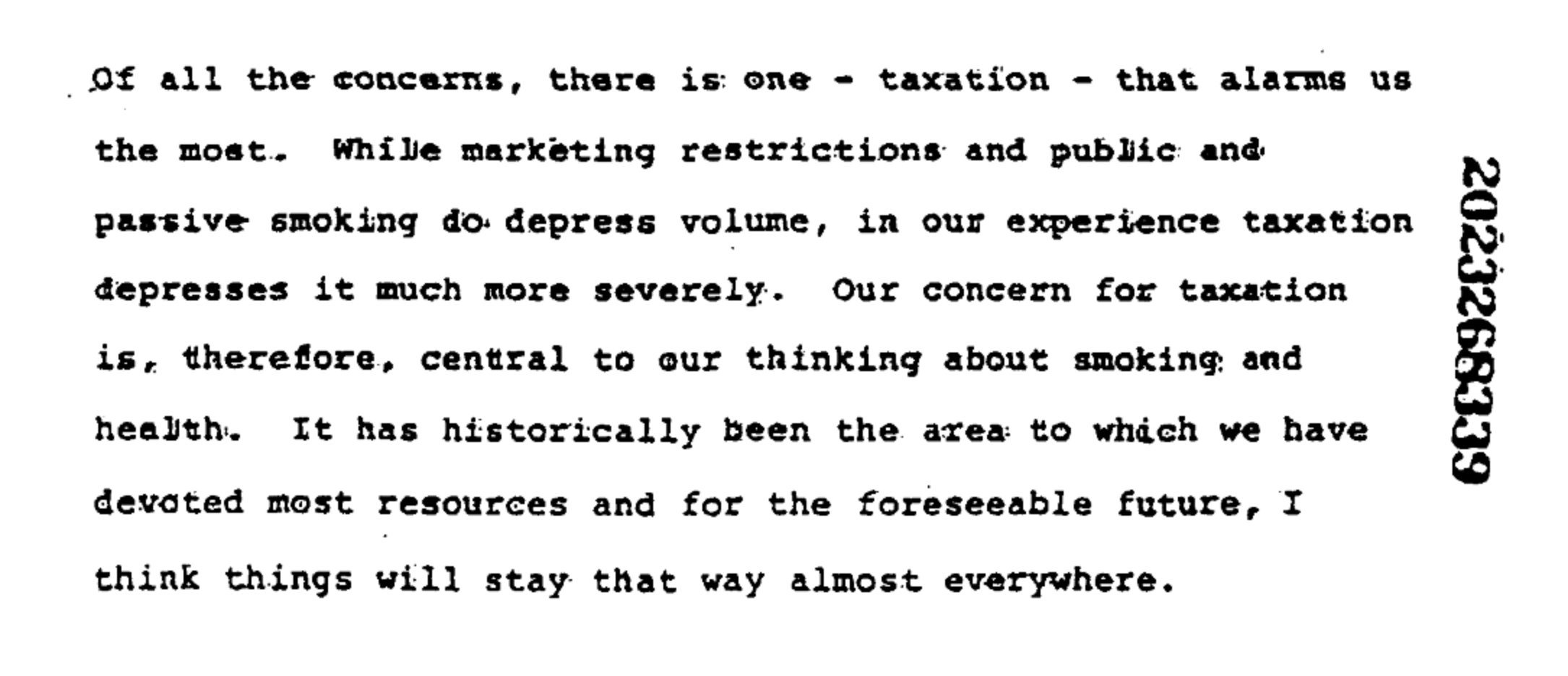
Pigouvian taxes (eg: on sugar, carbon, alcohol, tobacco) are fundamentally about correcting an externality – some behaviour that a government wants to see change. That’s different from our other taxes, where the goal is raising revenue. With Pigouvian taxes, we want to change behaviour. With revenue-raising taxes, we don’t want to change behaviour.
Indeed, in the case of tobacco taxes, governments want revenue to fall, because when matched by falling smoking prevalence, it means the policy is working as intended.
Martin a “Tobacco Harm Reduction Advisor”
James Martin is listed on Harm Reduction Australia’s website as one of 15 board members, with his profile dated March 1, 2020. He is described as a “Tobacco Harm Reduction Advisor.” However the Australian Charities and Not for Profit Commission (ACNC’s) details on HRA do not show him as a “responsible person” (“Generally, a charity’s Responsible People are its board or committee members, or trustees.”)
Martin’s research output on his university page shows he has published 24 papers and book chapters since 2013. Not one of these concern tobacco or vaping. But with no published research track record in any aspect of tobacco control, he apparently thinks differently to the significant national and global organisations which have never recommended lowering tobacco taxes. And to the governments of 183 nations representing over 90% of world population which are parties to the global Framework Convention on Tobacco Control, which gives prominent emphasis to tobacco tax in reducing smoking.
Martin recently described Clive Bates on Twitter as “a master”, yet appears to diverge from him when it comes to tobacco tax matters. Perhaps he needs to widen his understanding of tobacco control and start his peer reviewed contributions to the field if he wants to offer advice that might be taken seriously.

















 Simon Chapman AO