The roll call of groups promoting vaping in Australia which have slipped quietly into oblivion is impressive. We’ve seen Legalise Vaping Australia, the Australian Tobacco Harm Reduction Association, the Public Health Alliance, the Australian Vaping Association, the Vaping Association of Australia and that household name, the Australian Smokefree Alternative Consumers Association all come and go not with a bang, but with whimpers.
Far right politicians including Hollie (“What is Big Tobacco”) Hughes, Cory Bernardi and Barnaby Joyce (all who have jumped to One Nation), David Leyonhjelm, Eric Abetz, Tim Wilson, James Paterson, and Ross Cadel and Matt Canavan both from the Philip Morris-funded National Party have all carried flags for vaping, but none have kicked any policy goals.
Every policy but one they fought for blustered away, then crashed and burned. Their sole victory saw some of them pile on to a backbench revolt against a proposal by Liberal Health Minister Greg Hunt to ban personal imports of vapes and liquid nicotine. With that ban in the legislative bin, under the cover of the pandemic when all health department hands were on deck with COVID, criminals seized their moment and the mushrooming of shops selling illegal vapes rapidly turned into a tsunami of cheap smuggled cigarettes openly on sale across the country.
When the history of how the illegal sales tidal wave happened, the 28 signatories to this letter and their urgers in vaping advocacy will be key exhibits for the disaster that unfolded.
Can I be your leader?
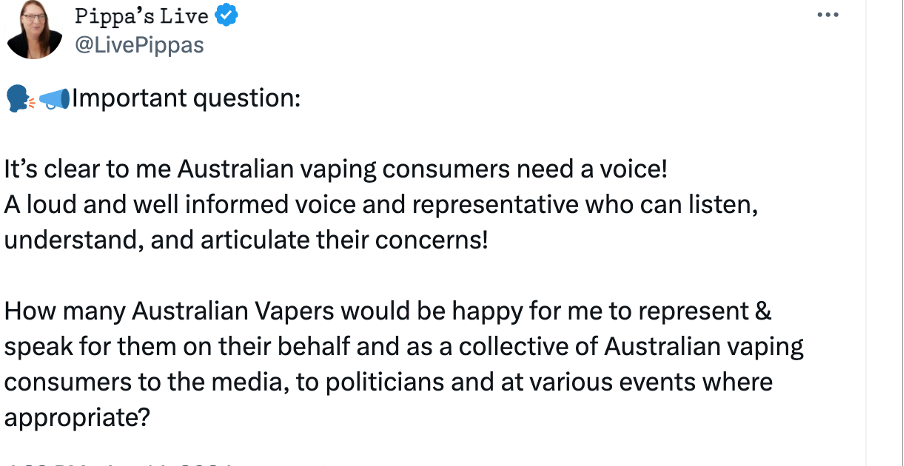
Around 2016 Queensland-based Pippa Starr (pictured above) began posting about her journey with vapes with the fervour of a religious convert. Starr held ambitions to be a spokesperson for Australians wanting to liberalise vaping access. And with the above exodus of the other minnows, there were few standing in her way, but possibly even fewer reading her posts (see follower data at the end of the blog).
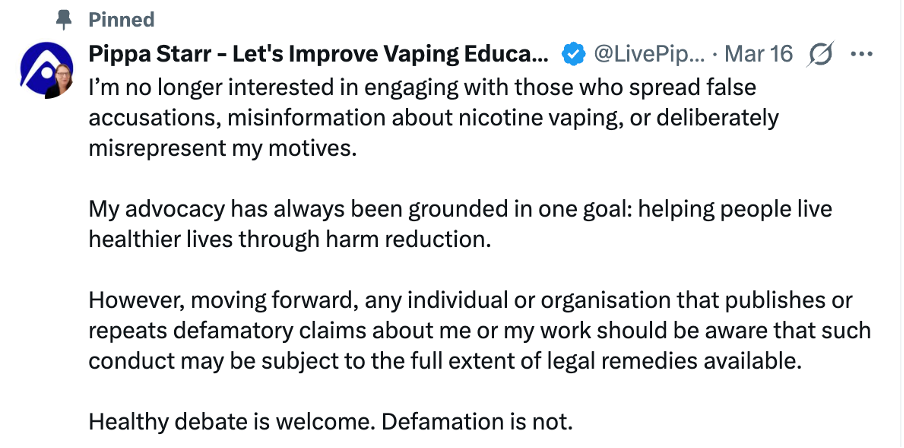
Starr is a prolific social media user and she wants us to know that her antennae are set on red alert for defamation. She warns she just won’t stand for it.
But, hey, can she dish it out. Here are three examples.
At one point Hughes asked me out of nowhere “Professor Chapman, were you on the board of the Cancer Council in 2013?” Perplexed, I answered “No, I don’t think I was.” (I was on the board from 1997-2006). She appeared to be reading from her phone as she asked the question.
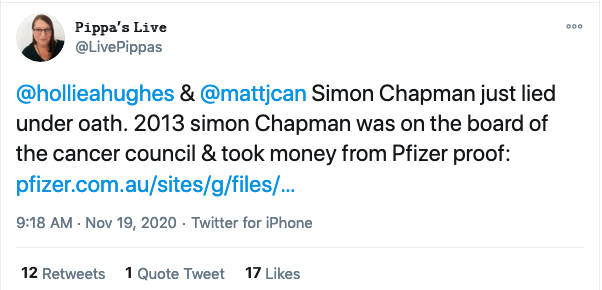
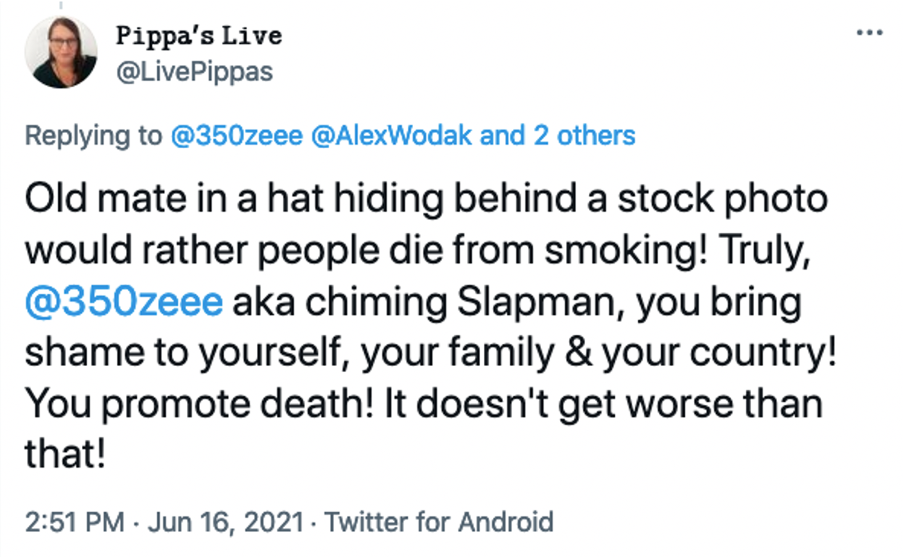
After giving evidence, I found the tweet below posted by Starr.
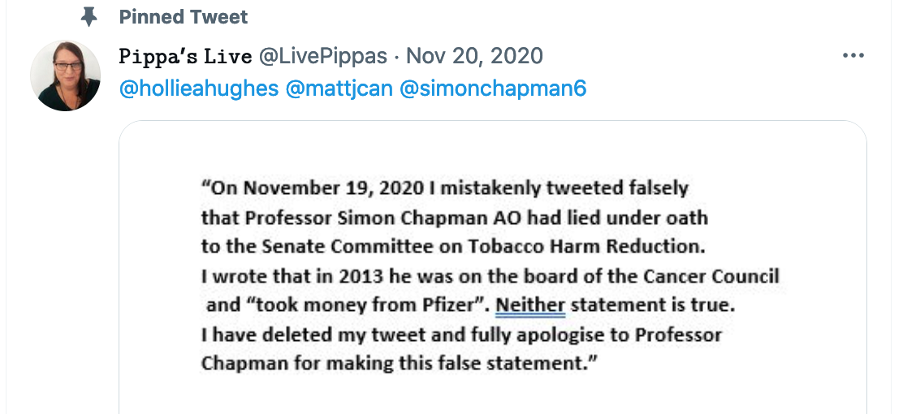
I emailed Starr explaining that there was not a syllable of what she had tweeted that was correct and demanded she retract, apologise and pin the apology to her twitter feed for 12 months. She rapidly agreed and pinned the apology to her feed the next day where it remained for a year.
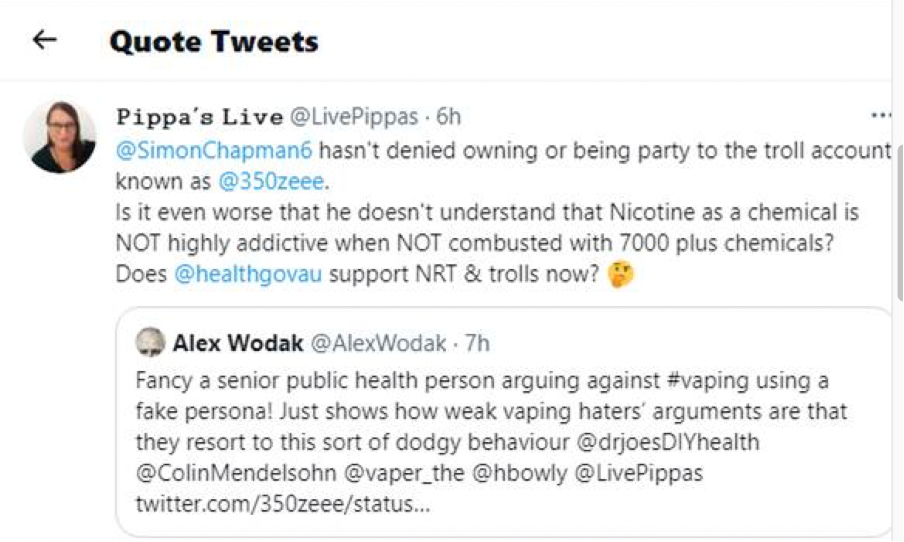
I block her on my Twitter feed as we do with persistent pests who door knock or make unsolicited calls, but others sometimes sent me her work. Some seven months after the pinned apology expired, I saw more of her vile bile, this time accusing me of hiding behind a fake Twitter account.
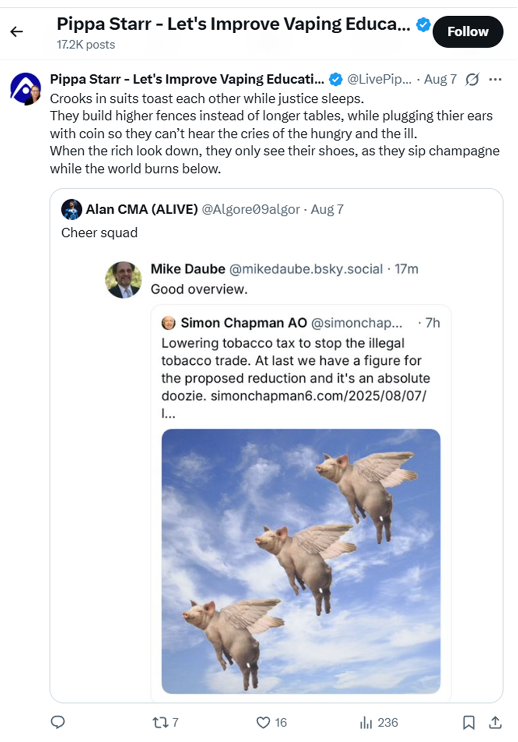
On 7 Aug, 2025 Starr tweeted the post below, calling Professor Mike Daube and I “crooks in suits”, thus somehow being involved in illegal activity. The obvious imputation was that we figuratively plugged our ears with money we earned from this activity so as to not hear cries from “the hungry and the ill” whose conditions are the result of our illegal activity. Moreover, we are “rich” partly as a result of this illegal activity and we celebrate our illegal earnings with champagne and avoid considering the lives of people who are hungry and ill, presumably partly as a consequence of the alleged illegal activities we perform.
On reading this bilge, lawyer friends immediately said “how much do you want?”. We decided to add it to a dossier of abuse that ranged from the juvenile name-calling (“chiming Slapman”) to openly defamatory remarks. It would keep.
3 I’m an anonymous firebomber
A year later, she was off the leash again. This time I (apparently along with friends) was an anonymous firebomber, threatening her because we “couldn’t handle that our time was nigh”. This quasi biblical turn of phrase presumably meant that our lifetime of tobacco control efforts were about to fall in a heap because of the unstoppable tide of illicit cigarettes and vapes that would soon bring the decades-long decline in smoking to a humiliating end.
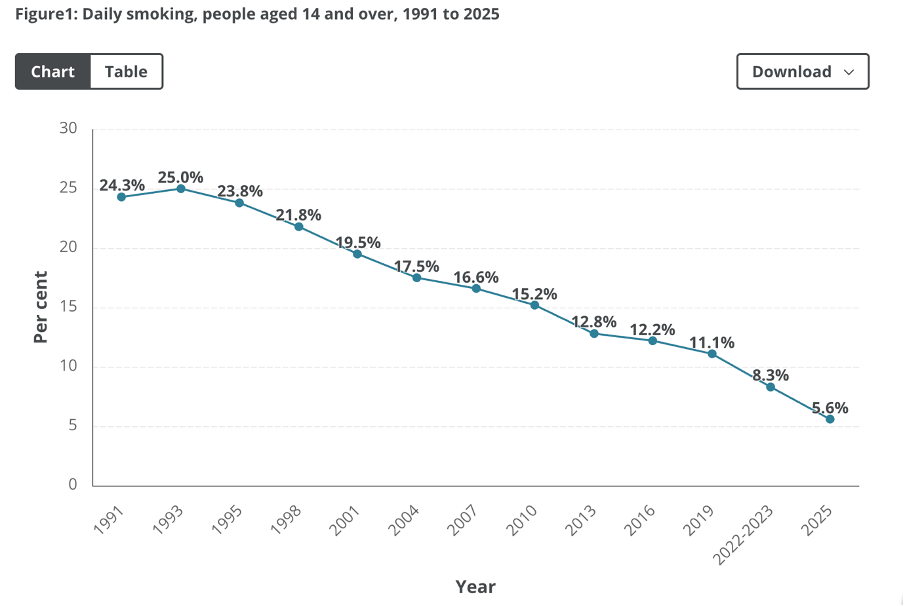
The small detail missing from this tragic scenario, was that the recently released 2025 data on national smoking prevalence showed the largest decline ever recorded since the surveys began in 1991 (see graph below).
The claims being made now were:
Again, that I use a “troll account”, this time namely cptsnooze @plimpee, to try to intimidate her
Those who use anonymous accounts seek to hide their identity to enable them to make threatening and disparaging comments with impunity. This is unprincipled, devious and cowardly behaviour.
I want her to “pull your head in” about vaping
I have threatened to firebomb her if she does not “pull her head in”
I am thus planning criminal arson and perhaps injury and murder
I therefore should be widely understood to be a disgraceful, contemptible person deserving criminal investigation.
This fevered, sick stuff had attracted 258 views and 9 likes by the time I sent her a concerns notice with a list of demands involving immediate deletion and pinning a full apology to the top of all her social media.
She wrote apologising and took down the post. But added this little beauty “For the avoidance of doubt, I did not intend to accuse you of threatening to firebomb me, planning arson, intending to injure or murder me, or engaging in any other criminal conduct. Those allegations were not words that I published, and they were not the meaning I intended to convey.” (my emphasis)
I accepted the apology but told her the snivelling weasel words above were puerile and disingenuous. Assuming she was not awash with assets, I said I had no appetite to harm her financially, but would not hesitate to take legal action if she had another crack.
In preparing for a possible lack of apology and takedown, I looked at the followers data on her social media pages to get some perspective to the reach of her defamation. As can be seen, they are sad little numbers with her messages landing with an almost homeopathically small proportion of Australia’s vapers, let alone of the Australian public.
Trolling and abuse sadly goes with the territory in much of public health advocacy. Here’s a selection of some of the very worst I kept from a few years ago. The vaping space is one of the very worst I’ve encountered in a 50 year career of contribution to a wide range of public health issues.
Recently in The Conversation three commentators proposed a three-pronged template for ending the dominance of illegal tobacco and vapes over legal, taxed and pharmacy-accessed products. Their article was triggered by the release of the latest (2025) AIHW national survey data on smoking and vaping prevalence, where the lowest ever rates were reported for smoking (5.6% daily, 7.8% current).
Let’s look at the evidence and reasoning behind their three proposals: (1) lowering tobacco tax (2) making vapes and other putative reduced risk nicotine products more widely available (3) keeping up enforcement at borders and of stock seizures, fines and closures of illegal retailers.
First, let’s look at their reservations about the integrity of the AIHW data.
They claim that the AIHW has earlier stated that its reports underestimate “actual consumption levels”, meaning that its reports underestimate smoking. But “consumption levels” refer to the number of cigarettes smoked per day, not whether or not people smoke. Reporting lower than true smoking frequency is well known in smoking surveys, where underestimation and rounding down is common.
But there is scant recent evidence of smokers denying they smoke in surveys, particularly when surveys — as with the AIHW’s — are not conducted only face-to-face or via phone where some smokers may feel awkward admitting they smoke.
They also note that the AIHW reported fall occurred at same time that illicit sales “moved underground and were harder to measure”. Surely they realise that the AIHW’s smoking prevalence data report all smoking, regardless of whether this is of legal or illicit products?.
Moreover, authors Jegasothy and Martin have referenced past AIHW data in their government submissions and in their limited academic writing. When useful to their argument, these data are apparently fine, but when inconvenient, they are critical of the data’s integrity.
1 Lowering tobacco tax
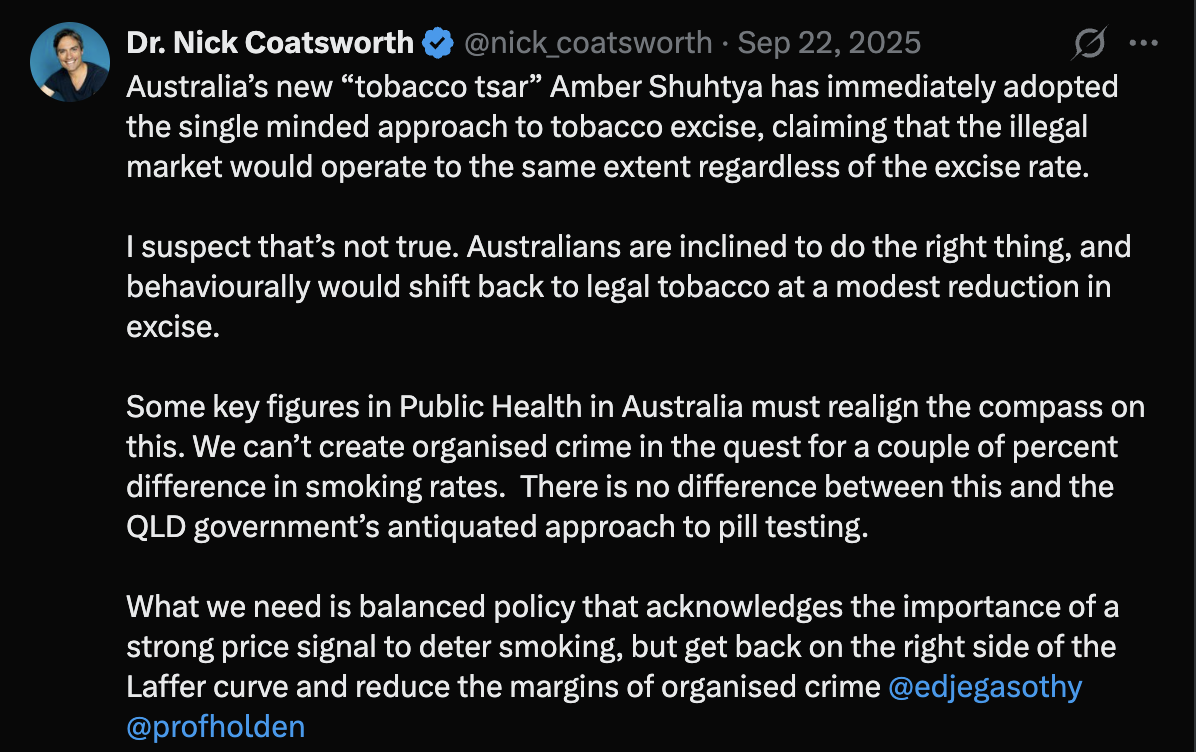
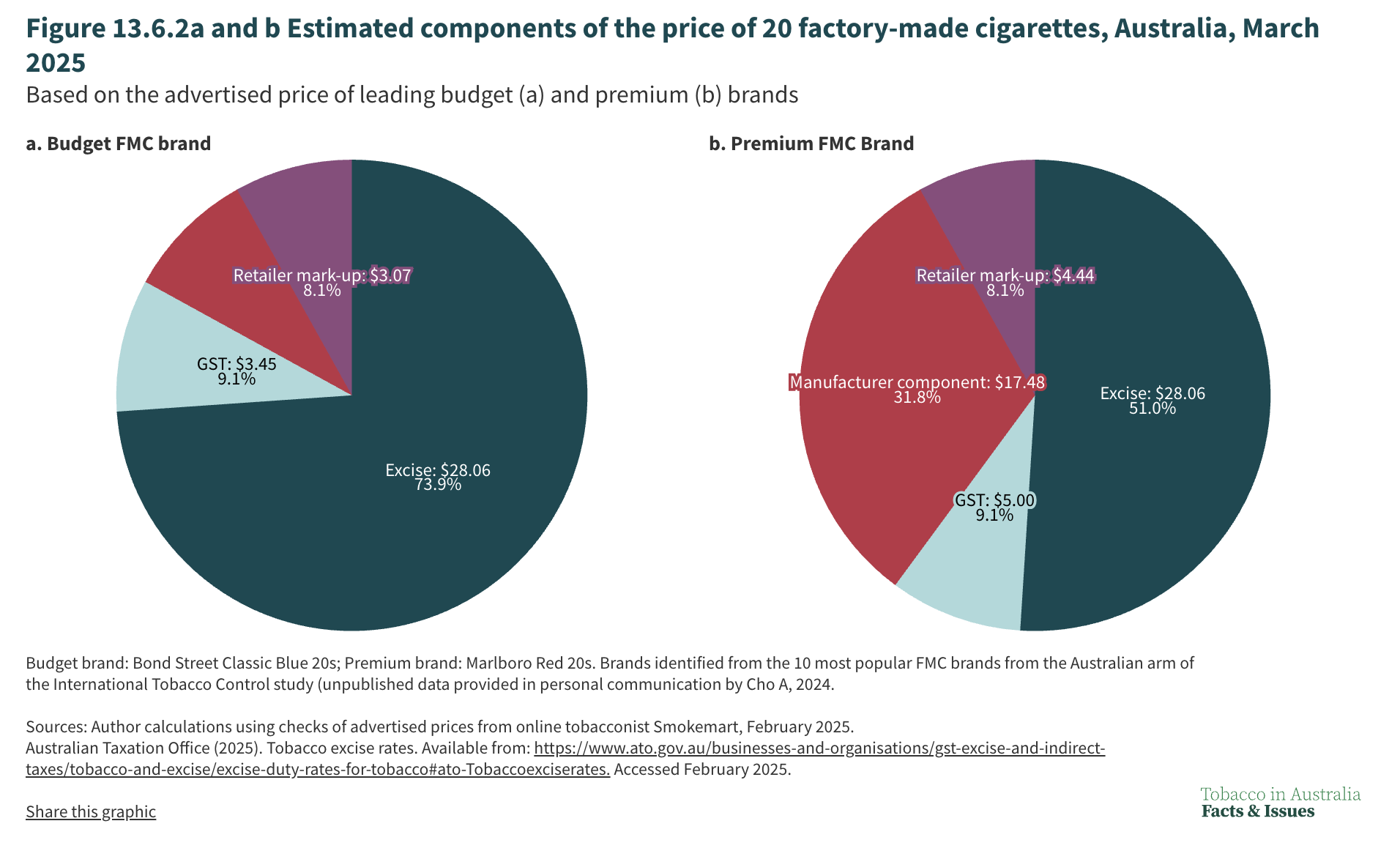
I’ve shredded the “reduce the tax” argument many times, like here. But here they go again, advocating an unspecified tax cut and providing no explicit assumptions or modelling. They write “A tax cut won’t close the price gap with the black market entirely. It doesn’t need to. Every dollar the gap narrows weakens the incentive to buy illicit products and the profitability of selling them.”
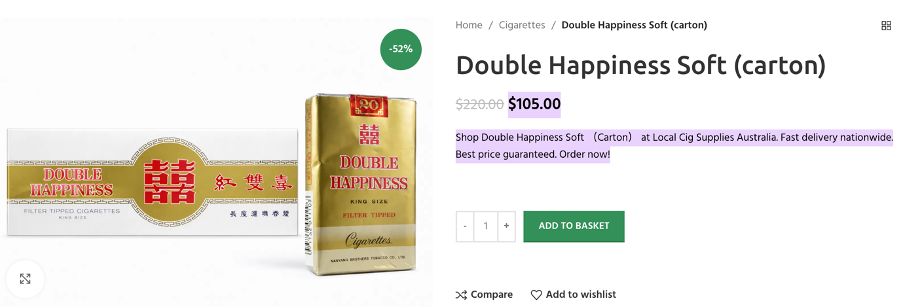
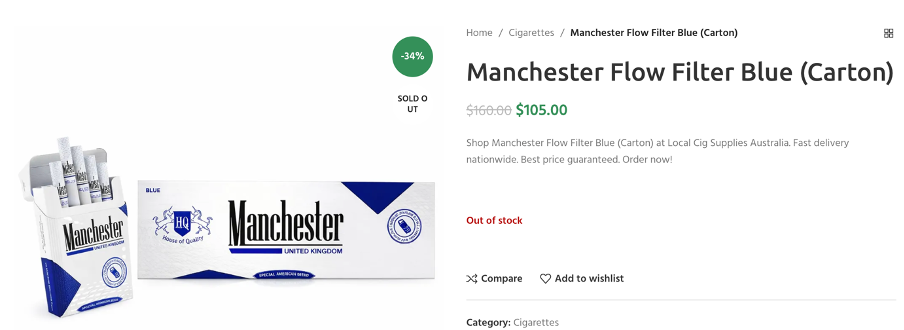
Illegal cigarettes can be bought for as little as $7 a pack if bought by the carton. If in the highly unlikely and globally unprecedented event that all tobacco excise was removed tomorrow, and manufacturers’ and retailers’ components of price remained at today’s ratios, a pack would cost around $11.50. Most chatter here though has suggested dropping the tax to make a legal pack cost $20-30 instead of the current common $40+. The examples below show on-line carton prices for illicit brands Manchester and Double Happiness of $10.50 per pack.
Illegal prices could also quickly fall far lower than now, with packs in the well-known illicit transit nation of Cambodia for example selling for as little as 34c.
So here they appear to be suggesting that narrowing the price gap will persuade some current illegal tobacco purchasers to ignore any remaining reduced price gap and return to buying more expensive taxed cigarettes.
When pressed, some arguing this way – always without evidence — suggest that many smokers would prefer to be law-abiding and would be willing to “do the right thing” and pay quite a few dollars more for taxed products if the tax was only reduced.
Here we need only to look at the extent of the cash economy and undeclared sales common with barbers, hairdressers, nail bars, cafes and tradies. The Australian Taxation Office estimates the shadow or cash economy costs Australia approximately $16-$25 billion a year in unpaid tax revenue, with the broader economic impact estimated to be as large as 3% of GDP (exceeding $80 billion in 2025).
Straw-clutching, they also provide a 32 year old (1994) Canadian example of a tax cut with increased enforcement reducing illicit sales. This 2019 World Bank report shows that illegal trade rose again, so that by 2010/11, 32% of Canadian tobacco sales were illicit.
2 Be like Sweden: make vapes and other putative harm reduction products more available
They quote Sweden as an example where policy that embraces harm reduced products has greatly lowered smoking. But Canada and the US are other examples of nations with no legal impediment to the sale of smokeless tobacco and where use of these products is very small and smoking prevalence higher than Australia’s (see “Cherry-picking in Sweden” here). So why only look at Sweden and not mention that it has had low smoking prevalence for many years as well as long-standing comprehensive tobacco control policies?
Illegal vapes are being sold openly in nearly all of the thousands of illegal tobacco outlets in Australia and online with 60% of current 90 day closures in NSW being licensed tobacco retailers. Below is a 70,000 puff vape advertised illegally for $36, less than the cost of one packet of taxed cigarettes. The authors want them to be even more available, as they are in nations like New Zealand, the UK, the USA and Canada. Given how widespread access to vapes is now in Australia, it is difficult to imagine any would-be vaper finding access anything of a problem. And note too that Australian smoking prevalence is also lower than in each of these countries (see table here). So how would even greater access help here?
Early in their article they argue closing down illegal retailers and imports has done little to stem illegal trade. But then they go and recommend it as the third “absolutely essential” of their strategies! This looks like an attempt to walk on both sides of the street. Can please they make up their minds here?
A Sydney closed shop which brazenly reopened was fined $1.18m and permanently closed. There are some 60 more reoffenders in the legal pipeline.
These penalties, which can also include gaol times, are radically changing the risks and costs of engaging in illicit trade in Australia. No country has zero illicit tobacco trade, but Australia is now taking the problem seriously.
The horrendous arson and violence we are witnessing with the extortion and standover tactics being used by criminal syndicates is of course far from unique to their entry into tobacco. Violence is standard modus operandi with organised crime. Extortion and firebombing is also now happening with restaurants, bars and liquor supplies in Victoria, which has nothing to do with excise tax.
Many Australians will tell you that smoking rates here are going up. It’s so obvious, right? Just look at all the illegal tobacco shops that have sprouted across the country selling cigarettes at prices that haven’t been seen here since the late 1990s. Those who smoke the most (low income groups) no longer have the disincentive of high prices to check their smoking. Few kids can afford a $50 pack of legal cigarettes, but many can easily afford $10-$15.
So “everyone knows” that the wheels have therefore fallen off Australia’s historic record of reducing smoking. We are no longer on the front row of the grid of nations who are making smoking history by sending it to record lows. There’s no shortage of ignorant or innocent down-in-the-last shower experts ready to repeat this truth.
Well, hold the press …
The latest national survey of more than 17,500 people aged 14 and over across Australia took part in the National Drug Strategy Household Survey (NDSHS) with data collected from June to December 2025 has been published today by the Australian Institute of Health and Welfare (AIHW).
In 2025, just 5.6% of people aged 14 and over smoked daily, the lowest rate ever recorded since the AIHW began conducting NDSHS surveys in 2001 when the rate was 19.5% (3.5x more than now). In 2022-23 – the last time the national survey was undertaken, the daily smoking rate at 8.3% — an absolute unprecedented fall of 2.7% (and a whopping percentage fall of 32.5%).
Current smoking (at least once per month) is now 7.8% in those aged 14 plus.
Vaping down too
In 2024, the Australian government restricted legal access to vapes to pharmacies, although illegal sales remain widespread. Daily vaping in those aged 14+ (3.6%) has plateaued since from 2022–2023, whereas it was previously increasing.
But current vaping (including less than monthly use) in 18-24 year olds was 14% in 2025, down from an alarming 20.6% in 2022-23, with no increase in smoking as those who opposed pharmacy access often confidently predicted would happen. The same pattern was seen among 14–17-year-olds: current vaping fell from 9.7% in 2022–23 to 6.4% in 2025. Overall, 6% of people aged 14+ vaped at least monthly.
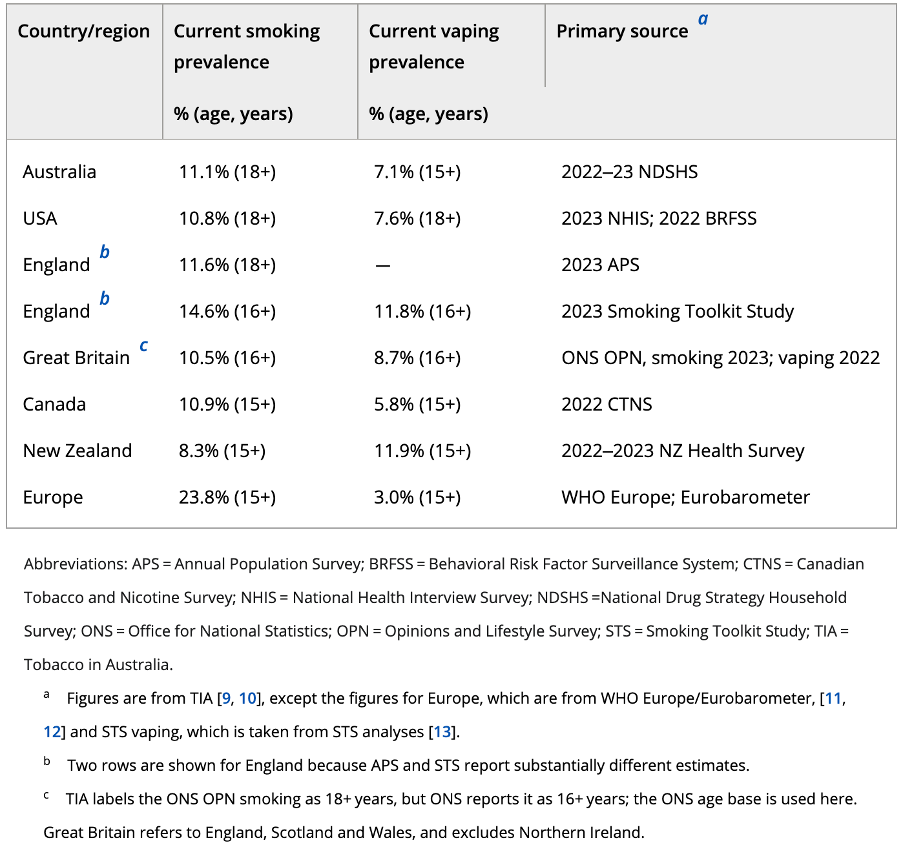
These figures place Australia ahead of other comparable nations with established tobacco control programs on both current smoking and vaping, including the much-vaunted New Zealand rates, which are often held up as the gold standard (see table below). The latest (2024/2025) New Zealand data show 8.3% current smoking (compared with 7.8% in Australia) and 13.8% current vaping, more than double Australia’s rate. (See New Zealand data sources here and here).
Country/region
Current smoking prevalence
Current vaping prevalence
Primary source
% (age, years)
% (age, years)
Australia
7.8% (14+)
6.0% (14+)
2025 NDSHS
USA
9.9% (18+)
7.6% (18+)
2024 NHIS; 2022 BRFSS
England
10.4% (18+)
—
2024 APS
England
14.6% (16+)
11.8% (16+)
2023 Smoking Toolkit Study
Great Britain
9.1% (16+)
10.0% (16+)
2024 ONS OPN
Canada
10.9% (15+)
5.8% (15+)
2022 CTNS
New Zealand
8.3% (15+)
13.8% (15+)
2024/25 NZ Health Survey
Europe
24.1% (15+)
3.0% (15+)
WHO Europe 2024; Eurobarometer 2023
^ Figures are from Tobacco in Australia (TIA) (9,10) except Europe figures, which are from WHO Europe/Eurobarometer, (11,12) and STS vaping, which is from STS analyses.(13) ^^ Two England rows are shown because APS and STS report substantially different estimates. * TIA labels GB ONS OPN smoking as 18+, but ONS reports it as 16+; the ONS age base is used here. Great Britain refers to England, Scotland and Wales, and excludes Northern Ireland. Source for bracketed references shown here
Findings are consistent with other recent surveys
The 2025 NDSHS results are icing on the cake of recent usage surveys conducted in NSW, Queensland, South Australia and with Roy Morgan data from 2022 to 2024. The precise rates of decline vary between studies, but all show that fewer people are smoking.
But … but ….
This news will cause acute dyspepsia in the handful of peripheral commentators who have attracted news spotlights by telling us all that tobacco control is failing in Australia because of high tax and restrictions on the sales of vapes (a bizarre claim because illegal vapes remain highly accessible).
Here are my predictions on how they will try to discredit the new data.
Wastewater analysis shows total nicotine use is up
In June this year the Australian Bureau of Statistics (ABS) published a report on nicotine metabolites in Australian wastewater. The headline finding was that “The quantity of nicotine consumed in Australia increased by almost 40% from 2017 to 2025, with most of the increase occurring since 2021. Population growth over the period 2017-25 was 14%.”
So now that NDSHS data show both smoking and vaping were down in 2025, how can we reconcile this with the ABS nicotine wastewater data?
The ABS report emphasised that “While wastewater data provide reliable estimates of total nicotine consumption, they do not identify which products the nicotine came from.” Importantly, it also states that “It is not possible to discern whether the rise in per capita consumption reflects a rise in the number of people consuming tobacco and/or existing smokers consuming more.”
The NDSHS reports on smoking prevalence, not on nicotine consumption. But the possibility that existing smokers are consuming more nicotine is highly plausible.
Globally, vaping products are undergoing rapid and radical changes. Perhaps chief among these have been the rapid rise in availability and use of nicotine salts. These lower the pH balance of inhaled vapour, producing smoother “throat hit”. Lower pH allows vapers to comfortably inhale much higher nicotine concentrations. AS this has been happening, we have also been seeing the promotion and use of disposable vapes delivering enormous puff counts.
A US analysis found that monthly milligrams of nicotine sold in e-cigarettes increased by 249.2% between February 2020 and June 2024.
Here are examples from a Google search on “50,000 puff vapes”. It’s highly likely that these nicotine geysers are making a substantial contribution to wastewater even among a diminishing number of people who vape.
There’s also evidence of a recent uptick in nicotine replacement therapy, which would add to the volume of nicotine metabolites in wastewater.
Many smokers and vapers questioned for the NDSHS will have lied
These critics will also say scornfully that it’s surely obvious that since a large volume of smokers and vapers are buying illegal products, many will fear trouble if they admit to breaking the law in a questionnaire. This is quite a puerile argument.
The small problem here is that no one has been prosecuted or fined for possessing illegal cigarettes or vapes, unless in commercial quantities. Those buying illegal nicotine products do it openly. The same NDSHS survey asks about illicit drug use where individuals have often been prosecuted and has published data since 2001.
If the AIHW contracted survey team were forwarding information to police gained from their surveys, they would be shut down tomorrow and their directors prosecuted for gross breaches of privacy and misleading conduct.
And had the 2025 findings shown that smoking had risen, it would have been impossible to find any of these critics who would not have fully backed its findings.
Why has smoking kept falling?
Price has always been a major factor explaining both smoking uptake and cessation. Many were therefore concerned that the widespread availability of dirt-cheap cigarettes would put the brakes on the continuing decline in smoking that Australia has enjoyed.
But the task of explaining why smoking has been falling for decades is far more than a simple adding of the sum of the impacts of the all the policies and campaigns we have used to reduce smoking. Trying to disentangle the precise impact of all of them is simplistic reductionist fantasy. In 2017, I wrote this column in The Conversation on the “policy termites” that were slowly eating out the foundations of smoking in Australia and elsewhere. In this review I wrote nearly 20 years ago with Becky Freeman on markers of the denormalisation of smoking, we catalogued a vast range of examples of the ways that the meaning of smoking has changed from something enticing and desirable to something regretted, resented and reviled.
In 2004 some 90% of smokers regretted ever taking it up. This proportion would be much higher today. I’ve never met a smoker who wanted their kids to take it up. The tobacco industry has been repeatedly ranked as ethical bottom feeders in polls on business ethics and trust. It struggles to attract high calibre staff. Most politicians would rather be photographed with the Grim Reaper than enjoying hospitality in a tobacco corporate sporting box.
In the 53 years since Australia introduced its first tobacco control policy (pack warnings), there rarely been a policy advocated to reduce smoking that has failed to be adopted by governments. The tobacco industry and its useful idiot acolytes have lost every policy battle they fought. There is no tobacco manufacturing or legal tobacco farming in Australia, all tobacco advertising and sponsorship has long gone. All indoor workplaces are smokefree. Tobacco packaging is the only consumer product where every square millimetre is regulated. Shops cannot display tobacco.
Today’s wonderful data reflect those successes and the political leadership that made it all happen. Lowering tobacco use and the diseases it causes is the whole point of tobacco control. Australia is well on track to get smoking to down 5% by 2030, and to see the end of smoking by kids. These are simply huge public health achievements.
My colleagues rate Health Minister Mark Butler in the highest pantheon of smart and effective federal health ministers, alongside Nicola Roxon. Australia leads the world in tobacco control. Thank you Mark and your parliamentary colleagues. Stay the course and let’s make smoking history.
Tailpiece 8.50am 17 Jul 2026
Well, we didn’t have to wait long for confirmation of my prediction above that “had the 2025 findings shown that smoking had risen, it would have been impossible to find any of these critics who would not have fully backed its findings.”
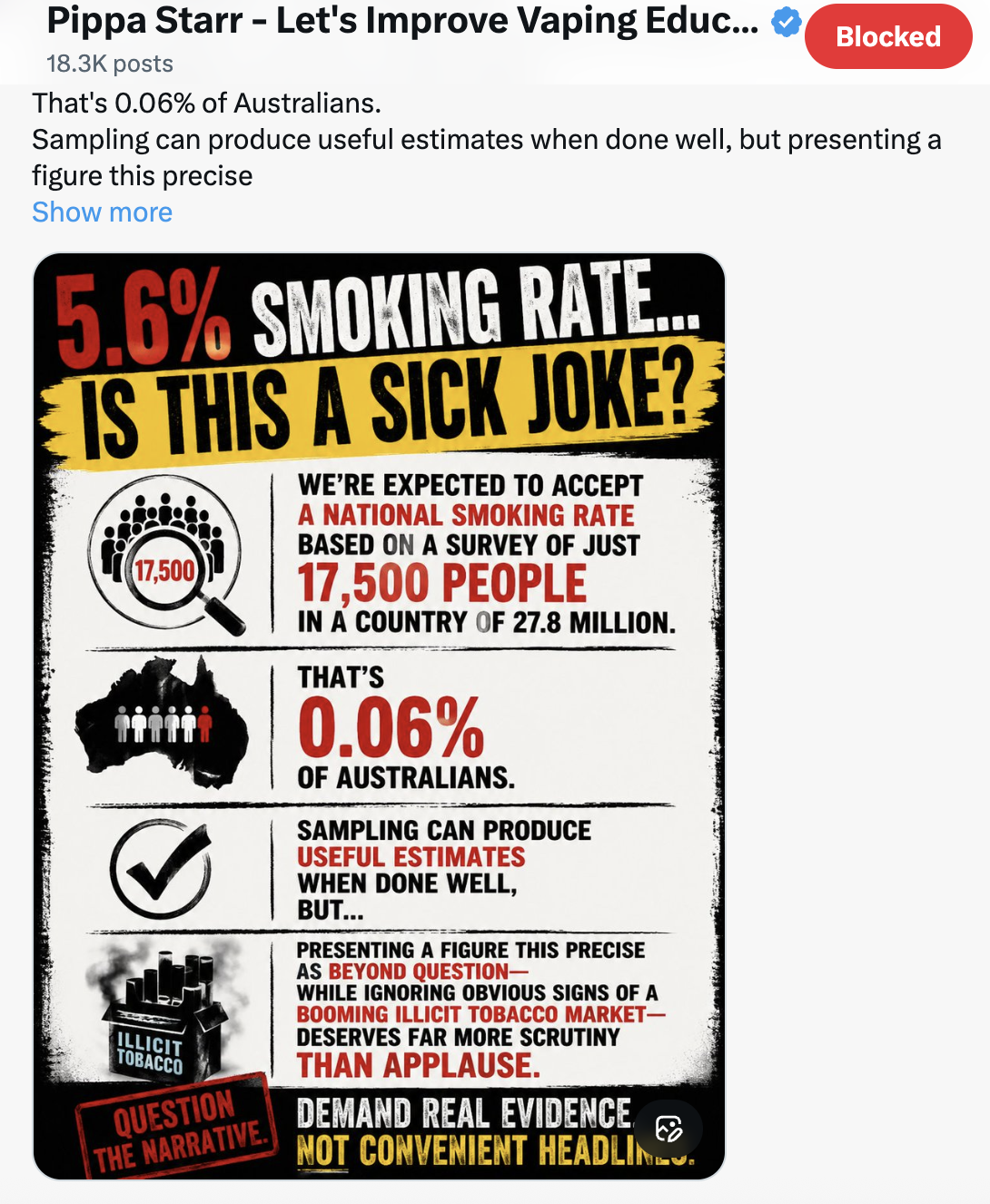
Here’s the inimitable vaping fanatic Pippa Starr on X
And here is a small selection of her past citing of earlier NDSHS data to argue her case. Their data was just fine then apparently, but not now that the findings are inconvenient.
The two giant pillars underpinning vaping advocacy are that (1) vapes are essentially all but as safe as breathing clean air and that (2) vaping is now finally cemented at the highest level of evidence as “the most effective way” we have of quitting smoking. I’ve previously looked at the first of these claims here. This time I’ll look at the effectiveness argument.
Randomised controlled trials: the “gold standard of evidence”
Many smoking cessation advocates megaphone evidence obtained from systematic reviews of randomised controlled trials (RCTs) to argue for the superiority of different drugs or nicotine replacements (especially vapes), over largely unassisted quitting. Quitting cold turkey is routinely cast into a purgatory dungeon as having the lowest level of effectiveness of all ways of quitting. This is despite 70 years of evidence showing that quitting without drugs, aids or professional assistance is and always has been by far the way that most ex-smokers stop on their final quit attempt (see later in this blog). Apparently and preposterously, such quitting is not “evidence based”.
The double-blinded RCT has been elevated to the hallowed zenith of evidence-based medicine. But there are many important ways in which RCTs seriously differ from how therapeutics are used in real world settings, away from the close involvement of RCT researchers. Nowhere is this clearer than with smoking cessation.
When a vaping advocate wants to broadcast the wonderful evidence on vaping, they rarely qualify their claims about RCTs by highlighting or even noting any of these differences. So what does the RCT evidence say and what are these critical differences?
Cochrane evidence on smoking cessation RCTs
The Cochrane library is a global project to pool RCTs on treatments and diagnostics for a wide range of health issues, winnowing those with high quality evidence from those with significant flaws. It has a dedicated sub-section focussed on drugs, nicotine replacement, behavioural and policy interventions to stop tobacco use.
The most recent (10 Nov 2025) Cochrane review of the effect of vaping on smoking cessation measured at (at least) 6 months after the trials concluded that across 104 studies involving 30,366 adults:
“for every 100 people using e-cigarettes to stop smoking 8 to 11 might successfully stop, compared with only 6 in 100 people using NRT, 6 in 100 using e-cigarettes without nicotine or 4 of 100 people having no support or behavioural support [typically advice, counselling etc] only.”
For simplicity here, let’s be generous and take 10 in 100 as the outcome for the e-cigarette group, instead of the stated range 8-11. The Cochrane sentence describes in plain English what is known as the absolute difference in efficacy between vapes, NRT and no support/behavioural support when it comes to quitting. But vaping advocates seldom lead with statements of absolute effect sizes, preferring to use relative effect sizes. Here’s a quick explanation of the important difference between relative and absolute differences, very basic but often misleadingly used concepts at the heart of questions about smoking cessation effectiveness (effectiveness means how something works in the real world; efficacy means how it works in the artificial world of trials).
Absolute vs relative impact
An absolute difference means theexact mathematical difference in event rates (here quit rates) between groups. So if 100 people were to use a smoking cessation medication and 10 quit, while 100 took a placebo and 5 quit, the difference between the two groups at follow-up would be a 5 percentage-point absolute difference. Five more in 100 who used the medication quit (10 altogether) compared with the 5 who used a placebo.
But the relative difference between the two groups is that those on the medication did 100% better than those on placebo (10% being twice as much as 5% — or 100% better). So, if a smoker heard that a particular quit smoking method worked twice as well (ie: 100% better) they would understandably think that here was a no brainer: a way of quitting which was very substantially better that a placebo (or a comparative drug).
So in other words with the latest Cochrane data described above, if you are in a RCT (notwithstanding all the serious caveats set out below) and you used a nicotine vape to try and quit, there would be an absolute positive difference of 4 percentage points higher than if you had used NRT or a nicotine free vape, and 6 percentage points higher than if you had no support to quit or (for example) called a quitline for some counselling.
Flipping this around, this would also mean that a smoker using a nicotine vape would be 90% likely to be still smoking after at least 6 months if they used a nicotine vape; 94% if they used NRT or a nicotine free vape and 96% if they tried to quit pretty much unaided.
So if you were to only express these percentages in relative improvement terms, things will sound so much more encouraging! Now, the improvements from nicotine vaping leap to 66% better than NRT or nicotine free vapes (10/100 v 6/100, the 4/100 difference being 4/6 or 66% better), and 150% better than quitting virtually unaided!
How much more impressive do relative improvements of 66% or 150% sound than the meagre absolute increases of 4 and 6 percentage points?
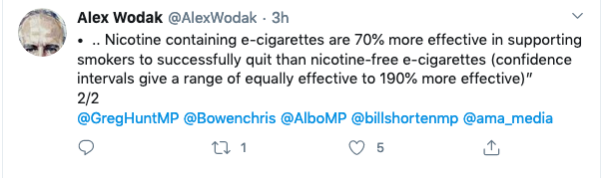
Veteran vape promoter Alex Wodak had no hesitation in using the heavy ordnance to talk vaping up here when celebrating the release of an earlier Cochrane report:
The Lancet’s policy is that when describing “risk changes or effect sizes … absolute values rather than relative changes” should be used in reports.
Ordinary people typically understand the concept of therapeutic effectiveness as being straightforward. They have many experiences of personally using drugs to alleviate or prevent fever, pain, itching, cramping, nausea, gut problems, contraception, hypertension and more in a very long list.
If they ask a doctor whether a drug being prescribed or recommended “works” they mean works very well: they have high expectations. Few would be keen to use a drug that had a 90% failure rate (as with vapes) when it came to any of these health problems. And they would see trying to quit unaided as well beyond hopeless.
But this is the very low, dismal bar of absolute “success” we find with quit smoking meds, NRT and vaping in RCTs that are widely promoted as the best evidence we can get.
Critical differences between RCTs and real world use
But when RCTs are compared with “real world” studies of how successful vapes are in smoking cessation, the bad news has barely got out of bed.
In RCTs, it is de rigueur to randomly allocate people to the experimental intervention or to a control group and not tell them which group they have been allocated. Those in the experimental intervention group are assigned to receive the active drug or procedure of interest while those in the control group(s) get an inert substance or placebo (a ‘sugar pill’ or saline solution are common). Sometimes there is an extra group being compared: a ‘usual care’ group who have the relevant condition (eg: insomnia, anxiety, migraine). This group are asked to simply continue using the drugs or strategies they normally use for the condition in focus.
With double blinding, the aim is to have neither the trial participants nor the trial research staff know which subjects are in either group. Here, independent third parties are charged with group random allocation and those running the trial are kept in the dark about who is in which group until after the trial has concluded and the data are being examined. Those in the ‘usual care’ group of course know that they are not in the experimental or control group because they are not getting anything.
Enhanced or amplified placebo effects
Allocation is blinded to avoid staff inadvertently letting the cat out of the bag and telling subjects that they are getting the active drug or procedure or the placebo.
This is of critical importance because this knowledge can powerfully influence the expectations of those in a trial. Knowing you are being asked to take a dummy pill (or ointment, patch, lozenge, spray etc) or an established treatment that has been around for decades is understandably likely to deflate expectations of experiencing a positive outcome. This may increase the likelihood of people dropping out of the study (“I know I’m not getting the real thing here, so why bother?”) or adopting other strategies to reduce the problem that inspired them to join the trial to fix the problem. Equally, knowing you really are on the active ingredient intervention may raise your expectations, mirroring those that occur in real world use of a drug.
The asymmetry between knowing you are getting the active drug and knowing you are not may well artificially widen the gap between the performance of the two groups, flattering the performance of the active intervention or drug. This is because of what is termed the enhanced or amplified placebo effect. Belief about whether you are taking an active drug or placebo has been shown to have a substantial impact on therapeutic outcome, with stronger positive expectations resulting in greater therapeutic improvement. This is especially the case when it comes to psychiatric outcomes.
Ideally, those allocated to both intervention and control (placebo) groups should have identical toss-of-a-coin probability of guessing to which group they have been allocated. But many RCTs don’t even test for this “blindness integrity” and when they do, those using the active drug guess correctly far more than by chance,
A 2004 study of 73 nicotine replacement therapy (NRT) trials found only 17 tested for blindness integrity and that in 12 of these 17 subjects (71%) accurately judged treatment assignment at a rate significantly above chance. In a varenicline RCT, those in the varenicline arm were >3 times as likely to believe they were taking varenicline, versus “not sure” and the belief that one had received varenicline was significantly associated with a 5x increase in cessation rate. There’s a similar story with bupropion: Compared to those who guessed “not sure” those guessing they were taking bupropion were more than twice as likely to have been randomized to bupropion.
With nicotine-delivery products (including NRT and nicotine vaping) those with nicotine dependence are thoroughly familiar with the physiological cues they get many times every day when their brain signals to them “feed me, feed me more nicotine please!” So if they have been allocated to placebo group and are still getting those strong sensations, it’s little wonder they often guess they are not getting active nicotine in the trial.
How did the latest Cochrane review handle the issue of blindness integrity?
The Cochrane authors judged all 9 studies in their e-cigarette vs NRT cessation comparison (Analysis 1.1) to be at low risk for “Blinding of participants and personnel (performance bias)”.
Here’s how they get there. The authors say that for randomised studies without blinding, they still rated this domain low risk “if the intervention was compared to an active control of similar intensity”, because they “judged performance bias to be unlikely in this circumstance.” No elaboration of their reasoning was given here.
The lack-of-blinding problem was basically waved through on the assumption that an active NRT comparator neutralises performance bias. But in a field where it is common for trial authors to have spent years publicly and forcefully barracking for e-cigarettes, trial staff enthusiasm and investigator attitudes can shape encouragement, troubleshooting, adherence support, follow-up energy, and participant expectations. So the low-risk performance bias rating for all 9 studies is surely highly questionable.
Combating trial drop out
When RCTs are being planned, calculations should always be made to ensure that sufficient numbers of eligible participants are enrolled to enable enough statistical power to be available to reliably point to any meaningful differences in quit rates. Those running trials must also plan for inevitable dropouts who start a trial but who do not complete it for whatever reasons.
Trial managers are acutely sensitive to the serious threats to scientific integrity, budget blowout and delayed trial completion posed by significant participant drop out. Accordingly both formal ‘tried and tested’ protocols and informal practices are involved in trying to minimise participant attrition. Trial managers use retention strategies which centre around building good relationships with participants to motivate them to remain in trials and maintain their data records. Staff qualities seen as influencing retention include “empathy, being approachable, having a good manner, making trial participants feel appreciated, as well as staff who chat, listen, and answer participant queries, and go ‘the extra mile” … “Having face-to-face contact, or regular follow-up calls with participants, is felt to facilitate building good rapport … Less participant contact possibly hinders retention, as participants do not have a relationship built with trial staff and consequently may not feel as obliged to complete follow-up”
The phenomenon of “research participation effects” (RPE) has largely replaced investigation of issues previously conceptualised as the Hawthorne effect. These constructs are acknowledged as introducing factors which can add important motivations for trial participants to want to please the researchers with whom they have formed positive relationships. Trials often include staff who are PhD candidates who are highly motivated to ensure good trial retention so that their PhD research papers cross that elementary standard of trial integrity and reduce the risk of rejection by journal editors.
Walsh’s 2008 review of 12 smoking cessation trials found subjects were contacted on average 7.1 times across these trials. This level of on-going contact with people who are reminding you and willing you on to keep using a drug for at least the minimum recommended time does not occur when a smoker buys a course of NRT from a supermarket or pharmacy, picks up a script for varenicline, bupropion or cytisine from a doctor or buys a vape.
And here’s the crunch. A review of 7,521 participants in 16 NRT cessation studies found 61% of those in RCTs adhered to their full course of NRT compared with only 26% doing so in population studies. Only 20% of participants in an Australian bupropion trial had completed their full course when followed up. These are radically different levels of adherence, demanding scepticism when RCT results are seamlessly extrapolated to real world relevance.
Smoking cessation treatments are free to trial participants
Again, unlike in real world use, trial participants are provided with free drugs, NRT or vapes. Neither do they pay doctors’ consultation fees where these are relevant. These savings may be particularly attractive to those on low incomes and may positively bias their volunteering in trials. With illegal vapes in Sydney today costing $70-90 for rechargeable products and $50-60 for non-rechargeables depending of the number of puffs obtainable, free vapes will motivate some smokers but represent an unrealistic factor.
RCT subjects are often paid
And again, unlike real world purchasers of quit smoking products, subjects in RCTs are almost always compensated for any expenses incurred in their participation. These includetravel expenses, parking, meals during study visits, accommodation if required and compensation from time away from work. “General inconvenience” payments are also common. Research ethics committees generally will not approve payments that might inordinately influence trial participation “just for the money”. But again, those on low incomes may be attracted to trials and more motivated to see them through even where “general inconvenience” honoraria may be only a few hundred dollars.
Eligibility criteria Ideally, those enrolled in trials should mirror as closely as possible the characteristics of smokers in the population. Some of these are very well established with over-representation in smokers of social disadvantage (low income, education) and higher mental health problem rates than in the general community. This data linkage study of a sample of 1.5m Danish people (1995-2018) found 80% of the population had a history of treatment for a mental health disorder in a hospital setting, from general practitioners or private psychiatrists.
But those running trials prune out participants prior to trial commencement who can be expected to have unacceptable likelihoods of dropping out of the trial, fail to follow the expected procedures and contacts with the researchers or who live in situations where they are hard to contact.
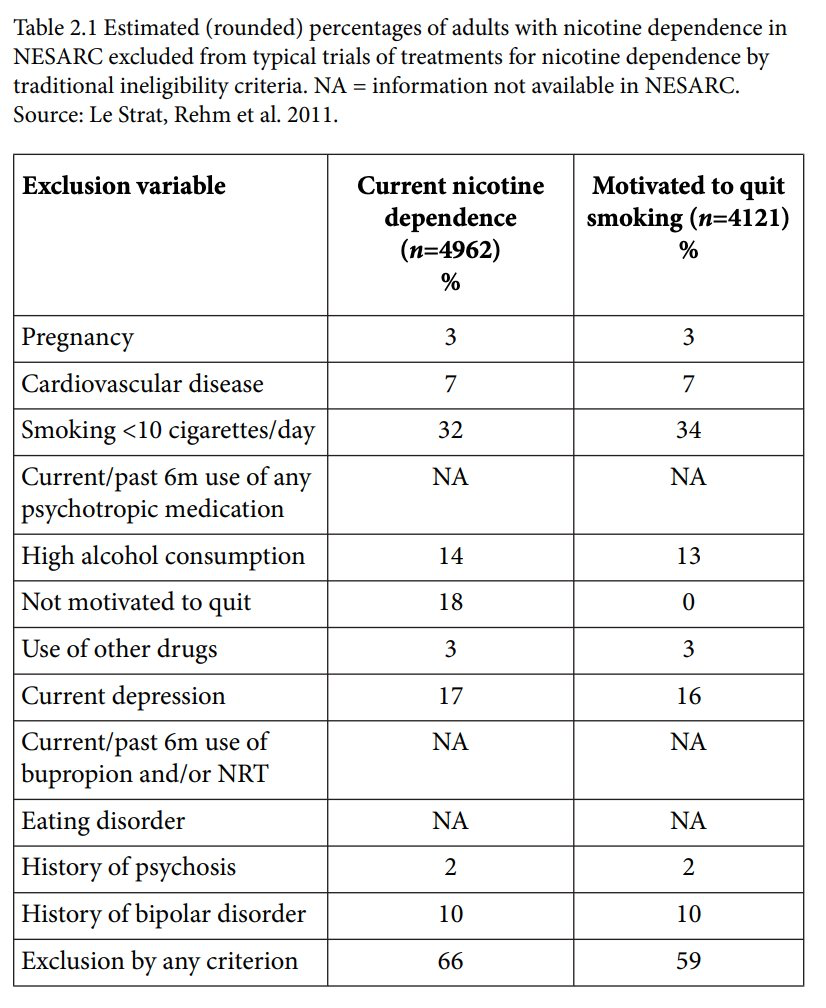
In this review of exclusions from smoking cessation trials, 66% of those with nicotine dependence were excluded and 59% of those motivated to quit were rejected. In the table below the two largest criteria were smoking less than 10 cigarettes a day and insufficient motivation to quit. This is in spite of recommendations for light smokers to use medications and efforts to promote medication use in unmotivated smokers as part of pre-quittng or “preparation to quit” interventions, developments often promoted by pharmaceutical companies.
This US study found 36% of 1206 smokers screened for smoking cessation trial were deemed ineligible for reasons that included serious mental illness, alcohol and drug issues. While 24% of Caucasians were ineligible, 42% of African Americans were excluded.
A review of reviews on 279 RCTs of smoking cessation using pharmacotherapies found 18.3% explicitly excluded participants with any MHDs (mental health disorders), 54.5% conditionally excluded based on certain MHD criteria and 27.2% provided insufficient information to ascertain either inclusion or exclusion. The authors concluded that “smokers with MHDs are not sufficiently represented in RCTs examining the safety and effectiveness of smoking cessation medications.”
In summary, when we add the widespread culling of those less likely to fully participate throughout a smoking cessation trial to the known radically lower levels of treatment adherence as described above, we are looking at serious differences between those participating in trials and those independently using quit smoking aids in real world, totally unsupervised contexts.
Collectively, these differences are likely to significantly flatter the communicated success rates for vaping (and any quit smoking med) promoted from RCTs compared with real world outcomes.
Defenders of RCTs here counter that because trial outcomes are typically calculated using intention-to-treat (ITT) analysis, that RCT outcomes always take attrition into account. ITT analysis involves considering the outcomes of all participants “according to their original assigned treatment group, regardless of whether they actually received the treatment, or dropped out”.
But as discussed above, this does not consider the intense efforts undertaken in RCTs to retain trial participants and to initially screen them to preclude those with known propensity to drop out or with other factors known to be associated with poot outcomes. These collectively introduce important biases into RCTs that make those participating very different and have very different experiences to random cross-sections of smokers trying to quit in the real world.
Longitudinal cohort and population studies
My 2023 (open access) book Quit Smoking Weapons of Mass Distraction(see from pp 185-198) summarises longitudinal population cohort studies on the success of vaping in quitting. It looks also at the question of whether nations with widespread, open-slather vape access have lower smoking prevalence than those where vapes are more restricted or even banned.
Longitudinal cohorts show a similar desultory performance to RCTs, with by far the most common experience of vaping by smokers over several years of follow-up being continuing smoking and vaping (dual use) and abandonment of vaping while smoking continues (see the above pages my book for details).
And when it comes to asking whether nations with now over a decade of widespread liberal access to vapes have plummeting smoking prevalence compared with those with stricter controls, the answer is similarly mostly negative. On this, our recent piece in Addiction shows that with the exception of New Zealand, there is very little difference in smoking prevalence between the five nations shown below nor any obvious relationship between the prevalence of vaping and that of smoking.
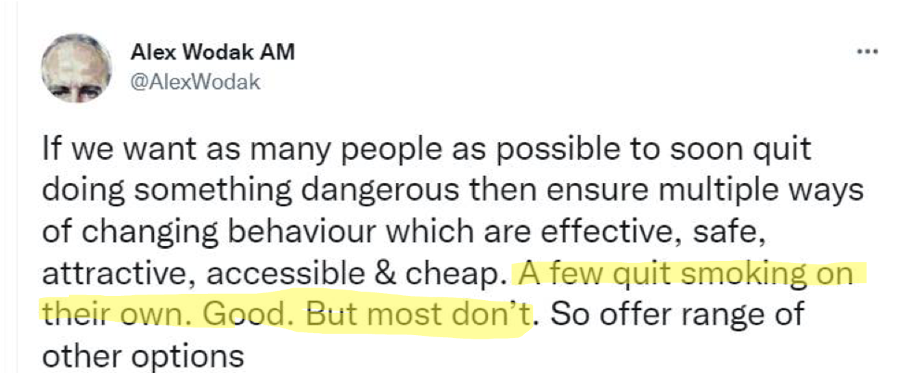
“A few quit smoking on their own. Good. But most don’t”
Earlier, I noted the denigration of unassisted quitting as the low water mark of useful ways of quitting. The Australian Department of Health notes that “While quitting cold turkey may not work for everybody, many smokers quit smoking this way.” This is quite an understatement (see here). Wodak’s statement is flagrantly, stonkingly incorrect and suggests he has little understanding of population-wide smoking cessation.
The reputation of unassisted quitting (cold turkey) for having a poor success rate derives from a research obsession with evaluating the outcome of individual quit attempts, rather than taking a population perspective on how large numbers of former smokers stopped smoking on their final, successful attempt.
If we ask “which method of quitting has the best success rate per quitting attempt?” common assisted quitting methods perform better than unassisted attempts. But if we instead ask, “For every 1000 former smokers, what method of quitting has produced the most quitting numbers?” unassisted cessation always wins the prize. What this obsession with success rates rather than with success numbers camouflages is that population attributable quit volumes are a product of success rates multiplied by the number of smokers using various methods. And here, there is daylight between smoking trying to quit without assistance and any (and sometimes all combined) other quit strategy.
Other blogs in this series:
Vaping theology: 1 The Cancer Council Australia takes huge donations from cigarette retailers. WordPress 30 Jul, 2020
Vaping theology: 2 Tobacco control advocates help Big Tobacco. WordPress 12 Aug, 2020
Vaping theology: 3 Australia’s prescribed vaping model “privileges” Big Tobacco WordPress Feb 15, 2020
Vaping theology: 4 Many in tobacco control do not support open access to vapes because they are just protecting their jobs. WordPress 27 Feb 2021
Vaping theology: 5 I take money from China and Bloomberg to conduct bogus studies. WordPress 6 Mar, 2021
Vaping theology: 6 There’s nicotine in potatoes and tomatoes so should we restrict or ban them too? WordPress 9 Mar, 2021
Vaping theology: 7 Vaping prohibitionists have been punished, hurt, suffered and damaged by Big Tobacco WordPress 2 Jun, 2021
Vaping theology: 9 “Won’t somebody please think of the children”. WordPress 6 Sep, 2021
Vaping theology: 10: Almost all young people who vape regularly are already smokers before they tried vaping. WordPress 10 Sep, 2021
Vaping theology: 11 The sky is about to fall in as nicotine vaping starts to require a prescription in Australia. WordPress 28 Sep, 2021
Vaping theology: 12 Nicotine is not very addictive WordPress 3 Jan 2022
Vaping theology 13: Kids who try vaping and then start smoking,would have started smoking regardless. WordPress 20 Jan, 2023
Vaping theology 14: Policies that strictly regulate vaping will drive huge numbers of vapers back to smoking, causing many deaths. WordPress 13 Feb, 2023
Vaping theology 15: The government’s prescription vape access scheme has failed, so let’s regulate and reward illegal sellers for what they’ve been doing. WordPress 27 Mar 2023
Vaping theology 16: “Humans are not rats, so everybody calm down about nicotine being harmful to teenage brains”. WordPress 13 Jul, 2023
Vaping theology 17: “Vaping advocates need to be civil, polite and respectful” … oh wait. WordPress 3 Oct, 2023
Vaping theology 18: Vaping is a fatally disruptive “Kodak moment” for smoking. WordPress Oct 30, 2023
Vaping theology 19: Vaping explosions are rare and those who mention them are hypocrites. WordPress 17 Nov, 2023
Vaping theology 20 : Today’s smokers are hard core nicotine dependent who’ve tried everything and failed – so they need vapes. WordPress 14 Dec, 2023
Vaping theology 21: Australia’s prescription vapes policy failed and saw rises in underage vaping and smoking. WordPress 10 Jan, 2024
Vaping theology 22: “Prohibition has never worked at any point for any other illicit substance”. WordPress 17 Mar 2024
Vaping theology 23: “84% of the Australian public are opposed to the way the government will regulate vapes” WordPress 2 Apr, 2024
Vaping Theology 24: “Tobacco control advocates are responsible for vape retail store fire bombings and murders. WordPress 27 May, 2024
Vaping theology 25: Vaping is as harmless as breathing in stream. So everyone relax. 10 tenets of vaping harm denial.WordPress 10 Mar, 2026
Vaping theology 26: “If Australia allowed vapes to be sold openly, this would lower smoking prevalence and kill illegal tobacco stone dead” WordPress 5 Jun,2026
James Martin is a Deakin University criminologist with a modest research track record in the tobacco control field. Of his 44 publications listed in Google Scholar, just five concern tobacco or vaping, with only two of these being published in peer reviewed journals. These five have received all of nine citations, with two being self-cites.
This background is relevant to his recent piece in Michael West Media, where he knits a loose thread between the current criminal tsunami of illegal tobacco and vape sales in Australia, Sweden’s falling smoking rates, Australia’s “punishment” of the tobacco industry, our alleged failure to reduce tobacco use, the failure of law enforcement to stem illicit sales and the heinous cruelty to the disadvantaged he says high tobacco prices cause.
His piece there provides just one reference to support his assertions. So let’s walk through how these stand up.
Tobacco control “harms poor smokers”
Martin argues that the Australian government has “abandon[ed] nicotine consumers, disproportionately some of our most vulnerable citizens, to early disease and death – an abominable moral calculation” because of instead of allowing vapes to be sold almost anywhere, it has confined legalised access to vaping through pharmacies to control the open supply of vapes to kids by self-described law-abiding convenience stores, tobacconists and vape shops.
While 2,358 pharmacies have dispensed over-the-counter vapes, and the government fully subsidises prescribed smoking cessation meds to low income health card holders, the unabated supply of cheap illegal, flavoured vapes by criminals continues to undermine the same potential of pharmacy access that we see year in and out when nearly all of us participate in the 440m annual visits to pharmacies to pick up 331m annual prescribed medicines.
If crime syndicates were also brazenly selling these medicines in every suburb to walk-ins without prescriptions, saving low income customers lots of money, should we applaud their public spirited service to the poor and let them get on with it? Or would we instead applaud swift and serious government effort to close this down and uphold the rule of law? I know what I would do.
And Big Tobacco — apparently the new white knights of health promotion – according to Martin now “grasps that its future, at least in the West, lies in selling nicotine without the smoke.” This is the same Big Tobacco which a decade on from entering the vaping and smokeless markets, still derives over 80% of its income from cigarettes with not one company setting a date to get out of tobacco.
Global Tobacco Industry Revenue Breakdown
Cigarettes: 83% to 88% of global sales
Smokeless tobacco: ~11%
Cigars: ~2%
Otherproducts (e.g., vapes, pouches): ~3%
Company-Specific Financials
British American Tobacco (BAT): Reported that combustible products (primarily cigarettes) generated 80% of total global revenue.
New Category Products: “Next-generation” items make up 13.3% of BAT’s revenue.
Traditional Oral & Other: These account for the remaining 6.7%.
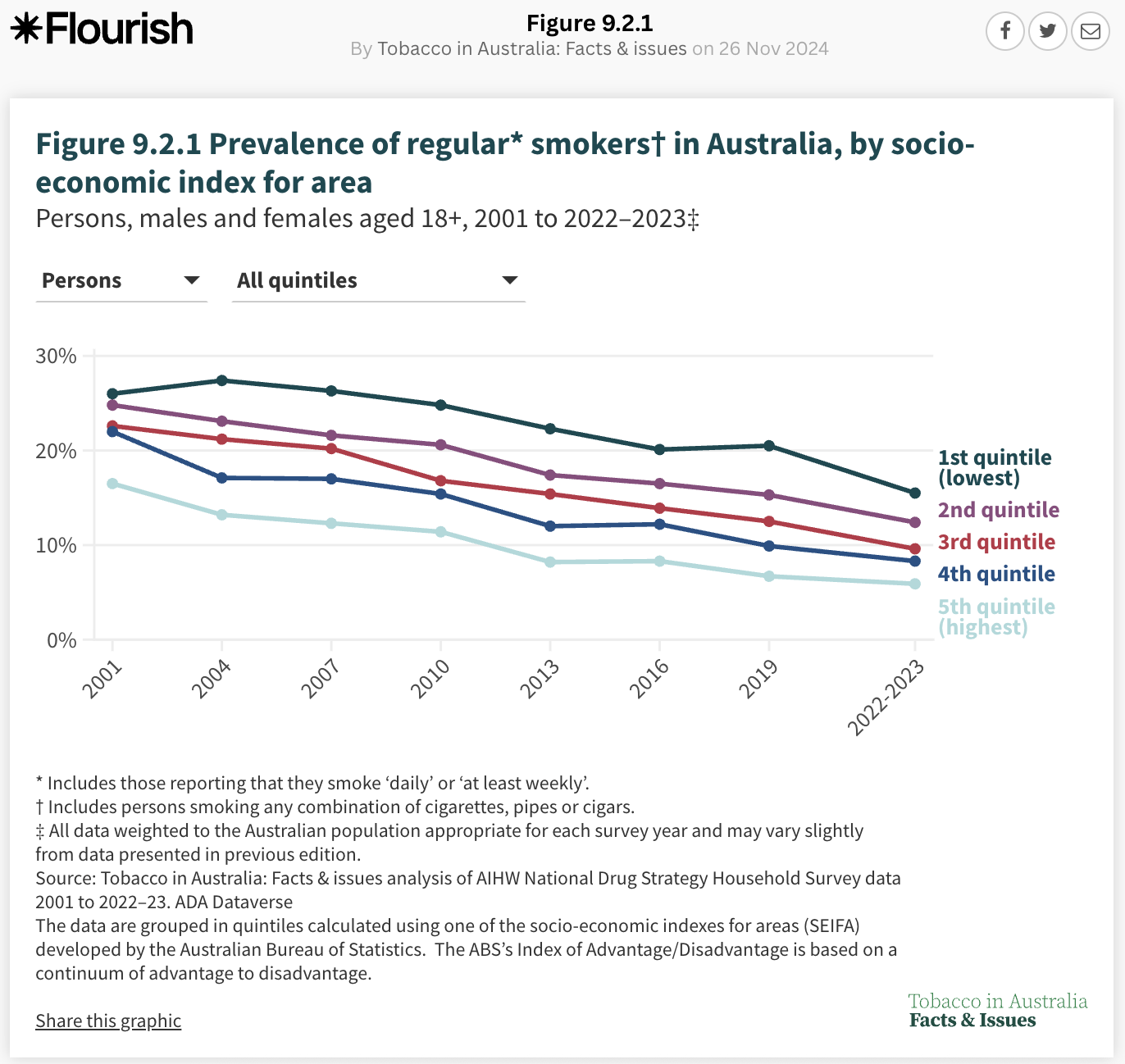
Martin’s claims about tobacco control harming low-income groups are also wildly uninformed. This link could have taken him to oceans of Australian data and graphs showing that, regardless of what definition of disadvantage is used (composite indexes, income, education) disadvantaged Australians have been smoking less in parallel with smoking declines in their more advantaged counterparts, continuously since at least 2001. This is the case for both declining prevalence and reduced cigarettes per day. Here’s just one graph of many that are inconvenient to his argument.
Yes, the lowest levels of disadvantage do have higher smoking rates than those in the highest, but as a criminologist Martin may be ignorant that this observation holds for almost every disease, cause of injury, vital statistic or health related behaviour (diet, obesity, alcohol etc), not just smoking. Poorer health travels with disadvantage.
And more news for him. It is not just tobacco prices which impact those on low incomes more than their more advantaged counterparts. This happens with every good and service they purchase, a truism in every country in the world where there is not perfect income equality for all people. In other words, everywhere.
In Australia today, there are only two groups where a majority of people smoke: those with psychosis and those in prison. In every other group, early school leavers, the unemployed, single parents and First Nations people there are more ex-smokers than smokers. Talk of people who, as Martin insists “can’t or won’t stop” smoking, will always struggle to explain why so many millions of these disadvantaged smokers over the years have managed to quit despite their disadvantage.
They regret having started to smoke, have agency to quit (mostly unaided), and are doing so more and more. Their higher smoking rates are explained far more by decades of higher smoking uptake than by lower quitting rates.
Few laws ever eliminate the problems they were intended to reduce. But we don’t see Martin’s equivalents in road safety calling for reduced penalties for drink driving because they badly sting those on low incomes, or ditching these laws because many continue to be detected over the limit.
We balance the harms to offenders with the declines in road deaths and injuries.
Can there be anything more perverse in public health than believing the poor would benefit by access to cheap cigarettes which will kill two in three long term users?
Cherry picking in Sweden
Sweden has a low smoking rate (4.8%) and according to Martin, this is all down to the enlightened widespread use of non-combustible nicotine, especially snus. Ergo, Australia need only look to Sweden for the answer, right? Here, Martin is a champion cherry picker when it comes to advancing his argument. Smokeless tobacco has been freely available in Canada and the US for decades and in both countries, it has low usage despite this open availability. In the USA, 2.6% of adults currently use smokeless tobacco and in Canada, only 0.6% regularly use it.
So do the US and Canada wipe the floor with Australia in reducing smoking given that they both allow open access to smokeless? Ermmm no. In the US, recent use of any combustible tobacco is 12.6% of adults in 2023-24. And Canada? In 2022 it’s 12.9% for any use in the last 30 days. This compares to 11.1% in Australia in 2022-23. So where’s the dramatic impact in the US and Canada of open access to smokeless tobacco on smoking rates? Why only highlight Sweden?
Sweden was one of the first nations to implement population-wide tobacco control polices like advertising bans, anti-smoking campaigns and health warnings. But clearly there are also cultural reasons why Swedes use smokeless, much in the same way they are unique in taking to surströmming, a famous Swedish fermented herring delicacy. It’s considered one of the world’s most foul-smelling foods, with an overpowering aroma often compared to rotten eggs, sewage and rancid butter. Or like Australians’ passion for vegemite, almost unique in the world.
“Punishing” the tobacco industry
Martin implies that “punishing” the tobacco industry with policies like taxation, plain packaging, and smoking restrictions is somehow a uniquely Australian thing. Is he seriously unaware that the global Framework Convention on Tobacco Control signed by 183 nations, has an entire section (“Article”) devoted to ways of controlling the tobacco industry’s efforts to wreck effective tobacco control? Here’s a report I co-authored for the WHO in 2008, which catalogues the many ways the tobacco industry has sought to defeat, delay, disrupt and dilute effective tobacco control policies. But for Martin, they are apparently now the good guys.
The industry screams loudest about policies that threaten its sales, and the very loudest screams have always been about high tobacco tax. Most people understand what this means, but Martin thinks it’s somehow unseemly and the nice people in Big Tobacco are misunderstood social welfarists leading people away from early deaths.
Here are a few historic examples of the industry screaming about tobacco tax. The tobacco company Philip Morris (Australia) in 1983 said:
… The most certain way to reduce consumption is through price.
… Of all the concerns, there is one – taxation – which alarms us the most. While marketing restrictions and public and passive smoking do depress volume, in our experience taxation depresses it much more severely. Our concern for taxation is, therefore, central to our thinking about smoking and health. It has historically been the area to which we have devoted most resources and for the foreseeable future, I think things will stay that way almost everywhere.
… A high cigarette price, more than any other cigarette attribute, has the most dramatic impact on the share of the quitting population.
In 2011, British American Tobacco’s boss in Australia, David Crow, publicly acknowledged the impact of tobacco tax, telling a Senate committee:
We saw that last year very effectively with the increase in excise. There was a 25% increase in the excise and we saw the volumes go down by about 10.2%; there was about a 10.2% reduction in the industry last year in Australia. (see here at p xviii)
So if these (and many more like them) do not indicate virulent industry concern about tobacco tax, why has it carried on screaming about tax in the same way for at least 43 years?
Reducing tobacco tax?
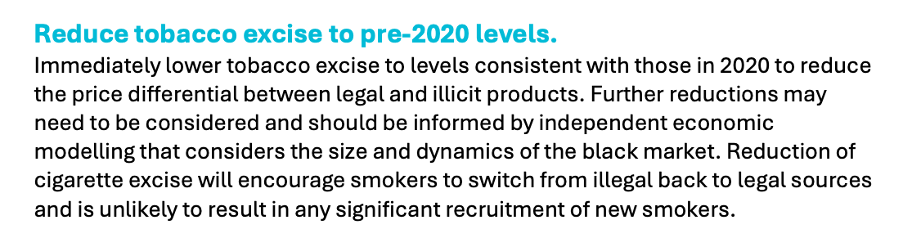
Martin has been prominent arguing for the “obvious” necessity of reverting tobacco excise tax to the halcyon days before illegal tobacco erupted in Australia. In this he and a handful of others are in lockstep with the entire tobacco industry who have chorused that Australia should revert to 2020 tax levels. The table below shows what this would likely do to recommended retail prices for a current budget brand, JPS.
JPS Classic (20s)
May-20
May-26
Difference
Excise per stick (1)
$0.94964
$1.52829
$0.57865
Excise per pack
$18.99
$30.57
$11.57
Manufacturers cost (2)
$6.65
$8.33
$1.69
Wholesale price per pack of 20 (3)
$25.64
$38.90
$13.26
Retailer margin (4)
$3.72
$4.28
$0.56
GST 1/11th of final price (5)
$2.94
$4.32
$1.38
Final price per pack of 20
Recommended price (listed in wholesale price lists) (3)
$32.30
$47.50
$15.20
(1) ATO tax rates
(2) Manufacturer cost derived by deducting excise from wholesale cost (3) Wholesale & Recommended price lists 2020 and 2026
(4) Retailer margin is at industry discretion
(5) Calculated by dividing the final price by 11
So today, when a pack of illegal cigarettes can be bought for $7 if you buy a carton, in what universe would price sensitive smokers look at a tax-reduced pack of JPS from Woolies for $32.00 and not continue to immediately walk across the street to buy a pack for $7 in an illegal shop –at less than four times the price?
And that $7 price could even go lower. Cambodia is a high corruption index nation (ranking 158/180 worst in the world). It is also a major transit hub for smuggled tobacco to other destinations. There, a pack of locally taxed cigarettes can be bought for as little as 34c. There is clearly wide scope for the price of illegal cigarettes to go much further south if ever required by ever lower tax drops.
And then there’s the inconvenient problem of Martin’s silence on how it happens that there is also massive illicit tobacco trade in many nations with tobacco tax much lower than Australia’s.
Vaping advocates eat, live, breathe and rejoice in their nicotine addiction. But in 2024, they lost the political debate on vaping policy when the Australian Senate voted to make vapes only legally accessible through pharmacies.
You could hear their wailing deep into the night. This heinous decision would make accessing vapes hugely difficult, they swore. It was gently pointed out that Australians make 440m annual visits to some 5000 pharmacies, an average of 18 times per year, walking out with 331m subsidised prescriptions. So onerous that vapers should have to go to such lengths.
They then retorted that the tiny range of allowed flavours were massively unappealing. They’d lost the parliamentary vote, but will never stop insisting that, unlike every inhalable drug in the global pharmacopeia where flavours have never been allowed for safety reasons, it’s just fine with vapes. It’s not OK to inhale flavouring chemicals in lifesaving therapeutics, but it’s quite OK to do that hundreds of times a day when you vape. Makes perfect sense eh?
The two main vaping advocacy groups, the Australian Tobacco Harm Reduction Association (ATHRA) and Legalise Vaping Australia both put up their white flags quietly and shut down. Those remaining are tiny inconsequential echo chambers.
But the recent focus on Australia’s massive illegal tobacco and vape trade has acted like smelling salts to a few punch drunk vaping advocates who were down on the canvas. They are now disporting themselves in new white hero hats holding aloft their messianic vision that the time is now right for the government to repeal its galactic folly on pharmacy-only vape access.
If vapes could be re-liberated from pharmacies and made available through all those highly responsible tobacconists, vape shops and convenience stores (who have never been known to break the law by selling illicit tobacco or selling to kids), many smokers who for the last 12 years have apparently never heard of vapes let alone tried them, would have the tape peeled from their eyes. En masse, they would discard their cheap cigarettes and storm into vape stockists. Smoking prevalence would drop like a stone.
There are a couple of teensy-weensy problems with these wide-eyed fantasies.
First, almost every illegal tobacco shop across the country – and there are thousands — is also stocking illegal vapes and have been doing so for at least four years. The vaping advocates’ dream is already a reality with a huge number of stockists and the cornucopia of flavours they lie awake dreaming of. This being the case, why then haven’t we already seen an avalanche of smokers switching to vapes? Shouldn’t we be seeing vaping going through the roof already?
Not quite.
Second, there are many countries where the very policies that these fantasists dream of are a reality, for many years. Vapes are freely available in much of Europe, across the USA, in Canada, the UK and New Zealand. And sorry to mention this, illegal tobacco also proliferates. And vapes.
This being the case, it should be obvious that smoking prevalence in such nations should be embarrassing the socks off Australia, right?
Let’s then take a look at the most recent data in a range of often-compared countries.
So Australia currently has the lowest current smoking rate (with daily smoking being 5.6%). And the second lowest vaping rate, shaded marginally by Canada. Similarly striking is Hong Kong: despite banning the sale and public personal possession of vapes, it has just reported a 2025 smoking prevalence of 8.5%, down from 9.1% in 2023.
With highly liberal vape retail access across the past decade occurring as much, if not more, in England, USA and Canada as in New Zealand, and smoking prevalence in all these nations declining, any putative causal generalisation about the downward effect on smoking of liberal versus restricted vape access as in Australia becomes immediately contentious. If liberal access to vaping sees smoking fall across populations, why are not all liberal access nations’ smoking rates much lower than Australia’s after at least a decade of widespread use and liberal access?
And then there’s this bell ringer. In nations where data are available, there are 45 nations which have smoking prevalence under 10%. Just one of these nations (New Zealand) has liberal vape access policy. The rest don’t. So much for the vaping theology that vaping is somehow necessary to reducing smoking to rock bottom.
Other blogs in this series
Vaping theology: 1 The Cancer Council Australia takes huge donations from cigarette retailers. WordPress 30 Jul, 2020
Vaping theology: 2 Tobacco control advocates help Big Tobacco. WordPress 12 Aug, 2020
Vaping theology: 3 Australia’s prescribed vaping model “privileges” Big Tobacco WordPress Feb 15, 2020
Vaping theology: 4 Many in tobacco control do not support open access to vapes because they are just protecting their jobs. WordPress 27 Feb 2021
Vaping theology: 5 I take money from China and Bloomberg to conduct bogus studies. WordPress 6 Mar, 2021
Vaping theology: 6 There’s nicotine in potatoes and tomatoes so should we restrict or ban them too? WordPress 9 Mar, 2021
Vaping theology: 7 Vaping prohibitionists have been punished, hurt, suffered and damaged by Big Tobacco WordPress 2 Jun, 2021
Vaping theology: 9 “Won’t somebody please think of the children”. WordPress 6 Sep, 2021
Vaping theology: 10: Almost all young people who vape regularly are already smokers before they tried vaping. WordPress 10 Sep, 2021
Vaping theology: 11 The sky is about to fall in as nicotine vaping starts to require a prescription in Australia. WordPress 28 Sep, 2021
Vaping theology: 12 Nicotine is not very addictive WordPress 3 Jan 2022
Vaping theology 13: Kids who try vaping and then start smoking,would have started smoking regardless. WordPress 20 Jan, 2023
Vaping theology 14: Policies that strictly regulate vaping will drive huge numbers of vapers back to smoking, causing many deaths. WordPress 13 Feb, 2023
Vaping theology 15: The government’s prescription vape access scheme has failed, so let’s regulate and reward illegal sellers for what they’ve been doing. WordPress 27 Mar 2023
Vaping theology 16: “Humans are not rats, so everybody calm down about nicotine being harmful to teenage brains”. WordPress 13 Jul, 2023
Vaping theology 17: “Vaping advocates need to be civil, polite and respectful” … oh wait. WordPress 3 Oct, 2023
Vaping theology 18: Vaping is a fatally disruptive “Kodak moment” for smoking. WordPress Oct 30, 2023
Vaping theology 19: Vaping explosions are rare and those who mention them are hypocrites. WordPress 17 Nov, 2023
Vaping theology 20 : Today’s smokers are hard core nicotine dependent who’ve tried everything and failed – so they need vapes. WordPress 14 Dec, 2023
Vaping theology 21: Australia’s prescription vapes policy failed and saw rises in underage vaping and smoking. WordPress 10 Jan, 2024
Vaping theology 22: “Prohibition has never worked at any point for any other illicit substance”. WordPress 17 Mar 2024
Vaping theology 23: “84% of the Australian public are opposed to the way the government will regulate vapes” WordPress 2 Apr, 2024
Vaping Theology 24: “Tobacco control advocates are responsible for vape retail store fire bombings and murders. WordPress 27 May, 2024
Vaping theology 25: Vaping is as harmless as breathing in stream. So everyone relax. 10 tenets of vaping harm denial.WordPress 10 Mar, 2026
When you ask vapers why they vape, different answers are typically given by new experimental vapers and those who have been doing it for longer. Curiosity, the attraction of flavours and lower price are often top of mind in novices. But optimistic harm reduction beliefs are often given by committed vapers.
The twin pillars of vaping advocacy are that vapes have a risk profile that is as near as you can get to being utterly benign, and that they are peerless as a way of quitting smoking. I’ve looked at the latter argument here.
In this blog I’ll revisit 10 articles of faith about the safety issue.
“Vaping is 95% less dangerous than smoking”
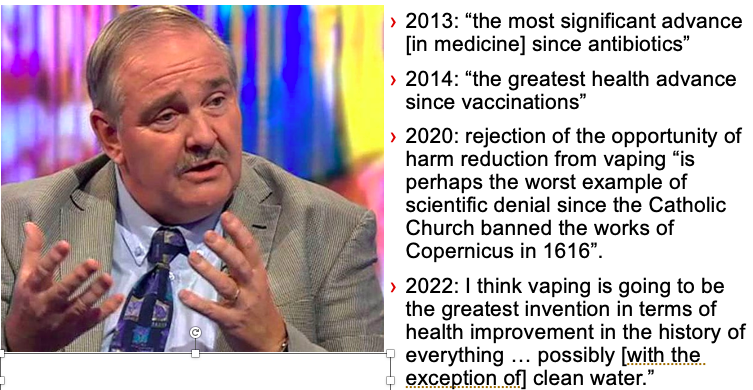
This trite factoid enjoyed massive sunlight for a few years after a 2014 meeting in which it was conjured. I took a close look at its discredited origins in this 2019 blog on the dirty dozen myths about vaping and again with others in this review in the American Journal of Public Health in 2020. Today it is richly deserved future museum piece alongside the greatest hits of the hyperbole king of vaping impact, Britain’s David Nutt.
2.Significant levels of vaping have been around now in Australia for some 10 years. If it was dangerous, where are all the bodies?
Daily vaping rates in Australiaincreased sevenfold between 2016-2023 from0.5% (100,000) in 2016 to 3.5% (700,000 people) in 2022–2023. So there are big numbers out there. Should we therefore be seeing evidence of declining deaths from smoking if so many are vaping these “extraordinarily successful” quit smoking aids? No. So when might that start being seen?
Smoking-caused chronic diseases like lung and cardiovascular disease and cancer have latency periods between first exposure and onset of symptoms and formal diagnosis of these diseases. This can vary with age of smoking commencement, duration of smoking and sex. These periods are uncommonly as soon as 15 years but much more likely to be 45+ years.
Current smokers are often diagnosed at a younger age (median ~63y) compared to former smokers (median ~69y). The overall average age for all lung cancer patients (including non-smokers) is typically around 70–72ys. So if smoking commences at ~15, latency periods range from 48-57 years (reference).
If chronic vaping also proves to cause chronic disease, we would not expect to see clear population level evidence of this until around 2050-60.
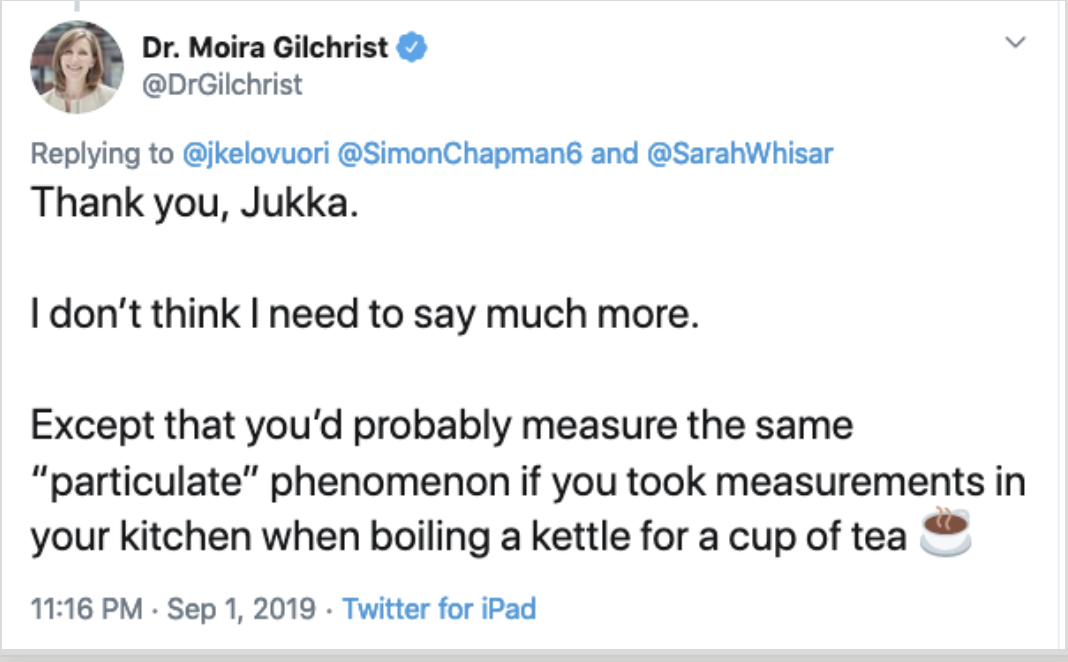
3. Vaping exposes you to particulates comparable to breathing steam from a kettle in your kitchen
The tobacco industry has decades-long form in trying to trivialise the harms of smoking. This priceless industry document from 1984 was a 20 page aide memoir for industry spokespeople being interviewed by the media about the harms of smoking. It’s not hard to imagine its genesis: “ok team, I want you to find as many things that can cause any sort of health problem that we can rattle off to interviewers who say smoking is harmful. Long hair, hot soup, hobbies. Find us more!
Thirty five years later, Moira Gilchrist, today Chief Global Communications Officer at Philip Morris International, echoed the same thinking when ridiculing silly people who worry about particulate matter exposure from vapes.
4.Flavour chemicals in vapes are just “food grade” chemicals – so nothing to worry about, folks!
Any toxicology undergraduate understands that the route of exposure or administration of a drug or chemical is fundamental in understanding its risks and benefits.Science journalist Dr Heather Goldstone put it beautifully like this (at 11m10to 24m50)
“It doesn’t take someone with an advanced degree in toxicology to understand that drinking water is different than breathing water”.
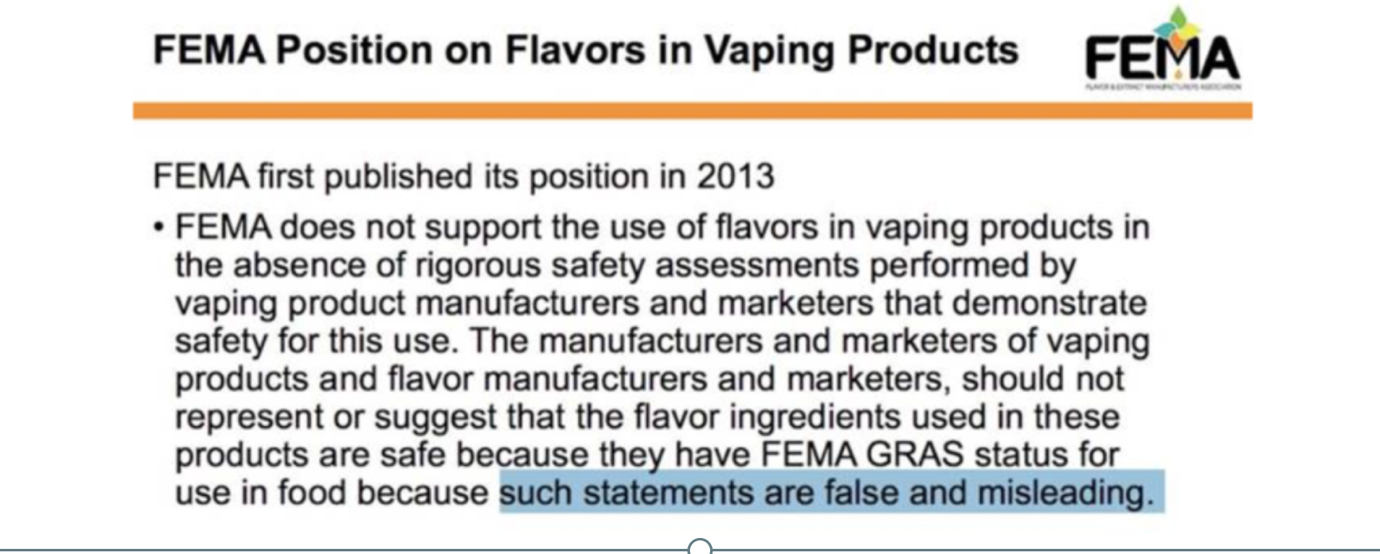
So swallowing a chemical may present a whole different risk profile to injecting, inhaling or having skin contact with the same chemical. In this blog, I looked at what the peak flavouring and extracts manufacturing association (FEMA)) in the US had to say about inhaling vapourised flavourants.
Here was an industry which earns its fortune from food, beverage and perfume smells and flavours which stood to earn gazillions more if toxicology gave the green light to adding flavourants to vapes. But twice (in 2013 and again in 2020) FEMA red-lighted the entire idea:
This has made zero impression with vaping advocates who cannot see beyond flavours being a major attractant for vaping. That’s the only myopic question they ask in their evangelical zeal.
In this 2020 blog, I examined the obvious question of why there is no inhalable pharmaceutical product anywhere in the world registered with a government drug regulatory authority which is flavoured. There’s no such thing as flavoured Ventolin (salbutamol) because flavours are totally unnecessary to the therapeutic action of salbutamol. People with asthma do not sign petitions demanding mango or watermelon flavours in their puffers. But vaping advocates will tell you again and again “nothing to worry about” – go ahead and try any one of these beguiling thousands of flavour chemicals, you suckers. Vaping is sooo important, it’s beyond being tied up in the regulations that all therapeutic goods have to meet.
5. “The liquid excipient propylene glycol used in vape liquid is harmless to breathe”
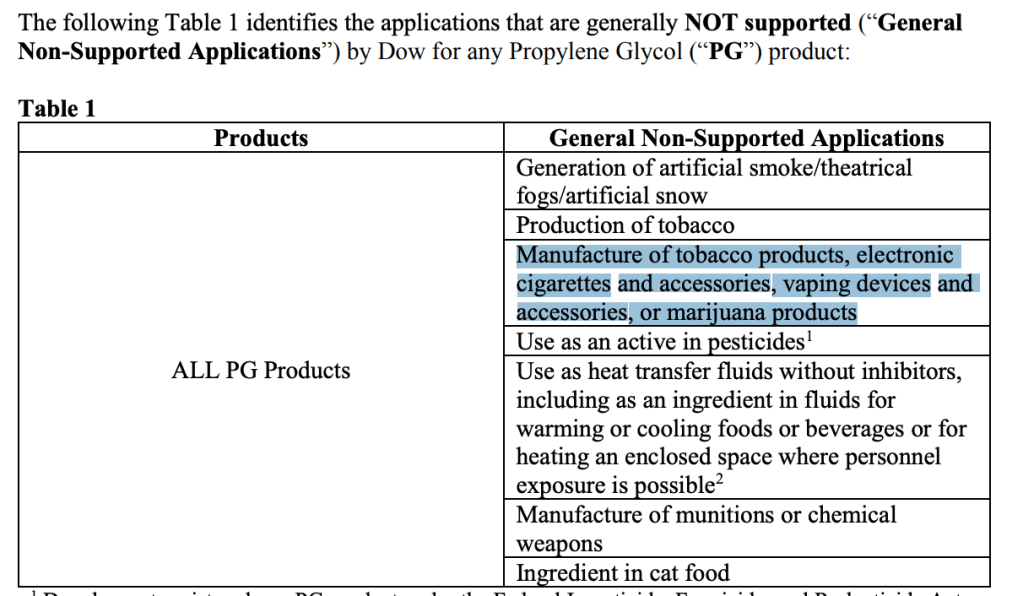
Nicotine in vapes is mostly infused in liquid propylene glycol (PG), along with nicotine, flavourings and temperature control chemicals. When a vape is inhaled, a metal coil in the vape heats this mixuture to 300o Celsius.
Dow Chemical, a major manufacturer of PG in 2019 explicitly named PG in vaping devices and accessories as a “non-supported application”. With the vast earnings potential for Dow in embracing PG in vapes, clearly the risk exposure to the company in doing so must have been assessed as massive.
6. Vaping liquids have cooling agent chemicals added to them to mask harshness
It’s not just PG, flavouring chemicals and nicotine that is added to the brew in vapes. University of Wollongong researchers detected the synthetic cooling agentWS-23 ((N-ethyl-p-menthane-3-carboxamide) in often high concentrations in all disposable vapes they tested. They noted that cytotoxicity studies have found that concentrations of WS-23 below those observed in e-liquids produced adverse effects in cell viability assays.
7.Heavy metal in your lungs, not just in your ears
Heated metal coils in vapes have been shown to shed micro particicles of heavy metals which are inhaled into the lungs.Korean researchers found e-cigarette users exhibited significantly higher serum concentrations of heavy metals than non-smokers. Lead levels were 10 % higher, mercury levels 13.7 % higher and cadmium levels were 61.4 % higher Cigarette smokers demonstrated elevated levels of these metals compared to non-smokers, but had generally lower levels than e-cigarette users.
8. Nicotine levels in vapes are not very addictive
Alex Wodak the tireless Australian vape promoter, says hand-on-heart that “vaping is not terribly addictive”. So consider this recent ABC video at 2m50s where a vaper says he goes through one 5000 puff disposable vape every four days and vapes “first thing in the morning and last thing at night” That’s 1,250 deep lung bastings every day. He’s vaped for four years. So that’s 1.825 million puffs pulled deep across the pink lungs of his mouth, throat and lungs across that time. Not terribly addictive. Yeah, right.
In this observational study of vapers allowed to vape ad libitum (ie as much or as little as they liked), for 90 minutes using their own vaping equipment, the median number of puffs taken over 90 minutes was 71 (i.e. 0.79 puffs per minute or 47.3 per hour). If a person vaped for 12 hours a day at that rate (generously allowing 12 hours for sleep and periods of non-vaping), this would translate to 568 puffs across a 12 hour day or 207,462 times in a year.
But in the ABC video we have a current vaper probably using a vape with five-fold higher nicotine dose than earlier generations of vape.
9. “Nicotine in the doses people get from vaping is all but benign”
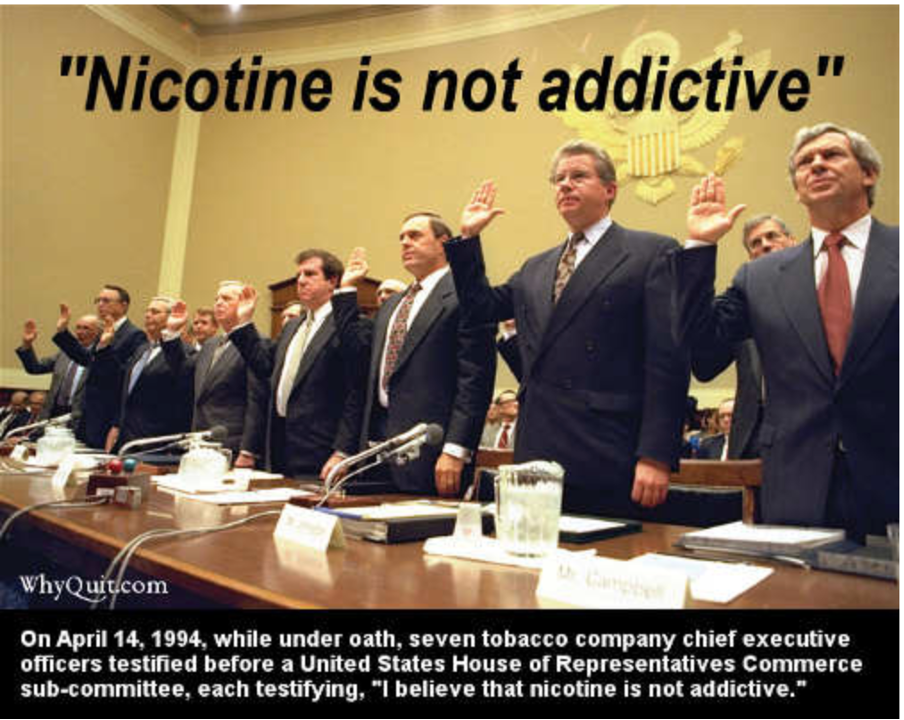
The sine qua non of smoking is nicotine. Marketing flashes in the pan like nicotine free herbal cigarettes have all been total market failures because smokers smoke to re-dose themselves with nicotine. The industry fiercely resists proposals for mandated nicotine-free cigarettes, from similar concerns. The industry and its supporters for decades publicly denied nicotine was addictive. After oceans of its internal documents showed this to be an elaborate collusion to stall regulation and reassure the public, it changed its tune.
The chorus then changed to “well yes, it is addictive but its harms have been demonised and besides, it’s pleasurable!”. In 2019 I compiled this selection of research about concerns with nicotinepublished in notable journals including Nature Reviews Cancer, Lancet Psychiatry, American Journal of Psychiatry, Mol Cancer Res, Critical Reviews in Toxicology, Carcinogenesis, Mutation Research, Int J Cancer, Apoptosis and Biomedical Reports. These concerns are seldom mentioned by those who recite Michael Russell’s dictum that “People smoke for the nicotine but they die from the tar” as a talisman against any expressed concerns about nicotine.
I’ve also listed numerous recent reviews of the emerging evidence about vaping and precursors of respiratory and cardiovascular disease. This evidence hardly describes an assessment of vaping as a benign practice akin to inhaling steam in a shower or having a couple of cups of coffee a day, analogies we hear used by vaping advocates.
Vaping cheer leader psychologist Peter Hajek said in 2013“Nicotine itself is probably safer than caffeine ….The case for regulating e-cigarettes as a pharmaceutical product is on a par with regulating coffee.”
In this piece in The Conversation, I looked at the nature of the pleasure that smokers claim for smoking. Just as we all get pleasure from the end of a terrible movie when we are finally able to escape from the middle of a row in the cinema, or from codeine when it works to quell a bad toothache, I argued that nicotine’s reputation for pleasure is mostly about each puff subtly relieving the onset of nicotine withdrawal sensations:
“Smokers know from the earliest days of their addiction these feelings can disappear within a few seconds as the nicotine is rapidly transported from their lungs to their brains where dopamine is released and experienced as pleasurable.
Smokers often insist the pleasure from this release can somehow be experienced independently of the pleasures of the nicotine withdrawal symptoms rapidly dissipating.
So what is the “pleasure” being experienced here? When you have a toothache and this is relieved by a strong analgesic, your mood can quickly elevate as the codeine begins to work.
The argument that smoking and inhaling nicotine is “pleasurable” is a bit like saying being beaten up every day is something you want to continue with, because hey, it feels so good when the beating stops for a while.”
Latvian ad for West cigarettes.
Translation: Westo -This shit won’t take it away from me.(ie I’d rather be beaten up than stop smoking West)
Also in this series
Vaping theology: 1 The Cancer Council Australia takes huge donations from cigarette retailers. WordPress 30 Jul, 2020
Vaping theology: 2 Tobacco control advocates help Big Tobacco. WordPress 12 Aug, 2020
Vaping theology: 3 Australia’s prescribed vaping model “privileges” Big Tobacco WordPress Feb 15, 2020
Vaping theology: 4 Many in tobacco control do not support open access to vapes because they are just protecting their jobs. WordPress 27 Feb 2021
Vaping theology: 5 I take money from China and Bloomberg to conduct bogus studies. WordPress 6 Mar, 2021
Vaping theology: 6 There’s nicotine in potatoes and tomatoes so should we restrict or ban them too? WordPress 9 Mar, 2021
Vaping theology: 7 Vaping prohibitionists have been punished, hurt, suffered and damaged by Big Tobacco WordPress 2 Jun, 2021
Vaping theology: 9 “Won’t somebody please think of the children”. WordPress 6 Sep, 2021
Vaping theology: 10: Almost all young people who vape regularly are already smokers before they tried vaping. WordPress 10 Sep, 2021
Vaping theology: 11 The sky is about to fall in as nicotine vaping starts to require a prescription in Australia. WordPress 28 Sep, 2021
Vaping theology: 12 Nicotine is not very addictive WordPress 3 Jan 2022
Vaping theology 13: Kids who try vaping and then start smoking,would have started smoking regardless. WordPress 20 Jan, 2023
Vaping theology 14: Policies that strictly regulate vaping will drive huge numbers of vapers back to smoking, causing many deaths. WordPress 13 Feb, 2023
Vaping theology 15: The government’s prescription vape access scheme has failed, so let’s regulate and reward illegal sellers for what they’ve been doing. WordPress 27 Mar 2023
Vaping theology 16: “Humans are not rats, so everybody calm down about nicotine being harmful to teenage brains”. WordPress 13 Jul, 2023
Vaping theology 17: “Vaping advocates need to be civil, polite and respectful” … oh wait. WordPress 3 Oct, 2023
Vaping theology 18: Vaping is a fatally disruptive “Kodak moment” for smoking. WordPress Oct 30, 2023
Vaping theology 19: Vaping explosions are rare and those who mention them are hypocrites. WordPress 17 Nov, 2023
Vaping theology 20 : Today’s smokers are hard core nicotine dependent who’ve tried everything and failed – so they need vapes. WordPress 14 Dec, 2023
Vaping theology 21: Australia’s prescription vapes policy failed and saw rises in underage vaping and smoking. WordPress 10 Jan, 2024
Vaping theology 22: “Prohibition has never worked at any point for any other illicit substance”. WordPress 17 Mar 2024
Vaping theology 23: “84% of the Australian public are opposed to the way the government will regulate vapes” WordPress 2 Apr, 2024
Vaping Theology 24: “Tobacco control advocates are responsible for vape retail store fire bombings and murders. WordPress 27 May, 2024
Australia’s epidemic of illicit (untaxed) cheap cigarette shops is entering a new phase as Australian Border Force reports record seizures and three states (South Australia, Queensland and New South Wales) have taken off the kid gloves and are now hammering illegal tobacco retailers.
Australian Border force data show “From 1 July 2024 to 30 June 2025, the ABF made 23,097 illicit tobacco detections, seizing 2.53 billion cigarette sticks and 435.46 tonnes of loose-leaf tobacco. This equates to a total of over 2,091 tonnes of illicit tobacco products seized and prevented an estimated $4.36 billion in duty evaded across the financial year.” In the first quarter of the 2025/2026 financial year, a further “586 million cigarettes and over 3 million vapes have already been seized at the Australian border in the first quarter of this financial year (1 July – 30 September)”.
Queensland has recently introduced fines of up to $161,300 or one year jail for a commercial landlord who knowingly allows a tenant to sell illegal cigarettes and vapes. Its store closure powers are now 3 months, up from a mere 72 hours, once commonly referred to as “the tobacconists’ long weekend”. The Health and Ambulance Services Minister Tim Nicholls describes the new laws as “an absolute game changer“.
South Australia has now closed 100 shops for 28 days, with two closed for much longer with another eight before the courts facing long term closure and massive fines; seized 41 million cigarettes (2.05 million packs); and 140,000 vapes.
NSW Health began getting serious when legislation enabling on the spot 90 day closures, stock seizures, landlord fines and serious maximum on-the-spot fines ($1.54m) came into effect from the first week in November. The Department updates its register of busts each Friday, with the current list now at 40 closures.
In early December raids on homes and storage facilities saw arrests and seizures of 10 tonnes of illegal tobacco.
Western Australia and Victoria which have historically been on the national podium for their early adoption of most tobacco control laws and regulations but look certain to get the booby prize on this issue, both still playing catch-up with other states .
For as long as governments have taxed tobacco, tobacco companies have lobbied for the taxes to be frozen or reduced. For over 40 years they have had day-by-day, shop-by-shop, brand-by brand data on the sales impact of every variable know to reduce or increase cigarette sales. Significantly here, tax increases have always been in the industry’s crosshairs because they depress sales.
Sweet spot tax fantasies
It’s been standard for several years now for those in lockstep with Big Tobacco’s calls for lowering tobacco tax to call for a halt to rises and to make allusions to tobacco excise tax actually falling. Deakin University criminologist James Martin has been in the forefront of these calls for Australia’s tobacco tax to be lowered but until quite recently had been too shy to give us all his expert figure on a new “sweet spot” for a tax reduction. This would be the point where many smokers would abandon buying cheap illicits and go back to paying for legal taxed cigarettes.
Today, if you buy a carton illegal cigarettes, you can get them for as low as $7 a pack of 20. A common range for a single pack is $10-$15. Martin and Alex Wodak dodged naming a tax rate in July 2025 in a Crikey piece when vaguely urging “reducing tobacco excise to undercut the illicit trade”. Something called “Harm Reduction Australia” published an unsigned Tobacco Harm Reduction Policy Brief , presumably covered with the fingerprints of its tobacco harm reduction advisors, Wodak and Martin. They suggested that the tax be reduced to the level it was in 2020. In this August 2025 blog, I did the maths, and generously took the hypothetical cuts even further back to 2019 tax levels to see how things tasted.
If this occurred today, the retail price of a reduced tax pack would fall to some $22, still $7 or 47% more than a pack of $15 illegals or $15 more than the $7 a pack when buying by the carton price.
So on what planet would anyone be living on who seriously thought such a tax reduction would see droves of smokers rush back to the newly reduced tax legal cigarettes?
Eliminate tobacco tax … to get more smokers buying taxed tobacco!
This ludicrous penny may well have finally dropped for Martin when in November he was publicly quoted in the Singapore Straits Times that “taxes would need to be significantly lowered and even eliminated to discourage criminals from operating a black market.” [my emphasis]. Eliminated. Now how would this work?
Let’s walk through his brilliance.
So … the government has a problem that it’s losing lots of tax revenue because many smokers are buying illegal untaxed cigarettes. To fix this, Martin suggests that the government should consider dropping all tobacco tax. If it did this, there would of course be no tobacco tax to collect, but, hey, these now (legal) untaxed cigarettes would be competitive with (illegal) untaxed cigarettes and the black market would be “discouraged”. All following this?
But wait… with the newly tax-free legal cigarettes, where would the government get the extra river of gold of tobacco tax revenue from that it desperately needs, since it would have just eliminated it all? Whoops!
Enter the Davidson
The latest player to step forward into this mess is Professor Sinclair Davidson from Victoria’s RMIT. Davidson, an adjunct ‘fellow’ at regulation-scything Institute of Public Affairs has been an anti tobacco control warrior for sometime via his now defunct Catallaxy Files blog and his four time participation in Big Tobacco’s annual invitation-only global shindig, the Global Tobacco and Nicotine Forum.
In a paper for the Centre for Independent Studies, Davidson is also shy of telling us what his tobacco tax cut/illegal tobacco ending magic number is. All he’s willing to say is that it would be “stabilised within an economically defensible range”. And that would be?
Google Scholar shows Davidson has had 320 publications since 1991, 134 (42%) of which are uncited. Six of these are about tobacco, which have attracted all of 26 cites. That’s his form in all this. Still, a 42% never-cited rate is a lot better than the 82% rate reported across the humanities.
Those lobbying hard to get governments to do something sensible to wreck Australia’s illegal tobacco and vapes market are in an unlikley choir that has never sung from the same hymn sheet before. It includes Treasury, the convenience store, tobacco and vaping industries, and public health. All are very keen to see illicit tobacco trade fall dramatically. Treasury wants tobacco tax to grow, and the three industries want their tobacco sales revenue streams back. Public health and government want smoking to fall, and non-smokers (especially kids) to not buy vapes or tobacco, as they increasingly are failing to do.
Wastewater nicotine analysis: total nicotine is falling, not rising
Here, wastewater nicotine analysis offers a potential lever for the industry interests to pull in its lobbying for tax reduction. We have all seen illegal tobacco shops openly trading, and some think this must mean that more people are smoking to make this trade viable. But is it actually true that cheap illegal cigarettes are causing more people to take up smoking and less to quit? Or is it just moving lots of current smokers from legal sales outlets to much cheaper illegal ones?
Here, Davidson quotes from the National Wastewater Drug Monitoring Program’s (NWDMP) latest report for 2023-24 .They have been testing since 2016-17, publishing data on nicotine found in wastewater (sewage) in testing sites serving 57% of the Australian population (14.5m) with both regional and capital city sampling.
The summary below from its latest report shows that between April and August 2024, population weighted nicotine consumption fell in both regional and capital city Australia. In fact this fall has been going on since August 2023: page 16 of the report states that while illegal tobacco and vape retailing was booming “for nicotine, average consumption [across Australia] decreased between August 2023 and August 2024” Although page 87 notes that “average capital city nicotine consumption then increased from August to October 2024”.
Contrast those words with Davidson’s at p6 of his report “Wastewater analysis reinforces this picture: between August 2023 and August 2024, aggregate consumption of nicotine rose to above long-term averages”. The NWDMP reports on “average consumption decreased” (ie population weighted) while Davidson says “aggregate consumption … rose” (ie total consumption unweighted for population growth).
Sorting different sources of nicotine
The NWDMP’s testing to estimate consumption of nicotine is done by measuring two nicotine metabolites, cotinine and hydroxycotinine. Their report notes on page 32 that this method “cannot distinguish between nicotine from tobacco, e-cigarettes, or nicotine replacement therapies such as patches and gums” and that “consumption of nicotine has increased over the life of the Program” (p59)
This is hardly surprising. Vaping in Australia rose substantially between 2019-2023 and in 2022-23, 233,544 PBS prescriptions were issued for nicotine replacement therapy (NRT), some 43% of the estimated NRT market (a majority of which is over-the- counter sales in pharmacies and supermarkets). So together with nicotine from vapes, this NRT sourced nicotine represents a river of excreted nicotine in the sum of total nicotine in Australian sewage systems, a point acknowledged by Davidson.
Emerging science points to possibilities of testing wastewater to get separate estimates for total nicotine (cigarettes, vapes and NRT combined) including that only from cigarette use.Anabasine and anatabine are minor alkaloids found in tobacco but are absent in NRT. However anabasine is present not just in cigarettes but also in e-liquids and aerosols. So challenges remain to test for estimates of only tobacco use (leaving out NRT and vaping nicotine exposure).
This is an area of science very much in its infancy, with the take-home message being that we all need to remain sceptically alert to crude claims that “wastewater” analysis is showing changes one way or the other in tobacco smoking.
Those in Australia who have collectively decades of experience in monitoring and interpreting different data sets on tobacco use, repeatedly emphasise that longer term data from multiple sources including survey data are essential in getting a true picture of trends. Prof Coral Gartner from the University of Queensland said that “All data, including that from wastewater, has limitations and errors, including seasonal effects. What may look like an increase in one data collection can become just ‘noise’ when further data points are added.”
If you search “wastewater and nicotine” for Australia, stand by for reports on the latest NWDMP data that variously describe nicotine as being up or down. Those catastrophising the possibility that smoking will be certain to rise in the presence of cheap illegal cigarettes can take nothing definitive from the latest wastewater statistics. But with those who collect and interpret it saying that total nicotine is down across the country, those saying it is up need to explain themselves.
Modern vaping theology venerates New Zealand’s “regulated vaping market model” as the way all nations should go if they want to reduce smoking. Its doctrinaire, excitable adherents feverishly point to unparalleled recent declines in smoking prevalence in all adults, in Māori adults (who smoke much more than the general population) and in youth. These declines are said to have followed the advent and rise in vaping and New Zealand’s Nov 2020 regulation of vapes which allowed them to be legally sold from dedicated vape stores and ‘dairies’(small, owner-operated convenience stores selling groceries, milk and other essentials, often outside of regular business hours).
As I noted in an earlier blog, the UK, USA and Canada also have highly liberal vape access policies (regulated market models) but comparable or higher smoking prevalence than Australia, which has far more restricted vape access legislation. Vaping advocates like to cherry pick New Zealand to provide a comparison with Australia compatible with their previous outspoken advocacy for regulated market models.
The evidence being used here is cross-sectional (ie: annual school surveys of around half of all New Zealand year 10 –14-15yo students) from 2014-2019.2015 was the first year that the survey asked questions about vaping frequency, enabling reporting on daily vaping. The graph below shows a 0.7% absolute decline and a 25% relative fall in daily smoking between 2014 and 2019, while daily vaping rose between 2015-2019 from 1.1% to 3.1% (2% absolute and 65% relative increases).
Every first semester biostats student has it drilled into them that cross-sectional data cannot be used to draw causal conclusions. When I edited Tobacco Control across 17 years, this criticism was probably that most commonly made by reviewers of papers which used post hoc ergo propter hoc (after therefore because of) reasoning with cross-sectional data. The 2020 paper’s authors were therefore wise to use “suggests …might” when they concluded “…overall decline in smoking over the past 6 years in New Zealand youth suggests that e-cigarettes might be displacing smoking”.
But many vaping advocates aren’t typically bothered by the sublimation of associations into causal language conclusions when it suits their agenda. An analysis of submissions to the New Zealand Parliament’s Health Select Committee considering a 2020 Bill which regulated the sale and marketing of e-cigarettes, found that the 2020 paper was the most frequently cited evidence used to try and influence the Committee, including by British American Tobacco. Those fervidly embracing the paper who are determined to preserve, strengthen and evangelically promote New Zealand’s experience internationally would have hardly complained if associations morphed into causes when the rubber met the road of political, media treatment and public understanding tests.
But , whoa! Hold the horses!
Sensing there were problems with the paper, Sam Egger from Cancer Council NSW led a paper that took a deeper dive into an expanded data set from 1999-2023 noting that the 2020 paper had only looked at 2014-2019 data and that 2014 was “years after vaping had established a notable presence in New Zealand. Importantly, the analysis did not assess whether smoking trends changed before and after shifts in vaping prevalence, an essential requirement for evaluating the population-level impacts of vaping on smoking.”
In other words, the 2020 paper had not considered the question of whether the remarkable decline in youth smoking which started well before the appearance and proliferation of vaping in youth (see chart below), accelerated with the arrival of vapes in about 2010 and then their rapid uptake after 2019 (with the latter, it of course could not have done this, having 2019 data as its endpoint).
This was a very basic omission, and one that amounted to seriously narrowing the evidence goalposts in the exercise of assessing vaping’s possible role in influencing trends in smoking by 14 and 15 year olds. The question about ever vaping was added to the school survey in 2014, with daily vaping added a year later. This start of these questions would not have been a capricious choice but one that almost certainly would have reflected common observational ‘knowledge’ of youth vaping increasing, perhaps over several years prior to 2014 when it was first counted. ASH, which is responsible for the annual surveys since 1999 (see graph below), clearly knew youth smoking had been in freefall since at least 1999 so that factors other than vaping were in play.
In their no stone unturned paper using interrupted time series analysis they concluded “In stark contrast to the conclusion of the previous study, we found that among 14-15 year-olds, the emergence and rapid rise in vaping in New Zealand may have slowed the rates if decline in ever- and regular smoking, while having little or no impact on the rate of decline in daily smoking.”
In a commentary in The Conversation, they noted “the rates of decline in ‘ever smoking’ and ‘smoking regularly’ slowed significantly from 2010 onwards, coinciding with the emergence of vaping in New Zealand. The rate of decline in daily smoking did not change significantly from 2010 onwards.
In 2023, about 12.6% of 14 and 15-year-olds in New Zealand had ‘ever smoked’ (ranging from just a few puffs to smoking daily). However, if the ‘ever smoking’ rate had continued along its pre-2010 trajectory (before vaping emerged) this figure would have been 6.6%.”
So there was now plenty of heat in this particular data analytic kitchen. But then a blowtorch arrived with an apparently blistering critique of what the Egger authors had done. Four authors from the University of Queensland gave the Egger group both barrels with a three point shellacking that essentially went “here’s what you did, and here’s what you should have done … so your conclusions are unsound”. Read it all in the link.
All this will have been read by a small number of people who closely follow these debates. And will have been understood by an even smaller number who are highly trained in analysis of trend data.
But one thing is absolutely certain, the veteran nag confirmation bias will yet again get a good run around the block. Those who like the conclusions of the 2020 paper will keep megaphoning them without mentioning the Egger group’s very contrasting findings. Criminologists have a term for this: the ‘woozle effect’ where studies with flawed conclusions that have been discredited continue to be referenced, as though those conclusions still offer credible evidence.
I published a paper in 2009 on citation bias, which is the selective citation of published results to support the findings, arguments or interests of authors and those funding their work. Our paper showed that a very old (1982) and small study (n=24) showing extremely high smoking prevalence in people with schizophrenia (88%), had been massively cited in preference to many more recent and larger studies which showed far lower smoking by those with schizophrenia. News media commonly referred to smoking rates in those with schizophrenia as “as high as 90%” when a meta-analysis of 42 studies found average smoking prevalence to be 62%, much higher than the general population but nowhere near 90%.
Australian smoking rates have never been lower in adults, school kids, low socio-economic groups, and First Nations people. That’s a good thing, right? These outcomes represent the results of decades of policy reform and government campaigns. But these bottom lines mean little to fringe critics of Australia’s approach to tobacco control, who are licking their wounds after failing badly to stop the government from regulating vapes to allow then to be sold in as many retail situations as possible.
Then there those who passionately believe that expensive, highly taxed cigarettes are a cruel impost on low income earners. For several years, in pitch perfect unison with Big Tobacco which has lobbied for decades to keep tobacco tax low to sell more cigarettes, they argue that the government should lower tobacco tax to make it easier for them to afford to smoke. Could there be any more truly perverse way to help the poor?
Illicit tobacco has been widely available in Australia for over 25 years, long before the significant rises in tobacco tax began in 2012.These critics also never mention the inconvenient truth that large black markets for tobacco exist in most countries, including those where tobacco tax is much lower than in Australia. So plainly, there is far more to understanding illicit tobacco markets than tax alone.
The widespread, blatant proliferation of duty-not-paid dirt cheap tobacco has excited these critics. Barely a week goes by when they are quoted on what the government needs to do, and “lowering” tobacco tax is always front and centre of the mantra.
But as I’ve noted before, it’s one thing to call for tax to be lowered, and quite another to draw on your expertise to help the Treasury know exactly where the magic sweet spot reduction should fall to make smokers who are now buying cheap illicits go back to duty-paid cigarettes. James Martin and Alex Wodak fudged naming a date or percent reduction in a Crikey piece when urging “reducing tobacco excise to undercut the illicit trade”. So OK gents, how much of a reduction are you talking about?
But all rejoice! The wait is now over!
In recent weeks, critics have put their hands up with several figures. In June, Harm Reduction Australia published an unsigned Tobacco Harm Reduction Policy Brief , presumably with the fingerprints of its tobacco harm reduction advisors, Alex Wodak and James Martin.
The short document recommended this:
So there’s the level: lower the tax rate back five years to that we had in 2020. That will fix things, right?
Or we could go back another year to 2019 when tobacco tax was still lower. In a very uncharacteristic slip, ABC economics expert Alan Kohler, snuck this final line into an otherwise very sensible commentary on the black market: “The other thing the federal government could do is reduce the tobacco excise back to what it was before 2019, which would lead to a huge increase in revenue.” An increase presumably explained by droves of smokers abandoning illegal cigarettes for the newly competitively reduced-tax legal ones.
Or according to Kingsley Wheaton, Chief Corporate Officer for British American Tobacco, who flew out to Australia in June to talk about the “basic economics” of tobacco tax, this should involve a “reversion to the 2018 (tobacco tax) rate“.
And then we come to the really heavy duty ordinance, this time from Australian economist Steven Hamilton, a professor at George Washington University. Quoted in The Saturday Paper, in April “So my suggestion would be that there is one solution and one solution only, and it is to radically reduce the rate of tax on cigarettes. Take the tax rate on cigarettes back to where it was 10 years ago, make legal channels competitive, and the black market will disappear.” Disappear! It’s that easy! Ten years ago – in 2015 – tobacco tax was $0.53096 and a packet of 20 budget cigarettes cost $24.28 (see table 13.3.3 here)
OK, so let’s take one of these named years – 2019 – and do the simple early high school arithmetic on how dropping tax back seven years would go in demolishing the black market.
In 2019, excise tax on cigarettes per stick was $0.81775 (in March) and $0.96653 (in September) —see Table 13.6.2 here. This means that the tax component in 2019 of a pack of 20 was either $16.335 or $19.3306. For retail price, we need to add GST and the manufacturers’ and retailers’ margins (see chart below for the current proportions) to see what a legal pack of 20 cigarettes would retail at under the new retro tax regime proposed by our disappearing black market pundits.
So let’s show this for a typical budget brand in the chart.
Excise 73.9% = $16.34
GST 9.1% = $2.01
Retail mark-up 8.1% = $1.79
Manufacturer mark-up 8.9% = $1.97
Total retail price: $22.11
Here’s a conversation between two smokers:
Bill: Hey, the government has dropped tobacco tax big time! You can get a pack of 20 now for Just over $22.
Bob: Really? I can buy my smokes at cheap smokes shop for as low as $10 a pack, sometimes as high as $20 in high income suburbs. So these new reduced tax smokes are still more than double the lowest price of the dodgy ones. Why would I be mad enough to pay out all that extra?
The common $10 smokers can now pay for illegal cigarettes is clearly still highly profitable for those selling them. It is anyone’s guess how much even lower their price could fall and still retain acceptable profitability. After first publishing this blog, I was told of $8 packs of 20 being sold in Muswellbrook in rural NSW, presumably still making a profit for all in the chain. So the above sums are likely conservative about how much tax would need be lowered to get prices on par or cheaper than illicit cigarettes.
So this heroic step would do absolutely nothing to solve the problem.
It is just gobsmacking that people positioning themselves as credible advisors on how to undercut the black market could not have asked this most basic and fundamental of all questions about their magic reductions. And equally, that so many journalists have let them blather on and never questioned it. A Sydney Morning Herald editorial in June stated without blinking “a tax rethink on tobacco excise is self-evident and common sense”.
The tax cut to 2015 levels proposed by Steven Hamilton goes closest to a nominal sweet spot. But If the Government were to put the tax down to 2015 levels then the prices of taxed products would only be competitive with the current illicit prices if Big Tobacco and all retailers also selflessly reverted to what they charged back in 2015. Yeah, that’s really going to happen. Pigs might fly too.
8 Nov 2025 BREAKING! Deakin University criminology academic James Martin publicly stated in the Straits Times that “taxes would need to be significantly lowered and even eliminated to discourage criminals from operating a black market.” [my emphasis]. Now how will this work? Martin suggests even eliminating all tobacco tax so that smokers who have been buying illicit untaxed cigarettes, will switch to legal cigarettes … which will be also untaxed. The government will then reap the tax benefit from these untaxed legal cigarettes. Are we all following this remarkable proposal?