
Tags
Addendum: One month ago to the day from when I published this blog, the NSW Minns’ has announced major weapons-grade increases in fines and jail terms for illegal tobacco traders. Importantly, it will allow landlords to evict those legally trading from their rented properties. Huge congratulations to the leadership at NSW Health and the Minns’ government.
*****
Several Australian states are experiencing a wholesale disregard for laws that outlaw the sale of tobacco products where excise duty has not been paid, and with vapes being sold in any circumstance other than through a registered pharmacy. It has been unambiguously illegal to sell duty-not-paid cigarettes since 1901 and to sell vapes outside a pharmacy since July 1, 2024. Major media attention is being focussed on
- the extent of this brazen contempt
- the involvement of criminals in its operation
- the major fall in government revenue as droves of smokers unsurprisingly choose to pay $10-$15 a pack for smuggled cigarettes instead of north of $40 and past $60 for cigarettes which are currently taxed at $1.40 per stick
- alleged objections from police about reluctance to get involved in “regulating a legal product”
High excise is not the cause nor lowering it the solution
The populist wisdom on why all this has happened is that Australia, with the world’s highest tobacco tax rate, has foolishly brought this on itself. This claim is manifestly ignorant because how do we then even begin to explain that nearly every nation – including all those with much lower tobacco tax than Australia (especially in low income nations) – have long had extensive black markets for tobacco too? Black markets are booming today in (to name just a few) Malaysia and South Africa (both with 65% of all tobacco sold being illicit) and Brazil (50%), all which have lower tobacco tax than Australia.
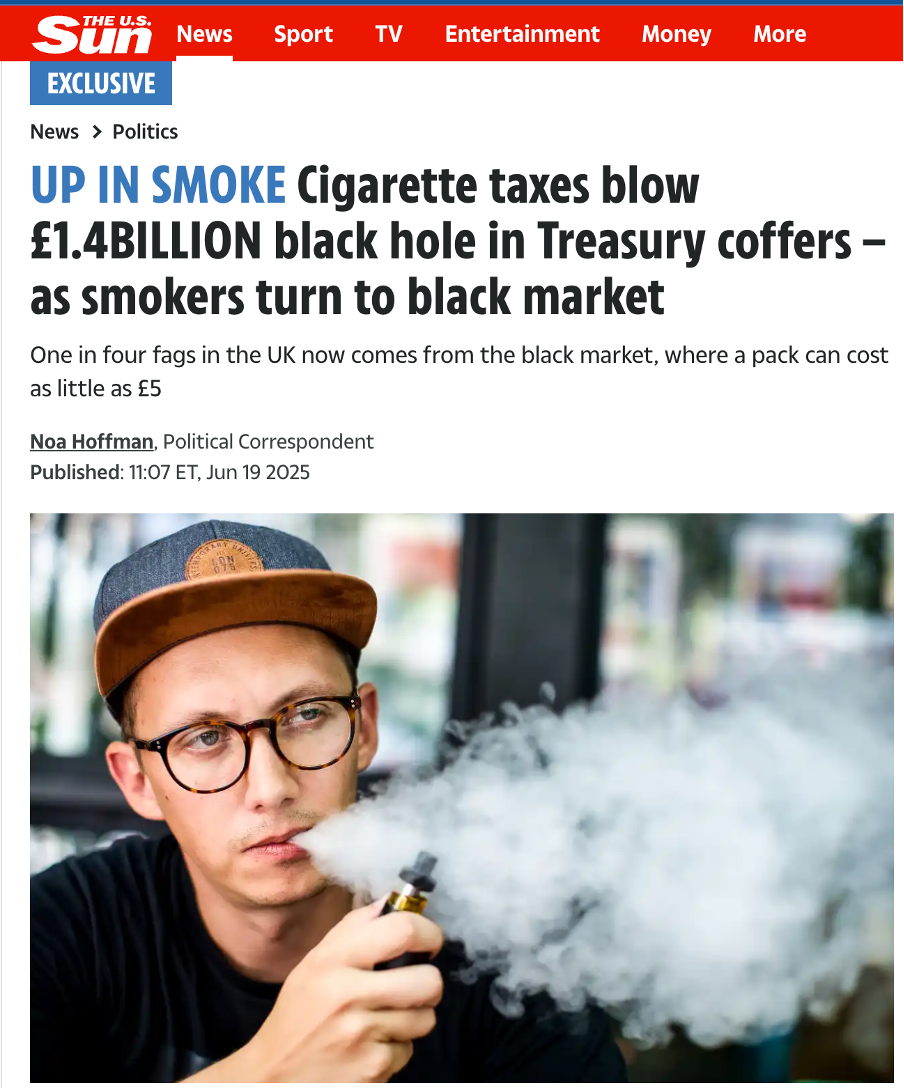
Tobacco industry estimates of the extent of black markets routinely exaggerate their size, as part of a decades-long global campaign to lobby governments to reduce tax, with cheaper retail prices known to increase demand.
The Australian Association of Convenience Stores which has a history of Big Tobacco links is cheer leading the claim on repeat that the excise should be “lowered”. But tellingly, those joining this choir never name how much of a reduction would be required to make the price of legal duty paid cigarettes competitive with cheaper illicit packs.
Basic arithmetic shows this: the current tax of $1.40 per cigarette means $28 excise is already in the mix before the lucrative cuts for both cigarette manufacturers and retailers combine to lift the cost of a pack of 20 at the very low budget brands end of the market to $40. Premium taxed brands can cost well over $50.
So let’s imagine the Commonwealth government introduced the radical and globally unprecedented step of slashing excise by a huge 50%, a truly la-la land proposition. This would mean the tax component would fall to 70c a stick, or $14 a pack of 20s. No one, just no one is arguing that manufacturers and retailers would then follow suit and reduce their margins by a comparable percentage in a selfless noble gesture to assist smashing the black market.
This means that our hypothetical 50% reduction in tobacco tax would still mean a tax-paid budget brand would still cost $14 in tax alone, already nudging the high end ($15) of what black market packs cost today. So adding the retailer+manufacturer’s combined margin of $12 to the $14 taxed price component, our fantasy “reduced tax” pack would retail at $26. This would still be blown right out the water by comparable budget black market offerings of $10-$12 a pack.
So even halving tobacco tax would do nothing to make legal taxed cigarettes competitive with cheap smuggled smokes. Freezing tobacco tax or cutting it by less than 50% would be equally inconsequential.
Just as every nation has illegal trade in illicit drugs (even in nations where death penalties are given by courts), no regulatory plan will eliminate the tobacco black market. But there is a world of difference between neon-lit, 7 days a week, 18 hours a day high street illegal tobacco trading and what would remain if it was driven totally underground.
Failure to enforce the law — the elephant in the room
There are many challenges being faced in prosecuting illegal tobacco and vape sellers. Here are a few. Staff in the shops are often instructed by their bosses to simply run out of the premises if visited by inspectors. Those who talk typically insist they have never met the owners and don’t know their names. They are instructed to take their cash wages from the till on each payday, so presumably all staff are on untaxed cash arrangements. All purchases are cash only, leaving no credit card trails, both facts that would be of considerable interest to the Australian Taxation Office.
With seizures being sometimes very substantial and so costly to the illegal sellers, many now limit their in-store tobacco and vape stock to only that required for a typical day’s sales, with any needed extra stock being kept off-site in car boots parked near the shops. Commercial storage companies are also suspected of being used to store large quantities. Section 233 of the Customs Act 1901 Smuggling and unlawful importation and exportation states that it is illegal for anyone to “unlawfully convey or have in his or her possession any smuggled goods or prohibited imports or prohibited exports.” So these storage facilities would be legally vulnerable if police were to tail deliveries picked up from them.
It’s common to find shops which have had stock seized and staff put on notice today, open again tomorrow with new stock delivered overnight.
The strategy of holding small quantities in-store limits the cost of losses to the shops through seizures, but this is irrelevant to establishing a prosecution as even having a single vape or illegal pack of cigarettes can trigger a prosecution with no court likely to find it credible that a store operated with just a handful of stock.
In country towns in particular, some police claim they face real challenges in storing seized goods because of no storage facilities in typically small police stations. Seized goods must be kept as exhibits until prosecutions are finalised through the courts, which can take many months. But we don’t hear the same lame concerns made about storage problems with recovered stolen vehicles, large scale hauls of goods recovered from break and enters, nor about illicit drug busts including whole fields or greenhouses of marihuana.
Police ‘don’t want to be regulators”
This reported police complaint points to a wider issue of some often anonymous police commentators feeling that illicit tobacco selling does not deserve the attention of serious police work. I’m old enough to remember police indifference and even hostility to getting involved in random breath testing, preventive domestic violence intervention, white collar and cyber crime, all of which today are part of the daily meat and potatoes of police work.
I’ve heard threats of police being taken off the beat chasing hardened criminals and of resultant understaffing to attend to domestic violence should policing illegal tobacco step up. But police attend outdoor music festivals in droves with 75% of attendees surveyed saying they had experienced police in relation to their drug use at such festivals.
The Australian Federal Police actively police counterfeit imported luxury good knock-offs on sale in Australia as part of their work investigating breaches of intellectual property. With the significant excise tax losses to the Commonwealth from black market tobacco, it is difficult to understand why sleuthing fake Channel perfume or Louis Vuitton handbag vendors could be of higher priority than systematically busting a trade costing the government billions of dollars a year.
One argument with its hand up is that tobacco is a “legal product”, with some police believing they should have no part in ensuring that its sale is within the law. Alcohol, firearms, gambling and motor vehicles are also legal products, yet police have long histories both of issuing defect notices on cars and doing firearm license and home safe storage compliance checks: two examples of legal goods and services being used under illegal circumstances. Just as with the present situation on illegal “legal” tobacco.
And not to mention illegal trade in alcohol. Here are all the offences and penalties that go with illegal of serving liquor in NSW. Police are active in investigating and enforcing the ban on selling alcohol to minors.
Food
State governments are well used to regulating businesses, with there being no better example of the way food safety laws are enforced. Food standards are enforced by Australian state and territory food regulatory agencies, the Australian Government’s Department of Agriculture and Fisheries and Forestry. In NSW, the government’s NSW Food Authority is responsible for monitoring and regulating food safety across the entire food industry supply chain from paddock to plate. Importantly, it maintains a public online “name and shame” register where there are currently 901 businesses listed which since December 2022 have been fined for breaches.
Again, food is a “legal product” with preparing this legal food in unhygienic and unsafe ways being illegal.
But police are being cooperative
Despite these media claims, I’m advised by public health colleagues that in fact, NSW police have been very cooperative when asked to join in inspections of known illegal tobacco retailers. There has been good cooperation between Health, Border Force, and the Commonwealth’s Therapeutic Goods Administration (when illegal vapes are of interest). All this suggests other agenda like industrial jostling for greater funding may be at work when “not our bailiwick” comments are reported.
Solutions – breaking the weakest link
With the evasive template described above, cooperative agency tactics could include ensuring inspections see all entrances to shops guarded prior to raids. Surveillance of deliveries, with tracing of vehicles after drop-offs to locate storage premises and those working in them and pro-active warning to commercial self-storage businesses that failure to ensure illicit tobacco and vapes are not being stored will have major consequences.
But the very weakest link in all of this is that all cheap tobacco premises are not owned by those trading in them. The shops are always rented. While the patsy shop assistants may well be ignorant of the identities of those above them, those owning the premises are legally obliged to have the names, contact details and typically banking details of the parties who are paying them rent. The Office of Fair Trading makes it clear that it is illegal for a landlord to knowingly allow a commercial premises to be used for illegal activities. All standard commercial tenancies across Australia include terms that consider illicit activities by the tenant a major breach and cause to terminate the tenancy agreement. If evidence is provided to these landlords that their renters are conducting illegal trade on their premises, this is grounds for termination of a lease and prosecution of landlord should the illegal trade continiue.
Voiding insurance
Huge publicity including via ABC Four Corners and a series of large pieces in the Sydney Morning Herald has been given to arson attacks and standover tactics by criminals intent on forcing legal tobacco retailers to stock illegal tobacco and vapes that they supply. The insurance industry has reacted to this by raising premiums to stratospheric levels making it almost impossible for tobacconists to buy insurance. Landlords run massive risks by renting to uninsurable illegally trading tobacco businesses. Should an arson fire spread to adjoining premises causing extensive property damage or death and injury to people, landlords’ liability would be immense.
But this scenario has been on-going and clearly increasing for many months. Enough landlords are presumably prepared to take these very substantial risks. So what actions and reforms could state governments make to quickly bring the legal and pecuniary interests of landlords to bear on illegal tobacco and vape retailers?
If all states were to adopt a public “name and shame” strategy modelled on that used with food safety breaches in concert with substantial on-the-spot fines, landlords and insurers could routinely search the database for the names applicants for tenancy or insurance. Such fines should immediately result in inclusion on the register. Establishing such a register could be implemented at virtually no cost in a matter of weeks.
Queensland and South Australia
Queensland and South Australia both offer examples of very encouraging progress.
Queensland has recently amended its legislation to empower significant on-the-spot fines in addition to subsequent prosecutions through the courts. For individuals, maximum fines can be issued up to $32,260 for the commercial supply of illicit tobacco and nicotine products. Corporations face penalties of up to $161,300. South Australia too, has stepped up firmly to the enforcement plate with an illicit tobacco taskforce within its Consumer and Business Services in partnership with Health and SAPOL’s [South Australian Police] running Operation Eclipse. The operation has seized millions of dollars’ worth of illicit cigarettes, vapes and loose tobacco. More than 500 inspections have been conducted around the state with 20% of these taking place in regional South Australia. representing $4 million worth of the illicit products seized.
The Minister has also issued 33 short-term closure orders and successfully had two long term closure orders approved by the Magistrates Court. The SA government has also recently passed legislation to increase fines to up to $6.6 million for the supply and possession of commercial quantities of illicit tobacco and vapes.
Between 1 July 2024 and 31 May 2025, 819 penalty infringement notices were issued in Queenland for supply and commercial possession of illicit products, with a value of more than $10.7 million.
Queensland Health can also issue an interim closure order for up to 72 hours and up to six months under a court order where there is evidence of either unlicensed or continued illicit tobacco or vape supply. More than 121 interim closure orders have been issued since September 2024 when the commencement of powers for closures began.
Legacy of the neglect
The loss of tobacco tax to the Treasury being caused by the current tobacco black market is a public finance issue, not primarily a health issue. When smokers buy cheaper cigarettes, the money they save does not somehow disappear from the economy. It is either saved or used to buy other goods and services, most of which are goods and services (GST) taxed and all of which have multiplier effects in the economy. Non-smokers are not unpatriotic tax-avoiders, for the very same reason.
But easy access to cheap tobacco is most definitely is a public health issue because of the huge body of evidence linking tobacco tax prices rises to reduced smoking through quitting and reducing the number of cigarettes smoked as well as powerfully dissuading uptake in non-smokers. Smoking rates in both adults and teenagers are now the lowest ever recorded in Australia. It would be a tragedy if that record was trashed by a continuing failure to enforce the law.
Criminals who have now for many months sold illegal tobacco with impunity might well think that they would experience a similar dream run if they opened up a river of shops where unlicensed, they brazenly sold cheap duty-not-paid alcohol to anyone who anyone who wanted it, or counterfeit prescription only drugs to walk-ins.

 Simon Chapman AO