At yesterday’s Illicit Tobacco and E-Cigarette national symposium in Canberra, veteran illicit trade expert Ted Leggett from the UN’s Office of Drugs and Crime told the room in the final session that those at the peak of the global illicit tobacco trade can buy cigarette packs from manufacturers for just US42 cents. Many of these are sourced from Big Tobacco companies which export in bulk to customers and then wash their hands of any knowledge or responsibility when these products end up in illicit trade.
In Australia, the retail carton price of an illegal untaxed pack is as low as $7 – over 1500% more than they were first bought for by those at the apex of the trade. Of course, $7 provides cuts for the retailers, transportation from overseas, warehousing costs and distribution to the retailers. So a single pack price of $10-$15 is common as all get their heads in the trough.
For the last few years, several Australian commentators on the dynamics of Australia’s in-your-face illicit tobacco retailing have been on repeat telling anyone commercially illiterate enough to listen that the way out of the problem needs to be led by a government volte face on tobacco tax. Deakin University criminologist James Martin has been a go-to person for those seduced by how obvious a solution lowering the tax must surely be.
In an earlier blog I listed some of Martin’s public statements on just how low tax would need to fall. Last November he even suggested to the Singapore Straits Timesthat tobacco tax might need to be “even eliminated to discourage criminals from operating a black market”. No country in the world has zero tobacco tax, so that’s quite an out there suggestion, to say the least.
Australia’s current tobacco tax since March 3 2026 has been $1.52829 per stick, or $30.57 per pack of 20. Martin has suggested lowering the tax to the “sweet spot” which applied in 2020, around the time that sales of illicit cigarettes really began booming. In March 2020, excise was $0.94964 or $18.99 a pack.
So if the government was to heed Martin’s “eliminate” tax nostrum tomorrow, a typical budget brand costing $42 would cost $11.43 and if instead they dropped the tax to 2020 levels, the pack cost would be $23.
Given that current price competition for taxed budget band cigarettes is within a $2-3 range (check the price board in any supermarket), the price difference between Martin’s eliminated tax packs and the $7 for illicits you can pay if you buy by the carton, is already way over that, at $4.43. And the reduction to the 2020 sweet spot? A whopping $12 more than $7, a difference that of course would not make a blind bit of difference to the price attractiveness of illicits.
What started all this?
Under the Morrison government (Aug 2018 – May 2022) Health Minister Greg Hunt introduced a bill with two pillars: to make vapes available only through pharmacies, and to outlaw personal and commercial importation of vapes unless these were for the pharmacy trade. In June 2022, 28 Liberal/National backbenchers led by Matt Canavan signed a letter to Prime Minister Morrison which set in train the deliberate gutting of Hunt’s bill. Pharmacy access remained but the import ban lapsed after Morrison presumably caved. This rendered the pharmacy access component a dead duck: why go to a chemist when you could get vapes anywhere?
Vape shops then began mushrooming in plague proportions across the country, with state health authorities rarely raising a finger. With the COVID pandemic declared on March 11, 2020 COVID dominated public health priorities for several years. Understandably, the last thing state governments were going to do amid this crisis was to direct any serious action at illegal vape shops.
Across several years, flagrant illegal retailing with bold signs advertising availability consolidated across Australia. Criminals (by definition) who were supplying this illegal trade collectively thought “no one has done anything to stop us with vapes … so what are we waiting for? Let’s expand and sell illegal, untaxed cigarettes openly too.”
This was compounded by state governments having unfit for purpose legislation that prevented them issuing on-the-spot fines, seizing stock and closing illegal traders instead having to go through long drawn out and expensive legal action. Most states did not require tobacconists to be licensed, so there were no databases on retailers either.
All this has now changed radically as I detailed here. Queensland and South Australia led the way with weapons-grade legislation, with NSW late to the party in 2025 with on-the-spot seizures, closures and eye-watering maximum fines for both individuals and corporations caught selling. Victoria and Western Australia have still to embed their legislation.
Immensely effective regulatory models have long existed in the pharmaceutical, alcohol and firearms retailing areas. Any enterprising criminal who set up high street shops selling prescribed drugs to walk-ins with no prescription, alcohol without a liquor license or firearms to unlicensed shooters would be hit with the proverbial tonne of legal and jail time bricks.
We are a way off emulating those best practices with tobacco sales. There was important discussion at the symposium about the bizarre anomaly that there are some 40,000 tobacco retailers serving less than 10% of the population who now smoke; while there are 7,000 petrol stations for 19 million licensed drivers and 6,000 pharmacies serving well over 90% of the population want prescribed and other medicines.
Supermarkets have easily the most responsible tobacco sales record when it comes to not selling to kids. The idea that cigarette sales might only occur there may well be in the wind.
Mass shootings like Port Arthur, Christchurch and Bondi focus nations’ minds on gun control far more than day-in-day-out shootings where one or two typically die. Mass shootings demand political response: something must be done. Thoughts and prayers are never enough. Parliaments rapidly convene and the usual suspects roll out their talk of knee-jerk reactions and of “decent, law-abiding citizens” whose freedoms to own frighteningly lethal weapons must never be impinged. On cue, Nationals like Bridget McKenzie and One Nation’s new recruit Barnaby Joyce didn’t disappoint in the last week, climbing in their tardis and repeating discredited arguments from 30 years ago.
In their world apparently, there are decent law abiding gun owners and those who should never be let near guns. But in ten mass gun homicides at Hoddle St, Melbourne (1987), Canley Vale NSW (1987), Oenpelli Northern Territory (1988), Strathfield (1990), Terrigal (1992), Hillcrest Queensland (1996), Port Arthur (1996), Osmington, Western Australia (2018), Christchurch (2019) and Bondi (2025) all the perpetrators had neither any history of violence nor any documented history of mental illness.
Two of these attracted post hoc descriptions of the shooters being strange or loners, joining millions who might attract such comments. Until they started shooting, all were McKenzie’s and Joyce’s law abiding citizens.
The new laws will give police greater powers to do background checks on gun licence applicants. One of the Bondi shooters was licensed and had six legal, registered weapons which he shared with his unlicensed son. So will more thorough licence application checks require police to also investigate the backgrounds of all family members too – sons, brothers, fathers, uncles? And what about all associates and friends? Might not someone with an unblemished background easily be a conduit who could pass their legal guns and arsenal of ammunition others? Clearly all such possibilities are way beyond any realistic chance of being investigated.
But we don’t use the same arguments about any form of policing. Every day a random breath testing unit picks up a few over the limit, many more are driving intoxicated without being caught. It’s the same with speeding. So stop both of these practices because they fail to eliminate all dangerous driving? Really?
Port Arthur saw sweeping reform centred on the outlawing of semi-automatic rifles and pump action shot guns from civilian ownership, gun registration and mandatory locked storage in homes. In the 17 years before Port Arthur, there were 13 mass gun homicides where four or more (not including the killers) died. In the 30 years since, there have been two: a six victim familicide in Western Australia and Bondi.
After I published a report 20 years on from the 1996 reforms, opponents of the changes were arguing that a mass shootings are rare events and that the 20 year absence of massacres then might just be a chance occurrence. We calculated the likelihood of this being mere chance was some 200,000 to 1 and that had the trend of mass shootings pre-Port Arthur continued, we would have expected another 16 mass shootings. We had none in 20 years, with just two since.
Bondi revealed that 30 years after the 1996 Port Arthur triggered National Firearms Agreement, a functioning national system of seamless gun registration is still not a reality. The police can get and share instant information on criminal records, vehicle registration and driver licensing. All our medical records are available to any doctor with our consent. The intransigence with gun registration is utterly scandalous.
We can expect the new reforms will reduce the probability of future massacres, but may not eliminate them. Gun control advocates have long asked governments to require all licensed weapons to be stored in high security community armouries, user paid through gun licensing and registration. This has never been taken up. Maybe next time.
Australian smoking rates have never been lower in adults, school kids, low socio-economic groups, and First Nations people. That’s a good thing, right? These outcomes represent the results of decades of policy reform and government campaigns. But these bottom lines mean little to fringe critics of Australia’s approach to tobacco control, who are licking their wounds after failing badly to stop the government from regulating vapes to allow then to be sold in as many retail situations as possible.
Then there those who passionately believe that expensive, highly taxed cigarettes are a cruel impost on low income earners. For several years, in pitch perfect unison with Big Tobacco which has lobbied for decades to keep tobacco tax low to sell more cigarettes, they argue that the government should lower tobacco tax to make it easier for them to afford to smoke. Could there be any more truly perverse way to help the poor?
Illicit tobacco has been widely available in Australia for over 25 years, long before the significant rises in tobacco tax began in 2012.These critics also never mention the inconvenient truth that large black markets for tobacco exist in most countries, including those where tobacco tax is much lower than in Australia. So plainly, there is far more to understanding illicit tobacco markets than tax alone.
The widespread, blatant proliferation of duty-not-paid dirt cheap tobacco has excited these critics. Barely a week goes by when they are quoted on what the government needs to do, and “lowering” tobacco tax is always front and centre of the mantra.
But as I’ve noted before, it’s one thing to call for tax to be lowered, and quite another to draw on your expertise to help the Treasury know exactly where the magic sweet spot reduction should fall to make smokers who are now buying cheap illicits go back to duty-paid cigarettes. James Martin and Alex Wodak fudged naming a date or percent reduction in a Crikey piece when urging “reducing tobacco excise to undercut the illicit trade”. So OK gents, how much of a reduction are you talking about?
But all rejoice! The wait is now over!
In recent weeks, critics have put their hands up with several figures. In June, Harm Reduction Australia published an unsigned Tobacco Harm Reduction Policy Brief , presumably with the fingerprints of its tobacco harm reduction advisors, Alex Wodak and James Martin.
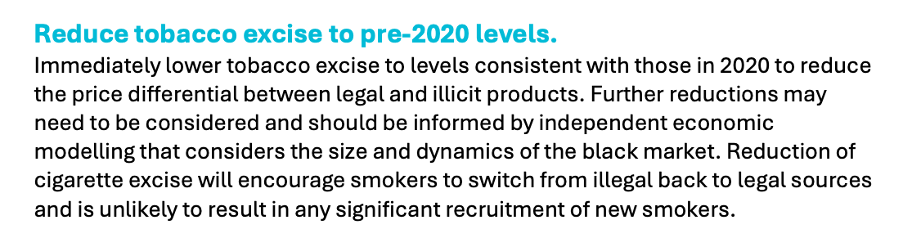
The short document recommended this:
So there’s the level: lower the tax rate back five years to that we had in 2020. That will fix things, right?
Or we could go back another year to 2019 when tobacco tax was still lower. In a very uncharacteristic slip, ABC economics expert Alan Kohler, snuck this final line into an otherwise very sensible commentary on the black market: “The other thing the federal government could do is reduce the tobacco excise back to what it was before 2019, which would lead to a huge increase in revenue.” An increase presumably explained by droves of smokers abandoning illegal cigarettes for the newly competitively reduced-tax legal ones.
Or according to Kingsley Wheaton, Chief Corporate Officer for British American Tobacco, who flew out to Australia in June to talk about the “basic economics” of tobacco tax, this should involve a “reversion to the 2018 (tobacco tax) rate“.
And then we come to the really heavy duty ordinance, this time from Australian economist Steven Hamilton, a professor at George Washington University. Quoted in The Saturday Paper, in April “So my suggestion would be that there is one solution and one solution only, and it is to radically reduce the rate of tax on cigarettes. Take the tax rate on cigarettes back to where it was 10 years ago, make legal channels competitive, and the black market will disappear.” Disappear! It’s that easy! Ten years ago – in 2015 – tobacco tax was $0.53096 and a packet of 20 budget cigarettes cost $24.28 (see table 13.3.3 here)
OK, so let’s take one of these named years – 2019 – and do the simple early high school arithmetic on how dropping tax back seven years would go in demolishing the black market.
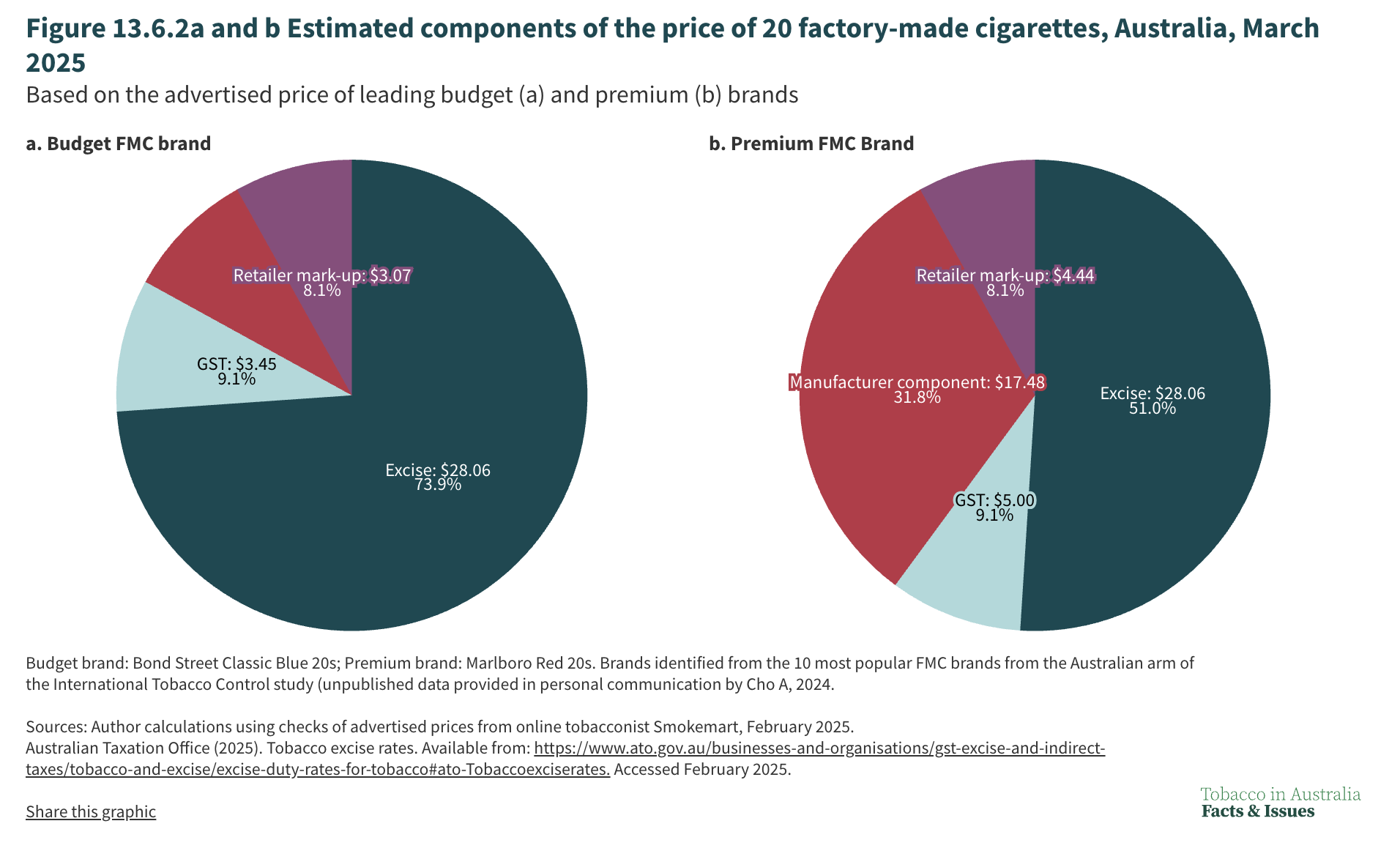
In 2019, excise tax on cigarettes per stick was $0.81775 (in March) and $0.96653 (in September) —see Table 13.6.2 here. This means that the tax component in 2019 of a pack of 20 was either $16.335 or $19.3306. For retail price, we need to add GST and the manufacturers’ and retailers’ margins (see chart below for the current proportions) to see what a legal pack of 20 cigarettes would retail at under the new retro tax regime proposed by our disappearing black market pundits.
So let’s show this for a typical budget brand in the chart.
Excise 73.9% = $16.34
GST 9.1% = $2.01
Retail mark-up 8.1% = $1.79
Manufacturer mark-up 8.9% = $1.97
Total retail price: $22.11
Here’s a conversation between two smokers:
Bill: Hey, the government has dropped tobacco tax big time! You can get a pack of 20 now for Just over $22.
Bob: Really? I can buy my smokes at cheap smokes shop for as low as $10 a pack, sometimes as high as $20 in high income suburbs. So these new reduced tax smokes are still more than double the lowest price of the dodgy ones. Why would I be mad enough to pay out all that extra?
The common $10 smokers can now pay for illegal cigarettes is clearly still highly profitable for those selling them. It is anyone’s guess how much even lower their price could fall and still retain acceptable profitability. After first publishing this blog, I was told of $8 packs of 20 being sold in Muswellbrook in rural NSW, presumably still making a profit for all in the chain. So the above sums are likely conservative about how much tax would need be lowered to get prices on par or cheaper than illicit cigarettes.
So this heroic step would do absolutely nothing to solve the problem.
It is just gobsmacking that people positioning themselves as credible advisors on how to undercut the black market could not have asked this most basic and fundamental of all questions about their magic reductions. And equally, that so many journalists have let them blather on and never questioned it. A Sydney Morning Herald editorial in June stated without blinking “a tax rethink on tobacco excise is self-evident and common sense”.
The tax cut to 2015 levels proposed by Steven Hamilton goes closest to a nominal sweet spot. But If the Government were to put the tax down to 2015 levels then the prices of taxed products would only be competitive with the current illicit prices if Big Tobacco and all retailers also selflessly reverted to what they charged back in 2015. Yeah, that’s really going to happen. Pigs might fly too.
8 Nov 2025 BREAKING! Deakin University criminology academic James Martin publicly stated in the Straits Times that “taxes would need to be significantly lowered and even eliminated to discourage criminals from operating a black market.” [my emphasis]. Now how will this work? Martin suggests even eliminating all tobacco tax so that smokers who have been buying illicit untaxed cigarettes, will switch to legal cigarettes … which will be also untaxed. The government will then reap the tax benefit from these untaxed legal cigarettes. Are we all following this remarkable proposal?
Several Australian states are experiencing a wholesale disregard for laws that outlaw the sale of tobacco products where excise duty has not been paid, and with vapes being sold in any circumstance other than through a registered pharmacy. It has been unambiguously illegal to sell duty-not-paid cigarettes since 1901 and to sell vapes outside a pharmacy since July 1, 2024. Major media attention is being focussed on
the extent of this brazen contempt
the involvement of criminals in its operation
the major fall in government revenue as droves of smokers unsurprisingly choose to pay $10-$15 a pack for smuggled cigarettes instead of north of $40 and past $60 for cigarettes which are currently taxed at $1.40 per stick
alleged objections from police about reluctance to get involved in “regulating a legal product”
High excise is not the cause nor lowering it the solution
The populist wisdom on why all this has happened is that Australia, with the world’s highest tobacco tax rate, has foolishly brought this on itself. This claim is manifestly ignorant because how do we then even begin to explain that nearly every nation – including all those with much lower tobacco tax than Australia (especially in low income nations) – have long had extensive black markets for tobacco too?Black markets are booming today in (to name just a few) Malaysia and South Africa (both with 65% of all tobacco sold being illicit) and Brazil (50%), all which have lower tobacco tax than Australia.
The Australian Association of Convenience Stores which has a history of Big Tobacco links is cheer leading the claim on repeat that the excise should be “lowered”. But tellingly, those joining this choir never name how much of a reduction would be required to make the price of legal duty paid cigarettes competitive with cheaper illicit packs.
Basic arithmetic shows this: the current tax of $1.40 per cigarette means $28 excise is already in the mix before the lucrative cuts for both cigarette manufacturers and retailers combine to lift the cost of a pack of 20 at the very low budget brands end of the market to $40. Premium taxed brands can cost well over $50.
So let’s imagine the Commonwealth government introduced the radical and globally unprecedented step of slashing excise by a huge 50%, a truly la-la land proposition. This would mean the tax component would fall to 70c a stick, or $14 a pack of 20s. No one, just no one is arguing that manufacturers and retailers would then follow suit and reduce their margins by a comparable percentage in a selfless noble gesture to assist smashing the black market.
This means that our hypothetical 50% reduction in tobacco tax would still mean a tax-paid budget brand would still cost $14 in tax alone, already nudging the high end ($15) of what black market packs cost today. So adding the retailer+manufacturer’s combined margin of $12 to the $14 taxed price component, our fantasy “reduced tax” pack would retail at $26. This would still be blown right out the water by comparable budget black market offerings of $10-$12 a pack.
So even halving tobacco tax would do nothing to make legal taxed cigarettes competitive with cheap smuggled smokes. Freezing tobacco tax or cutting it by less than 50% would be equally inconsequential.
Just as every nation has illegal trade in illicit drugs (even in nations where death penalties are given by courts), no regulatory plan will eliminate the tobacco black market. But there is a world of difference between neon-lit, 7 days a week, 18 hours a day high street illegal tobacco trading and what would remain if it was driven totally underground.
Failure to enforce the law — the elephant in the room
There are many challenges being faced in prosecuting illegal tobacco and vape sellers. Here are a few. Staff in the shops are often instructed by their bosses to simply run out of the premises if visited by inspectors. Those who talk typically insist they have never met the owners and don’t know their names. They are instructed to take their cash wages from the till on each payday, so presumably all staff are on untaxed cash arrangements. All purchases are cash only, leaving no credit card trails, both facts that would be of considerable interest to the Australian Taxation Office.
With seizures being sometimes very substantial and so costly to the illegal sellers, many now limit their in-store tobacco and vape stock to only that required for a typical day’s sales, with any needed extra stock being kept off-site in car boots parked near the shops. Commercial storage companies are also suspected of being used to store large quantities. Section 233 of the Customs Act 1901 Smuggling and unlawful importation and exportation states that it is illegal for anyone to “unlawfully convey or have in his or her possession any smuggled goods or prohibited imports or prohibited exports.”So these storage facilities would be legally vulnerable if police were to tail deliveries picked up from them.
It’s common to find shops which have had stock seized and staff put on notice today, open again tomorrow with new stock delivered overnight.
The strategy of holding small quantities in-store limits the cost of losses to the shops through seizures, but this is irrelevant to establishing a prosecution as even having a single vape or illegal pack of cigarettes can trigger a prosecution with no court likely to find it credible that a store operated with just a handful of stock.
In country towns in particular, some police claim they face real challenges in storing seized goods because of no storage facilities in typically small police stations. Seized goods must be kept as exhibits until prosecutions are finalised through the courts, which can take many months. But we don’t hear the same lame concerns made about storage problems with recovered stolen vehicles, large scale hauls of goods recovered from break and enters, nor about illicit drug busts including whole fields or greenhouses of marihuana.
Police ‘don’t want to be regulators”
This reported police complaint points to a wider issue of some often anonymous police commentators feeling that illicit tobacco selling does not deserve the attention of serious police work. I’m old enough to remember police indifference and even hostility to getting involved in random breath testing, preventive domestic violence intervention, white collar and cyber crime, all of which today are part of the daily meat and potatoes of police work.
I’ve heard threats of police being taken off the beat chasing hardened criminals and of resultant understaffing to attend to domestic violence should policing illegal tobacco step up. But police attend outdoor music festivals in droves with 75% of attendees surveyed saying they had experienced police in relation to their drug use at such festivals.
The Australian Federal Police actively police counterfeit imported luxury good knock-offs on sale in Australia as part of their work investigating breaches of intellectual property. With the significant excise tax losses to the Commonwealth from black market tobacco, it is difficult to understand why sleuthing fake Channel perfume or Louis Vuitton handbag vendors could be of higher priority than systematically busting a trade costing the government billions of dollars a year.
One argument with its hand up is that tobacco is a “legal product”, with some police believing they should have no part in ensuring that its sale is within the law. Alcohol, firearms, gambling and motor vehicles are also legal products, yet police have long histories both of issuing defect notices on cars and doing firearm license and home safe storage compliance checks: two examples of legal goods and services being used under illegal circumstances. Just as with the present situation on illegal “legal” tobacco.
And not to mention illegal trade in alcohol. Here are all the offences and penalties that go with illegal of serving liquor in NSW. Police are active in investigating and enforcing the ban on selling alcohol to minors.
Food
State governments are well used to regulating businesses, with there being no better example of the way food safety laws are enforced. Food standards are enforced by Australian state and territory food regulatory agencies, the Australian Government’s Department of Agriculture and Fisheries and Forestry. In NSW, the government’s NSW Food Authority is responsible for monitoring and regulating food safety across the entire food industry supply chain from paddock to plate. Importantly, it maintains a public online “name and shame” register where there are currently 901 businesses listed which since December 2022 have been fined for breaches.
Again, food is a “legal product” with preparing this legal food in unhygienic and unsafe ways being illegal.
But police are being cooperative
Despite these media claims, I’m advised by public health colleagues that in fact, NSW police have been very cooperative when asked to join in inspections of known illegal tobacco retailers. There has been good cooperation between Health, Border Force, and the Commonwealth’s Therapeutic Goods Administration (when illegal vapes are of interest). All this suggests other agenda like industrial jostling for greater funding may be at work when “not our bailiwick” comments are reported.
Solutions – breaking the weakest link
With the evasive template described above, cooperative agency tactics could include ensuring inspections see all entrances to shops guarded prior to raids. Surveillance of deliveries, with tracing of vehicles after drop-offs to locate storage premises and those working in them and pro-active warning to commercial self-storage businesses that failure to ensure illicit tobacco and vapes are not being stored will have major consequences.
But the very weakest link in all of this is that all cheap tobacco premises are not owned by those trading in them. The shops are always rented. While the patsy shop assistants may well be ignorant of the identities of those above them, those owning the premises are legally obliged to have the names, contact details and typically banking details of the parties who are paying them rent. The Office of Fair Trading makes it clear that it is illegal for a landlord to knowingly allow a commercial premises to be used for illegal activities. All standard commercial tenancies across Australia include terms that consider illicit activities by the tenant a major breach and cause to terminate the tenancy agreement. If evidence is provided to these landlords that their renters are conducting illegal trade on their premises, this is grounds for termination of a lease and prosecution of landlord should the illegal trade continiue.
Voiding insurance
Huge publicity including via ABC Four Corners and a series of large pieces in the Sydney Morning Herald has been given to arson attacks and standover tactics by criminals intent on forcing legal tobacco retailers to stock illegal tobacco and vapes that they supply. The insurance industry has reacted to this by raising premiums to stratospheric levels making it almost impossible for tobacconists to buy insurance. Landlords run massive risks by renting to uninsurable illegally trading tobacco businesses. Should an arson fire spread to adjoining premises causing extensive property damage or death and injury to people, landlords’ liability would be immense.
But this scenario has been on-going and clearly increasing for many months. Enough landlords are presumably prepared to take these very substantial risks. So what actions and reforms could state governments make to quickly bring the legal and pecuniary interests of landlords to bear on illegal tobacco and vape retailers?
If all states were to adopt a public “name and shame” strategy modelled on that used with food safety breaches in concert with substantial on-the-spot fines, landlords and insurers could routinely search the database for the names applicants for tenancy or insurance. Such fines should immediately result in inclusion on the register. Establishing such a register could be implemented at virtually no cost in a matter of weeks.
Queensland and South Australia
Queensland and South Australia both offer examples of very encouraging progress.
Queensland has recently amended its legislation to empower significant on-the-spot fines in addition to subsequent prosecutions through the courts. For individuals, maximum fines can be issued up to $32,260 for the commercial supply of illicit tobacco and nicotine products. Corporations face penalties of up to $161,300. South Australia too, has stepped up firmly to the enforcement plate with an illicit tobacco taskforce within its Consumer and Business Services in partnership with Health and SAPOL’s [South Australian Police] running Operation Eclipse. The operation has seized millions of dollars’ worth of illicit cigarettes, vapes and loose tobacco. More than 500 inspections have been conducted around the state with 20% of these taking place in regional South Australia. representing $4 million worth of the illicit products seized.
Between 1 July 2024 and 31 May 2025, 819 penalty infringement notices were issued in Queenland for supply and commercial possession of illicit products, with a value of more than $10.7 million.
Queensland Health can also issue an interim closure order for up to 72 hours and up to six months under a court order where there is evidence of either unlicensed or continued illicit tobacco or vape supply. More than 121 interim closure orders have been issued since September 2024 when the commencement of powers for closures began.
Legacy of the neglect
The loss of tobacco tax to the Treasury being caused by the current tobacco black market is a public finance issue, not primarily a health issue. When smokers buy cheaper cigarettes, the money they save does not somehow disappear from the economy. It is either saved or used to buy other goods and services, most of which are goods and services (GST) taxed and all of which have multiplier effects in the economy. Non-smokers are not unpatriotic tax-avoiders, for the very same reason.
But easy access to cheap tobacco is most definitely is a public health issue because of the huge body of evidence linking tobacco tax prices rises to reduced smoking through quitting and reducing the number of cigarettes smoked as well as powerfully dissuading uptake in non-smokers. Smoking rates in both adults and teenagers are now the lowest ever recorded in Australia. It would be a tragedy if that record was trashed by a continuing failure to enforce the law.
Criminals who have now for many months sold illegal tobacco with impunity might well think that they would experience a similar dream run if they opened up a river of shops where unlicensed, they brazenly sold cheap duty-not-paid alcohol to anyone who anyone who wanted it, or counterfeit prescription only drugs to walk-ins.
Labor’s stunning election victory and the relegation of the conservative opposition to likely years of political eunuch status opens up many opportunities across all areas of government. With health minister Mark Butler playing a powerful wingman role to the Prime Minister, he is in the driver’s seat to finish the historic job he started back in 2022 with regulating vaping. In the three years, Australian streets have been deluged by blatant law-breaking cheap tobacco and convenience shops selling smuggled cigarettes and vapes, since 2024 permitted to be sold only in pharmacies.
Butler’s deeply impressive leadership on vaping and tobacco reforms saw him carry forward a Labor heritage which started in 1973 when Gough Whitlam took the first step to ban tobacco advertising. Butler was Minister for Ageing and Australia’s first Minister for Mental Health in the Gillard Government when Nicola Roxon was the senior health minister and introduced the world’s first plain tobacco packaging bill, now adopted by 25 nations and under active consideration in another 14.
Like plain packs, the regulation of access to vapes to pharmacy sales is another world first. But Butler must be understandably frustrated by what has become an epidemic of political duck-shoving where some states have talked the supportive talk, but not walked the implementation and enforcement walk.
As a result, illicit vapes remain readily available mostly via the plague of “cheap cigarette” shops which lead their trade with lucrative totally illegal duty-not-paid smuggled cigarettes which also break Australia’s plain packaging laws.
So how has this got to the in-your-face blatant law-breaking it has, and what should happen to fix it?
Enforcement of the law
All states and the Commonwealth government now have in place laws that make selling vapes anywhere but in a pharmacy unambiguously illegal. Importing, wholesaling and retailing tobacco products which have evaded excise tax are all illegal under Commonwealth law, attracting eye-watering major maximum fines for large scale offenders and routine confiscation and destruction of stock.
But illegal sales of both vapes and tobacco are rampant with the Sydney Morning Herald noting that there are currently 60 “cheap smokes” shops in Sydney for every one McDonalds outlet. 824 have opened in recent years in the Inner West council region alone. This situation is most pronounced in NSW and Victoria, the two states yet to implement mandatory tobacco retail licensing, despite calls for years from public health experts for this to happen. Licensing provides a database enabling authorities to routinely check whether licensees are compliant with the law and the threat of removal of a license and close-down orders for those not.
However clearly, many now selling illegally will reason from several years of experience that no authorities have ever raided their shops, so why would things be any different if they bothered to not get a tobacco retailing license?
And that has been the elephant in the room sized problem that few will talk about. Most state health authorities seem purposefully blind to what everyone else can see: that there is a burgeoning forest of “cheap smokes” and convenience stores selling illegally which open every day with zero consequence.
How have they justified this wholesale neglect?
I recently had dinner with the head of a NSW state public health unit. I asked him what his unit was doing about enforcement of the laws on selling illegal tobacco and vapes. He confirmed very little was being done with the major reason being concern about staff safety. His staff were well aware and concerned that violent criminals are involved in the tobacco and vape trade, and of the screaming headlines of multiple arson attacks on tobacco outlets by rival tobacco supply gangs, particularly in Victoria. All illegal tobacco outlets have CCTV cameras and staff were anxious they would be identified and threatened. Several public heath chiefs understandably took these concerns seriously and believed that police needed to be involved far more in enforcement of the laws.
Imagine if criminal syndicates decided that there were vast amounts of money to be made by selling prescribed drugs in high street shops and online to anyone who wanted them without a prescription. Or that the law on selling alcohol only through premises with liquor licences could just as easily be ignored with every town and suburb opening up multiple shops selling duty-not-paid booze. Public and licensed liquor outrage would be immense and police action swift.
Pharmacies are rarely prosecuted for supplying drugs to those without prescriptions, and pubs, clubs and bars known to routinely sell liquor to kids are jumped on fast, with their goldmine liquor licences under threat.
One mystery here is why the supermarket sector, which has always had an exemplary record of rarely selling tobacco to kids, has not used its massive power and united to demand strong action against illegal tobacco retailing. If this trade diminished in a major way, supermarkets would be major beneficiaries of returning smoking customers.
NSW
The Herald reported that some 2000 inspections of these dodgy retailers in metropolitan illegal trade had been undertaken by NSW health inspectors who had seized illegal stock worth $24m. These are far from trivial numbers, but there’s an obvious mystery here. Conspicuously absent in the Herald’s report was any mention of completed or in-process prosecutions of those from whom these products were seized.
Let’s assume that nearly all those inspected were selling. The customers who come and go into these premises each day know that. So why wasn’t stock seized from all of them, and why is there no apparent data on how many are facing prosecutions when since November 2024, NSW has had maximum penalties of $154,000 and up to $22,000 for selling to children, with higher for corporations?
Last Friday, one Sydney tobacco retailer with a business turnover of $3.3m was hit with a $5,560 fine plus $6,850 in costs. The cynical Herald commented “That’ll show him, or it would if the financial gains made from running tobacconists weren’t so generous … [the] fine and the prosecution’s costs put a 0.37 per cent dent in last year’s bottom line.”
NSW Health staff are known to be immensely frustrated by the Department’s legal branch refusing to proceed with cases. This must be a major focus of the current NSW parliamentary enquiry into illegal tobacco trade.
Police in some states seem reluctant to see illegal tobacco retailing as serious crime unless violence or arson is involved. The Sydney Morning Herald reported a senior officer as saying “Our involvement is primarily about the acts of violence that was used by these people to take the tobacco. I think our system and our response is adequate, and we’ll keep maintaining that.”
South Australia, and to a lesser extent Queensland seem to have sorted out any problems that NSW seems to have with lack of police interest In enforcing the law. There, the police apparently don’t pick and choose which law breaking they will investigate.
South Australia
Under A media release dated 6 May 2025 from South Australia’s Consumer and Business Services stated:
“More than $23 million in illicit tobacco and vapes have been seized across South Australia since the start of Consumer and Business Services’ crackdown.
Since 1 July, our illicit tobacco taskforce within CBS, in partnership with SAPOL’s [South Australian Police] Operation Eclipse and other agencies, has seized millions of dollars’ worth of illicit cigarettes, vapes and loose tobacco.
This includes:
17.2 million cigarettes valued at $13.7 million. (860,000 packs of 20)
105,100 vapes valued at $4.5 million.
6 tonnes of loose tobacco valued at $3.1 million.
2.3 million cigarette tubes valued at $1.4 million.
834 nicotine pouches valued at $25,000.
More than 500 inspections have been conducted around the state with 20 per cent of these taking place in regional South Australia representing $4 million of the illicit products seized.
The Minister has also issued 33 short-term closure orders and successfully had two long term closure orders approved by the Magistrates Court for illicit tobacco stores in Salisbury North and Hackham West.
The state government has been relentless in its fight against the illicit tobacco trade investing $16 million in a new taskforce within CBS from 1 July last year.
The state government has also introduced among the toughest penalties of any state or territory in the nation against the sale of illegal vapes and tobacco, with fines of up to $1.5 million for those caught selling.
The government has also recently passed legislation to increase fines to up to $6.6 million for the supply and possession of commercial quantities of illicit tobacco and vapes.”
South Australian Health Minister Chris Picton who is driving enforcement in the state. Picture ABC News
Queensland
In early May, Queensland conducted raids in 30 locations across the state in one week. Products worth $20.8m were seized including 76,000 vapes, 19m illicit cigarettes and3.6 tonnes of loose tobacco. This is a good start, but there are clearly far more than 30 locations across Queensland selling illegal vapes and tobacco. Why isn’t Queensland doing this regularly?
In the 2023/24 financial year, the Australian Border Force made over 51,600 detections of illicit tobacco, including over 1.8 billion cigarettes and more than 436 tonnes of loose leaf tobacco. The May budget allocated $157m to further enforcement of laws against illegal vape and tobacco importing and trade.
Lowering tobacco tax: a fools’ errand
Simplistic solutions calling for tobacco excise tax to be reduced to make illegal cigarettes less competitive instantly fail the most rudimentary question: how much would the tax need to be lowered to make legal (tax paid) cigarettes competitive with illegal cigarettes? I answered this in a recent blog. Spoiler, government would need to scrap all tobacco tax. Pigs flying in formation across Sydney Harbour is far more likely.
I wrote:
“It’s easy to call for ‘lower’ tobacco tax, but how much lower would it need to be to see budget-conscious smokers switch back to buying taxed cigarettes? A common price for the most popular illegal brand of cigarettes in Australia is $15. The current excise rate on cigarettes in Australia is $1.40313 per stick. So the tax alone on a pack of 20 cigarettes is now $28.06.
A common retail price for popular brands of legal duty paid cigarettes is around $40, with the extra component costs (after ~$12 tax is deducted) being those going to cigarette manufacturers and retailers. Given that tobacco manufacturing and retailing interests are not talking at all about radically dropping their margins to compete with $15 illegal pack prices, are the “cut the excise” voices then suggesting that the government should therefore “take one for the convenience stores” and give up perhaps all of its tobacco excise ($40-$28 = $12), a price that would certainly blow illegal retail trade out of the water?
We don’t know how low illegal cigarette retail pricing could fall to still remain very profitable to those running it. But by now, simplistic calls to “cut excess” lead us very quickly into this truly absurd territory, when the obvious solution is instead for governments to crack down hard on the illegal retailers. Small cuts would make no significant difference to the large gap between legal and illegal cigarettes. Only massive or even entire scrapping of tobacco excise would bridge that gap.”
Enforcement, enforcement, enforcement
Now fully equipped with legislation and weapons-grade penalties for illegal selling and advertising (now $6.6 million in South Australia), the Albanese government now needs to seriously address some states’ unwillingness to implement the law. If they are looking for a role model, South Australia is the clear front runner.
Every shop advertising “cheap smokes” effectively has a neon sign saying “Here I am, selling illegal tobacco and vapes. Step inside, bust me, seize all my stock, fine me heavily and close me down”. There’s no detective work involved here. It’s blatant, walk-in crime busting.
Similarly, every social media ad offering “fruit” has long been offering illegal flavoured disposable vapes. You text a number that regularly disappears, but the Achilles heel is when the illegal vapes are handed over to the buyer via a delivery courier. A suburban street corner is arranged. Police could easily order a delivery, interrogate the delivery riders or follow them back to where they pick up their stock to bust the suppliers.
Screenshot from Facebook Marketplace
The apparent police culture in some states that they are the ones who will decide which laws they will and won’t enforce needs to be called out by governments, which control police. Imagine where we would be if police decreed they would not investigate white collar or cyber crime, or domestic violence, three areas where in the past they were often reluctant to act.
“But you’ll never wipe it out”
I routinely am finger-jabbed on social media that it doesn’t matter how illegal you make any drug, including illicit tobacco and vapes: there will always be a market willing to buy and enrich the criminals keen to supply No nation has ever eliminated illicit drug use, just as no nation has ever eliminated all crime, tax avoidance or drink driving. From that, it obviously doesn’t follow that any constraints on any of these activities should be abandoned as “not working”. While crime elimination may well be an aspiration, crime reduction is plainly the year-on-year reality against which the success of police and border force efforts are assessed.
Drug decriminalisation is being wound back in Oregon as problems accelerate. No nation I’m aware of is seeking ways to liberalise access to tobacco or vapes. All news from around the world about regulation describes tightening access, raising tax, ending retail display, making packaging evermore gruesome and licensing retailers. Nations like Britain, New Zealand and Canada which have had sell anywhere policies on vapes are now back peddaling furiously especially with bans on disposables. Meanwhile, Big Tobacco — major donors to Trump — are likely to be running their hands together with the axing of the US FDA’s tobacco control section.
Smoking is now at record lows among adults and teenagers. The entire illegal trade issue is not seeing smoking prevalence rise: it is a story of mostly price-sensitive low income smokers buying smokes where they can save thousands of dollars a year. Treasury is losing big money from reduced tobacco excise. But, we all need to understand that people who don’t smoke do not somehow shirk their ‘duty’ as provident tax contributors – a point made by Professor Ken Warner from the University of Michigan, who summed all this up in a heavily cited paper in 2000.
“when resources are no longer devoted (at all or as much) to a given economic activity, they do not simply disappear into thin air—the implication of the industry’s argument. Rather, they are redirected to other economic functions. If a person ceases to smoke, for example, the money that individual would have spent on cigarettes does not evaporate. Rather, the person spends it on something else. The new spending will generate employment in other industries, just as the spending on cigarettes generated employment in the tobacco industry. Studies by non-industry economists in several countries have confirmed that reallocation of spending by consumers quitting smoking would not reduce employment or otherwise significantly damage the countries’ economies.”






 Simon Chapman AO