
I’ve written about the most memorable meals I’ve ever had the pleasure to eat. So now it’s time for the very worst. Here are five traumatic experiences.

Photo by Towfiqu barbhuiya on Unsplash
Andouillette
I ordered this once in 2006 at a renowned restaurant, Les Adrets on Rue de Boeuf in Lyon’s old town. We lived in that wonderful city for 7 months. The menu described a classic French sausage, served on a bed of mustard sauce. I’d eaten and loved many market-bought French saucisson, so what could go wrong?
Dear readers, a whole lot. The large near semi-circular andouillete arrived. I could smell it coming from across the room. As I later learned, someone had described it “something that looked, smelled and tasted like it belonged in a toilet.” It smelled for everything like the smell of the first concentrated warm piss that greets you on a cold winter’s morning.
Oh well, in for a penny, in for a pound I thought and sliced off the first of what I could see would need to be many discs of the rotund beast on my plate. Now, I confess here that I have never tasted warm urine (I am unpersuaded by arguments for its virtues). But this was the overwhelming sense of what I was eating. The texture was also confronting. On inspection, the creature was made from tightly wound intestine, which I later learned to be pig. What to do in such a refined setting? The napkins were linen and so unsuitable for a mouthful of barely chewed pig-inards. So I borrowed a tissue from Trish, surreptitiously spat into it and put the mess in my pocket for later.
I sat there glum while the other three at our table enjoyed their wonderful choices. The waitress passed and noticed my disconsolate demeanour. “Oh, you do not like l’andouillete?” she said to the Australian culinary philistine. No, I simpered in sheepish apology. She whisked it off the table and moments later returned with the tourist meal stand-by, coquille St Jacques. It was delicious.
Here’s Stanley Tucci absolutely nailing the attractions of anandouilette.
Papuan mumu cooked pig flaps
In 1983, I was working in Papua New Guinea for WHO. A guy I was staying with in Port Moresby ran an adventure travel business. He asked if I might be interested in spending the weekend rafting with him and about a dozen paying customers down the Angabanga river, which sounded like something straight out of a Phantom comic. There was a space in one of the rubber boats they used. It was on the house, he said. We’d be leaving the next morning and back in Moresby late Sunday night. Is the Pope a catholic, I asked.
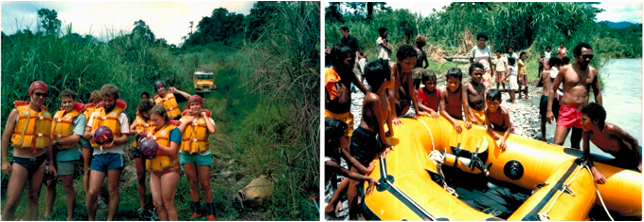
On the second day around 11am we pulled into a small village where a family had an arrangement to cook up pig meat in a ground oven (mumu in tok pisin). In a shallow earth pit, a fire had been heating up rocks before our arrival. Banana leaves were then placed on top of the rocks, and large flaps of raw pig and yams positioned on top of this. More banana leaves were then added, then soil and more fire started above the soil, if I remember it well enough.
We all then sat in a raised, wall-less hut and tried chewing betel nut while dranking warm South Pacific lager from cans with a few of the men from the household.
About four hours after arriving, and with us all nearly dropping with hunger and the forgettable effort to politely drink lousy warm, flat beer in the heat, steps were taken to check whether the meat was showing signs of being ready. The soil and top layer of banana leaves were removed and after some discussion about whether it needed to stay in for another hour, the vote was to give it a try.
With a few exceptions, the slabs of meat were barely warm. A few from down near the hot rocks were almost there and these were sliced up and given to us with a chunk of barely cooked yam and another can of warm beer. The skin still had bristles all over it, now covered with half congealed, oozing fat making it all the more appetising. Forget crackling. Forget the idea of any meat you wouldn’t have thrown straight in the bin anywhere else. I tried to extract what might have been a sliver of lean meat from its thick fat surrounds. The little I got was barely past raw, and whatever hunger I had rapidly abated at thoughts of all the stomach problems I could imagine erupting a few hours later.
It was clear the others held this gustatory feast in the same esteem as I did. So we took a few tentative bites out of the bland, under-cooked yams and indicated to our crew leader that we thought we’d best continue our journey. Never again.
Chiko rolls
The legendary Chiko roll was an early pioneer in Australian take-away food. I my hometown of Bathurst in the 1950s and 60s it graced the bain maries of every cafe and fish and chip shop in the town, along with gelatinous dim sims, potato scallops, and hamburgers-with-the-lot.
I cannot do more justice to this excrescence than to cite Sydney gastronome David Dale from his Facebook seriesEverything Ever Invented, illuminated by cartoonist Matthew Martin.
“In my high school playground, The Big Question, after “Who’s better, the Beatles or the Stones?” was this: “What is actually IN the deep-fried Chiko rolls we buy at the fish and chip shop on the way home from school (alternating with potato scallops)?” When you bit the blackened end off, you could see bits of cabbage and carrot in the filling, held together by a translucent mucus. But were those greyish-brown bits supposed to be meat, and if so, from what animal? And if animal, from what parts of the animal?
We did not know at the time that the Chiko roll had been “invented” in 1950 by Frank McEnroe, a former boilermaker who used to drive around country shows in outback Victoria and southern NSW selling pies and pastries from a caravan. His aim was to build a sturdier and more portable version of the spring rolls he’d eaten in the Chinese cafes that abounded in Australian small towns (often beside the Greek milk bar). The first place McEnroe sold the prototype was Wagga Wagga, which now proudly proclaims itself the birthplace of the Chiko.
Having constructed the roll, McEnroe went into partnership with a freezing works, which enabled him to send the cylinders around the nation to any food outlet that possessed a deep fryer, along with special bags into which they would squirt tomato sauce before sliding in an orange cylinder freshly tonged from the boiling fat.
Now it can be told: The lumps inside were mutton and, in more recent times, beef. Plus, in the version now made by Simplot, Flavour Enhancer 635.”

Chartreuse liqueur
There’s not much I don’t like drinking, although the attractions of Campari, Greek retsina and Laphroaig single malt are completely lost on me. But I once bought a bottle of Chartreuse, in a period where I was intrigued by French art house film, impenetrable existential philosophy and Bridget Bardot. Made since 1737 by Carthusian monks north of Grenoble, it blends distilled alcohol with 160 herbs and flowers. I cannot put it any plainer than this. It is absolutely vile, tasting as I imagine castor oil must taste. Never, ever make the mistake of buying it.
Maotai liqueur
Maotai is a Chinese liqueur. It is the toasting drink of choice at many Chinese dinners. I’ve visited China about six times for research collaboration with Fudan University scholars in Shanghai and to teach for a week in Shandong province, near Korea. At the dinner at end of that week, the leader of the Chinese group stood to thank me for my efforts. He filled my glass with a liquid I couldn’t guess at. At different times in his speech he’d toast various senior people in the group, and me for a variety of reasons.
After the first toast, I knew I was in big trouble. The drink I later learned was maotai was quite disgusting. I swallowed the first toast in a gulp and knew I couldn’t do it again. So I politely tilted the glass each time and kissed the surface of the vile stuff.
I knew from toasting rounds in previous visits that this would go on for some time, as new speakers rose to go through the ritual. Finally, it would be my turn, all translated by an interpreter. So I left the room on a toilet pretext, went up to my room and brought down my unopened duty free litre of Glenmorangie. I could do my toasts with this in a kind of muddled thinking gesture of respect.
When it came to my turn to toast I poured about half a glass, mentally calculating the number of people I would need to thank. This worked well. But when I’d finished, mandatory government party official who’d hovered in the classroom throughout the week, picked up the Glenmorangie bottle, filled his glass to near the top, then filled mine. He made a short speech then sculled the lot in several huge gulps. He then signalled that I should do the same. It was drink-the-foreigner- under-the-table time. I chickened out to gales of laughter.


No wonder Jews and Muslims abhor pig.
LikeLike