• Home
  • About/CV
  • Blog
  • Vaping Research Alerts
  • Blog archive list
  • My books
  • Memoirs
  • Music, bands, films
  • Contact

Simon Chapman AO

~ Public health, memoirs, music

Simon Chapman AO

Monthly Archives: January 2025

Are Tesla owners simply “supporting the finance arm of the Nazi party?”

26 Sunday Jan 2025

Posted by Simon Chapman AO in Blog

≈ 2 Comments

Tags

electric-vehicles, elon-musk, evs, greenhouse-gases, tesla, trump

Like a lot of Tesla owners, I’m sickened by Elon Musk’s metamorphosis into a mega-funder of extreme right wing political aspirants. Since acquiring Twitter in October 2022, his gleeful unleashing of armies of vile miscreants who had been blocked by Twitter’s previous management policies is rapidly turning it into a toxic sewer.

Like many others, my own Twitter following began haemorrhaging as people bailed in disgust at what he unleashed (including his own rancid posts) and his desecration of the platform’s functionality and culture. Today, I rarely use it, having moved to the fresh air on BlueSky.    

At first many of us resisted the name change from Twitter to X, but we must now acknowledge that Twitter is dead and what remains, X, is a very different beast. To refer to it as Twitter is to deny Musk’s destruction of what was a vibrant town square.

The oceans of money he poured into Trump’s re-election campaign turbo-charged his X disgrace. His fascist-style fist-pumps and salutes on Trump’s inauguration day removed any scintilla of doubt about Musk’s values.

If I ever buy another car, it would certainly be an EV, but not a Tesla. I fully support efforts to raise awareness of Musk’s mendacity and to urge potential EV purchasers to think hard about their choices.

But that said, there’s a good deal of simplistic Manichean thinking being flung about here. And not a little hypocrisy when, as is highly likely, many of the Tesla haters continue to do their bit to fund Big Oil when they continue to fill their fossil-fuelled cars and motorbikes.

So should those who are disgusted by Musk all feel mortified about driving our Teslas? Should we all get rid of them and spread the word? It’s now common to hear people remark that while they understand how excellent Teslas may be as an electric vehicle, they would never buy one because of all Musk stands for. The implication here is that if you have a Tesla, you are somehow declaring yourself as a Musk fan and have lined up with all other Tesla owners to enrich him. You need to feel shameful, apologise and seriously think about selling your Tesla. This video lays out that case.

Tesla also makes Powerwall batteries, with 600,000 sold worldwide by early 2024. Many competitors have now entered the rapidly expanding market.

Tesla also owns Starlink the high speed internet service which is a wholly-owned subsidiary of SpaceX, a major Musk company. Among its many uses, is its ability to provide internet access in remote locations inaccessible to Australia’s National Broadband Network. The Starlink Mini is a compact, portable internet kit. An ocean sailing friend tells me there is currently no alternative for affordable internet access far away from land.

So presumably, those arguing that buying Tesla vehicles helps fund Musk’s agenda would also count purchasers of his batteries and Starlink internet as equally complicit and shameful.

Tesla was incorporated in 2003 by Martin Erberhard and Marc Tarpenning. From February 2004, the PayPal multi-millionaire Musk led fundraising and had been chairman and principal fundraiser for Tesla, then CEO from 2008. Today he’s the world’s wealthiest person.

Teslas have been on sale since 2008. We’d used one on a holiday to France in 2016 and had been immensely impressed but until the Model 3 was launched in 2017, found the price way out of our league. We bought our Model 3 in June 2021 for $AUD52,000 after a $15,000 trade-in on our sedate little Mazda. This outlay was similar to the cost of many decidedly non high-end petrol-fuelled cars.

Three motivations to buy our Tesla

We bought the car to reduce our carbon footprint, to save serious money on fuel and servicing and to enjoy a driving experience that is endlessly wonderful.

Transport vehicles are the leading source of anthropogenic carbon emissions and the only source where these emissions are rising  (see European data below). A typical fossil fuelled car emits 4.6 tonnes of CO2 a year from its exhaust. EVs of course have no exhaust and emit nothing once manufactured.

Like ICE vehicles, EV manufacturing entails emissions. The chart below shows US EPA lifetime greenhouse gas emissions (GHGs) estimates for ICE and fully electric vehicles.

# “feedstock” here refers to materials like liquids, cloth, rubber etc used in manufacturing

So in summary, reducing vehicle emissions is of immense importance in reducing anthropogenic greenhouse gas emissions, and EVs are hands-down winners over ICE vehicles when it comes to emission reductions.

Cost savings

The savings involved in EV ownership can be huge. Our experience of the car has been beyond outstanding. It is a fantastic thing. Our only outlay in 3.5 years has been two $60 wheel rotations. That’s all. No fuel (saving $1500 a year), no servicing and engine part repairs (saving perhaps $2500 in a typical year), 90% of our charging is done free off our solar roof during sunny days, with most of the remainder done during cheap off-peak times overnight.

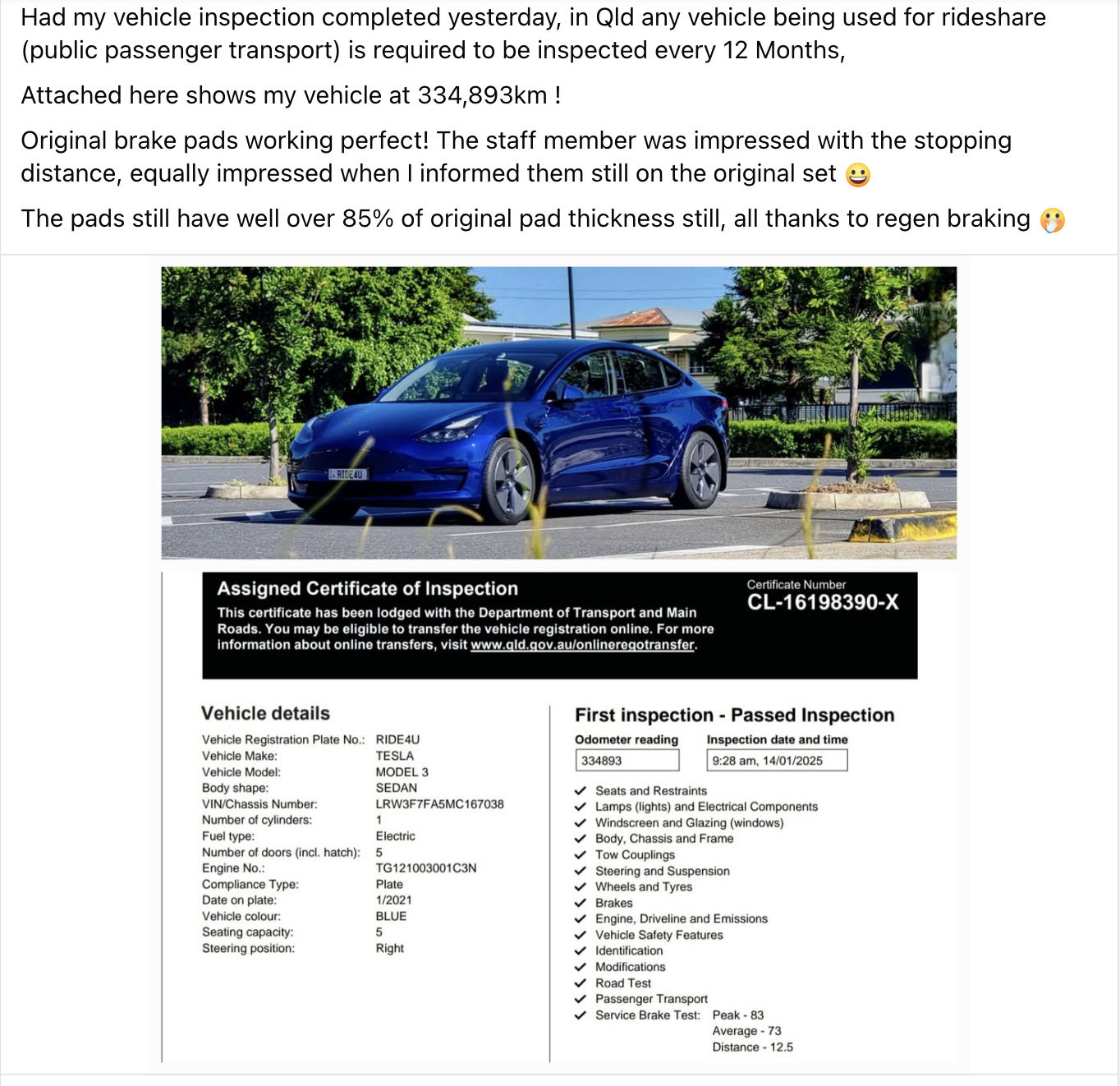
A recent post on Australia’s Tesla owners Facebook page (81.6k members) from a guy who uses his as a rideshare business and has done 334,893km, explains how he’s still on the original brake pads which are more than 85% of original thickness, thanks to regenerative braking (ie: the electric motor turns into a generator and slows the car — charging the car! — when you decelerate).
This week I noticed and responded to a post on BlueSky
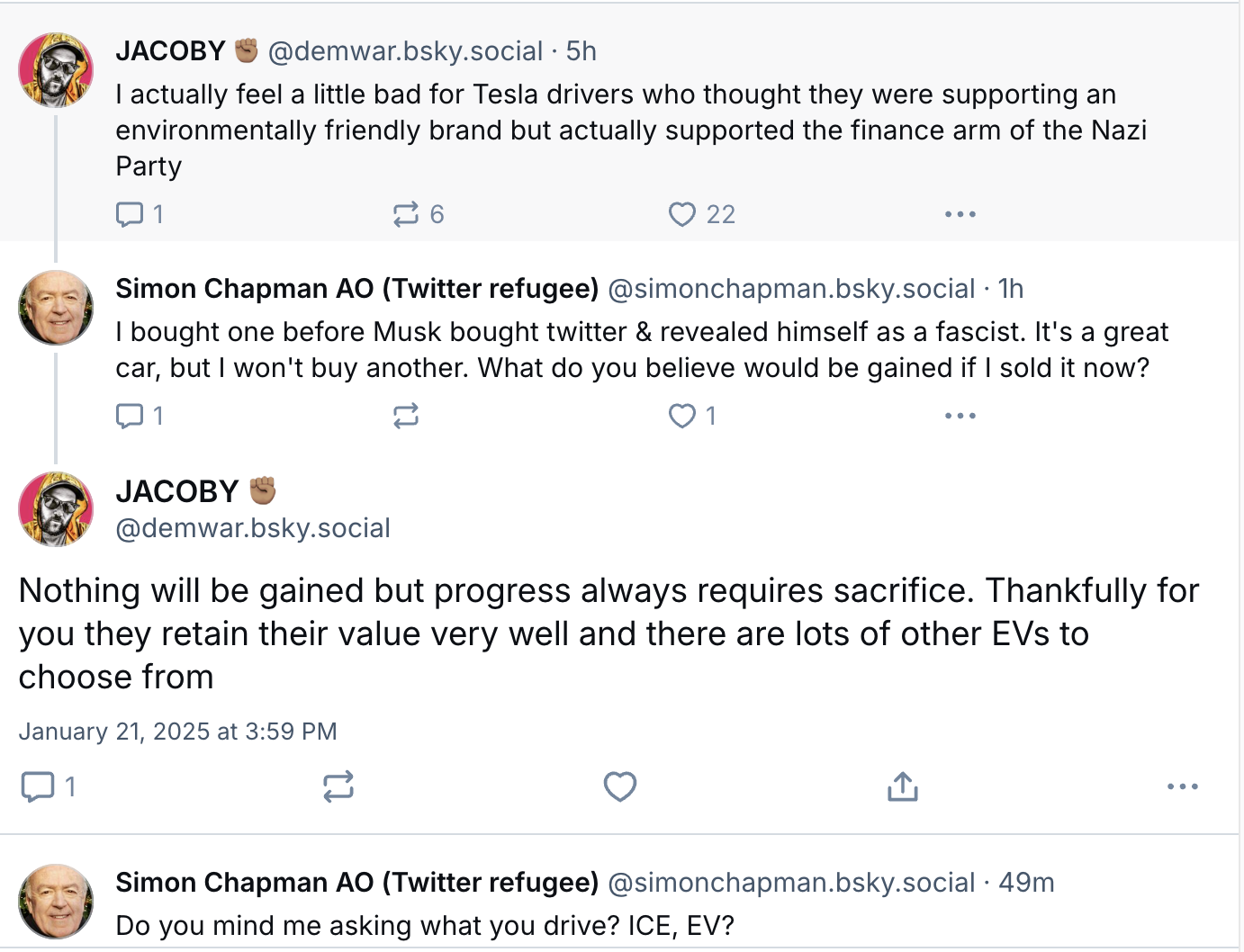
So let me parse the ethical issues involved. Three issues arise here for me.

First, while it is true that Musk benefits directly from every Tesla new car sale, he’s by no means the single beneficiary. The company’s market capitalisation on 26 Jan 2025 was $1.27 trillion. Musk owned 20.5% of Tesla’s stock by the end of 2024. So 79.5% of its global market capitalisation benefits other investors via dividends and stock value increases. With pension and superannuation funds being massive investors, there will be millions of ordinary working people who will be also benefitting beside Musk. Then there are the more than 100,000 Tesla employees. They probably feel good about working for a company that today makes the world’s #1 selling new car (the Model Y) and playing a role in inspiring competition from most other vehicle manufacturers which is seeing massive uptake of EVs. 18% of all cars sold in 2023 were EVs, up from 14% in 2022 and only 2% in 2018.

Ninety five percent of 2023 new EV registrations were just three markets: 60% in China (1 in 3 of all new registrations), nearly 25% in Europe (1 in 5), and 10% in the USA (1 in 10).

This is nothing but a positive development. Whatever Trump might try to do in the US, there is a massive, moving global wall of green EVs, rooftop solar, windfarms, home batteries, new green buildings and city design which is pushing forward hard. Bizarrely, Musk is in the front row in this while his buddy Trump is lining up with oil interests.

The huge curve ball being thrown here, is that Musk/Tesla is a massive contributor and stimulator to efforts by his competitors to reduce greenhouse emissions. But he is at the same time an odious stimulus to politics that may take humanity back to very dark periods.

Second, if I were to sell our Tesla and buy another EV make, I would lose an estimated $25-$30k off the purchase price. Competition since 2021 has seen the new price for the Model 3 fall to be competitive with and burgeoning cheaper alternatives in other manufacturers’ models. So pfft to “retaining value” — few cars ever do that and Teslas are no exception. But Jacoby glibly counsels me here that “progress always requires sacrifice”.

So, if I follow this, I’m supposed to take a $30k haircut in order to achieve …. what precisely?

Sydney’s roads would have one less Tesla reminding people of Elon? Oh wait, no. Whoever bought ours would fill the Tesla ownership gap we vacated.

So I’m left wondering what I asked Jacoby: what possible benefit selling our Telsa could ever be argued to bring?

Third, Jacoby did not answer about his own driving choices. If he drives a non-Tesla EV, great. But if he drives an ICE (internal combustion engine), I’m hoping that he has also counselled cyberspace to put notices under all ICE car and truck wipers to remind them of their moral turpitude in generating CO2.

I put this to one of Jacoby’s other respondents who wrote:

The oil industry spent $US445m in the last election cycle to help re-elect Trump and from day 1, Trump has begun thanking them with his “drill, drill, drill” war cry on the environment.

By the very same argument being used by those rallying against Musk and Telsa, anyone still driving an ICE vehicle is polluting the earth’s atmosphere while lining the pockets of Big Oil which, like Musk, is facilitating the Trumpian politics that will put major lead in the saddlebags of the global race to reduce greenhouse emissions.

To my mind, that’s the first question that anyone trying to shame Tesla drivers needs to answer.      


Selling our Tesla wouldn’t result in any fewer Teslas on the road, whereas buying a new one would. So for as long as Elon is at the helm, I won’t be buying a new Tesla. In the meantime, I’ll keep driving my zero-emissions vehicle… and I’ve ordered a sticker from Etsy that says “I bought my Tesla before we knew Elon was a Nazi.”


Smoking is fast becoming extinct in Australia but spare us from hare-brained extremist policies

10 Friday Jan 2025

Posted by Simon Chapman AO in Blog

≈ Leave a comment

Tags

health, movies, smoking, tobacco, vaping

Population-focussed tobacco control in Australia has seen smoking prevalence fall to its lowest ever levels for both adults and teenagers. Teenage smoking is all but extinct – an amazing achievement. This has been driven by 50 years of successful public health advocacy for policies, legislation and campaigns increasing public and political awareness intended to foment declines in smoking. Since the 1970s in Australia, there has been no advocated tobacco control policy that has failed to be taken up by governments. The tobacco industry has lost every battle it fought. All cigarette factories have closed and you seldom see anyone smoking in the street. Smoking is a pale shadow of what it was 40 years ago.

Sitting astride all of this has been the continual and progressive denormalization of both smoking and the tobacco industry. Ninety percent of smokers regret ever starting. There’s no product whose users are so disloyal. All political parties except the hillbilly Nationals refuse to accept tobacco industry donations and would rather be photographed with the Grim Reaper than be seen enjoying  tobacco industry hospitality.

But over the 45 years I’ve worked in tobacco control, I’ve lost count of the number of times people have assumed I would want to give my support to some truly loopy and sometimes unethical policies. Four leap out. I’ll briefly outline the first three, then go to town on the why the fourth – censorship of films showing people smoking – is the mothership of muddled thinking, indeed stupidity.

1: Got some new way to quit? Sign me up!

Many assumed that I would want to rush to embrace and recommend almost any agent or process intended to help smokers quit. Rarely did a month pass when I was not contacted by a breathless enthusiast for some new purported breakthrough. These included any new way of consuming nicotine other than smoking (I’m still waiting for nicotine suppositories, but surely it can’t be long); any new drug; any complementary procedure maximally accompanied by soothing, holistic placebo-enhancing mumbo-jumbo and eye-watering costs for consumers; any “professional” intervention featuring the nostrums of doctors, nurses, pharmacists, psychologists and counsellors in clinical, group, on-line or app settings.

A  piece I wrote 40 years ago in the Lancet (“Stop smoking clinics: a case for their abandonment” see pp154 here)  set out why well-intended dedicated quit smoking centres were distractions from the main goal of reducing smoking across whole populations. They were never going to make any serious contribution to reducing smoking nationally because smoking was so widespread and interest in attending such clinics so low, that impossibly massive numbers of clinics would need to open for them to make a difference.

In 2009, again in the Lancet,  I proposed the “inverse impact law of smoking cessation” which states “the volume of research and effort devoted to professionally and pharmacologically mediated cessation is in inverse proportion to that examining how ex-smokers actually quit. Research on cessation is dominated by ever-finely tuned accounts of how smokers can be encouraged to do anything but go it alone when trying to quit―exactly opposite of how a very large majority of ex-smokers succeeded.”

I then quantified this with a look at how research on quitting had become overwhelmingly focussed on assisted quitting, with research into unassisted quitting far less common. This was truly bizarre given that no one disputes that the most common way of quitting used in final successful quit attempts has always been to do it cold turkey.  So why not learn more about that and shout it from the rooftops?

My contributions caused apoplexy and multi-signatured condemnations from those who had tethered their career sails to assisting smokers. My 2022 book Quit smoking weapons of mass distraction looked in depth at why professional smoking cessation was dominated by the tiny “tail” of treatments, while the large “dog” of real world unassisted quitting was often denigrated by tobacco treatment professionals and the pharmaceutical industry, for obvious self-interested reasons.

2. The smoker-free workplace

A second perennial bad idea proposed that employers should be allowed to reject applicants (for any job) who smoked, even if they were completely agreeable with smokefree workplace policy and did not want to take divisive “smoking breaks” not available to non-smokers. Henry Ford pioneered early workplace smoking bans in his car factories  (see photo below) But a century on, some were now arguing that even  if workers smoked entirely in the privacy of their own life, employers could threaten them with unemployment because they smoked.

I made a case against this nonsense in 2005.

Two arguments were typically used by advocates for this policy

1: employers’ rights to optimise their selection of staff (smokers are likely to take more sick leave and breaks)

2: enlightened paternalism (‘‘tough love’’).

The first argument fails because while it is true that smokers as a class are less productive through their absences, many smokers do not take extra sick leave or smoking breaks. By the same probabilistic logic, employers might just as well refuse to hire younger women because they might get pregnant and take maternity leave, and later take more time off than men to look after sick children. Good luck with that argument!

But what about paternalism? There are some acts where governments decide that the exercise of freewill is so dangerous that individuals should be protected from their poor risk judgements. Mandatory seat belt and motorcycle crash helmets are good examples.

It was argued that the threat of ‘‘quit or reduce your chances of employment’’ was founded on similar paternalism. I think the comparison is questionable.

Seat belt and helmet laws represent relatively trivial intrusions on liberty and cannot be compared with demands to stop smoking, something that some smokers would wish to continue doing. By the same paternalist precepts, employers might consult insurance company premiums on all dangerous leisure activity, draw up a check list and interrogate employees as to whether they engaged in dangerous sports, rode motorcycles, or even voted conservative!

Many would find this an odious development that diminished tolerance. There is not much of a step from arguing that smokers should not be employed (in anything but tobacco companies where perhaps it should  be mandatory?), to arguing that they should be prosecuted for their own good.

3. Finish the job … ban smoking in all outdoor public areas

When the evidence mounted in the early 1980s that breathing other people’s smoke was not just unpleasant to many but could cause deadly diseases like lung cancer, bans on smoking followed in enclosed areas like public transport, workplaces and eventually the “last bastions” of ignoring occupational health: in  bars, pubs and clubs.

Some in tobacco control then excitedly began to argue “why stop now? Let’s extend bans to even wide-open spaces like parks, beaches and streets.” The teensy-weensy problem here was that all the evidence on breathing other people’s smoke being harmful came from studies of long-term exposure in homes and workplaces. There was almost no evidence that fleeting exposures of the sort you get when a smoker passes you in the street is measurably harmful.

So banning smoking in wide-open outdoor spaces was not a policy anchored in evidence about health risks to others.

Accordingly, I advocated for smoking prisoners to be allowed to smoke in outdoor areas, for ambulatory patients and their visitors to be able to smoke in hospital grounds if they chose to and for smoking to be allowed in streets.  When I was a staff elected fellow of my university’s governing Senate, I voted against a (failed proposal) for a total campus ban on smoking in favour of having small dedicated outdoor smoking areas (see photo).  I set out my concerns in these papers, here, here and here.

This marked me as a heretic for some. But as I argued in one of these “I have had heated discussions with some colleagues about this who are triumphant that the proposed ban [on smoking in prisons] will help many smoking prisoners quit. I agree that it will, and that is a good thing. But so would incarcerating non-criminal smokers on an island and depriving them of cigarettes. We don’t do that not just because we can’t, but because it would be wrong. The ethical test of a policy is not just that it will “work”. In societies which value freedom, we only rarely agree to paternalistic policies which have the sole purpose of saving people from harming themselves if they are not harming others.”

4. Ban smoking in movies, or slap them with box-office killing R-ratings

But true peak silliness in tobacco control advocacy  arrived when a small number of people began arguing for all movies which depicted smoking to be either banned, or more commonly, slapped with R (18 and over) classifications, known to severely  reduce box office receipts. This threat would see most film producers order their directors to impose on-screen smoking bans.

I first flashed bright amber lights on this idea in 2008. With a US co-author, I followed up with four arguments  against this proposal in this PLoS Medicine paper and this response to criticism that followed. Much of our paper was hypercritical of research that purports to show that there is a strong association between kids seeing smoking in movies and their subsequent smoking. Some – including even the World Health Organization – even tried to extrapolate attributable fraction estimates of the number of deaths down the track that this exposure would cause down the track in what was an uncritical orgy of highly confounded leaping from simple associations to causal statements. The huge number of assumptions and uninhibited reductionist reasoning in this exercise was quite extraordinary.

The main problem here was that when characters smoke in films, they do not just smoke: they bring to their roles a constellation of other attributes that are likely to be deeply attractive to youth at-risk of smoking.

As we wrote: “Teenagers select movies because of a wide range of anticipated attractions gleaned from friends, trailers, and publicity about the cast, genre (action, sci-fi, teen romance, teen gross-out/black humour, survival, sports, super hero, fantasy, and so on), action sequences, special effects, and soundtrack. It is likely that youth at risk for current or future smoking self-select to watch certain kinds of movies. These movies may well contain more scenes of smoking than the genres of movies they avoid (say, parental-approved “family friendly,” wholesome fare like the Narnia Chronicles or Shrek).

Teenagers at risk of smoking are also at higher risk for other risky behaviors and comorbidities. They thus are likely to be attracted to movies promising content that would concern their parents: rebelliousness, drinking, sexual activity, or petty crime. … Movie selection by those at risk of smoking is thus highly relevant to understanding what it might be that characterizes the association between young smokers having seen many such movies and their subsequent smoking. Movie smoking may be largely artifactual to the wider attraction that those at risk of smoking have to certain genres of films. These studies rarely consider this rather obvious possibility, being preoccupied with counting only smoking in the films.

By assuming that seeing smoking in movies is causal, rather than simply a marker of movie preferences that have more smoking in them than the movie preferences of those less at risk, authors fail to consider problems of specificity in the independent variable (movies with “smoking”). It may be just as valid to argue that preferences for certain kinds of movies are predictive of smoking. The putative “dose response” relationships reported may be nothing more than reporting that youth who go on to smoke are those who see a lot of movies where smoking occurs, among many other unaccounted things.”

All this was silly enough, but where the silliness became weapons-grade in its over-reach was the way in which some in public health didn’t hesitate to decide  they had every right to start urging that governments should censor movies (and presumably theatre, books, art, smoking musical performers) which showed smoking.

We wrote:

“most fundamentally, we are concerned about the assumption that advocates for any cause should feel it reasonable that the state should regulate cultural products like movies, books, art, and theatre in the service of their issue. We believe that many citizens and politicians who would otherwise give unequivocal support to important tobacco control policies would not wish to be associated with efforts to effectively censor movies other than to prevent commercial product placement by the tobacco industry.

The role of film in open societies involves far more than being simply a means to mass communicate healthy role models. Many movies depict social problems and people behaving badly and smoking in movies mirrors the prevalence of smoking in populations. Except in authoritarian nations with state-controlled media, the role of cinema and literature is not only to promote overtly prosocial or health “oughts” but to have people also reflect on what “is” in society. This includes many disturbing, antisocial, dangerous, and unhealthy realities and possibilities. Filmmakers often depict highly socially undesirable activities such as racial hatred, injustice and vilification, violence and crime. It would be ridiculously simplistic to assume that by showing something most would regard as undesirable, a filmmaker’s purpose was always to endorse such activity. Children’s moral development and health decision-making occurs in ways far more complex than being fed a continuous diet of wholesome role models. Many would deeply resent a view of movies that assumed they were nothing more than the equivalent of religious or moral instruction, to be controlled by those inhabiting the same values.

The reductio ad absurdum of arguments to prevent children ever seeing smoking in movies would be to stop children seeing smoking anywhere.”

Despotic and fundamentalist religious governments have huge appetites for censorship (think North Korea and Afghanistan under the Taliban). But in the west, there is a long and often disturbing queue of single-issue advocates who would wish to see greater state intervention in cultural expression. Precedents for such doors to be opened should be treated with great caution. If scenes of smoking should be kept from childrens’ eyes, why stop there?

The slippery slope is today well-oiled in the USA where in a growing number of Republican states a large range of books are being removed from school libraries at the behest of Christian family-values activists.

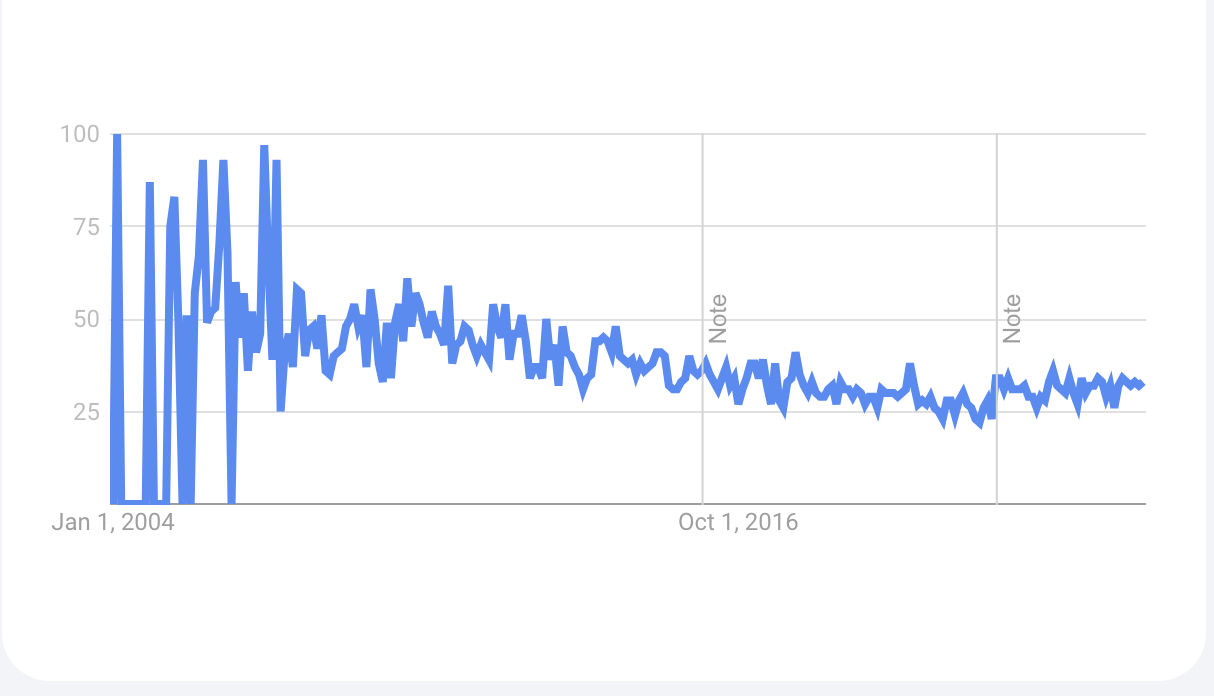
The Google Trends graph below shows that globally the debate about R-rating smoking in movies had a massive rush-of-blood from 2004-2009, with attention waning in the years since.  Advocates for censorship and R-rating have succeeded in several national and global agencies endorsing their calls. But significantly, no nation has legislated to R-rate smoking films.

Even if they did, as far back as 2004,  81% of under 18s were allowed by their parents to view R-rated movies in the USA occasionally, some or all of the time. With all the myriad ways available today to view movies on-line, via downloads, movie swapping and piracy, any thoughts that R-rating would achieve anything look increasingly absurd.

The Tobacco In Australia website has a very thorough section on all the debating points relevant to the whole issue.

Google Trends “smoking in movies” 10 Jan, 2023: 2004-present, worldwide

Blog Stats

  • 163,470 hits

Top Posts & Pages

  • Why I’m not quitting Spotify because its owner has hugely invested in weaponry
  • Australia takes off the gloves on illegal tobacco while ‘lower the tax’ fantasists plumb new absurdities
  • About/CV
  • Vaping theology: 6 There’s nicotine in potatoes and tomatoes, so should we restrict or ban them too?
  • My books
  • Regrets … I’ve had a few. Paul Hogan and his Winfield role.
  • Thinking of keeping koi? Advice for beginners in NSW
  • Cheap illegal cigarettes save low income pack-a-day smokers over $9000 a year. So why don’t social justice champions give them full support?
  • Why Australia’s illegal tobacco and vape trade continues to flourish and what should be done about it
  • My first seen, best and worst bands 1964-2022

Blog archive

Comment Policy: No anonymous or pseudonymous posts will be published

Recent Posts

  • Australia takes off the gloves on illegal tobacco while ‘lower the tax’ fantasists plumb new absurdities
  • Egg on some faces: statisticians at 10 paces on the impact of New Zealand’s vape laws on youth smoking
  • Lowering tobacco tax to make illegal tobacco sales “disappear overnight”: at last we have a proposed figure and it’s an absolute doozie
  • Why I’m not quitting Spotify because its owner has hugely invested in weaponry
  • Should we believe Fiona Patten on vapes? Here are just a few problems

Recent Comments

Jon Krueger's avatarJon Krueger on Egg on some faces: statisticia…
Atul Kapur's avatarAtul Kapur on Should we believe Fiona Patten…
Unknown's avatarCould a national tob… on If expensive cigarettes are dr…
tahirturk1's avatartahirturk1 on Why Australia’s illegal tobacc…
malonere's avatarmalonere on Words I’ve seen, but didn’t kn…

Archives

  • December 2025
  • August 2025
  • July 2025
  • June 2025
  • May 2025
  • March 2025
  • January 2025
  • November 2024
  • October 2024
  • September 2024
  • July 2024
  • May 2024
  • April 2024
  • March 2024
  • February 2024
  • January 2024
  • December 2023
  • November 2023
  • October 2023
  • September 2023
  • August 2023
  • July 2023
  • June 2023
  • May 2023
  • March 2023
  • February 2023
  • January 2023
  • December 2022
  • November 2022
  • October 2022
  • August 2022
  • June 2022
  • April 2022
  • March 2022
  • February 2022
  • January 2022
  • December 2021
  • October 2021
  • September 2021
  • August 2021
  • June 2021
  • May 2021
  • April 2021
  • March 2021
  • February 2021
  • January 2021
  • December 2020
  • November 2020
  • October 2020
  • September 2020
  • August 2020
  • July 2020
  • June 2020
  • May 2020
  • April 2020
  • March 2020
  • February 2020
  • January 2020
  • December 2019
  • November 2019
  • October 2019
  • September 2019
  • August 2019
  • July 2019
  • June 2019
  • May 2019
  • April 2019
  • March 2019
  • February 2019
  • January 2019
  • December 2018
  • November 2018
  • October 2018
  • September 2018
  • August 2018

Categories

  • Blog

Meta

  • Create account
  • Log in
  • Entries feed
  • Comments feed
  • WordPress.com

Blog at WordPress.com.

  • Subscribe Subscribed
    • Simon Chapman AO
    • Join 198 other subscribers
    • Already have a WordPress.com account? Log in now.
    • Simon Chapman AO
    • Subscribe Subscribed
    • Sign up
    • Log in
    • Report this content
    • View site in Reader
    • Manage subscriptions
    • Collapse this bar
 

Loading Comments...