• Home
  • About/CV
  • Blog
  • Vaping Research Alerts
  • Blog archive list
  • My books
  • Memoirs
  • Music, bands, films
  • Contact

Simon Chapman AO

~ Public health, memoirs, music

Simon Chapman AO

Monthly Archives: August 2025

Egg on some faces: statisticians at 10 paces on the impact of New Zealand’s vape laws on youth smoking

28 Thursday Aug 2025

Posted by Simon Chapman AO in Blog

≈ 1 Comment

Tags

confirmation-bias, health, new-zealand, smoking, vaping

Source: Sergey Vinagradov- Unsplash

Modern vaping theology venerates New Zealand’s “regulated vaping market model”  as the way all nations should go if they want to reduce smoking. Its doctrinaire, excitable adherents feverishly point to unparalleled recent declines in smoking prevalence in all adults, in Māori adults (who smoke much more than the general population) and in youth. These declines are said to have followed the advent and rise in vaping and New Zealand’s Nov 2020 regulation of vapes which allowed them to be legally sold from dedicated vape stores and ‘dairies’(small, owner-operated convenience stores selling groceries, milk and other essentials, often outside of regular business hours).

As I noted in an earlier blog, the UK, USA and Canada also have highly liberal vape access policies (regulated market models) but comparable or higher smoking prevalence than Australia, which has far more restricted vape access legislation. Vaping advocates like to cherry pick New Zealand to provide a comparison with Australia  compatible with their previous outspoken advocacy for regulated  market models.

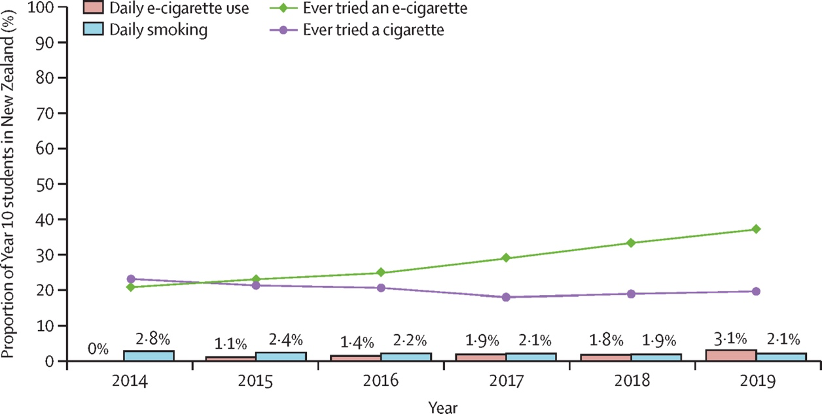
The evidence being used here is cross-sectional (ie: annual school surveys of around half of all New Zealand year 10 –14-15yo students) from 2014-2019.2015 was the first year that  the survey asked questions about vaping frequency, enabling reporting on daily vaping. The graph below shows a 0.7% absolute decline and a 25% relative fall in daily smoking  between 2014 and 2019, while daily vaping rose between 2015-2019 from 1.1% to 3.1% (2% absolute and 65% relative increases).
Source

Every first semester biostats student has it drilled into them that cross-sectional data cannot be used to draw causal conclusions. When I edited Tobacco Control across 17 years, this criticism was probably that most commonly made by reviewers of papers which used post hoc ergo propter hoc (after therefore because of) reasoning with cross-sectional data. The 2020 paper’s authors were therefore wise to use “suggests …might” when they concluded “…overall decline in smoking over the past 6 years in New Zealand youth suggests that e-cigarettes might be displacing smoking”.

But many vaping advocates aren’t typically  bothered  by the sublimation  of associations into causal language conclusions when it suits their agenda. An analysis  of submissions to the New Zealand Parliament’s Health Select Committee considering a 2020 Bill which regulated the sale and marketing of e-cigarettes, found that the 2020 paper was the most frequently cited evidence used to try and influence the Committee, including by  British American Tobacco.  Those fervidly embracing the paper who are determined to preserve, strengthen and evangelically promote New Zealand’s experience internationally would have hardly complained if associations morphed into causes when the rubber met the road of political, media treatment and public understanding tests.

But , whoa! Hold the horses!

Sensing there were problems with the paper, Sam Egger from Cancer Council NSW led a paper that took a deeper dive into an expanded data set from 1999-2023 noting that the 2020 paper had only looked at 2014-2019 data and that 2014 was “years after vaping had established a notable presence in New Zealand. Importantly, the analysis did not assess whether smoking trends changed before and after shifts in vaping prevalence, an essential requirement for evaluating the population-level impacts of vaping on smoking.”

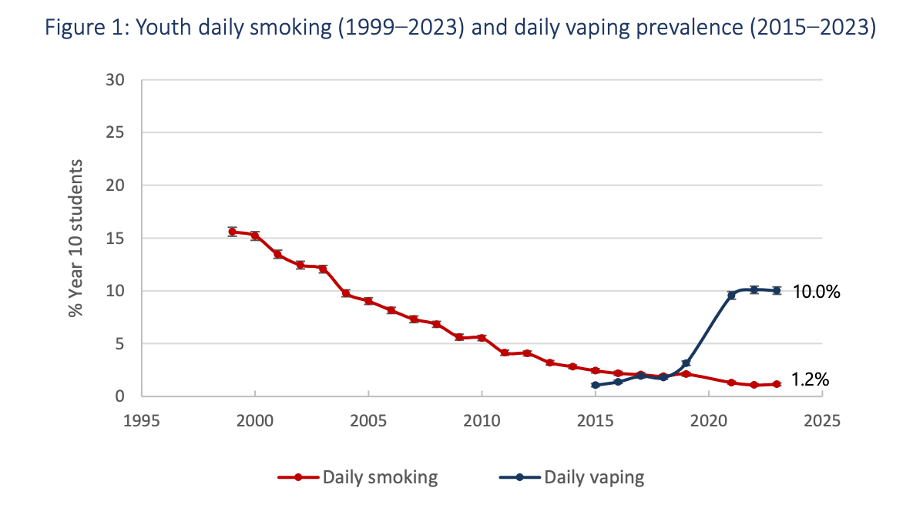
In other words, the 2020 paper had not considered the question of whether the remarkable decline in youth smoking which started well before the appearance and proliferation of vaping in youth (see chart below), accelerated with the arrival of vapes in about 2010 and then their rapid uptake after 2019 (with the latter, it of course could not have done this, having 2019 data as its endpoint).

This was a very basic omission, and one that amounted to seriously narrowing the evidence goalposts in the exercise of assessing vaping’s possible role in influencing trends in smoking by 14 and 15 year olds. The question about ever vaping was added to the school survey in 2014, with daily vaping added a year later. This start of these questions would not have been a capricious choice but one that almost certainly would have reflected common observational ‘knowledge’ of youth vaping increasing, perhaps over several years prior to 2014 when it was first counted. ASH, which is responsible for the annual surveys since 1999 (see graph below), clearly knew youth smoking had  been in freefall since at least 1999 so that factors other than vaping were in play.
Source:

In their no stone unturned paper using  interrupted time series analysis they concluded “In stark contrast to the conclusion of the previous study, we found that among 14-15 year-olds, the emergence and rapid rise in vaping in New Zealand may have slowed the rates if decline in ever- and regular smoking, while having little or no impact on the rate of decline in daily smoking.”

In a commentary in  The Conversation, they noted “the rates of decline in ‘ever smoking’ and ‘smoking regularly’ slowed significantly from 2010 onwards, coinciding with the emergence of vaping in New Zealand. The rate of decline in daily smoking did not change significantly from 2010 onwards.

In 2023, about 12.6% of 14 and 15-year-olds in New Zealand had ‘ever smoked’ (ranging from just a few puffs to smoking daily). However, if the ‘ever smoking’ rate had continued along its pre-2010 trajectory (before vaping emerged) this figure would have been 6.6%.”

So there was now plenty of heat in this particular data analytic kitchen. But  then a blowtorch arrived with an apparently blistering critique of what the Egger authors had done. Four authors from the University of Queensland gave the Egger group both barrels with a three point shellacking that essentially went  “here’s what you did, and here’s what you should have done … so your conclusions are unsound”. Read it all in the link.

But channelling Crocodile Dundee (“THAT’s not a knife … THIS is a knife”) the Egger group then  rapidly returned serve, eviscerating the Queensland group’s critique point-by-point. Again, read it for yourself.

All this will have been read by a small number of people who closely follow these debates. And will have been understood by an even smaller number who are highly trained in analysis of trend data.

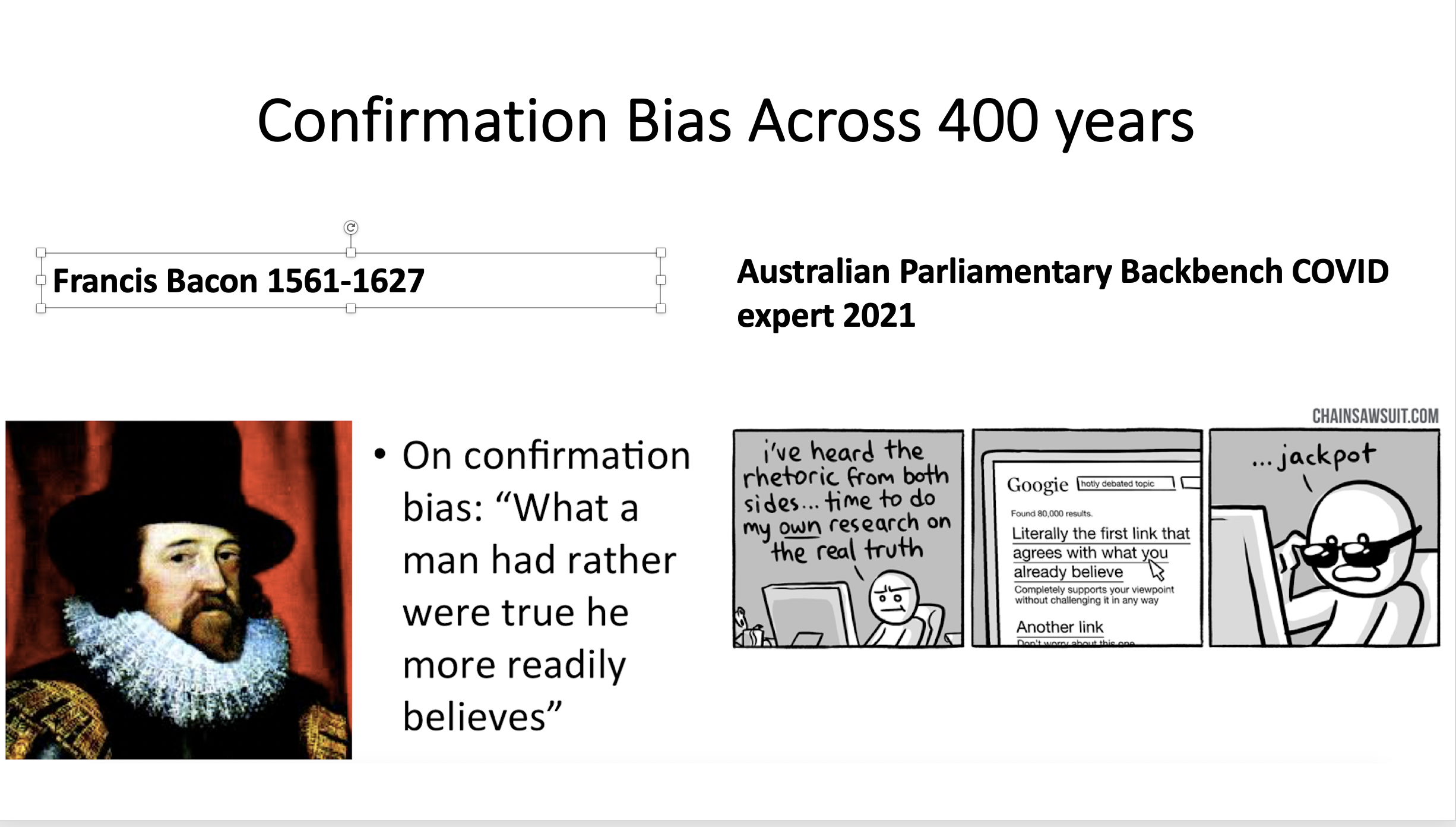
But one thing is absolutely certain, the veteran nag confirmation bias will yet again get a good run around the block. Those who like the conclusions of the 2020 paper will keep megaphoning them without mentioning the Egger group’s very contrasting findings. Criminologists have a term for this: the ‘woozle effect’ where studies with flawed conclusions that have been discredited continue to be referenced, as though those conclusions still offer credible evidence. 

I published a paper in 2009 on citation bias, which is the selective citation of published results to support the findings, arguments or interests of authors and those funding their work.  Our paper showed that a very old (1982) and small study (n=24) showing extremely high smoking prevalence in people with schizophrenia (88%), had been massively cited in preference to many more recent and larger studies which showed far lower smoking by those with schizophrenia. News media commonly referred to smoking rates in those with schizophrenia as “as high as 90%” when a meta-analysis of 42 studies found average smoking prevalence to be 62%, much higher than the general population but nowhere near 90%.
Lowering tobacco tax to make illegal tobacco sales “disappear overnight”: at last we have a proposed figure and it’s an absolute doozie

07 Thursday Aug 2025

Posted by Simon Chapman AO in Blog

≈ Leave a comment

Tags

health, illicit-tobacco, politics, smoking, tobacco-tax, vaping

[updated 9 Aug 2025; 8 Nov 2025]

Australian smoking rates have never been lower in adults, school kids, low socio-economic groups, and First Nations people.  That’s a good thing, right? These outcomes represent the results of decades of policy reform and government campaigns. But these bottom lines mean little to fringe critics of Australia’s approach to tobacco control, who are licking their wounds after failing badly to stop the government from regulating vapes to allow then to be sold in as many retail situations as possible.

Then there those who passionately believe that expensive, highly taxed cigarettes are a cruel impost on low income earners. For several years, in pitch perfect unison with Big Tobacco which has lobbied for decades to keep tobacco tax low to sell more cigarettes, they argue that the government should lower tobacco tax to make it easier for them to afford to smoke. Could there be any more truly perverse way to help the poor?

Illicit tobacco has been widely available in Australia for over 25 years, long before the significant rises in tobacco tax began in 2012.These critics also never mention the inconvenient truth that large black markets for tobacco exist in most countries, including those where tobacco tax is much lower than in Australia. So plainly, there is far more to understanding illicit tobacco markets than tax alone.

The widespread, blatant proliferation of duty-not-paid dirt cheap tobacco has excited these critics. Barely a week goes by when they are quoted on what the government needs to do, and “lowering” tobacco tax is always front and centre of the mantra.

But as I’ve noted before, it’s one thing to call for tax to be lowered, and quite another to draw on your expertise to help the Treasury know exactly where the magic sweet spot reduction should fall to make smokers who are now buying cheap illicits go back to duty-paid cigarettes. James Martin and Alex Wodak fudged naming a date or percent reduction in a Crikey  piece  when urging “reducing tobacco excise to undercut the illicit trade”. So OK gents, how much of a reduction are you talking about?

But all rejoice! The wait is now over!

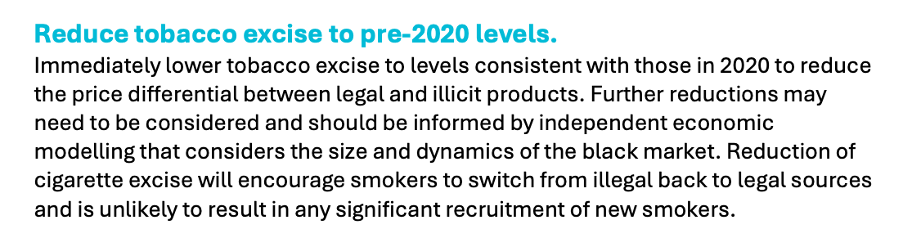
In recent weeks, critics have put their hands up with several figures.  In June, Harm Reduction Australia published an unsigned Tobacco Harm Reduction Policy Brief , presumably with the fingerprints of its tobacco harm reduction advisors, Alex Wodak and James Martin.

The short document recommended this:

So there’s the level: lower the tax rate back five years to that we had in 2020. That will fix things, right?

Or we could go back another year to 2019 when tobacco tax was still lower. In a very uncharacteristic slip, ABC economics expert Alan Kohler, snuck this final line into an otherwise very sensible commentary on the black market:  “The other thing the federal government could do is reduce the tobacco excise back to what it was before 2019, which would lead to a huge increase in revenue.”  An increase presumably explained by droves of smokers abandoning illegal cigarettes for the newly competitively reduced-tax legal ones.

Or according to Kingsley Wheaton, Chief Corporate Officer for British American Tobacco, who flew out to Australia in June to talk about the “basic economics” of tobacco tax, this should involve a “reversion to the 2018 (tobacco tax) rate“.

And then we come to the really heavy duty ordinance, this time from Australian economist Steven Hamilton, a professor at George Washington University. Quoted in The Saturday Paper, in April “So my suggestion would be that there is one solution and one solution only, and it is to radically reduce the rate of tax on cigarettes. Take the tax rate on cigarettes back to where it was 10 years ago, make legal channels competitive, and the black market will disappear.”   Disappear! It’s that easy! Ten years ago – in 2015 – tobacco tax was $0.53096 and a packet of 20 budget cigarettes cost $24.28 (see table 13.3.3 here)

OK, so let’s take one of these named years – 2019 – and do the simple early high school arithmetic on how dropping tax back seven years would go in demolishing the black market.

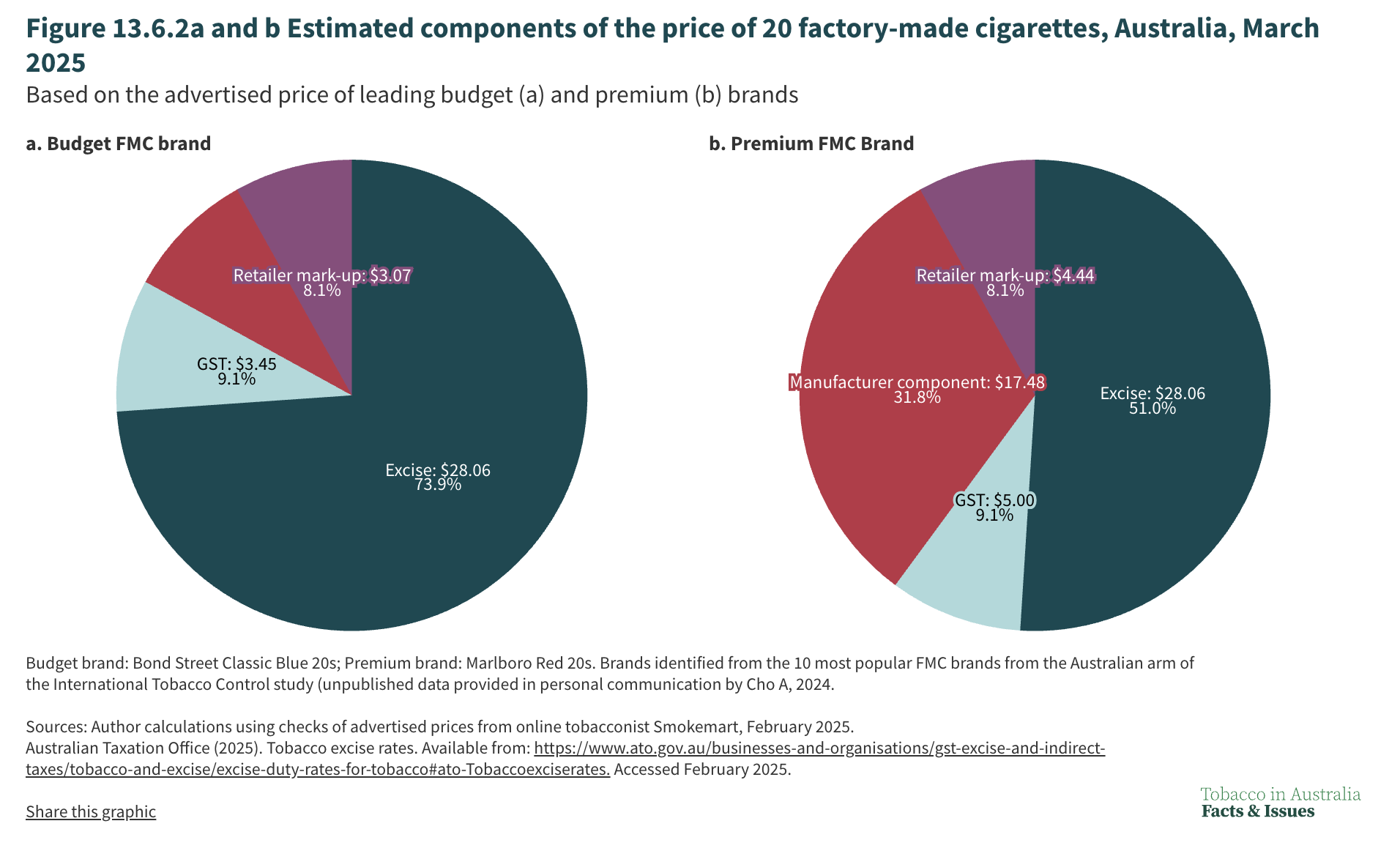
In 2019, excise tax on cigarettes per stick was $0.81775  (in March) and $0.96653 (in September) —see Table 13.6.2 here.   This means that the tax component in 2019 of a pack of 20 was either $16.335 or $19.3306.  For retail price, we need to add GST and the manufacturers’ and retailers’ margins (see chart below for the current proportions) to see what a legal pack of 20 cigarettes would retail at under the new retro tax regime proposed by our disappearing black market pundits.  

So let’s show this for a typical budget brand in the chart.

Excise 73.9% = $16.34

GST 9.1% = $2.01

Retail mark-up 8.1% = $1.79

Manufacturer mark-up 8.9% = $1.97

Total retail price: $22.11

Here’s a conversation between two smokers:

Bill: Hey, the government has dropped tobacco tax big time! You can get a pack of 20 now for Just over $22.

Bob: Really? I can buy my smokes at cheap smokes shop for as low as $10 a pack, sometimes as high as $20 in high income suburbs. So these new reduced tax smokes are still more than double the lowest price of the dodgy ones. Why would I be mad enough to pay out all that extra?

The common $10 smokers can now pay for illegal cigarettes is clearly still highly profitable for those selling them. It is anyone’s guess how much even lower their price could fall and still retain acceptable profitability. After first publishing this blog, I was told of $8 packs of 20 being sold in Muswellbrook in rural NSW, presumably still making a profit for all in the chain. So the above sums are likely conservative about how much tax would need be lowered to get prices on par or cheaper than illicit cigarettes.

So this heroic step would do absolutely nothing to solve the problem.

It is just gobsmacking that people positioning themselves as credible advisors on how to undercut the black market could not have asked this most basic and fundamental of all questions about their magic reductions. And equally, that so many journalists have let them blather on and never questioned it. A Sydney Morning Herald editorial in  June  stated without blinking “a tax rethink on tobacco excise is self-evident and common sense”.

The tax cut to 2015 levels proposed by Steven Hamilton goes closest to a nominal sweet spot. But If the Government were to put the tax down to 2015 levels then the prices of taxed products would only  be competitive with the current illicit prices if Big Tobacco and all retailers also selflessly reverted to what they charged back in 2015. Yeah, that’s really going to happen. Pigs might fly too.

Enforcement of the weapons-grade penalties now in place across the country, together with turning attention to landlords who are knowingly allowing tobacconist tenants to use their rental premises to break the law are the obvious ways to go, as Alan Kohler also emphasised.

8 Nov 2025 BREAKING! Deakin University criminology academic James Martin publicly stated in the Straits Times that “taxes would need to be significantly lowered and even eliminated to discourage criminals from operating a black market.” [my emphasis]. Now how will this work? Martin suggests even eliminating all tobacco tax so that smokers who have been buying illicit untaxed cigarettes, will switch to legal cigarettes … which will be also untaxed. The government will then reap the tax benefit from these untaxed legal cigarettes. Are we all following this remarkable proposal?

Why I’m not quitting Spotify because its owner has hugely invested in weaponry

06 Wednesday Aug 2025

Posted by Simon Chapman AO in Blog

≈ Leave a comment

Tags

ai, arms, artificial-intelligence, Music, spotify

I’m a daily user of Spotify. I have it on daily in the car, the house and at my desk. My tastes are very eclectic with extensive playlists across almost every genre of music with the exceptions of metal and all its variants, rap/hip hop, “musicals” and light orchestral.  It has hugely expanded my discovery and appreciation of unimagined music.

The other day a close friend asked me whether I knew that Spotify’s owner Daniel Ek, had recently invested €600 million ($AUD1.074 billion) in military armaments in Hesling, a German based company which he chairs. I didn’t, but was concerned enough to find out more.

My friend sent a link to the best painless ways to move to other music streaming platforms and said he was planning to move in protest.

A Guardian report listed all of three bands, one Australian and two from the US, who were leading a so-called “exodus” from Spotiify. One stated “We just removed our music from the platform. Can we put pressure on these Dr. Evil tech bros to do better?” Another band  was taking all its music off “garbage hole violent armageddon portal Spotify”.

Australian musician David Bridie also bought into all this with this Guardian article. He’s removed his work from Spotify, explaining  “In recent years, we’ve witnessed the horror of AI drone wars in Ukraine and Gaza – children killed and hospitals destroyed with the press of the space bar. Ek is investing in technology that can cause suffering and death. Spotify used to seem like a necessary evil. By association, it now just seems evil.”

So what does Hesling’s website (Protecting our democracies) tell us?  That it’s a military defence company providing “mass and autonomous capabilities to democracies so they can deter and protect”.

Among its products are:

  • An Electronic Warfare (EW) system using AI to classify radio signals
  • Underwater drone swarms for surveillance and signal detection
  • Software for command centers
  • Strike drones using AI for defeating jamming/spoofing

In February, the company announced it was producing 6,000 strike drones for use by Ukraine against Russian attacks, supplementing an early 4,000 already produced. Its website talks about ethical practices in supplying its products to nations.

Since Russia began pounding Ukraine, killing 46,000 civilians and 120,000 troops plus 180,000 injuries with 7 million having fled the country, the western world has held its breath hoping that NATO members and the US would adequately fund Ukrainian resistance. Nations bordering Russia are all vitally interested in anything that might give Russia pause to invade them.

So Spotify/Daniel Ek/Hesling are not so much as trying to cause suffering and death (except to Russian invading troops), but trying to prevent it as much as possible by shooting down incoming missiles, destroying Russian tanks and troop convoys.

Is all warfare weaponry inherently unethical?

Ethical investment funds typically refuse to invest in “fossil fuels, weapons, gambling, tobacco and other unethical industries”. Weapons are an interesting and challenging inclusion. Costa Rica, Iceland, Mauritius, Panama, and Vanuatu have no military forces. Other minnow nations, like Andorra, Kiribati, Liechtenstein, and the Marshall Islands, rely on other nations or agreements for their defence. But all large nations have military investments. So are they all unethical in investing in military defence?

Advanced technology useful in preventing enemy capability to wreak havoc on nations is morally neutral until we start dividing nations possessing this technology into bad and good actors. If Hesling is indeed only selling its drone and other AI driven defensive technology to nations fearful of Russian or other bad actor aggression, what’s not to like?

As one Reddit contributor put it succinctly “So I should boycott Spotify because their CEO is investing into one of the companies that is trying to beat the Russians in the drone race, support Ukraine, and protect Europe and western democracies and values against tyranny?

I’ll pass on that, thanks.

Boycott Spotify for ripping off musicians?

Then there’s the argument that Spotify is killing the music industry. I’ve friends who are musicians who are scathing about the derisory returns Spotify pays them per play. At the moment it is 0.00318 cents. They argue passionately that these music platforms are all parasitical, making huge profits from the creative talents of musicians while giving little back. Streaming has dramatically reduced musicians’ earnings from LP and CD sales, leaving live performance as the main income source. (I sometimes still buy CDs at gigs, but have long sold about 90% of the large number of CDs and LPs I owned, having rarely played them across many years).

PlatformPay per Stream
Pandora$0.00133
Spotify$0.00318
Amazon Music$0.00402
Deezer$0.0011
YouTube Music$0.002
Apple Music$0.008
Tidal$0.01284

Source

But this simple comparison of differences between platforms is confounded by the different subscriber and audience sizes of these platforms. In April 2025 Spotify had 276 million paying subscribers in their total user base of 696 million monthly active users. Spotify’s royalties are based on total plays, not just those by paying subscribers. In June 2023 Apple Music had over 93 million subscribers, an increase from its 88 million subscribers in 2022. I’ve not found later data.

So a smaller per stream payment on a platform with more users could earn more than a larger payment on a rival platform with far fewer users.

For 10,000 plays, Spotify will pay an artist all of $31.80. David Bridie’s most listened-to track on Spotify is his quite wonderful  I’ve got a plan (from his 1994 My Friend the Chocolate Cake collaboration). As of today it’s had  517,792 plays. That’s royalties of $1,647.With 6 in the band, that’s $275 each. 

I’m not an Apple music subscriber so don’t know how many plays that track has had over there. But as has been emphatically argued many times before, streaming  royalties make only a tiny minority of performers rich, regardless of the platform. And that has always been the case: many musicians don’t make a living, while relatively few make fortunes.

This page on Spotify reports on royalties paid since 2017. $10 billion was paid  out in 2024 Under the payouts you can look at growth in nine levels of royalty earnings from $5000 and over (110,500) to $10 million and over (70 acts).

Blog Stats

  • 163,470 hits

Top Posts & Pages

  • Why I’m not quitting Spotify because its owner has hugely invested in weaponry
  • Australia takes off the gloves on illegal tobacco while ‘lower the tax’ fantasists plumb new absurdities
  • About/CV
  • Vaping theology: 6 There’s nicotine in potatoes and tomatoes, so should we restrict or ban them too?
  • My books
  • Regrets … I’ve had a few. Paul Hogan and his Winfield role.
  • Thinking of keeping koi? Advice for beginners in NSW
  • Cheap illegal cigarettes save low income pack-a-day smokers over $9000 a year. So why don’t social justice champions give them full support?
  • Why Australia’s illegal tobacco and vape trade continues to flourish and what should be done about it
  • My first seen, best and worst bands 1964-2022

Blog archive

Comment Policy: No anonymous or pseudonymous posts will be published

Recent Posts

  • Australia takes off the gloves on illegal tobacco while ‘lower the tax’ fantasists plumb new absurdities
  • Egg on some faces: statisticians at 10 paces on the impact of New Zealand’s vape laws on youth smoking
  • Lowering tobacco tax to make illegal tobacco sales “disappear overnight”: at last we have a proposed figure and it’s an absolute doozie
  • Why I’m not quitting Spotify because its owner has hugely invested in weaponry
  • Should we believe Fiona Patten on vapes? Here are just a few problems

Recent Comments

Jon Krueger's avatarJon Krueger on Egg on some faces: statisticia…
Atul Kapur's avatarAtul Kapur on Should we believe Fiona Patten…
Unknown's avatarCould a national tob… on If expensive cigarettes are dr…
tahirturk1's avatartahirturk1 on Why Australia’s illegal tobacc…
malonere's avatarmalonere on Words I’ve seen, but didn’t kn…

Archives

  • December 2025
  • August 2025
  • July 2025
  • June 2025
  • May 2025
  • March 2025
  • January 2025
  • November 2024
  • October 2024
  • September 2024
  • July 2024
  • May 2024
  • April 2024
  • March 2024
  • February 2024
  • January 2024
  • December 2023
  • November 2023
  • October 2023
  • September 2023
  • August 2023
  • July 2023
  • June 2023
  • May 2023
  • March 2023
  • February 2023
  • January 2023
  • December 2022
  • November 2022
  • October 2022
  • August 2022
  • June 2022
  • April 2022
  • March 2022
  • February 2022
  • January 2022
  • December 2021
  • October 2021
  • September 2021
  • August 2021
  • June 2021
  • May 2021
  • April 2021
  • March 2021
  • February 2021
  • January 2021
  • December 2020
  • November 2020
  • October 2020
  • September 2020
  • August 2020
  • July 2020
  • June 2020
  • May 2020
  • April 2020
  • March 2020
  • February 2020
  • January 2020
  • December 2019
  • November 2019
  • October 2019
  • September 2019
  • August 2019
  • July 2019
  • June 2019
  • May 2019
  • April 2019
  • March 2019
  • February 2019
  • January 2019
  • December 2018
  • November 2018
  • October 2018
  • September 2018
  • August 2018

Categories

  • Blog

Meta

  • Create account
  • Log in
  • Entries feed
  • Comments feed
  • WordPress.com

Blog at WordPress.com.

  • Subscribe Subscribed
    • Simon Chapman AO
    • Join 198 other subscribers
    • Already have a WordPress.com account? Log in now.
    • Simon Chapman AO
    • Subscribe Subscribed
    • Sign up
    • Log in
    • Report this content
    • View site in Reader
    • Manage subscriptions
    • Collapse this bar
 

Loading Comments...