The relentless commodification of quitting

Tags

, , ,

What is the #1 most common method used by those who successfully quit smoking that the US Centers for Disease Control refuses to name?

In July 2024, a brief report titled Methods US Adults Used to Stop Smoking, 2021–2022 was published on the research portal Medrxiv (pronounced Med Archive) a preprint site where authors publish research which has not yet been peer reviewed. This is typically a procedure designed to get researchers’ data and ideas out there in public much earlier than almost always occurs with the often glacial pace of having papers pass through peer reviewed to publication in journals. Publication often follows as authors move down the research journal food chain till one finally publishes it with a “peer reviewed” pedigree.

The Medrxiv report used “Nationally representative Centers for Disease Control and Prevention (CDC) survey data … to identify which subpopulations of US adults had stopped smoking cigarettes for 6 months or longer in the last year and the methods they used” for the years 2021-22” when the data showed 2.9 million Americans stopped smoking.

The authors reported that “Among those who stopped smoking for 6 months or longer, the most commonly reported methods used were nicotine products (53.9%, 1.5 million US adults), primarily e-cigarettes used alone or in combination with other methods (40.8%, 1.2 million US adults). The least commonly reported methods were non-nicotine, non-prescription drug methods (including a quit line, counseling or clinic, class, or group) (6.3%, 0.2 million US adults). Of the listed methods, the most commonly reported exclusive method selected was e-cigarettes; 26.0% (0.7 million US adults) of adults who stopped smoking from 2021 through 2022 for 6 months or longer selected e-cigarettes as their only listed method.”

So, of 2.9 million who quit, 1.5 million used nicotine products and 200,000 used non-nicotine or non-prescription methods. That leaves a mere 1.2 million (41%) unaccounted for who stopped smoking but were deemed not to have used CDC anointed “surveyed evidence-based methods to stop smoking. Methods containing nicotine, primarily e-cigarettes, were the most commonly-reported methods that were explicitly surveyed.”

A table in the report lists all the methods used by nation’s quitters in descending order. Triumphant in floodlights at the top of the league are those who exclusively used e-cigarettes (40.8%) while skulking right down the end of the list we find the desolate and cryptic “none of the above” with 42.5%, which the numerate among you might have noticed is higher than the quit proportion who exclusively used vapes.

So how on earth did the people who successfully quit smoking for six months or more possibly manage to quit when they weren’t sensible enough to use the “evidence-based methods” explicitly asked about and listed by the CDC and ignored by the report’s authors?  

It’s possible that tiny proportions may have attributed their success to a wide range of weird and wonderful procedures not given as options to respondents by the CDC (a range of placebo complementary medicine and consumer cons like “laser therapy” and even  prayer).  But such options have never been shown to score more than an asterisk (designating homeopathically small numbers) in any study of quit methods I’ve ever seen.

The ignored elephant in the room of this “none of the above” massive army of successful quitters is unassisted, mostly cold turkey quitting: smokers who for a variety of motivations decide to finally stop smoking, and do so without using any pharmaceutical product or vape or being guided or supervised by specialist professionals or clinicians.

Before the availability of nicotine replacement therapy, prescribed drugs or vaping untold millions of smokers stopped permanently around the world. This was seldom documented or researched, but in the US  way back in1979, the then director of the US Office on Smoking and Health noted in a National Institute of Drug Abuse Monograph “In the past 15 years, 30 million smokers have quit the habit, almost all of them on their own.”

The US National Center for Health Statistics routinely included a question on “cold turkey” cessation in its surveys between 1983 and 2000, but this option stopped being even asked in 2005. This was not because quitting unassisted had  somehow become uncommon or irrelevant to the main ways that smokers quit. It was rather a revealing index of the success of efforts by those with vested interests in discrediting unassisted quitting.  Let’s not even ask ex-smokers about it.

The commodification of smoking cessation

In his seminal 1975 paper,  On the structural constraints to state intervention in health Marc Renaud wrote of the fundamental tendency of capitalism to “transform health needs into commodities … When the state intervenes to cope with some health-related problems, it is bound to act so as to further commodify health needs.” (Renaud 1975) The pharmaceutical industry creed is that wherever possible, problems coming before physicians need to be pathologized as biomedical problems that need to be treated with medication. This message is also megaphoned to the public.

My highly-cited 2010 PLoS Med paper  The global research neglect of  unassisted smoking cessation: causes and consequences and my 2022 Sydney University Press open-access book, Quit Smoking Weapons of Mass Distraction document  the on-going 45 year efforts by commercial interests (pharmaceuticals and today’s vaping industry) and professional helping professions to convince smokers wanting quit that they’d need their heads examined if they were foolish enough to try and quit unaided, ironically the very way that most ex-smokers stop.

My 2009 Lancet paper The inverse impact law of smoking cessation  posited  that  “the volume of research and effort devoted to professionally and pharmacologically mediated cessation is in inverse proportion to that examining how most ex-smokers actually quit. Research on cessation is dominated by ever-finely tuned accounts of how smokers can be encouraged to do anything but go it alone when trying to quit—exactly opposite of how a very large majority of ex-smokers succeeded.”

The financial clout of the pharmaceutical, vaping and tobacco industries with their ability to spend billions on PR, across the decades and have legions of researchers “follow the money” continues to see the inverse law being heavily corroborated.

The CDC’s willing or unwitting collusion with these interests by continuing to cold-shoulder unassisted smoking cessation as being even unworthy of mention is truly appalling. An investigation into the politics of and influences on how this happened and continues would make compelling reading.

The continuing  denigration of unassisted cessation as bizarrely not being “evidence-based” when there are oceans of evidence that quitting unaided has contributed more ex-smokers across the decades than all other methods combined is frankly Orwellian.

High 5s for Floe and Ray!

The two authors of the Medrxiv paper both have connections with the vape manufacturers Juul Labs Inc,  First author Floe Foxon works for Pinney Associates  a consultancy company servicing the nicotine industry.  Foxon declared “F.F. provides consulting services through Pinney Associates on tobacco harm reduction on an exclusive basis to Juul Labs Inc, which had no involvement in this article.”  

Most reassuring.

Ray Naiura declared that he “communicated with Juul Labs personnel, for which there was no compensation”. Internal documents from Juul show the company named Niaura in a 2018 list of “current allies” and rated him as one of five “collaborators” with a maximum rank of 10 out of 10 in the same year.

These backgrounds may explain why their paper gave zero emphasis to unassisted quitting, leaving readers to deduce its major impact from a row at the end of a table.   With such a dogs balls obvious omission in the abstract, results and discussion  sections of the paper it is hard to believe that such a report could ever pass peer review in a serious research journal.  The “uninvolved” Juul would surely be just delighted with their research spin here.

Below are five papers on unassisted cessation by a research group I led 2013-2015.

Smith A, Chapman S, Dunlop S. What do we know about unassisted smoking cessation in Australia? A systematic review 2005–2012. Tobacco Control 2013

Smith A, Carter SM, Chapman S, Dunlop S, Freeman B. Why do smokers try to quit without medication or counselling? A qualitative study with ex-smokers. BMJ Open 2014

Smith A, Chapman S, Carter SM, Dunlop S, Freeman B. The views and experiences of smokers who quit unassisted. A systematic review of the qualitative evidence. PLoS One May 26, 2015

Smith A, Carter SM, Dunlop S, Freeman B, Chapman S. Revealing the complexity of quitting smoking: a qualitative grounded theory study of the natural history of quitting in Australian ex-smokers. Tobacco Control 2017

Smith A, Carter SM, Dunlop S, Freeman B, Chapman S. Measured, opportunistic, unexpected and naïve quitting: a qualitative grounded theory study of the process of quitting from the ex-smokers’ perspective. BMC Public Health 2017

Are there really informed “fears that Australia’s mission to reduce smoking to 5% by 2030 is going backwards”?

Tags

, ,

Photo credit: Gerd Altman, Pixabay

[updated 21 Feb, 2025]

The Australian Institute of Health and Welfare’s triennial National Drug Strategy Household Survey (NDSHS) published its most recent report in February 2024. The latest data were collected in 2022-23, with the report offering a wealth of comparative data across past surveys. The latest survey saw more than 21,000 people provide information.

Smoking is a major focus of the NDSHS and in this blog, I’ll highlight some of the gains where undeniable progress has occurred, and look at a claim that the government is haemorrhaging taxation revenue so badly from a drift to illicit duty-not-paid cigarettes that it needs to change course.

A recent segment on ABC TV’s 7.30, on illicit tobacco sales in Australia saw the journalist set up the piece by stating “There is universal acknowledgement that the black market poses a serious threat to reducing smoking” and that there are “fears that Australia’s mission to reduce the daily rate [of smoking] to just 5% by 2030 is going backwards.”

As we will see shortly, there is no evidence in the NDSHS that Australia’s progress in reducing smoking is “going backwards”. Anything but. First, we need to clarify what data are critical to any examination of that proposition.

What is smoking prevalence?

The expression “smoking rate” is commonly used to refer to smoking prevalence – the percentage of people in a population who smoke. Typically, this is a composite figure of those who smoke daily and less than daily, even if only occasionally. The NDSHS counts daily smoking as well as two measures of occasional smoking (less than daily, but at least weekly; and current occasional – less than weekly) in what it counts as “current smoking”. Current smoking thus includes people who might smoke very occasional cigarettes—even less than once a month.

Falling smoking prevalence is a product of two phenomena: (1) reductions in the proportion of people who start smoking and (2) smoking cessation (quitting) by smokers. Smoking prevalence alone does not give a clear picture of whether the rate of quitting is changing.

The quit proportion

Getting a handle on how a country is travelling with policies, laws and campaigns designed to increase quitting is not best measured by looking at prevalence data, because this is powerfully influenced by changes in the uptake of smoking, mostly by young people which has been in continuous free-fall for 25 years since 1999.

Source: https://www.tobaccoinaustralia.org.au/chapter-1-prevalence/1-6-prevalence-of-smoking-teenagers

Instead we look across time at a measure known as the “quit proportion”. This is the proportion of people who have ever smoked but no longer smoke (ex-smokers as a proportion of current smokers + ex-smokers). Changes in the proportions of people who have never smoked and who are dragging smoking prevalence down are thus accounted for here by only considering those who have ever smoked.

Below are the data on changing smoking prevalence and quit proportions between 1998 and 2022-23. When a quit proportion increases across time, this is rock-hard evidence that quitting is increasing throughout the population.

Tobacco smoking status, people aged 14 and over, 1998 to 2022–2023
YEARNEVER SMOKERSEX- SMOKERSDAILY SMOKERSCURRENT SMOKERSQUIT PROPORTION (~)
199849.225.9*21.824.851.1 *
200150.626.219.423.153.1 (0.2)
200452.926.417.520.656.2 (3.1)
200755.425.116.619.456.4 (0.2)
201057.924.015.118.157.0 (0.6)
201360.124.012.815.860.3 (3.2)
201662.322.812.214.960.5 (0.2)
201963.122.811.014.062.0 (1.5)
2022-365.424.18.310.569.7 (7.7)
Change 1998 to 2022-23  + 32.9%  -6.9%#  – 61.9%  -57.7%  +36.4%

Source: Table 2.1 in smoking table at  https://www.aihw.gov.au/reports/illicit-use-of-drugs/national-drug-strategy-household-survey/data

*1998 saw a change in the earlier definition of current and former smoking (to exclude those who have smoked fewer than 100 cigarettes (or equivalent) in their lifetime

#The decline in the prevalence of ex-smoking over this period results importantly from the reduced uptake of smoking, resulting in fewer ever-smokers in the population from which people may or may not quit.

A helicopter view of this data since 1998 shows (1) continual growth in the proportion of never smokers (up 33%), (2) continual falls in both daily smokers (62% fewer) and (total) current smokers (58% fewer) and (3) a continual rise in quit proportions, with a 36% increase since 1998.

Moreover, the latest data point (2022-23) shows that compared with the previous survey data year (2019) the absolute falls in the prevalence of daily smoking (-2.7%), of current smoking (-3.5%) and the growth in quit proportions (+7.7%) were all at record levels. These are hard measures of smoking declining in the population and of quitting increasing.

So in what universe could anyone look at these data and point to anything but clear and significant progress?  Glass-half-empty critics claiming that other comparable nations are doing better than Australia often neglect to mention that “smoking” is measured differently in different national smoking surveys (Australia counts use of any combustible tobacco product as “smoking”, with some nations only counting cigarettes); conveniently leave inconvenient data off their  gotcha graphs to show unflattering progress; and focus on the rate of recent falls overseas rather than acknowledging that Australia remains on the front row of the grid, with only New Zealand ahead showing recent 15+ smoking prevalence of 8.3%.

Here are the bottom lines from the most recently published national data on smoking:

Australia (2022-23 14+) 10.5% current & 8.3% daily  — all combustible tobacco products

Canada (2022 15+) 10.9% current in last 30 days, 8.2% daily, cigarettes only

Europe (all EU members 2019 15+) 18.4% daily, cigarettes only

New Zealand (2022-23 15+) 8.3% current & 6.8% daily –all combustible tobacco products

UK (2023 16+) 10.5% current cigarettes only

USA (2021 18+) 14.5% any combustible product, 11.5% cigarettes

New Zealand’s success is something of an outlier among Canada, the EU, the UK and the USA which like it, have had years of liberal access to vapes but not seen anything like New Zealand’s fall in smoking while vaping shot up. This may have had something to do with the (now abandoned) high profile policy in New Zealand to radically restrict the supply of tobacco products to create a “Smokefree Generation”, and all the publicity that accompanied that proposal.

In any event, the NDSHS is a cross sectional repeated time series survey with different respondents, not a longitudinal cohort of the same people, so causal conclusions about the contributions of particular polices or campaigns to the changing data cannot be drawn, only speculated.

Growth in illicit tobacco sales

On the ABC 7.30 program, James Martin, a criminologist from Deakin University, opined that an alleged massive growth in purchasing illicit  tobacco commenced “in the last 18-24 months” i.e. since 2022, the date when the  latest NDSHS survey was conducted. So if large numbers of smokers were switching to cheap illicit tobacco and not quitting at that time as Martin argued (“now that’s not due again primarily to people quitting smoking but rather taking that money and instead of paying tax on it and paying for a legal product that is going straight to the hands of organised crime”) then  how do we begin to explain the substantial leap in the quit proportion for that same period in the table above? (The NDSHS counts smokers of licit or illicit tobacco as smokers.)

Asked whether the drift to purchasing far cheaper illicit cigarettes would “bring more people back to smoking” (i.e. ex-smokers and never smokers) Martin agreed that as smokers were price sensitive “the widespread availability of black market tobacco … would be encouraging people into smoking.”  Remarkably, when asked whether the government should lower the tobacco tax rate, he agreed they should.

Here, Martin’s position is intriguing: he agrees cheap illegal cigarettes encourage smoking, but says the government should reduce the taxation rate to … encourage smokers back to duty-paid smoking?

Illicit tobacco sold in Australia is a very expensive tobacco product by world standards for black market tobacco. A typical price commonly reported in Australia is $20 per illegal pack, making it still more expensive than tax-paid tobacco products in the US and many European countries. Tobacco tax drives up the price of illicit tobacco, with vendors calibrating it against what local smokers pay for licit cigarettes. If tax were reduced, the price of both legal and illicit tobacco would fall.

On the program, Health Minister Mark Butler commented on this suggestion by noting that there were no significant organisations –such as the World Bank, the IMF or the WHO which argued that governments should reduce tobacco tax because of the threat of illegal tobacco.

In summary, the NDSHS data provide no support at all for the doomsaying suggestion that Australia’s “mission to reduce the daily rate to just 5% by 2030 is going backwards.” Nor to Martin’s ominous – some might say rather theatrical – prediction that “At some point the federal government will have to admit that they’ve got the policy wrong and they will have to change tack.”

There are clearly lots of smokers buying the illegal, duty-not-paid cigarettes, but the net result has not seen any evidence of increased uptake of smoking, nor of reductions in quitting. We have seen the opposite, which has been the decades-long intent of policy on tobacco tax rises.

The government is losing considerable tobacco tax revenue and retailers of duty-paid tobacco and cigarettes may be seeing falls in sales, but when it comes to tobacco, Australian governments since the 1970s have explicitly introduced polices and campaigns designed to do just that and the falls shown are consistent with that policy intent.

But aren’t smokers cash cows to governments ?

Social media has always been full of cynical smokers arguing that governments don’t really want to reduce smoking because it would kill a goose that keeps laying large golden eggs. This is a truly bizarre claim when we consider all the tobacco control policies governments have implemented over the decades, designed explicitly to reduce smoking and successfully doing so. These policies have long caused apoplexy in the local and international tobacco industry, which is really all we need to know about how damaging they are to sales.

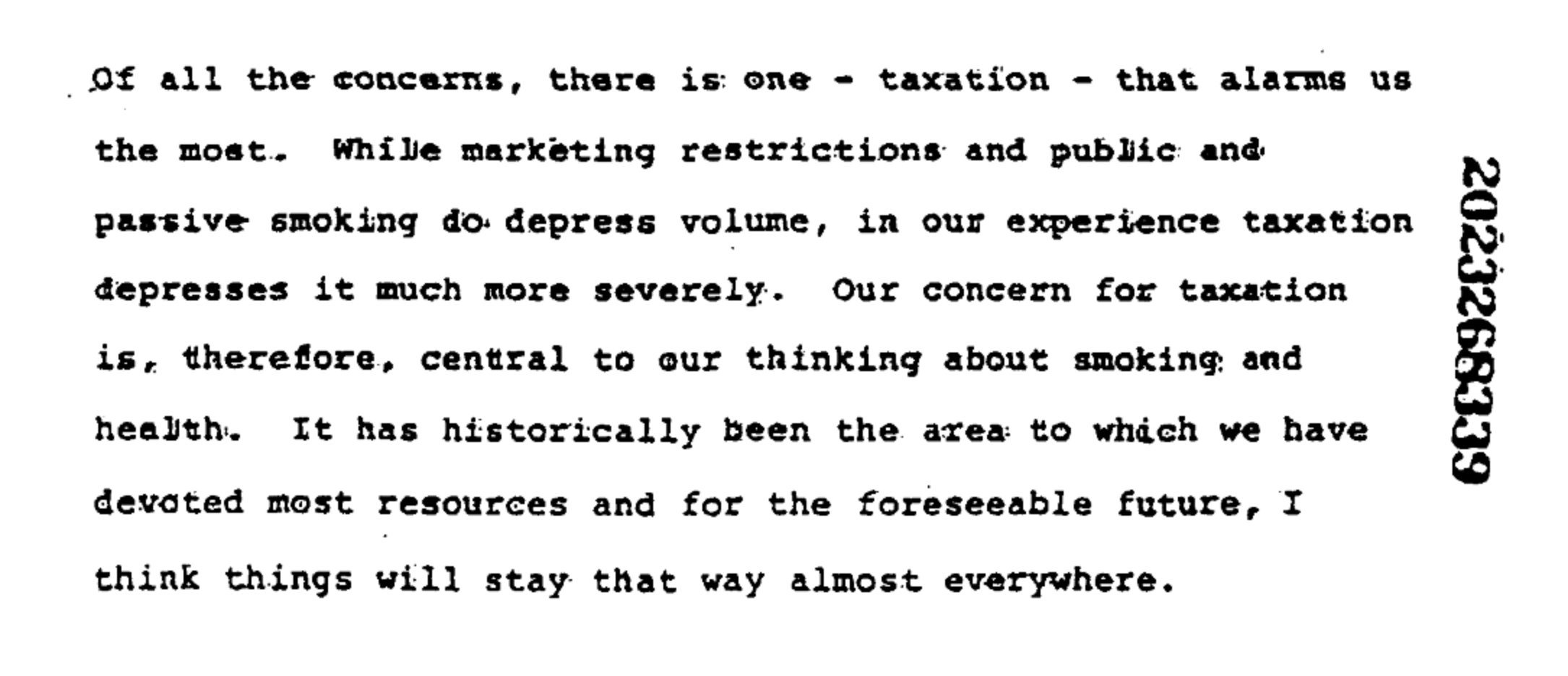
Philip Morris International internal top management document 1985

But when someone doesn’t smoke, they don’t calculate each night how much tobacco tax their non-smoking status has deprived the government that day, take out scissors or matches and destroy that money to spitefully deprive grasping governments of revenue.

Instead, we spend the money we have not spent on tobacco on other goods and services, nearly all of which attract a 10% goods and services tax, and create multiplier economic benefits in the economy. Certainly, with tobacco excise tax being additional to GST, smoking does indeed lay extra golden tax eggs.

But in fact spending money on tobacco has been shown to be one of the worse things a consumer can do to benefit an economy. This 2020 review concluded that “In nearly all countries …” effective tobacco control “policies will have either no effect or a net positive effect on overall employment because tobacco-related job losses will be offset by job gains in other sectors.” For example,  this US paper by two health economists modelled the large economic benefits to Michigan if it were to be (hypothetically) entirely smokefree. Other studies have reached similar conclusions about the net employment impact of reduced smoking (see table)

Source: https://cancercontrol.cancer.gov/sites/default/files/2020-06/m21_15.pdf

Professor Ken Warner from the University of Michigan,  summed all this up in a heavily cited paper in 2000.

“when resources are no longer devoted (at all or as much) to a given economic activity, they do not simply disappear into thin air—the implication of the industry’s argument. Rather, they are redirected to other economic functions. If a person ceases to smoke, for example, the money that individual would have spent on cigarettes does not evaporate. Rather, the person spends it on something else. The new spending will generate employment in other industries, just as the spending on cigarettes generated employment in the tobacco industry. Studies by non-industry economists in several countries have confirmed that reallocation of spending by consumers quitting smoking would not reduce employment or otherwise significantly damage the countries’ economies.”

This point was also made in 2001 in the British Medical Journal by Clive Bates, a long time commentator on tobacco control.

“taxes are just a recycling of money in the economy. If there was no smoking  … consumers would be spending their money on other things (which would also be taxed), and the government would be raising the budget it needs through other taxes, with no change in the total tax burden … Taxes just cannot be counted as a benefit in the same way that healthcare costs or savings can be counted.”

Further, all three tobacco transnationals selling in Australia are unlisted on the Australian stock exchange, have not manufactured tobacco products in Australia since 2016, importing all their cigarettes and roll-your-own tobacco into Australia, dragging on the balance of trade. They  have tiny workforces here and repatriate all profits to their international headquarters. Tobacco has not been legally grown in Australia since the 1990s, so there is no agriculture or manufacturing sectors contributing to the Australian economy. These are  further major considerations when considering the economic benefits of tobacco control.

Pigouvian taxes (eg: on sugar, carbon, alcohol, tobacco) are fundamentally about correcting an externality – some behaviour that a government wants to see change. That’s different from our other taxes, where the goal is raising revenue. With Pigouvian taxes, we want to change behaviour. With revenue-raising taxes, we don’t want to change behaviour. 

Indeed, in the case of tobacco taxes, governments want revenue to fall, because when matched by falling smoking prevalence, it means the policy is working as intended.  

Martin a “Tobacco Harm Reduction Advisor”

James Martin is listed on Harm Reduction Australia’s website as one of 15 board members, with his profile dated March 1, 2020. He is described as a “Tobacco Harm Reduction Advisor.”  However the  Australian Charities and Not for Profit Commission (ACNC’s) details on HRA do not show him as a “responsible person” (“Generally, a charity’s Responsible People are its board or committee members, or trustees.”)

Martin’s research output on his university page shows he has published 24 papers and book chapters since 2013. Not one of these concern tobacco or vaping.  But with no published research track record in any aspect of tobacco control, he apparently thinks differently to the significant national and global organisations which have never recommended lowering tobacco taxes. And to the governments of  183 nations representing over 90% of world population which are parties to the global Framework Convention on Tobacco Control, which gives prominent emphasis to tobacco tax in reducing smoking.

Martin recently described Clive Bates on Twitter as “a master”, yet appears to diverge from him when it comes to tobacco tax matters. Perhaps he needs to widen his understanding of tobacco control and start his peer reviewed contributions to the field if he wants to offer advice that might be taken seriously.

Pssst … doctors can still prescribe higher-concentrated nicotine vapes in Australia

Image: hosnysalah Pixabay

[updated 4 Sep 2025]

In the June 2024 Senate vote on the Therapeutic Goods and Other Legislation Amendment (Vaping Reforms) Bill 2024, the Greens party introduced a significant amendment which required that, instead of vapes being obtained only via a doctor’s prescription (the Government’s intention), they would be instead scheduled S3 (ie over-the-counter, non-prescription sales with advice on use from a pharmacist to customers aged 18 and over). Vapes available this way would have nicotine concentrations with a maximum of 20mg/mL.

The Labor government accepted the amendment, allowing the amended Bill to pass through the Senate vote and onto its subsequent passage through the House of Representatives into law on June 27. To have rejected the amendment would have likely seen the entire Bill sunk. So the government understandingly accepted the compromise which will be implemented in less than a month from  Oct 1, 2024.

In the few weeks remaining, those wanting to buy vapes from a pharmacy (now the only legal source for vapes), will still be required to get a doctor’s prescription and have this dispensed at a pharmacy.

But what seems to have flown way under the public awareness radar here is that these changes do not mean that after Oct 1, there will be no longer be the need for anyone to get a prescription for vapes. Anyone wanting a nicotine vape with more than the 20mg/mL will still be able to access these from a pharmacy, but only with a prescription.

This is all set out in the TGA’s Requirements for unapproved therapeutic vapes for smoking cessation and the management of nicotine dependence Guidance on the Therapeutic Goods (Standard for Therapeutic Vaping Goods) (TGO 110) where a maximum concentration of 100mg/mL is currently specified.

[update: The TGA revised the upper limit for prescription-required vapes to 50mg/mL from July 2025]

So importantly, prescription access is far from dead in Australia. The intriguing question here is whether the Greens knew this all along.  Or did their inexperience blindside them to the detail of the TGA’s regulations, with their amendment unwittingly preserving  prescription access for the higher nicotine concentrations that exasperated vaping advocates have insisted are essential in minimising vapers’ abandoning vaping and resuming smoking?

Two critical concerns about low nicotine delivery devices

The preservation of prescribed access to higher nicotine concentration vapes is a very important part of Australia’s new vaping laws. Here’s why.

First, there is a huge body of evidence that low yielding nicotine delivery devices (nicotine replacement therapy) have been abandoned by millions of smokers across over 30 years as unsatisfying, and so have very poor success rates under real world conditions of use, with smoking typically being resumed (my 2022 open access Sydney University Press book Quit Smoking Weapons of  Mass Distraction documents this in detail)

The same concerns may exist about low-nicotine concentration vapes. If this is the case, then clearly low nicotine vapes will be hamstrung in their utility in assisting hardened  smokers to remain off cigarettes.

Second, when nicotine-dependent smokers use so-called low nicotine delivery cigarettes, many change the way they smoke to try and get more nicotine to their brains to satisfy subtle craving cues. As we will see below, this causes increased exposure to other toxic components of cigarette smoke or vaping aerosol, as the case may be. This collateral toxicity is a serious argument for allowing heavy smokers prescription controlled access to higher nicotine concentrated vapes.

Here’s how these problems happen.

The way smokers inhale has long been studied by researchers inside and outside the tobacco industry. This research shows that smokers “titrate” or adjust the way they smoke to obtain a dose of nicotine that their brain signals to them that they need.

It is fundamental to the understanding of both smoking and vaping behaviour that those with nicotine dependence change their puff parameters (puff frequency, puff volume, between-puff intervals) to obtain the nicotine dose that satisfies or quells their cravings.

This evidence was at the heart of the 2005 action by the Australian Competition and Consumer Commission (ACCC) to ban the use of ‘light’, ‘mild’ and similar descriptors because the terms falsely implied that smoking machine-measured nicotine yields were a reasonable guide to the nicotine actually inhaled by smokers using these products.  Smokers thought they were getting “lighter” exposure to nasties when they bought products thus labelled. However these products changed the way they smoked to obtain more nicotine. “Lights” were nothing but a deceptive commercial practice which saw the tobacco industry pinged for millions of dollars in corrective advertising and the terms outlawed.

Many studies show that a majority of people who vape, continue to smoke (dual users) – often for years (see chapter 5 of my 2022 book). Some of these are people who have no interest in quitting smoking. However many dual users do want to stop smoking but find that vapes alone do not satisfy their nicotine craving and supplement their vaping by also smoking. This is harm increasing, not harm reducing.

NRT nicotine limits produce dismal cessation rates

For decades, it has been widely acknowledged that nicotine replacement therapy’s  (NRT) dismal effectiveness in smoking cessation under conditions of real-world use is in large part due to its poor ability to successfully satisfy nicotine cravings exhibited by smokers. Even under the highly artificial conditions in which RCTs are conducted, some 95% of smokers using NRT in RCTs are smoking at post six month follow-up. Many smokers find NRT unsatisfying, with the nicotine “grunt” being a pale shadow of that inhaled from cigarettes, In this 2021 systematic review, 61% of smokers  allocated to NRT in RCTs adhered to the recommended use throughout trials, compared to only 26% in longitudinal population (real world) studies. Randomised trials see participants subjected to many influences from their research participation which enhance compliance to recommended use. But most of these influences do not exist in real world use (see chapter 2 of my 2022 book).

The research literature on NRT contains many recommendations about contemporaneous multiple modes of NRT use. This points further to the recognition that NRT in the limited very low nicotine dose of single NRT products that have been approved by governments around the world perform very poorly in cessation under conditions of real world use.

The poor performance of NRT has been summarised by pointing out that many smokers find it too low and too slow in nicotine delivery in comparison with smoking and relapse back to smoking.

With vaping, similar concerns exist.

New JAMA paper

Of great relevance here, is a research paper recently published in JAMA Network Open. The study randomised 50 current vapers in a controlled cross-over trial to complete two sessions of using the same product (JUUL or NJOY) that differed by nicotine concentration (3% [JUUL] or 2.4% [NJOY] and 5% [JUUL or NJOY]) in random order. In each session, participants vaped up to 60 minutes ad libitum, preceded by 12 hours of nicotine abstinence.

The primary outcomes measured in each session were puffing topography parameters  (total session time, cumulative puffing time, total puff number, inter-puff interval, total inhaled volume, average puff volume) and plasma nicotine levels measured before and after each session.

They found that median topography parameters were significantly higher during the vaping sessions with the lower 3% or 2.4% nicotine concentrations compared with the higher 5% nicotine concentration for three of the measured  outcomes: puffing time (1.3 minutes vs 1.2 minutes], puff duration (2.6 seconds  vs 2.4 seconds, and total inhaled vapour volume (1990.0 mL vs 1490.0 mL. The median plasma nicotine boost observed in the 5% nicotine concentration condition (0.0060 mg/L was significantly higher than that in the 3% or 2.4% vape sessions (0.0043 mg/L.

The authors concluded thatThis randomized crossover clinical trial provides direct evidence that partial nicotine reduction in salt-based e-cigarettes was associated with acute compensatory puffing and the potential for increased exposure to toxicants. These results suggest that at least for current e-cigarette users, partial nicotine reduction can lead to enhanced exposure to some toxicants in the short term” as vapers change the way they vape to get a dose that satisfies their nicotine appetite.

They referenced seven studies published between 2016 and 2021 which had reported similar compensatory vaping measures, but noted that each of these had involved older generation vapes, not the nicotine salt-based products that were used in their study and which are commonly used today.

What vapers inhale besides nicotine

When vapers inhale, it is not just vapourised nicotine they pull into their lungs. The aerosol inhaled also contains vapourised excipients (substances other than the active drug – here, nicotine – used to support the process of delivering the active substance). With vapes these include synthetic favouring chemicals, none of which have ever been tested as safe for inhalation; propylene glycol (PG) and/or vegetable glycerine (VG); and minute metallic particles sloughed off from the metal heating coils found in all vapes when these metal coils are heated.

Dow Chemical is a leading manufacturer of PG.  Here’s what it has to say about breathing it in.

“Therefore breathing spray mists of these materials should be avoided … Dow does not support or recommend glycols in applications where breathing … is likely”

Likely!? This is the understatement of understatements when it comes to vaping.  With an average ~568 puffs a day by daily vapers, that’s 568 point-blank deep lungfuls of vapourised PG – not just nicotine – that vapers are getting – a rather different exposure to the fleeting exposure to theatrical fog (also PG) that most of us have experienced occasionally when watching drama in a theatre.

This study notes that “in experimental animal studies, unheated PG or VG have minimal lung toxicity. However, when delivered from e-cigs, there are measurable increases in lung inflammatory infiltrates, cytokines, infections, reactive oxygen species, and gene expression.”

Lowering maximum nicotine concentration in e-liquids to 20 mg/mL in base form (or base equivalent), allowed Australia to align with the limits in the EU, UK and Canada.

But here, it is critically important to note that, unlike Australia, the EU, EK and Canada do not yet have a pharmacy and prescription-access only vaping access policy like Australia’s. These nations have set the 20 mg/mL nicotine limit to try and reduce the likelihood of nicotine naïve children becoming addicted when they obtain vapes under “consumer access” models of regulation favoured by the vaping industry and all tobacco companies now also selling vapes.

Australia’s 20mg/mL limit is not being set for the prevention of regular use by children (who will rarely be prescribed vapes) but for nicotine-addicted smokers using vapes to try to quit.

Had the TGA made no provision for higher nicotine concentration vape to be prescribed by doctors, it would have been highly probable that, as has long occurred with NRT, many heavily nicotine addicted users will similarly quickly desist from using prescribed vapes after finding that their cravings persist. This is obviously not the outcome being sought via prescription access to vapes for those who are already nicotine addicted.

Those pharmacy chains which have argued that they would have been happy to supply vapes only by prescription may well be happy with the realisation that they can still dispense vapes. The Royal Australian  College of GPs and the AMA which were both highly supportive of the original prescription-only policy, are likely to advise their thousands of members that the prescription route still exists for those smokers with entrenched nicotine addiction.

Pharmacists who are obligated by S3 regulations to discuss the vapes they are dispensing with purchasers, are in the perfect position to inform relevant more nicotine addicted customers about seeking a prescription from a doctor.

[added 5 Sep 2024] Here is a list of vapes (including vaping substances, vaping accessories and vaping devices) that sponsors have provided to the TGA stating that the vapes comply with applicable standards for supply in Australia for smoking cessation or the management of nicotine dependence. The listed vapes have not been assessed by the TGA for quality, safety and efficacy or performance. As of 5 Sep 2024 there are 1,472 notified products, many of which have nicotine concentrations between >20mg/mL and 100mg/mL.

Pharmacists:  are you comfortable dispensing a tobacco company’s vaping products?

Imagine a global distilling company bankrolling a comprehensive multi-media campaign directed at teens, purportedly designed to convince them that alcopops and binge pre-loading with vodka disguised in fruit juice were dangerous, even deadly activities. Meanwhile, the company aggressively promotes alcopops, pleading that lots of adults like the sickly sweet drinks too.

Then enter a major manufacturer of gaming machines offering doctors incentives to refer problem gamblers to support groups, against the reality that revenue from poker machines is dominated by people with life-destroying gambling problems and implacable industry opposition to reforms that in any way seriously threaten that income stream.

Well, right now we have a third example that requires no hypotheticals, but only the 10,000 watt searchlights of duplicity focussed on the activities of Philip Morris International (PMI), the world’s second largest tobacco company after the Chinese National Tobacco monopoly.

In 2023, PMI manufactured 612.9 billion cigarettes globally. It also sells several nicotine delivery products it promotes as “alternatives” to smoking. One of these is the vape VEEV.  Its marketing staff have been extremely busy trying to get VEEV stocked by Australian pharmacies so that staff will supply it to those wanting to buy vapes from Oct 1, 2024 when pharmacies will be able to sell them to anyone aged 18 or over without a prescription.

So what’s the problem here? Why does it matter that smokers might be channelled to get a tobacco company product instead of one sold by companies with no tobacco industry connections?

If you instinctively recoiled at the two parallel examples I started this blog with, then you already know the answer. Just as we know that a wealthy drug dealer putting $5000 in the church plate each Sunday, does not wash clean the source of his weekly charity, a tobacco company posturing as a solution to the problem they continue to cause is literally sickening.  But let me spell it out.

Over the last few years, PMI has been telling everyone that it wants to “unsmoke” the world. It says it wants those who smoke to stop smoking and switch to its alternative nicotine delivery systems. It  has even gone further, saying that they want their customers to stop using all forms of nicotine: “To be clear, PMI’s core message is: For adults who use nicotine in any form it is best to quit completely.” Here, we are meant to believe that the company wants its cigarette customers to stop smoking and switch to its non-combustible nicotine products. But it says it also wants even these customers (“it is best”) to also quit these. This sounds as credible as a motor vehicle company urging owners of its petrol-powered vehicles not just to switch to its fully electric models, but to also then abandon those and not own cars at all. Only a tobacco company could have the weapons-grade gall to make such a statement publicly, even in our increasingly post-truth world.

Dual use: the motherlode reward for Big Tobacco

The industry’s public pitch is that smokers should switch from cigarettes to the non-combustible products. But the reality is that dual use (smoking and vaping, not smoking instead of vaping) is the motherlode of rewards for Big Tobacco here.

In 2018, British American Tobacco’s (BAT) then boss Nicandro Durante said that dual use had become not “a”, but the key consumer dynamic” for his company, growing from 13% to 23% in less than one year. A BAT presentation identified most popular “new occasions” for e-cigarette  users were “when I can’t smoke cigarettes (86%), “in the car” (62%) and “inside pubs and restaurants (47%). In a 2019 presentation to investors, BAT emphasised that dual and poly-using next generation product (NGP) users were of vital importance to its mission. Sixty five per cent of vapers and 55% of heated tobacco product users were dual users at the time.

All tobacco companies know very well that their bread will be buttered far more by the pursuit of dual use and multiple nicotine delivery system use than by just concentrating on cigarettes. Their clear objective is to maximise sales of all of their addictive products.

No tobacco company has set a date to end cigarette manufacturing

All transnational tobacco companies have lost no time investing heavily in the development and marketing of vapes. Some of these companies have made statements that they hope to one day stop selling combustible tobacco products. But tellingly, unlike the car manufacturing industry where companies are lining up to announce dates for them to stop manufacturing fossil-fuelled cars, no tobacco company has set a target date for the end of cigarettes. And just as tellingly, they continue to do all they can to maximise cigarette sales and as they’ve done for 70 years, thwart any evidence-based government policies which seriously threaten to put a brake on the uptake of smoking or accelerated quitting.

Far from turning off its efforts to produce and market cigarettes, PMI continues to expand its cigarette business wherever it can. For example, in March 2018, PMI opened a new factory in Tanzania with  capacity to produce 400 million cigarettes a year “to cater for the local and international market.”

In June 2022, PMI launched a new cigarillo brand Chesterfield Leaf, using a tax loophole that saw the brand priced below all cigarettes in New Zealand. This is the action of a company seeking to retain and attract smokers — particularly those on low incomes including kids — not one that would drive them away from smoking.

In Indonesia the world’s fourth most populous nation with huge rates of male smoking and feeble tobacco control, PMI owns the Sampoerna cigarette company but local sales of its IQOS heat not burn product are very small. 

Gaprindo, the white (non kretek) cigarette manufacturers association in Indonesia, represents the interests of transnationals like PMI, BAT and JTI (Japan Tobacco International). Gaprindo routinely lobbies to oppose tobacco control policies like tax increases, as does the tobacco industry globally.

PMI’s 2023 third  quarter report to investors on its global results highlighted $US9 billion in quarterly net revenues for the first time. Its CEO emphasised “resilient combustible trends”, barely coded words meaning that its cigarettes were still selling the house down. He did not suggest this was unfortunate, regrettable or a problem.

This is spelt out very clearly by PMI’s numbers. The Motley Fool summed it up this week “Let’s not forget the profitable legacy cigarette business, which is still generating boatloads of cash flow. Due to Philip Morris International’s exposure to emerging markets, volumes are actually stable for the segment. Cigarette volumes declined by just 0.4% last quarter, which the company can make up for through price increases.”

That stability in cigarette volume can be simply put as: for every (western) smoker that PMI magnanimously ‘unsmokes’, they are replaced by a newly recruited cigarette smoker from Africa, the middle east or Asia.

PMI makes substantially more profit (about double) from heat-not-burn products than cigarettes, thanks to lower tax rates (or triple the profit if you are on a friendly basis with the Associate Health Minister, as we saw in New Zealand recently).

All tobacco major tobacco transnationals are fervently opposed to the pharmacy-only access policy just passed into law in Australia. They have always wanted vapes to be categorised as “consumer products” not subject to the restrictions of therapeutic goods regulations, like pharmaceuticals. The setback they will now experience with pharmacy-only access in Australia will be seen as policy they would like to smash quickly before it spreads globally. This has been their playbook with all effective tobacco control policies.

Becoming a participant in the supply of vapes provides tobacco companies with  opportunities to use their massive resources to engage in anti-competitive behaviour by blowing all competition out of the game via deals they strike with pharmacists. Over a year ago, The Guardian reported that Philip Morris was offering Australian pharmacists an 80% margin on VEEV, trying to lock them into deals where the VEEV device would sell for $19.90 and two pods at or below $14.90. This was said to be below cost and cheaper than pharmaceutical wholesalers could supply comparable products.

The Australian Competition and Consumer Commission needs to be keeping a very watchful eye on any such possibly anti-competitive conduct, and hitting any company found to be engaging in this with brutal, deterrent penalties.

In March this year The Guardian reported that the Therapeutic Goods Administration was investigating four vaping telehealth “prescription mills” which includes cases where companies using doctors were allegedly providing prescriptions to particular branded products. With prescriptions no longer needed for vapes containing nicotine concentrations of 20mg/mL (these can be purchased via such vapes “under-the-counter”) prescriptions will only be needed for concentrations above 20mg/mL and up to 100mg.

Non-combustible nicotine delivery systems owned by tobacco transnationals

So if you are a pharmacist (or a vaper) who wants nothing to do with helping the profits of  a tobacco company, here is a list of some non-combustible inhalable nicotine brands now being sold around the world by tobacco companies.

Philip Morris International: IQoS, VEEV, lil

British American Tobacco: Vuse, glo

Imperial Brands: Blu, Pulze

As one vaper put it on Reddit …

Source

The Thoracic Society of Australia and New Zealand recently cut all ties with Mundipharma, a pharmaceutical company specialising in asthma medications, after Mundipharma struck a deal with Vectura, a Philip Morris subsidiary selling asthma drug inhalers.  This followed a  January 2022 statement from the Forum of International Respiratory Societies about the takeover of Vectura by Philip Morris. The President of the European Respiratory Society stated “the takeover is a dark time for respiratory medicine and this development represents an incredible blurring of the lines, whereby a company may now profit from the medicines used to treat the illnesses that its products cause.”

By entering the therapeutics market, Philip Morris would have its eyes on the prize of a strategic seat at the tables of health regulatory bodies where it would hope to rebirth itself as a “wellness” company, providing air cover distraction from its on-going tobacco sales. It would also hope to leverage disruption of the policy rollout of the WHO’s Framework Convention on Tobacco Control (FCTC), the global blueprint for reducing tobacco use and the tobacco industry’s interference in that effort. This 2017 major Reuter’s report on Philip Morris’ plans to block and weaken FCTC treaty provisions makes this explicit.

Will it be long before tobacco companies cynically invest heavily in hospices, palliative care, crematoria, funeral services and catering for wakes? Nothing should ever surprise us about this industry.

How to report the illegal sale or promotion of vapes in Australia

Source: Hiberliu- Pixabay

On July 1 2024, the Therapeutic Goods and Other Legislation Amendment (Vaping Reforms) Bill 2024  came into effect across Australia, following its rapid passage through both houses of parliament. The Greens party negotiated their needed support for the government’s bill by requiring  pod system vapes with 20mg/ML of nicotine concentration to be sold in pharmacies. This put an end to the plan whereby all vapes would need a doctor’s prescription. Prescription access will still be available for vapes with nicotine concentration of 21-100mg/ML.

The main provisions of the Bill are to:

  • Make it illegal for anyone other than a registered pharmacy to dispense or sell any vaping product, whether or not it contains nicotine
  • Allow pharmacies to sell vapes “behind the counter” with a maximum nicotine content of 20mg/ML to anyone aged 18 or above. Vapes are classified as S3 products, meaning that they cannot be displayed or in any way advertised or promoted to the public, must be stored in a dispensary and each transaction must involve provision of evidence that the purchaser is aged 18 or over and the provision of advice on use by the dispensing pharmacist.  There are no limits on how many vapes a purchaser may buy and no records will be kept on the name or contact details of the purchaser, as occurs (for example) with  sales of the cough medicine pseudoephedrine to facilitate individual surveillance of possible multi-pharmacy purchasing.
  • The only permitted flavours to be sold are mint, menthol and “tobacco” (I argued in my submission to the Senate enquiry that “tobacco” was an unfortunate inclusion as it may trigger thoughts of tobacco smoking in vapers trying to stop smoking. I suggested some anodyne flavour names like “standard”, “classic”, “basic” or “regular”.  Nicorette NRT gum uses “classic”. I do not believe any NRT products are flavoured with “tobacco”. Opportunity may arise to amend this provision down-the-track).
  • Vapes will be sold in “plain packs”, in the same manner that all S3 or above drugs are sold. To me, this provision is of minor importance because unlike smokers, vapers do not carry their vapes around in the packaging in which it was sold. These are immediately discarded by vapers, so any efforts to glamourise vapes via packaging is moot – quite different to cigarette packs which are taken out and displayed each time a new cigarette is taken from the pack.
  • The vape itself will also be required to conform to a standard appropriate to their S3 pharmaceutical status.  Just as we do not see people with asthma using brightly coloured and uniquely shaped puffers, vapes will also look like a dull therapeutic good rather than act as a “look-at-mine!” identity signalling fashion accessory. School epidemics of nicotine patch wearing are unknown because patches have zero cachet as cool items to display and compare. 
  • Maximum penalties for importing or supplying vapes intended sale outside of the registered pharmacy channel are severe: for individuals importing this is 5,000  penalty points`  (ie: $330 x 5,000 = $1,650,000) and 7,000 penalty points (ie: $330 x 7,000 = $2,310,000) for corporations. For corporations selling it is   70,000  penalty points (ie $330 x 70,000 =$23,100,000) and 7,000 for individuals (ie: $330 x 7,000 = $2,310,000). These penalties can also involve up to 7 years in prison. 

These high penalties reflect the large scale criminal importation, distribution and sale of illegal vapes that has occurred since the importing floodgates were held way open by a Liberal/National Party backbench revolt that gutted former health minister Greg Hunt’s prescription access/import ban in 2022. Previous maximum fines were treated with contempt, barely skimming the petty cash box in the unlikely event of a prosecution.

The bottom line in all this is that the confusing mess that in the past characterised illegal vaping sales and derisory levels of investigation and prosecution is now over. Any sale of any vapes outside of pharmacies is prohibited with those concerned facing very serious penalties.

So this is a very powerful law, the first where any nation has limited vape access to pharmacies. This seems highly likely to greatly reduce children’s access to vapes because the professional commercial culture of pharmacies differs radically from that in convenience and vape stores. Pharmacies are ubiquitous across the country, with online provisions for those living in remote areas.

Chinese vape exports to Australia have continued to plummet since January 2024, following the ban. Many reports are being received about the price of illicit vapes skyrocketing, putting them out of reach of kids’ pocket money limits.

Reporting illegal vape sales

Illicit drugs never disappear entirely from communities in spite of being banned. But their access is incomparably harder than tobacco and now vapes. This is reflected in drug use statistics in minors, where regular illicit drug use is far less common than that for nicotine products and alcohol.

The new laws promise greatly reduced vape access by kids, but research efforts will now be important to understand the routes that will still be supplying vapes to school children.

Schools across Australia are in the frontline of the vaping epidemic in children. Research indicates that the most common ways that kids obtain vapes have been via friends, followed by purchasing vapes from retailers. On-line purchasing has been uncommon, with platforms like Snapchat being used to arrange pick-ups. “Secret” or pseudo shopper methods have often been used to determine shops which sold cigarettes to children. These will undoubtedly be reprised with vape surveillance.

When children are found to have vapes at school, these are invariably confiscated and  parents informed. During this process, children frequently tell all about where they have obtained the confiscated vapes. So schools have been and will continue to be invaluable sources of information about retailers who continue to sell illegal vapes to minors.  This information can be then used by agencies empowered to investigate and prosecute illegal selling.

The TGA

The Therapeutic Goods Administration (TGA)  is empowered to investigate and prosecute illegal supply (sales), promotion  and importation of vapes. Its website provides summaries of such prosecutions and the penalties that have been imposed (see this example where fines of $5m were imposed).

You can report illegal selling or promotion of vapes to the TGA via this form (note that at the time of writing, the form does not make explicit mention of vapes, but is a general form for reporting concerns about the sale and promotion of any therapeutic good. This is however, the correct form for reporting about illegal vape sales).

States and territory health departments are also charged with investigating prosecuting illegal vape sales (see contacts below). At the time of writing, some have not yet harmonised their penalties with those applying at the Commonwealth level. The TGA is working closely with state governments, so until state penalties are aligned with those of the TGA, notifying the TGA as well will be sensible.

ACT

NSW or phone your local Public Health Unit on 1300 066 055

Northern Territory 08 89992691 ask for the tobacco compliance officer

Queensland: phone 13 74 68

South Australia

Tasmania phone 1800 671 738

Victoria: Report cases to your local police station

Western Australia

Always keep a record of` your report, including the date you made it and the name of the person you spoke with if you phoned your report in.

Vaping Theology 24: “Tobacco control advocates are responsible for vape retail store fire bombings and murders”

In recent months Alex Wodak, a frequently professed doyen of polite, respectful debate about vaping policy, has ratcheted up his nastiness meter to 11. He’s pointed his finger at the root cause of the gang warfare and growing fire bombings of mostly Victorian shops, as well as  three murders. He says the cause of all this is the galactic folly of the prescription access vape model implemented by the Morrison government from Oct 1, 2021. More precisely, it is various individuals inside and outside government who supported or reported on this model and are playing hard today inside his head (see examples below).

Wodak’s inane and offensive reasoning here is that those who supported former health minister Greg Hunt’s prescription policy would be proud and delighted by these serious crimes and are cheering them on in ghoulish delight at what they have reaped. He apparently seriously believes none of this would be happening had he and his vape promoting mates not failed in their advocacy for open access to vapes via the government classifying them as “consumer products”. This would have allowed them to be sold by (for example) tobacconists and convenience stores, those upstanding stalwarts of public health who of course never sold tobacco to kids across the decades.

Former long-time employee of British American Tobacco and now head honcho at the Australian Association of Convenience Stores (which received tobacco industry support over two decades and has helped industry campaigns) Theo Foukkare, trained his Exocet far more narrowly in  the Herald Sun on May 8 – “Health Minister Mark Butler is solely to blame for Australia’s youth vaping crisis and the rampant black market that he has created, which has already resulted in over 70 firebombings and multiple homicides throughout our communities.”

Someone who knows a thing or two about crime data is a former head of the NSW Bureau of Crime Statistics, Prof Don Weatherburn. He called out this puerile garbage recently in an amusing exchange on Twitter:

Wodak and Foukkare both seem to have conveniently forgotten that criminal involvement in tobacco supply in Australia has been going on long before vaping became widespread. And just a reminder that “sell anywhere” tobacco supply is the very model that they both want for vapes. Here’s a small selection of examples:

2005 murder of an illicit tobacco dealer

2008 documentation of crime gangs, illegal tobacco syndicate, of middle eastern origin

2009 Police corruption in tobacco trade

2010 Corrupt dock workers, outlaw motorcycle gangs in smuggling

2011 Three unsolved murders, illicit tobacco 

2014  27 arrests middle eastern crime gangs    

2016 Links ofmiddle eastern crime gangs to funding of Hezbollah

These sprays about the claimed architects of prescription access seem designed to distract
attention away from how it actually happened that illegal vapes flooded the market in Australia in recent years.

In any blame game about the booming illegal vapes trade in Australia, the obvious dramatis
personae
with the lead roles are the pots now calling public health and political kettles black. In 2020, a  
Liberal National backbench revolt by 28 backbenchers led by the National’s Senator Matt Canavan was responsible for intimidating the Morrison government into destroying one of the two complementary pillars of its health minister Greg Hunt’s policy when it quietly scrapped Hunt’s  ban on vape imports in late 2020. Ten thousand watt green lights were then turned on to light the way for vape importers who instantly figured correctly “why would anyone bother getting a prescription for vapes when you can pick them up almost anywhere?”

To the delight of Big Tobacco, which is unified in implacably opposing prescription access, pulls strings on a seemingly “independent” well-funded campaign and pours funding at the yokels in the National Party, the backbench plotters left the prescription component intact. They then bought front row seats to watch the whole policy collapse, pausing now and then for solemn obligatory statements about how no one wants to see children vape.

Chain-sawing  Greg Hunt’s policy in half and thereby chocking open the floodgates to industrial scale criminal importation of vapes was always going to have the obvious outcome. Sabotaging the import ban left the prescription access pillar bereft of any complementary incentive that would have driven lots of vapers to get a prescription.

“Nicotine free vapes”

Any hesitancy by retailers to sell vaping stock obtained from these importers was then doused by a brilliant deception.  The massive loophole that it remained legal to sell vapes which did not contain nicotine saw millions of vapes flooding Australia mostly in ditzed-up boxes obligingly added by Chinese exporters for their Aussie importing customers. These falsely stated that the vapes did not contain nicotine.  “M’lud! Hand-on-heart, I truly thought I was selling legal, nicotine-free vapes! You’d understand that I don’t do chemical analyses of the groceries I sell to check whether they conform to their labelling either.”

Health Department inspectors were required to submit any seized vaping stock to accredited labs to test if it did indeed contain nicotine. And even if they tested positive for nicotine, a retailer could argue that they had sold them in good faith  as nicotine-free. I was in a meeting in Adelaide in 2023 called by the South Australian Health Minister Chris Picton. A senior Health official there explained that testing each batch of suspect vapes cost thousands of dollars as no mass testing facility was available locally.

The result was that seizures and testing were fatally hamstrung and occurred at homeopathically small rates. Those illegally retailing understood this perfectly well and knew that the probability of them ever being fined was beyond remote. So under-the-counter surreptitious sales morphed into open displays with neon lights outside shops, all in plain sight of kids and legally impotent health inspectors.

Enablers of the vape black market 

So who then were the true enablers of the tsunami of “black market vapes” that turbo-charged around Australia from the beginning of 2021 and the violent criminality that went with it? The 28 Liberal National politicians led by Queensland National Matt Canavan and NSW’s freshly turfed Hollie Hughes are obvious. They  sought  and succeeded in gutting Hunt’s policy from inside the LNP, to the certain delight of their tobacco industry donors.

But who got in their ears? Who were the go-to interest groups who were the consultant architects of the policy rubble that came to pass and  turbo-charged all we are reaping today: skyrocketing increases in current vaping by 14-17 year olds (from 1.8% in 2019 to 9.7% in 2022-23) and fire bombings of retailers, presumably by those intent on maximally cashing in on such growth?

I think we all know the answer here. All those who were implacably opposed to prescription access cosied up to anyone who might help their cause, mostly from the far right of politics. So who is it today who is gloating that their work managed to wreck the prescription vapes model for a few years? Who is it saying “look over there at those who hatched the original policy (but please don’t look at those of us who wrecked it and saw the predictable boom in kids vaping because access was so easy)” And who is so panicked that Mark Butler’s resurrected scheme looks like passing into law with a few sensible amendments clarifying personal vs commercial possession, that they are having daily apoplexy. 

“Cigarettes are sold everywhere, so should be vapes”

A related tenet of vaping theology has received a huge workout in Australia. This is the argument that because cigarettes can be sold literally through any retail outlet which (in most states) has a tobacco retail licence, vapes should enjoy no less freedom of access.

Their argument here runs: (1) cigarettes are more dangerous than e-cigarettes (2) cigarettes have always been sold and are not banned from sale (3) therefore, consistency and coherency demand that e-cigarettes should also be allowed to be sold at very least in the same way because of the precedent established by cigarettes.

This deeply flawed syllogism takes no account of the reasons why cigarettes are sold in the way they are today, and not in the way restricted substances like prescribed drugs are sold to consumers.  Sales of cheap machine-made cigarettes burgeoned from the early twentieth century when there was no case against smoking, beyond that made by temperance groups. Tobacco control commenced more than 60 years later with the first tepid health warnings appearing in the USA in 1966. Across those years, tobacco consolidated its special exceptionalist regulatory status as being entirely exempt from ingredient controls. Even today, fully comprehensive tobacco control has been enacted in only a minority of nations.

To date, no country other than the minnow, isolated nation of Bhutan has ever contemplated banning cigarettes. Yet throughout my 45 year career, it’s been common to hear leaders in this field say “if cigarettes were invented tomorrow, when we know now what we never knew when they first appeared, no nation would allow them to be sold.” Those pointing this out know that no nation will ban cigarettes any day soon. They know the legacy of cigarettes’ historical circumstances saw them (unlike pharmaceuticals, foods, beverages, cosmetics, agricultural, industrial and household chemicals) totally exempted from regulation. They know this historical legacy has tied two hands behind the backs of any thought that backwards time-travel could somehow magically allow this situation to be
undone.

Importantly, they know that when proposing gold standard regulations for any product carrying serious risks, the very last model any regulatory authority would reach for is that which applies now to tobacco regulation. Yet knowing all this, those calling for vapes to enjoy the same open slather access regulations that tobacco does, are happy to set their ethical bar to this lowest imaginable level and accuse supporters of tough regulation as being “incoherent”. We allow cigarettes to be sold everywhere, so therefore we should allow a putative less dangerous cigarette substitute to be subject to the same non-standards of
regulation, they argue.

This reasoning is completely arse-up.

Instead, we should commence our comparison by saying “We made every conceivable error in the way we allowed cigarettes to be allowed into commerce, in the way we allowed it to be advertised, packaged and sold as if it was confectionery. We know that we were deceived by the tobacco industry with the harm reduction false promises of filters and light/mild cigarettes. We now face a new opportunity to get regulation right with new nicotine delivery products carrying unknown risks from daily, long-term use. Let’s learn from the disastrous history of tobacco non-regulation and not make the same mistakes again.”

Governments have banned leaded fuel and paint, asbestos and innumerable examples of dangerous consumer goods, all for health and safety reasons. In Australia and New Zealand pure caffeine was swifty banned from September 2019, following the tragic death of  21 year old Lachlan Foote, the son of friends of mine.  

But vapes are not being banned in Australia, any more than antibiotics and all prescribed drugs are “banned”. Vaping advocates’ trivialisation of nicotine and vaping as a drug and a practice deserving the same regulatory oversight as caffeine is where their rubber meets the road. A huge amount of early evidence is now emerging about particularly the cardiovascular, respiratory and DNA damaging effects of vaping, which as occurs with smoking and asbestos exposure, features latency periods lasting decades before disease is clinically diagnosed.

Lessons from prescription drug access

No one in all this seems to have asked a very obvious question. With there being massive demand for a huge range of (not) “banned” prescribed drugs (315 million PBS  and RPBS prescriptions in 2020-2021), why has the prescription model of drug access been flourishing for many decades  in all but lawless or chaotic nations where you can often pick up almost any drug you want without a prescription?

Why have not Australian “criminal gangs” decided that here was a golden opportunity to supply any of the 925 PBS drugs to people wanting them without the hassle of getting a prescription? Why are we not seeing  pharmacies torched by criminal gangs?

In Australia, there are black markets for products including anabolic steroids, some new and expensive weight-loss drugs and erectile dysfunction drugs. A BBC report details criminal gangs diverting a range of prescribed drugs in England.  Black markets do exist for prescribed drugs but the size of these are a tiny fraction of those which operate via prescription access.

And no one, not even Alex Wodak (see below), wants to see dependence producing drugs available on prescription being sold across the counter in shops. But dependence producing nicotine vapes, full of flavouring and coolant chemicals  never approved by any drug regulatory system anywhere in the world for inhalation? No problem for Wodak: available at your corner store now, right next to the bubble gum.

In this blog series on vaping theologies, I’ll give the last apposite word to Don Weatherburn’s characterisation of Wodak:

Also in this series

Vaping theology: 1 The Cancer Council Australia takes huge donations from
cigarette retailers. WordPress  30 Jul, 2020

Vaping theology: 2 Tobacco control advocates help Big Tobacco. WordPress 12 Aug, 2020

Vaping theology: 3 Australia’s prescribed vaping model “privileges” Big Tobacco WordPress Feb 15, 2020

Vaping theology: 4 Many in tobacco control do not support open access to vapes because they are just protecting their jobs. WordPress 27 Feb 2021

Vaping theology: 5 I take money from China and Bloomberg to conduct bogus studies. WordPress 6 Mar, 2021

Vaping theology: 6 There’s nicotine in potatoes and tomatoes so should we restrict or ban them too? WordPress 9 Mar, 2021

Vaping theology: 7 Vaping prohibitionists have been punished, hurt, suffered and damaged by Big Tobacco WordPress 2 Jun, 2021

Vaping theology: 8 I hide behind troll account. WordPress 29 Jun, 2021

Vaping theology: 9 “Won’t somebody please think of the children”. WordPress 6 Sep, 2021

Vaping theology: 10: Almost all young people who vape regularly are already smokers before they tried vaping. WordPress 10 Sep, 2021

Vaping theology: 11 The sky is about to fall in as nicotine vaping starts to require a prescription in Australia. WordPress 28 Sep, 2021

Vaping theology: 12 Nicotine is not very addictive WordPress 3 Jan 2022

Vaping theology 13: Kids who try vaping and then start smoking,would have started smoking regardless. WordPress 20 Jan, 2023

Vaping theology 14: Policies that strictly regulate vaping will drive huge
numbers of vapers back to smoking, causing many deaths. WordPress 13 Feb, 2023

Vaping theology 15: The government’s prescription vape access scheme has failed, so let’s regulate and reward illegal sellers for what they’ve been doing. WordPress 27 Mar 2023

Vaping theology 16: “Humans are not rats, so everybody calm down about nicotine being harmful to teenage brains”. WordPress 13 Jul, 2023

Vaping theology 17: “Vaping advocates need to be civil, polite and respectful” … oh wait. WordPress 3 Oct, 2023

Vaping theology 18: Vaping is a fatally disruptive “Kodak moment” for smoking. WordPress Oct 30, 2023

Vaping theology 19: Vaping explosions are rare and those who mention them are hypocrites. WordPress 17 Nov, 2023

Vaping theology 20 : Today’s smokers are hard core nicotine dependent who’ve tried everything and failed – so they need vapes. WordPress 14 Dec, 2023

Vaping theology 21: Australia’s prescription vapes policy failed and saw rises in underage vaping and smoking. WordPress 10 Jan, 2024

Vaping theology 22: “Prohibition has never worked at any point for any other illicit substance”. WordPress 17 Mar 2024

Vaping theology 23: “84% of the Australian public are opposed to the way the government will regulate vapes” WordPress 2 Apr, 2024

Vaping Theology 24: “Tobacco control advocates are responsible for vape retail store fire bombings and murders. WordPress 27 May, 2024


Precious objects

Our house is filled with artwork, cloth and knick-knacks we’ve picked up over decades of travel.

I often wonder what I’d take if we chose to downsize to an apartment when zimmer frames make the house too difficult. Here are seven very special pieces that I’ll take to my grave.

Maoist kitsch

I bought this statuette in a Beijing flea market about 20 years ago for $15. These pieces were massively popular during the Maoist cultural revolution in China and now command sometimes high prices from kitsch aficionados.

I took it back securely wrapped in hand luggage where it went to my university office, sitting on my desk for several years.

One day a Chinese student came to see me for feedback on an essay. I saw her look at the figurine and asked her “so who is the man kneeling? Is he someone well known, or is he a particular kind of worker or dissident?” This much seemed obvious.

She looked very awkward and said carefully “It’s no one special … but he’s a professor”

I could not have been more delighted to learn this. Clearly here was someone who might have been me, had I been an academic in Maoist China. The red guard holds aloft Mao’s Little Red Book, the only book worth reading, and stands on his shoulder, publicly humiliating the professor in his re-education.

“So what does the wording on the sign around his neck say?” I asked.

She seemed mortified and looked at the floor. I assured her that I knew it must have been something awful about the professor. She could tell me. I wouldn’t be offended.

After some moments, she sheepishly told me that it said “Academics are parasites on society”.

The fish mouth vase or water jug

This truly bizarre piece was the featured image in the catalogue at a Lawson’s decorative arts and objects auction several years ago.  We’ve had a koi pond for 25 years (photo below), and their beauty has since piqued my interest in fish art and objects. So this item burned into my attention. I won the bid and took it home, to my wife’s horror.

It had a dark residue inside suggesting it had been used to keep flowers in water. I cleaned this out and now use it to pour table water at dinners. A single kanji character on the base told a neighbour who is a fine arts specialist that it’s Japanese.

Our koi pond at dusk

Senegalese barbershop advertising sign

I’m an Africaphile and have spent hundreds of hours in the African quarters of cities in record and CD shops when these used to be  common. On a trip to New York about 30 years ago, I bought this painting in a small SoHo gallery. I’d seen many of its kind before. They are front-of-shop advertising signs for barber and hairdressing shops in West Africa.

My parents were both hairdressers. They had many magazines in their salon’s waiting area with hundreds of photos of women’s hairstyles that customers could browse for ideas as they waited their turn. So this barbershop art resonated strongly with my childhood.

This one is one of the best examples I’ve seen, among many that are far more naïve in the quality of the art (see large selection here). I have a book in French  Ici bon coiffeur by  Jean-Marie Lerat (1992) which shows examples from most West African nations.

Beatles drawing

On the same New York trip when I found the barbershop ad, I found this ink drawing being sold by a wizened up old man, selling his work from a square card table on the footpath, again in SoHo. As the Beatles audition, a slovenly record executive asks “What else do you do?” I thought it was perfectly witty and paid something ridiculously small like $20 for it.

I  noticed it was signed “Tuli”. In my teens I’d been a huge fan of the New York beat poets rock band The Fugs . Named as a nod to Norman Mailer’s book The naked and the dead where he substituted “fug” for “fuck” to taunt puritanical censorship policies of the time, their most famous song was the salacious Boobs a Lot. I loved the driving Group Grope off their second album too. Country town Simon thought they were just cooler than. Tuli Kupferberg was a core Fugs member.

So I said to him “Are you Tuli Kupferberg, by any chance?” and knock me over, he was! He was delighted to be recognised. We chatted excitedly for 20 minutes or so and he invited me to his place that evening with the promise of illicit experiences. I gave my excuses. He died in 2010 at 86. The sex, drugs and roll n’ roll didn’t cut him short.

Our original Modigliani

Wandering one morning in Ho Chi Minh city years back, we saw a labyrinthine art shop with several artists inside painting portraits  from photographs and copies of famous paintings from books.

And then we saw it. A clearly original Amedeo Modigliani. In fact, a painting so famous that it graces the cover of  the Taschen collection by  Doris Kyrstof  (see below). And here it was in front of us, with the shop owner clearly unaware of its immense value. After a lengthy tea ceremony, we shook hands on $40. We’re sending it to Southeby’s  next year.

We also bought a Van Gough haystacks original.

Turkish shop dioramas

I’ve been to Turkey several times since the early 1970s. Istanbul should be on every traveller’s bucket list. One day in 2014, walking on the shore of the Bosphorus after a night singing on a marriage boat, I found a small shop selling intricate diaoramas of old Turkish shop fronts. There were many to choose from, all about $120. I bought two and on return visits have bought more. Pictured (top to bottom) are  a general grocery shop, a fish monger, a bakery and a fruit and vegetable shop.

These miniatures transport me back to childhood nativity, military and historical diaoramas that fascinated me and which I crudely constructed in shoeboxes with toy soldiers, knights and cowboys.

Reg Mombassa tunes up

When COVID restrictions in Sydney lifted after months of us being cooped up, it was announced that we could have a maximum of 20 people at home, in addition to those living there.

A tennis mate, Dizzy, called me and said that in celebration, he wanted to host a pay-to-come house concert to raise money for a charity in Indigenous housing. His contribution would be to pay for the musos. Did I know how to contact Dog Trumpet? I did, and gave him the details. Pete and Reg jumped at the idea.

So on a Saturday night in Dizzy and Margot’s amazing renovation of the upstairs of a Balmain shop, 20 guests joined them for a two set gig in the living room. Another friend, the photo gallery owner Phillip Bell came along too. He took the stunning photo below and sold it to me at mate’s rates.

I always think of Vermeer when I take it in.

The central bottom right window pane, you can see Reg Mombassa tuning up before the start. Everyone was mesmerised by their sheer, original talent and easy presence throughout the best of nights. If you don’t know their work, here are two of my favourite pieces. Buttons undone and Bored wife.

Will the Greens back the Nats’ and One Nation’s efforts to kill Mark Butler’s vaping reforms?

The report of the Senate Inquiry into the regulation of vapes has been published. It will inform the debate in the Senate scheduled for the June sitting.

The Greens will play a pivotal role in the outcome of the vote. In the report, their concerns are well expressed – particularly when it comes to the detail of how we can be assured that possession of vapes is not criminalised – only commercial supply and sales outside of that which will be dispensed to those with prescriptions will be hit with huge deterrent fines.  No one. No one wants users to be prosecuted, fined or otherwise criminalised. The only exception should be where people ignore no smoking or vaping regulations, as has long been the case with smoking. Every airline in the world bans vaping.

The Bill does not ban or prohibit vapes

But the Greens are apparently exercised about “prohibition”. As a section of the Senate report states:

This concern is very easily addressed.  The Bill does not ban or prohibit vapes. They will be available to anyone who has a doctor’s prescription and obtainable from a pharmacy. To say that vapes are “banned” or “prohibited” is therefore like saying Australia bans all prescription drugs. If anyone were to say straight-faced that in Australia, antibiotics and the pill are “banned” because they require a prescription, we would know we were dealing with someone with some bizarre agenda. Yet this is the routine way in which extremist vaping advocates speak about current vaping policy.

Whenever I need a repeat prescription for one of the two life-saving drugs I have used for over 20 years, I contact my GP via a prescription renewal app and pick up several months supply at my local pharmacy. On a scale of life’s many inconveniences, I’d rank it way below trying to contact a human at a bank, a telco or utility provider, arranging travel or voting. A very first world problem.

Getting a prescription vape is no different the way we deal with other drugs of dependence. Methadone and buprenorphine are prescribed harm reduction drugs for those with opiate dependence. They  are not sold in convenience stores or bong shops. They are most commonly dispensed  at pharmacies. It’s the same with the very good analgesic codeine: it’s available on prescription to those who need it. These are not “banned”.

Before February 2018, low-dose codeine was available across-the-counter in Australia in a variety of medications. Following accumulating evidence of abuse, it was then rescheduled to prescription-only access. A wastewater evaluation found codeine use dropped 37% across Australia between 2016 and 2019. Many who were using it who did not need to, stopped using it when access was limited. This was harm reduction in action.

So where were the howls of protest at this heinous blow to the freedom for anyone to use as much codeine as they like?

Vape crusader Alex Wodak is adamant: he’s highly supportive of prescription access to regulated drugs. But he’s apoplectic about vapes being treated the same way.

Concerns were also raised in the Senate enquiry about vapers living in small country towns or isolated rural addresses. How would they access legal prescribed vapes when there was no pharmacy anywhere near where they lived, but there were general stores or petrol stations who could stock vapes?

The answer of course, is that people living in such isolation nearly all use all manner of prescribed drugs too. Doctors do online consultations and pharmacies have long dispensed via mail or courier services. This concern is nothing but rural solidarity posturing which doesn’t survive even cursory interrogation.

Why is there no significant black market in prescribed drugs?

No one in all this seems to have asked a very obvious question. With there being massive demand for a huge range of (not) “banned” prescribed drugs (315 million PBS  and RPBS prescriptions in 2020-2021), why has the prescription model of drug access been flourishing for many decades  in all but lawless or chaotic nations where you can often pick up almost any drug you want without a prescription?

Why have not Australian “criminal gangs” decided that here was a golden opportunity to supply any of the 925 PBS drugs to people wanting them without the hassle of getting a prescription? Why are we not seeing  pharmacies torched by criminal gangs?

There are black markets for some weight loss and male sexual dysfunction drugs and anabolic steroids for men anxious about their muscles. But these are the few exceptions that prove the rule: Australia’s Therapeutic Goods Administration is second to none in world in assuring public access to safe and efficacious drugs, highly subsidised in the case of 925 PBS approved drugs.

Some wet-behind-the-ears contributors have backed a compromise: scheduling vapes as pharmacy-only, but over-the-counter. This would simply hand the same gold pass to vapes that exists now to kids and non-smoking “recreational” vapers. Right now they can front hundreds, perhaps thousands of retail vape shops and online retailers and easily get vapes.

But with no prescription required, any street smart kid will be able to do what kids have long done with cigarettes: with cash ready, ask an older friend or an adult outside a pharmacy to go inside and buy them vapes, Over 18 recreational vapers will just waltz in and buy them.

But critically, this step would also set a dangerous precedent. It would signal that our parliament thinks it’s OK for it to do the job that the TGA’s expertise has been established to do. If they can dictate scheduling for vapes, why stop there? Why not tell the TGA how to schedule any drug that a bunch of politicians with the balance of power thinks should be made more freely available or in other scenarios made unavailable (eg; the morning after pill)

If the Greens vote to tear the prescription access heart out of the Butler bill, they will have carried on the legacy of this bunch of 28 Liberal and National Party backbench political vandals who knee-capped Greg Hunt’s  2022 import ban on vapes, dooming the crippled model to failure by letting cheap, flavoured kid-friendly vapes flood in. They will have helped the Big Tobacco funded Nationals ($340,000 in the last decade from Philip Morris, and $55,000 recently from British American Tobacco), with their ragbag of fellow travellers like Ralph Babet, One Nation and Tammy Tyrell – to have their way.

We’d expect nothing less from that lot, but many of us expect far, far more from the Greens.

If the Greens throw their lot in with this rabble and the Australian Association of Convenience Stores, also partly funded by Big Tobacco, they will have made a statement that retailers which have brazenly broken the law over the past years should now be rewarded by being anointed as official newly-minted, government-approved  vape retailers.

“Convenience stores and vape shops: not the problem, the solution!

Those like Wodak advocating for vapes to be sold as “consumer products” by licenced retailers constantly refer to the proliferation of vapes as being supplied by “criminals”. But 2022-23 data on where  vapers obtain their vapes, show that 56.5% bought their NVPs from ‘bricks and mortar’ retailers (tobacconists, vape shops, convenience stores, service stations etc). With children, 15.6% buy from shops, with 77.8% obtaining them from family or friends, many of whom bought them from shops too.

This “criminals” language is designed to imply that those knowingly selling illegal NVP products alongside ordinary grocery items are somehow not criminal but respectable, law-abiding, folksy small business people. But the NVPs are supplied to retailers who knowingly sell them illegally by the very bulk importing criminals vaping advocates want us to keep front-of-mind. They act as fences for criminal importers.

Today, the vested interests which loathe and despise the prescription scheme are now in full blown panic mode that they are about to lose their lucrative brazen illegal trade.  They have decided their best bet is to inhabit the caring, concerned, faux outraged narrative of how terrible it is that kids can so easily buy vapes from the heinous ‘black market’: vapes that are dangerous to kids because they might come from seedy ‘bathtub and kitchen sink’ chemical workshops in China! Not like the nice clean vapes often made by Big Tobacco that we can provide. Like their cigarettes, these don’t cause health problems. Oh wait …

They have tried to characterise the evil black market as those retailers who have been selling illegal vapes, including to children, whom they contrast with legitimate, law-abiding retailers who would no sooner sell vapes to children that sell their grandmothers for pet food. They are now jostling to stand sanctimoniously in the front line of reform advocacy which would see any retailer who puts their hand up to be a “licensed vape retailer” able to sell.

Holding loud hailers, they chorus “the prescription model has been a huge failure! It’s now time to properly regulate vapes as a legitimate consumer good and let it be sold  … well, everywhere by responsible retailers just like us.”

The sheer, galactic gall in all of this is, of course, that many of these “we’re here to help” retailers have been openly breaking the law for years. They now want everyone to have massive amnesia about all this and see convenience stores as not the problem, but the solution. They have openly broken the law at industrial levels but are now wanting governments to believe that there could be no better candidates for responsible, law-abiding vape retailing than them. We would just never sell to children, they chorus.

China vape exports drying up fast

Last week, March data on Chinese vape exports to Australia were released. Nearly all vapes entering in Australia are from China, which in  May 2022 decreed that all vape exporters must comply with the laws on vaping trade in the destination countries.  As we saw in January and February,  exports to Australia in March were at rock bottom, compared with the record exports reported in November and December 2023. These were supplying retail stockpiles, which are already dwindling as shown by the number of  “sold out” signs in Australian on-line vape retailers.

If the Greens act responsibly and support the Senate Bill, their action will resonate with a huge majority of Australians who support tough government action on vaping. This level of support puts support for many high profile  social issues in the shade. For example, the 2017 national plebiscite on marriage equality saw 61.7% vote yes. Two thirds of Australians want the government to do more on climate change. In 2022, two in three believed junk food advertising in children’s viewing times should be banned and 70% believe that gambling ads on TV should be banned.  But support for tough restrictions on promotion and sale of vaping products is running between 78% and 86%.

Support is particularly high in young people, the heartland of Green voting. Cancer Council supported research shows 84% of young Australians support or do not oppose the removal of vapes from retail stores.

Vaping theology #23: “84% of the Australian public are opposed to the way the government will regulate vapes”

[updated 18 Apr 2024]

The latest official national data on smoking and vaping in Australia were released in late February.  One of the most remarkable sets of findings was the massive support across the community for tough controls on the promotion and supply of vapes (see chart below).

The data were collected between 2022 and May 2023 from some 21,500 people across Australia by the Roy Morgan company, on contract from the Australian Institute of Health and Welfare to conduct the latest in the National Drug Household Survey (NDHS) series, run since 1985. 

A question about restricting sales of vapes to those with a prescription was not included. But former health minister in the Morrison government Greg Hunt had announced his support for the TGA recommendation in December 2020. This received widespread news coverage in the three years since, including during the survey period.

Here’s how much the Australian public supports four proposals to reduce youth vaping.

  • Banning all additives in e‑cigarettes, to make them less attractive to young people: 78%, (question asked for the first time in the 2022–2023 survey)
  • Restricting the use of e‑cigarettes in public places: 80% – an increase from 69% in 2019.
  • Prohibiting the sale of e‑cigarettes, including those without nicotine, to people under 18 years of age: 86%, an increase from 79% in 2019.
  • Strengthening restrictions on the advertising and promotion of e‑cigarettes: 82%, an increase from 67% in 2019.

I’ve tried, but I cannot find any contemporary social issue where there is anything surpassing the overwhelming support for vaping controls shown in the chart above.  For example, the 2017 national plebiscite on marriage equality saw 61.7% vote yes. Two thirds of Australians want the government to do more on climate change. In 2022, two in three believed junk food advertising in children’s viewing times should be banned and 70% believe that gambling ads on TV should be banned.  But support for tough restrictions on promotion and sale of vaping products is running between 78% and 86%.

But then we have this …

A letter signed by “31 Australian tobacco control and addiction experts” sent to federal politicians on 18 March 2024 stated that  “A recent Redbridge Survey found that 84% of adults agree/strongly agree that ‘Nicotine vaping products should only be available through licensed retail outlets to adults’”.

The report of the survey is here. It was commissioned by the Australian Association of Convenience Stores (AACS) whose CEO is a former long-time employee of British American Tobacco.   It focuses on industry-supported positions about how vaping products would best be regulated in Australia and shows the data by the 2022 voting choices of those completing the survey. So with this complexion, it was clearly intended by those who commissioned it as an exercise in warning politicians about the possible political repercussions of the government’s legislation being adopted.

So let’s take a walk through it.

First, who is the Redbridge consulting company which is responsible for the survey? Its website states its mission is “helping clients manage political risks through research-led communication and advocacy” and that “We enable clients to influence governments, stakeholders and public opinion to achieve outcomes that provide shared and meaningful benefits.” Redbridge’s pitch to potential clients is nakedly about influencing opinion and policy rather than simply measuring knowledge, attitudes and behaviour in the way that any survey with no agenda would have done.

Redbridge’s mission is to deliver its clients potent data consistent with its clients’ policy objectives that might help foment the clients’ desired outcomes being achieved.

So who then, was the commissioning client for survey? Significantly, the report says nothing about this, a standard inclusion in survey reporting.  So we are left to speculate about who forked out for the survey, which would not have been cheap.

Along with the big three tobacco companies in Australia (PMI, BAT and Imperial Brands)  which have all declared their opposition to prescription access to vapes) the AACS is a sworn enemy of prescription access. The AACS of course exists to serve the interests of its members in the convenience store channel, most of which sell tobacco. The AACS has a long history of tobacco industry support, with tobacco companies paying premium top-tier membership fees. All tobacco companies are heavily invested in vapes.

The AACS recently declined to declare to a Senate committee the amount of the support it receives from the tobacco and vaping industries, with Senator Marielle Smith who is chairing the current Senate committee on vaping telling its CEO to provide that information as soon as possible.

Convenience stores have been one source of supply of vapes in Australia with approximately 8.5% of consumers reporting that they’d purchased nicotine vaping products from convenience stores despite it being illegal to sell vaping products containing nicotine outside the prescription arrangements. They desperately want that river of gold to keep flowing into their shops. Effective enforcement of Australia’s longstanding laws on prescription medicines will end their ability to sell vapes openly, and the large penalties for selling proposed amendments currently under consideration by the Parliament are likely to deter the great majority of retailers from doing so.

The report does not show the actual questionnaire

While the Redbridge report takes us through responses to questions asked in the survey, it provides no copy of the exact questionnaire used, showing the order of the questions. In surveys, ordering can be critical in framing and conditioning respondents’ understanding of and responses to subsequent questions. Critically here, the industry-supported position that vapes ‘should be regulated like alcohol and tobacco’ was asked without any alternative policies being presented or contextualised. Without such alternatives, many respondents who are likely to have no detailed understanding of the alternatives and their rationale, would have their response options powerfully framed by this comparison with alcohol and tobacco regulation.

The prescription regulatory model used for restricting access to addictive drugs like codeine, methadone and pseudoephedrine (and indeed to all prescribed drugs) is the clear and obvious alternative here. There are very few cases of retailers selling of prescription drugs by those not authorised to do so (registered pharmacists).

If as seems likely, this question appeared early in the questionnaire, this placement would make it highly likely that many would agree with that proposition in the absence of any alternative options. As we saw in the NDHS survey, almost all Australians want more effective action to stop illegal vape sales. So having agreed that the regulatory models used for alcohol and tobacco were the way to go at the beginning of the survey, many respondents would want their subsequent responses to be consistent with what they had responded earlier, biasing their consideration through to the end of the survey. 

Who were the sample of people who completed the questionnaire?

The report simply states that the respondents were “recruited over online panel” using quotas forage, gender, location, education and vote at the 2022 federal election. So we know nothing from the report about how the online panel came to be assembled. How were they recruited? What were the refusal rates to join the panel and to engage with this survey on vaping? How was the survey’s scope and purpose described to them? Were they told who had commissioned the survey? If not, why not? Were they paid? The absence of this basic information is concerning.

Question asked: Do you agree or disagree with the following statement? Regulated nicotine vaping products should only be available for sale to persons aged 18 and above through licensed retail outlets, the same as alcohol and tobacco products.

The tobacco and convenience store lobbies want prescription access scrapped and instead the licensing of vape retailers. It is doubtful that many respondents would be aware that tobacco retailers are already licensed/registered in six Australian jurisdictions or that it has always been illegal to sell nicotine vapes to anyone and to sell non-nicotine vapes to those under 18 years. Such sales are enormous despite this illegality.

Between 2019 and 2023, the proportion of young people buying e-cigarettes directly from tobacco retailers went up—from 7.1% to 16.8% of 14–19 year-old users and from 12.5% to 26.1% in 15–24 year old users The proportion of 18-24 years old users who reported purchasing from a tobacco retail outlet increased from 13.7% to 30.1% (Table 3.39). Among those 18-24, fewer than 10% of young reported using vapes sold as not containing nicotine (Table 3.18), so the vast majority of sales to young people in all these groups would have been illegal either because they were under 18 and/or because the vapes contained nicotine. [Tables here].

An informative preamble to the question should have been worded like this:

“Tobacco retailers are licensed or registered in six Australian states and territories. It is already illegal to sell nicotine vapes to anyone without a prescription, yet the latest data show that tobacco retailers are major sources of purchasing vapes despite this illegality. Given this, doyou agree or disagree with the following statement? Regulated nicotine vaping products should only be available for sale to persons aged 18 and above through licensed retail outlets, the same as alcohol and tobacco products.” 

This would have provided respondents with highly relevant information critical to answering the question.

How many respondents may have supported the general sales model and how many the pharmaceutical supply model as their preferred option had they been presented with the following data?

Use of highly biased information in preamble

In the preamble to the question about the preferred model,a statistic is used that would clearly bias respondents against the plan that the Government should tighten laws to ensure that the prescription-access model actually works.  It states that despite restrictions, the “National Illicit Drug Reporting System survey has found only 3% of vapers have a nicotine prescription, with 97% of nicotine vapers purchasing illegally.

Few if any respondents would have any knowledge about what the NIDRS study is. It is not a population representative survey. It is a study tracking behaviour among a group of regular illicit drug users, not the whole population.  So it is a group of people quite different to the population as a whole. Use of prescriptions is much higher among the general public, as shown in a 2022 survey of adults in Victoria, and the 2022-23 NDHS.

This information would suggest that nearly all vapers are choosing to not buy their vapes via prescription. This would hardly be surprising, given that none of the Government’s new enforcement measures came into place until 2024, whereas the Redbridge survey was conducted in February 2024. Vapes remain readily available today, with no penalty to either users or retailers (the latter being simply due to lack of enforcement).

But in any case, it is hardly surprising that high numbers of people reported purchasing from tobacco and other retailers selling illegally.  None of the Government’s new enforcement measures relating to local sale or supply will come into force until later in 2024, whereas this survey was conducted in February 2024. Vapes remain readily available today, with no penalty to either users or retailers (the latter being simply due to current lack of feasible enforcement).

In summary, the Redbridge survey ticks many boxes as a deliberate effort to secure data that serve the commissioning sponsors’ commercial agenda of discrediting the prescription access model and showing that Australians think regulating access to vapes should learn nothing from the catastrophic errors across 120 years of allowing tobacco to be sold literally everywhere.

This has been achieved by biased and incomplete preambles to questions that do not allow respondents relevant information and which would likely deflate their glib assumption that teenage vaping is a problem that can be sold by handing the official keys to “regulated” vaping to the very retail sectors which have knowing and brazenly broken the law for years.

How many of the 31 signatories actually read the survey?

The list of 31 “expert” addiction and tobacco control signatories to the letter to politicians  contains many names who have no or next to no track record in population-focussed tobacco control. Across my 40+ years in tobacco control I have never seen most of them in any meeting, conference, forum or committee concerned with any aspect of tobacco control.  And across 17 years of editing the BMJ’s Tobacco Control , I saw very few of them ever submit a single paper to the journal.

Their views on vaping control are as relevant as mine would be on a political letter about (say) the best way to reform pill testing at music festivals.

The dominant group among the signatories are those with illicit drug professional backgrounds who appear to have little understanding of the detail of tobacco control policy, its history and achievements, and the short and long game strategies of those highly motivated to jeopardise those achievements.

But their signatures on the political letter also suggest many of them did not even look at the survey their names blessed by their gesture. They should be embarrassed.

The NHHS data above suggest that any major political party failing to acknowledge this unprecedented support will alienate a large proportion of the community if it seeks to respond to the vaping epidemic with self-serving options being cheered on by the vaping, tobacco and convenience store industries.

Other blogs in this series

Vaping theology: 1 The Cancer Council Australia takes huge donations from cigarette retailers. WordPress  30 Jul, 2020

Vaping theology: 2 Tobacco control advocates help Big Tobacco. WordPress 12 Aug, 2020

Vaping theology: 3 Australia’s prescribed vaping model “privileges” Big Tobacco WordPress Feb 15, 2020

Vaping theology: 4 Many in tobacco control do not support open access to vapes because they are just protecting their jobs. WordPress 27 Feb 2021

Vaping theology: 5 I take money from China and Bloomberg to conduct bogus studies. WordPress 6 Mar, 2021

Vaping theology: 6 There’s nicotine in potatoes and tomatoes so should we restrict or ban them too? WordPress 9 Mar, 2021

Vaping theology: 7 Vaping prohibitionists have been punished, hurt, suffered and damaged by Big Tobacco WordPress 2 Jun, 2021

Vaping theology: 8 I hide behind troll account. WordPress 29 Jun, 2021

Vaping theology: 9 “Won’t somebody please think of the children”. WordPress 6 Sep, 2021

Vaping theology: 10: Almost all young people who vape regularly are already smokers before they tried vaping. WordPress 10 Sep, 2021

Vaping theology: 11 The sky is about to fall in as nicotine vaping starts to require a prescription in Australia. WordPress 28 Sep, 2021

Vaping theology: 12 Nicotine is not very addictive WordPress 3 Jan 2022

Vaping theology 13: Kids who try vaping and then start smoking,would have started smoking regardless. WordPress 20 Jan, 2023

Vaping theology 14: Policies that strictly regulate vaping will drive huge
numbers of vapers back to smoking, causing many deaths. WordPress 13 Feb, 2023

Vaping theology 15: The government’s prescription vape access scheme has failed, so let’s regulate and reward illegal sellers for what they’ve been doing. WordPress 27 Mar 2023

Vaping theology 16: “Humans are not rats, so everybody calm down about nicotine being harmful to teenage brains”. WordPress 13 Jul, 2023

Vaping theology 17: “Vaping advocates need to be civil, polite and respectful” … oh wait. WordPress 3 Oct, 2023

Vaping theology 18: Vaping is a fatally disruptive “Kodak moment” for smoking. WordPress Oct 30, 2023

Vaping theology 19: Vaping explosions are rare and those who mention them are hypocrites. WordPress 17 Nov, 2023

Vaping theology 20 : Today’s smokers are hard core nicotine dependent who’ve tried everything and failed – so they need vapes. WordPress 14 Dec, 2023

Vaping theology 21: Australia’s prescription vapes policy failed and saw rises in underage vaping and smoking. WordPress 10 Jan, 2024

Vaping theology 22: “Prohibition has never worked at any point for any other illicit substance”. WordPress 17 Mar 2024

Vaping theology 23: “84% of the Australian public are opposed to the way the government will regulate vapes” WordPress 2 Apr, 2024

Vaping Theology 24: “Tobacco control advocates are responsible for vape retail store fire bombings and murders. WordPress 27 May, 2024

Vaping theology #22: “Prohibition has never worked at any point in history for any other illicit substance.”

The Australian government with support from all the states and nearly every health and medical agency in the country, has introduced a policy that requires all vapers to have a prescription for these products which can only be dispensed by a registered pharmacist. In 2021/22, 223.1 million prescriptions subsidised by the Pharmaceutical Benefits Scheme (PBS) were filled in a population of some 26 million.

There can be few who do not get a prescription dispensed at least each once a year. In our two-person house, we take seven drugs between us. It’s a routine part of nearly all our lives. Oral contraceptives, statins, blood pressure and diabetes control drugs, strong pain relief and asthma control drugs are among those most commonly used.

If anyone were to tell you that in Australia, antibiotics and the pill are “banned” because they require a prescription, you would look past them knowing you were dealing with someone with some bizarre agenda. Yet this is the routine way in which extremist vaping advocates and their few remaining megaphones in the media speak about current vaping policy.

Nicotine is an addictive drug, and it has always been illegal for vape shops and tobacconists to sell nicotine vaping products in Australia. It’s a law that has been widely ignored by retailers who have pretended that they only sell vapes without nicotine. On repeat, proponents of e-cigarettes drone on that the Government has banned vapes and that this is “prohibition”. However, what happened in 2021 was a loosening of supply, not a ban. Far from ‘prohibition’ the changes were intended to ensure that people who wanted to use vapes to try to quit could legally do so, so long as they had a prescription. Unfortunately, retailers exploited that loosening of restrictions and sales of nicotine vaping products have exploded. To make the law work, the Government has recently stopped people importing vapes, just as entrepreneurs cannot import (eg) for example, Viagra or flog strong pain medications in convenience stores. But they will still be available to anyone who wants to use them for help with quitting or nicotine addiction.

Changes are common to the scheduling of drugs. For example,  before February 2018, low-dose codeine, a very useful opiate for pain relief, was available across-the-counter in Australia in a variety of medications. Following accumulating evidence of abuse, it was then rescheduled to prescription-only access. A wastewater evaluation found codeine use dropped 37% across Australia between 2016 and 2019. Many who were using it who did not need to, stopped using it.

Despite the roll-out of the new policy being far from complete, a piece in The Australian this week was headlined Australia’s vape ban has utterly failed. What now? The article forgot to mention the rather elephantine-sized obvious point that vaping retailers have until July 1, 2024 to sell off any remaining stock they have. That’s why we still see vapes on sale in many shops today. This next phase of the plan is to ensure kids no longer walk past vapes shops on their way to school, no longer have fruity pink vapes sold to them in the very same shops selling lollies, fizzy drinks and ice cream. Without this crucial next piece of legislation being passed, retailers will simply continue to flout the law and our prescription model will never get the chance to be implemented as intended. 

The same thing happened when plain packs were introduced in 2012: there was a grace period when old stock could be sold off before this finally became illegal. Vape advertising has long been banned and imports on vapes not destined for the pharmacy trade were banned from March 1. After July 1, retailers will risk massively deterrent fines, with prosecutions by the states and the TGA.

It is the situation that has operated for the past three years that has been impossible to enforce. The new reforms being introduced will actually make enforcement possible.  Retailers transacting vape sales through shops, market stalls, or on-line need to let customers know how to contact them to get vapes. These routes will now fully expose those sellers who can no longer hide behind the cover of non-nicotine vapes. If a teenage kid can work out how to get vapes, those experienced in investigating illegal sales of any sort will find it child’s play. Many retailers will see it as simply too risky.

The Australian article also failed to mention why the policy failed so badly under the Morrison government when its prototype was first introduced by former LNP health minister Greg Hunt. A back bench revolt lead by Matt Canavan and Hollie Hughes, aided by luminaries like Barnaby Joyce,  Eric Abetz, Tim Wilson and James Paterson, gutted the Hunt policy by leaving the prescription access pillar intact, but overturning the import bans. This was like entering a three-legged horse in the Melbourne Cup. But all this is never mentioned by those dancing around the corpse of the Hunt reforms.

Mark Butler’s policy has reinstated the twin pillars of the Hunt policy and extended them to include non-nicotine vaping products (because these falsely-labelled items were being used as a legal defence by retailers (“the pack said no nicotine, m’lud. How was I as an honest shopkeeper trying put a roof over my family’s head, supposed to know this was incorrect?”) It “bans” vapes in the same way that the government “bans” all prescription drugs.

“Everyone knows” prohibition doesn’t work

It is a commonplace for people, including some wet-behind-the-ears ‘experts’, to solemnly declare that prohibition never works. But such claims rarely specify what the test of failure actually means. Is random breath testing, introduced in Australia in 1976,  a failure  because every day people are still charged with being over the limit? Or is zero drink driving the only meaningful test of its importance? All governments across the last 48 years seem to agree that zero cases would be a preposterous standard against which to assess impact, knowing that there have been huge reductions in alcohol-caused driving fatalities in that time. Illicit drugs of course are still procurable in all countries in which they are illegal. Tiny percentages of Australian school students reported using opiates and methamphetamine in the last month of the most recent national survey (see table). But 14.5% (nearly 1 in 7) 14-17 year olds have vaped in the past month

I asked my 14-year old granddaughter if she knew where her friends buy vapes. She did. I know she would be clueless about how to buy heroin, cocaine or meth. By contrast, for the last few years vapes have been sold cheaply and openly in every suburb and country town. So if a small number of clandestine sellers find ways to keep selling vapes after July 1, will this mean the policy has “utterly failed”, as the Australian screamed?

Alcohol and drugs research maven Emeritus Professor Wayne Hall from the University of Queensland commenced his 2010 review in Addiction of the lessons to be learned from alcohol prohibition in the USA with “ ‘Everyone knows’ that national alcohol prohibition in the United States between 1920 and 1933 was a quixotic and failed social experiment”.

In his erudite myth-busting review, Hall examined this factoid (unreliable information that is reported and repeated so often that it becomes accepted as fact) and its implications for policy debates about “bans” on alcohol. He concluded “It is incorrect to claim that the US experience of National Prohibition indicates that prohibition as a means of regulating alcohol is always doomed to failure. Subsequent experience shows that partial prohibitions can produce substantial public health benefits at an acceptable social cost, in the absence of substantial enforcement.”

His review and this piece suggest that prohibition was associated with a number of positive social and economic changes while it lasted, and that the almost universally accepted “fact” that it caused widespread growth in the black market for alcohol and in associated crime and corruption may in fact have been phenomena only documented for a small number of cities.

Beverage alcohol can be quite easily made, as the popularity of home brewing and wine-making attests. But the manufacturing of vaping equipment is something very few people would be capable of doing, particularly in commercial quantities. Shutting down retail access outside of pharmacies is highly unlikely to see burgeoning hobbyist manufacturing networks set up. Where would they acquire the oceans of liquid nicotine, for a start?

Dr Alex Wodak, an unswerving advocate for open access to vaping products, argued recently that Vaping is to smoking what methadone is to street heroin.” Correct. But curiously Wodak failed to note in his comment that methadone is only available via special prescription authority, dispensed at some pharmacies and clinics.

 In 2021, 70.6% of Australia’s 47,500 methadone patients received their methadone at a pharmacist. Some keep obtaining it illegally, but there are no sensible calls for this system to be axed, let alone for methadone to be sold in corner shops.

In fact Wodak says he has never advocated that methadone should be available to whoever wants to buy it from any retailer wanting to sell it, in just the way that cigarettes can be sold and in the way he believes vapes should also be sold. He believes that drugs like opiates and “all prescribed drugs” which are acutely toxic and capable of causing serious health consequences quickly including death, should appropriately be restricted to medical oversight.

But addiction to nicotine causes the death of over 8 million people a year because without nicotine in tobacco, very few would ever smoke.

In Australia and elsewhere governments ban many things: child pornography, semi-automatic firearms, mace and pepper sprays, flick knives, dynamite, DDT, asbestos, often accompanied by the wailing of aggrieved libertarian consumers who want to “choose” to have these things. Consumer protection legislation has banned and regulated 1000s of both acute and chronically dangerous goods, chemicals and set standards for emissions etc. Many of these  exposures do not cause disease quickly, but over long periods of time. Wodak’s rationalisation that only agents capable of causing rapid toxic effects should be medically regulated is blind to the massive dominance of chronic disease in modern health problems.

If cigarettes were invented tomorrow, no government would allow them to be sold with the knowledge we have today of their health effects. So what should this teach us about vaping? That we should learn nothing from the disaster of allowing tobacco to be sold as freely as it is?

A 2021 statement by 15 past presidents of the Society for Research into Nicotine and Tobacco  declared “High-quality clinical and epidemiological data on vaping’s health effects are relatively sparse. There are no data on long-term health effects, reflecting the relative novelty of vaping and the rapid evolution of vaping products. Determining even short-term health effects in adults is difficult because most adult vapers are former or current smokers.”

We do not know the net health effects of vaping and will not know them for decades, just as occurred with the slow emergence of knowledge of the health effects of smoking and breathing in asbestos particles.

Mark Butler’s policy on vaping will again stamp Australian governments as being in the front row of the grid of nations which have dared to stand up to Big Tobacco. Every major tobacco company in the world has invested heavily in vapes while leaving its feet firmly on the throttle of promoting smoking as well. All are implacably opposed to Mark Butler’s policy. That’s all we need to know.

Other blogs in this series

Vaping theology: 1 The Cancer Council Australia takes huge donations from cigarette retailers. WordPress  30 Jul, 2020

Vaping theology: 2 Tobacco control advocates help Big Tobacco. WordPress 12 Aug, 2020

Vaping theology: 3 Australia’s prescribed vaping model “privileges” Big Tobacco WordPress Feb 15, 2020

Vaping theology: 4 Many in tobacco control do not support open access to vapes because they are just protecting their jobs. WordPress 27 Feb 2021

Vaping theology: 5 I take money from China and Bloomberg to conduct bogus studies. WordPress 6 Mar, 2021

Vaping theology: 6 There’s nicotine in potatoes and tomatoes so should we restrict or ban them too? WordPress 9 Mar, 2021

Vaping theology: 7 Vaping prohibitionists have been punished, hurt, suffered and damaged by Big Tobacco WordPress 2 Jun, 2021

Vaping theology: 8 I hide behind troll account. WordPress 29 Jun, 2021

Vaping theology: 9 “Won’t somebody please think of the children”. WordPress 6 Sep, 2021

Vaping theology: 10: Almost all young people who vape regularly are already smokers before they tried vaping. WordPress 10 Sep, 2021

Vaping theology: 11 The sky is about to fall in as nicotine vaping starts to require a prescription in Australia. WordPress 28 Sep, 2021

Vaping theology: 12 Nicotine is not very addictive WordPress 3 Jan 2022

Vaping theology 13: Kids who try vaping and then start smoking,would have started smoking regardless. WordPress 20 Jan, 2023

Vaping theology 14: Policies that strictly regulate vaping will drive huge
numbers of vapers back to smoking, causing many deaths. WordPress 13 Feb, 2023

Vaping theology 15: The government’s prescription vape access scheme has failed, so let’s regulate and reward illegal sellers for what they’ve been doing. WordPress 27 Mar 2023

Vaping theology 16: “Humans are not rats, so everybody calm down about nicotine being harmful to teenage brains”. WordPress 13 Jul, 2023

Vaping theology 17: “Vaping advocates need to be civil, polite and respectful” … oh wait. WordPress 3 Oct, 2023

Vaping theology 18: Vaping is a fatally disruptive “Kodak moment” for smoking. WordPress Oct 30, 2023

Vaping theology 19: Vaping explosions are rare and those who mention them are hypocrites. WordPress 17 Nov, 2023

Vaping theology 20 : Today’s smokers are hard core nicotine dependent who’ve tried everything and failed – so they need vapes. WordPress 14 Dec, 2023

Vaping theology 21: Australia’s prescription vapes policy failed and saw rises in underage vaping and smoking. WordPress 10 Jan, 2024

Vaping theology 22: “Prohibition has never worked at any point for any other illicit substance”. WordPress 17 Mar 2024

Vaping theology 23: “84% of the Australian public are opposed to the way the government will regulate vapes” WordPress 2 Apr, 2024

Vaping Theology 24: “Tobacco control advocates are responsible for vape retail store fire bombings and murders. WordPress 27 May, 2024