• Home
  • About/CV
  • Blog
  • Vaping Research Alerts
  • Blog archive list
  • My books
  • Memoirs
  • Music, bands, films
  • Contact

Simon Chapman AO

~ Public health, memoirs, music

Simon Chapman AO

Monthly Archives: March 2025

Cheap illegal cigarettes save low income pack-a-day smokers over $9000 a year. So why don’t social justice champions give them full support?

22 Saturday Mar 2025

Posted by Simon Chapman AO in Blog

≈ 1 Comment

Tags

excise-tax, illicit-trade, smoking, smoking-prevalence, tobacco

In my first weeks working at the University of Sydney in the late 1970s, I received a tip-off that a lunchtime talk in the School of Economics would be led by a student who was a Rothmans employee. I went along to a room where about 20 listened to a highly detailed and occasionally furtive talk about how Rothmans gathered its intelligence about what impacted its cigarette sales. The audience were all economics wonks interested in data processing. But I had my then innocent eyes opened to something elementary I’d never forget.

He explained something obvious, if you thought about it. The company had day-by-day, suburb-by-suburb, shop-by-shop and brand variant by brand variant sales data. This was routinely gathered from its delivery van drivers at the end of each day after their stock drop offs. Their sales analysts could map these data against any variable of interest: their prices and those of their competitors, against advertising launches and campaign reach , seasonality and to assess the impact any further bad news reporting on tobacco and disease, or any new policy or campaign the government introduced designed to reduce smoking.

The delivery drivers and a small army of sales workers would also gather qualitative information from shop staff about what customers were saying about anything relevant to smoking.  In two papers, my research group later looked at how this was used here and here.

Unsurprisingly, the information collected by on-the-ground staff is used to shape and fine tune company efforts to maximise sales and profits. Compared to the delayed and state or nationally aggregated information available to those in public health via large cross-sectional surveys done every few years, the industry’s intelligence about changes was Exocet precise. Today with instantaneous sales data recording, business intelligence is lightning fast. Price discounting remains the main strategy left to an industry that cannot advertise, promote, place its deadly products in highly market-researched packaging or even display it in shops.

The memory of the Rothmans guy’s presentation came back to me when I read an opinion piece this week in the Guardian coauthored  by Ed Jegasothy, from the School of Public Health at Sydney University and Francis Markam from the ANU.  Their drift was that Australia has lost its way in tobacco control, despite – they acknowledged — tobacco being “a vitally important public health issue” and smoking rates having “declined remarkably”. They declared that the “growth of the black market fundamentally undermines the health aims of the tobacco excise”.

So are we all getting confused here? Or perhaps it’s the authors who are? If smoking rates have declined remarkably (yes, true see their graph and see here for extra detail on just how much), how has the rise of black market retailing undermined the “health aims” of the tobacco excise when presumably this means lowering smoking and after a lagged period, the diseases it causes?

The major rise of illegal cigarette retailing has certainly eroded excise receipts, but when we survey to measure smoking prevalence, we count smokers regardless of how they buy their cigarettes – excise paid and excise avoided are both counted. Both licit and illicit tobacco kill smokers.

Last year I began seeing Jegasothy quoted in news media on the issue of tobacco tax and smoking prevalence, particularly in low socioeconomic people. Curious, I looked up the authors’ track records on tobacco here and here. Between them they have just one published letter to a peer reviewed journal. [update 20 Jul 2025: they have since published this so far uncited paper on 24 March 2025. To date it is the only paper to have (self-cited) their earlier published letter from July 2024]

This was a critique of a paper on the impact of Australia’s tobacco tax on smoking prevalence. The authors of that original paper responded to the critique with an iron fist in a polite velvet glove writing diplomatically that serious criticism here “should be based on a deep understanding of the tobacco control landscape over this time period” and pointing out why the time period their original study had examined was most appropriate.

The simplistic scream test

Early in their Guardian piece, Jegasothy and Markam disparage the notion that what the tobacco industry protests most about is reasonably seen as a litmus “scream test” for policies that it cares most about. Linking to a recent Four Corners program where I used the expression, they call this “simplistic reasoning” because tobacco manufacturing and retailing price components often quietly rise under the air-cover of heinous, cruel tax rises that grab the headlines. So as long as Big Tobacco is still profitable despite tax rises, they couldn’t care less about these rises. Is that their interesting reasoning?

True, the industry has a history of raising its margins and profiting even further in the shadows of tax increases, but notwithstanding, here are a few historic examples of the industry screaming about tax. The tobacco company Philip Morris (Australia) in 1983 said:

… The most certain way to reduce consumption is through price.

Then again in 1985:

… Of all the concerns, there is one – taxation – which alarms us the most. While marketing restrictions and public and passive smoking do depress volume, in our experience taxation depresses it much more severely. Our concern for taxation is, therefore, central to our thinking about smoking and health. It has historically been the area to which we have devoted most resources and for the foreseeable future, I think things will stay that way almost everywhere.

And 1993:

… A high cigarette price, more than any other cigarette attribute, has the most dramatic impact on the share of the quitting population.

In 2011, British American Tobacco’s boss in Australia, David Crow, publicly acknowledged the impact of tobacco tax, telling a Senate committee:

We saw that last year very effectively with the increase in excise. There was a 25% increase in the excise and we saw the volumes go down by about 10.2%; there was about a 10.2% reduction in the industry last year in Australia.  (see here at p xviii)

So if these (and many more like them) do not indicate virulent industry concern about tobacco tax, why has it carried on screaming about tax in the same way for at least 42 years?

How low would tobacco tax need to go to make the black market disappear in Australia?

They write that “government officials remain inflexible, rejecting even temporary pauses in tax hikes”, let alone countenancing the profanity of significant falls in tobacco excise duty.

But those who blithely call for tobacco tax pauses or cuts never name the size of the cuts that would make illegal, duty-not-paid cigarettes less attractive to low-income smokers. Why be so shy?  Let me assist here by repeating what I wrote in my last blog.

It’s easy to call for “lower” tobacco tax, but how much lower would it need to be to see budget-conscious smokers switch back to buying taxed cigarettes? A common price for the most popular illegal brand of cigarettes in Australia is $15. The current excise rate on cigarettes in Australia is $1.40313 per stick. So the tax alone on a pack of 20 cigarettes is now $28.06.

A common retail price for popular brands of legal duty paid cigarettes is around $40, with the extra component costs (after tax is deducted) being those going to cigarette manufacturers and retailers. Given that tobacco manufacturing and retailing interests are not talking at all about radically dropping their margins to compete with $15 illegal pack prices, are the “cut the excise” voices then suggesting that the government should therefore  “take one for the convenience stores” and give up perhaps all of its tobacco excise ($40-$28 = $12), a price that would certainly go near to blowing illegal retail trade out of the water?

We don’t know how low illegal cigarette retail pricing could fall even further to still remain very profitable to those running it. But by now, simplistic calls to “cut excise” lead us very quickly into this truly absurd territory, when the obvious solution is instead for governments to crack down hard on the illegal retailers, importers and wholesalers. Small cuts would make no significant difference to the large gap between legal and illegal cigarettes. Only massive or even entire scrapping of tobacco excise would bridge that gap. And pigs might fly in that space.

Where incomes are unequal, pricing of every commodity is regressive

In May 2023 Jegasothy published a blog The tobacco tax hike is not a public health measure: it’s a regressive tax grab.  where he concluded for tobacco tax rises “The policy has not been successful in meeting the bar of being effective, equitable, or ethical.”

When there is income inequality in a society (which is and has always been the case in every nation) then there is inequity in the ability of people with different means to pay for any and every commodity or service, from basic necessities to luxury goods. Cigarettes are no different.

Lowering the price of tobacco would be a disincentive to quitting and reducing the number of cigarettes smoked per day by continuing smokers (this has fallen by 40% from 20 in 2001 to 12 in 2019). It would erode the severe disincentive to take up smoking by highly price-sensitive kids and it would make Australia a pariah in global public health by making it an easier decision to smoke.

Oh, the irony … cheap illicit cigarettes “help the poor” right now

The huge irony in Jegasothy and Markham’s piece of course is that because the most price-sensitive smokers are heavily attracted to cheap duty-not-paid cigarettes, it might be argued that the black market is right now a huge welfare gift to low-income smokers.  If every time a pack-a-day smoker buys a $15 pack of black market cigarettes, they save $25 on what they would have paid to buy a popular taxed brand. That’s an annual saving of $9125.  So why aren’t  they out there urging low income smokers to count their luck and providing lists of illegally trading shops to support them in saving money?

Here of course, they’d be thoroughly wedged by the knowledge that smoking kills up to two in three long time users. Any public health researcher urging that poor smokers be given every encouragement to keep smoking by lowering the price they pay would be recommending a truly perverse way of ‘helping’ disadvantaged people.

Not just tax driving smoking down

In their Guardian piece. Jegasothy and Markham hint that other tobacco control measures may even work better than excise policy.

“Smoking rates have declined remarkably – but at similar rates during periods with and without significant tax increases. This suggests minimal impact from the tax hikes themselves.”   

They write that tobacco tax policy is “central” to tobacco control policy and that “policy discussions have been “fixated on tax as a silver bullet” and note that “smoking rates fell during periods of price stability indicates that shifting social attitudes and cultural norms around tobacco use, as well as policies such as smoke-free areas, are playing significant roles in reducing smoking prevalence.”

First, note here that there have been no periods of price stability across the years they consider. Prices have risen over the entire period. And in any case, it’s not just any acute, immediate effect of the increases that needs to be considered. Costliness/affordability exerts an impact even during periods between that dates when increases happen.

All this evinces large scale ignorance of the core guiding principle of tobacco control which has never been only about tobacco tax.  Since the 1970s, comprehensive policies and programs in reducing smoking through both preventive and cessation impacts have been the tobacco control policy template. Anyone who has worked in tobacco control and read its vast research literature knows understands this as ABC level awareness.

Far from being fixated on just tobacco tax, those working in tobacco control in Australia from the 1970s have fought (and won) a multitude of policy battles that in total have greatly increased consumer agency and profoundly changed social norms about smoking. Here are some highlights:

  • Four generations of pack health warnings starting in 1973, all resisted tooth and nail by the industry, with a fifth due for introduction in July this year
  • Bans introduced between 1973 and ‘76 of advertising of cigarettes on TV and radio, later extended to cinemas, and in print media in 1989 and the internet in 2010
  • Total bans on advertising and promotion on billboards, outside shops, on public transport vehicles and shelters and throughout all sponsorship of sport and the arts
  • Complete indoor workplace smoking bans, including on all public transport,  and in all restaurants, clubs, bars and pubs. Workplace bans reduce number of cigarettes smoked over 24 hours and were responsible for about 22% of the total decline in tobacco consumption in Australia between 1988-1995 when they were being introduced
  • Mandatory smoke-free zones in shopping malls, children’s playgrounds and between the flags on beaches
  • Unique among all general retail products, retail display bans (all stock kept out-of-sight)
  • Introduction of world-leading and emulated mass reach public education programs in every state and territory and nationally
  • Globally unique plain tobacco packaging commenced in Australian in 2012, starting a global domino effect that now sees 24 nations having implemented or legislated for their introduction, with more on the way. The industry invested massively to stop this, but always lost
  • end of all tobacco growing in Australia (this let the air out of the industry’s tyres to lobby via growers in the few electorates where tobacco was once grown)
  • end of all tobacco manufacturing (BAT and Philip Morris products are all now imported). This benefits tobacco control because there’s now negligible local industry employment and all profits are repatriated, a disbenefit to the balance of trade and therefore an incentive for governments to reduce smoking further)
  • world’s highest retail price of tobacco led by tax policy and the industry using tax rises as air cover to raise their own margins
  • ban on personal importation of cigarettes by mail
  • Import duty free limit of 25 cigarettes in an open pack
  • An end to misleading product names and additives that make cigarettes more palatable to children (due for introduction from July 2025)
  • The Liberal, Labor and Greens parties all refuse tobacco industry donations, unique among all industries
  • No university allows staff to accept tobacco industry grants or students to take scholarships
  • Only far right fringe of politics would ever be seen in a photo opportunity with tobacco or vaping interests.
  • Big Tobacco has long ranked (way) last as the industry with the lowest reputation (see chart below)
  • Widespread denormalization of smoking
  • The industry understands that all the above make it an unattractive employment choice which creates staff quality problems

Like Jegasothy now, I worked in the University of Sydney’s School of Public Health for several lengthy periods from 1977. I helped write and teach units of study in the first year in the first Masters of Public Health in the southern hemisphere and spent 17 years editing the BMJ’s specialist Tobacco Control journal from its 1992 launch. I’ve never met Ed and am unaware of any contribution he has made to tobacco control other than through his efforts to critique tobacco tax.

Criticism is a sacred duty of scholarship, but so is collegiality and constructiveness. Regardless of how much of a role taxes have played in reducing smoking in Australia, cutting them now would undoubtedly increase smoking, particularly so among young people and the most disadvantaged Australians. This is why every player with financial skin in the game is piling on to  attack excise taxes.

Informed specific investigation of ways of actually reducing illicit trade in tobacco are the global focus of a huge amount of scholarship and collaborative work. It is an immensely sticky problem. No party with any standing, track record or credibility calls for the same response that those invested in having as many as possible smoking support tax cuts.

Australia has pioneered the regulation and sale of a large and diverse list of both useful and harmful consumer goods. Firearms, prescription medicines, asbestos, unleaded petrol, vehicle and consumer safety standards are several examples.  We have an enviable track record and matching outstanding global ranking on health vital statistics. No nation has ever eliminated  illegal tobacco, but many are now watching how current efforts will progress.

If expensive cigarettes are driving the Australian black market, why do so many countries with much cheaper cigarettes have thriving black markets too?

12 Wednesday Mar 2025

Posted by Simon Chapman AO in Blog

≈ 4 Comments

Tags

cigarettes, health, illicit-trade, smuggling, tobacco, vaping

Big Tobacco and its errand boys in the convenience store industry are clearly limbering up to try and make illicit cigarettes and vapes a hot button issue in the forthcoming election.

The buttons they are hoping to push are a wind back in tobacco excise, and scrapping of the pharmacy-only regulatory model of vape access. This would allow virtually any registered retailer to sell vapes, something many convenience stores have been doing illegally for years and continue to do so. So a great idea — let’s reward them now for years of ignoring the law, as they clearly have built community trust as responsible retailers!

The main games here, under the cover of raising community alarm about criminality in tobacco and vape retailing, are to remove the exclusive sale of vapes from pharmacies and the forlorn hope that lowered tobacco tax will see mass criminal exit from selling cheap cigarettes. As we will see, this fantasy has all the integrity of a chocolate teapot.

The Australian Association of Convenience Stores which has a long history of tobacco industry support and its chief executive Theo Foukkare who started his career with British American Tobacco, recently publicised its latest commissioned report on illegal tobacco retailing. In a report in The Australian, Foukkare wanted the government to freeze excise on tobacco products for four years. A few days before, he went further “it is time for the Government to seriously consider lowering the excise on tobacco”.

Foukkare, nor any other advocate for lowering excise, ever go beyond this slogan. But as we shall see later in the blog, excise reductions would need to be simply galactic to make legal cigarettes price competitive with illegal duty-not-paid cigarettes.

Two National Party MPs have also called for tobacco tax to be reduced in Australia to make legal, duty-paid cigarettes more competitive. The National Party receives financial support from British American Tobacco and Philip Morris International, which have lost every policy debate on tobacco control since the 1970s when the first pack health warnings appeared.

Both the ABC’s Four Corners and Nine’s 60 Minutes have very recently covered the issue, leading and promoting their programs with memorable graphic footage of standover firebombings of stores, as rival criminal gangs viciously shirtfront each other for greater control of the lucrative illegal market.

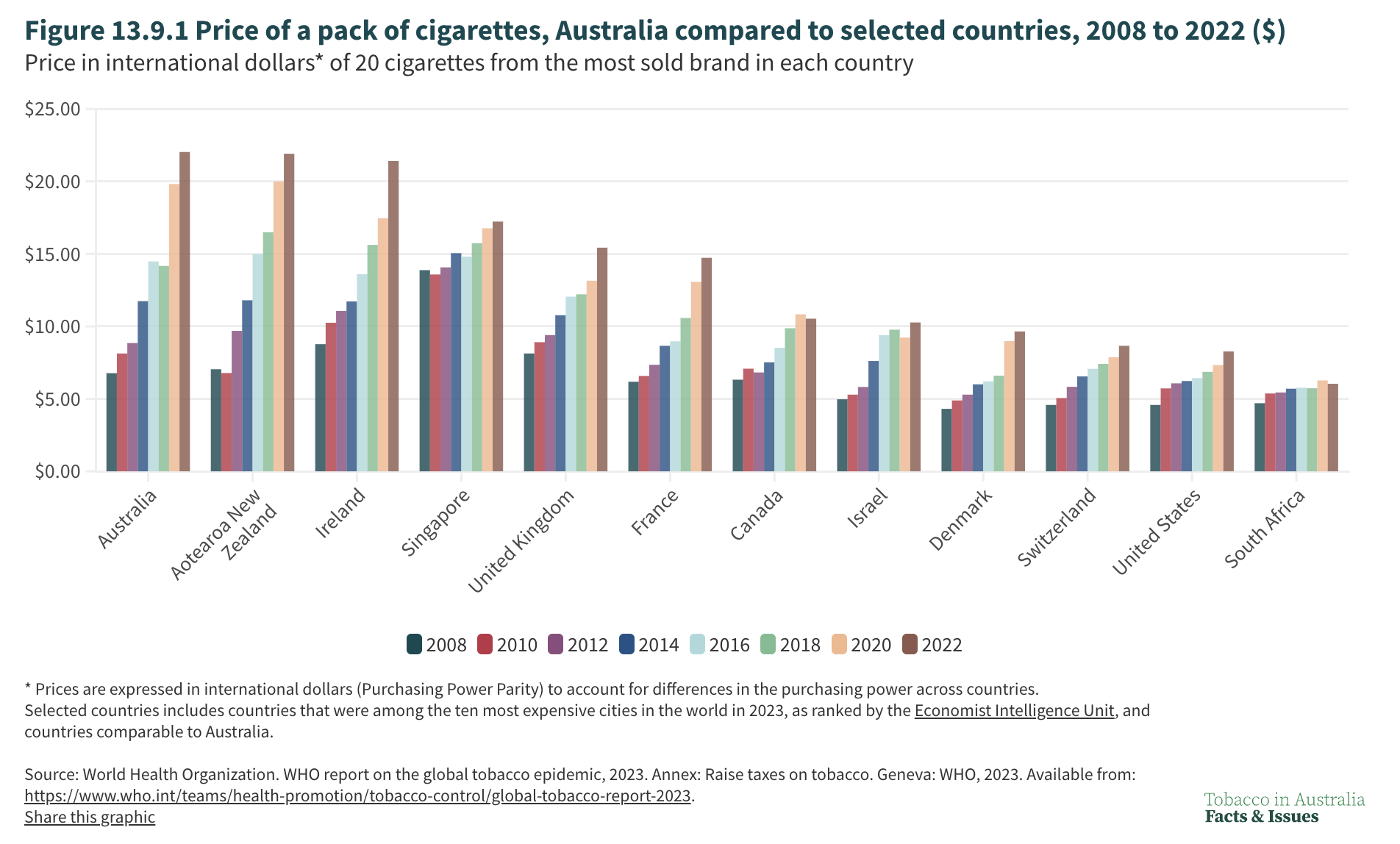
Australia currently has the highest retail and among the least affordable prices in the world (see two graphs below), and no one disputes that those who buy cheap illegal cigarettes here, as in every country which has illegal tobacco trade, are motivated alone by lower prices. So would lowering the price by lowering excise in Australia, see those running the many shops selling illegal cigarettes just walk away?

An obvious question

A most obvious question to ask here is “do nations with more affordable legal cigarettes, also have significant tobacco black markets?” If they do, it would be clear that criminals will continue to see large opportunities to sell illegal stock regardless of how high or low the prices of legal cigarettes are. The cut-the-tax house of cards would tumble down in the first breeze of evidence.

The commercially-motivated magic bullet of lowering tobacco tax to lower illicit sales reflects a parochial ignorance of global illicit trade in tobacco, and the lack of a consistent relationship between the operation of that trade and the retail price of legal tobacco. Low income nations (for example) Vietnam, Philippines and Senegal where tobacco is dirt cheap are often also awash with black market cigarettes.

This month, Thai officials arrested 690 vendors in just one week allegedly breaking Thailand’s laws on selling vapes.

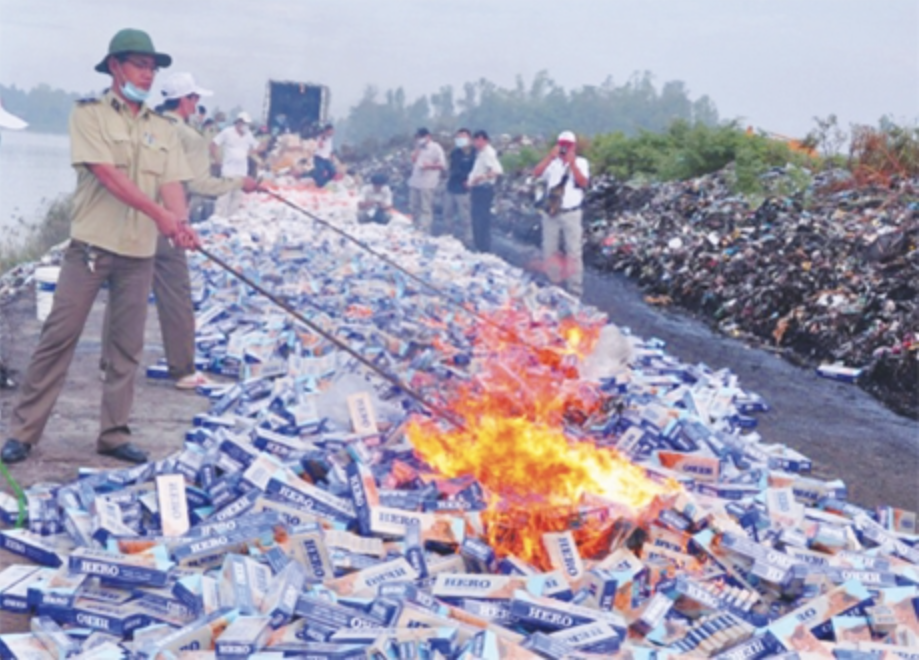
Vietnam officials burning contraband tobacco

But what about nations that are more socially and economically comparable to Australia? Before I look at three such countries (USA, UK, Canada), a brief overview of the published literature on global illegal tobacco trade, including in Australia.

Illicit tobacco trade: a very long history

Some commentators on illicit tobacco trade appear to have come down in the last shower. This is a global phenomenon which has a long history. Over 30 years ago in 1994, tracking of European tobacco export and import data  found a 30.8% difference between the number of cigarettes officially exported and imported. The only plausible explanation for these missing cigarettes was smuggling, particularly of expensive premium brands moving from northern Europe into lower income eastern and southern European markets.

The tobacco industry has long been active in supplying cigarettes to the illegal duty-not-paid trade while trying to alarm governments about excise tax losses and lobbying for reduced excise. A 2019 systematic review of 35 assessments of the extent of illegal tobacco trade found that 31 of these reported that tobacco industry estimates of the extent of illegal trade were higher than independent estimates by researchers with no tobacco industry ties. Lack of transparency from data collection right through to presentation of findings was a key issue with insufficient information to allow replication of the findings frequently cited.

The authors concluded that tobacco industry data on illegal tobacco trade are not reliable and are intended to talk up the problem in the hope that governments would hobble policies like tax and plain packaging that have serious potential to reduce smoking.

There has been a long history of illegal retailing of duty-not-paid cheap cigarettes and loose “chop chop” tobacco in Australia, with reports of use back to 2001. Tobacco industry estimates of the proportion of tobacco use in Australia sourced illegally since 2012, ranged from 11.8-23.5%, substantially higher than independent estimates from the Australian Taxation Office’s revenue gap analysis which estimates 5.4 to 14.3% between 2015-16 and 2022-23. The ATO estimates that approximately 18% of tobacco for sale is illicit.

Illicit trade in UK

The graphs above show cigarettes today are cheaper and more affordable in Britain than in Australia. A 2024 report by the UK’s HM Revenue and Customs concluded that the forgone value of the  “illicit market in tobacco duty and related Value Added Tax was £2.8 billion in 2021 to 2022.The proceeds of this crime fund the smuggling of weapons, drugs, and even human beings across the globe. We must tackle the cancer of organised criminal groups as unwaveringly as we tackle the harms of smoking itself.”

Years of effort by UK Border Force “have reduced the estimated duty gap for cigarettes by a third (from 16.9% in 2005 to 11% in 2021 to 2022) and for hand-rolling tobacco by a half (from 65.2% to 33.5% over the same period).”

From April 2015 to March 2023, this resulted in:

  • £10 billion: tobacco duty receipts in 2022 to 2023
  • 10.6 billion: non UK-duty paid cigarettes seized by HMRC and Border Force
  • 1,600 tonnes: non UK-duty paid hand-rolling tobacco seized by HMRC and Border Force
  • 1,571: people convicted of tobacco crime offences
  • 8,000: assessments to recover unpaid excise duty
  • 9,304: excise wrongdoing penalties issued for tobacco offences
  • £298 million: value of penalties and assessments raised

Illicit tobacco trade in USA and Canada

The graphs above show both cigarette prices and affordability in the US are much lower than in Australia. In 2024, the average cost of a pack of 20 cigarettes was $US8 ($AUD12.71) compared with Australia at around $40. Nonetheless, illicit traffic in the US is decidedly non-trivial.

The 2015 report from the US National Academies Understanding the US  illicit tobacco market estimated the total market represented by illicit sales in the United States was between 8.5 percent and 21 percent of the total. It recommended that“research and data are needed about the individuals and criminal networks who traffic in illicit tobacco.”

Comparing illicit trade in Australia with that is the US is difficult, because Australia does not have state taxes whereas the US has a variety of low and high taxing states. Illicit tobacco trade in the US is dominated by illegal movement of cigarettes from lower taxing states to those with higher taxes, including from Native American tax free  zones.  The US federal tobacco tax is $US1.01, with the lowest state tobacco tax an additional $US0.17  and the highest in New York state at  $US5.35. These sorts of differences also occur in Canada.

So like Australia where nation-wide high tax and prices have attracted significant illicit trade, high tobacco taxing US and Canadian states also attract incoming illicit trade from lower taxing states. But the critical point to make here, is that even though cigarettes are considerably more affordable than in Australia, illicit traders still have major involvement in tobacco commerce.

These US and Canadian examples illustrate that for whatever reason, where you have high retail prices, criminals will seek to illegally undercut these, and it doesn’t  matter how low the prices are, they will still try to do it.  New York’s average pack price is $US14.55 ($A23.12) far less than Australia’s ~$40, and far more affordable than Australia’s. And in very low income  countries, dirt cheap legal cigarettes are still undercut by illicits.

Market research firm Circana estimates that in 2024 sales of unauthorised, flavoured disposable vapes in the US amounted to  35% of the $6.8 billion worth of e-cigarettes sold in tracked convenience stores and supermarkets. And this estimate does not include massive on-line sales or those from vape shops. The FDA puts the proportion of vapes being sold in the US which do not have a required FDA marketing order at 86.4%. Vapes are sold openly in most of the US, as they are in Canada and the UK.

Canada

Taxes and prices are also considerably lower and cigarettes considerably more affordable in Canada than in Australia. The Canadian convenience store industry recently stated low-cost tobacco products have become a “major selling feature” for well-known and established organized criminal groups such as the Hell’s Angels. “It is absolutely organized crime at the highest level. It’s a billion-dollar industry for (organized criminal groups). It involves all the levels of violence, and extortion and gangsterism that comes along with it.” ) In Canada illegal sales outnumber legal sales in one province by 52% and 36-45% in three others.

The dramatic data above instantly repudiate claims that open access sales of vapes and cheaper, more affordable legal duty-paid cigarettes prevent or even reduce illegal supply and deter criminal involvement. 

Tobacco control—including tax policy – has driven smoking to its lowest ever level

Both 60 Minutes and Four Corners featured ex-Australian Federal Police and former Border Force Tobacco Task Force head Rohan Pike. Pike was described by 60 Minutes as someone “who now advises the retail sector” and by Four Corners as “a lobbyist for retailers”. But neither program asked Pike whether he was advising the convenience store industry out of the goodness of his heart, or whether he had any financial relationship with them.

Pike told 60 Minutes “excise rates are the primary driver of this problem from the start, we should be looking to reduce the excise rates” and hyperbolically described the illicit trade situation as “This policy is perhaps one of the biggest failures in Australian history, really.” A memorable soundbite, but “really”? Really? Bigger even than the housing crisis? The AUKUS submarine debacle? Indigenous health and incarceration rates? The plight of the Great Barrier Reef?

In the 60 Minutes program, veteran organised crime observer John Sylvester stated  “putting heavy tax on smoking was done for two quite legitimate reasons: to raise revenue and secondly to discourage people from smoking. So governments and authorities would look and go, ‘Wow, our excise is down, that means people aren’t smoking.’”

Well, no. Only the most inexperienced analysts of tobacco and nicotine use in Australia would ever exclaim that a fall in total excise receipts could only be due to a fall in smoking. People moving to illicit duty-not-paid cigarettes would clearly reduce total excise but this would not allow any sensible conclusion about whether smoking was falling or rising.  The proportion of people who buy their cigarettes from illegal supplies is an entirely different question from the proportion of people who smoke. It’s not about how or where you get your cigarettes, it’s about whether you get them at all.

Mark McKenzie, CEO  of ACAPMA, Australia’s fuel industry lobby group, has also swallowed the tobacco consumption is rising argument writing that the explosion of illicit retailers “is clear evidence of a rising tide of tobacco consumption – one that government statistics fail to capture”. No Mark, it’s clear evidence of criminal interests fighting intensely over the shrinking market of smokers.

In a recent blog I showed that data on smoking prevalence from the National Drug Strategy Household Survey collected since 1998, shows smoking is now lower  than it’s ever been, with the most recent fall being the largest seen since surveys began. Smoking by kids is heading toward extinction.

So how low would tobacco excise need to go to make the black market disappear in Australia?

It’s easy to call for “lower” tobacco tax, but how much lower would it need to be to see budget-conscious smokers switch back to buying taxed cigarettes? A common price for the most popular illegal brand of cigarettes in Australia is $15. The current excise rate on cigarettes in Australia is $1.40313 per stick. So the tax alone on a pack of 20 cigarettes is now $28.06.

A common retail price for popular brands of legal duty paid cigarettes is around $40, with the extra component costs ( after ~$12 tax is deducted) being those going to cigarette manufacturers and retailers. Given that tobacco manufacturing and retailing interests are not talking at all about radically dropping their margins to compete with $15 illegal pack prices, are the “cut the excise” voices then suggesting that the government should therefore  “take one for the convenience stores” and give up perhaps all of its tobacco excise ($40-$28 = $12), a price that would certainly blow illegal retail trade out of the water?

We don’t know how low illegal cigarette retail pricing could fall to still remain very profitable to those running it. But by now, simplistic calls to “cut excess” lead us very quickly into this truly absurd territory, when the obvious solution is instead for governments to crack down hard on the illegal retailers. Small cuts would make no significant difference to the large gap between legal and illegal cigarettes. Only massive or even entire scrapping of tobacco excise would bridge that gap.

Recent advocacy by convenience stores to list the river of extra money that the government would receive if excise tax was “lowered” and smokers flooded back to buying legal cigarettes would therefore be conditional on the government removing most or all of the very tobacco tax which the convenience stores say would start pouring again into the coffers.  So how does that all work again?!

Enforcement of the law: the missing elephant in the room

The giant Achilles heel of rampant illegal retailing of cheap, duty-not-paid cigarettes in Australia is its sheer blatancy. Every shop selling them and every on-line ad for courier delivered vapes reaches out to its customers with often unmistakable signage and none too cryptic on-line language (eg: fruit, many varieties). “Here we are, come on in, or txt us a meeting point where we’ll deliver the vapes”. It could hardly be more in-your-face.  I recently counted 22 cheap smokes shops in just two adjacent Sydney suburbs.

If ordinary citizens can locate these outlets with absolute ease, it is obvious that so can those charged with investigating and enforcing the laws. So why are the shops proliferating and prosecutions occurring at dismal rates?  Many of the public are asking this question. Health Minister Mark Butler this week encouragingly announced $156.7m extra for police enforcement.

Those selling illegal recreational drugs do not open shops with signs like “Cheap meth, heroin, ecstasy here”. The government has for many decades “banned” all retailers other than pharmacies from selling prescribed drugs, but criminal gangs have not set up high street shops all over the country with signs “Get your medicines here – no prescription needed!” Neither do we see every second corner shop without a liquor licence selling alcohol.  In both cases, the law would come down very fast and hard.

Australian governments now have national and state laws with numbingly high maximum penalties for selling illegal vapes and duty-not-paid smuggled tobacco.  These penalties are set at levels designed to seriously deter both major a small-level commercial involvement in these illegal sales. 

The fuel industry’s Mark McKenzie,  the convenience stores’ Theo Foukkare and Big Tobacco all have got one thing very right: governments need to act quickly on illegal trade. Illegal and legal cigarettes are both deadly (up to two in three long term smokers die from tobacco caused disease). Legal tobacco retailers, like petrol-driven car manufacturers, DVD hire shops and typewriter manufacturers know they are well into the endgame of having large customer numbers who still want to buy their products.

As with illicit drugs, no government has succeeded in eliminating all contraband tobacco. But some, like the UK, appear to have made major in-roads into the illegal tobacco problem.

Australia’s pharmacy vape access policy together with governments acting against illegal retailers and importers, could feed a global appetite for a template that will make smoking history. So what is Australia waiting for?

Addendum

The Government today announced a huge round of law enforcement reforms to the issues raised above. Plus press conference transcript

Cherry-picking redux: problems in comparing vaping retail regulatory models when only two nations are considered

03 Monday Mar 2025

Posted by Simon Chapman AO in Blog

≈ Leave a comment

Picture source

Dr Colin Mendelsohn recently published a co-authored paywalled paper in Addiction comparing smoking and vaping prevalence in adults and adolescents in New Zealand and Australia during 2016-2023, when smoking fell in both nations and vaping rose under two different nicotine vaping products regulatory regimes.

Mendelsohn has summarised the paper  here and in an opinion piece in the Sun Herald where he modesty declared the paper to be a “landmark” study. The principal policy question driving the paper is whether countries with more restricted access policies on vapes such as Australia with its pharmacy-only access see different changes in smoking than those with more permissive “regulated market models” (RMMs) such as their comparator case study, New Zealand.

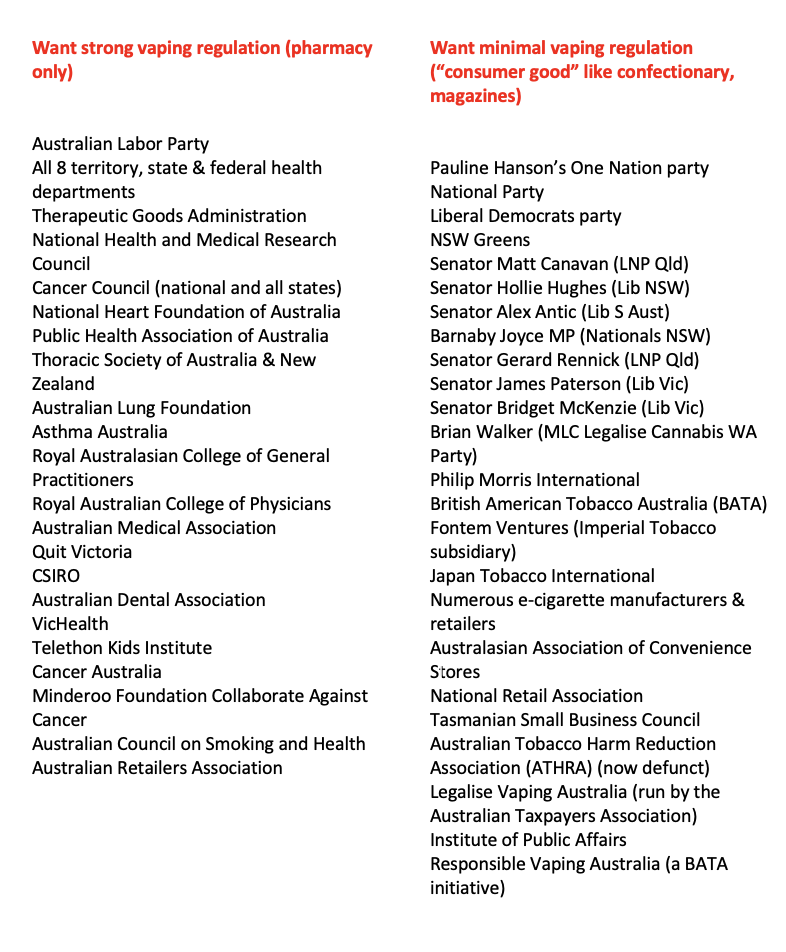
Notably, all but one of the Mendelsohn group authors have histories of often strident public advocacy for vapes to be sold to adults through a wide range of registered retailers. These could include dedicated vape stores and tobacconists and any type of retail business. They have relentlessly opposed Australia’s policy of pharmacy-only access to vapes, including in submissions to governments. This has aligned them with advocacy and submissions from all the major tobacco transnationals, right wing think tanks, the convenience store and tobacco retailing industries, Pauline Hanson’s One Nation and the National parties. It has also set them apart from all major medical and public health agencies, every state and the commonwealth health department and a large majority of Australian researchers and public health advocates who strongly supported the government’s proposals (see table).

Their paper concludes that New Zealand’s greater reductions in adult smoking may suggest a causal relationship between higher rates of vaping with higher falls in smoking, concluding “adopting the New Zealand model for vaping is likely to assist Australia in reaching its [smoking reduction] target earlier.” Below I critique three issues which I believe make this conclusion less robust than it may seem. The concerns are:

  1. Cherry-picking one comparator nation when other RMM nations of equally obvious relevance present far less persuasive evidence
  2. A pollyannish, naïve or ill-informed view of the ability of RMMs to reduce illegal trade in vapes
  3. Use of dated smoking prevalence data in modelling forecasts to declare Australia is likely to miss its 2030 target of less than 5% smoking prevalence

I argue below that Australia’s pharmacy access model preserves access to vapes for adult smokers trying to quit in a retail environment where sales to children are highly unlikely because of professional pharmacist ethics. Illegal sales are widespread in nations with RMMs, while ex-pharmacy sales of prescribed drugs are marginal. Pharmacies have long histories of managing access to narcotics and other drugs with misuse or abuse potential such as methadone and codeine.

  1. Why compare only two nations?

Fundamentally, the stunningly obvious question demanding to be asked is why the authors selected only two nations from which to base their conclusion that a regulated consumer access model is superior to what they call “highly restrictive” models like Australia’s. There are many nations which allow vapes to be freely sold to adults. Three other nations which also largely share the comparable demographic and multi-cultural backgrounds and history of strong tobacco control of Australia and New Zealand justified by the authors for selecting New Zealand and Australia are the UK, the USA and Canada.

Comparing smoking rates between nations is fraught with problems summarised here. These especially include differences in definitions of “smoking” (some defining only cigarettes, others counting any combustible product) and in different reported age ranges (14+, 15+, 18+). Nations like the UK and the USA which count only cigarette use underestimate true exposure to combusted tobacco smoke (smoking), particularly where use of tobacco in water pipes and cigarillos is widespread.

With  smoking prevalence being very low in adolescents in each of these nations, those which include under 18s in their total smoking prevalence data like New Zealand, Canada, and the UK will thereby dilute their total point prevalence figures compared to nations which only count 18 and over smokers of all combustibles. Patterns may also differ depending on whether it is daily, weekly or any current smoking that is being tracked, and whether current smoking includes smoking less frequently than monthly.

Point prevalence of current smoking from the latest available data sets for the five nations are:

Australia (10.5%, 14+, all combustibles, 2022-23 National Drug Strategy Household Survey)

Australia  (11.1%, 18+, all combustibles, 2022-23 National Drug Strategy Household Survey)

Canada (10.9%, 15+, all cigarettes only, 2022 Canadian Tobacco and Nicotine Survey)

New Zealand (8.4%, 15+, all combustibles, 2023/24 New Zealand Health Survey)

UK (10.5%, 16+, cigarettes only. 2023 Opinions and Lifestyle Survey,)

UK (11.9%, 18+, cigarettes only 2023 Annual Population Survey)

USA (11.6%, 18+, cigarettes only, 2023 National Health Interview Survey)

Additionally, in Europe where vapes are often openly sold, average data from all EU member states for 2019 show daily smoking prevalence of 18.4% in those aged 15+.

The margins of error around these numbers, together with them each being obtained from different starting ages and defining smoking differently, make direct comparisons problematic.

With declining smoking being the primary focus of Mendelsohn et al’s paper, why were these other three nations each with permissive retail RRMs not also compared for the lessons they might equally hold for Australia?  With highly liberal vape retail access occurring as much, if not more, in the UK, USA and Canada as in New Zealand, and smoking prevalence in all five nations declining, any putative causal generalisation about the downward effect on smoking of liberal versus restricted retail access becomes immediately contentious. By selecting only New Zealand for comparison with Australia, the authors have cherry-picked a nation to provide a comparison compatible with their previous outspoken advocacy for RRMs.

Similar regulations on retailing vapes in other RMMs

Vaping advocates often describe New Zealand as having the most preferred regulatory model for vapes. Retailers like supermarkets, ‘dairies’ and petrol stations are allowed to sell vapes, but only in limited flavors like tobacco, menthol, and mint.  Licensed ‘specialist’ vape retailers can sell a wider range of flavours. However, in practice New Zealand is little different to the UK, the USA and Canada. All have age restrictions on selling, and unlike Australia, all allow retailers engaged in any type of retailing to sell vapes after simply registering.

UK: There are no restrictions on types of retailers which can sell vapes to those aged 18+ in premises or on-line. All products must comply with the Tobacco and Related Products Regulations by only selling products that are notified and compliant with the Medicines and Healthcare products Regulatory Agency specifications.

USA: Vapes assessed by the FDA as suitable for sale can be sold by any retailer to those aged 21+. Twenty-one of 50 states require a permit or retail license to sell vapes.

Canada: Vapes can be sold by anyone with a vaping product licence. Those eligible need only meet financial transparency and probity criteria.

Australia: While Australian consumers were able until 2021 to import nicotine vaping liquid with a prescription, it has never been legal to sell nicotine vapes in Australia. However this was rarely if ever enforced, with vapes being often displayed and openly sold in shops. COVID caused health departments to reallocate staff to COVID-related duties, severely curtailing surveillance and inspection of illegal NVP selling.  The fact that non-nicotine vapes were legal to sell until July 2024 made enforcement difficult both at the border and at retail. From mid-2023 a trickle of enforcement commenced, but illegal retailing remains widespread. The Government’s 2024 package of reforms to reinforce a pharmacy dispensing model for supply of vaping products in Australia is wide-ranging. It includes

  • Restricting the supply of vaping products to pharmacists, with a prescription required for higher dose products (>20mg/ml <100mg/ml), for people under 18 (and for all customers in Western Australia and Tasmania)
  • Requirement for discussion with a health professional about other quitting options, to counsel against dual use and to encourage cessation of vaping
  • Banning disposable, flavoured vapes that have proved attractive to children
  • Requiring pharmaceutical style packaging to reduce appeal to and risk of accidental poisoning for children
  • Limiting chemical additives to a small range of approved flavours
  • Standards for electrical safety
  • A pre-registration system to allow authorities to investigate suspected instances of failure to comply with standards
  • Enforcing legislation prohibiting sale of vapes from other sorts of retail outlets, including on-line sales

Some of this package will not be fully implemented until July 2025. So what is being compared to New Zealand in the Mendelsohn paper  is not the full Australian model, but rather the very unsatisfactory situation in Australia which preceded it—the situation which allowed widespread sales which is what the very recently introduced reform package is intended to address.

As with pharmaceuticals, alcohol, firearms and explosives, surveillance and enforcement is necessary under every regulatory model. With so many more products needing to be scrutinised and retailers to be monitored, enforcement under a RRM presents far more challenges than a pharmacy-only model.

Pharmacists have long been granted exclusive rights to dispense prescribed and scheduled drugs.  While ex-pharmacy supplies of restricted drugs and supply to those without a prescription are occasionally prosecuted, any non-pharmacist retailer who flagrantly decided to supply prescription drugs to the public would be rapidly investigated, prosecuted and likely suffer severe penalties. This is very much not the experience with the illegal supply of vapes in all the four RMM nations named.

  • Do regulated market models reduce illegal sales of vapes?

A purported major benefit of regulated consumer markets for vapes is said to be that they will reduce illegal trade. Mendelsohn et al state “there is no evidence of a significant organised illicit market for vapes in New Zealand” citing a submission to the Australian parliament by two of their group authors which asserted  “There is little incentive to operate an illicit supply chain at any commercially viable scale due to effective competition from the legal marketplace.”

This pollyannaish, naïve or ill-informed statement sits awkwardly with recent New Zealand government prosecutions for illegal sales and a controlled purchasing exercise where 10% of 600 tobacco retailers were selling to children. Copious international evidence exists of rampant illicit trade in the UK, USA (market research firm Circana estimates that in 2024 sales of unauthorised, flavoured disposable vapes in the US amounted to  35% of the $6.8 billion worth of e-cigarettes sold in tracked convenience stores and supermarkets. And this estimate does not include massive on-line sales or those from vape shops. The FDA puts the proportion of vapes being sold in the US which do not have a required FDA marketing order at 86.4% — see graph below) and Canada where illegal sales outnumber legal sales in one province amount 36-45% in three others. Canada has an RMM. These dramatic data repudiate claims that RMMs prevent illegal supply.

Source

The Canadian convenience store industry recently stated low-cost tobacco products have become a “major selling feature” for well-known and established organized criminal groups such as the Hell’s Angels. “It is absolutely organized crime at the highest level. It’s a billion-dollar industry for (organized criminal groups). It involves all the levels of violence, and extortion and gangsterism that comes along with it.”

This is in a nation where cigarettes that are taxed less than in Australia vapes can be legally sold by anyone with a permit (see graph below).

  1. Will Australia likely  miss its 2030 smoking reduction target?

The Mendelsohn paper concludes by saying:

 “Australia’s current trajectory and a daily rate of 8.3% indicate it is likely to miss its target of 5% daily smoking or less by 2030”. Here they cite two modelling papers which drew on reports published prior to the availability of the most recently data used by the authors in their paper.  Australia’s  2022/23 National Drug Strategy Household Survey reported daily adult prevalence at 8.3%, down from 11% in 2019 (an absolute fall of 2.7% and relative fall of 24.5%). This was the largest decline in smoking prevalence reported in 10 triennial NDSHS surveys since they commenced in 1998. As such, it may represent a step change in the decline in smoking.

Vaping may well be a factor helping adult smoking cessation in both countries, although both nations also have the world’s highest retail prices, advanced comprehensive tobacco control policy and enjoy widespread public support for further government action. Recent data shows 94.6% of New Zealand smokers were aware of the Smokefree New Zealand proposal, with 77.8% of smokers and recent ex-smokers supporting the Smokefree Generation proposal and  73% supporting the denicotinisation of cigarettes.

When the price of cigarettes between the two countries is standardised to international dollars, cigarettes in New Zealand are the least affordable in the world in 2022.  Might not this have had a little something to do with so many smokers quitting in New Zealand?

Source

Collateral damage to youth

There has also been significant collateral damage in the form of re-ignition of nicotine addiction among former-smokers and starting it in many who had never smoked. A recent large (n=31,733) US cohort study assessed smoking and vaping transitions between two waves (2016-2017 and 2018-2019) and found for every beneficial transition out of smoking via vapes, there were 2.1 harmful transitions (ie never smokers starting to vape, exclusive vapers taking up or adding smoking to vaping).  So the net population effect of vaping may well be negative.

Here, teenage vaping data is of particular interest. A New Zealand Ministry of Health analysis of pooled data from 2020/21 and 2021/22 for 15-17 year olds found 76% of daily vapers had never smoked, 18% were former smokers and 6% were dual users [24]. The latest wave of data from Australia’s GenVape study show that 50% of current vapers (last 30 days) had never smoked. (unpublished data provided by GenVape)

When smoking prevalence is very low in youth (as in the five nations discussed above), the argument that high vaping prevalence might be substituting for more widespread smoking is difficult to sustain against a background of plummeting smoking prior to significant uptake of vaping.  Daily vaping rates in 14-15yr Australian, New Zealand and US students are 2.8%, 10% and 3.5% respectively, and in 15 year olds in Canada 8.1% and 10.9% in English adolescents. Daily smoking rates have been below those figures for some time.

Concern about youth vaping has mostly been about vaping priming some for subsequent smoking, as well as about the financial and health burdens of nicotine dependence in itself (eg: on-going expense, social inconvenience, possible neurological and major psychiatric problems and possible cancer promoting action). As 15 presidents of the Society for Research on Nicotine and Tobacco wrote in 2021 “There are no data on long-term health effects, reflecting the relative novelty of vaping and the rapid evolution of vaping products. Determining even short-term health effects in adults is difficult because most adult vapers are former or current smokers.”

Benefits of prescription drug access

Australia’s pharmacy-only access model harnesses the benefits of providing easy access to vapes by adult users and minimising collateral damage to children. Argument that accessing vapes through pharmacies is onerous is particularly silly. Some 5935 community pharmacies are located throughout the country, with at least one in every shopping mall, and in all but the smallest shopping strips in suburbs and in towns throughout regional Australia. In capital cities, 97% of people live within 2.5 kilometres of a pharmacy, and 66% live within 2.5 kilometres in the rest of the country. Over 2000 are open after hours and at weekends. Telepharmacy and postal delivery service those in remote areas. The Pharmacy Guild estimates that in 2022-23 there were 443.6 million individual pharmacy visits. In a population of 27 million, 335.8m prescriptions were dispensed for all drugs. Many more across-the-counter purchases would have additionally occurred, as can occur with 20mg or less vapes now without any prescription.

The prescription model of access to drugs with misuse or abuse potential has flourished for decades  in all but lawless or chaotic nations where almost any drug can be obtained without a prescription. Criminal gangs have not decided that Australia presents a golden opportunity to supply any of the 925 Pharmaceutical Benefits Scheme drugs to millions of people wanting them cheaper and without the inconvenience of getting a prescription.

In Australia, there are black markets for some pharmaceuticals including anabolic steroids, some new and expensive weight-loss drugs and erectile dysfunction drugs, but these are very marginal compared to the overwhelming supply volume via prescription access through pharmacies. A BBC report detailed criminal gangs diverting a range of prescribed drugs in England.  Black markets do exist for prescribed drugs but the size of these are a tiny fraction of those which operate via prescription access.

Blog Stats

  • 163,470 hits

Top Posts & Pages

  • Why I’m not quitting Spotify because its owner has hugely invested in weaponry
  • Australia takes off the gloves on illegal tobacco while ‘lower the tax’ fantasists plumb new absurdities
  • About/CV
  • Vaping theology: 6 There’s nicotine in potatoes and tomatoes, so should we restrict or ban them too?
  • My books
  • Regrets … I’ve had a few. Paul Hogan and his Winfield role.
  • Thinking of keeping koi? Advice for beginners in NSW
  • Cheap illegal cigarettes save low income pack-a-day smokers over $9000 a year. So why don’t social justice champions give them full support?
  • Why Australia’s illegal tobacco and vape trade continues to flourish and what should be done about it
  • My first seen, best and worst bands 1964-2022

Blog archive

Comment Policy: No anonymous or pseudonymous posts will be published

Recent Posts

  • Australia takes off the gloves on illegal tobacco while ‘lower the tax’ fantasists plumb new absurdities
  • Egg on some faces: statisticians at 10 paces on the impact of New Zealand’s vape laws on youth smoking
  • Lowering tobacco tax to make illegal tobacco sales “disappear overnight”: at last we have a proposed figure and it’s an absolute doozie
  • Why I’m not quitting Spotify because its owner has hugely invested in weaponry
  • Should we believe Fiona Patten on vapes? Here are just a few problems

Recent Comments

Jon Krueger's avatarJon Krueger on Egg on some faces: statisticia…
Atul Kapur's avatarAtul Kapur on Should we believe Fiona Patten…
Unknown's avatarCould a national tob… on If expensive cigarettes are dr…
tahirturk1's avatartahirturk1 on Why Australia’s illegal tobacc…
malonere's avatarmalonere on Words I’ve seen, but didn’t kn…

Archives

  • December 2025
  • August 2025
  • July 2025
  • June 2025
  • May 2025
  • March 2025
  • January 2025
  • November 2024
  • October 2024
  • September 2024
  • July 2024
  • May 2024
  • April 2024
  • March 2024
  • February 2024
  • January 2024
  • December 2023
  • November 2023
  • October 2023
  • September 2023
  • August 2023
  • July 2023
  • June 2023
  • May 2023
  • March 2023
  • February 2023
  • January 2023
  • December 2022
  • November 2022
  • October 2022
  • August 2022
  • June 2022
  • April 2022
  • March 2022
  • February 2022
  • January 2022
  • December 2021
  • October 2021
  • September 2021
  • August 2021
  • June 2021
  • May 2021
  • April 2021
  • March 2021
  • February 2021
  • January 2021
  • December 2020
  • November 2020
  • October 2020
  • September 2020
  • August 2020
  • July 2020
  • June 2020
  • May 2020
  • April 2020
  • March 2020
  • February 2020
  • January 2020
  • December 2019
  • November 2019
  • October 2019
  • September 2019
  • August 2019
  • July 2019
  • June 2019
  • May 2019
  • April 2019
  • March 2019
  • February 2019
  • January 2019
  • December 2018
  • November 2018
  • October 2018
  • September 2018
  • August 2018

Categories

  • Blog

Meta

  • Create account
  • Log in
  • Entries feed
  • Comments feed
  • WordPress.com

Blog at WordPress.com.

  • Subscribe Subscribed
    • Simon Chapman AO
    • Join 198 other subscribers
    • Already have a WordPress.com account? Log in now.
    • Simon Chapman AO
    • Subscribe Subscribed
    • Sign up
    • Log in
    • Report this content
    • View site in Reader
    • Manage subscriptions
    • Collapse this bar
 

Loading Comments...