• Home
  • About/CV
  • Blog
  • Vaping Research Alerts
  • Blog archive list
  • My books
  • Memoirs
  • Music, bands, films
  • Contact

Simon Chapman AO

~ Public health, memoirs, music

Simon Chapman AO

Tag Archives: smuggling

Lowering tobacco tax for dummies

26 Wednesday Aug 2026

Posted by Simon Chapman AO in Blog

≈ Leave a comment

Tags

cigarettes, illicit-trade, politics, smuggling, tobacco

One Nation is throwing election promises around like a drunken sailor. It says it will reduce tobacco excise by 75% to make legal, taxed cigarettes competitive with cheap illegal tobacco. Not to be outdone, two federal Liberals today made another hairy chested bid for an 80% tax decrease, pulling another magic number out of a hat.

Here’s why all these “reduce the tax” proposals are commercially illiterate brain farts, devoid of the most elementary arithmetical argument and coated with staggering ignorance about the global trade in illegal tobacco.

Nothing new in large scale illicit tobacco trade

Many commentators on illicit tobacco trade appear to have come down in the last shower. The level of tunnel-visioned parochialism in this debate is quite remarkable. There are few, if any nations which have insignificant illegal tobacco black markets. I explored this is a previous blog I titled If expensive cigarettes are driving the black market why do so many countries with much cheaper cigarettes have thriving black markets too?   

Illegal (untaxed) tobacco is a global phenomenon which has a long history. Over 30 years ago in 1994, tracking of European tobacco export and import data  found a 30.8% difference between the number of cigarettes officially exported and imported. The only plausible explanation for these massive quantities of missing cigarettes was smuggling, particularly of expensive premium brands moving from northern Europe into lower income eastern and southern European markets.

With tobacco tax being the largest component of tobacco retail price and price being the most important factor that determines sales volumes and profits, the tobacco industry has always been desperate to lobby governments not to raise taxes. But at the very same time as trying to alarm governments with claims that tax increases increase illicit trade and reduce government revenue, tobacco companies have played an active role in several markets in actually supplying cigarettes to the illegal duty-not-paid trade

After concerns about health, high prices have always been named by people who have quit smoking as their primary motivation. So the prospect of significant price falls at the swipe of a government tax reduction pen has long been seen as a life raft by Big Tobacco as  smoking rates have fallen to their lowest ever levels in many nations including Australia.

Crunching the numbers

Tobacco excise in Australia from September 1 this year will be $1.55274 per cigarette meaning the excise component on a pack of 20 will be $31.05. To this we have to add the cigarette manufacturers’ and retailers’ margins and then 10% GST to give us the final retail price. The photo below shows the prices smokers pay today in my local Woolworths.
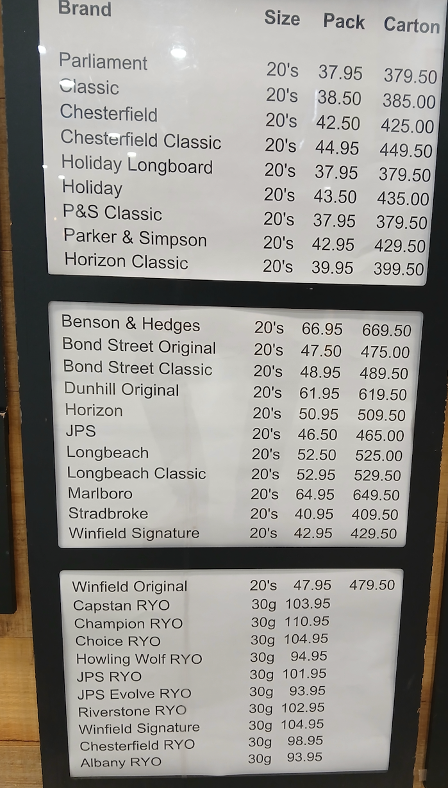
One Nation’s proposed excise reduction of 75% would see the tax on a pack of 20 fall from $31.05 to $7.76 at today’s rates. Using the Woolworths prices above and assuming both manufacturers and retailers kept both their margins constant (it would be highly unlikely that they would reduce their takes) and allowing for a lower GST amount payable, we would see the retail price fall to something like $13.00 for the cheapest brands selling now at $37.95, and to something like $40.00 for the most expensive, Marlboro, now selling at $64.95.

How much do illicits cost to buy now?

I have often heard reports that illegal packs, if bought by the carton, can cost as little as $7. $15 is a common price asked, but if you shop around you can buy for nearly $5 less, as the screenshot from a .au tobacco website offering free postage shows: a 10-pack carton price of $105 or $10.50 per pack.
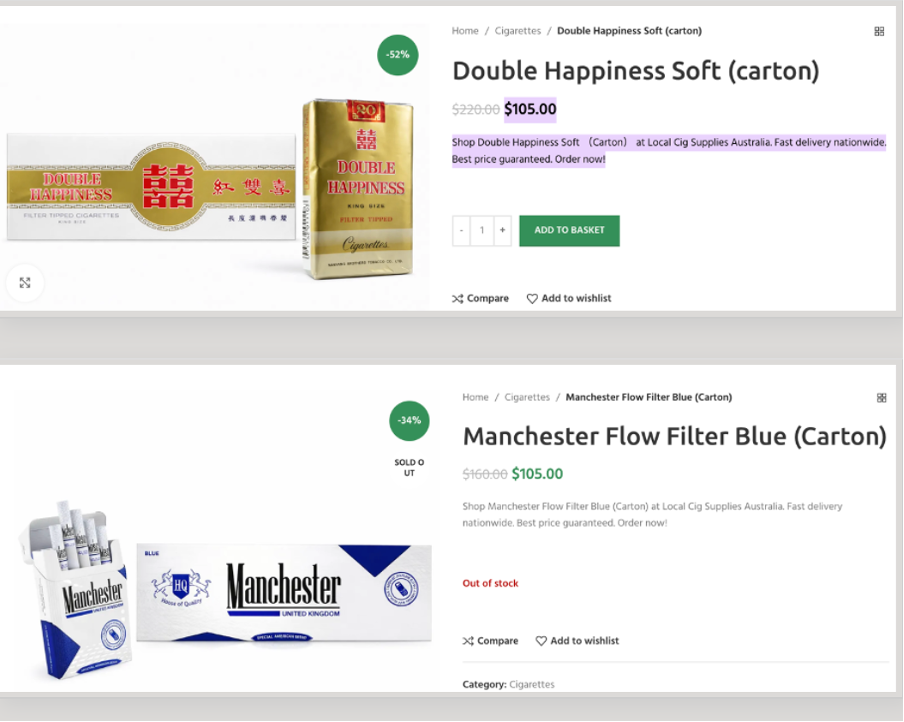
So with illegal cigarettes selling now for $10.50, this means that the cheapest tax-reduced brands in Hanson’s plan at $13.00 would be nearly 25% more than they could get them from an illegal supplier perhaps 100 metres away if they bought at carton price. And this is before the certainty of any potential further illicit price reductions, as I’ll discuss below.

Note too that in the under $40 a pack budget range of five brands now on sale at Woolworths, there, is a maximum price difference of $2, a 6.3% difference. This is nothing remotely like the 25% difference under Hanson’s proposal. These five budget brands are manufactured by different tobacco companies which all possess years of exquisitely sensitive national sales data about the price points that see them lose customers to cheaper brands. A 40% price difference would be seen as commercial madness.

Ex federal police officer Rohan Pike is a regular commentator on illicit tobacco in Australia. He recently spoke with the ABC’s David Speers, who had very clearly informed himself about claims likely to be made by Pike.

David Speers: So do you have a particular number on where you think tax should be, or how far it should be lowered? One Nation, as I mentioned, is saying a 75% cut. We’ll see what the coalition lands on. What do you think?

Rohan Pike: I haven’t got any specific modelling myself. I would suggest it will take a significant cut. And let’s just even the market up.

David Speers: So get the price down to where the black market price is.

Rohan Pike: It’s never going to be that low because the criminals can then still undercut and lower their price even further. But people, consumers will pay a premium for the better quality product. They’ll pay a premium for the brands that they like. They’ll pay a premium to stay within the law. So Australia’s generally law abiding. People know that they’re breaking it. But most people, I think, with some education and a choice of two to one perhaps as opposed to the four, 5, 6 to one that it is at the moment might go back to the legal market.

Significantly,  Pike here acknowledges that criminals distributing smuggled stock will always be able to undercut the retail price arising from any reduction in tobacco price. So he knows that any rate drop he might name will always see the cost of reduced (or even legal totally untaxed cigarettes) still well below that of illegal untaxed cigarettes. But he still argues about a nebulous “significant cut” while admitting he’s got no modelling he could point to provide justification.

Cambodia—34c a pack cigarettes

The 2026 UN Office on Drugs and Crime report on Southeast Asia states that Cambodia is a long-time ‘transit’ nation involved in receiving shipments of tobacco not destined for consumption in such nations. The report explains “These products are often exported openly from their source countries but then smuggled into their destination countries, often via transit countries in the region, including the use of free zones”. 

It continues “Cambodia has been found to be a key country of origin and transit for illicitly traded cigarettes which are then on smuggled to Vietnam by land or sea, with Vietnam acting as both a market for consumption and transit point for onward international distribution … Recent law enforcement operations by the Cambodian government have detected very large factories producing high-quality counterfeits for the regional market, and perhaps beyond. The international brands allegedly produced are found in many of the illicit markets in the region.”

So how much might a smuggler pay who wanted to sell cigarettes smuggled from Cambodia to retailers in Australia? Below is a screenshot of a page detailing tobacco prices in Cambodia from a 2025 WHO report.
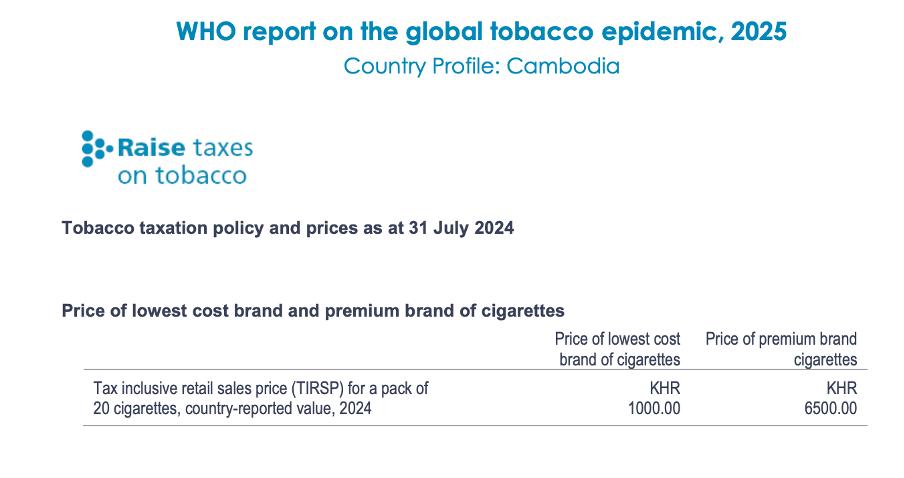
In 2024 the lowest price (1000 KHR or Cambodian riel) converts to just AUD 34c. This price includes local Cambodian tobacco tax, manufacturers’ costs and profit, and retailers’ margins. So if a cashed-up major smuggler were to buy these 34c cigarette packs in huge multiple container sized volumes from local manufacturers or importers, they would pay far less than even 34c.  Let’s say perhaps half that might be around the mark – say 17c.

Add freight costs from Cambodia or some other transit nation plus warehousing and local distribution costs in Australia plus any look-the-other-way bribery costs involved, and we might see the landed cost rise to say 30c. 

A 40-foot container with 70 cubic metres can ship 40 million cigarettes (2 million packs), which at $0.30 a pack would cost $600,000. The gross return if these sold in Australia for $10.50 (as now) would be $21 million, less the retailers’ margins, distribution and warehousing costs in Australia.

This would represent a gross profit of $20,400,000 – a 35-fold return on investment, on just one container. This galactic profit provides enormous wriggle room to criminal importers. If Australia was to go where no other nation has ever been and axe all tobacco tax, as one economist – again providing no modelling – suggested, the smugglers would eat this for breakfast.

Rohan Pike’s argument that if legal, tax-reduced cigarettes still cost more than illicits, many smokers would “pay a premium to stay within the law. So Australia’s generally law abiding. People know that they’re breaking it. But most people, I think, with some education and a choice of two to one perhaps as opposed to the four, 5, 6 to one that it is at the moment might go back to the legal market” bears little scrutiny.

Here we need only to look at the extent of the cash economy and undeclared sales common with barbers, hairdressers, nail bars, cafes and tradies. The Australian Taxation Office estimates the shadow or cash economy costs Australia approximately $16-$25 billion a year in unpaid tax revenue, with the broader economic impact estimated to be as large as 3% of GDP (exceeding $80 billion in 2025).

As The Castle’s Darryl Kerrigan might have said to Pike  “tell him he’s dreaming”.

Pike also painted a picture of illegal tobacco retailing that can have its tentacles everywhere if blatant high street illegal retailing were to become too risky with increasing shop closures.

Pike: “the criminals will pivot, they’ll go online, they’ll do home deliveries, the consumers are not going away.”

But three recent studies of those buying illegal cigarettes show that on-line  sales are very small. Here’s a screenshot of a talk given by James Martin in March 2026 describing the results of his interviews with some 4000 past-month nicotine consumers. Martin is a fervent “lower the tax” disciple too. He has not yet published his results, but as can be seen, online purchasing is very low.
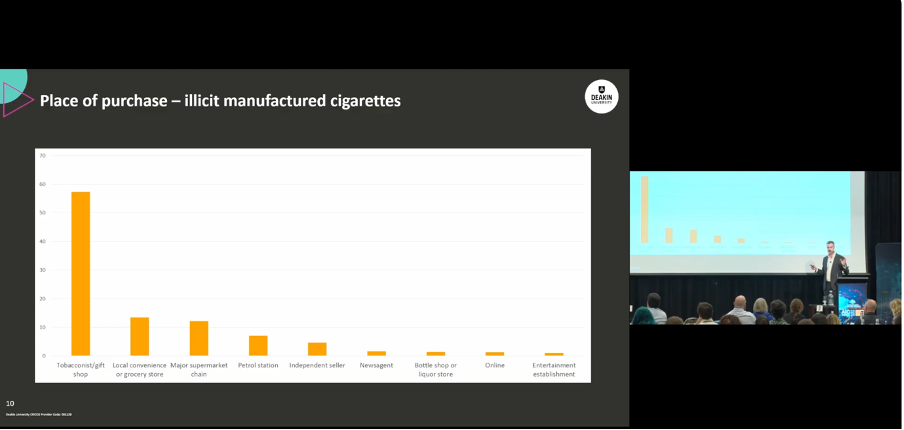
In the on-going Genvape study, only 9 of 232 interviewed who had bought illegal tobacco, bought it on-line. And in the latest AIHW national study, purchasing online was subsumed in a residual “other” category totalling only 2.9% of users.

So can we ask, where is Pike’s evidence about any major pivot by criminals to online or home delivery?

Enforcement

Between 1 July 2025 and 30 June 2026 at the Australian border, the Australian Border Force seized:

  • Over 2.2 billion cigarette sticks
  • Over 586.7 tonnes of loose-leaf tobacco
  • Over 13.2 million illicit vaping products – representing a 112% increase on vape seizures compared to the previous financial year.

Much has been made of the impossibility of Border Force inspection of anything but a small fraction of the 8.5-9.1 million shipping containers that enter Australian ports each year. Those pushing “lower the tax” agenda often make light of the successes above and make similar remarks about the futility of trying to close illegal retailers.

Retailing is the Achilles heel of illegal tobacco trade. Unlike hidden shipping containers, retailers need to be in plain sight to attract customers. So they are also in plain sight of  those responsible for their closures and prosecution.

All serious parties in this debate agree that enforcement is absolutely essential. Three state governments have closed 260 illegal tobacco shops for a total of 13,000 days in Queensland; NSW has closed 421 for 37,890 days since November 2025; and South Australia got out of the blocks first with 100 closures between June and November 2025.

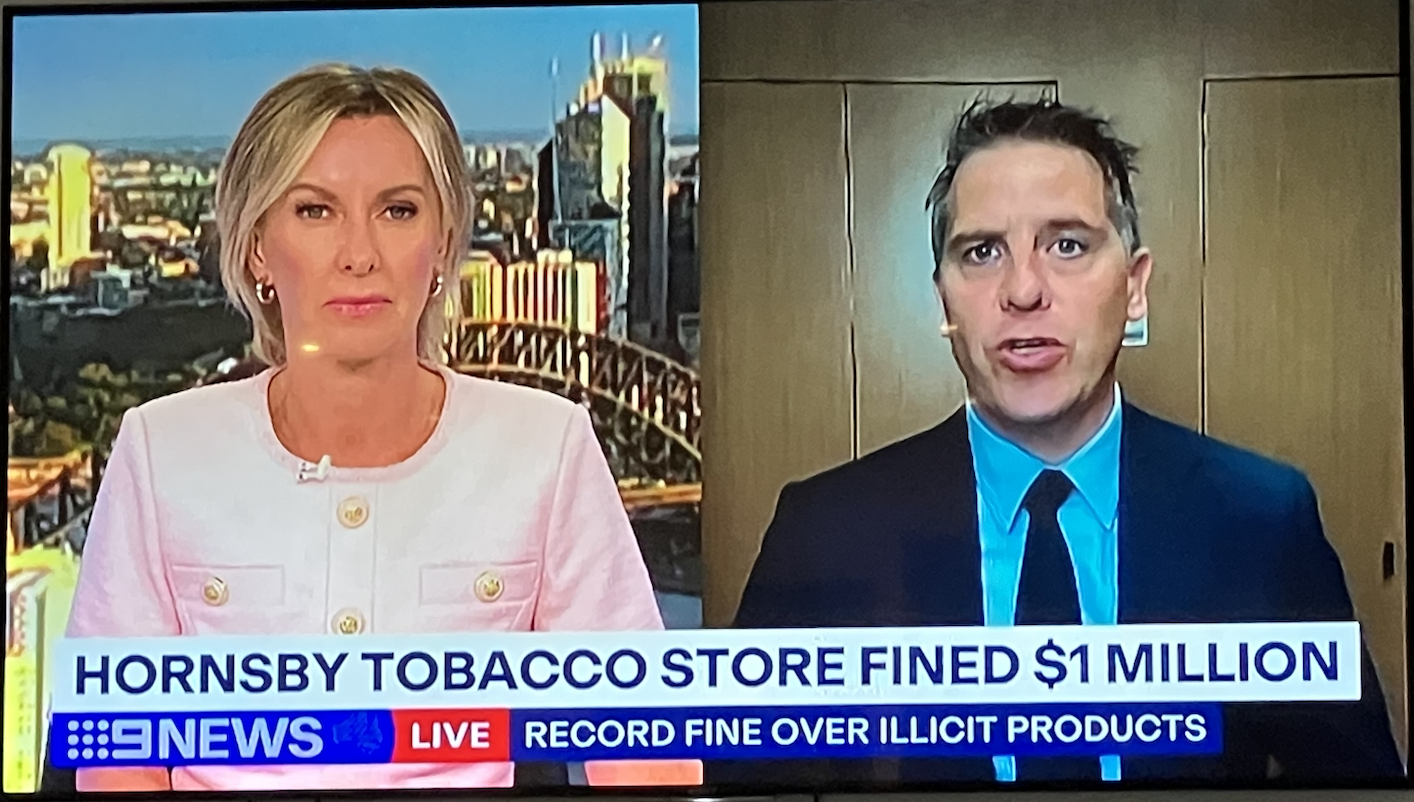
A Sydney closed shop which brazenly reopened was fined $1.18m and permanently closed. There are some 60 more reoffenders in the legal pipeline.

These penalties, which can also include gaol times, are radically changing the risks and costs of engaging in illicit trade in Australia. No country has zero illicit tobacco trade, but Australia is now taking the problem seriously.

Political posturing with unmodelled, elementary nonsense about lowering tax debases any pretence at sophisticated evidence-driven analysis of this problem.

If expensive cigarettes are driving the Australian black market, why do so many countries with much cheaper cigarettes have thriving black markets too?

12 Wednesday Mar 2025

Posted by Simon Chapman AO in Blog

≈ Leave a comment

Tags

cigarettes, health, illicit-trade, smuggling, tobacco, vaping

Big Tobacco and its errand boys in the convenience store industry are clearly limbering up to try and make illicit cigarettes and vapes a hot button issue in the forthcoming election.

The buttons they are hoping to push are a wind back in tobacco excise, and scrapping of the pharmacy-only regulatory model of vape access. This would allow virtually any registered retailer to sell vapes, something many convenience stores have been doing illegally for years and continue to do so. So a great idea — let’s reward them now for years of ignoring the law, as they clearly have built community trust as responsible retailers!

The main games here, under the cover of raising community alarm about criminality in tobacco and vape retailing, are to remove the exclusive sale of vapes from pharmacies and the forlorn hope that lowered tobacco tax will see mass criminal exit from selling cheap cigarettes. As we will see, this fantasy has all the integrity of a chocolate teapot.

The Australian Association of Convenience Stores which has a long history of tobacco industry support and its chief executive Theo Foukkare who started his career with British American Tobacco, recently publicised its latest commissioned report on illegal tobacco retailing. In a report in The Australian, Foukkare wanted the government to freeze excise on tobacco products for four years. A few days before, he went further “it is time for the Government to seriously consider lowering the excise on tobacco”.

Foukkare, nor any other advocate for lowering excise, ever go beyond this slogan. But as we shall see later in the blog, excise reductions would need to be simply galactic to make legal cigarettes price competitive with illegal duty-not-paid cigarettes.

Two National Party MPs have also called for tobacco tax to be reduced in Australia to make legal, duty-paid cigarettes more competitive. The National Party receives financial support from British American Tobacco and Philip Morris International, which have lost every policy debate on tobacco control since the 1970s when the first pack health warnings appeared.

Both the ABC’s Four Corners and Nine’s 60 Minutes have very recently covered the issue, leading and promoting their programs with memorable graphic footage of standover firebombings of stores, as rival criminal gangs viciously shirtfront each other for greater control of the lucrative illegal market.

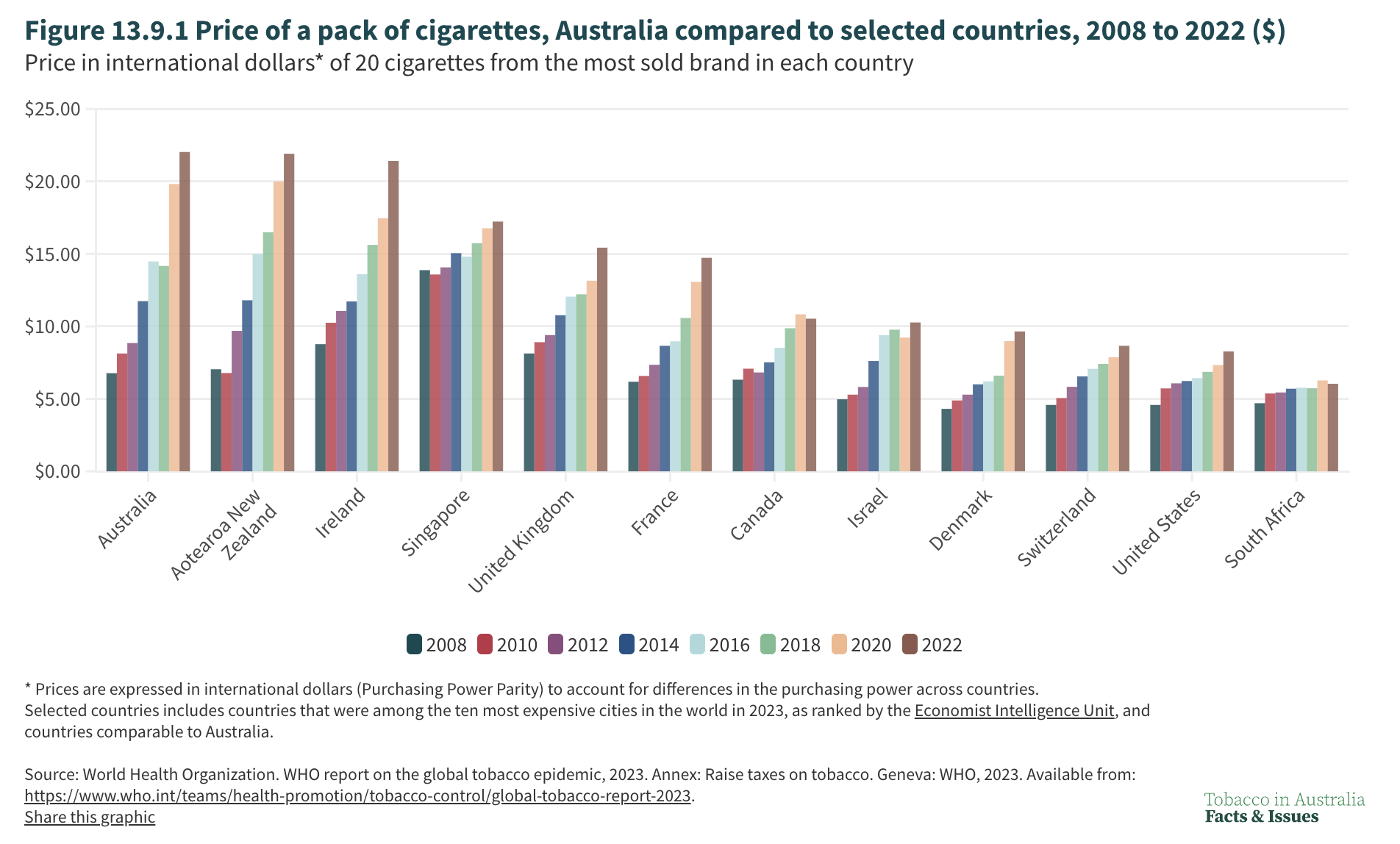
Australia currently has the highest retail and among the least affordable prices in the world (see two graphs below), and no one disputes that those who buy cheap illegal cigarettes here, as in every country which has illegal tobacco trade, are motivated alone by lower prices. So would lowering the price by lowering excise in Australia, see those running the many shops selling illegal cigarettes just walk away?

An obvious question

A most obvious question to ask here is “do nations with more affordable legal cigarettes, also have significant tobacco black markets?” If they do, it would be clear that criminals will continue to see large opportunities to sell illegal stock regardless of how high or low the prices of legal cigarettes are. The cut-the-tax house of cards would tumble down in the first breeze of evidence.

The commercially-motivated magic bullet of lowering tobacco tax to lower illicit sales reflects a parochial ignorance of global illicit trade in tobacco, and the lack of a consistent relationship between the operation of that trade and the retail price of legal tobacco. Low income nations (for example) Vietnam, Philippines and Senegal where tobacco is dirt cheap are often also awash with black market cigarettes.

This month, Thai officials arrested 690 vendors in just one week allegedly breaking Thailand’s laws on selling vapes.

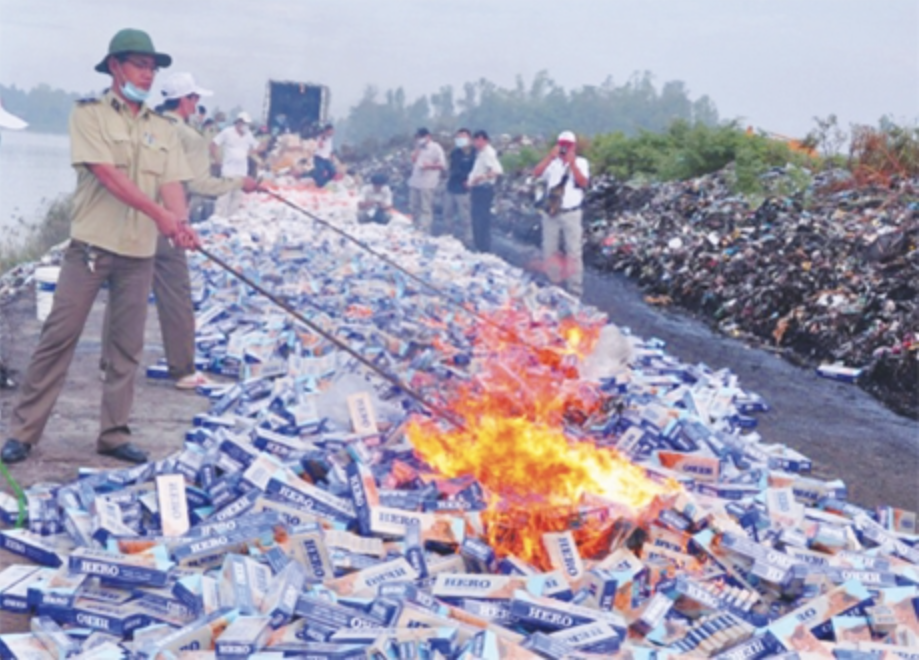
Vietnam officials burning contraband tobacco

But what about nations that are more socially and economically comparable to Australia? Before I look at three such countries (USA, UK, Canada), a brief overview of the published literature on global illegal tobacco trade, including in Australia.

Illicit tobacco trade: a very long history

Some commentators on illicit tobacco trade appear to have come down in the last shower. This is a global phenomenon which has a long history. Over 30 years ago in 1994, tracking of European tobacco export and import data  found a 30.8% difference between the number of cigarettes officially exported and imported. The only plausible explanation for these missing cigarettes was smuggling, particularly of expensive premium brands moving from northern Europe into lower income eastern and southern European markets.

The tobacco industry has long been active in supplying cigarettes to the illegal duty-not-paid trade while trying to alarm governments about excise tax losses and lobbying for reduced excise. A 2019 systematic review of 35 assessments of the extent of illegal tobacco trade found that 31 of these reported that tobacco industry estimates of the extent of illegal trade were higher than independent estimates by researchers with no tobacco industry ties. Lack of transparency from data collection right through to presentation of findings was a key issue with insufficient information to allow replication of the findings frequently cited.

The authors concluded that tobacco industry data on illegal tobacco trade are not reliable and are intended to talk up the problem in the hope that governments would hobble policies like tax and plain packaging that have serious potential to reduce smoking.

There has been a long history of illegal retailing of duty-not-paid cheap cigarettes and loose “chop chop” tobacco in Australia, with reports of use back to 2001. Tobacco industry estimates of the proportion of tobacco use in Australia sourced illegally since 2012, ranged from 11.8-23.5%, substantially higher than independent estimates from the Australian Taxation Office’s revenue gap analysis which estimates 5.4 to 14.3% between 2015-16 and 2022-23. The ATO estimates that approximately 18% of tobacco for sale is illicit.

Illicit trade in UK

The graphs above show cigarettes today are cheaper and more affordable in Britain than in Australia. A 2024 report by the UK’s HM Revenue and Customs concluded that the forgone value of the  “illicit market in tobacco duty and related Value Added Tax was £2.8 billion in 2021 to 2022.The proceeds of this crime fund the smuggling of weapons, drugs, and even human beings across the globe. We must tackle the cancer of organised criminal groups as unwaveringly as we tackle the harms of smoking itself.”

Years of effort by UK Border Force “have reduced the estimated duty gap for cigarettes by a third (from 16.9% in 2005 to 11% in 2021 to 2022) and for hand-rolling tobacco by a half (from 65.2% to 33.5% over the same period).”

From April 2015 to March 2023, this resulted in:

  • £10 billion: tobacco duty receipts in 2022 to 2023
  • 10.6 billion: non UK-duty paid cigarettes seized by HMRC and Border Force
  • 1,600 tonnes: non UK-duty paid hand-rolling tobacco seized by HMRC and Border Force
  • 1,571: people convicted of tobacco crime offences
  • 8,000: assessments to recover unpaid excise duty
  • 9,304: excise wrongdoing penalties issued for tobacco offences
  • £298 million: value of penalties and assessments raised

Illicit tobacco trade in USA and Canada

The graphs above show both cigarette prices and affordability in the US are much lower than in Australia. In 2024, the average cost of a pack of 20 cigarettes was $US8 ($AUD12.71) compared with Australia at around $40. Nonetheless, illicit traffic in the US is decidedly non-trivial.

The 2015 report from the US National Academies Understanding the US  illicit tobacco market estimated the total market represented by illicit sales in the United States was between 8.5 percent and 21 percent of the total. It recommended that“research and data are needed about the individuals and criminal networks who traffic in illicit tobacco.”

Comparing illicit trade in Australia with that is the US is difficult, because Australia does not have state taxes whereas the US has a variety of low and high taxing states. Illicit tobacco trade in the US is dominated by illegal movement of cigarettes from lower taxing states to those with higher taxes, including from Native American tax free  zones.  The US federal tobacco tax is $US1.01, with the lowest state tobacco tax an additional $US0.17  and the highest in New York state at  $US5.35. These sorts of differences also occur in Canada.

So like Australia where nation-wide high tax and prices have attracted significant illicit trade, high tobacco taxing US and Canadian states also attract incoming illicit trade from lower taxing states. But the critical point to make here, is that even though cigarettes are considerably more affordable than in Australia, illicit traders still have major involvement in tobacco commerce.

These US and Canadian examples illustrate that for whatever reason, where you have high retail prices, criminals will seek to illegally undercut these, and it doesn’t  matter how low the prices are, they will still try to do it.  New York’s average pack price is $US14.55 ($A23.12) far less than Australia’s ~$40, and far more affordable than Australia’s. And in very low income  countries, dirt cheap legal cigarettes are still undercut by illicits.

Market research firm Circana estimates that in 2024 sales of unauthorised, flavoured disposable vapes in the US amounted to  35% of the $6.8 billion worth of e-cigarettes sold in tracked convenience stores and supermarkets. And this estimate does not include massive on-line sales or those from vape shops. The FDA puts the proportion of vapes being sold in the US which do not have a required FDA marketing order at 86.4%. Vapes are sold openly in most of the US, as they are in Canada and the UK.

Canada

Taxes and prices are also considerably lower and cigarettes considerably more affordable in Canada than in Australia. The Canadian convenience store industry recently stated low-cost tobacco products have become a “major selling feature” for well-known and established organized criminal groups such as the Hell’s Angels. “It is absolutely organized crime at the highest level. It’s a billion-dollar industry for (organized criminal groups). It involves all the levels of violence, and extortion and gangsterism that comes along with it.” ) In Canada illegal sales outnumber legal sales in one province by 52% and 36-45% in three others.

The dramatic data above instantly repudiate claims that open access sales of vapes and cheaper, more affordable legal duty-paid cigarettes prevent or even reduce illegal supply and deter criminal involvement. 

Tobacco control—including tax policy – has driven smoking to its lowest ever level

Both 60 Minutes and Four Corners featured ex-Australian Federal Police and former Border Force Tobacco Task Force head Rohan Pike. Pike was described by 60 Minutes as someone “who now advises the retail sector” and by Four Corners as “a lobbyist for retailers”. But neither program asked Pike whether he was advising the convenience store industry out of the goodness of his heart, or whether he had any financial relationship with them.

Pike told 60 Minutes “excise rates are the primary driver of this problem from the start, we should be looking to reduce the excise rates” and hyperbolically described the illicit trade situation as “This policy is perhaps one of the biggest failures in Australian history, really.” A memorable soundbite, but “really”? Really? Bigger even than the housing crisis? The AUKUS submarine debacle? Indigenous health and incarceration rates? The plight of the Great Barrier Reef?

In the 60 Minutes program, veteran organised crime observer John Sylvester stated  “putting heavy tax on smoking was done for two quite legitimate reasons: to raise revenue and secondly to discourage people from smoking. So governments and authorities would look and go, ‘Wow, our excise is down, that means people aren’t smoking.’”

Well, no. Only the most inexperienced analysts of tobacco and nicotine use in Australia would ever exclaim that a fall in total excise receipts could only be due to a fall in smoking. People moving to illicit duty-not-paid cigarettes would clearly reduce total excise but this would not allow any sensible conclusion about whether smoking was falling or rising.  The proportion of people who buy their cigarettes from illegal supplies is an entirely different question from the proportion of people who smoke. It’s not about how or where you get your cigarettes, it’s about whether you get them at all.

Mark McKenzie, CEO  of ACAPMA, Australia’s fuel industry lobby group, has also swallowed the tobacco consumption is rising argument writing that the explosion of illicit retailers “is clear evidence of a rising tide of tobacco consumption – one that government statistics fail to capture”. No Mark, it’s clear evidence of criminal interests fighting intensely over the shrinking market of smokers.

In a recent blog I showed that data on smoking prevalence from the National Drug Strategy Household Survey collected since 1998, shows smoking is now lower  than it’s ever been, with the most recent fall being the largest seen since surveys began. Smoking by kids is heading toward extinction.

So how low would tobacco excise need to go to make the black market disappear in Australia?

It’s easy to call for “lower” tobacco tax, but how much lower would it need to be to see budget-conscious smokers switch back to buying taxed cigarettes? A common price for the most popular illegal brand of cigarettes in Australia is $15. The current excise rate on cigarettes in Australia is $1.40313 per stick. So the tax alone on a pack of 20 cigarettes is now $28.06.

A common retail price for popular brands of legal duty paid cigarettes is around $40, with the extra component costs ( after ~$12 tax is deducted) being those going to cigarette manufacturers and retailers. Given that tobacco manufacturing and retailing interests are not talking at all about radically dropping their margins to compete with $15 illegal pack prices, are the “cut the excise” voices then suggesting that the government should therefore  “take one for the convenience stores” and give up perhaps all of its tobacco excise ($40-$28 = $12), a price that would certainly blow illegal retail trade out of the water?

We don’t know how low illegal cigarette retail pricing could fall to still remain very profitable to those running it. But by now, simplistic calls to “cut excess” lead us very quickly into this truly absurd territory, when the obvious solution is instead for governments to crack down hard on the illegal retailers. Small cuts would make no significant difference to the large gap between legal and illegal cigarettes. Only massive or even entire scrapping of tobacco excise would bridge that gap.

Recent advocacy by convenience stores to list the river of extra money that the government would receive if excise tax was “lowered” and smokers flooded back to buying legal cigarettes would therefore be conditional on the government removing most or all of the very tobacco tax which the convenience stores say would start pouring again into the coffers.  So how does that all work again?!

Enforcement of the law: the missing elephant in the room

The giant Achilles heel of rampant illegal retailing of cheap, duty-not-paid cigarettes in Australia is its sheer blatancy. Every shop selling them and every on-line ad for courier delivered vapes reaches out to its customers with often unmistakable signage and none too cryptic on-line language (eg: fruit, many varieties). “Here we are, come on in, or txt us a meeting point where we’ll deliver the vapes”. It could hardly be more in-your-face.  I recently counted 22 cheap smokes shops in just two adjacent Sydney suburbs.

If ordinary citizens can locate these outlets with absolute ease, it is obvious that so can those charged with investigating and enforcing the laws. So why are the shops proliferating and prosecutions occurring at dismal rates?  Many of the public are asking this question. Health Minister Mark Butler this week encouragingly announced $156.7m extra for police enforcement.

Those selling illegal recreational drugs do not open shops with signs like “Cheap meth, heroin, ecstasy here”. The government has for many decades “banned” all retailers other than pharmacies from selling prescribed drugs, but criminal gangs have not set up high street shops all over the country with signs “Get your medicines here – no prescription needed!” Neither do we see every second corner shop without a liquor licence selling alcohol.  In both cases, the law would come down very fast and hard.

Australian governments now have national and state laws with numbingly high maximum penalties for selling illegal vapes and duty-not-paid smuggled tobacco.  These penalties are set at levels designed to seriously deter both major a small-level commercial involvement in these illegal sales. 

The fuel industry’s Mark McKenzie,  the convenience stores’ Theo Foukkare and Big Tobacco all have got one thing very right: governments need to act quickly on illegal trade. Illegal and legal cigarettes are both deadly (up to two in three long term smokers die from tobacco caused disease). Legal tobacco retailers, like petrol-driven car manufacturers, DVD hire shops and typewriter manufacturers know they are well into the endgame of having large customer numbers who still want to buy their products.

As with illicit drugs, no government has succeeded in eliminating all contraband tobacco. But some, like the UK, appear to have made major in-roads into the illegal tobacco problem.

Australia’s pharmacy vape access policy together with governments acting against illegal retailers and importers, could feed a global appetite for a template that will make smoking history. So what is Australia waiting for?

Addendum

The Government today announced a huge round of law enforcement reforms to the issues raised above. Plus press conference transcript

Blog Stats

  • 181,891 hits

Top Posts & Pages

  • Why I’m not quitting Spotify because its owner has hugely invested in weaponry
  • Lowering tobacco tax for dummies
  • Agnotology: the study of the willful production of ignorance
  • Vaping theology: 9 “Won't someone please think of the children!”
  • My books
  • Vaping theology: 6 There’s nicotine in potatoes and tomatoes, so should we restrict or ban them too?
  • Australian smoking and vaping rates fall yet again: new national data
  • Autopsy report finds Queensland man’s  death probably caused by 10 years of vaping
  • “An abominable moral calculation”: how Australia punishes poor smokers and the tragically misunderstood tobacco industry
  • What’s to be done about Van Morrison and Eric Clapton’s anti-lockdown antics?

Comment Policy: No anonymous or pseudonymous posts will be published

Recent Posts

  • Lowering tobacco tax for dummies
  • Demented, incontinent, fat, orange and balding: should there be limits on attacks on the vile Trump?
  • Hairy tales from before the death of hitch hiking
  • Fact Check: How sensible are three proposed solutions to Australia’s illegal tobacco crisis?
  • Australian smoking and vaping rates fall yet again: new national data

Recent Comments

Brandon Steven's avatarBrandon Steven on Vaping theology 26: “If Austra…
mellow23e2e3b287's avatarmellow23e2e3b287 on Torture by omission: why pain…
howfarlongami's avatarhowfarlongami on Farcical half-pregnant Austral…
Simon Chapman AO's avatarSimon Chapman AO on Oil crisis sees emergence of n…
hdeastburn's avatarhdeastburn on Oil crisis sees emergence of n…

Archives

  • August 2026
  • July 2026
  • June 2026
  • May 2026
  • April 2026
  • March 2026
  • February 2026
  • January 2026
  • December 2025
  • August 2025
  • July 2025
  • June 2025
  • May 2025
  • March 2025
  • January 2025
  • November 2024
  • October 2024
  • September 2024
  • July 2024
  • May 2024
  • April 2024
  • March 2024
  • February 2024
  • January 2024
  • December 2023
  • November 2023
  • October 2023
  • September 2023
  • August 2023
  • July 2023
  • June 2023
  • May 2023
  • March 2023
  • February 2023
  • January 2023
  • December 2022
  • November 2022
  • October 2022
  • August 2022
  • June 2022
  • April 2022
  • March 2022
  • February 2022
  • January 2022
  • December 2021
  • October 2021
  • September 2021
  • August 2021
  • June 2021
  • May 2021
  • April 2021
  • March 2021
  • February 2021
  • January 2021
  • December 2020
  • November 2020
  • October 2020
  • September 2020
  • August 2020
  • July 2020
  • June 2020
  • May 2020
  • April 2020
  • March 2020
  • February 2020
  • January 2020
  • December 2019
  • November 2019
  • October 2019
  • September 2019
  • August 2019
  • July 2019
  • June 2019
  • May 2019
  • April 2019
  • March 2019
  • February 2019
  • January 2019
  • December 2018
  • November 2018
  • October 2018
  • September 2018
  • August 2018

Categories

  • Blog

Meta

  • Create account
  • Log in
  • Entries feed
  • Comments feed
  • WordPress.com

Blog at WordPress.com.

  • Subscribe Subscribed
    • Simon Chapman AO
    • Join 194 other subscribers
    • Already have a WordPress.com account? Log in now.
    • Simon Chapman AO
    • Subscribe Subscribed
    • Sign up
    • Log in
    • Report this content
    • View site in Reader
    • Manage subscriptions
    • Collapse this bar
Loading Comments...