How good are ecigarettes at helping smokers quit?

Any radio discussion of ecigarettes inevitably attracts evangelical callers wanting to tell their story of the miracle they have experienced:

  • “As a fortunate survivor of extended tobacco addiction, 40 years of a pack a day, I have not smoked a single bit of tobacco since I started vaping 5 months ago. I was able to finally give up tobacco after failed attempts at cold turkey, patches, and gum as NRT”
  • “I know about 200 people in our small town of 3000 that vape, and only about 3 of those still smoke some cigarettes, and those that do have cut consumption by about 90%.” [note here that a recent English analysis concluded “If use of e-cigarettes and licensed NRT while smoking acted to reduce cigarette consumption in England between 2006 and 2016, the effect was likely very small at a population level.”)

As I’ve previously summarised, there are many reasons why such testimonial statements are considered the weakest form of evidence in answering questions about whether ecigs are serious new entrants in the population-wide game of helping smokers to quit.

The obvious problems with individual testimonies are self-selection bias (people with a success story are far more likely to want to enthusiastically proselytise their story than the many who try and fail); lead time bias or “borrowing from the future” (some people who quit would have quit weeks or months later anyway, perhaps on their own or using another approach, thus artificially inflating the apparent importance of the method they used when they quit); and relapse.

Relapse is a major, much studied sequalae to quit attempts. Far more smokers relapse than quit permanently. Across all methods, relapse dominates, with the maximum rates occurring in the first month after an attempt (eg: see table below).
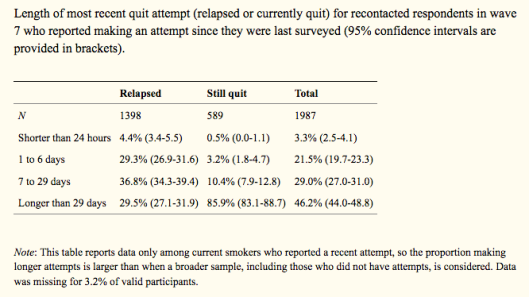
1. screen shot 2019-01-08 at 4.26.59 pmSource

This means that cross-sectional (“snap-shot”) surveys which report findings on what people’s smoking status is on the day they answered the survey questions have major limitations. Many people have inaccurate recall of their smoking and quit attempt histories and many people who report being ex-smokers on the day they answered the question would answer that they had returned to smoking if asked the same question a few weeks or months later.

For example, this study proposed that by 2014, 6.1m Europeans had quit smoking by vaping. But such “big” numbers often do not withstand scrutiny. The 6.1 million number comes from a cross-sectional survey where ex-smokers reported they used to smoke, then used e-cigarettes and now don’t smoke. Were it only that simple. This critique makes the key point that the survey questions would have allowed those who quit for only a short period to say they had stopped, when relapse is a major phenomenon and demands a longer-term view.

The critics also asked:

… how many of those who claim that they have stopped with the aid of e-cigarettes would have stopped anyway, and how many of those who used an e-cigarette but failed to stop would have stopped had they used another method?”

Randomised controlled trials?

Well conducted randomised controlled trials are considered high quality evidence, but have major problems that make them difficult to generalise to “real world” settings. If you volunteer to participate in a trial, you are likely to have a disposition to want to help science and so will probably be very positive and diligent about following the study protocol – unlike the way many in real world conditions forget to take their drugs or relapse. Trial participants are regularly contacted by study organisers trained in  cohort retention strategies. This regular contact can result in trialists wanting to please “the lovely research assistant who calls me up each week” and can artificially increase study group retention rates, again unlike real world use where no such influences occur.

And if you are heavily dependent on nicotine, enrolled in an RCT  and allocated to a study arm with placebo nicotine, guess what? Your withdrawal symptoms will quickly let you know that you are not getting any nicotine, so your belief that the nicotine replacement (NRT or ecigs) you hope you are using might do the trick will instantly be in tatters, with undermining consequences for your quit attempt.

For all these (and several other) reasons, the most important forms of evidence about how people quit smoking are longitudinal cohort studies which use high quality participant selection protocols to best ensure that those being interviewed are a representative sample of the smoking population. With smoking cessation, the endemic problem of high relapse back to smoking makes it vital that we take a helicopter view across time of how long transitions in and out of smoking last, long term and permanent quitting, being the ultimate outcome of interest. The large body of evidence we have about relapse heavily underlines that “persistent abstinence” is of far more importance than a former smoker’s smoking status on a particular day, which can change quickly.

In 2018, two particularly important papers were published by US researchers using the longitudinal PATH ( Population Assessment of Tobacco and Health) data set.

Let’s take a close look at what they found.

Coleman B et al, Tob Control 2018;0:1–10. doi:10.1136/tobaccocontrol-2017-054174

This important report on transitions in the vaping and smoking status of a nationally representative cohort of American  adults  aged 18+ who use electronic cigarettes (EC) provides rich data that greatly advances our understanding of the natural history of EC use.

If we examine the report’s data and consider the net impact of vaping on the critical goals of having vapers stopping smoking and vaping non-smokers not starting to smoke, the findings are very sobering and should give strong reason for pause among those advocating e-cigarettes as a game-changing way of stopping smoking.

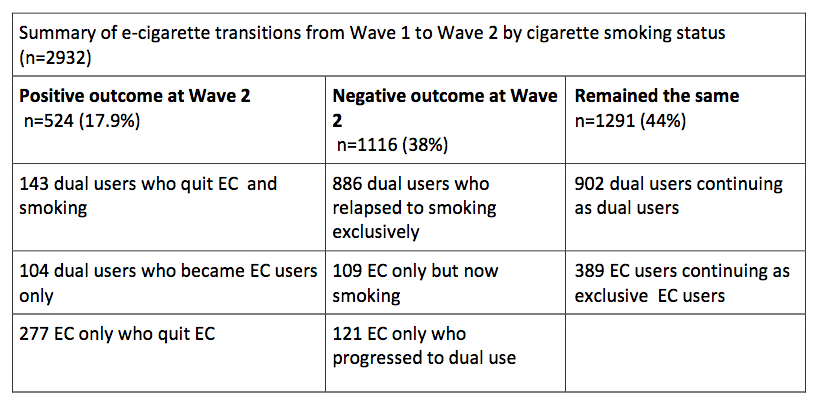
The study reported on transitions between participants’ responses at Wave 1 and Wave 2, obtained 12 months later. At Wave 2, of the cohort of 2036 dual users (EC + smoking) only 104 (5.1%) had transitioned to exclusively using ECs and another 143 (7%) had quit both EC and smoking for a combined total of 247 (12.1%) who had persistently quit smoking. Of the 896 exclusive EC users at Wave 1, 277 (30.9%) had stopped vaping at Wave 2.

So together, 524 out of the 2932 EC users (17.9%) followed from Wave 1 might be considered to have had positive outcomes at Wave 2 (ie: quitting smoking and/or quitting EC).

The other side of the coin however, shows that of the 2036 dual users at Wave 1, 886 (43.5%) relapsed to using cigarettes exclusively. In addition, among the 896 exclusive ECusers from Wave 1, 109 (12.2%) had stopped vaping and were now smoking, with another 121 having resumed smoking as well as using EC (i.e. became dual users). Importantly, 502 of 896 (56%) exclusive e-cigarette users were those who had never been established smokers prior to using e-cigarettes. Alarmingly, of these 502 adults, 120 (23.9%) progressed from using only e-cigarettes to either dual use (54 or 10.8%) or smoking only (66 or 13.2%).

Taken together, 886 dual users in Wave 1 relapsed to become exclusive cigarette smokers in Wave 2, and 230 exclusive vapers in Wave 1 took up cigarette smoking in Wave 2 (dual use or exclusively cigarettes). Undoubtedly, these should be considered as negative outcomes.

The table below shows that for every person vaping at Wave 1 who benefited across 12 months by quitting smoking, there were 2.1 who either relapsed to or took up smoking. Most disturbingly, in this adult cohort nearly one in four of those who had never been established smokers took up smoking after first using EC. Concern about putative gateway effects of ECs to smoking have been dominated by concerns about youth. These data showing transitions from EC to smoking in nearly a quarter of exclusive adult EC users with no histories of established smoking should widen this debate to consider adult gateway effects too.

(2018) ColemanTransitionsSummary.png

By far the largest proportion of those with negative outcomes are those dual users who relapsed to smoking (886 or 43.5% of dual users). As the authors noted in their discussion, many of these were infrequent EC users, possibly involved in transitory experimentation at Wave 1. If we add the 902 who were still dual using at Wave 2, then 1788 of 2036 dual users (87.8%) in this sample might be said to have been held in smoking (dual using or exclusive smoking) 12 months later compared to 12.1% dual users who may have benefited by using ECs.

Commercial interests in both the tobacco and EC industries would be more than delighted with these findings. However, from public health harm reduction perspective these results argue against EC being a revolutionary effective harm reduction strategy, and point to their far stronger potential to both recruit smokers and hold many smokers in smoking.

Benmarhnia T et al American Journal of Epidemiology 2018 DOI: 10.1093/aje/kwy129

In a second paper using the PATH data, the authors considered persistent abstinence (not using tobacco for more than 30 days). The red highlighted section of the table below shows that those smokers who used ecigs (called ENDS in the table) had the worst persistent abstinence all-tobacco quit rates of any group in the cohort (5.6% of those who were vaping at the Wave 1 survey  and 3.7% of those who too up vaping between Wave 1 and Wave 2). By far the most successful all-tobacco quit rate was for “no aid used” (ie cold turkey or unassisted cessation) with 12.5%.

When we multiply these quit rates by the numbers of smokers using each quit method, the yield of persistent quitters is even starker (see the second table below derived from the data in the table immediately below).
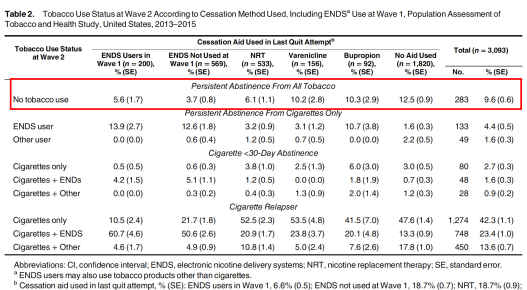
blog table

screen shot 2019-01-09 at 1.37.45 pm

So in this major national cohort of US smokers, not only did EC use produce the lowest rate of persistent abstinence from tobacco use after one year compared to all other quit methods, but EC’s contribution to population-wide tobacco abstinence was utterly dwarfed by all other methods (10.9% v 89.1%). The much-denigrated and neglected unassisted cessation approach quietly ploughed on, continuing  its massive historical dominance of how most ex-smokers quit, contributing 1.5 times more quitters than all other methods combined.

“Man the lifeboats! Australian smoking has stopped falling” … or has it?

ATHRA, a small Australian lobby group for e-cigarettes with a Twitter following today of all of 494 (including many vaping activists from overseas), often argues that smoking prevalence in Australia is lagging behind the US and the UK. Its website states “Australia’s National Health Survey confirms that smoking rates have plateaued in Australia. According to the national survey this month, 15.2% of Australians adults smoked in 2017-18 compared to 16% three years ago.”

“Current smoking” to the Australian Bureau of Statistics means daily smoking plus “other” which means “current smoker weekly (at least once a week, but not daily) and current smoker less than weekly.” We now have 13.8% of adults smoking daily, and a further 1.4% less than daily.

And very critically, unlike in the USA and the UK, Australian data on “smoking” explicitly include use of other combustible tobacco products (see questions establishing “smoking” below). This means that Australia’s 2017-2018 15.2% smoking prevalence includes exclusive cigarette smokers, all cigarette smokers who also smoke other combustible tobacco products and any smokers who exclusively smoke any of the non-cigarette combustible products (eg: cigars, cigarillos, pipes, waterpipes, bidis).

ABS QA

ATHRA repeatedly asserts that the US and the UK, both awash with ecigarettes, have both galloped ahead of Australia in reducing smoking. A tweet from November 9, 2018 (below) shows  a graph they like to use.

Screen Shot 2018-12-20 at 12.00.17 pm

US smoking prevalence: 14%  … or as high as 17.3%?

ATHRA’s graph above shows the US National Health Interview Survey (NHIS) “18+ smoking rate” being 14% for 2017. NIHAS defines “Current cigarette smokers [as] respondents who reported having smoked ≥100 cigarettes during their lifetime and were smoking every day or some days at the time of interview.”

But in fact, 14%  is the US prevalence for only cigarette smoking, not all smoking— see https://www.cdc.gov/nchs/nhis/SHS/tables.htm If we add all the other smoked tobacco products in widespread use in the USA (cigars, cigarillo, pipes, water pipes, hookahs, bidis) the prevalence of smokers who use any combusted tobacco product rises to 16.7% with an upper confidence internal boundary of 17.3% (see the table here).  Quite a way above Australia’s 15.2% rate.

More recent US data for the first half of 2018 show “the percentage of adults aged 18 and over who were current cigarette smokers was 13.8% (95% confidence interval = 13.08%-14.53%) which was not significantly different from the 2017 estimate of 13.9%.” So far, ATHRA has not issued any public statements about the fall in cigarette smoking stagnating in the US despite some 3% of adults vaping, but these can’t be far off. Surely?

The year before (2016), also in the midst of untrammelled ecigarette promotions, the prevalence of current cigarette smoking among US adults was 15.5%, a  slight but statistically nonsignificant rise from the 2015  figure of 15.1%.

Also, the 2016 NHIS US cigarette smoking prevalence estimate (15.1%) was a massive 24.5% lower than seen in the cigarette smoking prevalence figure (21%) for those aged 18+ in the 2015 National Survey on Drug Use and Health (NSDUH). With such different estimates, plainly, the real proportion is debatable.

A commentary in Addiction published in March 2017 commenting on another US survey noted “While it is possible that some proportion of non‐cigarette combustible tobacco use is concurrent with cigarette smoking, it is likely that overall combustible tobacco use prevalence for adults 18+ in the United States is higher than 15.2%, and somewhere in line or just below the 2013–14 National Adult Tobacco Survey (NATS) estimate that 18.4% of US adults aged 18+ were current users of any combustible tobacco product (defined by NATS as use every day or some days, with different thresholds of life‐time use by combustible tobacco product)”

UK

The UK government’s official smoking survey asks “do you smoke cigarettes at all nowadays? Please exclude electronic cigarettes”. In 2017, 15.1% of UK adults aged 18+ answered yes, but this figure also does not include people who smoke only non-cigarette combustible tobacco products such as cigars and pipe tobacco. So yes. 15.1% may be a cigarette paper below Australia’s 15.2% rate but it’s hardly a “man the lifeboats, the boat is sinking” difference that ATHRA and its spokespeople try to paint.

Latest adult prevalence data summary

  • Australia: 15.2% (includes cigarette smokers plus all exclusive users of other combustible tobacco products)
  • UK: 15.1% (cigarettes only: other exclusive combustible tobacco product users to be added)
  • USA: 13.8% (cigarettes only: other exclusive combustible tobacco product users to be added)

And mostly down to ecigarettes?

ATHRA  argue that the widespread use of ecigarettes is a major factor explaining the falls in smoking prevalence in the UK and the USA. The graph below from the Smoking in England project transposes the dramatically increased use of ecigarettes in quit attempts with the slow decline in adult smoking prevalence in England.

Screen Shot 2018-12-19 at 5.49.35 pm

No one could look at this graph and point to any clear relationship between the two.

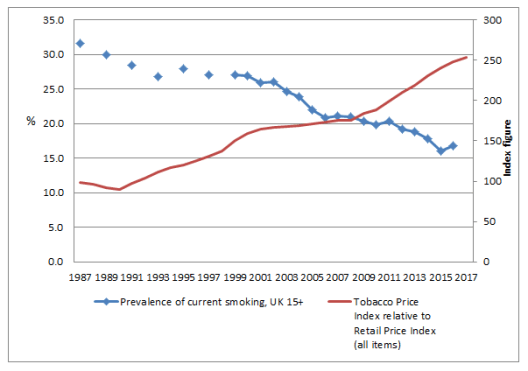
By contrast, the graph below shows the relationship between cigarette costliness and smoking prevalence in the UK. It is very clear that as the real price of tobacco rose (and hence costliness increased) that smoking prevalence fell, in an almost complete inverse relationship.Screen Shot 2018-12-20 at 5.12.58 am

Source: Smoking prevalence and Tobacco affordability index

Huge prevention effect of Australian tobacco control

Colin Mendelsohn from ATHRA has been beating the same “the wheels have fallen off falling smoking prevalence” drum since 2017. I criticised his statements at length here in August 2017.

What’s missing in his almost total focus on what’s happening with smoking prevalence, is that while Australia’s current decline in smoking prevalence status compares favourably to the US and UK, our data on youth smoking prevention are quite stunning. Only 1.9% of 15-17 year old Australians smoked in 2017-2018, down from 2.7% in 2014-2015 and 3.8% in 2011-2012. This is a 50% fall in the 7 years 2011-2018, during which time Australia introduced plain packs and a series of annual 12.5% tax increases from 2013-2018.

The proportion of adult Australians who have never smoked was 52.6% in 2014-15 and rose to 55.7% in 2017-18. These figures are the tobacco industry’s on-going nightmare, presaging it as a sunset industry which will wither and starve from lack of “replacement” customers as its current users quit or die.

In my August 2017 critique I highlighted several reasons why Mendelsohn’s claim at the time that there had been an increase in the number of smokers in Australia needed careful circumspection. I wrote:

“Mendelsohn appears to have arrived at a figure of 21 000 extra smokers by multiplying the percentage of daily smokers listed for each year in Table 3 of the AIHW report, with an estimate of population numbers of Australians 18 years and over in June 2013 and 2016 released by the Australian Bureau of Statistics in June 2017. These population estimates were published some months after the AIHW would have undertaken the analysis of smoking prevalence for 2016 and some years after it released its estimate of prevalence in 2013.

The estimate ignores the complexity of how survey results are weighted by population composition. It also ignores the fact that the prevalence figure is only an estimate, with margins of error. The AIHW’s table of relative standard errors and margins of error indicates that the prevalence of daily smoking among people aged 18 years and over in 2016 was somewhere between 12.2% and 13.4%. This means that the number of smokers in 2016 could have been anywhere between 2 293 000 and 2 512 000. A similar range applies to the figure for 2013. The calculation of an extra 21 000 smokers between 2013-2016 is therefore essentially meaningless.

Moreover, the Australian Bureau of Statistics population figures show that between 2013 and 2016, Australia’s population aged 18 years and over grew by 864 340 people as a result of births, deaths and immigration. Many immigrants in this number would be from nations where smoking rates are high, particularly among men.

The elephant in the room? Massive growth in never smokers from smoking prevention.

Media attention has focused on smokers. But applying the same calculation Dr Mendelsohn has done for current smokers to people in the rest of the population, one would conclude that there are more than 870 000 extra non-smokers in Australia in 2016 than there were in 2013 — more than 80 times the number of extra current smokers (and more than 40 times the number of extra daily smokers) that he is so concerned about.”

ATHRA has egg on its face with its apparently naïve understanding of what smoking prevalence data for the three countries actually mean.

Professor Robert West (a leading figure in tobacco cessation research, editor-in-chief of Addiction  and director of the large Smoking in England national study told the BBC in February 2016:

“[This widespread use of e-cigarettes] raises an interesting question for us:  If they were this game changer, if they were going to be – have this massive effect on everyone switching to e-cigarettes and stopping smoking we might have expected to see a bigger effect than we have seen so far which has actually been relatively small” [my emphasis]

and

“We know that most people who use e-cigarettes are continuing to smoke and when you ask them they’ll tell you that they’re mostly doing that to try to cut down the amount they smoke.  But we also know that if you look at how much they’re smoking it’s not really that much different from what they would have been doing if they weren’t using an e-cigarette.  So I think as far as using an e-cigarette to reduce your harm while continuing to smoke is concerned there really isn’t good evidence that it has any benefit.” [my emphasis]

Esther Han at the Sydney Morning Herald reported earlier this year here about funding received by ATHRA from two companies involved in the vaping industry and here about their receipt of $8000 from an organisation that received funding tobacco companies.

Fortunately, governments in Australia have heeded the evidence reviews from the CSIRO, the Therapeutic Goods Administration and the NHMRC, and the advice from the overwhelming proportion of public health and medical organisations (table below) to take a precautionary approach about many of the over-hyped claims being made for ecigarettes and the vast areas of research where the evidence remains non-existent or very limited.


Screen Shot 2018-12-20 at 12.19.45 pm

With multi-party support, Australia remains in the very front line of global tobacco control with commitments like plain packaging, high taxation, retail display bans and smoke free policies. Australia’s smoking prevalence would look a lot better if governments had not fallen asleep at the wheel in one critical areas- failing to run evidence-based national media campaigns since 2012.

ATHRA’s public statements need to be scrutinized very, very carefully.

Tailpiece

After it was recently announced that Philip Morris/Altria is planning to invest in cannabis, ATHRA’s Colin Mendelsohn tweeted on Dec 8 that it was “surely a good thing if they make money” from this move. With 20.8% of US high school kids now currently vaping (at least once in the past 30 days)  compared to 3% of US adults, and the immense appeal of Juul involving its discreet properties (easily secreted, minimal clouding, memory stick lookalike), it is reasonable to ask what could possibly go wrong with PMI’s planned entry into the cannabis market. Vaping equipment is already being used to vape cannabis and other  drugs. Philip Morris of course would be horrified if children were to vape dope before sitting down in the classroom. It would just never happen, right?(2018)12-8 - supports PM cannabis deal

Readers or royalties? why now I make my books open access

[Updated 16 Feb, 2026]

I wrote my first book in 1983. It was a small manual of tactics for counteracting the tobacco industry’s promotional strategies, described by a tobacco industry snoop at the conference where I sold it to delegates as  “a rather paranoid and disturbing `contribution’ by an Australian called Simon Chapman”. I got a small grant from an international consumer organisation to print it and I took 300 copies to the 5th World Conference on Smoking and Health in Canada where I sold copies for $5, recouping my excess baggage charge and adding a few first gold bricks to an authorship royalties’ pathway I planned to pave during the rest of my career. On the final night I spread all the bank notes over my hotel bed and dived into it, Scrooge McDuck style. I was on my way!

ScroogeMcDuckDives

I followed this by convincing a small media studies publisher in London to publish a book from my PhD thesis in 1986. Great Expectorations: advertising and the tobacco industry. I never recall getting any royalties, but it got reviewed in the Times and the Guardian, with the Times even running an editorial. I got a lot of mail from readers. Long out of print, a US bookseller today hopes to extract $US169.73 for it from some discerning reader.

Screen Shot 2018-12-11 at 9.15.38 am

I then wrote a global atlas of tobacco control in the third world, as we called it then. The American Cancer Society paid for the printing and gave one to every delegate at the 7th world conference on tobacco control in Perth. This became the inspiration for subsequent international atlases of tobacco control published by the US Centers for Disease Control and later by Judith Mackay. I got no royalties for this one either and my hopes to put a deposit on an Aston Martin were looking ever fragile.

In 1994, I knew I was about to hit the big time when  British Medical Journal books published the first of two textbooks I wrote on the theory and practice of public health advocacy. This one, and the next (published by Wiley in 2007) saw annual royalty payments go into my bank. I never added them all up, but estimate that over the 24 years since I might have earned $12,000. Today my bank charges for the foreign deposits are usually as much as the annual royalties.

Two other books (one on gun control for Pluto Press and another on voluntary euthanasia) produced utterly desultory royalties, despite being on hot-button news issues. Like every author I’ve talked to, I spent many a weekend visiting bookshops sometimes looking in vain for these on the new releases display shelves.

These experiences left me convinced that writing non-fiction books was highly unlikely to earn me a living or even significant icing for my salary cake. But there are reputational benefits and indirect outcomes like conference invitations, consultancies and training opportunities that flow from publishing a book.

But well before thoughts of the untold riches heading their way, funnily enough every author hopes that their writing will be read. We polish, buff and manicure our babies through many revisions, all the time imagining the readers’ pleasure with the text. So when for my next six books I was given an opportunity to trade chimerical riches for gushing geysers of readers, I didn’t hesitate.

In 2009 I approached Sydney University Press with a book idea on the prostate cancer testing debate. My editor there, Agata Mrva-Montoya, set out several options: a commercial option with a paperback book where I would get the standard 10% royalty, a paid ebook option (with 25% royalty), or a hybrid open access option where there would be a paperback and ebook option available for sale and a  totally free (for readers) pdf download. SUP has some 50 titles in its catalogue available as open access.

I elected for the pay-for-print/free download option for this and all subsequent books I’ve done with SUP. They republished the gun control book which had seen around 1000 sold in paperback with Pluto. Links to all these books are here.

The table shows the total and average per day accesses since each book was published. (table updated 22 Dec, 2025)

Book, open access publication date (*= Sydney University Press)Total accesses (& per day)
* Let sleeping dogs lie: what men should know before getting tested for prostate cancer. Oct 29, 201086,545(15)
*Over our dead bodies: Port Arthur and Australia’s fight for gun control. Jan 15, 201349,517 (10)
*Removing the emperor’s clothes: Australia and plain  packaging. Nov 27, 201461,917 (15)
*Smoke signals: selected writing. 28 Jul, 20179,845 (3)
*Wind turbine syndrome: a communicated disease. Dec 1, 201734,842 (12)
*Quit smoking weapons of mass distraction. Jul 25, 20229,195 (7)
Better to be looked over, than overlooked: 50 years in public health research and advocacy. Jan 14, 2026784 (20)
The last right: Australians take sides on the right to die. May 1, 20146421 (1)

These 259,003 accesses are very pleasing. I’m confident that a small fraction of that number would have been purchased if I’d gone for the pay-for-print option. My combined royalties to date for the print editions I’ve received for all of these books have been around $1000.

When I’ve recommended giving one’s books away online to authors who have gone down the sales-only route, I sometimes encounter a disdainful superiority in the remark “a curious mouse click on a pdf download button is not the same as someone actually reading a book”.

It’s certainly true that many people who open an online book don’t read it, or don’t read it fully.  But of course, the very same can be said about purchased books. How many books do we all have on our shelves that we bought with the intention reading them cover-to-cover but never got around to it?

I had a job throughout the years I wrote these books, so (thankfully) did not need to rely on income from publishing. Those who rely on writing for their living clearly cannot consider this route to readership.

For authors who do not need to rely on royalties, publishing open access is a good way to increase readership.

The Rolling Stones at the Enmore Theatre, Feb 18 2003

I’d seen the Rolling Stones at Wembley Empire Pool in north London in 1973 on the Goats Head Soup tour, still with Mick Taylor and Bill Wyman. I remember scorching versions of Starfucker, Happy and Rip this joint. I saw them again on the Voodoo Lounge tour at the Sydney Cricket Ground, supported by the Cruel Sea, with 78,000 others including my 13 year old son, Joe. Our tickets were numbered something like Stand 7 Row 1, seats 4 and 5. I just knew we would be in the first row right in front of the stage, not in the front row of a nosebleed stand where, without any binoculars, we could watch ants with guitars performing way off in the distance. I spent much of the evening trying to convince Joe that what we were experiencing was just amazing.

By the time they next came to Sydney in 2003, on the Licks tour, I’d surpressed the memory of that anti-climax but was crushed after trying and failing to get tickets to their sold out gigs at the Olympic stadium. But then they announced a single gig at the decaying art deco Enmore Theatre in the next suburb to ours. With maximum capacity of 1600, this called for the abandonment of all restraint on how unbelievable getting a ticket would be.

Screen Shot 2018-11-09 at 1.22.19 pm

Sydney’s Enmore Theatre

Tickets would go on sale on a Monday morning at 9am, by phone or on-line. All the publicity insisted that all tickets would be sold to the first 1600 who got through. I got to my office at 8am and experimented with which desk arrangements of phone and mouse would give me as a right hander the best hope of frantic, rapid phone redial and repeat resets of the web booking page. I’d mouse with my right hand and press the redial button with my left. At 8.55am I got going, over and over for a full hour like a bar-pressing rat in a lab experiment. Not once did I get through.

As all optimism drained away, I gave it a few final attempts, running a “this time, surely” prayer in my head. Nothing. I then walked down two floors to the room that housed my research grant team. “Well, meet the guy who just wasted an hour of time he should have spent working away on a paper, trying in vain to get tickets to the Rolling Stones gig at the Enmore” I told them sheepishly.

Katie Bryan-Jones was a Californian Fulbright scholar who was spending a year with us. She was about six foot two, in her early twenties and bursting with good health and vitality. She looked at me and said deadpan “Do you like the Rolling Stones?”  I began to explain that everyone my age had grown up with their music as a soundtrack to their lives.

She interrupted me. “Hey, I‘ve got two tickets to that gig. Would you like one?” She explained that she’d heard that if you joined the Rolling Stones’ Australian fan club, and paid $100, you got well over that in merch like T-shirts, caps, badges and CDs but importantly, priority access to tickets. So she’d joined and got the tickets to the Enmore.

I nearly wet myself with excitement. These were the hottest tickets I could ever remember going on sale. An almost intimate gig with the world’s most famous ever rock band  to tell people about for the rest of your life. Would I like a ticket?  Is water wet? Is the Pope a catholic? But haven’t you bought the other ticket for your boyfriend or something? “Well, sort of .. but really, you’re very welcome to have it” she assured me. I handed her the money on the spot.

On the night of the gig a few weeks later, we met in a Turkish pide shop a block away from the Enmore. My shout and order anything you want, the magnanimous ticket holder told her. I’d brought a very good wine along.

An hour later, we walked down toward the theatre, stopping to buy and load up a disposable camera at a pharmacy. This I secreted down my underpants, expecting a no cameras inspection at the door.

As we neared the main entrance, Katie handed me the tickets. I looked at them and froze. There were no seat numbers on them. Had she been conned and been sent fake tickets?  It seemed possible.

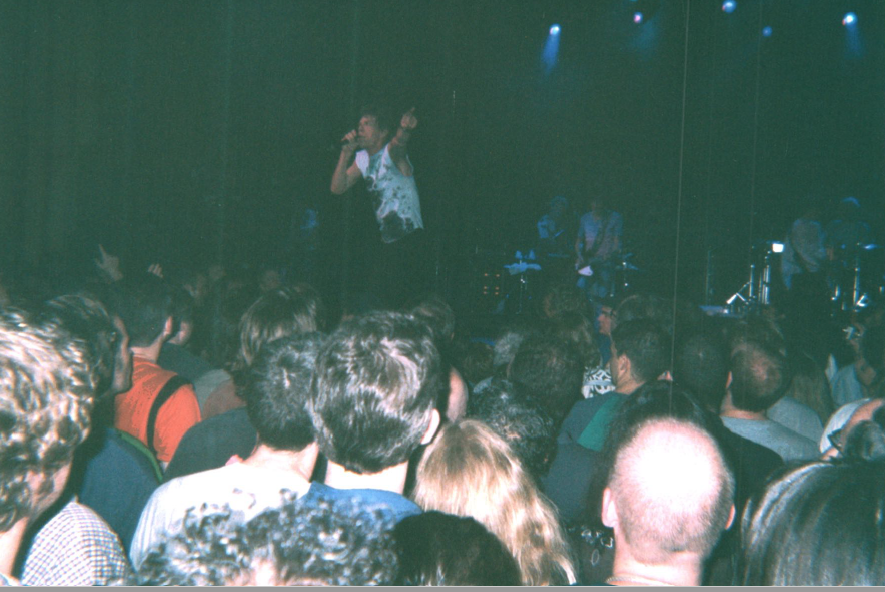
Security goons swarmed everywhere. One came up to us and reached for our tickets. It was the “colourful Sydney identity” strongman Tom Domican. I was reminded of the Rolling Stones hiring the Hells Angels as security at the ill-fated Altamont concert  in 1969. He pointed us to an internal doorway which led us to the mosh pit. So not only had we real tickets, but we had the best tickets you could get. We were about 10 metres from the stage in a sea of aging forever youngs.

I saw a few famous names and faces near us in the crowd, Glenn A Baker and Adam Spencer were two.  How amazing that these celebrities had been able to get tickets in the huge competition to get the few that were on offer! What were the odds of that?

Jet were the support act. I remember nothing about them other than wanting them to get off after each song. Twenty interminable minutes later, it started. They opened with Midnight Ramber, Tumbling Dice and Live with me. Ronnie Wood and Keef both looked cadaverous. Both  ignored the smoking ban and played sweeping, chiming chops and riffs deep in my DNA. They throttled their guitar necks and looked utterly dissolute. Mick ran about all night, pouting and jaggering and enjoying it enormously. Charlie was in his own world, impassive and rock solid.

Screen Shot 2018-11-09 at 5.00.56 pm.png

Screen Shot 2018-11-09 at 5.01.19 pm

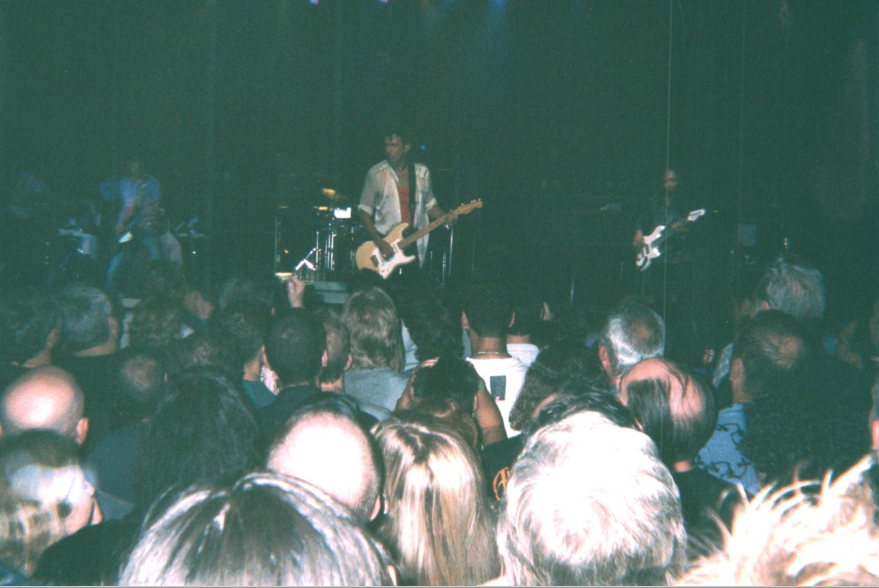
About three quarters of the way through, two ordinary looking guys in jeans and tees with guitars sauntered on stage. I missed what Mick said but then it rapidly dawned: it was Angus and Malcom Young from AC/DC. The four guitar gods dueled through the BB King standard Rock me baby, and Angus and Keef duck-walked across stage, Chuck Berry style. We all died and went to heaven.

I’ve seen hundreds of musical acts over my life (Bands seen), many unforgettable. But this had just everything. It was the benchmark. The best. Pure bliss.

Throughout the night, Mick constantly pulled on a water bottle and at one stage threw an open one into the air near us. Water that had been in the bottle, perhaps in direct contact with his lips splashed over us. This molecular intimacy made us both decide that, for those moments, homeopathy might well have something to it after all.

Me, I’ve not washed my face in the 20 years since.

Sydney Morning Herald review

The full concert

10 favourite Rolling Stones tracks  I’m movin’ on (live)  She said yeah  That’s how strong my love is Get off my cloud Monkey man Can you hear me knockin’ Fool to cry Backstreet girl  Too much blood   Rocks off  (and my band doing it in 2012  at Balmain’s Cat & Fiddle pub with Adam Spencer guesting on guitar)

Are scratch ‘n sniff gangrene warnings next for cigarette packs?

I’m often asked “so now that we have plain tobacco packs, with their huge graphic health warnings, what’s next in the marshaling yard to try and drive home the realities of the risks of smoking?”

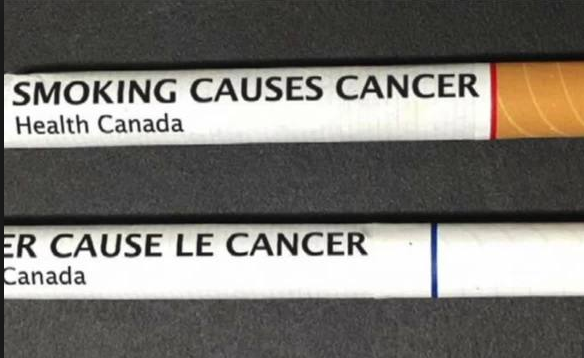
Canada pioneered graphic health warnings on packs in 2000, and by 2016, over 100 nations required the “see and can’t forget” pictorial warnings. Canada is now actively considering health warnings on all cigarettes (see picture).

Screen Shot 2018-11-06 at 8.36.08 am

One of the most potent of all the graphic health warnings that have run in Australia since 2006 is the one about smoking causing gangrene.

Gangrene (rotting flesh) can occur with peripheral vascular disease. It occurs mostly in the extremities of the body, particularly in the in the feet and toes when insufficient blood supply reaches these areas due to narrowing of the blood vessels. Smoking is a major risk factor for PVD because it is a vasoconstrictor and raises blood pressure.

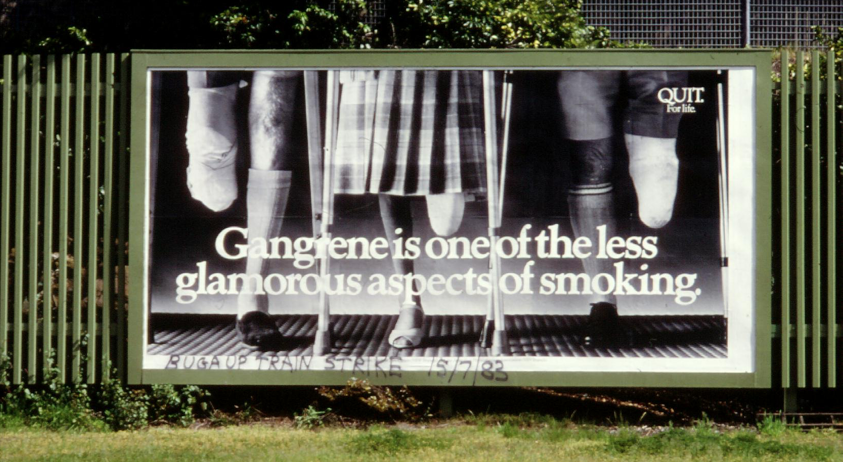
The first public campaign to highlight gangrene was run in New South Wales in a 1983 campaign for the NSW health department developed by John Bevins.  A TV ad on amputation after gangrene was screened in the years after the gangrene pack warning appeared.

Screen Shot 2018-11-05 at 4.54.06 pm

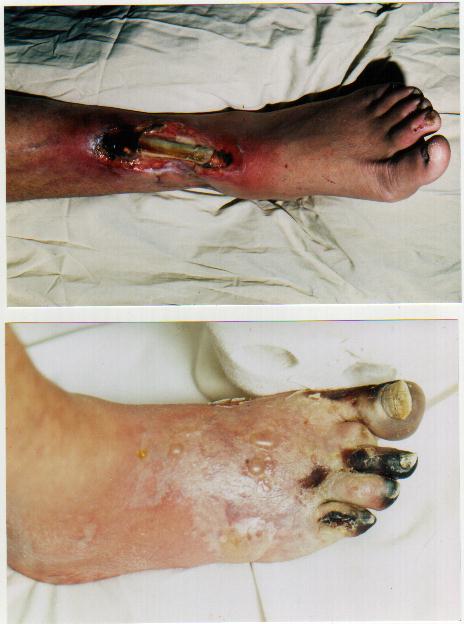
I helped find the lower photograph below of the gangrenous foot that was used in Australia’s first generation of graphic health warnings that appeared from 2006. I obtained it from a surgeon at Sydney’s Westmead Hospital where I worked at the time. He gave me these two photographs of gangrenous limbs of smoking patients. I sent them to the Health Department in Canberra who tested them in focus groups. The first one showing the exposed bone was apparently rejected as being just too confronting.

gangrene

The huge reaction the gangrene warning and the public discussion the graphic warnings caused got me thinking about how they might be made even more powerful.

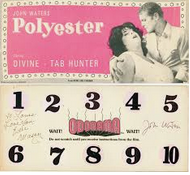
In 1981, I saw John Waters’ cult film, Polyester staring the drag queen Divine and Tab Hunter. Waters incorporated “Odorama” scratch and sniff cards into the film. Wikipedia notes that “Special cards with spots numbered 1 through 10 were distributed to audience members before the show (see picture below). When a number flashed on the screen, viewers were to scratch and sniff the appropriate spot. Smells included the scent of flowers, pizza, glue, gas, grass, and faeces. For the first DVD release of the film the smell of glue was changed due to, as Waters states, “political correctness”. The gimmick was advertised with the tag “It’ll blow your nose!”

Screen Shot 2018-11-05 at 5.26.00 pm

Gangrene has a very potent foul smell that can be highly distressing to patients and those who care for them before amputation.  When I started being asked the “what’s next?” question, I wondered about the potential of extending tobacco health warnings into the olfactory zone.

I called up a Professor of Chemistry at my university and asked him whether he knew of any chemical attempts to develop the smell of rotting flesh. I explained my interest. Absolutely deadpan and as quick as a flash, he told me that there were two candidate organic compounds cadaverine and putrescine. Putrescine is manufactured industrially. He called me back an hour later, having looked up the costs of bulk supplies of putrescine. I recall it was not off the planet and in any case, would be paid for by tobacco companies if the idea ever progressed.

Australia’s tobacco packaging legislation could easily be amended to allow for the mandatory incorporation of a putrescine scratch and sniff tab on packs carrying the gangrene warning.

In 2015, two psychologists conducted experiments where they exposed subjects to three odours: a neutral smell, ammonia and putrescine. They recorded how long it took subjects to walk 80 metres away from the campus exposure locations after smelling these odours. Those randomly allocated to the putrescine smell walked away faster from the exposure sites, causing the authors to speculate that “the results are the first to indicate that humans can process putrescine as a warning signal that mobilizes protective responses to deal with relevant threats.”

“Heath warnings don’t work”

There is a conventional folk wisdom popular among continuing smokers that tobacco pack warnings have no impact: they keep smoking regardless and just switch off. The companion argument here is that smokers are fully informed about the risks of smoking and so banging the same drum about health risks is a useless strategy.

There are several big problems with these arguments. First, if health warnings were so ineffective, someone needs to explain why  the tobacco industry has fought them tooth and nail all around the world for decades, particularly when they moved from anodyne to explicit, specific and graphic warnings. As recently as December 2016, British American Tobacco’s lawyers were attempting to stymie increased graphic health warnings in Hong Kong and Philip Morris did all it could to prevent Uruguay from implementing graphic health warnings. Companies don’t usually bother attacking policies that are ineffective and have no impact n their bottom line.

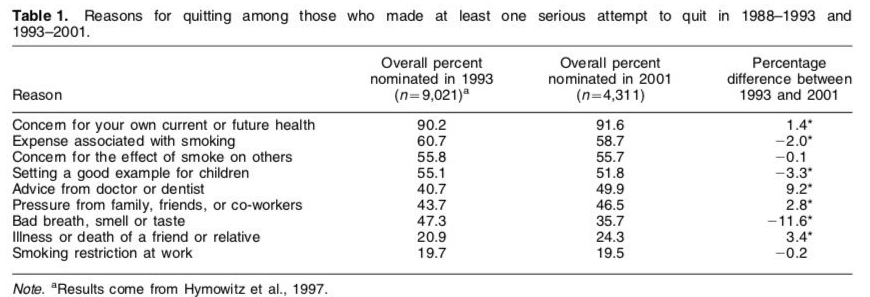
Second, it has been repeatedly shown that the overwhelming reason given by ex-smokers in explanation about why they were determined to quit, is health concerns. There is daylight between those concerns and other reasons that are nominated, as shown in the table below. Just where is it that smokers pick up these concerns from? Where would they ever find out or reflect on what atheroma or a brain bleed from stroke looks like if they never saw an image of it? How would they know about a person with emphysema’s constant struggle to breathe if they had not seen vision of it in a health warning ad? People with end-stage emphysema don’t tend to walk around in public very much, because they can’t.

quiy4health

And third, there is a very substantial body of research that examines questions about the impact of pack warnings on smokers’ understanding of risk, intention to quit and quitting behaviour, concluding that warnings can be powerful ingredients in motivating quitting.

Big Tobacco will hate this proposal. And that’s all we should really need to know in deciding that it’s an excellent idea.


Is Big Tobacco really trying to get out of tobacco?


This week, the journal Addiction published a letter signed by 6 high profile researchers, each with histories of working with tobacco companies on putatively reduced harm products. Their brief letter sought to “discuss” the ethical issues, as they saw them, that justified their remunerated research engagement. But it contained little more than several glib assertions.

While 181 nations have ratified the WHO’s Framework Convention on Tobacco Control, with its Article 5.3 setting out guidelines for limiting tobacco industry interference with tobacco control (“There is a fundamental and irreconcilable conflict between the tobacco industry’s interests and public health policy interests”), a small number of researchers apparently believe they  can rise above such concerns.

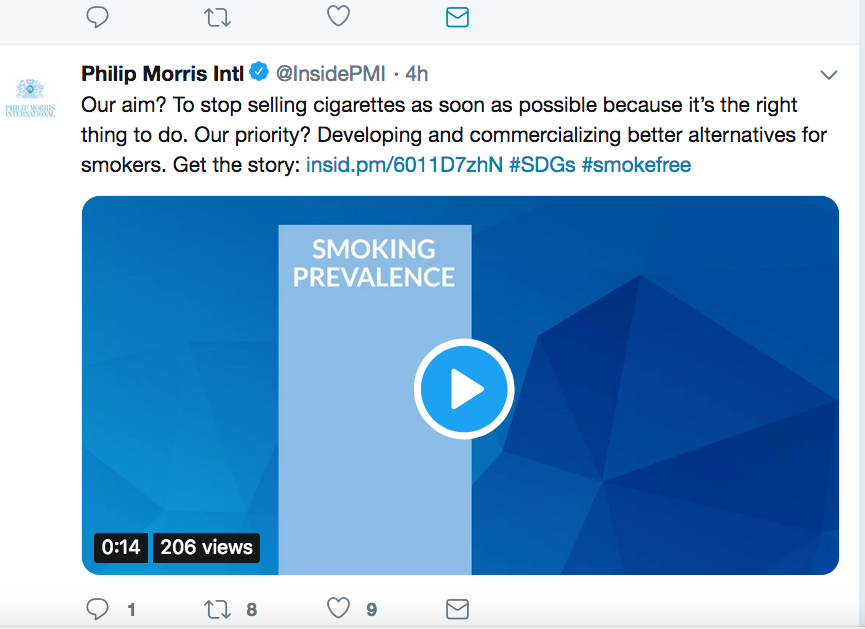
Their letter comes at a time when nearly all tobacco companies are adding so-called reduced risk products to their product portfolios. Some, like Philip Morris are engaging in “we’re changing” charm offensives claiming they are trying “to stop selling cigarettes as soon as possible”.

(2108) PM gettng out of smoking

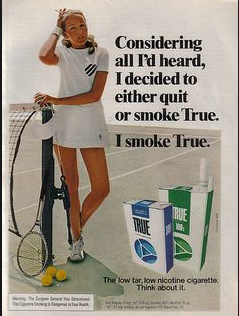
Ever since the bad news began rolling in from the early 1950s about the inconvenient problem of the very nasty harms smoking causes (latest estimates are that two in three long term smokers will die of a smoking caused disease, translating to some 7 million deaths a year), the industry has pursued a public agenda of announcing successive generations of allegedly reduced harm products. Unfortunately, every one of these  crashed as false hopes. All were primarily designed to keep nicotine addicts loyal to the companies’ evolving products and to dissuade people from quitting, as hundreds of millions around the world began doing in increasing numbers from the early 1960s, the great majority without any assistance and often without much difficulty.

True Cig_Ad

No need to quit, when you can keep smoking a “reduced risk” cigarette?

No industry likes seeing its longest and most loyal customers dying early. They’d far prefer that they lived to consume and be contributing cash cows for as many years as possible. There is also no industry more loathed and mistrusted than the tobacco industry. Against this, the harm reduction agenda represents a trifecta of hope for Big Tobacco: it’s a kind of perpetual holy grail, never reached but always sought, with the promise of seeing smokers living and consuming longer. It’s also a way of enticing new generations of users into the market who each time swallow the hype about radically reduced risk products. And it carries hope of eroding the industry’s on-going corporate pariah status, with its attendant risks of attracting sub-optimal staff indifferent to working in a killer industry. It’s a virtue signalling cornucopia that keeps on giving.

Enter e-cigarettes

E-cigarettes and heat-not-burn products (ENDS or Electronic Nicotine Delivery Systems) are the latest harm reduction debutantes. The size of the popularity wave they are riding in several nations puts these products in the league of two previous, disgraced heavyweight champions of harm reduction: filter tips and so-call light and mild, cigarettes. Filters are almost universally still used today in cigarettes, but with 7 million deaths a year still occurring, it’s a bit like saying that arsenic is less harmful than cyanide, thanks to filters. Because of compensatory smoking, lights and milds were declared misleading and deceptive descriptors by the Australian Competition and Consumer Commission in 2005 and outlawed. Tobacco companies in the USA are currently running court-ordered corrective advertising, including messages about the lights and milds scam.

The rise of ENDS has been accompanied by a chorus of Big Tobacco CEOs proclaiming that they mark the beginning of the end of smoking. “Look what we are doing.” they gush “We are transforming ourselves into companies that are saving lives! We are investing billions into research, development, production and marketing of these new products.”

With their new health promotion vocation, they have tried to cosy up to governments, the WHO and sadly, to researchers like those who signed the letter in Addiction.

The Jekyll and Hyde defence

The authors of the letter in Addiction state that they “limit our work with the industry to projects involving reduced-risk products.” This argument is a kind of Jekyll and Hyde defence. It invites readers to consider that tobacco companies produce both morally defensible and indefensible products, and that it is ethically unproblematic for a scientist to have supportive dealings with those representing the Dr Jekyll persona, but self-evidently unethical to do anything to support murderous Hyde characters.

The unavoidable, blindingly obvious problem here of course, is that Jekyll and Hyde are the same person. Prisons are full of people who at their trials presented outstanding employment records, character references, and receipts for generous charity donations, but who had feet of clay and committed heinous deeds. In the corridors of tobacco companies there are divisions of both Jekylls and Hydes. The two camps may have little to with each other (BAT’s “science” twitter feed @BAT_Sci daily parades the work of its busy harm reduction product staff, but I’ve never seen mention of what its legions of cigarette division chemist staff are up to).

But on the floors that house those in the executive who pull the strings for the entire companies, they know exactly how the company bread is buttered and what the future vision looks like. And for all the sloganeering about the end of smoking, that future has, as it has always been, cigarettes right at the very front of the business model.

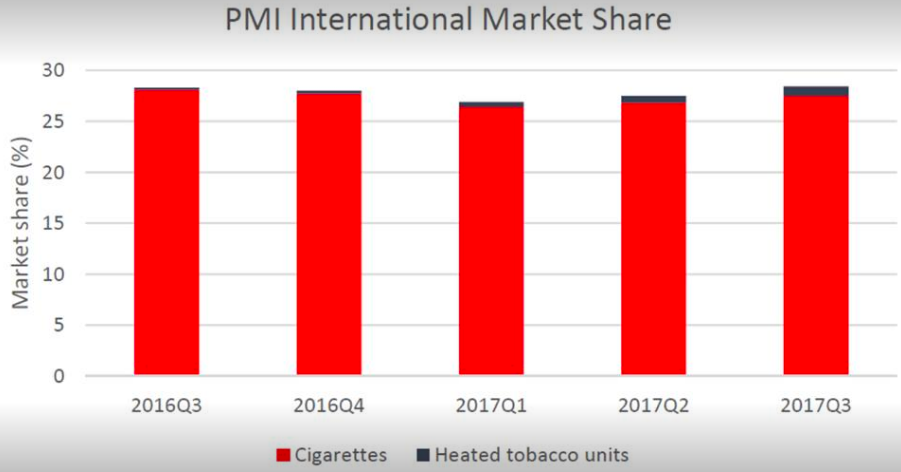
(2017)PMI cigs v heated

PMI’s global market is dominated by cigarettes.

BAT’s 2018 half yearly report could not have been more emphatic on this from its opening paragraphOur strategy is to continue to grow our combustible business while investing in the exciting potentially reduced risk categories of THP, vapour and oral. As the Group expands its portfolio in these categories, we will continue to drive sustainable growth.” (my emphases)

A senior Philip Morris International spokesman, Corey Henry, told  the New York Times in August 2018 “As we transform our business toward a smoke-free future, we remain focused on maintaining our leadership of the combustible tobacco category outside China and the U.S.”

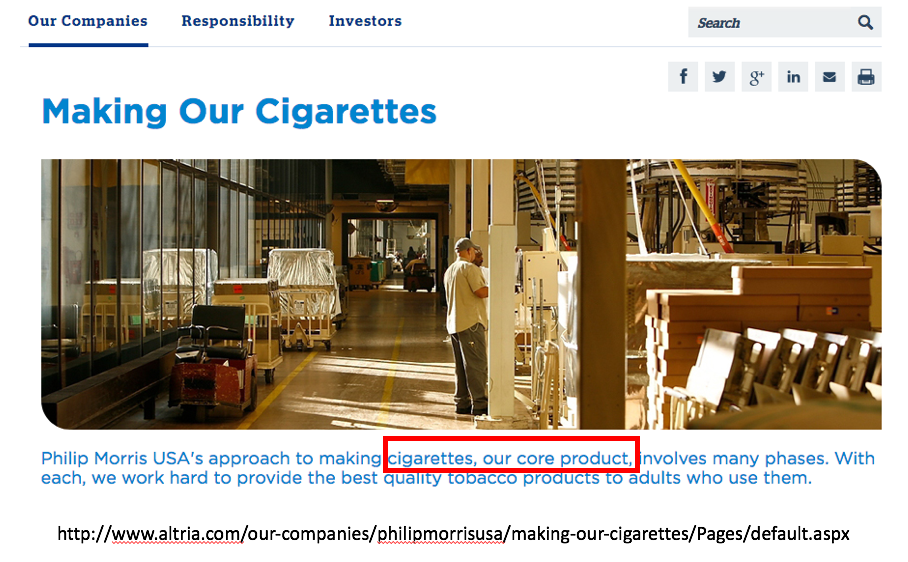
Philip Morris USA’s website candidly speaks of “making cigarettes our core product”.

PM cigs our core product

Reduced risk products instead of or as well as cigarettes? 

The Addiction letter authors wrote “If the tobacco industry seeks to make money by making reduced risk products instead of  [my emphasis] more risky products, we fail to see this as a menace to public health.”

Yes, I’m afraid they do fail to see. Put simply, there is no evidence – apart from an incontinent river of public declarations – that any tobacco company is taking its foot off the twin business-as-usual accelerators of massively funded marketing of combustible tobacco products (chiefly cigarettes), and continuing  efforts to discredit and thwart policies known to have an impact on preventing uptake and promoting cessation.

In recent years companies like BAT and Philip Morris have been relentless in seeking to dilute, delay and defeat any policy posing any threat to their tobacco sales. This is not the behaviour of an industry earnestly trying to get all its smokers to quit. Witness their massive efforts to stop Australia’s historic plain packaging legislation. Witness their years’ long efforts to stop Uruguay’s graphic health warnings.  As recently as December 2016, BAT’s lawyers wrote this appalling letter to the Hong Kong administration trying to stop graphic health warnings going ahead. This was from a company which, published in its 2016 financial results statement a call to “champion informed consumer choice”.

Attacking tobacco tax

British American Tobacco’s twitter feeds relentlessly highlight seizures of illicit tobacco. The sub-text for these is that tobacco tax is so high that it is fueling demand for cheaper, illicit tobacco which evades tax. Joining the dots, the proposal here is that governments should stop raising tobacco tax (and perhaps even reduce it) to perversely “help” smokers buy the company’s brands.

In nauseatingly unctuous displays of civic-mindedness, the companies publicly wring their socially responsible hands about smokers having to interact with criminal tax evaders, unknowingly channeling their tobacco purchasing money into terrorism, and depriving national treasuries of much-needed revenue.

All this neatly avoids the public understanding that tobacco companies have used tax rises as air cover to add to their own margins by raising the prices they charge retailers who in turn pass on these increases to smokers. For example, In Australia from August 2011 to February 2013, while excise duty rose 24¢ for a pack of 25, the tobacco companies’ portion of the cigarette price (which excludes excise and GST), jumped $1.75 to $7.10. While excise had risen 2.8% over the period, the average net price had risen 27%. Philip Morris’ budget brand Choice 25s rose $1.80 in this period, with only 41¢ of this being from excise and GST. (see p77 here)

These public displays also keep attention away from the large body of evidence across many years that shows the tobacco industry has long supplied tobacco products to agents in knowledge that these products would enter the illicit, tax avoiding market.

The Philip Morris fully-funded “Foundation for a Smokefree World” has recently awarded New Zealander Marewa Glover $1m to advance harm reduction globally among indigenous peoples. Glover has been a frequent written and vocal critic of tobacco tax, claiming it is ineffective in reducing demand.  This contrasts to the overwhelming consensus of evidence about the role of tax in reducing demand. Price elasticity is why all tobacco companies (just like those in every industry) engage in price discounting: smokers smoke more when prices fall, and less when they rise.

In 2011, BATA’s Australian CEO David Crow told a Senate committee “We understand that the price going up when the excise goes up reduces consumption. We saw that last year very effectively with the increase in excise. There was a 25 per cent increase in the excise and we saw the volumes go down by about 10.2 per cent; there was about a 10.2 per cent reduction in the industry last year in Australia.”

All but one of the authors of the Addiction letter are from the USA. Professor Robert West, editor of Addiction, has recently drawn attention to the propensity of American researchers for US parochialism. Looking outside of the US border, we see rampant cigarette promotion still happening wherever possible, particularly in low income nations.  A moment’s searching finds examples like the Philip Morris’ controlled Indonesian Sampoerna company, with around a third of the country’s cigarette sales, promoting “stronger” cigarettes on the crest of a 15% industry-wide increase in smoking in the world’s fourth most populous nation. Or evidence of ubiquitous selling of single cigarettes across Africa and promotions near schools.

What could it do?

If Big Tobacco was sincere in its claims it wants to stop selling cigarettes there is much it could do. It could immediately stop all advertising and promotion of tobacco products around the world. It could voluntarily introduce the world’s best practices in graphic health warnings on packs (every company makes decisions every year about how its packaging will look). It could stop supplying illicit trade with tobacco products (currently estimated at one third of all illicit trade), knowing the importance of this in supplying very low income smokers with cigarettes that allows them to keep smoking and hopefully graduate to company brands.

Of course, it will do none of this, continuing instead to endlessly witter its sanctimonious claims about getting out of cigarettes but doing nothing to demonstrate that it is.  What it is doing, is to hide behind the weasel words that it will get out of selling cigarettes “as soon as possible”. That’s about as meaningful as saying “when hell freezes over”.

In this, it contrasts with sections of the motor vehicle industry and some governments over the transformation of motor vehicles from being powered by fossil fuels and moving to electric power, in concert with goals to move power generation to renewables. Volvo has announced that 50% of its vehicles will be electrically powered by 2025. By 2017, 10 nations had set dates for the end of fossil fuel car sales. More will follow. No tobacco company has set any target dates.

Over decades, we have seen Big Tobacco’s response to any proposal that threatens their bottom line. Any government announcing that it would no longer allow combusted tobacco to be sold would see every stop being pulled out by the industry to prevent this. But meanwhile the industry, hand-on-heart, assures us all that it really, really wants smoking to end.

And do they really reduce harm?

And then, at the end of the day, all this requires that we all acquiesce and accept that so-called reduced risk products will, in fact, be found to actually reduce risk after years of use.  The diseases caused by smoking are chronic diseases (pulmonary, cardiovascular, cancer). For each of these, many years pass between the uptake of smoking across a population and evidence of rising disease incidence.

The seminal January 2018 report of the US National Academies of Science, Engineering and Medicine repeatedly concluded that the quality of evidence now available that e-cigarettes actually reduce health risks was either non-existent, low or limited (see health effects conclusions here) because of the insufficient time that large numbers of people have been vaping.

There are many reasons to expect that e-cigarettes may indeed cause less disease than cigarettes. But we know from recent data from longitudinal samples that by far the largest proportion of e-cigarette users continue to smoke (“dual users”); that the reduction in the number of cigarettes that they smoke each day is trivial (see Table 3 here); that reducing (rather than quitting) smoking confers little risk reduction; and that for every one e-cigarette user who has a positive outcome by quitting smoking, more than two continue smoking and vaping, or relapse totally to smoking.

Screen Shot 2018-10-22 at 9.37.39 am

Source: Coleman et al (2018)

Moreover, if we add the dual users who relapsed, the once exclusive e-cigarette users who took up smoking, and the dual users who just kept on smoking and vaping, this important study shows that 12 months on, for every e-cigarette user who benefited by quit smoking and/or e-cigs, 4.6 e-cig users relapsed to smoking, took up smoking or were held in dual use.  Little wonder that tobacco companies are wildly enthusiastic about these products.

The 6 authors of the letter state that they are comfortable in working for the industry because “the FDA  considers the tobacco industry  legitimate, why should we not do so?”  The FDA is not directly funded by the tobacco industry, but is regulating it, so there is a world of difference here. This assertion merely acknowledges that tobacco industry manufactures products that are legal to sell if meeting standards being developed by the FDA.

There is much research undertaken on illicit drugs, but it is not funded by the criminals in charge of the trade. Few sensible people would argue that such research is not very important, but no one would seriously suggest that it would be ethical to accept funding by drug dealers.

Most understand that companies have a corporate interest in funding researchers whose outputs will be useful to them, and not create conflicts with their commercial ambitions. There is a very extensive research literature (eg here) that shows a consistent association between industry funding and research findings that are positive for the funding companies.

This is the reason that all serious journals require full disclosure of funding, and why some journals will not accept papers authored by tobacco industry researchers and why the Cochrane Collaboration insists that a majority of its review authors have no competing interests and refuses to consider reviews funded by commercial interests. For these reasons, mechanisms like mandated hypothecated taxes on the industry to fund external research have been proposed  as a way of better ensuring the independence and transparency of such research.

The concerns I have described should suggest that the opprobrium some of the authors have experienced should come as no surprise to them. I would welcome any of them responding to the issues I have raised by using the comments function on this page.


An unforgettable dinner in Istanbul

Istanbul has wonderful nightlife, although Erdogan’s agenda may soon end much of that. I’ve been there four times and been showered with famous Turkish hospitality. My oldest and best friend there is a senior professor who, last time I was there in 2014, was running a conference at which I was speaking. There was always going to be a great dinner sometime that week. But this one would be unforgettable.

She invited her best friends at the conference to a restaurant about 400 metres from the conference centre in the Taksim district. It was in a quite narrow, newish high rise building of about 10 floors, cheek-by-jowl between other similar anodyne structures. We caught the lift from street level up several floors. There were ten of us: several locals, a French woman, me and my wife Trish, and others I can’t remember. There were three men among the ten. I landed at a part of the table with great conversationalists.

There was feverish talk about the mess Turkey was in. All the Turks at the table were incendiary about the creeping erosion of the secular state under Erodgan. Angry accounts were given about daughters having to wear headscarfs for university entrance interviews or be instantly rejected. About jailed journalists and academics and the small-mindedness of those in power. The women were feisty feminists with commanding jobs in a male dominated culture. They all drank alcohol and bossed the waiters around.

About an hour into the meal, the restaurant was full and people were loose and enjoying themselves. The two women opposite me suddenly said emphatically “Oh. My. God.” They were staring past our side of the table and looking through the restaurant windows into the building next door.

There, not five metres away, was a room with the lights on. A gossamer thin white curtain had been drawn, but with the lights on inside, we could see everything in the room. The curtain presumably prevented them from looking out clearly. A very overweight middle aged naked man and a considerably younger, large breasted and full-bodied woman, also naked, had entered the room, perhaps from the bathroom. They set about their tasks. The quick consensus was that she was a prostitute he had called out to his hotel. If we were wrong about this, the man was punching well above his weight if this was his wife or girlfriend.

Our table had the box seat for the spectacle, but there was no hiding what they were up to from almost every vantage point in our restaurant. Very quickly those on other tables got up, brought their drinks with them and crowded round behind our table to get the next best view. Young couples, small dinner groups, a few elderly couples and the staff all joined the throng.

Every new phase of the performance drew gales of laughter. When she took him in her mouth, some cheered and roared. “It’s a wonder she can locate it under all the fat!” “Ah, the first course is now being taken”. When the missionary position changed to rear entry and we saw the man’s thin little bottom gamely pounding away below his considerable back, there were lots of eewws and “oh my gods!” and goodness knows what else being said in Turkish.

This was the first time I had ever watched live sex in a room full of mostly strangers. Or actually, in any context.

I had these thoughts.

First, I’m confident that, presented with a questionnaire on what we would do in such a hypothetical context, nearly everyone in our group would have not hesitated to affirm that, of course, they would have asked for the restaurant curtain to be drawn, or dispatched a waiter into the next building to tell the occupants to please turn off their lights. But presented as we were with the opportunity to watch proceedings – unknown to the performers – no one could look away. The asymmetry of consent between the watching and the watched just flipped the ethical compass for everyone. “They don’t know they’re being watched. We don’t know who they are. We’ll never see them again, What’s the harm?” would have run the rationalisations.

Far more than that, everyone just roared at the spectacle. Far from there being any awkwardness, everyone instantly decided this was spectacular luck we’d chanced on. No one seemed to spend a nanosecond surreptitiously checking non-verbally with others how they should behave. It was uncontrollable, communal, bawdy unity that had been instantly let off its leash.

I wondered too about whether the reaction of the room would have been any different had the performers in our hotel window theatre looked very different. What if we had decided that they were two young honeymooners, with the bridal gown draped over a chair? Or a sweet, long-married couple from the Turkish countryside, in town for a short holiday having saved up for months? Or elderly tourists, lovingly pleasuring each other in the privacy of a hotel room during a holiday? What if the man had been lithe, muscular and handsome instead of fat and out of shape? What if their ages had been similar? Would any of this have changed our response?

It struck me that the essence of the hilarity went something like this: hiring a prostitute is a private and generally clandestine, knowingly shame worthy activity, nearly always done by men with the power to hire women to do something that many people routinely experience as a mutually exchanged gift from someone with love and affection for them. It’s something the man would have probably been hugely embarrassed about, had he known of the audience. Embarrassed about his cover being blown and about his less than film-star like body. So the laughter here was about the combination of the shattering of the man’s hopes to keep his private vices private and the sort of mirth occasionally experienced when we experience or see the wind or a wardrobe malfunction expose body parts in an everyday situation.

His innocent misjudgement about the lighting had transformed him from a man with the power and means to buy sex to an unwitting public cuckold, providing entertainment to a roomful of diners.

Most of our only experiences of watching others having sex is via filmed pornography, occasionally almost unavoidable to anyone using a computer. There, unless the acts are filmed and uploaded without the consent of those involved, the performances are consumed as inauthentic and clearly commercial: they are doing-it-for-money, or purposefully, consensually exhibitionist, in the case of amateur uploaded porn. But here we witnessed a couple in action who were quite unaware that their private, transacted intimacy in fact had an audience.

So public virtues, as might be expressed in a serious-minded conversation about respect for privacy, the ethics of the right thing to do in everyday life or of the case for prostitution took a running jump against the power of private vices – here, the temptation of force-fed voyeurism, of a box-seat on what goes behind closed doors.

I’ve told the story dozens of times, and have even had friends say “I hear that you had an amazing dinner in Istanbul once”, wanting to hear the details for themselves. It seems there’s a little voyeur in most of us.

The dinner group

25 of 12,000 Geological Society fellows challenge climate change science consensus

At a recent dinner, a senior scientific colleague unexpectedly bristled at a comment about anthropogenic global warming, commenting that the world had often seen similar changes to those now being experienced. Four of us in earshot pushed back with attempted jets of cold water, with one saying aghast “you’re sounding like Tony Abbott”.

We all quickly agreed that none of us were expert in all the relevant areas of knowledge and understanding. But this is of course a position that everyone  finds themselves  in daily in regard to any claim in which they are not trained.

So what we all tend to do is to fall in with rule-of-thumb heuristics or cognitive biases that help us make sense of the world. Perhaps the most ubiquitous is confirmation bias  where we seek out, retain and advance facts and assessments  which support our current beliefs.

Screen Shot 2018-09-05 at 6.23.33 am

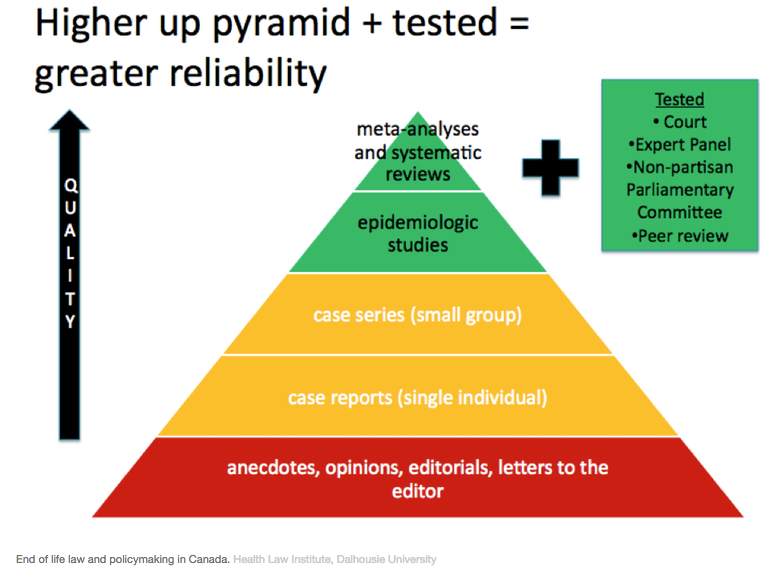
Anyone with even some elementary scientific background agrees too, that in the evidence pyramid of weakest to strong, the plural of anecdote and opinion does not equal evidence. But when that plurality of opinion manifests as expert consensus, its value is elevated as we see below: here it is reasonable and important to ask how experts across relevant fields view evidence.

Evidence pyramid

Our AGW sceptic that night was convinced he held the knockout punch and the next day sent us a June 2018 swingeing  open letter signed by 25 current Geological Society of London AGW skeptical fellows out of some 12,000, plus another 8 former fellows (with no denominator available to allow a calculation of the proportion). Twenty five of 12,000 is a tiny proportion, heading toward homeopathic territory: 1 in every 480 fellows of the Society. The open letter also referenced a  2010 Royal Society letter of complaint about the RS’s “unscientific” public statements on global AGW. That letter was signed by 43 Royal Society fellows (out of 1600 – 2.7%).

Those derisory proportions don’t say to me that AGW skepticism has much traction in those two most august of scientific communities. Clearly those collecting the signatures would have made efforts to build their lists, yet these small numbers are all they came up with.

In 2015, 76 Nobel Prize winners from across scientific disciplines signed or later fully supported the Mainau Declaration on climate change, which emphasised AGW. The potential Nobel Prize signatory denominator is a much smaller pool, given that the prizes tend to be awarded later in life  and that there are only three categories of scientific prize (physics, chemistry, and physiology or medicine) awarded annually.

Without any apparent self-satire,  the  Geological Society signatories stated “As this letter makes clear [my emphasis] it is not true that 97% of scientists unreservedly accept that AGW theory is fixed, or that carbon and COare ‘pollutants’ and their production should be penalised.” The authors also asked “how can the primary nutrient in photosynthesis be a pollutant?”  It beggars belief that they could write this when clearly the argument is about the impact of massive rises in CO2, not CO2 itself. Paracelsus’ “the dose makes the poison” is such an elementary principle in toxicology, and it applies to so many exposures and agents.

It’s obviously very far from clear that the arguments of just 35/12,000 geologists destroy the claim that the overwhelming proportion (97%) of climate scientists (working across  many disciplines) accept AGW.

The 97% figure dates from a study published in 2013 of 11,944 abstracts from the peer-reviewed scientific literature on climate change from 1991–2011. The authors wrote:

“We find that 66.4% of abstracts expressed no position on AGW, 32.6% endorsed AGW, 0.7% rejected AGW and 0.3% were uncertain about the cause of global warming. Among abstracts expressing a position on AGW, 97.1% endorsed the consensus position that humans are causing global warming. In a second phase of this study, we invited authors to rate their own papers. Compared to abstract ratings, a smaller percentage of self-rated papers expressed no position on AGW (35.5%). Among self-rated papers expressing a position on AGW, 97.2% endorsed the consensus. For both abstract ratings and authors’ self-ratings, the percentage of endorsements among papers expressing a position on AGW marginally increased over time. Our analysis indicates that the number of papers rejecting the consensus on AGW is a vanishingly small proportion of the published research.”

Since then there have been two further studies that strongly suggest this ballpark is accurate. One (Verheggen et al, 2014) found 90% of those scientists surveyed who had  more than 10 peer-reviewed papers related to climate science agreed with AGW. Another (Powell 2013) looked at 13,950  papers on  global warming and climate change between 1991 and 2012 and found only 24 rejected AGW.

The coalescence of these research findings and expert views is very compelling.

In the fields in which I’ve worked, I’ve seen many examples of attempts by highly motivated, often credentialed people to wreck consensus using Galilean/Copernican metaphors about their brave, truthful voices standing up against the orthodoxy. These include scientists espousing global epidemics of “electrosensitivity” and WiFi & EMR dangers, and anti-vax and  anti-fluoridation drum-bangers.

When these observations are made, we often then hear conspiracy theories  being invoked (“peer reviewers are too threatened by criticism/invested in their own conclusions” etc).

Very few non-specialists are fully equipped to engage in to and fro discussions about arcane oceanography, geophysics, earth sciences etc. What I do is to look to agencies with processes that inspire confidence in scientific integrity and which are transparent about important issues like any competing interests.

I am a strong supporter of renewable energy. We have solar cells all over our roof. Our next car will be electric. I wrote a book on the nonsense of “wind turbine syndrome”.  The arguments for moving rapidly toward  minimally polluting, renewable forms of energy that are producing huge numbers of jobs are self-evident to me. There seem to me to be no serious downsides in harvesting solar, wind, geothermal, hydro- and tidal energy compared to the very real externalities involved in polluting and resource-intensive forms of energy (fossil fuels, nuclear). A couple of weeks living on the east coast of China or Delhi as I have done is a big reality test about the utter folly of  continuing current fossil fuel burning.

Science is never complete, and debate is virtuous. But when debate stalls action, and the consequences of that are highly likely to be catastrophic, prolonging debate instead of acting is irresponsible.

Is it unethical to use fear in public health campaigns?

The efficacy and ethics of fear campaigns are enduring, almost perennial debates in public health which re-emerge with whack-a-mole frequency, eloquently chronicled by Fairchild et al [1].  Supported by evidence-based reasoning about motivating behaviour change and deterrence [2],  these campaigns intentionally present disturbing images and narratives designed to arouse fear, regret and disgust.

Health problems can be profoundly negative experiences unappreciated by those not living with them. Pain, immobility, disfigurement, depression, isolation and financial problems are common sequalae of disease and injury. It is beyond argument that these are outcomes which are self-evidently anticipated and experienced as adverse, undesirable and so best avoided. Efforts to prevent them are therefore, prima facie, ethically beneficent and virtuous.

Five main criticisms

Criticism of the ethics of fear messaging takes five broad directions. First, it is often asserted that fear campaigns should be opposed because they are ineffective: they simply “don’t work” very well. Fairchild et al [1] note that this argument persists despite the weight of evidence to the contrary.

The ineffectiveness argument can be valid independent of the content of failed campaigns: “positive” ineffective campaigns should also be subject to the same criticism. Yet sustained criticism of ineffective “positive” campaigns is uncommon, suggesting this criticism is enlisted to support more primary objections about fear campaigns.

Victim-blaming?

Second, critics argue that such campaigns target victims, not causes of health problems, and so are soft options mounted in lieu of more politically challenging “upstream” policy reform of social determinants of health such as education, employment or income distribution, or legislative, fiscal and product safety law reforms.

It is difficult to recall any major prescription for prevention in the last 40 years not involving advocacy for comprehensive strategies of both policy reforms and motivational interventions. For example, tobacco control advocates target advertising bans, smokefree policies, and tax rises as well as increased public awareness campaign financing. When governments fail to enact comprehensive approaches to prevention, supporting only public awareness campaigns, this is plainly concerning. The resultant concentration of public discourse around the importance of individualistic change instead of systemic, legislative or regulatory change in controlling health problems may lead to public perceptions that solutions are mostly contingent on what individuals do or don’t do(3). This myopic definition of health problems and their solution promotes victim blaming(4), where notions of individual responsibility are held to explain all health problems when any volitional component is involved.

This can be a serious criticism of failed government commitment to prevention, but is it a fair and sensible criticism of public awareness campaigns in themselves? Those making this argument draw the meritless implication that until governments are prepared to embrace the full panoply of policy and program solutions to health problems, they should not implement any individual element of such comprehensive approaches: if you cannot do everything, don’t do anything?

Further, in any public health utopia where governments enacted every platform of comprehensive programs and made radical political changes addressing the social determinants of health, every health problem with a behavioural, volitional component would still require individuals to make choices to act and to be sufficiently motivated to do so.  Campaigns to inform and motivate such changes will always be needed. The reductio ad absurdum of this objection is that attention-getting warning signs and poison labels are unethical.

Stigmatisation

Third, those who live with the diseases or practice the behaviours that are the focus of these campaigns can sometimes experience themselves as having what Irving Goffman called “spoiled identities”(5) and may feel criticized, devalued, rejected and stigmatized by others. The argument runs that these campaigns “ignore evidence that stigma makes life more miserable and stressful and so is likely to have direct health effects.”[6] and fail to recognize that the stigmatized health states or behaviours “travel with disadvantage”. [6]

Criticism of fear campaigns is mostly applied to health issues where personal behaviour as opposed to public health and safety is the focus. Campaigns seeking to stigmatize and shame alcohol and drug-affected driving, environmental polluters, domestic violence perpetrators, sexual predators, owners of savage dogs, or restaurant owners with unhygienic premises are rarely criticized. Some people deserve to be stigmatized, apparently.

Prisoners of structural constraints?

A fourth argument used against fear campaigns, is that many personal changes in health-related behaviour are difficult, requiring physical discomfort, perseverance, sacrifice and sometimes major lifestyle change, often limited by structural impediments like poor access to safe environments, cost, work and family constraints.

But unless one subscribes to an unyielding, hard determinist position that people have no agency and are total prisoners of social and biological determinants, the idea that individuals even in the direst of circumstances cannot make changes in their lives when motivated to do so is an extreme position, difficult to sustain. It is instructive, for example, to reflect that today in many nations, it is only a minority of the lowest socioeconomic group who still smoke.

Is it always wrong to upset people?

Perhaps the most common argument though, is that we should always avoid messaging which might upset people. This argument has two sub-texts. First, an assumption is made that how people feel about something ought to be inviolate and to challenge it is disrespectful. But we all have our views challenged often on many things, and some of those challenges motivate reflection and change, and in the process make us sometimes feel uncomfortable. Why is the goal of avoiding any communication which might make people feel uncomfortable or self-questioning, self-evidently a noble, ethical criterion in the ethical assessment of public health communication?

Here, feelings about desirable health-related practices often reflect powerfully promoted commercial agendas to normalize practices like over-consumption, poor food choices, and addiction.  The notion that such agenda should be not challenged out of some misguided fear of offending those who are its victims would see the door held open even wider to those commercial forces seeking to turbo-charge the impacts of their health damaging campaigns. If a smoker gets comfort and self-assurance from inhabiting the commercially contrived meanings of smoking promoted through tobacco advertising, should we suspend strident criticism of tobacco marketing because it might be disrespectful of smokers?

It is a perverse ethics that sees it as virtuous to keep powerful, life-changing information away from the community simply because it upsets some people.[7] Should we really tip-toe around vividly illustrating how deadly sun-burn can be through fear of offending some of those who value tanning? While rendering vivid the carnage and misery caused by speed and intoxicated driving may upset some who are quadriplegic, how do we balance the support for such campaigns by others now living that way and evidence that fear of public shame and personal remorse works to deter both?  And if ghoulish pack warning illustrations of tobacco-caused disease like gangrene and throat cancer render the damage of smoking far more meaningful than more genteel explanations, whose interests are served by decrying such depictions as being somehow unethically disturbing?

Some in the community do not like encountering confronting information that challenges their ignorance or complacency, but public health is not a popularity contest where an important criterion for assessing the merits of a campaign is the extent to which it is liked.

Fairchild et al’s paper [1] is a superb contribution to our field’s confused thinking on fear appeals in public health and deserves wide discussion.

References

  1. Fairchild A, Bayer R, Green SH, Colgrove J, Kilgore E, Sweeney M, Varma JK. The two faces of fear: a history of hard-hitting public health campaigns against tobacco and AIDS. Am J Public Health 2018;108(9): 1180-1186.
  2. Wakefield MA, Loken B, Hornik RC. Use of mass media campaigns to change health behaviour. Lancet. 2010;376(9748):1261-71.
  3. Bonfiglioli CM, Smith BJ, King LA, Chapman SF, Holding SJ. Choice and voice: obesity debates in television news. Med J Aust 2007;187(8):442-5.
  4. Crawford R. You are dangerous to your health: the ideology and politics of victim blaming. Int J Health Services 1977;7(4):663-80.
  5. Goffman E. Stigma: notes on the management of spoiled identity. Englewood Cliffs, N.J.:Prentice Hall, 1963.
  6. Carter SM, Cribb A, Allegrante JP. How to think about public health ethics. Pub Health Rev 2012;3(1):1-24.
  7. Chapman S. For debate: the means/ends problem in health promotion. Med J Aust 1988;149(5):256-60.

This is a pre-print of an editorial published in American Journal of Public Health 2018:1120-1122.

The life you (don’t) choose

In the next weeks, I’ll be publishing 20 short stories on work and travel experiences I’ve had. I’ll be publishing several in advance here. Here’s one as fresh as if it happened yesterday.

In 1973, at the ripe old age of 22, my then wife Annie and I took the fabled overland trip from London to Australia. We’d been living in London, where I worked as an accessions clerk in the library of the Natural History Museum and Annie worked temping as a typist.

After getting the ferry to Dieppe, in France, we hitchhiked to Brindisi in southern Italy,  took a ferry to the Peloponnese in Greece, a bus up to Athens, a cheap flight from Athens to Istanbul, and then got local buses through Turkey, where we spent nights with monstrous bed bugs in Sivas and Erzurum in the east of the country. The buses then continued all the way across Iran, Afghanistan and Pakistan, with third class unreserved trains from Amritsar to Delhi, Agra and then to Calcutta in India. After losing perilous amounts of weight to travelers’ diarrhoea, we surrendered to a cheap flight to Perth and took a bus across the Nullabor plain to Sydney, our home.

We were  adopted by a beaming Iranian girl, Farah, on a bus in Turkey, returning from au pair work in Germany. She insisted we stay with her family in Tehran. It was  during Ramadan.  On the first full day with them, they prepared vast quantities of food for us and watched us eat lunch. We repaid them by blocking their squat toilet with toilet paper, necessitating the arrival of a plumber and an assembly of curious neighbours. We traveled down to Isfahan to marvel at the turquoise mosaic covered mosques. We lived on pomegranates, pistachios, lamb kebab and pilaf, crossing the vast Iranian plains toward the magnetism of Afghanistan, a place that had fascinated me as a boy. We were warned by police to not go into the very fundamentalist Mashed, so changed into another bus at a station on its outskirts and then moved onto the border with Afghanistan.

We had arrived at the Iranian side of the border about 2pm. It would close at 4pm. With about ten minutes to go, baksheesh negotiated and eventually extracted by the border guards, we were let through and into the no-man’s land between the Iranian and Afghan border.  Because the Afghan side of the border also closed at 4pm, this meant we were obliged to stay in the only hotel in the no man’s land. This cosy arrangement, presumably benefiting all parties concerned, was known to every traveler on the route. The travel writer Paul Theroux, wrote about it in his 1975 book, The Great Railway Bazaar. (see extract below)

Boys who looked about 10 swarmed all over us offering palm-sized black hashish for a dollar. While we had both smoked dope in Sydney and London, we were wary enough to avoid it here. We had crossed the border with some German guys and a Yugoslav woman about our age. They had all immediately bought hash and sat in the garden smoking it before dinner. Shortly after, the boy who had sold it to then arrived with several Afghan border guards, pointing them out. They confiscated the Germans’ passports, saying that they would be returned after they paid ten per cent of the amount of money each border crosser had been obliged to note in their passport as we crossed on the Iranian side of the border.

The Yugoslav woman was taken away by the guards to a nearby garrison building. When the Germans went over to buy back their passports, they saw she was being raped by the men from the garrison. We were all helpless. We didn’t even know her name. There were no phones, no Yugoslav or Australian embassy in Kabul (which was weeks away for us) and the rapists seemed to be a mixture of border guards and soldiers who might have been the only authorities to contact. God knew what might have passed for police in such a place.

Welcome to Afghanistan.

Screenshot 2025-01-11 at 4.23.39 pm

Extract from Paul Theroux’s 1975 book The Great Railway Bazaar, describing the no-mans-land hotel

The next day we went onto Herat, 300km from the border. It was a dusty town with tree lined streets. We stayed for a week, the start of a month in that unforgettable country, then still a kingdom.  Our hotel had no bathroom, but there was a pit squat toilet that smelt so rank, you had to hyperventilate before going inside so that you could hold your breath for the minute needed. With the state of our bowels, that was easily time enough. There was a public bathhouse in the main street that had a women’s night once a week. However, the boss man there allowed Annie and I to go in together on a men’s night and have a private room that you could lock from the inside. We scoured the walls and door for any peepholes, but found none. The water was hot and the floor tiled. It was bliss.

We also stayed a week in Kandahar, a place that would decades later headquarter the Taliban. One afternoon and policeman told us to turn away from the market we were heading for. “Tribal people are there. They will cut your throat”, he told us. The capital Kabul, with its Chicken Street mecca for western travelers, sold lapis lazuli jewellery, wolf skin fur coats and leather horsemen’s knee boots.

This was in the days well before the internet, cell phones, fax machines and credit cards. You carried cash and travelers’ cheques, and picked up mail poste restante  at the post office. Some sold their blood at local hospitals, where you were invited to push your arm through an elasticised hole so they could take whatever they wanted. We gave that a miss.

Part of the adventure was to do it all as cheaply as possible. An old diary I found shows what we paid for transport from Istanbul to when we entered India: about $25 each in 1974 prices (see table below). A mud floor and wall ‘hotel’ in Herat in western Afghanistan cost 15 Afghani a night, with rats, a horsehair and straw paillasse  mattress, and complimentary hashish or opium, usually smoked with the hotel owners who liked to play the travelers at chess.  There were 40 Afghani to the US dollar.  The decrepit buses we traveled in regularly broke down, till the driver’s clanking under the bonnet for an hour got them going again.

(1974)Herat(1974)Kandahar

Herat street scene                                              Kandahar

Journey Duration Cost per person
Istanbul-Erzerum 24h 85 Turkish lira
Erzerum-Iran border 8h 30 lira
Border=Tehran 14h 350 Iranian rials
Tehran-Mashed 24h 200 rials
Mashed-Afghan border 14h 100 rials
Border- Heart 4.5h 50 Afghani
Herat-Kandahar 7h 25 Afghani
Kandahar-Kabul 14h 25 Afghani
Kabul -Peshawar 8h 400 Afghani
Peshawar-Lahore 9.5h 18.5 Pakistan rupees
Lahore-Indian border 2.25h 1.75 rupees
Border-Ferozopore 0.5hr 0.4 rupees

We finally we took a bus from Kabul through to Jalalabad, then through the Khyber Pass and into the even more lawless North West Frontier region of Pakistan. All day long we saw wild looking Pashtun men on small horses and camels, swathed in bullet belts with ancient looking rifles slung on their backs. Urchins and mangy dogs ran alongside the bus. When we stopped, small crowds would gather around in silence, utterly expressionless, staring at us without ever smiling or trying to touch or speak with us. It was unsettlingly eerie.

Peshawar is the first city you come to in Pakistan after passing through the Khyber Pass. The Australian cricket team played a test match and one day game there in 1998, but security has since stopped further international cricket there.  It was an unprepossessing place with a chaotic, unmemorable downtown area with shops selling the same cheap plastic junk, cloth and drab furniture that held no interest. After an hour or so of wandering about and being stared at still more, we were persuaded by a taxi driver to spend the rest of the day with him for about $3 in his deteriorated Morris Ambassador. He would show us the sights, where the people lived and some nice countryside near the town.

It was all dreary beyond imagination, with more unremitting staring all day, few trees and people eking out a living sitting all day next to a rag in the dirt displaying a few onions, fly infested goat meat or metal bric a brac, like locks, buckets and engine parts.

Late in the afternoon we unexpectedly came upon a circus tent pitched in a dry, featureless park.  In the hour that followed, I saw what my life might have been.

We got out of the taxi and made our way to a series of wagoned cages constructed of iron and hardwood. They looked like pieces out of a Frederico Fellini set from Satyricon in ancient Rome. Some housed monkeys and depressed, mangy bears, but one  had a liger, the result of a male lion mating with a female tiger to produce some of the biggest large cats known. But it was the young foreign couple who were the most exotic creatures to what rapidly built to another silent crowd of well over 100 men and boys who surrounded us, all utterly expressionless. No women were to be seen anywhere.

Within minutes we saw a  turbaned Sikh making his way through the crowd to us. He carried a splendid carved walking stick topped with gaudy coloured cut glass. He introduced himself as the circus owner and invited us to his personal tent for tea. There was no refusing. The crowds parted before the exotic entourage.

Glasses of tea and sweets were brought and we answered his enthusiastic questions about where we were from, what our occupations were (we had long learned to not say that we had no jobs or were students, which brought either consternation or obvious thoughts that we must have very rich parents). We were ‘teachers’. Then a litany of calibrating questions came about the price of various  goods in Australia, and the inevitable benchmark question: “how much does an engineer earn in your country?”

It was then that the conversation changed. I remember every word. It went like this.

“Do you know modern dancing?”

Modern dancing?  We looked at each other. What did he mean?

“You know, like cha-cha-cha?”

Well, yes, we did. I’d had a particularly progressive teacher who took dancing at school and daringly went beyond the barn dance and the Pride of Erin.

“And do you have bathing costume?”

Well, yes, we had those too. This was very much the right answer.

“Well, I am making proposal for you to join our very good, most famous circus. The best in all Pakistan. We travel all over the country including to the most famous and beautiful Swat Valley!”

We would have our own tent and we would dance the cha-cha-cha in our bathing costumes at each performance. This would be to audiences that we didn’t need to ask about but who would be all staring, silent Muslim men.

I had instant visions of my rapid disappearance, with Annie becoming the exotic consort of the sikh or traded to a local warlord in some valley in the ungoverned north of the northwest frontier.

We said that he had given us much to think about and we would need to contact our families and employers in Australia before committing to this tempting offer. We would send him a telegram with our answer as soon as we heard.

The next morning we got the bus to Lahore, where a solicitous, effusive businessman seeing us studying a town map, insisted on taking us to a cinema where an English language cowboy film was being shown. In the darkness he surreptitiously began to start his grope at Annie’s breasts. We got up and left, with the man following us back to our sub- one star hotel where he tried to force himself into our room.

Dancing in my swimming trunks in a traveling circus in Pakistan was not the life for me.

* the 20 short stories have now been completed and are here