

Of all the arguments flung at public health over the 50 years I’ve worked in it, the claim that “everyone knows prohibition doesn’t work” has few rivals on the podium of insults. It’s fraternal twin barb, the odious, interfering “nanny state” epithet, often walks hand-in-glove with the enemies of prohibition.
I got a confused post recently telling me that the illegal tobacco problem in Australia was caused by prohibition which “never works”. Last time I looked, legal tobacco was on sale in every supermarket (except Aldi), corner store, service station, newsagent, tobacconist and many more. So prohibition clearly was not to blame, but anyway … just put it out there anyway!
“Works?”
Those beloved of this meme rarely explain what they mean by “hasn’t worked”. Do they mean that any ban which is ever ignored by even a tiny minority has therefore failed? Or is the only acceptable bar here, one of a ban eradicating eternally every last instance of a problem?
Slavery began to be outlawed in the nineteenth century. It remains legal in Afghanistan under the Taliban with the International Labor Organisation estimating that 50 million live in illegal slavery today around the world. So put your hand up if this means that the prohibition on slavery has failed and so should now be abandoned.
“Everyone knows” US alcohol prohibition failed
Most claiming that prohibition doesn’t work point to the example of alcohol prohibition in the USA. Alcohol and drugs expert Professor Wayne Hall from the University of Queensland commenced his 2010 (pay-walled) review in Addiction of the lessons to be learned from alcohol prohibition in the USA with “ ‘Everyone knows’ that national alcohol prohibition in the United States between 1920 and 1933 was a quixotic and failed social experiment”.
In his erudite myth-busting review, Hall examined this factoid (unreliable information that is reported and repeated so often that it becomes accepted as fact) and its implications for policy debates about “bans” on alcohol. He concluded “It is incorrect to claim that the US experience of National Prohibition indicates that prohibition as a means of regulating alcohol is always doomed to failure. Subsequent experience shows that partial prohibitions can produce substantial public health benefits at an acceptable social cost, in the absence of substantial enforcement.”
His review and this piece suggest that prohibition was associated with a number of positive social and economic changes while it lasted, and that the almost universally accepted “fact” that it caused widespread growth in the black market for alcohol and in associated crime and corruption may in fact have been phenomena only documented for a small number of US cities. But most people just know it was an unmitigated failure cross the USA.
Outrage about prohibitions and the nanny state has a long history
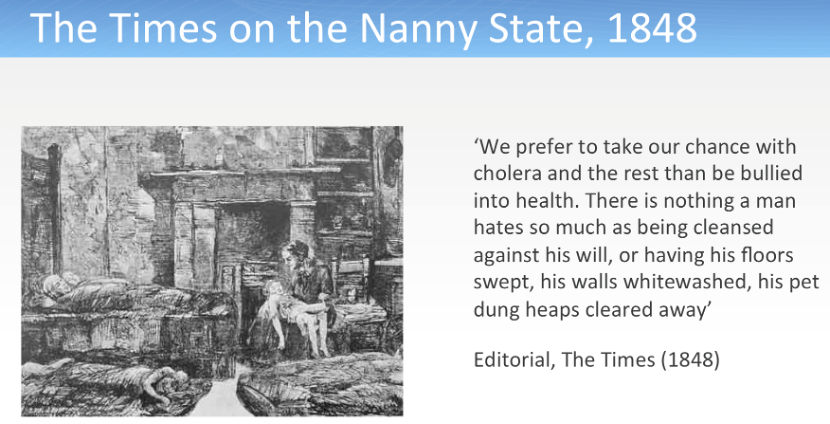
Attacks rained down on Edwin Chadwick, the architect of the first Public Health Act in England in 1848. He proposed the first regulatory measures to control overcrowding, drinking water quality, sewage disposal and building standards. After he was sacked for his trouble an editorial in The Times gloated: ‘We prefer to take our chance with cholera and the rest than be bullied into health. There is nothing a man hates so much as being cleansed against his will, or having his floors swept, his walls whitewashed, his pet dung heaps cleared away’. And yet on the 150th anniversary of the Public Health Act a British Medical Journal poll saw his invention of civic hygiene, and all of its regulations, voted as the most significant advance in public health of all time.
In February 1985, The Age reported that at least three Australian children had been disemboweled in the past two years after sitting on swimming pool skimmer box covers shaped like children’s seats. Before the advent of mandatory shatterproof safety glass for showers, over the years many suffered major lacerations and occasionally died after bathroom accidents. Before 2008, it was legal for fast buck retailers to sell children’s nightwear that could easily catch fire: many children were hideously burnt and scarred for life. Random breath testing was first introduced in 1976, to the chagrin of the Australian Hotels Association. In NSW it was followed by “an immediate 90% decline in road deaths, which soon stabilized at a rate approximately 22% lower than the average for the previous six years”.
These are just four of many examples of changes to laws, regulations, mandatory product standards and public awareness campaigns that were introduced following lobbying from health advocates. With these, as with nearly every campaign to clip the wings of those with the primitive ethics of a cash register, there was protracted resistance. I was a board member of Choice magazine for 20 years, and lost count of the number of times manufacturers staunchly resisted voluntarily making changes to their dangerous, ineffective or substandard products.

Tim Wilson MP
These bans and brakes on personal and commercial freedoms are routinely ridiculed as the interventionist screechings from that reviled harridan, the Nanny State. And the cathedral of the anti-nanny state in Australia has long been the Institute of Public Affairs (IPA). One of its early high priests in Australia was Tim Wilson, now Liberal Member for Goldstein, who pumped out an incontinent flow of the doctrine regularly in opinion pages and interviews.
In May 2013, Wilson, Australia’s champion of contemporary pet dung heap rights, railed that “Nanny state critics understand that incremental attacks on our freedom to choose are single steps down a longer road to remove individual choice and responsibility.” He wrote of the “rising groundswell of Australians who are sick of increasing local, state and federal government regulations of their choices”; denied that people like him want to “selfishly put their wants above the safety and happiness of others”; that we should all “learn to manage risk through our choices” and that it is not “the job of government to coddle us from the world’s evils, avoid risk and use taxes, laws and regulations to either steer or direct our behaviour.”
Those like Wilson opposed to state intervention in markets subscribe to often unarticulated social Darwinist values that imply that those with the misfortune to be killed, injured or made chronically ill by their participation in untrammeled marketplaces had it coming to them. The unregulated marketplace and community is a kind of noble jungle where the fittest survive thanks to their better education and judgment in their consumer choices, their better ability to pay for superior, less dodgy products and to keep up repairs on their cars and homes, and to get employment in work that is not dangerous or toxic. Children living in poorer housing near busy roads in the leaded petrol era, had only their parents to blame for their lead-lowered IQs: they didn’t have to live there! When a toddler drowned in a backyard pool before mandatory pool fencing laws, it was the fault of the feckless parents for not being more vigilant, and nothing to with failure of government to mandate the cost of a fence as part of the cost of a pool. When kids ingested lead or other heavy metals from dodgy toys when these were legal, their parents should have just done their homework and not bought them.
Those who can’t keep up find their way into national health statistics where across almost every area of public health, the poor and less educated have higher rates of disease, injury, major disease risk factors and death.
Below is a big list of nanny state coddlings and protections that a then profoundly ignorant Wilson would have said are “rarely supported by credible research”. I stopped at 150 and could have doubled, tripled or even quadrupled the list. We don’t hear much from the IPA and its ilk on any of these because they are all immensely popular, taken-for granted safeguards on our health, safety and quality of life. Other countries are climbing over themselves to emulate many of these as best practice. Australia is one of the healthiest nations on earth. The precious freedoms that they “erode” are almost always trivial and the industries that were regulated (with some exceptions like asbestos) reluctantly rolled over and still make money from safer products and procedures. No one cares less that their “choice” to buy leaded petrol has been removed. Only the most rapacious libertarians swoon at the unregulated, let-it-rip free market that would wind back the clock of civil society many decades if unleashed by their ideology.
So a public invitation to the IPA, Pauline Hanson and her ilk: which of these 150 heinous intrusions on people’s freedoms and the right to unbridled commerce have not “worked” and which does it wish to see abolished?
The regulations and laws below sometimes are explicit about prohibitions. But all set out what must happen for the standard to be operational. In doing so, each law, standard and regulation this sets up a prohibition on what would not be met if the standard was breached. So for example, compulsory third party motor vehicle injury insurance prohibits not having this insurance if you are a licensed driver.
150 ways …
- Access to pharmaceuticals: Drug regulation and scheduling
- Access to health care: Compulsory third party motor vehicle injury insurance
- Alcohol control: Minimum legal drinking age law
- Alcohol control: Responsible serving of alcohol law
- Building standards: Balustrade and railing height regulations
- Building standards: Builders’ licensing requirements
- Building standards: Electrician licensing requirements
- Building standards: Elevator standards and inspections
- Building standards: Building fire safety standards
- Building standards: Building for space standards (preventing over-crowding)
- Building standards: Mandatory smoke alarms
- Building standards: Mandatory swimming pool fences
- Building standards: Maximum water temperature regulation
- Building standards: Safety glass standards
- Building standards: Swimming pool skimmer box standards
- Building standards: Mandatory residual current devices (electricity)
- Building standards: Plumber licensing requirements
- Cancer control: Ban on commercial sunbeds
- Cancer control: Sunsmart regulations for schools and day care (no hat, no play, shade provision)
- Child protection: Background checks for staff working with children
- Child protection: Child pornography laws
- Child protection: Mandatory reporting of child protection incidents
- Congenital malformation prevention: Folate fortification
- Dental health: Fluoridation of water
- Disability: Disability parking permits and penalties
- Drug control: Pseudoephidruine pharmacy controls
- Drug regulation: Illicit drug laws
- Environmental health: Backyard burning controls
- Environmental health: Burial standards
- Environmental health: Air quality standards for industrial emissions
- Environmental health: Controls on industrial discharges into waterways
- Environmental health: Vehicle emission control standards
- Environmental health: Lead in paint banned
- Environmental health: Lead in petrol banned
- Environmental health: Legionella controls for cooling towers
- Environmental health: Petrol and diesel fuel standards (for emission controls)
- Environmental health: Planning regulations on open space
- Environmental health: Recycled water standards for reuse
- Environmental health: Septic tank standards
- Environmental health: Sewage discharge standards
- Environmental health: Stormwater discharge
- Farm safety: Tractor rollover harm reduction
- Fireworks: ban on private use
- Food safety: Abattoir standards
- Food safety: Food additive labelling
- Food safety: Food allergy labelling
- Food safety: Food handling standards
- Food safety: Food standards (many)
- Food safety: Genetically modified organisms regulation
- Food safety: Pasteurisation of milk
- Food safety: Café and restaurant food safety and hygiene standards
- Food safety: Regulation of food storage temperatures
- Health promotion: Mandatory physical education on schools
- Health promotion: Rights to breastfeed in public places
- Infection control: “blood rule”: in sport
- Infection control: Autoclaving of dental equipment
- Infection control: Bans on public spitting, urination , defecation
- Infection control: Chlorination of water supply
- Infection control: Dog faeces disposal
- Infection control: Drinking water quality standards
- Infection control: Immunisation standards
- Infection control: Infection control standards and protocols in health care
- Infection control: Regulation of sex on premises businesses
- Infection control: Mandatory immunization for healthcare workers
- Infection control: Mandatory sewerage and sanitation in urban areas
- Infection control: Notifiable disease laws
- Infection control: Sharps disposal and blood borne virus controls
- Infection control: Skin penetration legislation re hairdressers, dentists, tattooists, body piercing
- Infection control: Veterinary and animal husbandry standards
- Infection control: Water standards in swimming pools
- Information control: Advertising standards
- Mental health: Mental health scheduling
- Occupational safety: Workers’ compensation
- Occupational health: Asbestos building ban
- Occupational health: Dust standards
- Occupational health: Hard hats
- Occupational health: Harness standards
- Occupational health: Noise standards
- Occupational health: Personal protective equipment regulations
- Occupational health: Scaffolding standards
- Occupational health: Smoke free workplaces
- Occuptational health: Asbestos removal standards
- Product safety: Condom standards
- Product safety: Controls, bans on lead (other heavy metals) used in toys
- Product safety: Myriad of standards, bans, recalls etc.
- Professional standards: Childcare facilities
- Professional standards: Mandatory continuing medical education
- Professional standards: Licensing of healthcare facilities
- Professional standards: Medical, dental and allied health worker registration
- Professional standards: Nursing home regulation
- Public amenity: Outdoor noise regulations
- Public safety: Agricultural and Industrial chemicals regulation
- Public safety: Child resistant cigarette lighters
- Public safety: Child resistant medical packaging
- Public safety: Design rules for babies’ cots to reduce the risk of asphyxiation
- Public safety: Dog and cat licensing
- Public safety: Engineering standards for roads, bridges
- Public safety: Extraordinary powers under the Public Health Act to deal with emergencies
- Public safety: Gun laws
- Public safety: Hair dryer standards to prevention bath electrocution
- Public safety: Hazard reduction in playgrounds
- Public safety: Nightwear for children mandatory standards
- Public safety: Pesticides registration and control of use
- Public safety: Poisons act
- Public safety: Poisons labelling
- Public safety: Quarantine Act
- Public safety: Reduced ignition propensity cigarettes
- Public safety: Regulations around provision of footpaths
- Public safety: Safety standards fir fitness and leisure equipment
- Public safety: Sunglass standards
- Public safety: Total fire bans
- Public safety: Access to dynamite
- Public safety: Toy standards
- Radiation control: Carriage and transport of radiated material
- Radiation control: Dental x-ray equipment standards
- Radiation control: Commercial sun bed bans
- Radiation control: Uniformity in the control of radiation use
- Road safety: Air bags in cars
- Road safety: Bicycle helmet laws
- Road safety: Breath alcohol ignition interlock devices for repeat drink drive offenders
- Road safety: Double demerit points (driving)
- Road safety: Drink and drug driving laws
- Road safety: E-bike standards
- Road safety: Energy absorbing steering columns
- Road safety: Infant vehicle seat restraint laws
- Road safety: Mandatory motorcycle helmets
- Road safety: Motor cycle helmet standards
- Road safety: Motor vehicle design standards
- Road safety: Pedestrian crossings
- Road safety: Provisional and learner licensing
- Road safety: Random breath testing
- Road safety: Random drug testing
- Road safety: Seat belts in cars, school buses
- Road safety: Speed limits
- Road safety: Speed limits near schools
- Road safety: Fitness to drive medical assessments
- Road safety: Brake light standards on cars
- Road safety: Traffic regulation in general
- Road safety: Vehicle roadworthy inspections
- Road safety: Dedicated bicycle lanes
- Tobacco control: Health warnings on tobacco products
- Tobacco control: Outlawing “light and mild” descriptors on tobacco
- Tobacco control: Plain packaging of tobacco
- Tobacco control: Smokefree public transport
- Tobacco control: Sales to minors regulations
- Tobacco control: Tobacco tax
- Tobacco control: Retail display bans
- Tobacco control: Strict duty free limits
- Violence control: Criminalising domestic violence and coercive control
- Violence control: Pepper spray ban everywhere but West Australia
Finally here is a list of 74 specific and categories of goods which are prohibited from import into Australia. It includes laser pointers, flick knives, body armour, chemical weapons, dangerous breeds of dogs, radioactive substances and mace. There are doubtless advocates for free access to all of these.
# This blog is an edited and updated version of my 2013 piece for The Conversation 150 ways in which the nanny state is good for us (read 43,000 times)

