• Home
  • About/CV
  • Blog
  • Vaping Research Alerts
  • Blog archive list
  • My books
  • Memoirs
  • Music, bands, films
  • Contact

Simon Chapman AO

~ Public health, memoirs, music

Simon Chapman AO

Monthly Archives: May 2026

Why the “lower tobacco tax” emperor has no clothes

18 Monday May 2026

Posted by Simon Chapman AO in Blog

≈ Leave a comment

Tags

economy, finance, illegal-tobacco, politics, tobacco-tax

[updated 23 May 2026. See tailpiece]

Not for the first time, NSW Premier Chris Minns has again called for the Albanese government to make significant cuts to tobacco excise tax. He’s now been joined by Nick Coatsworth, someone whose previous contributions to tobacco control policy are elusive. Cutting tobacco tax has now become an established factoid: a prescription repeated so often by lazy journalists who’ve not done the calculations, opposition commentators and callers to radio stations that it is obviously the solution to Australia’s rampant illegal tobacco trade.

Anyone can see, right, that if the price of tax-paid cigarettes could be reduced to make them competitive with untaxed illegal cigarettes, smokers would walk away from the untaxed cheapies and drive them out of the market.

Chris Minns and other politicians in this chorus are used to overseeing multi-billion dollar state financing involving eye-watering elaborate forecasting and modelling. But when it comes to tobacco tax, basic primary school arithmetic appears beyond them.

When those calling for excise reduction move to the next obvious question of the size of their sensible tax cut, a common level proposed is the 2020 rate, a so-called “sweet spot” which preceded the explosion in illegal selling that commenced shortly after. So if we dropped it to there, that would fix the problem, right?

Let’s do the maths.

Australia’s tobacco tax since March 3 this year has been $1.52829 per stick, so  $30.57 in tax per pack of 20.  In March 2020, excise was $0.94964 or $18.99 per pack. If we take a common fully taxed budget brand now costing $42, this would mean the taxed price would drop by $11.58, the difference between $30.57 and $18.99. So our currently $42 retailed pack would cost $30.42 under this tax-slashed proposal.

Deakin University criminologist James Martin has gone a step further, telling the Singapore Straits Times that Australia should consider ditching tobacco tax altogether. This interesting proposal would place Australia with Kuwait and Brunei, where male smoking is 37% and 27%  respectively, levels we’ve not seen in Australia for over 40 years.

if the government was to heed Martin’s  tax nostrum tomorrow, a typical taxed budget brand costing $42 would then cost $11.43. So would that do the trick and drive illicits out of business?

In Australia, the price today of an illegal, untaxed pack can be as low as $7 if bought by the carton. So a tax drop to 2020 levels would mean a smoker would fork out $30.57, $23.57 or 3.4 times more than they could buy a cheap $7 illegal pack across the road at their nearest illegal tobacconist.

If the government changed Australia’s name to La La Land and axed all tobacco tax, an illegal untaxed $7 pack would still cost $4.43 less per pack than a legal untaxed pack at $11.43.

On either scenario, no budget conscious smoker would ever consider such reductions remotely attractive while illicit cigarettes were still readily available at far less cost.

And let’s remember that a $7 illegal pack includes margins for retailers, transportation from overseas, warehousing and distribution to the retailers, but clearly packs could sell for even less and still remain highly profitable to the criminal syndicates bringing them in. 

So how much lower could the illegal  price fall? Cambodia is a well-known transit hub for illegal tobacco smuggling. A pack of cigarettes, including local taxes, can be bought there for just 34c. Add margins for illegal retailers, transportation from overseas, warehousing and distribution to the retailers, and there will still be plenty of fat that will allow packs prices to fall far lower than $7.

Globally, there are many examples of nations with very low tobacco tax and very high levels of illicit trade. So if high tobacco tax explains high illicit trade, how is it that so many low taxing countries are awash with black market cigarettes too? Simplistic causal attributions about high tobacco tax clearly hold low generalisable explanatory power about what is a global problem which has often seen the major involvement of established tobacco transnationals.

For decades there have been huge global gaps between official tobacco export and import data. The gaps are explained by large volumes of exports arriving in transit countries where corruption facilitates re-export via illicit trade without any tax being levied.

Australia’s Border Force has intercepted nearly a kilotonne of illegal tobacco  and 4 million vapes since December 2025. Three state governments have closed 260 illegal tobacco shops for a total of 13,000 days in Queensland, NSW has closed 250 for 22,500 days since November 2025, including 10 in Sydney’s Haymarket just last week and South Australia got out of the blocks first with 100 closures between June and November 2025.

These penalties, which can also include massive fines and gaol times, are radically changing the risks and costs of engaging in illicit trade in Australia. No country has zero illicit tobacco trade, but those calling for reduced tax are in knowing or gormless lockstep with Big Tobacco which has routinely lobbied government to lower the tax for years to increase their own margins.

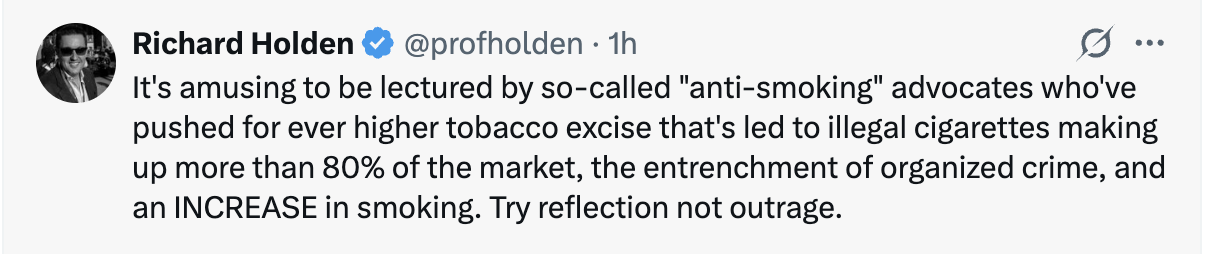
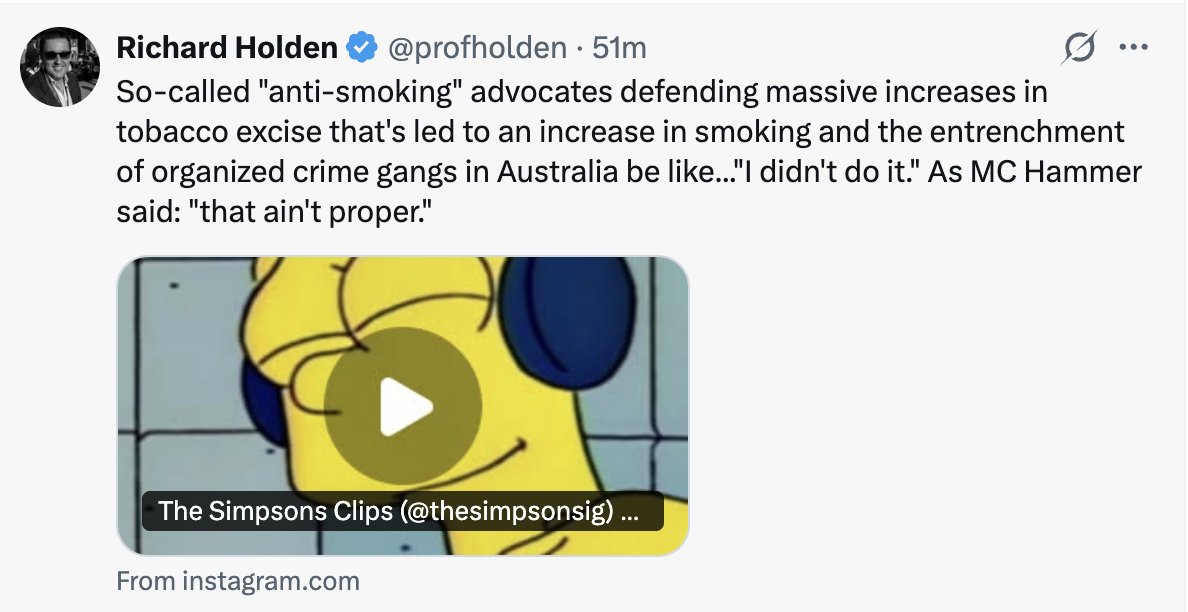
Tailpiece: John Menadue’s blog, Pearls and Irritations, republished this blog here on May 19. It caught the eye of the lugubrious vape promoter Dr Alex Wodak who reached into his deep lexicon of nastiness (see an earlier blog here), declaring on his BlueSky feed this garbled rubbish (“rather than argument and big smear” …what???) :
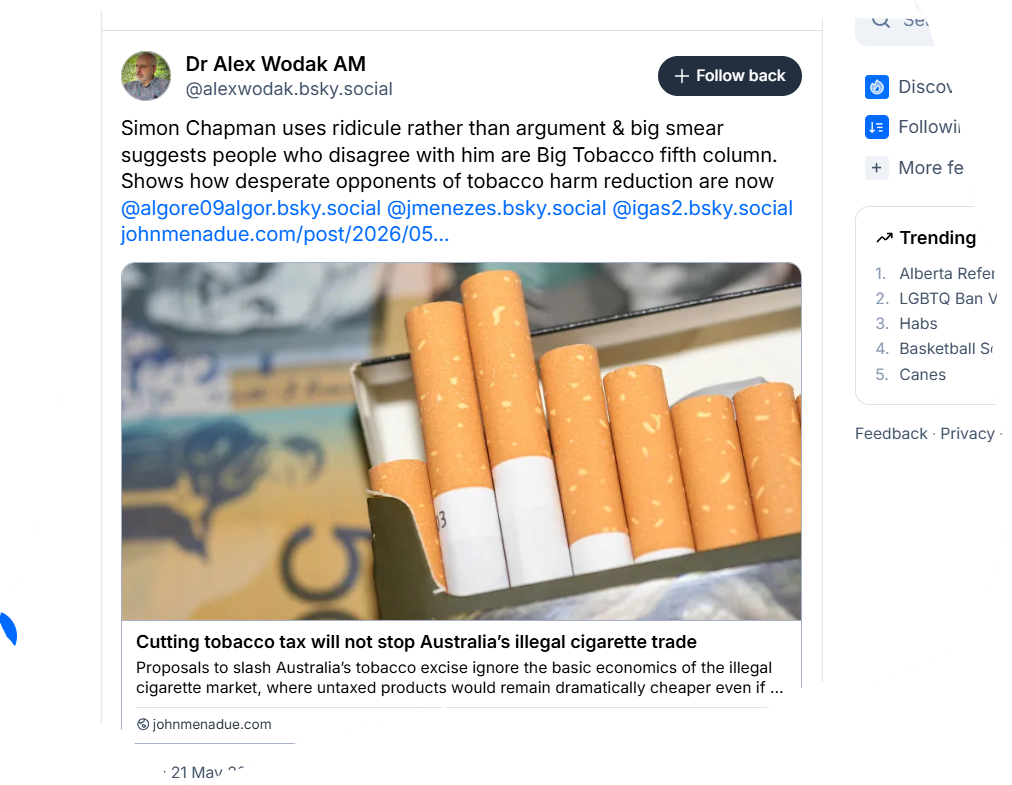
Fresh from a 2025 invited tour of British American Tobacco’s “innovation centre” in Southampton, Wodak recently made a doorstopper submission to the recent Australian Senate Enquiry into illicit tobacco.

Across 21 pages, he helpfully included no less than 17 screenshots from Philip Morris and Altria reports to make his argument that reduced harm products like vapes would lead nations away from smoking, a position identical to that of Big Tobacco companies. You could almost feel the love. Invited study tours of Philip Morris innovation centres can surely not be far off.

Odd then indeed that many nations awash with vaping thanks to liberal access policies have not seen them sweep past Australia’s smoking prevalence rate, as I argued with colleagues here.

Odd then too, that with all the years of all this innovation, British American Tobacco still rakes in 82% of its revenue from combustible tobacco. And no tobacco company – unlike car manfacturers transitioning from fossil fuel powered cars to electric vehicles – has yet to name a date whe they will stop making cigarettes.

Rare as rocking horse shit: orphaned tracks not on Spotify

14 Thursday May 2026

Posted by Simon Chapman AO in Blog

≈ Leave a comment

I resisted using Spotify for several years because a major area of my musical passions was in world music, and particularly African and thought there would be slim pickings. I had many hundreds of CDs and LPs and gradually  began digitising them to play on my iPod (remember those?).

After a while I started realising that a large proportion of my soon-to-be-digitised piles were on Spotify. So why was I bothering the slog of digitising? So I kept those that were hard to get or very special to me and sold off the rest. I then proceeded to look for my world and African albums. So many of them were there too.

 I built a list of albums and tracks that I couldn’t find on Spotify, and was able to play them from my account. But other people could not hear them. Each year, my list of “not on Spotify” reduced as entire albums or individual tracks were added.

The list below are those from my playlists which I’ve never found there. Youtube has many of them and I’ve uploaded a few sound files myself. So here we go.

*= highly rated tracks

# soon to be added after uploading

African

Spotify: My Best African: the Motherload List (915 tracks)

50 best Congolese rumba

50 best Senegal

50 best Mali

50 best Nigerian Afrobeat & Juju

50 best West African Highlife

50 best North African

50 best West African

50 best East African

50 best South Africa & Zimbabwe

Les Bantous de la Capitale (1963-9) Tokomisa Congo  Congo

*Basa Basa Soundz (1975): Disturbed Ghana

Moni Bile (1985) Tout Ca C’Est La Vie Cameroon

*Dollar Brand (1975) Soweto is where it’s at  South Africa

*Dollar Brand (1974) Mannenberg is where it’s happening South Africa

*Les Champions du Zaire (1990) Mayalalele  Congo

Les Champions du Zaire (1990) Bon retour Congo

AB Crentsil (1994) Menba bio  + live version Ghana

*AB Crentsil (1984) Odo Ghana

*Ntesa Dalienst (1985) Iza Issa Congo

*Ntesa Dalienst (1985) Rappeles-Toi Congo

*D’gary & Tihe (1996) Miady mafy Madagascar

*George Darko (1983) Odoyewu Ghana

*Dexter Johnson & Super Star et le Dakar (1994) Seul Senegal

*Mory Kante (1997) Djandjon 1 Guinea

Asi Kapela: (198a) Yo yo yo (Congo)

*Ems Pecola & Papa Noel Nedule (2007) Naloba? Nzambe temoin Angola/Congo

*Ems Pecola & Papa Noel Nedule (2007) Baweleli mbongo Angola/Congo

Ems Pecola & Papa Noel Nedule (2007): Objectif 2000 ans Angola/Congo

Ems Pecola & Papa Noel Nedule (2007): Sans a presence Angola/Congo

Ems Pecola & Papa Noel Nedule (2007): Porte a porte Angola/Congo

Ebeneezer Obey (1989) Ose olorum oba/sis ba millionaire lo Nigeria

*Franco et TPOK Jazz (1983) 5 ans ya Fabrice  Congo

Franco et TPOK Jazz (1980) Ambozi ya pambu Congo

*Franco et TPOK Jazz (1981) Mujinga Congo

*Harare Mambos (1980) Kudundere Zimbabwe

Harare Mambos (1980) Mbuya nehanda Zimbabwe

Job’s Combination (1984) Imali Zimbabwe

*Souzy Kasseya (1987) Monsieur Simon + full album The Phenomenal Congo

*Kakai Kilonzo & Les Kilimambogo Brothers (1970s) Mathitu mowe Kenya

Lagbaja (2005) Toun terin Nigeria

Julios Lakau & Orch Mode Success (1981) Tala mbuidi Congo

*Carlyto Lassa (1985) Je deviens malheureuse Congo

*Ismael Lo (1994) Setsinala Senegal

Ismael Lo (1994) Senegambie Senegal

*Baaba Maal (2008) Television Senegal

Green Mamba (1996) Busiku bwanduuma Zambia

*Thomas Mapfumo & Blacks Unlimited (1977) Ngoma yekwedu Zimbabwe

Thomas Mapfumo & Blacks Unlimited  Ndamutswa nengoma (2009)  Zimbabwe

Thomas Mapfumo & Blacks Unlimited (2005) Zvirwere disease Zimbabwe

Thomas Mapfumo & Blacks Unlimited (2005) Kukuvarira Mukati  + live Zimbabwe

*Thomas Mapfumo & Blacks Unlimited Zimbabwe (2005) Mukadzi Wangu Zimbabwe

Thomas Mapfumo & Blacks Unlimited Zimbabwe (2005) Marudzi Nemarudzi Zimbabwe

*Hugh Masekla (1973) Introducing Hedzoleh Sounds (full album) South Africa

*Bumba Massa (1982) Mbanda akoma television Congo

*Tshala Muana (1984) N’galula Congo

*Mikea Nagnaia Reliny (Madagascar)

*Sam Mangwana & African Allstars (1979) Mossesse yokole (fast version) slow version Congo

Patrick Mkwumba & 4 Brothers (1988) Emeriah Zimbabwe

Pierre Moutouari (1986) Telegramme Congo

*Orchestra Baobab (1978) Tante Marie Senegal

*Les Quatres Etoiles (1985) Kabyi Congo

Real Sounds (1987) Wende Zako Zimbawe/Congo

S.E. Rogie (1988) Palm wine music (full album) Sierra Leone

R.U.N.N. Family (1986) Hatichina wekutamba nay Samora Macel tribute Zimbabwe

#Bouba Sacko & Banning Eyre  Tiramakan Mali

Sankomota (1993) Afrika South Africa

Shamba Kahamba (1993) Messages Congo

*Tabu Ley Rochereau (1994) Bituide Congo

Tabu Let Rochereau (1982) Monsieur Molonga Congo

*Tabu Ley Rochereau (1983) Femme d’Auturi  Congo

Tabu Ley Rochereau (1985) Bosangano Congo

*Thione Seck (2000) Rassoul Senegal

*Rigo Starr (1998) Philie Congo

Tarika (1997) Tsy kivy Madagascar

Zaiko Langa Langa (1995) Songa-Fiele  Congo

*Condry Ziqubu Sekunjalo (1990) South Africa

Australian

The Allusions: Gypsy woman (1966)

The Allusions: The dancer (1966)

The Black Diamonds: See the way (1966) – from Lithgow, NSW

*Peter Blakely: Caterina (live version) (1987)

*Peter Blakely: Cattle train (live version) (1987)

*The Cicadas: That’s what I want (1964)

Bryan Davies: I just don’t like to be alone (1965)

The Executives: Sit down I think I love you (1967)

The Executives: My aim is to please you girl (1967)

The Executives: Wander boy (1968)

The Flying Circus: Run, run, run (1969)

The Flying Circus: Silvertown Girl (1971)

The Flying Circus Turn Away (1971)

Freshwater: Satan (1970)

*James Griffin & the Subterraneans (1985) Angel run

The Groove: Soothe me (1968)

Jimmy Hannan: Beach ball (1963)

Heart and Soul: Lazy life (1969)

Barry Humphries: Snow complications (1965)

*Barry Humphries: A nice night’s entertainment (1956)

*Barry Humphries: Sandy Claus (1971)

Barry Humphries: The old Pacific Sea (1965)

Barry Humphries: The migrant hostess (1958)

Bobbie & Laurie Sweet & tender romance (1966)

Russ Kruger: Tallahassee lassie (1966)

#Jeff Lang Bateman’s Bay (live version)

Lloyd’s World: Pinky lamour/Goodbye, goodbye (1968)

*Lloyd’s World: Brass bird (1968)

Mike McClennan: The one I love (1977)

*Moondog: Postcard from Hawaii (1995)

The Morloch Time machine (1966)

The Morloch Hit the road Jack (1966)

Ted Mulray: Julia (1970)

*The Necks: Sex (1988)

Red Onions Jazz Band: One hour compilation (1966) – features Gerry Humphries, singer from the Loved Ones

Doug Parkinson: Dear Prudence (1971)

Doug Parkinson: Something wonderful (1968)

Doug Parkinson I had a dream (1968)

*The Purple Hearts: You can’t sit down (1967)

The Radiators Gravitational pull (1983)

Lynne Randell (NZ) Ciao baby (1967)

*Nadia Reid (NZ): Rise & fall (live) (2011)

*The Renegades: Kahuna (1963)

*Resonets Shorebreak (1963)

Digger Revell & the Denvermen: My little rocker’s turned surfie (1964)

*John Rowles (NZ) If I only had time (1968)

*Kyle Slabb & Huey Benjamin: Jangarra (1999)

Mary-Jo Starr: Passionate kisses (1990)

Somebody’s Image: Hush (1967)

Ian Turpie: The decimal point (1964)

The Throb: Fortune teller (1968)

*Billy Thorpe: Blue day (1964)

*Vanda & Young: Lazy river (1971)

The Vibrants: Something about you baby (1967)

Tony Worsley & the Blue Jays: Talkin’ ‘bout you (1965)

Tony: Worsley & the Blue Jays: Velvet waters (1965)

Miscellaneous

Eleftheria  Arvanitaki Into my arms (Greece)

Babe Ruth (1975) Fascination (USA)

*Little Benny & the Masters (1984)  Who comes to boogie (USA)

Roy Buchanan (1976) OK (Canada)

*Ray Charles (1993) So help me god (USA)

Ray Charles (1993) Love has a mind of its own (USA)

*Charanga Cakewalk (2004) Carmela (USA)

The Chaps (1983) Rawhide Scotland

Shawn Colvin (1995) Viva las Vegas (USA)

Stewart Copeland (1985) Kemba (USA)

James Cotton (1967) Jelly Jelly + full album (USA)

*Creeper Lagoon (2001) Under the tracks (USA)

*Robert Crumb & his Cheap Suit Serenaders (1974) I’m gonna get it (USA)

*Dead Famous People True love leaves no traces (New Zealand)

*Iris Dement (1988) I miss a lot of trains (USA)

Diego el Cigala (2013) romance de la luna tucumana  (Spain)

*Dimitri from Paris (1996) A very stylish girl (France)

*Dimitri from Paris (1996) Free ton style (France)

*Jerry Douglas (1998) For those who’ve gone clear (USA)

*Jerry Douglas (1998) Follow on (USA)

Jerry Douglas (1998) Turkish taffee (USA)

Larkin Poe (2016) Trance (USA)

*Ronnie Earl & the Broadcasters (1995) (Live in Europe – Full album) Akos (USA)

*Ronnie Earl & the Broadcasters (1995)  (Live in Europe) Blues for Henry USA)

*Ronnie Earl & the Broadcasters (1995)  (Live in Europe) Szeren USA)

Ronnie Earl & the Broadcasters (1995)  (Live in Europe) Contrition (USA)

*Ronnie Earl & the Broadcasters Baby doll blues (USA)

#Ronnie Earl & the Broadcasters Still soul searching

#Ronnie Earl & the Broadcasters (1996)  Ice cream man  (USA)

Eufa (1993) Somewhere (UK)

Exile (1978) Kiss you all over (USA)

Roberto Fonseca (2007) dime que no (Cuba)

Roberto Fonseca (2007) Suspiro (live) (Cuba)

Roberto Fonseca (2007) Zamazu (Cuba)

Roberto Fonseca (2007) El niejo (Cuba)

Patty Griffin (2004) Useless desires + Live (USA)

Groove Armada (2000) Sir Raymond Mang No 1 (UK)

Butch Hancock  & Marce Lacouture (1985) Yella rose (USA)

Slim Harpo (1968) Rock me baby (USA)

John Hartford (1976) Golden Globe award (USA)

*Ofra Haza (1987) My aching heart (Israel)

*The Headboys (1979) The shape of things to come (USA)

The Honeys (2007) In the sun (USA)

Stan Getz (1979) Street tattoo (UK)

Diana King & Brian McKnight (1997)  When we were kings (USA)

*KD Lang (1990) Any way but here (Canada)

David Lindley (2001) How can a poor man face times and live (USA)

David Lindley (2001) The meatman (USA)

David Lindley (1982) Do you want my job (USA)

David Lindley (1995) Tijuana (USA)

Mighty Grynner (1984) Stingin’ bees + Live (Barbados)

#Daniel Lanois & Malcolm Byrne Waiting for my man (Canada)

Yasmin Levy (2007) Komo la rosa (Israel)

Yasmin Levy (2004) Y Tu Y Yo Subimos Al Cielo (Israel)

Yasmin Levy (2004)  Intentalo Encontrar (Israel)

Andre Manoukian (2008) Inkala (France)

Natalie Merchant (1995) Sympathy for the devil (Canada)

Mighty Avengers (1964) So much in love (UK)

Jim Moray (2006) Nightvisiting (Scotland)

Johnny Otis (1968) Goin’ back to LA (USA)

Johnny Otis (1968) Sittin’ here all alone (USA)

Ozark Mountain Daredevils (1974) It probably always will (USA)

*Ray Petersen (1964) Across the street is a million miles away (USA)

*Robert Plant & the Sensational Space Shifters (2015) Fixin’ to die (UK)

*Red One & Nabil Khyat (2012) Knockin’ on heaven’s door (USA)

Simon Ritchie (1976) (Sid Vicious) Anarchy in the UK (UK)

Bob Rivers (2003) Dirty deeds done with sheep (USA)

The Roaches (1992) Ing (USA)

The Roaches (1992) A dove USA

*Runaway Box Ooh girl (USA)

*Thane Russal & 3 (1966) Security (UK)

*Tony Sheveton (1964) A million drums

*Shriekback (1986) Gunning for the buddah + Live (UK)

Shriekback (1986) Underwater boys (UK)

*Nina Simone (1984) I’m not over you (USA)

*Nina Simone (1984) If you knew

*Soukoue Ko Ou (1983)  New York Ameliore (USA)

Spitting Image (1986) I’ve never met a nice South African (UK)

Maria Tanase (1955-58) Cine lubeste si lasa (Romania)

Town & Country Brothers (1963)  Sandy, Sandy (USA)

Los Van Van (1988) Y que to crees (Cuba)

Louden Wainwright (1997) Primrose Hill (USA)

#WiJaz Quartet (1993) Luo Soberana

Many remain terrified of COVID, but widespread immunity has greatly reduced its severity

11 Monday May 2026

Posted by Simon Chapman AO in Blog

≈ Leave a comment

Tags

covid, covid-19, health, pandemic, vaccine

Our three year old grandson’s day care recently sent an email to all parents saying there’d been a case of COVID in a child. A week earlier, our boy had a rough night with a temperature and a cough.  Panadol syrup calmed him within 30 minutes. By morning he’d rapidly recovered his normal high energy self.

So when the COVID note arrived, we all wondered whether he might have had undiagnosed COVID the week before when he had a 12 hour elevated  temperature. His mum and  four of his grandparents had seen a lot of him up close. So we all tested ourselves, with me being the only one testing negative over 3 rapid antigen tests. All but I experienced minor symptoms lasting a day or two.

Day care is a universally acknowledged cesspool of infection. Between our three children (now in their 40s) and their five offspring, we’ve seen croup, RSV, Coxscackie disease (hand, foot and mouth), stomach bugs, ear infections and innumerable episodes of snotty noses, coughing, sneezing bouts and fleeting temperatures. Occasionally these saw trips deep in the night to hospital outpatients (for bad croup) and visits to GPs where rest, comfort and panadol and were prescribed.

This commonplace history, experienced by nearly all parents, teaches us childhood infections are inevitable and that rushing off to a GP each time is both unrealistic and unnecessary. It has long been understood that  some early childhood infections can promote normal immunological maturation and preventing atopic disease (eczema, asthma, hay fever).

As adults, we use the same decision tree about our own colds with coughs, congestion, muscular aches, and common gut problems. Experience teaches that these are mostly self-limiting unless they persist or are particularly severe. While we often take a day or two off for a bad cold and cancel crowded and close-up interactions, we don’t push the panic buttons that still hover for many about COVID unless there are signs of deadly serious diseases like sepsis and most notifiable diseases (see NSW list here).

But for some, COVID still remains cloaked in a whole different meaning. If you tell someone you have COVID, the experience is often still redolent with the portent that has surrounded diseases at different historic times like bubonic plague, smallpox, tuberculosis, HIV and ebola. Globally, COVID has killed a conservative 7.1 million and infected 780 million since 2019, so this is pretty understandable.

I am in a retirees’ walking group on Fridays and have played tennis on Sunday morning in the fabled Perpetual Wimbledon Qualifiers competition for over 25 years. Both groups have participants in their 60s and 70s, with three in their early 80s. These age groups are at most risk of serious adverse outcomes from COVID infection. Two in my tennis group have chronic conditions and are understandably acutely concerned to minimise exposure to infection.

I heard about my wife’s positive test result about 3 hours into our Friday walk. No one asked me to leave, but I sensed or imagined some anxiety and so caught a train home at the first opportunity. I tested negative when I arrived home, as I did on the next two mornings. I told my tennis group about my and my wife’s status and one of the immuno-suppressed friends said he did not want to risk exposure, regardless of tennis being an open air, non-contact sport. I decided to step down from the game that Sunday to allow him to play. Three players gave me the thumbs up and thank you emojis.

All this stimulated some brushing up on current COVID data and on government recommendations on vaccination, testing and isolation. Here’s a summary of some of the key parameters:

  • The first orders for self-isolation for COVID commenced on March 26, 2020 with COVID notification becoming mandatory from January 2020.
  • From 14 Oct 2022 in NSW, it was no longer mandatory, only recommended,  to self-isolate if you had COVID nor to report a positive test. Most mandatory COVID regulations were repealed at midnight on 30 Nov, 2022 other than those applying in some health and aged care facilities. Many vaccination mandates for health care workers remain (list here)
  • In 2022, there were 3,345,187 cases of COVID notified to NSW Health. In 2023, the total number of notified cases fell to 307,076 (9.2% that in 2022). The first 111 days of 2026 have seen 12,226 cases. Extrapolated out to 365 days, this may see 40,263 cases notified for 2026, 1.2% of that notified in the peak year 2022. NSW Health has not published weekly COVID numbers since 20 October 2023. It states today that the best measures of COVID-19 in the community are admissions to hospital and in sewage monitoring. Much of the fall-off in COVID cases reflected the major drop-off in people testing with rapid antigen kits.
  • As at April, 2024 there had been 24,414 COVID deaths among 11,813,144 national COVID cases  with 2.7% in those aged under 60 and 55% in those over 85.
  • COVID vaccination and previous COVID diagnosis do not reduce the incidence of COVID, but critically, they greatly reduce its severity
  • Young children are at much lower risk from COVID than older adults. Child care services need not notify cases. Parents and staff  “don’t have to self-isolate if [they] have COVID-19, but NSW Health strongly recommend [they] stay home to protect others”.
  • Your child’s centre can’t tell you every time a child or staff member gets COVID. However, they will notify you of results which could be of concern to you and your family.

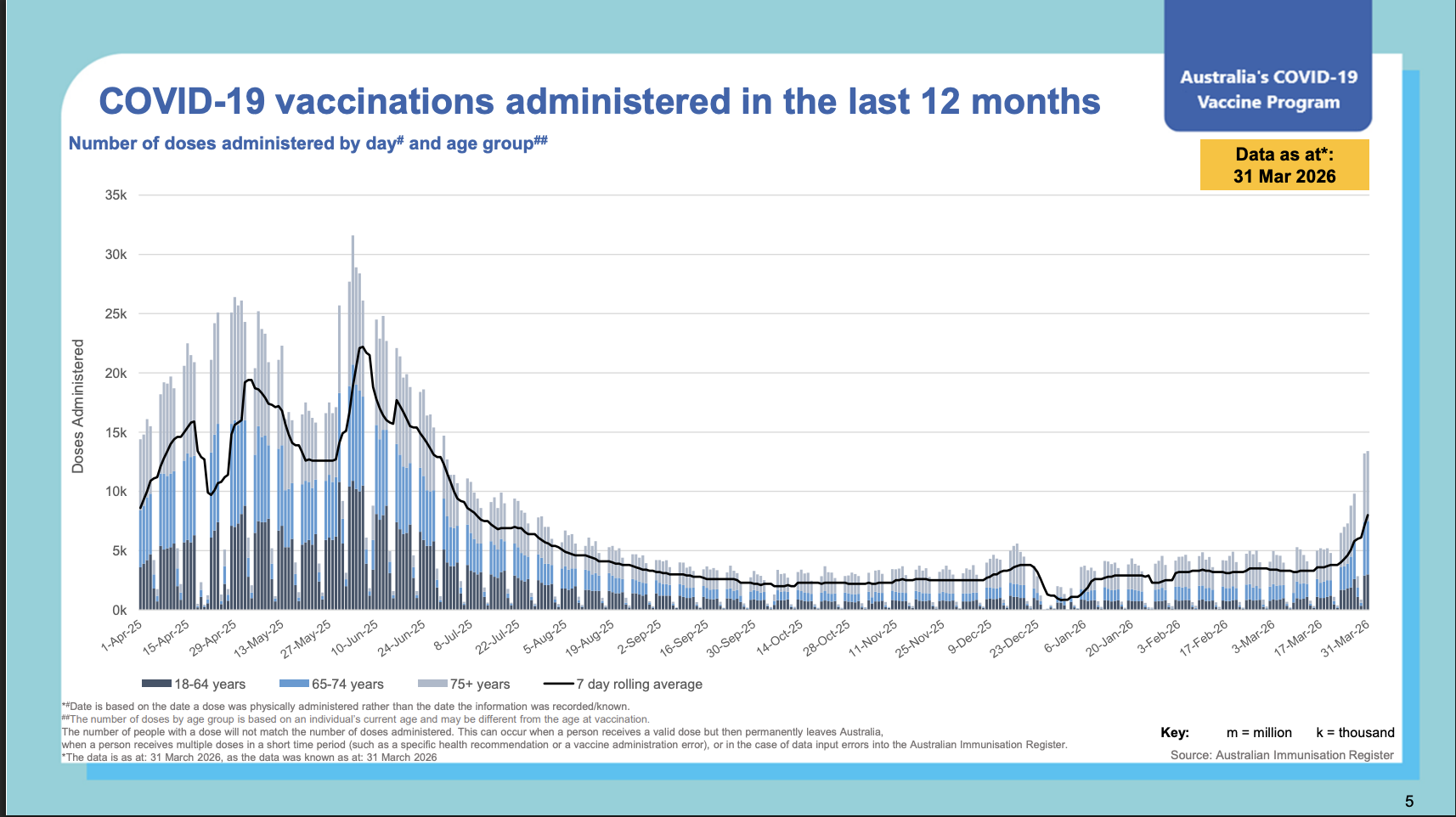
The dramatic fall in the incidence of COVID is explained by changes in immunity to the virus caused by the hybrid effect of huge numbers having been infected and by mass vaccination. Some 97% of adults have been vaccinated at least once in Australia. In the last 12 months,  1.382m doses of COVID vax were administered in Australia, with 60% of these in those over 65 years, and 30.6% in those over 75. Nearly all of these would be booster shots. The graph below shows the fall off across the  years of the pandemic.

Source

Discussing all this with a friend who is an international infectious diseases epidemiologist, he remarked “I wonder how many of those who want to keep far away from anyone with COVID  or even those living with someone with it, routinely isolate from others in their house and get themselves tested every time they have cold symptoms, because colds and COVID have a lot in common in their early stages. And do they expect or demand all those they live with to do the same? How does all that work out?”  

It’s plain there are some who seem to believe that COVID could be fully eradicated like smallpox, and until that time every precaution should continue to be observed as if serious illness and death were waiting around the next corner

My expert friend’s two clearly rhetorical questions obviate that most of us assume that signs of respiratory issues will be trivial, short-lived and passing.  Sneezing is universal with an estimated 95% of people sneezing up to four times a day. Adults typically have 2-3 colds a year, with children having more. If we isolated and informed those around us every time we had a sore throat, congestion with body pains or sneezed a few times, we might well rarely leave the house if our concerns were mirrored in others.

They also make it clear that as always, risk perception is only tenuously built on full comprehension and perspective on actual risk but far more on heuristic shorthand cognitive biases anchored to pre-existing beliefs and concerns. Our contagion-minimising behaviours are also inevitably confounded by uncertainty prior to any formal diagnosis.

If those who cohabit with someone who has COVID but who are asymptomatic and have tested negative should be nonetheless avoided, then how does this ethically parse differently to those who make their own assessment that precursor symptoms of possible COVID should not be tested, and they should go out in the world with a clear conscience?

COVID is far from gone, but for all but those with compromised health because of advanced age and co-morbidities like immunological vulnerability, it has mostly moved into the pantheon of sicknesses that will visit many of us from time to time, mostly with little consequence. Except for the very frail old, where COVID today still takes to the stage with ‘flu as a cause of death when death from some cause would have very probably happened within months anyway.

Since December 2023 NSW Health’s advice on minimising the likelihood of spreading COVID to people at higher risk from the disease includes:

  • Monitor for symptoms. If you have or develop cold or flu symptoms (runny nose, sore throat, cough, fever), stay home until your symptoms have gone. Wear a mask to protect others if you have symptoms and need to leave home
  • Maintain physical distancing where possible and get together outdoors or in well-ventilated indoor areas.
  • Regularly wash your hands
  • Consider doing a rapid antigen test (RAT) before visiting people at higher risk of severe illness. [my emphasis)

Note here, that the advice emphasises that self-isolation need only occur while symptoms are manifest. This is in spite of NSW Health information elsewhere (dated June 2024) saying that people can still be infectious after symptoms end for up to 10 days and that those with no symptoms can be infectious too.

When we test positive for COVID, we rarely know exactly who we acquired it from. When there are people close to us (family, colleagues friends), the principle of parsimony or Occam’s razor suggests that the simplest explanation is the one most likely. So, yes, our grandson did almost certainly spread it to four in his family. But when a family has an “index case” among them, and with many people positive people today not knowing they are positive and never experiencing any symptoms, it is not sensible to finger someone who has tested positive as the definitive  person who brought it into our homes or workplaces.

The most important take home in all this is that if you are in your final decade or two, you would be very sensible to do all you reasonably can to minimise the chances that you will be badly affected if you do get COVID.

As I prepared to end this post this, I read an excellent blog by an old South Australian colleague, epidemiologist Prof Adrian Esterman now 77, on the same topic. It has reliable, prudent information on what older people should do to reduce their chances of being seriously affected by COVID. Please read it.

My other blogs on COVID

⭐ over 500 reads ⭐⭐ over 1000 reads

⭐Should COVID vaccine refusniks now be restricted and fined. WordPress 19 Dec, 2021

⭐⭐The very best of cartoonists against COVID-19. WordPress 21 Aug, 2021

1 in 7 Australians still plan not to vaccinate: time to erode this with tough campaigning. WordPress 4 Aug, 2021

⭐⭐Should those avoiding AstraZeneca vaccination because of the clotting risk also avoid having an anaesthetic? WordPress Jun, 2021

⭐Eight common excuses for not being COVID-19 vaccinated and what you can say that might help. WordPress 27 May, 2021

⭐With the risks of AstraZeneca blood clots being tiny, what explains COVID19 vaccine hesitancy? WordPress 23 May, 2021

A reverse white feather? Let all who are COVID19 vaccinated wear a badge proclaiming and normalising it. WordPress 21 May, 2021

⭐⭐What should we make of 10 nations suspending the AstraZeneca COVID-19 vaccine rollout WordPress 15 Mar, 2021

Mandating masks rapidly and dramatically increases mask use: before law 7%, after 97%. WordPress 4 Feb 2021

COVID-19 mask laws drove use through the roof. So where are the data we should megaphone across the world? WordPress 2 Feb, 2021

⭐What’s to be done about Van Morrison and Eric Clapton’s anti-lockdown antics? WordPress 19 Jan, 2021.

Imagine a surgeon refusing to wear a mask. Gladys’ refusal to mandate public masks is this writ large WordPress 21 Dec, 2020

⭐⭐What Dr Fauci didn’t write about COVID19, but well could have. WordPress   14 Sep 2020

⭐The ethics of shaming prominent COVID-19 mask opponents. WordPress 26 Jul 2020.

When COVID-19 pandemic gets tough the conference scammers get going. WordPress  25 April, 2020

⭐⭐Indelibly sear this into the national public and political DNA: evidence-based prevention saves many lives so let’s honour our COVID-19 heroes. WordPress Apr 22, 2020

⭐⭐How can we erode self-exempting beliefs about COVID-19 contagion and isolation that might subvert flattening the curve. WordPress Apr 19, 2020.

⭐⭐Home isolation: except for food, medicine and exercise. So why are so many other stores open? WordPress Apr 7, 2020

⭐If self-isolating COVID-19 cases won’t isolate, should they be monitored with GPS wearables? WordPress Mar 10, 2020

Blog Stats

  • 173,738 hits

Top Posts & Pages

  • Why I’m not quitting Spotify because its owner has hugely invested in weaponry
  • Why the “lower tobacco tax” emperor has no clothes
  • So, it's apparently now "unethical" to be sceptical about e-cigarette hype.
  • Words I’ve seen, but didn’t know. Looked them up. Glad I did.
  • Vaping theology: 6 There’s nicotine in potatoes and tomatoes, so should we restrict or ban them too?
  • Thinking of keeping koi? Advice for beginners in NSW
  • Why Australia’s illegal tobacco and vape trade continues to flourish and what should be done about it
  • Banning smoking in wide-open public spaces goes way beyond the evidence and is unethical
  • Regrets … I’ve had a few. Paul Hogan and his Winfield role.
  • My books

Blog archive

Comment Policy: No anonymous or pseudonymous posts will be published

Recent Posts

  • Why the “lower tobacco tax” emperor has no clothes
  • Rare as rocking horse shit: orphaned tracks not on Spotify
  • Many remain terrified of COVID, but widespread immunity has greatly reduced its severity
  • Farcical half-pregnant Australian gambling advertising reforms destined for the scrapheap
  • Oil crisis sees emergence of new human sub-species: Insufferabilis EVmobilus

Recent Comments

howfarlongami's avatarhowfarlongami on Farcical half-pregnant Austral…
Simon Chapman AO's avatarSimon Chapman AO on Oil crisis sees emergence of n…
hdeastburn's avatarhdeastburn on Oil crisis sees emergence of n…
Terry Pechacek's avatarTerry Pechacek on Vaping theology 25: Vaping is…
Katina Kardamanidis's avatarKatina Kardamanidis on “Decent law abiding shoo…

Archives

  • May 2026
  • April 2026
  • March 2026
  • February 2026
  • January 2026
  • December 2025
  • August 2025
  • July 2025
  • June 2025
  • May 2025
  • March 2025
  • January 2025
  • November 2024
  • October 2024
  • September 2024
  • July 2024
  • May 2024
  • April 2024
  • March 2024
  • February 2024
  • January 2024
  • December 2023
  • November 2023
  • October 2023
  • September 2023
  • August 2023
  • July 2023
  • June 2023
  • May 2023
  • March 2023
  • February 2023
  • January 2023
  • December 2022
  • November 2022
  • October 2022
  • August 2022
  • June 2022
  • April 2022
  • March 2022
  • February 2022
  • January 2022
  • December 2021
  • October 2021
  • September 2021
  • August 2021
  • June 2021
  • May 2021
  • April 2021
  • March 2021
  • February 2021
  • January 2021
  • December 2020
  • November 2020
  • October 2020
  • September 2020
  • August 2020
  • July 2020
  • June 2020
  • May 2020
  • April 2020
  • March 2020
  • February 2020
  • January 2020
  • December 2019
  • November 2019
  • October 2019
  • September 2019
  • August 2019
  • July 2019
  • June 2019
  • May 2019
  • April 2019
  • March 2019
  • February 2019
  • January 2019
  • December 2018
  • November 2018
  • October 2018
  • September 2018
  • August 2018

Categories

  • Blog

Meta

  • Create account
  • Log in
  • Entries feed
  • Comments feed
  • WordPress.com

Blog at WordPress.com.

  • Subscribe Subscribed
    • Simon Chapman AO
    • Join 192 other subscribers
    • Already have a WordPress.com account? Log in now.
    • Simon Chapman AO
    • Subscribe Subscribed
    • Sign up
    • Log in
    • Report this content
    • View site in Reader
    • Manage subscriptions
    • Collapse this bar

Loading Comments...