
Tags
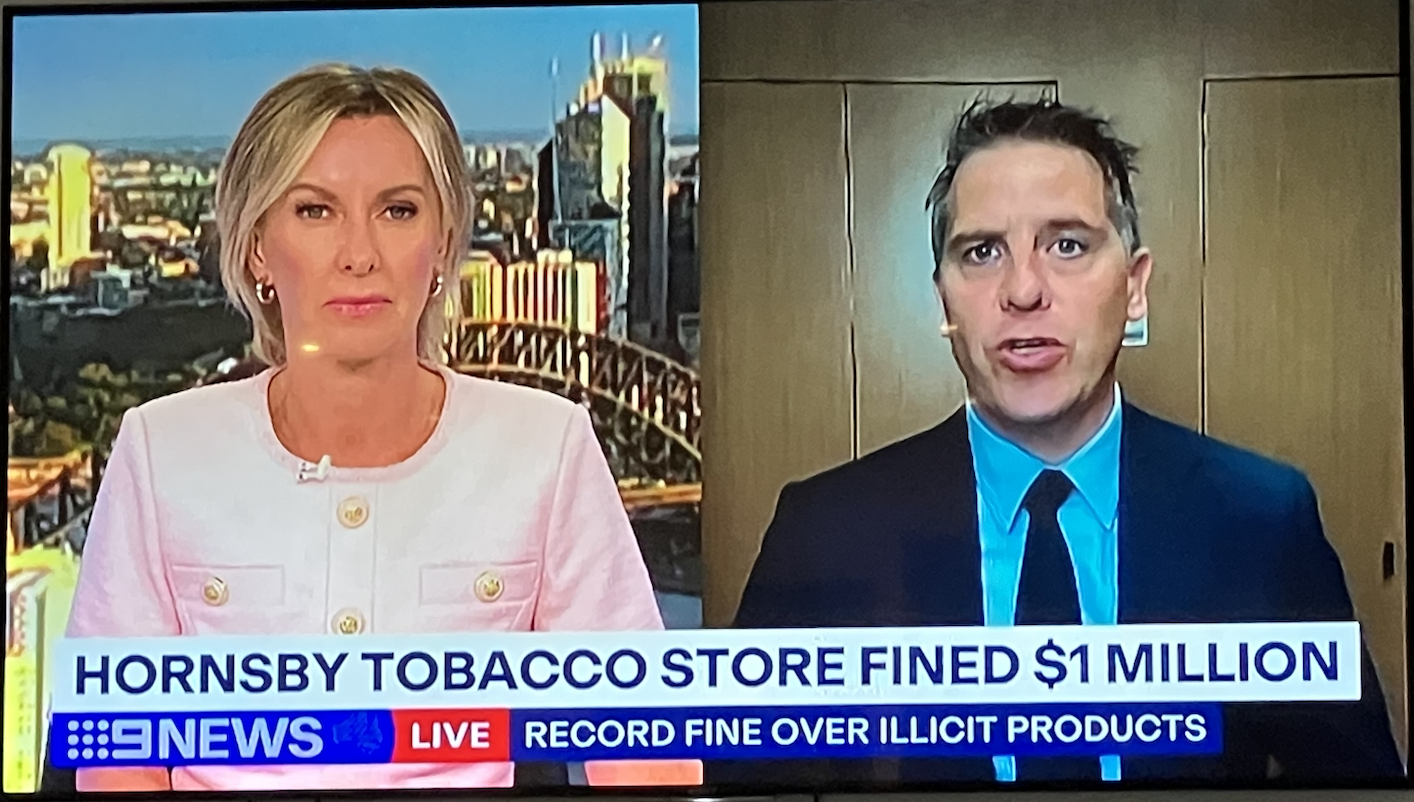
One Nation is throwing election promises around like a drunken sailor. It says it will reduce tobacco excise by 75% to make legal, taxed cigarettes competitive with cheap illegal tobacco. Not to be outdone, two federal Liberals today made another hairy chested bid for an 80% tax decrease, pulling another magic number out of a hat.
Here’s why all these “reduce the tax” proposals are commercially illiterate brain farts, devoid of the most elementary arithmetical argument and coated with staggering ignorance about the global trade in illegal tobacco.
Nothing new in large scale illicit tobacco trade
Many commentators on illicit tobacco trade appear to have come down in the last shower. The level of tunnel-visioned parochialism in this debate is quite remarkable. There are few, if any nations which have insignificant illegal tobacco black markets. I explored this is a previous blog I titled If expensive cigarettes are driving the black market why do so many countries with much cheaper cigarettes have thriving black markets too?
Illegal (untaxed) tobacco is a global phenomenon which has a long history. Over 30 years ago in 1994, tracking of European tobacco export and import data found a 30.8% difference between the number of cigarettes officially exported and imported. The only plausible explanation for these massive quantities of missing cigarettes was smuggling, particularly of expensive premium brands moving from northern Europe into lower income eastern and southern European markets.
With tobacco tax being the largest component of tobacco retail price and price being the most important factor that determines sales volumes and profits, the tobacco industry has always been desperate to lobby governments not to raise taxes. But at the very same time as trying to alarm governments with claims that tax increases increase illicit trade and reduce government revenue, tobacco companies have played an active role in several markets in actually supplying cigarettes to the illegal duty-not-paid trade
After concerns about health, high prices have always been named by people who have quit smoking as their primary motivation. So the prospect of significant price falls at the swipe of a government tax reduction pen has long been seen as a life raft by Big Tobacco as smoking rates have fallen to their lowest ever levels in many nations including Australia.
Crunching the numbers
Tobacco excise in Australia from September 1 this year will be $1.55274 per cigarette meaning the excise component on a pack of 20 will be $31.05. To this we have to add the cigarette manufacturers’ and retailers’ margins and then 10% GST to give us the final retail price. The photo below shows the prices smokers pay today in my local Woolworths.
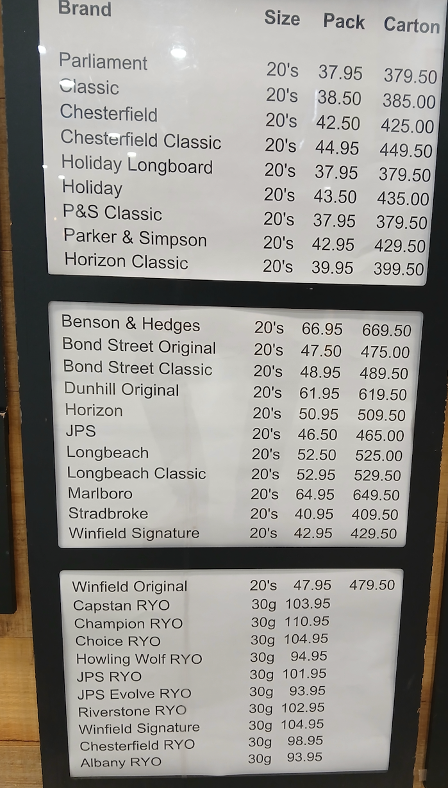
One Nation’s proposed excise reduction of 75% would see the tax on a pack of 20 fall from $31.05 to $7.76 at today’s rates. Using the Woolworths prices above and assuming both manufacturers and retailers kept both their margins constant (it would be highly unlikely that they would reduce their takes) and allowing for a lower GST amount payable, we would see the retail price fall to something like $13.00 for the cheapest brands selling now at $37.95, and to something like $40.00 for the most expensive, Marlboro, now selling at $64.95.
How much do illicits cost to buy now?
I have often heard reports that illegal packs, if bought by the carton, can cost as little as $7. $15 is a common price asked, but if you shop around you can buy for nearly $5 less, as the screenshot from a .au tobacco website offering free postage shows: a 10-pack carton price of $105 or $10.50 per pack.
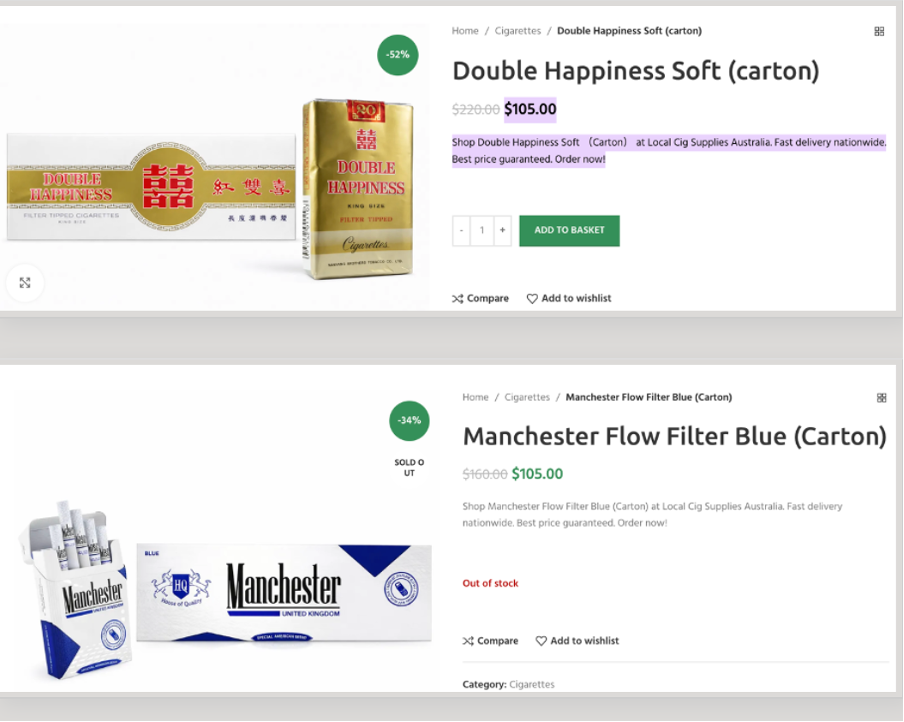
So with illegal cigarettes selling now for $10.50, this means that the cheapest tax-reduced brands in Hanson’s plan at $13.00 would be nearly 25% more than they could get them from an illegal supplier perhaps 100 metres away if they bought at carton price. And this is before the certainty of any potential further illicit price reductions, as I’ll discuss below.
Note too that in the under $40 a pack budget range of five brands now on sale at Woolworths, there, is a maximum price difference of $2, a 6.3% difference. This is nothing remotely like the 25% difference under Hanson’s proposal. These five budget brands are manufactured by different tobacco companies which all possess years of exquisitely sensitive national sales data about the price points that see them lose customers to cheaper brands. A 40% price difference would be seen as commercial madness.
Ex federal police officer Rohan Pike is a regular commentator on illicit tobacco in Australia. He recently spoke with the ABC’s David Speers, who had very clearly informed himself about claims likely to be made by Pike.
David Speers: So do you have a particular number on where you think tax should be, or how far it should be lowered? One Nation, as I mentioned, is saying a 75% cut. We’ll see what the coalition lands on. What do you think?
Rohan Pike: I haven’t got any specific modelling myself. I would suggest it will take a significant cut. And let’s just even the market up.
David Speers: So get the price down to where the black market price is.
Rohan Pike: It’s never going to be that low because the criminals can then still undercut and lower their price even further. But people, consumers will pay a premium for the better quality product. They’ll pay a premium for the brands that they like. They’ll pay a premium to stay within the law. So Australia’s generally law abiding. People know that they’re breaking it. But most people, I think, with some education and a choice of two to one perhaps as opposed to the four, 5, 6 to one that it is at the moment might go back to the legal market.
Significantly, Pike here acknowledges that criminals distributing smuggled stock will always be able to undercut the retail price arising from any reduction in tobacco price. So he knows that any rate drop he might name will always see the cost of reduced (or even legal totally untaxed cigarettes) still well below that of illegal untaxed cigarettes. But he still argues about a nebulous “significant cut” while admitting he’s got no modelling he could point to provide justification.
Cambodia—34c a pack cigarettes
The 2026 UN Office on Drugs and Crime report on Southeast Asia states that Cambodia is a long-time ‘transit’ nation involved in receiving shipments of tobacco not destined for consumption in such nations. The report explains “These products are often exported openly from their source countries but then smuggled into their destination countries, often via transit countries in the region, including the use of free zones”.
It continues “Cambodia has been found to be a key country of origin and transit for illicitly traded cigarettes which are then on smuggled to Vietnam by land or sea, with Vietnam acting as both a market for consumption and transit point for onward international distribution … Recent law enforcement operations by the Cambodian government have detected very large factories producing high-quality counterfeits for the regional market, and perhaps beyond. The international brands allegedly produced are found in many of the illicit markets in the region.”
So how much might a smuggler pay who wanted to sell cigarettes smuggled from Cambodia to retailers in Australia? Below is a screenshot of a page detailing tobacco prices in Cambodia from a 2025 WHO report.
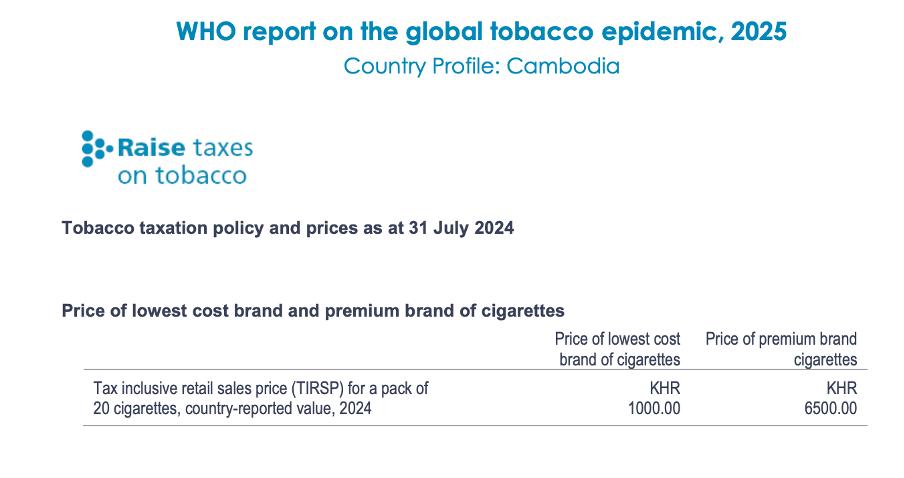
In 2024 the lowest price (1000 KHR or Cambodian riel) converts to just AUD 34c. This price includes local Cambodian tobacco tax, manufacturers’ costs and profit, and retailers’ margins. So if a cashed-up major smuggler were to buy these 34c cigarette packs in huge multiple container sized volumes from local manufacturers or importers, they would pay far less than even 34c. Let’s say perhaps half that might be around the mark – say 17c.
Add freight costs from Cambodia or some other transit nation plus warehousing and local distribution costs in Australia plus any look-the-other-way bribery costs involved, and we might see the landed cost rise to say 30c.
A 40-foot container with 70 cubic metres can ship 40 million cigarettes (2 million packs), which at $0.30 a pack would cost $600,000. The gross return if these sold in Australia for $10.50 (as now) would be $21 million, less the retailers’ margins, distribution and warehousing costs in Australia.
This would represent a gross profit of $20,400,000 – a 35-fold return on investment, on just one container. This galactic profit provides enormous wriggle room to criminal importers. If Australia was to go where no other nation has ever been and axe all tobacco tax, as one economist – again providing no modelling – suggested, the smugglers would eat this for breakfast.
Rohan Pike’s argument that if legal, tax-reduced cigarettes still cost more than illicits, many smokers would “pay a premium to stay within the law. So Australia’s generally law abiding. People know that they’re breaking it. But most people, I think, with some education and a choice of two to one perhaps as opposed to the four, 5, 6 to one that it is at the moment might go back to the legal market” bears little scrutiny.
Here we need only to look at the extent of the cash economy and undeclared sales common with barbers, hairdressers, nail bars, cafes and tradies. The Australian Taxation Office estimates the shadow or cash economy costs Australia approximately $16-$25 billion a year in unpaid tax revenue, with the broader economic impact estimated to be as large as 3% of GDP (exceeding $80 billion in 2025).
As The Castle’s Darryl Kerrigan might have said to Pike “tell him he’s dreaming”.
Pike also painted a picture of illegal tobacco retailing that can have its tentacles everywhere if blatant high street illegal retailing were to become too risky with increasing shop closures.
Pike: “the criminals will pivot, they’ll go online, they’ll do home deliveries, the consumers are not going away.”
But three recent studies of those buying illegal cigarettes show that on-line sales are very small. Here’s a screenshot of a talk given by James Martin in March 2026 describing the results of his interviews with some 4000 past-month nicotine consumers. Martin is a fervent “lower the tax” disciple too. He has not yet published his results, but as can be seen, online purchasing is very low.
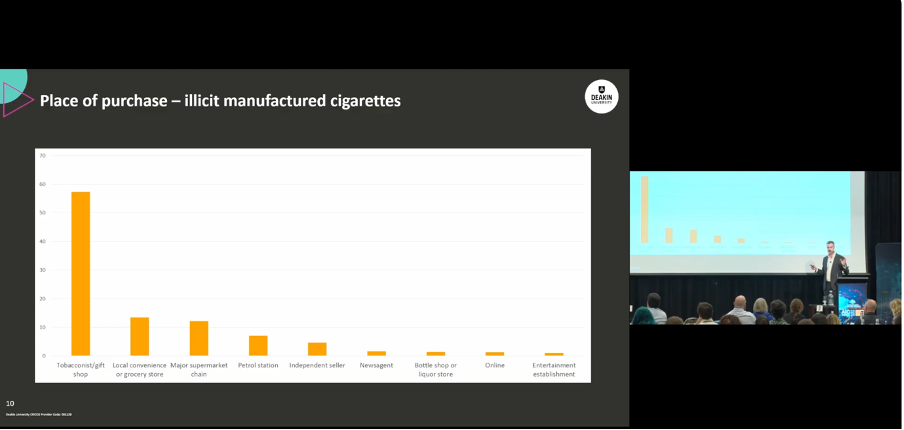
In the on-going Genvape study, only 9 of 232 interviewed who had bought illegal tobacco, bought it on-line. And in the latest AIHW national study, purchasing online was subsumed in a residual “other” category totalling only 2.9% of users.
So can we ask, where is Pike’s evidence about any major pivot by criminals to online or home delivery?
Enforcement
Between 1 July 2025 and 30 June 2026 at the Australian border, the Australian Border Force seized:
- Over 2.2 billion cigarette sticks
- Over 586.7 tonnes of loose-leaf tobacco
- Over 13.2 million illicit vaping products – representing a 112% increase on vape seizures compared to the previous financial year.
Much has been made of the impossibility of Border Force inspection of anything but a small fraction of the 8.5-9.1 million shipping containers that enter Australian ports each year. Those pushing “lower the tax” agenda often make light of the successes above and make similar remarks about the futility of trying to close illegal retailers.
Retailing is the Achilles heel of illegal tobacco trade. Unlike hidden shipping containers, retailers need to be in plain sight to attract customers. So they are also in plain sight of those responsible for their closures and prosecution.
All serious parties in this debate agree that enforcement is absolutely essential. Three state governments have closed 260 illegal tobacco shops for a total of 13,000 days in Queensland; NSW has closed 421 for 37,890 days since November 2025; and South Australia got out of the blocks first with 100 closures between June and November 2025.
A Sydney closed shop which brazenly reopened was fined $1.18m and permanently closed. There are some 60 more reoffenders in the legal pipeline.
These penalties, which can also include gaol times, are radically changing the risks and costs of engaging in illicit trade in Australia. No country has zero illicit tobacco trade, but Australia is now taking the problem seriously.
Political posturing with unmodelled, elementary nonsense about lowering tax debases any pretence at sophisticated evidence-driven analysis of this problem.

