I’m a daily user of Spotify. I have it on daily in the car, the house and at my desk. My tastes are very eclectic with extensive playlists across almost every genre of music with the exceptions of metal and all its variants, rap/hip hop, “musicals” and light orchestral. It has hugely expanded my discovery and appreciation of unimagined music.
The other day a close friend asked me whether I knew that Spotify’s owner Daniel Ek, had recently invested €600 million ($AUD1.074 billion) in military armaments in Hesling, a German based company which he chairs. I didn’t, but was concerned enough to find out more.
My friend sent a link to the best painless ways to move to other music streaming platforms and said he was planning to move in protest.
A Guardian report listed all of three bands, one Australian and two from the US, who were leading a so-called “exodus” from Spotiify. One stated “We just removed our music from the platform. Can we put pressure on these Dr. Evil tech bros to do better?” Another band was taking all its music off “garbage hole violent armageddon portal Spotify”.
Australian musician David Bridie also bought into all this with this Guardian article. He’s removed his work from Spotify, explaining “In recent years, we’ve witnessed the horror of AI drone wars in Ukraine and Gaza – children killed and hospitals destroyed with the press of the space bar. Ek is investing in technology that can cause suffering and death. Spotify used to seem like a necessary evil. By association, it now just seems evil.”
So what does Hesling’s website (Protecting our democracies) tell us? That it’s a military defence company providing “mass and autonomous capabilities to democracies so they can deter and protect”.
Among its products are:
An Electronic Warfare (EW) system using AI to classify radio signals
Underwater drone swarms for surveillance and signal detection
Software for command centers
Strike drones using AI for defeating jamming/spoofing
In February, the company announced it was producing 6,000 strike drones for use by Ukraine against Russian attacks, supplementing an early 4,000 already produced. Its website talks about ethical practices in supplying its products to nations.
Since Russia began pounding Ukraine, killing 46,000 civilians and 120,000 troops plus 180,000 injuries with 7 million having fled the country, the western world has held its breath hoping that NATO members and the US would adequately fund Ukrainian resistance. Nations bordering Russia are all vitally interested in anything that might give Russia pause to invade them.
So Spotify/Daniel Ek/Hesling are not so much as trying to cause suffering and death (except to Russian invading troops), but trying to prevent it as much as possible by shooting down incoming missiles, destroying Russian tanks and troop convoys.
Is all warfare weaponry inherently unethical?
Ethical investment funds typically refuse to invest in “fossil fuels, weapons, gambling, tobacco and other unethical industries”. Weapons are an interesting and challenging inclusion. Costa Rica, Iceland, Mauritius, Panama, and Vanuatu have no military forces. Other minnow nations, like Andorra, Kiribati, Liechtenstein, and the Marshall Islands, rely on other nations or agreements for their defence. But all large nations have military investments. So are they all unethical in investing in military defence?
Advanced technology useful in preventing enemy capability to wreak havoc on nations is morally neutral until we start dividing nations possessing this technology into bad and good actors. If Hesling is indeed only selling its drone and other AI driven defensive technology to nations fearful of Russian or other bad actor aggression, what’s not to like?
As one Reddit contributor put it succinctly “So I should boycott Spotify because their CEO is investing into one of the companies that is trying to beat the Russians in the drone race, support Ukraine, and protect Europe and western democracies and values against tyranny?
I’ll pass on that, thanks.
Boycott Spotify for ripping off musicians?
Then there’s the argument that Spotify is killing the music industry. I’ve friends who are musicians who are scathing about the derisory returns Spotify pays them per play. At the moment it is 0.00318 cents. They argue passionately that these music platforms are all parasitical, making huge profits from the creative talents of musicians while giving little back. Streaming has dramatically reduced musicians’ earnings from LP and CD sales, leaving live performance as the main income source. (I sometimes still buy CDs at gigs, but have long sold about 90% of the large number of CDs and LPs I owned, having rarely played them across many years).
But this simple comparison of differences between platforms is confounded by the different subscriber and audience sizes of these platforms. In April 2025 Spotify had 276 million paying subscribers in their total user base of 696 million monthly active users. Spotify’s royalties are based on total plays, not just those by paying subscribers. In June 2023 Apple Music had over 93 million subscribers, an increase from its 88 million subscribers in 2022. I’ve not found later data.
So a smaller per stream payment on a platform with more users could earn more than a larger payment on a rival platform with far fewer users.
For 10,000 plays, Spotify will pay an artist all of $31.80. David Bridie’s most listened-to track on Spotify is his quite wonderful I’ve got a plan (from his 1994 My Friend the Chocolate Cake collaboration). As of today it’s had 517,792 plays. That’s royalties of $1,647.With 6 in the band, that’s $275 each.
I’m not an Apple music subscriber so don’t know how many plays that track has had over there. But as has been emphatically argued many times before, streaming royalties make only a tiny minority of performers rich, regardless of the platform. And that has always been the case: many musicians don’t make a living, while relatively few make fortunes.
This page on Spotify reports on royalties paid since 2017. $10 billion was paid out in 2024 Under the payouts you can look at growth in nine levels of royalty earnings from $5000 and over (110,500) to $10 million and over (70 acts).
Fiona Patten (left) shares the stage with Moira Gilchrist, Philip Morris International, (right) in 2023, Warsaw
The former Victorian state politician Fiona Patten who failed to be re-elected in 2022 and again in the 2024 federal election for a Senate seat, is a dedicated advocate for vaping. She’s been a regular attender at the Global Forum on Nicotine (GFN), held annually mostly in Warsaw. In 2025 she was awarded the top gong at what is typically a modestly attended conference of the vaping faithful including those from Big Tobacco.
In the Sydney Morning Herald yesterday, she wrote an opinion piece calmly titled Australia has become the global village idiot on quitting smoking.
I spent 17 years editing the world’s first dedicated research journal on Tobacco Control. I handled 1000s of research manuscripts across that time. I also spent over 20 years teaching and marking Master of Public Health student course assignments at the University of Sydney for a unit I taught, Tobacco Control in the 21st Century.
So let’s imagine Fiona had submitted her piece for review and assessment. Here are my restrained comments on 13 issues. Read her piece in full here.
“When it comes to reducing harms from smoking, Australia finds itself cast as the global village idiot … we are now the cautionary tale.”
Comment: Smoking prevalence is the leading indicator of reducing the harms of smoking. This report shows the worst performing nations. Australia is not mentioned. In fact this map from the report shows Australia colour coded at the best level. So who’s really a village idiot?
2. “At present, 66 Australians die every day from the effects of smoking – not from an addiction to nicotine, but from the toxic delivery mechanism of cigarettes.”
Comment: If cigarettes did not contain nicotine, few if any people would smoke. Nicotine in itself is far from benign as these papers show, but it is the essential highly addictive cheese that baits the deadly mousetrap. Nicotine is the sina qua non of smoking. And we are steadily becoming aware of an increasing number of health problems from vaping (see reviews here).
3. “Legal cigarettes are taxed at rates so punitive that they have become virtually inaccessible to many, while vaping devices … are rendered unobtainable through deliberately restrictive access avenues.”
Comment: The corollary of the argument that cigarette tax is “punitive” is that making them less expensive would be somehow … compassionate? Tobacco companies engage in price discounting and have always fought tobacco tax rises because they are acutely aware that high price depresses demand. I’m aware of no government which has ever reduced tax on cigarettes to make them more affordable, a truly perverse step that would encourage uptake and depress quitting. It would be literally killing with kindness. And vapes being “unobtainable”? Any of Australia’s 5800+ pharmacies not already selling them can order them in.
4. In Australia only a “handful of well-intentioned but misguided health groups” support the government’s policies on vapes. “Nearly everyone else” opposes them.
Comment : Below are two columns. The one on the left shows the “handful” of “misguided health groups”. The other, “nearly everyone else”. Notice any pattern here, Ms Patten?
The graph below from the latest AIHW National Drug Household Survey shows support for action on vaping in the Australian community. There are few hot button issues in Australia that attract higher public support than vaping control (see here for comparisons and the lame efforts of vape lobbyists to demonstrate that night is actually day).
5. “Around the world, doctors, scientists and governments have embraced harm reduction and acknowledged that prohibition does not and cannot ever work”
Comment: Here is a VERY long list of doctors and scientists around the world who have major concerns about the safety and effectiveness of vapes. And here in great detail is information about the many nations which either ban vapes completely (33) or regulate them in ways that many vaping advocates oppose.
Predictably and very tediously, the boo-word “prohibition” makes an appearance. If vapes are “prohibited” but available in pharmacies, then by the same reasoning, Australia “prohibits” the 1000s of prescription drugs also only obtainable via pharmacies. Tell that to the millions of Australians who used some 335.8million scripts which were filled in a recent year in a population of 26 million people (and that’s not even counting the number who go to pharmacies for non-prescription items … including vapes with <20mg/mL nicotine which are OTC).
In any event, the idea that “prohibition” never works is contradicted by considerable evidence (see here). Most governments, including Australia, have prohibitions on goods and substances for a plethora of reasons including biosecurity, public safety (eg fireworks, laser pointers, flick knives, explosives, asbestos, DDT, leaded petrol and paint) and intellectual property. In 1996 Australia prohibited semi-automatic rifles and pump action shotguns and saw a sustained halt to mass shootings. The death of a friend’s son from adding caffeine powder to a drink, saw it banned. While “everyone knows” alcohol prohibition failed, Australian drug and alcohol expert, Wayne Hall, has documented in detail the considerable benefits that flowed from the US alcohol prohibition (1920-1933).
6. “And in countries where these products are promoted, smoking rates have plummeted.” Britain has seen smoking “drop steeply in the past five years, from 18 per cent to 11.6 per cent.”
Comment: In England, e-cigarette use rose sharply from 2021, but this increase was not accompanied by a faster decline in smoking rates between 2016 and 2023 among 18–24 and 25–44 year-olds. Even worse, among those aged 45 and over, the decline in smoking actually slowed._
Australia which has tighter regulation of vapes than Britain, the UK, Canada and New Zealand, has also seen smoking prevalence fall in recent years. Here are the most recent official statistics on smoking prevalence for several comparable countries.
Australia (2022-23 14+) 10.5% current and 8.3% daily — all combustible tobacco products
Canada (2022 15+) 10.9% current in last 30 days, 8.2% daily, cigarettes only
USA (2021 18+) 14.5% any combustible product, 11.5% cigarettes
Clearly, free-for-all vaping policy is not necessary in getting smoking down.
7. “in the short and medium term, vaping poses a small fraction of the risks of smoking”
Comment: In the “short and medium term” are very carefully chosen words here. Smoking, like asbestos, doesn’t typically kill or even manifest in symptoms in the short term — in days, weeks, month or years but in decades. As 15 presidents of the Society for Research into Nicotine and Tobacco wrote in 2021 “There are no data on long-term health effects, reflecting the relative novelty of vaping and the rapid evolution of vaping products. Determining even short-term health effects in adults is difficult because most adult vapers are former or current smokers.”
8. Because of the uptake of so-called harm reduced products “Japan, too, has reduced its smoking rate by more than 30 per cent in seven years”
Comment: For cultural reasons, there have long been huge differences in smoking between Japanese men, (currently 24.8%) and women (6.2%). Australia has not seen male smoking rates as high as 24.8% since 2001 – nearly a quarter of a century ago. Japan might well look to Australia to learn a thing or two about how to really get smoking down, not the other way round.
9. “New Zealand’s progressive policies on vaping and nicotine have it poised to join Sweden as a smoke-free nation.”
Comment: New Zealand has Patten-approved vaping policies (it also has the least affordable cigarettes in the world (see graph below) which almost certainly explains some of the country’s declining smoking rates). But New Zealand’s youth vaping rates are of great concern.
The only study to compare adolescent smoking trends before and after e-cigarettes became available in New Zealand found that progress in reducing adolescent smoking significantly slowed following the emergence and rise of vaping. The most recent data show that NZ had the first increase in a decade in daily smoking among adults (age 15+ in NZ health survey) from 6.8% in 2023 to 6.9% in 2024, despite daily vaping continuing to rise rapidly from 9.7% to 11.1% over the same period.
10. “The message is clear: when governments allow and encourage safer alternatives, lives are saved and deadly smoking rates decline. They are also not experiencing illicit tobacco wars.”
Comment:This is a sweeping generalisation. Where are the data on changing death rates (“lives are saved”) since vaping commenced? Why is it that smoking rates are also declining in Australia despite laws not being like Fiona wants them?
Sorry, it is patently untrue to say that there is no criminal involvement in illegal tobacco and vapes in nations like the UK and USA which have liberal vape access policies. See details here.
11. “Vaping, the most successful smoking cessation tool on record, is met with the harshest prohibitions.”
Comment: “Prohibitions” again ….zzzzz. Claims that vapes are the most successful way of quitting smoking disguise the fact that this “success” is pretty dismal. If any doctor tried to tell me any “successful” drug she was prescribing me had a 90% failure rate, I’d look for another doctor. But this is the language of success favoured by vaping advocates. Unequivocally, the most successful way of quitting, if your key criterion here is the sheer numbers of successes year in and year out, is unassisted quitting –cold turkey. But quitting has become dominated by commodified solutions pushed by vested interests. If you can’t sell it, don’t mention it.
12. “Australians are increasingly turning to black market tobacco and vapes; overall smoking rates are stagnating, even increasing in some disadvantaged communities and preventable deaths continue to mount.”
Comment: Smoking rates are not stagnating in Australia. The latest data point (2022-23) shows that compared with the previous survey data year (2019) the absolute falls in the prevalence of daily smoking (-2.7%), of current smoking (-3.5%) and the growth in quit proportions (+7.7%) were all at record levels. These are hard measures of smoking declining in the population and of quitting increasing.
12. “The mere possession of a vape in many states attracts thousands of dollars in fines, and even prison terms. In the ACT, the possession of a nicotine vape means you can be jailed for two years and fined $32,000.”
Comment: Correct, Both the ACT and Vic do not provide exemptions for possession of non-therapeutic vapes for personal use. Unless state legislation specifically says something else, these provisions just follow whatever arrangements were in place with regard to all S4 medicines in the jurisdiction.
In ACT, the penalty is 200 penalty units ($32k for an individual or $162k for a corporation), imprisonment for 2 years, or both.
In Victoria, the penalty is 10 penalty units ($2,035.10).
But significantly, what Patten doesn’t tell us here is that in order for these penalties to arise, the person would have to be charged by police and convicted by a court. Neither police in Victoria or the ACT are charging individuals for possession of non-therapeutic vapes. Searches of case law indicate that no jurisdictions appear to be charging for individual possession. So this is just bluster.
Several Australian states are experiencing a wholesale disregard for laws that outlaw the sale of tobacco products where excise duty has not been paid, and with vapes being sold in any circumstance other than through a registered pharmacy. It has been unambiguously illegal to sell duty-not-paid cigarettes since 1901 and to sell vapes outside a pharmacy since July 1, 2024. Major media attention is being focussed on
the extent of this brazen contempt
the involvement of criminals in its operation
the major fall in government revenue as droves of smokers unsurprisingly choose to pay $10-$15 a pack for smuggled cigarettes instead of north of $40 and past $60 for cigarettes which are currently taxed at $1.40 per stick
alleged objections from police about reluctance to get involved in “regulating a legal product”
High excise is not the cause nor lowering it the solution
The populist wisdom on why all this has happened is that Australia, with the world’s highest tobacco tax rate, has foolishly brought this on itself. This claim is manifestly ignorant because how do we then even begin to explain that nearly every nation – including all those with much lower tobacco tax than Australia (especially in low income nations) – have long had extensive black markets for tobacco too?Black markets are booming today in (to name just a few) Malaysia and South Africa (both with 65% of all tobacco sold being illicit) and Brazil (50%), all which have lower tobacco tax than Australia.
The Australian Association of Convenience Stores which has a history of Big Tobacco links is cheer leading the claim on repeat that the excise should be “lowered”. But tellingly, those joining this choir never name how much of a reduction would be required to make the price of legal duty paid cigarettes competitive with cheaper illicit packs.
Basic arithmetic shows this: the current tax of $1.40 per cigarette means $28 excise is already in the mix before the lucrative cuts for both cigarette manufacturers and retailers combine to lift the cost of a pack of 20 at the very low budget brands end of the market to $40. Premium taxed brands can cost well over $50.
So let’s imagine the Commonwealth government introduced the radical and globally unprecedented step of slashing excise by a huge 50%, a truly la-la land proposition. This would mean the tax component would fall to 70c a stick, or $14 a pack of 20s. No one, just no one is arguing that manufacturers and retailers would then follow suit and reduce their margins by a comparable percentage in a selfless noble gesture to assist smashing the black market.
This means that our hypothetical 50% reduction in tobacco tax would still mean a tax-paid budget brand would still cost $14 in tax alone, already nudging the high end ($15) of what black market packs cost today. So adding the retailer+manufacturer’s combined margin of $12 to the $14 taxed price component, our fantasy “reduced tax” pack would retail at $26. This would still be blown right out the water by comparable budget black market offerings of $10-$12 a pack.
So even halving tobacco tax would do nothing to make legal taxed cigarettes competitive with cheap smuggled smokes. Freezing tobacco tax or cutting it by less than 50% would be equally inconsequential.
Just as every nation has illegal trade in illicit drugs (even in nations where death penalties are given by courts), no regulatory plan will eliminate the tobacco black market. But there is a world of difference between neon-lit, 7 days a week, 18 hours a day high street illegal tobacco trading and what would remain if it was driven totally underground.
Failure to enforce the law — the elephant in the room
There are many challenges being faced in prosecuting illegal tobacco and vape sellers. Here are a few. Staff in the shops are often instructed by their bosses to simply run out of the premises if visited by inspectors. Those who talk typically insist they have never met the owners and don’t know their names. They are instructed to take their cash wages from the till on each payday, so presumably all staff are on untaxed cash arrangements. All purchases are cash only, leaving no credit card trails, both facts that would be of considerable interest to the Australian Taxation Office.
With seizures being sometimes very substantial and so costly to the illegal sellers, many now limit their in-store tobacco and vape stock to only that required for a typical day’s sales, with any needed extra stock being kept off-site in car boots parked near the shops. Commercial storage companies are also suspected of being used to store large quantities. Section 233 of the Customs Act 1901 Smuggling and unlawful importation and exportation states that it is illegal for anyone to “unlawfully convey or have in his or her possession any smuggled goods or prohibited imports or prohibited exports.”So these storage facilities would be legally vulnerable if police were to tail deliveries picked up from them.
It’s common to find shops which have had stock seized and staff put on notice today, open again tomorrow with new stock delivered overnight.
The strategy of holding small quantities in-store limits the cost of losses to the shops through seizures, but this is irrelevant to establishing a prosecution as even having a single vape or illegal pack of cigarettes can trigger a prosecution with no court likely to find it credible that a store operated with just a handful of stock.
In country towns in particular, some police claim they face real challenges in storing seized goods because of no storage facilities in typically small police stations. Seized goods must be kept as exhibits until prosecutions are finalised through the courts, which can take many months. But we don’t hear the same lame concerns made about storage problems with recovered stolen vehicles, large scale hauls of goods recovered from break and enters, nor about illicit drug busts including whole fields or greenhouses of marihuana.
Police ‘don’t want to be regulators”
This reported police complaint points to a wider issue of some often anonymous police commentators feeling that illicit tobacco selling does not deserve the attention of serious police work. I’m old enough to remember police indifference and even hostility to getting involved in random breath testing, preventive domestic violence intervention, white collar and cyber crime, all of which today are part of the daily meat and potatoes of police work.
I’ve heard threats of police being taken off the beat chasing hardened criminals and of resultant understaffing to attend to domestic violence should policing illegal tobacco step up. But police attend outdoor music festivals in droves with 75% of attendees surveyed saying they had experienced police in relation to their drug use at such festivals.
The Australian Federal Police actively police counterfeit imported luxury good knock-offs on sale in Australia as part of their work investigating breaches of intellectual property. With the significant excise tax losses to the Commonwealth from black market tobacco, it is difficult to understand why sleuthing fake Channel perfume or Louis Vuitton handbag vendors could be of higher priority than systematically busting a trade costing the government billions of dollars a year.
One argument with its hand up is that tobacco is a “legal product”, with some police believing they should have no part in ensuring that its sale is within the law. Alcohol, firearms, gambling and motor vehicles are also legal products, yet police have long histories both of issuing defect notices on cars and doing firearm license and home safe storage compliance checks: two examples of legal goods and services being used under illegal circumstances. Just as with the present situation on illegal “legal” tobacco.
And not to mention illegal trade in alcohol. Here are all the offences and penalties that go with illegal of serving liquor in NSW. Police are active in investigating and enforcing the ban on selling alcohol to minors.
Food
State governments are well used to regulating businesses, with there being no better example of the way food safety laws are enforced. Food standards are enforced by Australian state and territory food regulatory agencies, the Australian Government’s Department of Agriculture and Fisheries and Forestry. In NSW, the government’s NSW Food Authority is responsible for monitoring and regulating food safety across the entire food industry supply chain from paddock to plate. Importantly, it maintains a public online “name and shame” register where there are currently 901 businesses listed which since December 2022 have been fined for breaches.
Again, food is a “legal product” with preparing this legal food in unhygienic and unsafe ways being illegal.
But police are being cooperative
Despite these media claims, I’m advised by public health colleagues that in fact, NSW police have been very cooperative when asked to join in inspections of known illegal tobacco retailers. There has been good cooperation between Health, Border Force, and the Commonwealth’s Therapeutic Goods Administration (when illegal vapes are of interest). All this suggests other agenda like industrial jostling for greater funding may be at work when “not our bailiwick” comments are reported.
Solutions – breaking the weakest link
With the evasive template described above, cooperative agency tactics could include ensuring inspections see all entrances to shops guarded prior to raids. Surveillance of deliveries, with tracing of vehicles after drop-offs to locate storage premises and those working in them and pro-active warning to commercial self-storage businesses that failure to ensure illicit tobacco and vapes are not being stored will have major consequences.
But the very weakest link in all of this is that all cheap tobacco premises are not owned by those trading in them. The shops are always rented. While the patsy shop assistants may well be ignorant of the identities of those above them, those owning the premises are legally obliged to have the names, contact details and typically banking details of the parties who are paying them rent. The Office of Fair Trading makes it clear that it is illegal for a landlord to knowingly allow a commercial premises to be used for illegal activities. All standard commercial tenancies across Australia include terms that consider illicit activities by the tenant a major breach and cause to terminate the tenancy agreement. If evidence is provided to these landlords that their renters are conducting illegal trade on their premises, this is grounds for termination of a lease and prosecution of landlord should the illegal trade continiue.
Voiding insurance
Huge publicity including via ABC Four Corners and a series of large pieces in the Sydney Morning Herald has been given to arson attacks and standover tactics by criminals intent on forcing legal tobacco retailers to stock illegal tobacco and vapes that they supply. The insurance industry has reacted to this by raising premiums to stratospheric levels making it almost impossible for tobacconists to buy insurance. Landlords run massive risks by renting to uninsurable illegally trading tobacco businesses. Should an arson fire spread to adjoining premises causing extensive property damage or death and injury to people, landlords’ liability would be immense.
But this scenario has been on-going and clearly increasing for many months. Enough landlords are presumably prepared to take these very substantial risks. So what actions and reforms could state governments make to quickly bring the legal and pecuniary interests of landlords to bear on illegal tobacco and vape retailers?
If all states were to adopt a public “name and shame” strategy modelled on that used with food safety breaches in concert with substantial on-the-spot fines, landlords and insurers could routinely search the database for the names applicants for tenancy or insurance. Such fines should immediately result in inclusion on the register. Establishing such a register could be implemented at virtually no cost in a matter of weeks.
Queensland and South Australia
Queensland and South Australia both offer examples of very encouraging progress.
Queensland has recently amended its legislation to empower significant on-the-spot fines in addition to subsequent prosecutions through the courts. For individuals, maximum fines can be issued up to $32,260 for the commercial supply of illicit tobacco and nicotine products. Corporations face penalties of up to $161,300. South Australia too, has stepped up firmly to the enforcement plate with an illicit tobacco taskforce within its Consumer and Business Services in partnership with Health and SAPOL’s [South Australian Police] running Operation Eclipse. The operation has seized millions of dollars’ worth of illicit cigarettes, vapes and loose tobacco. More than 500 inspections have been conducted around the state with 20% of these taking place in regional South Australia. representing $4 million worth of the illicit products seized.
Between 1 July 2024 and 31 May 2025, 819 penalty infringement notices were issued in Queenland for supply and commercial possession of illicit products, with a value of more than $10.7 million.
Queensland Health can also issue an interim closure order for up to 72 hours and up to six months under a court order where there is evidence of either unlicensed or continued illicit tobacco or vape supply. More than 121 interim closure orders have been issued since September 2024 when the commencement of powers for closures began.
Legacy of the neglect
The loss of tobacco tax to the Treasury being caused by the current tobacco black market is a public finance issue, not primarily a health issue. When smokers buy cheaper cigarettes, the money they save does not somehow disappear from the economy. It is either saved or used to buy other goods and services, most of which are goods and services (GST) taxed and all of which have multiplier effects in the economy. Non-smokers are not unpatriotic tax-avoiders, for the very same reason.
But easy access to cheap tobacco is most definitely is a public health issue because of the huge body of evidence linking tobacco tax prices rises to reduced smoking through quitting and reducing the number of cigarettes smoked as well as powerfully dissuading uptake in non-smokers. Smoking rates in both adults and teenagers are now the lowest ever recorded in Australia. It would be a tragedy if that record was trashed by a continuing failure to enforce the law.
Criminals who have now for many months sold illegal tobacco with impunity might well think that they would experience a similar dream run if they opened up a river of shops where unlicensed, they brazenly sold cheap duty-not-paid alcohol to anyone who anyone who wanted it, or counterfeit prescription only drugs to walk-ins.
Reading and writing are two lifelong passions. I’ve long been in the habit of looking up the meaning of interesting looking words that I’ve never encountered or have seen but don’t feel confident in using. I had a dull English teacher at school who was scornful of anyone using words that needed to be looked up. Good writing to him meant never stepping out of the comfort zone of some vocabulary you decided was good enough at some time your life.
Some months ago the trolling author of a parody account on Twitter (see screenshot above) spent time going through my Twitter feed and finding the selection of “big words” which obviously marked me as a deplorable wanker who chose words to “cower readers in the shadow of my towering intellect”.
Apart from ‘agnotology’ which I only discovered this year (the study of deliberate, culturally induced ignorance or doubt, typically to sell a product, influence opinion, or win favour, particularly through the publication of inaccurate or misleading scientific data (disinformation), all the others are in widespread use. So no guessing about the literacy of the troll. Vignette, imbibing, relegated, denigration? Orwellian? Really? Needs to get out a bit more.
As above, I posted the troll’s tweet on my Facebook page and in the last six months got into the habit of adding to it any seen-but-don’t-know words I encountered when reading. The Facebook post has been popular with people chiming in with “neither did I know!”, thanks and suggestions I might add. That seldom worked, as clearly we all know many words that others might not. So this is a personal list. Feel free to add yours in the comments. I’ll update the alphabetical list regularly, adding new words including any from readers that I didn’t know either.
Here we go … alacrity: brisk and cheerful readiness
doughty: determined, brave and unwilling to ever stop trying to achieve something. We can all think of people like that, and with those it fits for me, it’s always something very admirable that they are prosecuting. I can think of despicable people like that too, who are trying to achieve stupid or horrible things. But somehow, I think it’s meant to be more of a compliment. Dogged and doggedly, similarly.
effulgence– a radiance or a brilliant light shining forth (seen in an obit by Zane Banks) – NOT to be confused with effluence. Now how many people do you know where that word fits perfectly? I live with one! Here she is ..
Eyorish: pessimistic & gloomy, after Eyore the donkey in A.A. Milne’s Winnie the Pooh. I have also heard someone use it about a mutual acquaintance who had a long nose & big ears who was a bit taciturn.
fealty : a feudal tenant’s or vassal’s sworn loyalty to a lord. “they owed fealty to the Earl rather than the Kin. As in a piece I just read about Australia’s attorney general flying to meet with the indicted war criminal Netanyahu
hock (when referring to wine): a British term for German white wine. It sometimes refers to white wine from the Rhine region (specifically Riesling) and sometimes to all German white wine. The word hock is short for the obsolete word hockamore, an alteration of “Hochheimer”, derived from the name of the town of Hochheim am Main in Germany.
inchoate: just begun and so not fully formed or developed, rudimentary
insuperable: (of a difficulty or obstacle) impossible to overcome. “insuperable financial problems”
irascible: easy to anger. Now, I knew that word but don’t believe I have ever used it Great word
kakistocracy: a state run by its least competent and least qualified citizens. Ring any bells?
manichean: to be manichean is to follow the philosophy of Manichaeism, which is an old religion that breaks everything down into good or evil. It also means “duality,” so if your thinking is manichean, you see things in black and white. I’ve know this one for a while, but underuse it — so many occasions where it’s perfect.
martinet: a person who demands strict obedience and discipline. But in looking for its synonyms I found a slew of older abusive names for women who are pushy, angry and uppity: termagent, harridan, virago, strumpet, shrew, scold, crone and harpy. I’ve heard all of those, but their usage brands their users as neanderthals so we seldom hear them. But wouldn’t it be great if lots of women proudly embraced these words, used almost exclusively by men to denigrate them, in the way the LBGTQI community often proudly embrace queer, poof, lezzo etc today?
panglossian: naively or unreasonably optimistic. Though he took a Panglossian view of the world in his youth, he became jaded as he grew older. (derogatory) Of or relating to the view that this is the best of all possible worlds.
picayune: A Canadian friend just used this is a message to me. I’ve seen it often enough in writing but never heard it in speech. It seems it’s a north American thing. It means petty, of little significance. Here’s how you say it
pinguid: of the nature of or resembling fat; oily or greasy.
prosaic: I always assumed it meant something that was nicely, or neatly, parsimoniously expressed. But looking it up, not at all! It means commonplace or dull; matter-of-fact or unimaginative: a prosaic mind. Synonyms: uninteresting, tiresome, tedious, humdrum, vapid, everyday, ordinary or having the character or form of prose, the ordinary form of spoken or written language, rather than of poetry.
pulsillanimous: showing a lack of courage or determination; timid
quotidian: of or occurring every day; daily. as in “the car sped noisily off through the quotidian traffic”
rebarbative: unattractive and objectionable, as in an ugly public building Never seen it before.
recumbent: lying down (aware of this one, but don’t recall ever using it.
risible: provoking laughter by being ridiculous. eg: Simon’s been making risible attempts to learn the saxophone. Another one that of course I’ve heard lots, but never used
simony: buying or selling church offices, sacred items or favours for money (heard in the movie Conclave.
stochastic: having a random probability distribution or pattern that may be analysed statistically but may not be predicted precisely. Seen this word many times, but never used it or looked it up
sybarite: a person who is self-indulgent in their fondness for sensuous luxury
uxorious: Just came across this is a Le Carre novel I’m reading: “having or showing an excessive or submissive fondness for one’s wife.” Have seen it many times, but never bothered to look it up. Great word. And I’ll proudly put my hand up for that descriptor. I’ve got a good one (only submissive when that is required though)
vertiginous: very high or steep. Can be used literally or metaphorically
vulpine: pertaining to foxes or fox-like characteristics
Labor’s stunning election victory and the relegation of the conservative opposition to likely years of political eunuch status opens up many opportunities across all areas of government. With health minister Mark Butler playing a powerful wingman role to the Prime Minister, he is in the driver’s seat to finish the historic job he started back in 2022 with regulating vaping. In the three years, Australian streets have been deluged by blatant law-breaking cheap tobacco and convenience shops selling smuggled cigarettes and vapes, since 2024 permitted to be sold only in pharmacies.
Butler’s deeply impressive leadership on vaping and tobacco reforms saw him carry forward a Labor heritage which started in 1973 when Gough Whitlam took the first step to ban tobacco advertising. Butler was Minister for Ageing and Australia’s first Minister for Mental Health in the Gillard Government when Nicola Roxon was the senior health minister and introduced the world’s first plain tobacco packaging bill, now adopted by 25 nations and under active consideration in another 14.
Like plain packs, the regulation of access to vapes to pharmacy sales is another world first. But Butler must be understandably frustrated by what has become an epidemic of political duck-shoving where some states have talked the supportive talk, but not walked the implementation and enforcement walk.
As a result, illicit vapes remain readily available mostly via the plague of “cheap cigarette” shops which lead their trade with lucrative totally illegal duty-not-paid smuggled cigarettes which also break Australia’s plain packaging laws.
So how has this got to the in-your-face blatant law-breaking it has, and what should happen to fix it?
Enforcement of the law
All states and the Commonwealth government now have in place laws that make selling vapes anywhere but in a pharmacy unambiguously illegal. Importing, wholesaling and retailing tobacco products which have evaded excise tax are all illegal under Commonwealth law, attracting eye-watering major maximum fines for large scale offenders and routine confiscation and destruction of stock.
But illegal sales of both vapes and tobacco are rampant with the Sydney Morning Herald noting that there are currently 60 “cheap smokes” shops in Sydney for every one McDonalds outlet. 824 have opened in recent years in the Inner West council region alone. This situation is most pronounced in NSW and Victoria, the two states yet to implement mandatory tobacco retail licensing, despite calls for years from public health experts for this to happen. Licensing provides a database enabling authorities to routinely check whether licensees are compliant with the law and the threat of removal of a license and close-down orders for those not.
However clearly, many now selling illegally will reason from several years of experience that no authorities have ever raided their shops, so why would things be any different if they bothered to not get a tobacco retailing license?
And that has been the elephant in the room sized problem that few will talk about. Most state health authorities seem purposefully blind to what everyone else can see: that there is a burgeoning forest of “cheap smokes” and convenience stores selling illegally which open every day with zero consequence.
How have they justified this wholesale neglect?
I recently had dinner with the head of a NSW state public health unit. I asked him what his unit was doing about enforcement of the laws on selling illegal tobacco and vapes. He confirmed very little was being done with the major reason being concern about staff safety. His staff were well aware and concerned that violent criminals are involved in the tobacco and vape trade, and of the screaming headlines of multiple arson attacks on tobacco outlets by rival tobacco supply gangs, particularly in Victoria. All illegal tobacco outlets have CCTV cameras and staff were anxious they would be identified and threatened. Several public heath chiefs understandably took these concerns seriously and believed that police needed to be involved far more in enforcement of the laws.
Imagine if criminal syndicates decided that there were vast amounts of money to be made by selling prescribed drugs in high street shops and online to anyone who wanted them without a prescription. Or that the law on selling alcohol only through premises with liquor licences could just as easily be ignored with every town and suburb opening up multiple shops selling duty-not-paid booze. Public and licensed liquor outrage would be immense and police action swift.
Pharmacies are rarely prosecuted for supplying drugs to those without prescriptions, and pubs, clubs and bars known to routinely sell liquor to kids are jumped on fast, with their goldmine liquor licences under threat.
One mystery here is why the supermarket sector, which has always had an exemplary record of rarely selling tobacco to kids, has not used its massive power and united to demand strong action against illegal tobacco retailing. If this trade diminished in a major way, supermarkets would be major beneficiaries of returning smoking customers.
NSW
The Herald reported that some 2000 inspections of these dodgy retailers in metropolitan illegal trade had been undertaken by NSW health inspectors who had seized illegal stock worth $24m. These are far from trivial numbers, but there’s an obvious mystery here. Conspicuously absent in the Herald’s report was any mention of completed or in-process prosecutions of those from whom these products were seized.
Let’s assume that nearly all those inspected were selling. The customers who come and go into these premises each day know that. So why wasn’t stock seized from all of them, and why is there no apparent data on how many are facing prosecutions when since November 2024, NSW has had maximum penalties of $154,000 and up to $22,000 for selling to children, with higher for corporations?
Last Friday, one Sydney tobacco retailer with a business turnover of $3.3m was hit with a $5,560 fine plus $6,850 in costs. The cynical Herald commented “That’ll show him, or it would if the financial gains made from running tobacconists weren’t so generous … [the] fine and the prosecution’s costs put a 0.37 per cent dent in last year’s bottom line.”
NSW Health staff are known to be immensely frustrated by the Department’s legal branch refusing to proceed with cases. This must be a major focus of the current NSW parliamentary enquiry into illegal tobacco trade.
Police in some states seem reluctant to see illegal tobacco retailing as serious crime unless violence or arson is involved. The Sydney Morning Herald reported a senior officer as saying “Our involvement is primarily about the acts of violence that was used by these people to take the tobacco. I think our system and our response is adequate, and we’ll keep maintaining that.”
South Australia, and to a lesser extent Queensland seem to have sorted out any problems that NSW seems to have with lack of police interest In enforcing the law. There, the police apparently don’t pick and choose which law breaking they will investigate.
South Australia
Under A media release dated 6 May 2025 from South Australia’s Consumer and Business Services stated:
“More than $23 million in illicit tobacco and vapes have been seized across South Australia since the start of Consumer and Business Services’ crackdown.
Since 1 July, our illicit tobacco taskforce within CBS, in partnership with SAPOL’s [South Australian Police] Operation Eclipse and other agencies, has seized millions of dollars’ worth of illicit cigarettes, vapes and loose tobacco.
This includes:
17.2 million cigarettes valued at $13.7 million. (860,000 packs of 20)
105,100 vapes valued at $4.5 million.
6 tonnes of loose tobacco valued at $3.1 million.
2.3 million cigarette tubes valued at $1.4 million.
834 nicotine pouches valued at $25,000.
More than 500 inspections have been conducted around the state with 20 per cent of these taking place in regional South Australia representing $4 million of the illicit products seized.
The Minister has also issued 33 short-term closure orders and successfully had two long term closure orders approved by the Magistrates Court for illicit tobacco stores in Salisbury North and Hackham West.
The state government has been relentless in its fight against the illicit tobacco trade investing $16 million in a new taskforce within CBS from 1 July last year.
The state government has also introduced among the toughest penalties of any state or territory in the nation against the sale of illegal vapes and tobacco, with fines of up to $1.5 million for those caught selling.
The government has also recently passed legislation to increase fines to up to $6.6 million for the supply and possession of commercial quantities of illicit tobacco and vapes.”
South Australian Health Minister Chris Picton who is driving enforcement in the state. Picture ABC News
Queensland
In early May, Queensland conducted raids in 30 locations across the state in one week. Products worth $20.8m were seized including 76,000 vapes, 19m illicit cigarettes and3.6 tonnes of loose tobacco. This is a good start, but there are clearly far more than 30 locations across Queensland selling illegal vapes and tobacco. Why isn’t Queensland doing this regularly?
In the 2023/24 financial year, the Australian Border Force made over 51,600 detections of illicit tobacco, including over 1.8 billion cigarettes and more than 436 tonnes of loose leaf tobacco. The May budget allocated $157m to further enforcement of laws against illegal vape and tobacco importing and trade.
Lowering tobacco tax: a fools’ errand
Simplistic solutions calling for tobacco excise tax to be reduced to make illegal cigarettes less competitive instantly fail the most rudimentary question: how much would the tax need to be lowered to make legal (tax paid) cigarettes competitive with illegal cigarettes? I answered this in a recent blog. Spoiler, government would need to scrap all tobacco tax. Pigs flying in formation across Sydney Harbour is far more likely.
I wrote:
“It’s easy to call for ‘lower’ tobacco tax, but how much lower would it need to be to see budget-conscious smokers switch back to buying taxed cigarettes? A common price for the most popular illegal brand of cigarettes in Australia is $15. The current excise rate on cigarettes in Australia is $1.40313 per stick. So the tax alone on a pack of 20 cigarettes is now $28.06.
A common retail price for popular brands of legal duty paid cigarettes is around $40, with the extra component costs (after ~$12 tax is deducted) being those going to cigarette manufacturers and retailers. Given that tobacco manufacturing and retailing interests are not talking at all about radically dropping their margins to compete with $15 illegal pack prices, are the “cut the excise” voices then suggesting that the government should therefore “take one for the convenience stores” and give up perhaps all of its tobacco excise ($40-$28 = $12), a price that would certainly blow illegal retail trade out of the water?
We don’t know how low illegal cigarette retail pricing could fall to still remain very profitable to those running it. But by now, simplistic calls to “cut excess” lead us very quickly into this truly absurd territory, when the obvious solution is instead for governments to crack down hard on the illegal retailers. Small cuts would make no significant difference to the large gap between legal and illegal cigarettes. Only massive or even entire scrapping of tobacco excise would bridge that gap.”
Enforcement, enforcement, enforcement
Now fully equipped with legislation and weapons-grade penalties for illegal selling and advertising (now $6.6 million in South Australia), the Albanese government now needs to seriously address some states’ unwillingness to implement the law. If they are looking for a role model, South Australia is the clear front runner.
Every shop advertising “cheap smokes” effectively has a neon sign saying “Here I am, selling illegal tobacco and vapes. Step inside, bust me, seize all my stock, fine me heavily and close me down”. There’s no detective work involved here. It’s blatant, walk-in crime busting.
Similarly, every social media ad offering “fruit” has long been offering illegal flavoured disposable vapes. You text a number that regularly disappears, but the Achilles heel is when the illegal vapes are handed over to the buyer via a delivery courier. A suburban street corner is arranged. Police could easily order a delivery, interrogate the delivery riders or follow them back to where they pick up their stock to bust the suppliers.
Screenshot from Facebook Marketplace
The apparent police culture in some states that they are the ones who will decide which laws they will and won’t enforce needs to be called out by governments, which control police. Imagine where we would be if police decreed they would not investigate white collar or cyber crime, or domestic violence, three areas where in the past they were often reluctant to act.
“But you’ll never wipe it out”
I routinely am finger-jabbed on social media that it doesn’t matter how illegal you make any drug, including illicit tobacco and vapes: there will always be a market willing to buy and enrich the criminals keen to supply No nation has ever eliminated illicit drug use, just as no nation has ever eliminated all crime, tax avoidance or drink driving. From that, it obviously doesn’t follow that any constraints on any of these activities should be abandoned as “not working”. While crime elimination may well be an aspiration, crime reduction is plainly the year-on-year reality against which the success of police and border force efforts are assessed.
Drug decriminalisation is being wound back in Oregon as problems accelerate. No nation I’m aware of is seeking ways to liberalise access to tobacco or vapes. All news from around the world about regulation describes tightening access, raising tax, ending retail display, making packaging evermore gruesome and licensing retailers. Nations like Britain, New Zealand and Canada which have had sell anywhere policies on vapes are now back peddaling furiously especially with bans on disposables. Meanwhile, Big Tobacco — major donors to Trump — are likely to be running their hands together with the axing of the US FDA’s tobacco control section.
Smoking is now at record lows among adults and teenagers. The entire illegal trade issue is not seeing smoking prevalence rise: it is a story of mostly price-sensitive low income smokers buying smokes where they can save thousands of dollars a year. Treasury is losing big money from reduced tobacco excise. But, we all need to understand that people who don’t smoke do not somehow shirk their ‘duty’ as provident tax contributors – a point made by Professor Ken Warner from the University of Michigan, who summed all this up in a heavily cited paper in 2000.
“when resources are no longer devoted (at all or as much) to a given economic activity, they do not simply disappear into thin air—the implication of the industry’s argument. Rather, they are redirected to other economic functions. If a person ceases to smoke, for example, the money that individual would have spent on cigarettes does not evaporate. Rather, the person spends it on something else. The new spending will generate employment in other industries, just as the spending on cigarettes generated employment in the tobacco industry. Studies by non-industry economists in several countries have confirmed that reallocation of spending by consumers quitting smoking would not reduce employment or otherwise significantly damage the countries’ economies.”
Robert Proctor is professor of the history of science at Stanford University. His Golden Holocaust (2011) on the origins of the tobacco epidemic and the disease it causes sits with Alan Brandt from Harvard’s The Cigarette Century (2007) as the two seminal doorstopper-length books chronicling and critically analysing the rise of smoking and its disease epidemics, the tobacco industry’s central role in this and the rise of tobacco control.
Proctor is a friend. We first met in 2008 when I visited him while in California. We got on like a house on fire, with shared instincts on everything we discussed. In 2003-4, I’d published two sets of 31 papers on the tobacco industry’s dissembling efforts to reassure its customers about smoking and health, addiction, passive smoking, pesticides and how it cultivated tame doctors and scientists in these efforts in Australia and Asia.
He loomed large in my list of scholarly mavens in my field whom I wanted to meet. His contributions to historical scholarship commenced in 1982 with a series of papers Nazi racial hygiene, the corruption of science and bioethics and a hugely-cited book The Nazi War on Cancer (1999), which examines how the Nazis advanced science to try and defeat cancer, often using utterly deplorable experimentation and shredding all relevant bioethics.
The Nazis were also very anti-smoking. Predictably, the opponents of tobacco control have often sought to cultivate that meme to paint those in public health as neo-Nazis. In 2008 when I edited the BMJ’s Tobacco Control journal, I commissioned Proctor to write an editorial, On playing the Nazi card, looking at the veracity of that claim. He wrote:
“The industry’s reductio ad Hitlerum is superficial, and ahistorical. The Nazis excelled at rocketry—does this mean that the Apollo mission was ballistic fascism? Many Nazis urged fitness and health through exercise: is jogging therefore athletic fascism? The fact that healthful or progressive policies were occasionally endorsed by the Nazis does not mean they are inherently fascist or oppressive.”
The tobacco industry have long been the sine qua non of industrial-scale efforts to lie and deceive their customers about tobacco use. Its global network conspired to reassure people and politicians that tobacco should not be subject to the controls it is today. It has become the index case in mass commercial deception, inspiring many other industries to use its copybook of strategies and tactics.
In 2008 with Londa Schiebinger he published Agnotology: The making and unmaking of ignorance which to date has been cited 2188 times, turbo-charged from 2016, when Trump elevated the production of fake news to a new apotheosis (see Google Scholar citations figure below).
He coined the word agnotology to denote efforts to deliberately produce and promote lying and deception to create ignorance. The word is from the neo-classical Greek agnosia, meaning “ignorance” or “not knowing”. A limited preview of the book is available here.
This recently updated 80m podcast with Alie Ward interviewing Proctor is 80m very well spent by anyone concerned or enegaged in exposing and countering commercially-driven efforts to lie to the public, as is this summary conversation between two voice robots resulting from Proctor and his co-editor feeding the entire text of their new book into Chat-GPT4.
With MAGA and Trump in turbo-overdrive to keep the public ignorant of inconvenient science and to gut scientific institutions in the service of their mission, the emergence of the science of agnotology could not be more timely.
In my first weeks working at the University of Sydney in the late 1970s, I received a tip-off that a lunchtime talk in the School of Economics would be led by a student who was a Rothmans employee. I went along to a room where about 20 listened to a highly detailed and occasionally furtive talk about how Rothmans gathered its intelligence about what impacted its cigarette sales. The audience were all economics wonks interested in data processing. But I had my then innocent eyes opened to something elementary I’d never forget.
He explained something obvious, if you thought about it. The company had day-by-day, suburb-by-suburb, shop-by-shop and brand variant by brand variant sales data. This was routinely gathered from its delivery van drivers at the end of each day after their stock drop offs. Their sales analysts could map these data against any variable of interest: their prices and those of their competitors, against advertising launches and campaign reach , seasonality and to assess the impact any further bad news reporting on tobacco and disease, or any new policy or campaign the government introduced designed to reduce smoking.
The delivery drivers and a small army of sales workers would also gather qualitative information from shop staff about what customers were saying about anything relevant to smoking. In two papers, my research group later looked at how this was used here and here.
Unsurprisingly, the information collected by on-the-ground staff is used to shape and fine tune company efforts to maximise sales and profits. Compared to the delayed and state or nationally aggregated information available to those in public health via large cross-sectional surveys done every few years, the industry’s intelligence about changes was Exocet precise. Today with instantaneous sales data recording, business intelligence is lightning fast. Price discounting remains the main strategy left to an industry that cannot advertise, promote, place its deadly products in highly market-researched packaging or even display it in shops.
The memory of the Rothmans guy’s presentation came back to me when I read an opinion piece this week in the Guardian coauthored by Ed Jegasothy, from the School of Public Health at Sydney University and Francis Markam from the ANU. Their drift was that Australia has lost its way in tobacco control, despite – they acknowledged — tobacco being “a vitally important public health issue” and smoking rates having “declined remarkably”. They declared that the “growth of the black market fundamentally undermines the health aims of the tobacco excise”.
So are we all getting confused here? Or perhaps it’s the authors who are? If smoking rates have declined remarkably (yes, true see their graph and see here for extra detail on just how much), how has the rise of black market retailing undermined the “health aims” of the tobacco excise when presumably this means lowering smoking and after a lagged period, the diseases it causes?
The major rise of illegal cigarette retailing has certainly eroded excise receipts, but when we survey to measure smoking prevalence, we count smokers regardless of how they buy their cigarettes – excise paid and excise avoided are both counted. Both licit and illicit tobacco kill smokers.
Last year I began seeing Jegasothy quoted in news media on the issue of tobacco tax and smoking prevalence, particularly in low socioeconomic people. Curious, I looked up the authors’ track records on tobacco here and here. Between them they have just one published letter to a peer reviewed journal. [update 20 Jul 2025: they have since published this so far uncited paper on 24 March 2025. To date it is the only paper to have (self-cited) their earlier published letter from July 2024]
This was a critique of a paper on the impact of Australia’s tobacco tax on smoking prevalence. The authors of that original paper responded to the critique with an iron fist in a polite velvet glove writing diplomatically that serious criticism here “should be based on a deep understanding of the tobacco control landscape over this time period” and pointing out why the time period their original study had examined was most appropriate.
The simplistic scream test
Early in their Guardian piece, Jegasothy and Markam disparage the notion that what the tobacco industry protests most about is reasonably seen as a litmus “scream test” for policies that it cares most about. Linking to a recent Four Corners program where I used the expression, they call this “simplistic reasoning” because tobacco manufacturing and retailing price components often quietly rise under the air-cover of heinous, cruel tax rises that grab the headlines. So as long as Big Tobacco is still profitable despite tax rises, they couldn’t care less about these rises. Is that their interesting reasoning?
True, the industry has a history of raising its margins and profiting even further in the shadows of tax increases, but notwithstanding, here are a few historic examples of the industry screaming about tax. The tobacco company Philip Morris (Australia) in 1983 said:
… The most certain way to reduce consumption is through price.
… Of all the concerns, there is one – taxation – which alarms us the most. While marketing restrictions and public and passive smoking do depress volume, in our experience taxation depresses it much more severely. Our concern for taxation is, therefore, central to our thinking about smoking and health. It has historically been the area to which we have devoted most resources and for the foreseeable future, I think things will stay that way almost everywhere.
… A high cigarette price, more than any other cigarette attribute, has the most dramatic impact on the share of the quitting population.
In 2011, British American Tobacco’s boss in Australia, David Crow, publicly acknowledged the impact of tobacco tax, telling a Senate committee:
We saw that last year very effectively with the increase in excise. There was a 25% increase in the excise and we saw the volumes go down by about 10.2%; there was about a 10.2% reduction in the industry last year in Australia. (see here at p xviii)
So if these (and many more like them) do not indicate virulent industry concern about tobacco tax, why has it carried on screaming about tax in the same way for at least 42 years?
How low would tobacco tax need to go to make the black market disappear in Australia?
They write that “government officials remain inflexible, rejecting even temporary pauses in tax hikes”, let alone countenancing the profanity of significant falls in tobacco excise duty.
But those who blithely call for tobacco tax pauses or cuts never name the size of the cuts that would make illegal, duty-not-paid cigarettes less attractive to low-income smokers. Why be so shy? Let me assist here by repeating what I wrote in my last blog.
It’s easy to call for “lower” tobacco tax, but how much lower would it need to be to see budget-conscious smokers switch back to buying taxed cigarettes? A common price for the most popular illegal brand of cigarettes in Australia is $15. The current excise rate on cigarettes in Australia is $1.40313 per stick. So the tax alone on a pack of 20 cigarettes is now $28.06.
A common retail price for popular brands of legal duty paid cigarettes is around $40, with the extra component costs (after tax is deducted) being those going to cigarette manufacturers and retailers. Given that tobacco manufacturing and retailing interests are not talking at all about radically dropping their margins to compete with $15 illegal pack prices, are the “cut the excise” voices then suggesting that the government should therefore “take one for the convenience stores” and give up perhaps all of its tobacco excise ($40-$28 = $12), a price that would certainly go near to blowing illegal retail trade out of the water?
We don’t know how low illegal cigarette retail pricing could fall even further to still remain very profitable to those running it. But by now, simplistic calls to “cut excise” lead us very quickly into this truly absurd territory, when the obvious solution is instead for governments to crack down hard on the illegal retailers, importers and wholesalers. Small cuts would make no significant difference to the large gap between legal and illegal cigarettes. Only massive or even entire scrapping of tobacco excise would bridge that gap. And pigs might fly in that space.
Where incomes are unequal, pricing of every commodity is regressive
When there is income inequality in a society (which is and has always been the case in every nation) then there is inequity in the ability of people with different means to pay for any and every commodity or service, from basic necessities to luxury goods. Cigarettes are no different.
Lowering the price of tobacco would be a disincentive to quitting and reducing the number of cigarettes smoked per day by continuing smokers (this has fallen by 40% from 20 in 2001 to 12 in 2019). It would erode the severe disincentive to take up smoking by highly price-sensitive kids and it would make Australia a pariah in global public health by making it an easier decision to smoke.
Oh, the irony … cheap illicit cigarettes “help the poor” right now
The huge irony in Jegasothy and Markham’s piece of course is that because the most price-sensitive smokers are heavily attracted to cheap duty-not-paid cigarettes, it might be argued that the black market is right now a huge welfare gift to low-income smokers. If every time a pack-a-day smoker buys a $15 pack of black market cigarettes, they save $25 on what they would have paid to buy a popular taxed brand. That’s an annual saving of $9125. So why aren’t they out there urging low income smokers to count their luck and providing lists of illegally trading shops to support them in saving money?
Here of course, they’d be thoroughly wedged by the knowledge that smoking kills up to two in three long time users. Any public health researcher urging that poor smokers be given every encouragement to keep smoking by lowering the price they pay would be recommending a truly perverse way of ‘helping’ disadvantaged people.
Not just tax driving smoking down
In their Guardian piece. Jegasothy and Markham hint that other tobacco control measures may even work better than excise policy.
“Smoking rates have declined remarkably – but at similar rates during periods with and without significant tax increases. This suggests minimal impact from the tax hikes themselves.”
They write that tobacco tax policy is “central” to tobacco control policy and that “policy discussions have been “fixated on tax as a silver bullet” and note that “smoking rates fell during periods of price stability indicates that shifting social attitudes and cultural norms around tobacco use, as well as policies such as smoke-free areas, are playing significant roles in reducing smoking prevalence.”
First, note here that there have been no periods of price stability across the years they consider. Prices have risen over the entire period. And in any case, it’s not just any acute, immediate effect of the increases that needs to be considered. Costliness/affordability exerts an impact even during periods between that dates when increases happen.
All this evinces large scale ignorance of the core guiding principle of tobacco control which has never been only about tobacco tax. Since the 1970s, comprehensive policies and programs in reducing smoking through both preventive and cessation impacts have been the tobacco control policy template. Anyone who has worked in tobacco control and read its vast research literature knows understands this as ABC level awareness.
Far from being fixated on just tobacco tax, those working in tobacco control in Australia from the 1970s have fought (and won) a multitude of policy battles that in total have greatly increased consumer agency and profoundly changed social norms about smoking. Here are some highlights:
Bans introduced between 1973 and ‘76 of advertising of cigarettes on TV and radio, later extended to cinemas, and in print media in 1989 and the internet in 2010
Total bans on advertising and promotion on billboards, outside shops, on public transport vehicles and shelters and throughout all sponsorship of sport and the arts
Complete indoor workplace smoking bans, including on all public transport, and in all restaurants, clubs, bars and pubs. Workplace bans reduce number of cigarettes smoked over 24 hours and were responsible for about 22% of the total decline in tobacco consumption in Australia between 1988-1995 when they were being introduced
Mandatory smoke-free zones in shopping malls, children’s playgrounds and between the flags on beaches
Unique among all general retail products, retail display bans (all stock kept out-of-sight)
Introduction of world-leading and emulated mass reach public education programs in every state and territory and nationally
Globally unique plain tobacco packaging commenced in Australian in 2012, starting a global domino effect that now sees 24 nations having implemented or legislated for their introduction, with more on the way. The industry invested massively to stop this, but always lost
end of all tobacco growing in Australia (this let the air out of the industry’s tyres to lobby via growers in the few electorates where tobacco was once grown)
end of all tobacco manufacturing (BAT and Philip Morris products are all now imported). This benefits tobacco control because there’s now negligible local industry employment and all profits are repatriated, a disbenefit to the balance of trade and therefore an incentive for governments to reduce smoking further)
The industry understands that all the above make it an unattractive employment choice which creates staff quality problems
Like Jegasothy now, I worked in the University of Sydney’s School of Public Health for several lengthy periods from 1977. I helped write and teach units of study in the first year in the first Masters of Public Health in the southern hemisphere and spent 17 years editing the BMJ’s specialist Tobacco Control journal from its 1992 launch. I’ve never met Ed and am unaware of any contribution he has made to tobacco control other than through his efforts to critique tobacco tax.
Criticism is a sacred duty of scholarship, but so is collegiality and constructiveness. Regardless of how much of a role taxes have played in reducing smoking in Australia, cutting them now would undoubtedly increase smoking, particularly so among young people and the most disadvantaged Australians. This is why every player with financial skin in the game is piling on to attack excise taxes.
Informed specific investigation of ways of actually reducing illicit trade in tobacco are the global focus of a huge amount of scholarship and collaborative work. It is an immensely sticky problem. No party with any standing, track record or credibility calls for the same response that those invested in having as many as possible smoking support tax cuts.
Australia has pioneered the regulation and sale of a large and diverse list of both useful and harmful consumer goods. Firearms, prescription medicines, asbestos, unleaded petrol, vehicle and consumer safety standards are several examples. We have an enviable track record and matching outstanding global ranking on health vital statistics. No nation has ever eliminated illegal tobacco, but many are now watching how current efforts will progress.
Big Tobacco and its errand boys in the convenience store industry are clearly limbering up to try and make illicit cigarettes and vapes a hot button issue in the forthcoming election.
The buttons they are hoping to push are a wind back in tobacco excise, and scrapping of the pharmacy-only regulatory model of vape access. This would allow virtually any registered retailer to sell vapes, something many convenience stores have been doing illegally for years and continue to do so. So a great idea — let’s reward them now for years of ignoring the law, as they clearly have built community trust as responsible retailers!
The main games here, under the cover of raising community alarm about criminality in tobacco and vape retailing, are to remove the exclusive sale of vapes from pharmacies and the forlorn hope that lowered tobacco tax will see mass criminal exit from selling cheap cigarettes. As we will see, this fantasy has all the integrity of a chocolate teapot.
The Australian Association of Convenience Stores which has a long history of tobacco industry support and its chief executive Theo Foukkare who started his career with British American Tobacco, recently publicised its latest commissioned report on illegal tobacco retailing. In a report in The Australian, Foukkare wanted the government to freeze excise on tobacco products for four years. A few days before, he went further “it is time for the Government to seriously consider lowering the excise on tobacco”.
Foukkare, nor any other advocate for lowering excise, ever go beyond this slogan. But as we shall see later in the blog, excise reductions would need to be simply galactic to make legal cigarettes price competitive with illegal duty-not-paid cigarettes.
Two National Party MPs have also called for tobacco tax to be reduced in Australia to make legal, duty-paid cigarettes more competitive. The National Party receives financial support from British American Tobacco and Philip Morris International, which have lost every policy debate on tobacco control since the 1970s when the first pack health warnings appeared.
Both the ABC’s Four Corners and Nine’s 60 Minutes have very recently covered the issue, leading and promoting their programs with memorable graphic footage of standover firebombings of stores, as rival criminal gangs viciously shirtfront each other for greater control of the lucrative illegal market.
Australia currently has the highest retail and among the least affordable prices in the world (see two graphs below), and no one disputes that those who buy cheap illegal cigarettes here, as in every country which has illegal tobacco trade, are motivated alone by lower prices. So would lowering the price by lowering excise in Australia, see those running the many shops selling illegal cigarettes just walk away?
An obvious question
A most obvious question to ask here is “do nations with more affordable legal cigarettes, also have significant tobacco black markets?” If they do, it would be clear that criminals will continue to see large opportunities to sell illegal stock regardless of how high or low the prices of legal cigarettes are. The cut-the-tax house of cards would tumble down in the first breeze of evidence.
The commercially-motivated magic bullet of lowering tobacco tax to lower illicit sales reflects a parochial ignorance of global illicit trade in tobacco, and the lack of a consistent relationship between the operation of that trade and the retail price of legal tobacco. Low income nations (for example) Vietnam, Philippines and Senegal where tobacco is dirt cheap are often also awash with black market cigarettes.
But what about nations that are more socially and economically comparable to Australia? Before I look at three such countries (USA, UK, Canada), a brief overview of the published literature on global illegal tobacco trade, including in Australia.
Illicit tobacco trade: a very long history
Some commentators on illicit tobacco trade appear to have come down in the last shower. This is a global phenomenon which has a long history. Over 30 years ago in 1994, tracking of European tobacco export and import data found a 30.8% difference between the number of cigarettes officially exported and imported. The only plausible explanation for these missing cigarettes was smuggling, particularly of expensive premium brands moving from northern Europe into lower income eastern and southern European markets.
The tobacco industry has long been active in supplying cigarettes to the illegal duty-not-paid trade while trying to alarm governments about excise tax losses and lobbying for reduced excise. A 2019 systematic review of 35 assessments of the extent of illegal tobacco trade found that 31 of these reported that tobacco industry estimates of the extent of illegal trade were higher than independent estimates by researchers with no tobacco industry ties. Lack of transparency from data collection right through to presentation of findings was a key issue with insufficient information to allow replication of the findings frequently cited.
The authors concluded thattobacco industry data on illegal tobacco trade are not reliable and are intended to talk up the problem in the hope that governments would hobble policies like tax and plain packaging that have serious potential to reduce smoking.
There has been a long history of illegal retailing of duty-not-paid cheap cigarettes and loose “chop chop” tobacco in Australia, with reports of use back to 2001. Tobacco industry estimates of the proportion of tobacco use in Australia sourced illegally since 2012, ranged from 11.8-23.5%, substantially higher than independent estimates from the Australian Taxation Office’s revenue gap analysis which estimates 5.4 to 14.3% between 2015-16 and 2022-23. The ATO estimates that approximately 18% of tobacco for sale is illicit.
Illicit trade in UK
The graphs above show cigarettes today are cheaper and more affordable in Britain than in Australia. A 2024 report by the UK’s HM Revenue and Customs concluded that the forgone value of the “illicit market in tobacco duty and related Value Added Tax was £2.8 billion in 2021 to 2022.The proceeds of this crime fund the smuggling of weapons, drugs, and even human beings across the globe. We must tackle the cancer of organised criminal groups as unwaveringly as we tackle the harms of smoking itself.”
Years of effort by UK Border Force “have reduced the estimated duty gap for cigarettes by a third (from 16.9% in 2005 to 11% in 2021 to 2022) and for hand-rolling tobacco by a half (from 65.2% to 33.5% over the same period).”
From April 2015 to March 2023, this resulted in:
£10 billion: tobacco duty receipts in 2022 to 2023
10.6 billion: non UK-duty paid cigarettes seized by HMRC and Border Force
1,600 tonnes: non UK-duty paid hand-rolling tobacco seized by HMRC and Border Force
1,571: people convicted of tobacco crime offences
8,000: assessments to recover unpaid excise duty
9,304: excise wrongdoing penalties issued for tobacco offences
£298 million: value of penalties and assessments raised
Illicit tobacco trade in USA and Canada
The graphs above show both cigarette prices and affordability in the US are much lower than in Australia. In 2024, the average cost of a pack of 20 cigarettes was $US8 ($AUD12.71) compared with Australia at around $40. Nonetheless, illicit traffic in the US is decidedly non-trivial.
The 2015 report from the US National Academies Understanding the US illicit tobacco marketestimated the total market represented by illicit sales in the United States was between 8.5 percent and 21 percent of the total. It recommended that“research and data are needed about the individuals and criminal networks who traffic in illicit tobacco.”
So like Australia where nation-wide high tax and prices have attracted significant illicit trade, high tobacco taxing US and Canadian states also attract incoming illicit trade from lower taxing states. But the critical point to make here, is that even though cigarettes are considerably more affordable than in Australia, illicit traders still have major involvement in tobacco commerce.
These US and Canadian examples illustrate that for whatever reason, where you have high retail prices, criminals will seek to illegally undercut these, and it doesn’t matter how low the prices are, they will still try to do it. New York’s average pack price is $US14.55 ($A23.12) far less than Australia’s ~$40, and far more affordable than Australia’s. And in very low income countries, dirt cheap legal cigarettes are still undercut by illicits.
Market research firm Circana estimates that in 2024 sales of unauthorised, flavoured disposable vapes in the US amounted to 35% of the $6.8 billion worth of e-cigarettes sold in tracked convenience stores and supermarkets. And this estimate does not include massive on-line sales or those from vape shops. The FDA puts the proportion of vapes being sold in the US which do not have a required FDA marketing order at 86.4%. Vapes are sold openly in most of the US, as they are in Canada and the UK.
Canada
Taxes and prices are also considerably lower and cigarettes considerably more affordable in Canada than in Australia. The Canadian convenience store industry recently stated low-cost tobacco products have become a “major selling feature” for well-known and established organized criminal groups such as the Hell’s Angels. “It is absolutely organized crime at the highest level. It’s a billion-dollar industry for (organized criminal groups). It involves all the levels of violence, and extortion and gangsterism that comes along with it.” ) In Canada illegal sales outnumber legal sales in one province by 52% and 36-45% in three others.
The dramatic data above instantly repudiate claims that open access sales of vapes and cheaper, more affordable legal duty-paid cigarettes prevent or even reduce illegal supply and deter criminal involvement.
Tobacco control—including tax policy – has driven smoking to its lowest ever level
Both 60 Minutes and Four Corners featured ex-Australian Federal Police and former Border Force Tobacco Task Force head Rohan Pike. Pike was described by 60 Minutes as someone “who now advises the retail sector” and by Four Corners as “a lobbyist for retailers”. But neither program asked Pike whether he was advising the convenience store industry out of the goodness of his heart, or whether he had any financial relationship with them.
Pike told 60 Minutes “excise rates are the primary driver of this problem from the start, we should be looking to reduce the excise rates” and hyperbolically described the illicit trade situation as “This policy is perhaps one of the biggest failures in Australian history, really.” A memorable soundbite, but “really”? Really? Bigger even than the housing crisis? The AUKUS submarine debacle? Indigenous health and incarceration rates? The plight of the Great Barrier Reef?
In the 60 Minutes program, veteran organised crime observer John Sylvester stated “putting heavy tax on smoking was done for two quite legitimate reasons: to raise revenue and secondly to discourage people from smoking. So governments and authorities would look and go, ‘Wow, our excise is down, that means people aren’t smoking.’”
Well, no. Only the most inexperienced analysts of tobacco and nicotine use in Australia would ever exclaim that a fall in total excise receipts could only be due to a fall in smoking. People moving to illicit duty-not-paid cigarettes would clearly reduce total excise but this would not allow any sensible conclusion about whether smoking was falling or rising. The proportion of people who buy their cigarettes from illegal supplies is an entirely different question from the proportion of people who smoke. It’s not about how or where you get your cigarettes, it’s about whether you get them at all.
Mark McKenzie, CEO of ACAPMA, Australia’s fuel industry lobby group, has also swallowed the tobacco consumption is rising argument writing that the explosion of illicit retailers “is clear evidence of a rising tide of tobacco consumption – one that government statistics fail to capture”. No Mark, it’s clear evidence of criminal interests fighting intensely over the shrinking market of smokers.
In a recent blog I showed that data on smoking prevalence from the National Drug Strategy Household Survey collected since 1998, shows smoking is now lower than it’s ever been, with the most recent fall being the largest seen since surveys began. Smoking by kids is heading toward extinction.
So how low would tobacco excise need to go to make the black market disappear in Australia?
It’s easy to call for “lower” tobacco tax, but how much lower would it need to be to see budget-conscious smokers switch back to buying taxed cigarettes? A common price for the most popular illegal brand of cigarettes in Australia is $15. The current excise rate on cigarettes in Australia is $1.40313 per stick. So the tax alone on a pack of 20 cigarettes is now $28.06.
A common retail price for popular brands of legal duty paid cigarettes is around $40, with the extra component costs ( after ~$12 tax is deducted) being those going to cigarette manufacturers and retailers. Given that tobacco manufacturing and retailing interests are not talking at all about radically dropping their margins to compete with $15 illegal pack prices, are the “cut the excise” voices then suggesting that the government should therefore “take one for the convenience stores” and give up perhaps all of its tobacco excise ($40-$28 = $12), a price that would certainly blow illegal retail trade out of the water?
We don’t know how low illegal cigarette retail pricing could fall to still remain very profitable to those running it. But by now, simplistic calls to “cut excess” lead us very quickly into this truly absurd territory, when the obvious solution is instead for governments to crack down hard on the illegal retailers. Small cuts would make no significant difference to the large gap between legal and illegal cigarettes. Only massive or even entire scrapping of tobacco excise would bridge that gap.
Recent advocacy by convenience stores to list the river of extra money that the government would receive if excise tax was “lowered” and smokers flooded back to buying legal cigarettes would therefore be conditional on the government removing most or all of the very tobacco tax which the convenience stores say would start pouring again into the coffers. So how does that all work again?!
Enforcement of the law: the missing elephant in the room
The giant Achilles heel of rampant illegal retailing of cheap, duty-not-paid cigarettes in Australia is its sheer blatancy. Every shop selling them and every on-line ad for courier delivered vapes reaches out to its customers with often unmistakable signage and none too cryptic on-line language (eg: fruit, many varieties). “Here we are, come on in, or txt us a meeting point where we’ll deliver the vapes”. It could hardly be more in-your-face. I recently counted 22 cheap smokes shops in just two adjacent Sydney suburbs.
If ordinary citizens can locate these outlets with absolute ease, it is obvious that so can those charged with investigating and enforcing the laws. So why are the shops proliferating and prosecutions occurring at dismal rates? Many of the public are asking this question. Health Minister Mark Butler this week encouragingly announced $156.7m extra for police enforcement.
Those selling illegal recreational drugs do not open shops with signs like “Cheap meth, heroin, ecstasy here”. The government has for many decades “banned” all retailers other than pharmacies from selling prescribed drugs, but criminal gangs have not set up high street shops all over the country with signs “Get your medicines here – no prescription needed!” Neither do we see every second corner shop without a liquor licence selling alcohol. In both cases, the law would come down very fast and hard.
Australian governments now have national and state laws with numbingly high maximum penalties for selling illegal vapes and duty-not-paid smuggled tobacco. These penalties are set at levels designed to seriously deter both major a small-level commercial involvement in these illegal sales.
The fuel industry’s Mark McKenzie, the convenience stores’ Theo Foukkare and Big Tobacco all have got one thing very right: governments need to act quickly on illegal trade. Illegal and legal cigarettes are both deadly (up to two in three long term smokers die from tobacco caused disease). Legal tobacco retailers, like petrol-driven car manufacturers, DVD hire shops and typewriter manufacturers know they are well into the endgame of having large customer numbers who still want to buy their products.
As with illicit drugs, no government has succeeded in eliminating all contraband tobacco. But some, like the UK, appear to have made major in-roads into the illegal tobacco problem.
Australia’s pharmacy vape access policy together with governments acting against illegal retailers and importers, could feed a global appetite for a template that will make smoking history. So what is Australia waiting for?
Dr Colin Mendelsohn recently published a co-authored paywalled paper in Addiction comparing smoking and vaping prevalence in adults and adolescents in New Zealand and Australia during 2016-2023, when smoking fell in both nations and vaping rose under two different nicotine vaping products regulatory regimes.
Mendelsohn has summarised the paper here and in an opinion piece in the Sun Herald where he modesty declared the paper to be a “landmark” study. The principal policy question driving the paper is whether countries with more restricted access policies on vapes such as Australia with its pharmacy-only access see different changes in smoking than those with more permissive “regulated market models” (RMMs) such as their comparator case study, New Zealand.
Notably, all but one of the Mendelsohn group authors have histories of often strident public advocacy for vapes to be sold to adults through a wide range of registered retailers. These could include dedicated vape stores and tobacconists and any type of retail business. They have relentlessly opposed Australia’s policy of pharmacy-only access to vapes, including in submissions to governments. This has aligned them with advocacy and submissions from all the major tobacco transnationals, right wing think tanks, the convenience store and tobacco retailing industries, Pauline Hanson’s One Nation and the National parties. It has also set them apart from all major medical and public health agencies, every state and the commonwealth health department and a large majority of Australian researchers and public health advocates who strongly supported the government’s proposals (see table).
Their paper concludes that New Zealand’s greater reductions in adult smoking may suggest a causal relationship between higher rates of vaping with higher falls in smoking, concluding “adopting the New Zealand model for vaping is likely to assist Australia in reaching its [smoking reduction] target earlier.” Below I critique three issues which I believe make this conclusion less robust than it may seem. The concerns are:
Cherry-picking one comparator nation when other RMM nations of equally obvious relevance present far less persuasive evidence
A pollyannish, naïve or ill-informed view of the ability of RMMs to reduce illegal trade in vapes
Use of dated smoking prevalence data in modelling forecasts to declare Australia is likely to miss its 2030 target of less than 5% smoking prevalence
I argue below that Australia’s pharmacy access model preserves access to vapes for adult smokers trying to quit in a retail environment where sales to children are highly unlikely because of professional pharmacist ethics. Illegal sales are widespread in nations with RMMs, while ex-pharmacy sales of prescribed drugs are marginal. Pharmacies have long histories of managing access to narcotics and other drugs with misuse or abuse potential such as methadone and codeine.
Why compare only two nations?
Fundamentally, the stunningly obvious question demanding to be asked is why the authors selected only two nations from which to base their conclusion that a regulated consumer access model is superior to what they call “highly restrictive” models like Australia’s. There are many nations which allow vapes to be freely sold to adults. Three other nations which also largely share the comparable demographic and multi-cultural backgrounds and history of strong tobacco control of Australia and New Zealand justified by the authors for selecting New Zealand and Australia are the UK, the USA and Canada.
Comparing smoking rates between nations is fraught with problems summarised here. These especially include differences in definitions of “smoking” (some defining only cigarettes, others counting any combustible product) and in different reported age ranges (14+, 15+, 18+). Nations like the UK and the USA which count only cigarette use underestimate true exposure to combusted tobacco smoke (smoking), particularly where use of tobacco in water pipes and cigarillos is widespread.
With smoking prevalence being very low in adolescents in each of these nations, those which include under 18s in their total smoking prevalence data like New Zealand, Canada, and the UK will thereby dilute their total point prevalence figures compared to nations which only count 18 and over smokers of all combustibles. Patterns may also differ depending on whether it is daily, weekly or any current smoking that is being tracked, and whether current smoking includes smoking less frequently than monthly.
Point prevalence of current smoking from the latest available data sets for the five nations are:
Australia (10.5%, 14+, all combustibles, 2022-23 National Drug Strategy Household Survey)
Australia (11.1%, 18+, all combustibles, 2022-23 National Drug Strategy Household Survey)
New Zealand (8.4%, 15+, all combustibles, 2023/24 New Zealand Health Survey)
UK (10.5%, 16+, cigarettes only. 2023 Opinions and Lifestyle Survey,)
UK (11.9%, 18+, cigarettes only 2023 Annual Population Survey)
USA (11.6%, 18+, cigarettes only, 2023 National Health Interview Survey)
Additionally, in Europe where vapes are often openly sold, average data from all EU member states for 2019 show daily smoking prevalence of 18.4% in those aged 15+.
The margins of error around these numbers, together with them each being obtained from different starting ages and defining smoking differently, make direct comparisons problematic.
With declining smoking being the primary focus of Mendelsohn et al’s paper, why were these other three nations each with permissive retail RRMs not also compared for the lessons they might equally hold for Australia? With highly liberal vape retail access occurring as much, if not more, in the UK, USA and Canada as in New Zealand, and smoking prevalence in all five nations declining, any putative causal generalisation about the downward effect on smoking of liberal versus restricted retail access becomes immediately contentious. By selecting only New Zealand for comparison with Australia, the authors have cherry-picked a nation to provide a comparison compatible with their previous outspoken advocacy for RRMs.
Similar regulations on retailing vapes in other RMMs
Vaping advocates often describe New Zealand as having the most preferred regulatory model for vapes. Retailers like supermarkets, ‘dairies’ and petrol stations are allowed to sell vapes, but only in limited flavors like tobacco, menthol, and mint. Licensed ‘specialist’ vape retailers can sell a wider range of flavours. However, in practice New Zealand is little different to the UK, the USA and Canada. All have age restrictions on selling, and unlike Australia, all allow retailers engaged in any type of retailing to sell vapes after simply registering.
UK: There are no restrictions on types of retailers which can sell vapes to those aged 18+ in premises or on-line. All products must comply with the Tobacco and Related Products Regulations by only selling products that are notified and compliant with the Medicines and Healthcare products Regulatory Agency specifications.
USA: Vapes assessed by the FDA as suitable for sale can be sold by any retailer to those aged 21+. Twenty-one of 50 states require a permit or retail license to sell vapes.
Canada: Vapes can be sold by anyone with a vaping product licence. Those eligible need only meet financial transparency and probity criteria.
Australia: While Australian consumers were able until 2021 to import nicotine vaping liquid with a prescription, it has never been legal to sell nicotine vapes in Australia. However this was rarely if ever enforced, with vapes being often displayed and openly sold in shops. COVID caused health departments to reallocate staff to COVID-related duties, severely curtailing surveillance and inspection of illegal NVP selling. The fact that non-nicotine vapes were legal to sell until July 2024 made enforcement difficult both at the border and at retail. From mid-2023 a trickle of enforcement commenced, but illegal retailing remains widespread. The Government’s 2024 package of reforms to reinforce a pharmacy dispensing model for supply of vaping products in Australia is wide-ranging. It includes
Restricting the supply of vaping products to pharmacists, with a prescription required for higher dose products (>20mg/ml <100mg/ml), for people under 18 (and for all customers in Western Australia and Tasmania)
Banning disposable, flavoured vapes that have proved attractive to children
Requiring pharmaceutical style packaging to reduce appeal to and risk of accidental poisoning for children
Limiting chemical additives to a small range of approved flavours
Standards for electrical safety
A pre-registration system to allow authorities to investigate suspected instances of failure to comply with standards
Enforcing legislation prohibiting sale of vapes from other sorts of retail outlets, including on-line sales
Some of this package will not be fully implemented until July 2025. So what is being compared to New Zealand in the Mendelsohn paper is not the full Australian model, but rather the very unsatisfactory situation in Australia which preceded it—the situation which allowed widespread sales which is what the very recently introduced reform package is intended to address.
As with pharmaceuticals, alcohol, firearms and explosives, surveillance and enforcement is necessary under every regulatory model. With so many more products needing to be scrutinised and retailers to be monitored, enforcement under a RRM presents far more challenges than a pharmacy-only model.
Pharmacists have long been granted exclusive rights to dispense prescribed and scheduled drugs. While ex-pharmacy supplies of restricted drugs and supply to those without a prescription are occasionally prosecuted, any non-pharmacist retailer who flagrantly decided to supply prescription drugs to the public would be rapidly investigated, prosecuted and likely suffer severe penalties. This is very much not the experience with the illegal supply of vapes in all the four RMM nations named.
Do regulated market models reduce illegal sales of vapes?
A purported major benefit of regulated consumer markets for vapes is said to be that they will reduce illegal trade. Mendelsohn et al state “there is no evidence of a significant organised illicit market for vapes in New Zealand” citing a submission to the Australian parliament by two of their group authors which asserted “There is little incentive to operate an illicit supply chain at any commercially viable scale due to effective competition from the legal marketplace.”
This pollyannaish, naïve or ill-informed statement sits awkwardly with recent New Zealand government prosecutions for illegal sales and a controlled purchasing exercise where 10% of 600 tobacco retailers were selling to children. Copious international evidence exists of rampant illicit trade in the UK, USA (market research firm Circana estimates that in 2024 sales of unauthorised, flavoured disposable vapes in the US amounted to 35% of the $6.8 billion worth of e-cigarettes sold in tracked convenience stores and supermarkets. And this estimate does not include massive on-line sales or those from vape shops. The FDA puts the proportion of vapes being sold in the US which do not have a required FDA marketing order at 86.4% — see graph below) and Canada where illegal sales outnumber legal sales in one province amount 36-45% in three others. Canada has an RMM. These dramatic data repudiate claims that RMMs prevent illegal supply.
The Canadian convenience store industry recently stated low-cost tobacco products have become a “major selling feature” for well-known and established organized criminal groups such as the Hell’s Angels. “It is absolutely organized crime at the highest level. It’s a billion-dollar industry for (organized criminal groups). It involves all the levels of violence, and extortion and gangsterism that comes along with it.”
This is in a nation where cigarettes that are taxed less than in Australia vapes can be legally sold by anyone with a permit (see graph below).
Will Australia likely miss its 2030 smoking reduction target?
The Mendelsohn paper concludes by saying:
“Australia’s current trajectory and a daily rate of 8.3% indicate it is likely to miss its target of 5% daily smoking or less by 2030”. Here they cite two modelling papers which drew on reports published prior to the availability of the most recently data used by the authors in their paper. Australia’s 2022/23 National Drug Strategy Household Survey reported daily adult prevalence at 8.3%, down from 11% in 2019 (an absolute fall of 2.7% and relative fall of 24.5%). This was the largest decline in smoking prevalence reported in 10 triennial NDSHS surveys since they commenced in 1998. As such, it may represent a step change in the decline in smoking.
Vaping may well be a factor helping adult smoking cessation in both countries, although both nations also have the world’s highest retail prices, advanced comprehensive tobacco control policy and enjoy widespread public support for further government action. Recent data shows 94.6% of New Zealand smokers were aware of the Smokefree New Zealand proposal, with 77.8% of smokers and recent ex-smokers supporting the Smokefree Generation proposal and 73% supporting the denicotinisation of cigarettes.
When the price of cigarettes between the two countries is standardised to international dollars, cigarettes in New Zealand are the least affordable in the world in 2022. Might not this have had a little something to do with so many smokers quitting in New Zealand?
There has also been significant collateral damage in the form of re-ignition of nicotine addiction among former-smokers and starting it in many who had never smoked. A recent large (n=31,733) US cohort study assessed smoking and vaping transitions between two waves (2016-2017 and 2018-2019) and found for every beneficial transition out of smoking via vapes, there were 2.1 harmful transitions (ie never smokers starting to vape, exclusive vapers taking up or adding smoking to vaping). So the net population effect of vaping may well be negative.
Here, teenage vaping data is of particular interest. A New Zealand Ministry of Health analysis of pooled data from 2020/21 and 2021/22 for 15-17 year olds found 76% of daily vapers had never smoked, 18% were former smokers and 6% were dual users [24]. The latest wave of data from Australia’s GenVape study show that 50% of current vapers (last 30 days) had never smoked. (unpublished data provided by GenVape)
When smoking prevalence is very low in youth (as in the five nations discussed above), the argument that high vaping prevalence might be substituting for more widespread smoking is difficult to sustain against a background of plummeting smoking prior to significant uptake of vaping. Daily vaping rates in 14-15yr Australian, New Zealand and US students are 2.8%, 10% and 3.5% respectively, and in 15 year olds in Canada 8.1% and 10.9% in English adolescents. Daily smoking rates have been below those figures for some time.
Concern about youth vaping has mostly been about vaping priming some for subsequent smoking, as well as about the financial and health burdens of nicotine dependence in itself (eg: on-going expense, social inconvenience, possible neurological and major psychiatric problems and possible cancer promoting action). As 15 presidents of the Society for Research on Nicotine and Tobacco wrote in 2021 “There are no data on long-term health effects, reflecting the relative novelty of vaping and the rapid evolution of vaping products. Determining even short-term health effects in adults is difficult because most adult vapers are former or current smokers.”
Benefits of prescription drug access
Australia’s pharmacy-only access model harnesses the benefits of providing easy access to vapes by adult users and minimising collateral damage to children. Argument that accessing vapes through pharmacies is onerous is particularly silly. Some 5935 community pharmacies are located throughout the country, with at least one in every shopping mall, and in all but the smallest shopping strips in suburbs and in towns throughout regional Australia. In capital cities, 97% of people live within 2.5 kilometres of a pharmacy, and 66% live within 2.5 kilometres in the rest of the country. Over 2000 are open after hours and at weekends. Telepharmacy and postal delivery service those in remote areas. The Pharmacy Guild estimates that in 2022-23 there were 443.6 million individual pharmacy visits. In a population of 27 million, 335.8m prescriptions were dispensed for all drugs. Many more across-the-counter purchases would have additionally occurred, as can occur with 20mg or less vapes now without any prescription.
The prescription model of access to drugs with misuse or abuse potential has flourished for decades in all but lawless or chaotic nations where almost any drug can be obtained without a prescription. Criminal gangs have not decided that Australia presents a golden opportunity to supply any of the 925 Pharmaceutical Benefits Scheme drugs to millions of people wanting them cheaper and without the inconvenience of getting a prescription.
In Australia, there are black markets for some pharmaceuticals including anabolic steroids, some new and expensive weight-loss drugs and erectile dysfunction drugs, but these are very marginal compared to the overwhelming supply volume via prescription access through pharmacies. A BBC report detailed criminal gangs diverting a range of prescribed drugs in England. Black markets do exist for prescribed drugs but the size of these are a tiny fraction of those which operate via prescription access.
Like a lot of Tesla owners, I’m sickened by Elon Musk’s metamorphosis into a mega-funder of extreme right wing political aspirants. Since acquiring Twitter in October 2022, his gleeful unleashing of armies of vile miscreants who had been blocked by Twitter’s previous management policies is rapidly turning it into a toxic sewer.
Like many others, my own Twitter following began haemorrhaging as people bailed in disgust at what he unleashed (including his own rancid posts) and his desecration of the platform’s functionality and culture. Today, I rarely use it, having moved to the fresh air on BlueSky.
At first many of us resisted the name change from Twitter to X, but we must now acknowledge that Twitter is dead and what remains, X, is a very different beast. To refer to it as Twitter is to deny Musk’s destruction of what was a vibrant town square.
The oceans of money he poured into Trump’s re-election campaign turbo-charged his X disgrace. His fascist-style fist-pumps and salutes on Trump’s inauguration day removed any scintilla of doubt about Musk’s values.
If I ever buy another car, it would certainly be an EV, but not a Tesla. I fully support efforts to raise awareness of Musk’s mendacity and to urge potential EV purchasers to think hard about their choices.
But that said, there’s a good deal of simplistic Manichean thinking being flung about here. And not a little hypocrisy when, as is highly likely, many of the Tesla haters continue to do their bit to fund Big Oil when they continue to fill their fossil-fuelled cars and motorbikes.
So should those who are disgusted by Musk all feel mortified about driving our Teslas? Should we all get rid of them and spread the word? It’s now common to hear people remark that while they understand how excellent Teslas may be as an electric vehicle, they would never buy one because of all Musk stands for. The implication here is that if you have a Tesla, you are somehow declaring yourself as a Musk fan and have lined up with all other Tesla owners to enrich him. You need to feel shameful, apologise and seriously think about selling your Tesla. This video lays out that case.
Tesla also makes Powerwall batteries, with 600,000 sold worldwide by early 2024. Many competitors have now entered the rapidly expanding market.
Tesla also owns Starlink the high speed internet service which is a wholly-owned subsidiary of SpaceX, a major Musk company. Among its many uses, is its ability to provide internet access in remote locations inaccessible to Australia’s National Broadband Network. The Starlink Mini is a compact, portable internet kit. An ocean sailing friend tells me there is currently no alternative for affordable internet access far away from land.
So presumably, those arguing that buying Tesla vehicles helps fund Musk’s agenda would also count purchasers of his batteries and Starlink internet as equally complicit and shameful.
Tesla was incorporated in 2003 by Martin Erberhard and Marc Tarpenning. From February 2004, the PayPal multi-millionaire Musk led fundraising and had been chairman and principal fundraiser for Tesla, then CEO from 2008. Today he’s the world’s wealthiest person.
Teslas have been on sale since 2008. We’d used one on a holiday to France in 2016 and had been immensely impressed but until the Model 3 was launched in 2017, found the price way out of our league. We bought our Model 3 in June 2021 for $AUD52,000 after a $15,000 trade-in on our sedate little Mazda. This outlay was similar to the cost of many decidedly non high-end petrol-fuelled cars.
Three motivations to buy our Tesla
We bought the car to reduce our carbon footprint, to save serious money on fuel and servicing and to enjoy a driving experience that is endlessly wonderful.
Transport vehicles are the leading source of anthropogenic carbon emissions and the only source where these emissions are rising (see European data below). A typical fossil fuelled car emits 4.6 tonnes of CO2 a year from its exhaust. EVs of course have no exhaust and emit nothing once manufactured.
# “feedstock” here refers to materials like liquids, cloth, rubber etc used in manufacturing
So in summary, reducing vehicle emissions is of immense importance in reducing anthropogenic greenhouse gas emissions, and EVs are hands-down winners over ICE vehicles when it comes to emission reductions.
Cost savings
The savings involved in EV ownership can be huge. Our experience of the car has been beyond outstanding. It is a fantastic thing. Our only outlay in 3.5 years has been two $60 wheel rotations. That’s all. No fuel (saving $1500 a year), no servicing and engine part repairs (saving perhaps $2500 in a typical year), 90% of our charging is done free off our solar roof during sunny days, with most of the remainder done during cheap off-peak times overnight.
A recent post on Australia’s Tesla owners Facebook page (81.6k members) from a guy who uses his as a rideshare business and has done 334,893km, explains how he’s still on the original brake pads which are more than 85% of original thickness, thanks to regenerative braking (ie: the electric motor turns into a generator and slows the car — charging the car! — when you decelerate).
This week I noticed and responded to a post on BlueSky
So let me parse the ethical issues involved. Three issues arise here for me.
First, while it is true that Musk benefits directly from every Tesla new car sale, he’s by no means the single beneficiary. The company’s market capitalisation on 26 Jan 2025 was $1.27 trillion. Musk owned 20.5% of Tesla’s stock by the end of 2024. So 79.5% of its global market capitalisation benefits other investors via dividends and stock value increases. With pension and superannuation funds being massive investors, there will be millions of ordinary working people who will be also benefitting beside Musk. Then there are the more than 100,000 Tesla employees. They probably feel good about working for a company that today makes the world’s #1 selling new car (the Model Y) and playing a role in inspiring competition from most other vehicle manufacturers which is seeing massive uptake of EVs. 18% of all cars sold in 2023 were EVs, up from 14% in 2022 and only 2% in 2018.
Ninety five percent of 2023 new EV registrations were just three markets: 60% in China (1 in 3 of all new registrations), nearly 25% in Europe (1 in 5), and 10% in the USA (1 in 10).
This is nothing but a positive development. Whatever Trump might try to do in the US, there is a massive, moving global wall of green EVs, rooftop solar, windfarms, home batteries, new green buildings and city design which is pushing forward hard. Bizarrely, Musk is in the front row in this while his buddy Trump is lining up with oil interests.
The huge curve ball being thrown here, is that Musk/Tesla is a massive contributor and stimulator to efforts by his competitors to reduce greenhouse emissions. But he is at the same time an odious stimulus to politics that may take humanity back to very dark periods.
Second, if I were to sell our Tesla and buy another EV make, I would lose an estimated $25-$30k off the purchase price. Competition since 2021 has seen the new price for the Model 3 fall to be competitive with and burgeoning cheaper alternatives in other manufacturers’ models. So pfft to “retaining value” — few cars ever do that and Teslas are no exception. But Jacoby glibly counsels me here that “progress always requires sacrifice”.
So, if I follow this, I’m supposed to take a $30k haircut in order to achieve …. what precisely?
Sydney’s roads would have one less Tesla reminding people of Elon? Oh wait, no. Whoever bought ours would fill the Tesla ownership gap we vacated.
So I’m left wondering what I asked Jacoby: what possible benefit selling our Telsa could ever be argued to bring?
Third, Jacoby did not answer about his own driving choices. If he drives a non-Tesla EV, great. But if he drives an ICE (internal combustion engine), I’m hoping that he has also counselled cyberspace to put notices under all ICE car and truck wipers to remind them of their moral turpitude in generating CO2.
I put this to one of Jacoby’s other respondents who wrote:
The oil industry spent $US445m in the last election cycle to help re-elect Trump and from day 1, Trump has begun thanking them with his “drill, drill, drill” war cry on the environment.
By the very same argument being used by those rallying against Musk and Telsa, anyone still driving an ICE vehicle is polluting the earth’s atmosphere while lining the pockets of Big Oil which, like Musk, is facilitating the Trumpian politics that will put major lead in the saddlebags of the global race to reduce greenhouse emissions.
To my mind, that’s the first question that anyone trying to shame Tesla drivers needs to answer.
Selling our Tesla wouldn’t result in any fewer Teslas on the road, whereas buying a new one would. So for as long as Elon is at the helm, I won’t be buying a new Tesla. In the meantime, I’ll keep driving my zero-emissions vehicle… and I’ve ordered a sticker from Etsy that says “I bought my Tesla before we knew Elon was a Nazi.”




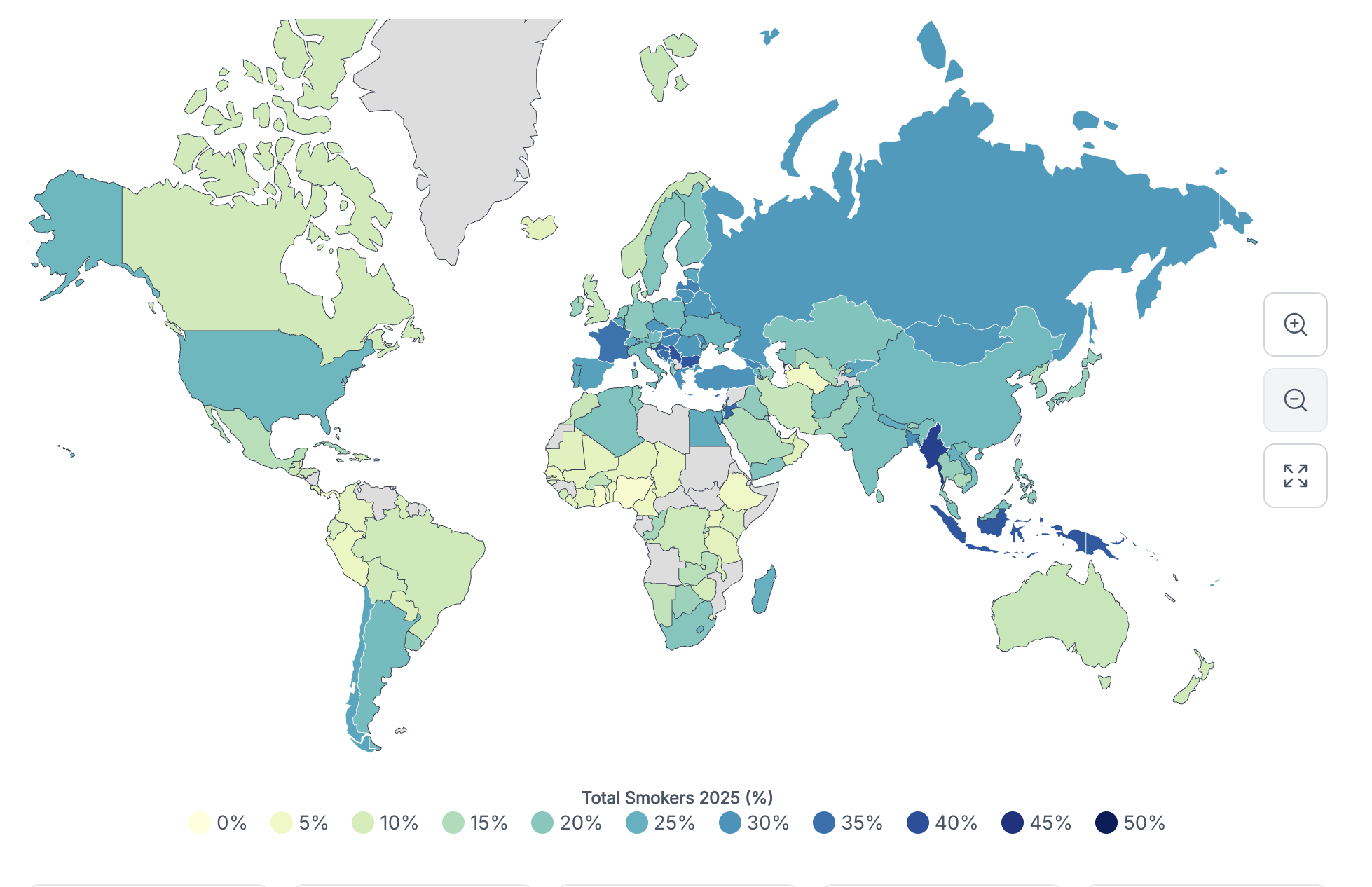


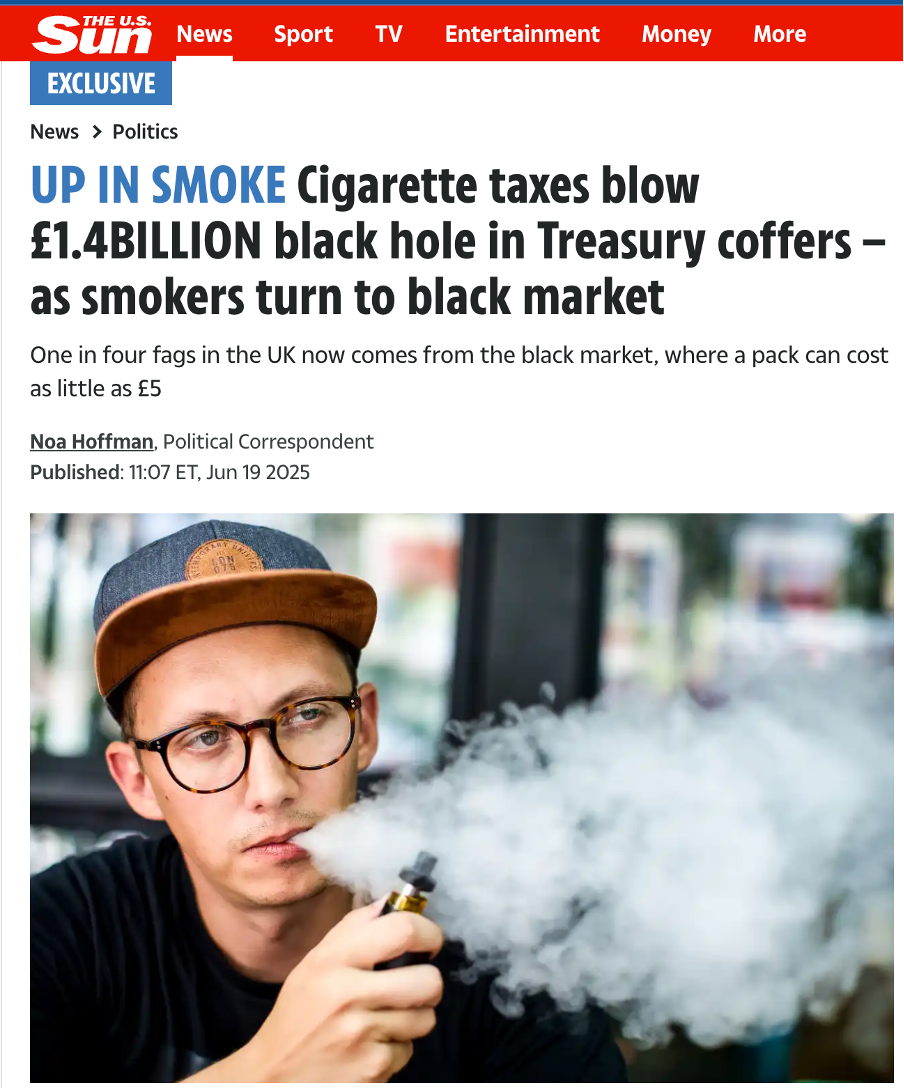

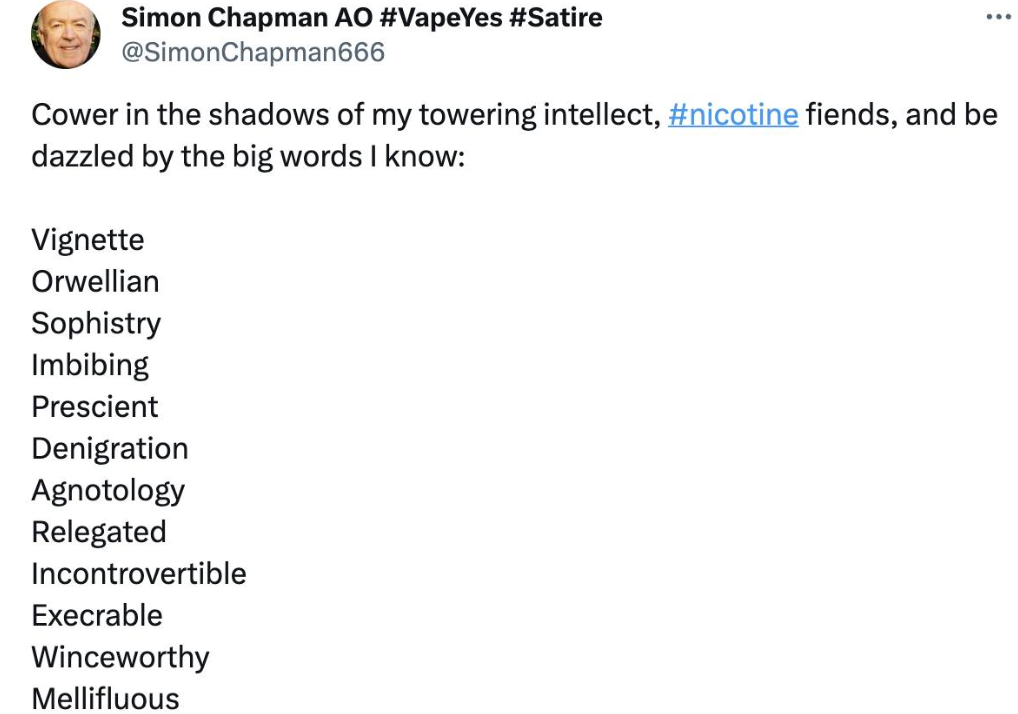

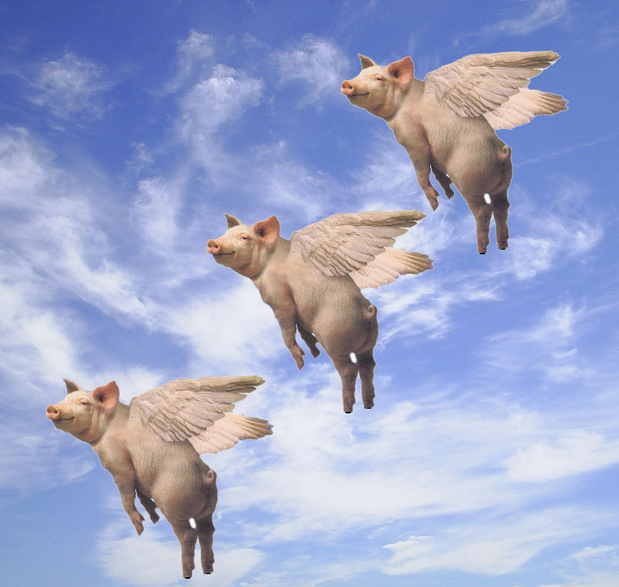





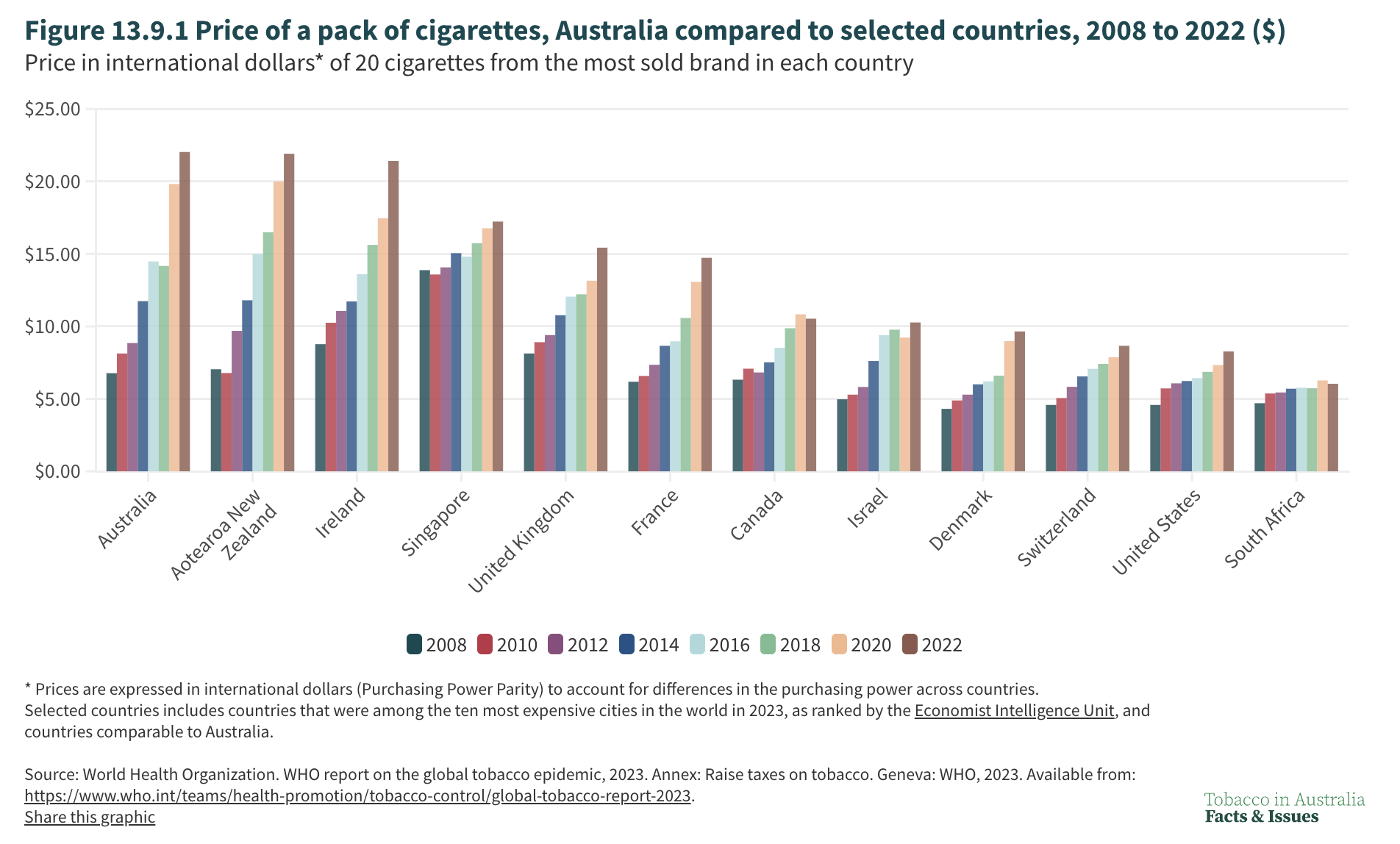
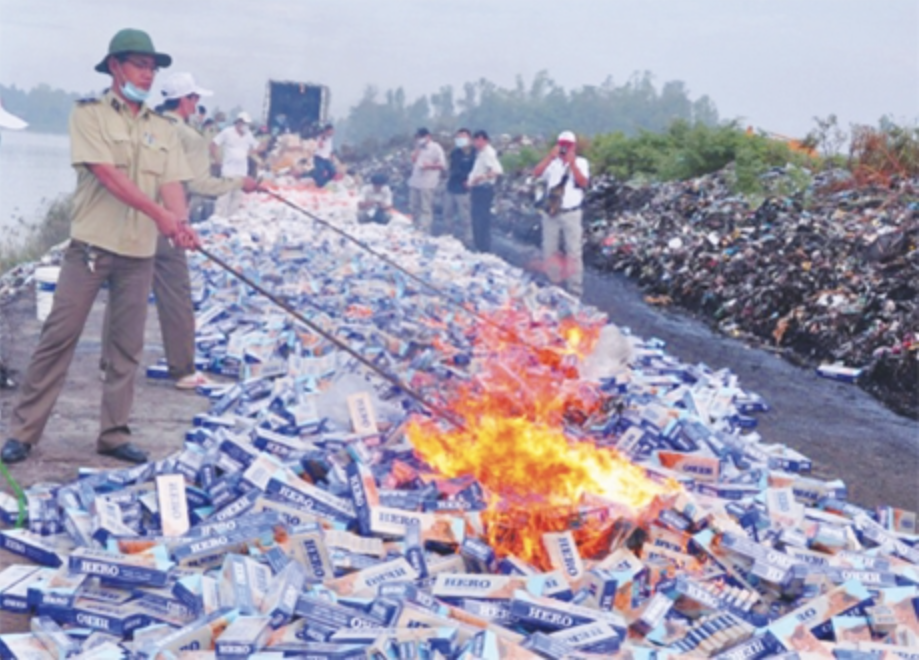

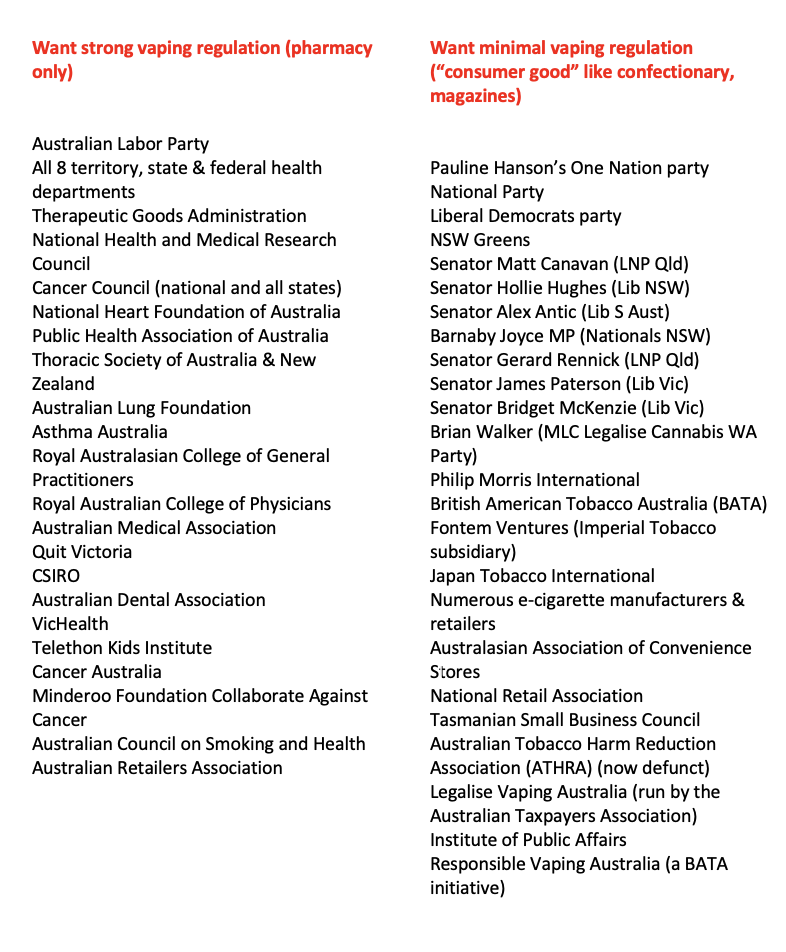


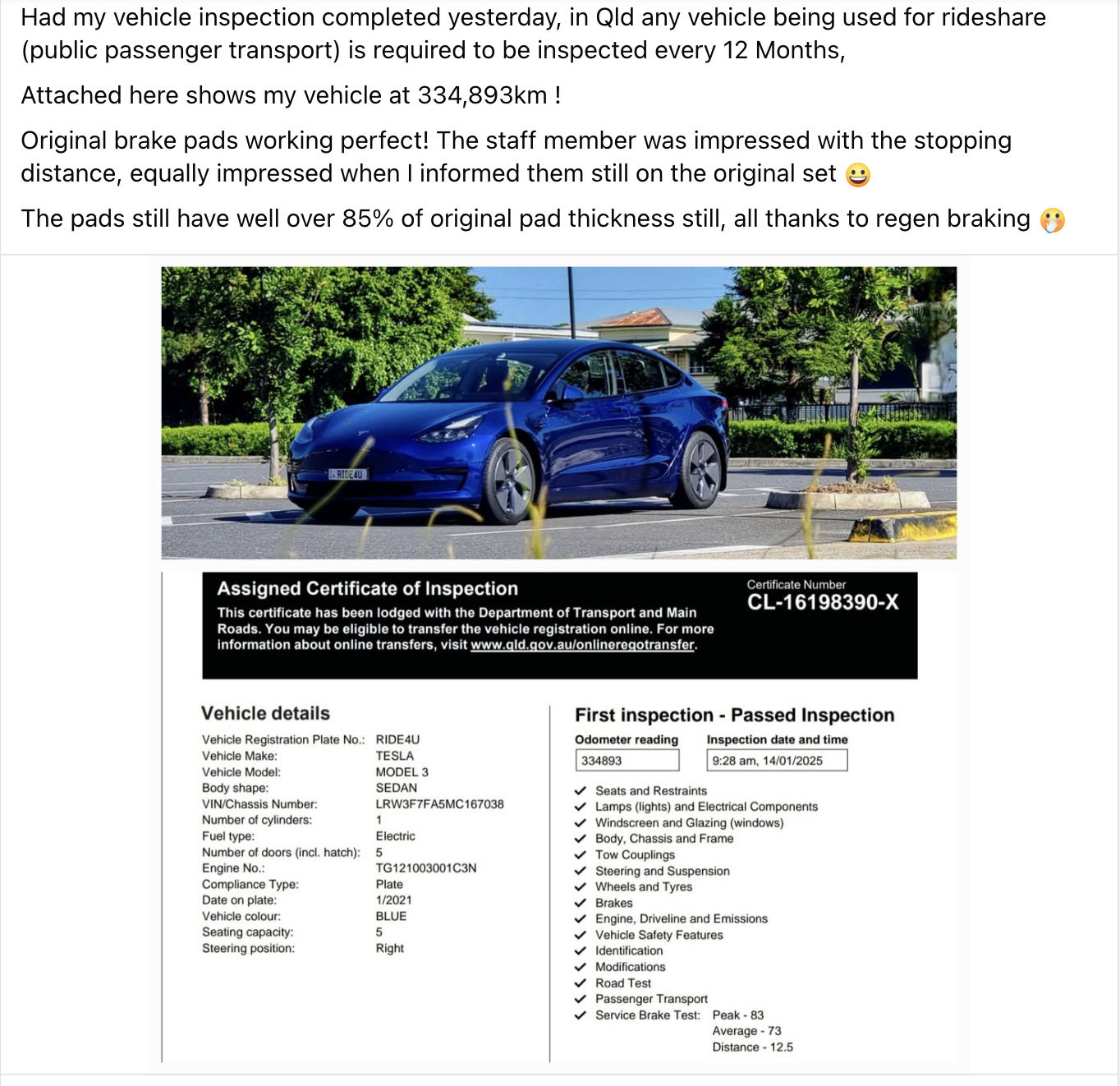
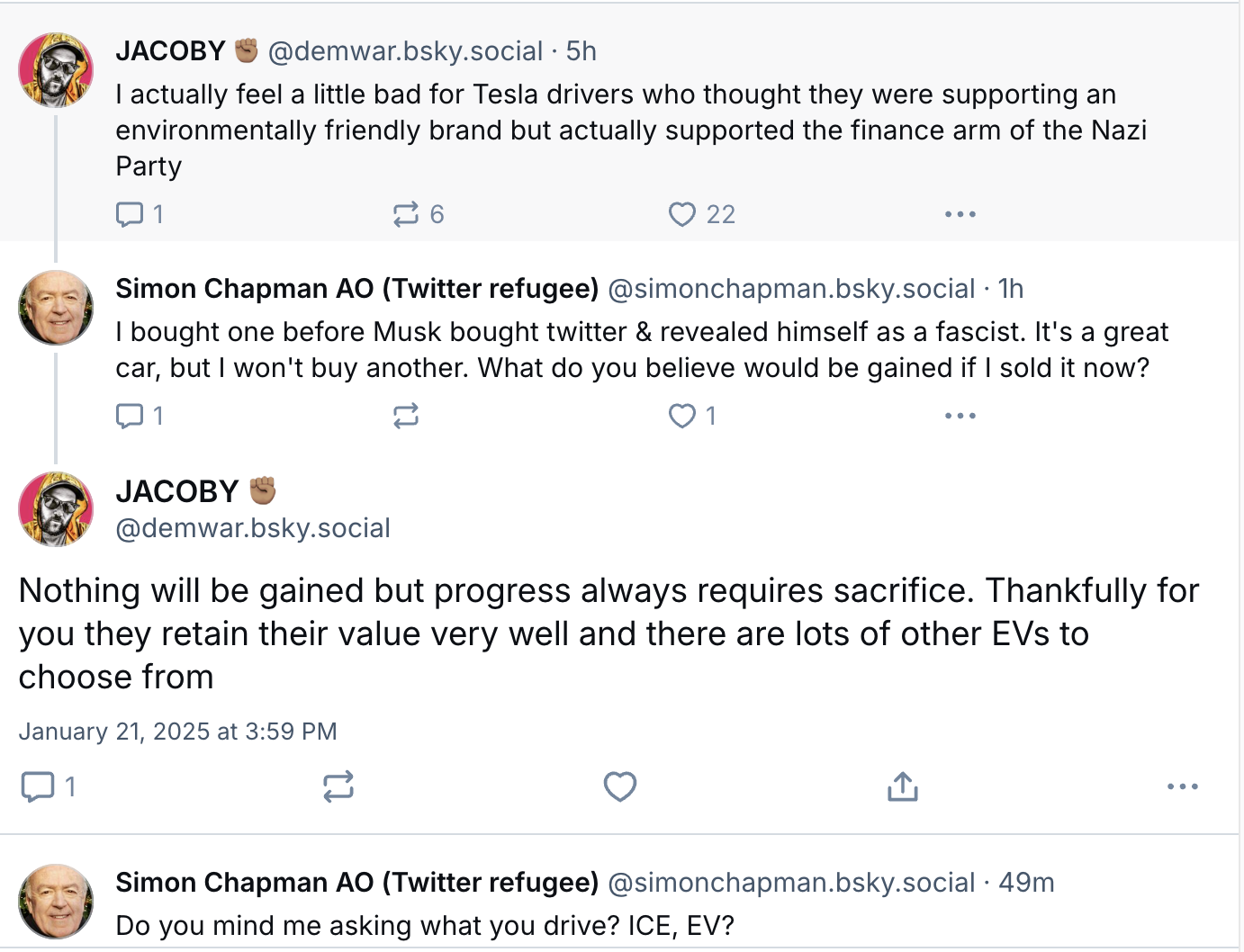


 Simon Chapman AO