• Home
  • About/CV
  • Blog
  • Vaping Research Alerts
  • Blog archive list
  • My books
  • Memoirs
  • Music, bands, films
  • Contact

Simon Chapman AO

~ Public health, memoirs, music

Simon Chapman AO

Tag Archives: sweden

“An abominable moral calculation”: how Australia punishes poor smokers and the tragically misunderstood tobacco industry

11 Thursday Jun 2026

Posted by Simon Chapman AO in Blog

≈ Leave a comment

Tags

smoking, sweden, tobacco-tax, vaping

James Martin is a Deakin University criminologist with a modest research track record in the tobacco control field. Of his 44 publications listed in Google Scholar, just five concern tobacco or vaping, with only two of these being published in peer reviewed journals. These five have received all of nine citations, with two being self-cites.

This background is relevant to his recent piece in Michael West Media, where he knits a loose thread between the current criminal tsunami of illegal tobacco and vape sales in Australia, Sweden’s falling smoking rates, Australia’s “punishment” of the tobacco industry, our alleged failure to reduce tobacco use, the failure of law enforcement to stem illicit sales and the heinous cruelty to the disadvantaged he says high tobacco prices cause.

His piece there provides  just one reference to support his assertions.  So let’s walk through how these stand up.

Tobacco control “harms poor smokers”

Martin argues that the Australian government has “abandon[ed] nicotine consumers, disproportionately some of our most vulnerable citizens, to early disease and death – an abominable moral calculation” because of instead of allowing vapes to be sold almost anywhere, it has confined legalised access to vaping through pharmacies to control the open supply of vapes to kids by self-described law-abiding convenience stores, tobacconists and vape shops.

While 2,358 pharmacies have dispensed over-the-counter vapes,  and the government fully subsidises prescribed smoking cessation meds to low income health card holders, the unabated supply of cheap illegal, flavoured vapes by criminals continues to undermine the same potential of pharmacy access that we see year in and out when nearly all of us participate in the 440m annual visits to pharmacies to pick up 331m annual prescribed medicines.

If crime syndicates were also brazenly selling these medicines in every suburb to walk-ins without prescriptions, saving low income customers lots of money, should we applaud their public spirited service to the poor and let them get on with it? Or would we instead applaud swift and serious government effort to close this down and uphold the rule of law? I know what I would do.

And Big Tobacco — apparently the new white knights of health promotion – according to Martin now “grasps that its future, at least in the West, lies in selling nicotine without the smoke.”  This is the same Big Tobacco which a decade on from entering the vaping and smokeless markets, still derives over 80% of its income from cigarettes with not one company setting a date to get out of tobacco.

Global Tobacco Industry Revenue Breakdown

  • Cigarettes: 83% to 88% of global sales
  • Smokeless tobacco: ~11%
  • Cigars: ~2%
  • Other products (e.g., vapes, pouches): ~3%

Company-Specific Financials

  • British American Tobacco (BAT): Reported that combustible products (primarily cigarettes) generated 80.0% of total global revenue.
  • New Category Products: “Next-generation” items make up 13.3% of BAT’s revenue.
  • Traditional Oral & Other: These account for the remaining 6.7%.

Philip Morris International: 58% of its revenue is still from tobacco

Source: https://www.tobaccoinaustralia.org.au/chapter-10-tobacco-industry/10-2-the-global-tobacco-manufacturing-industry

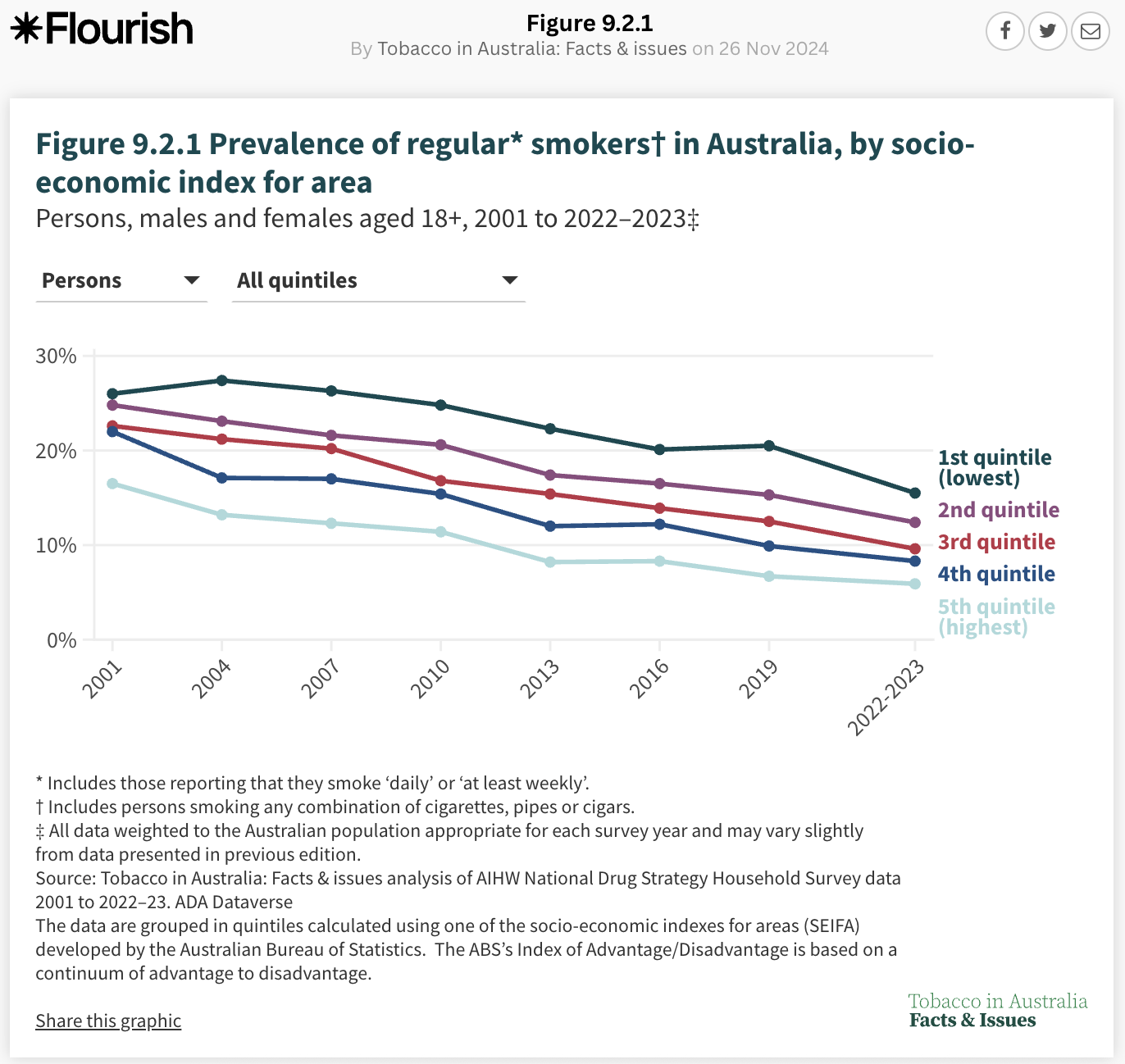
Martin’s claims about tobacco control harming low-income groups are also wildly uninformed. This link could have taken him to oceans  of Australian data and graphs showing that, regardless of what definition of disadvantage is used (composite indexes, income, education) disadvantaged Australians have been smoking less in parallel with smoking declines in their more advantaged counterparts, continuously since at least 2001. This is the case for both declining prevalence and reduced cigarettes per day. Here’s just one graph of many that are inconvenient to his argument.

Yes, the lowest levels of disadvantage do have higher smoking rates than those in the highest, but as a criminologist Martin may be ignorant that this observation holds for almost every disease, cause of injury, vital statistic or health related behaviour  (diet, obesity, alcohol etc), not just smoking. Poorer health travels with disadvantage.

And more news for him. It is not just tobacco prices which impact those on low incomes more than their more advantaged counterparts. This happens with every good and service they purchase, a truism in every country in the world where there is not perfect income equality for all people. In other words, everywhere.

In Australia today, there are only  two groups where a majority of people smoke: those with psychosis and those in prison. In every other group, early school leavers, the unemployed, single parents and First Nations people there are more ex-smokers than smokers. Talk of people who, as Martin insists “can’t or won’t stop” smoking will always struggle to explain why so many millions of these disadvantaged smokers over the years have managed to quit despite their disadvantage.

They regret having started to smoke, have agency to quit (mostly unaided),  and are doing so more and more. Their higher smoking rates are explained far more by decades of higher smoking uptake than by lower quitting rates.

Few laws ever eliminate the problems they were intended to reduce. But we don’t see Martin’s equivalents in road safety calling for reduced penalties for drink driving because they badly sting those on low incomes, or ditching these laws because many continue to be detected over the limit.

We balance the harms to offenders with the declines in road deaths and injuries.

Can there be anything more perverse in public health than believing the poor would benefit by access to  cheap cigarettes which will kill two in three long term users?

Cherry picking in Sweden

Sweden has a low smoking rate (4.8%) and according to Martin, this is all down to the enlightened widespread use of non-combustible nicotine, especially snus. Ergo, Australia need only look to Sweden for the answer, right? Here, Martin is a champion cherry picker when it comes to advancing his argument.  Smokeless tobacco has been freely available in Canada and the US for decades and in both countries, it has low usage despite this open availability. In the USA, 2.6% of adults currently use smokeless tobacco and in Canada, only 0.6% regularly use it.

So do the US and Canada wipe the floor with Australia in reducing smoking given that they both allow open access to smokeless?  Ermmm no. In the US, recent use of any combustible tobacco is 12.6% of adults in 2023-24. And Canada? In 2022 it’s 12.9% for any use in the last 30 days. This compares to 11.1% in Australia in 2022-23. So where’s the dramatic impact in the US and Canada of open access to smokeless tobacco on smoking rates? Why only highlight Sweden?

Sweden was one of the first nations to implement population-wide tobacco control polices like advertising bans, anti-smoking campaigns and health warnings. But clearly there are also cultural reasons why Swedes use smokeless, much in the same way they are unique in taking to surströmming, a famous Swedish fermented herring delicacy. It’s considered one of the world’s most foul-smelling foods, with an overpowering aroma often compared to rotten eggs, sewage and rancid butter. Or like Australians’ passion for vegemite, almost unique in the world.

“Punishing” the tobacco industry

Martin implies that “punishing” the tobacco industry with policies like taxation, plain packaging, and smoking restrictions is somehow a uniquely Australian thing. Is he seriously unaware that the global Framework Convention on Tobacco Control signed by 183 nations, has an entire section (“Article”) devoted to ways of controlling the tobacco industry’s efforts to wreck effective tobacco control? Here’s a report I co-authored for the WHO in 2008, which catalogues the many ways the tobacco industry has sought to defeat, delay, disrupt and dilute effective tobacco control policies. But for Martin, they are apparently now the good guys.

The industry screams loudest about policies that threaten its sales, and the very loudest screams have always been about high tobacco tax. Most people understand what this means, but Martin thinks it’s somehow unseemly and the nice people in Big Tobacco are misunderstood social welfarists leading people away from early deaths.

Here are a few historic examples of the industry screaming about tobacco tax. The tobacco company Philip Morris (Australia) in 1983 said:

… The most certain way to reduce consumption is through price.

Then again in 1985:

… Of all the concerns, there is one – taxation – which alarms us the most. While marketing restrictions and public and passive smoking do depress volume, in our experience taxation depresses it much more severely. Our concern for taxation is, therefore, central to our thinking about smoking and health. It has historically been the area to which we have devoted most resources and for the foreseeable future, I think things will stay that way almost everywhere.

And 1993:

… A high cigarette price, more than any other cigarette attribute, has the most dramatic impact on the share of the quitting population.

In 2011, British American Tobacco’s boss in Australia, David Crow, publicly acknowledged the impact of tobacco tax, telling a Senate committee:

We saw that last year very effectively with the increase in excise. There was a 25% increase in the excise and we saw the volumes go down by about 10.2%; there was about a 10.2% reduction in the industry last year in Australia.  (see here at p xviii)

So if these (and many more like them) do not indicate virulent industry concern about tobacco tax, why has it carried on screaming about tax in the same way for at least 43 years?

Reducing tobacco tax?

Martin has been prominent arguing for the  “obvious” necessity of reverting tobacco excise tax to the halcyon days before illegal tobacco erupted in Australia. In this he and a handful of others are in lockstep with the entire tobacco industry who have chorused that Australia should revert to 2020 tax levels. The table below shows what this would likely do to recommended retail prices for a current budget brand, JPS.

JPS Classic (20s) May-20May-26Difference
Excise per stick (1) $0.94964$1.52829$0.57865
Excise per pack $18.99$30.57$11.57
Manufacturers cost (2) $6.65$8.33$1.69
Wholesale price per pack of 20 (3)$25.64$38.90$13.26
Retailer margin (4) $3.72$4.28$0.56
GST 1/11th of final price (5) $2.94$4.32$1.38
Final price per pack of 20    
Recommended price (listed in wholesale price lists) (3)$32.30$47.50$15.20
(1) ATO tax rates
 
 
(2) Manufacturer cost derived by deducting excise from wholesale cost
(3) Wholesale & Recommended price lists 2020 and  2026
 
(4) Retailer margin is at industry discretion
 
(5) Calculated by dividing the final price by 11


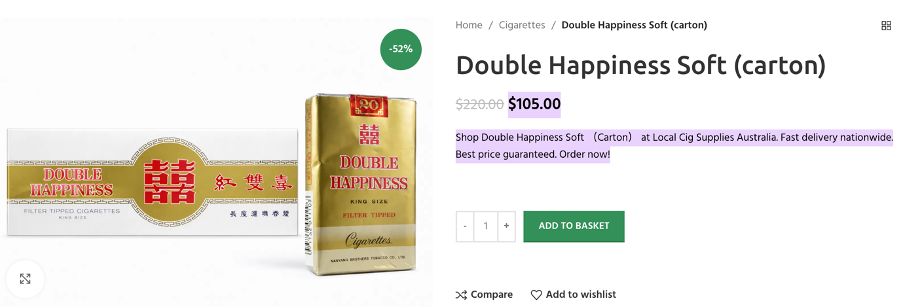
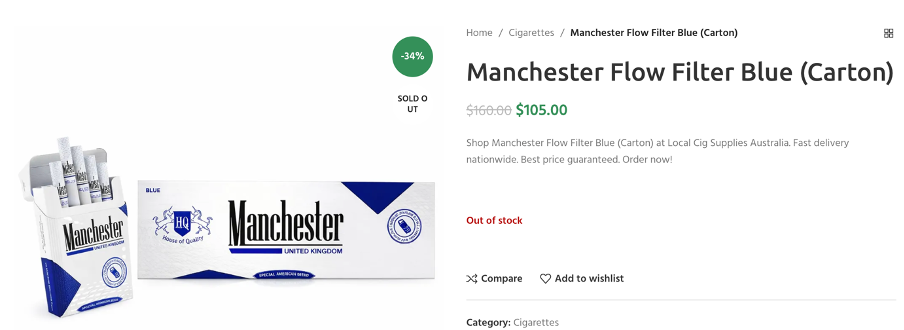
So today, when a pack of illegal cigarettes can be bought for $7 if you buy a carton, in what universe would price sensitive smokers look at a tax-reduced pack of JPS from Woolies for $32.00 and not continue to immediately walk across the street to buy a pack for $7 in an illegal shop –at less than four times the price?

And that $7 price could even go lower. Cambodia is a high corruption index nation (ranking 158/180 worst in the world). It is also a major transit hub for smuggled tobacco to other destinations. There, a pack of locally taxed cigarettes can be bought for as little as 34c. There is clearly wide scope for the price of illegal cigarettes to go much further south if ever required by ever lower tax drops.

And then there’s the inconvenient problem of Martin’s silence on how it happens that there is also massive illicit tobacco trade in many nations with tobacco tax much lower than Australia’s.

Blog Stats

  • 174,589 hits

Top Posts & Pages

  • “An abominable moral calculation”: how Australia punishes poor smokers and the tragically misunderstood tobacco industry
  • Why I’m not quitting Spotify because its owner has hugely invested in weaponry
  • Vaping theology: 9 “Won't someone please think of the children!”
  • If expensive cigarettes are driving the Australian black market, why do so many countries with much cheaper cigarettes have thriving black markets too?
  • Vaping theology: 6 There’s nicotine in potatoes and tomatoes, so should we restrict or ban them too?
  • The Rolling Stones at the Enmore Theatre, Feb 18 2003
  • Regrets … I’ve had a few. Paul Hogan and his Winfield role.
  • Junk research journal and conference emails: the gifts that keep giving
  • Vaping theology 26: “If Australia allowed vapes to be sold openly, this would lower smoking prevalence and kill illegal tobacco stone dead”
  • Wind turbine syndrome: the non-disease that only speaks English

Comment Policy: No anonymous or pseudonymous posts will be published

Recent Posts

  • “An abominable moral calculation”: how Australia punishes poor smokers and the tragically misunderstood tobacco industry
  • Vaping theology 26: “If Australia allowed vapes to be sold openly, this would lower smoking prevalence and kill illegal tobacco stone dead”
  • Why the “lower tobacco tax” emperor has no clothes
  • Rare as rocking horse shit: orphaned tracks not on Spotify
  • Many remain terrified of COVID, but widespread immunity has greatly reduced its severity

Recent Comments

howfarlongami's avatarhowfarlongami on Farcical half-pregnant Austral…
Simon Chapman AO's avatarSimon Chapman AO on Oil crisis sees emergence of n…
hdeastburn's avatarhdeastburn on Oil crisis sees emergence of n…
Terry Pechacek's avatarTerry Pechacek on Vaping theology 25: Vaping is…
Katina Kardamanidis's avatarKatina Kardamanidis on “Decent law abiding shoo…

Archives

  • June 2026
  • May 2026
  • April 2026
  • March 2026
  • February 2026
  • January 2026
  • December 2025
  • August 2025
  • July 2025
  • June 2025
  • May 2025
  • March 2025
  • January 2025
  • November 2024
  • October 2024
  • September 2024
  • July 2024
  • May 2024
  • April 2024
  • March 2024
  • February 2024
  • January 2024
  • December 2023
  • November 2023
  • October 2023
  • September 2023
  • August 2023
  • July 2023
  • June 2023
  • May 2023
  • March 2023
  • February 2023
  • January 2023
  • December 2022
  • November 2022
  • October 2022
  • August 2022
  • June 2022
  • April 2022
  • March 2022
  • February 2022
  • January 2022
  • December 2021
  • October 2021
  • September 2021
  • August 2021
  • June 2021
  • May 2021
  • April 2021
  • March 2021
  • February 2021
  • January 2021
  • December 2020
  • November 2020
  • October 2020
  • September 2020
  • August 2020
  • July 2020
  • June 2020
  • May 2020
  • April 2020
  • March 2020
  • February 2020
  • January 2020
  • December 2019
  • November 2019
  • October 2019
  • September 2019
  • August 2019
  • July 2019
  • June 2019
  • May 2019
  • April 2019
  • March 2019
  • February 2019
  • January 2019
  • December 2018
  • November 2018
  • October 2018
  • September 2018
  • August 2018

Categories

  • Blog

Meta

  • Create account
  • Log in
  • Entries feed
  • Comments feed
  • WordPress.com

Blog at WordPress.com.

  • Subscribe Subscribed
    • Simon Chapman AO
    • Join 192 other subscribers
    • Already have a WordPress.com account? Log in now.
    • Simon Chapman AO
    • Subscribe Subscribed
    • Sign up
    • Log in
    • Report this content
    • View site in Reader
    • Manage subscriptions
    • Collapse this bar

Loading Comments...