
Tags
Updated 15 Aug 2026
Recently in The Conversation three commentators proposed a three-pronged template for ending the dominance of illegal tobacco and vapes over legal, taxed and pharmacy-accessed products. Their article was triggered by the release of the latest (2025) AIHW national survey data on smoking and vaping prevalence, where the lowest ever rates were reported for smoking (5.6% daily, 7.8% current).
Let’s look at the evidence and reasoning behind their three proposals: (1) lowering tobacco tax (2) making vapes and other putative reduced risk nicotine products more widely available (3) keeping up enforcement at borders and of stock seizures, fines and closures of illegal retailers.
First, let’s look at their reservations about the integrity of the AIHW data.
They claim that the AIHW has earlier stated that its reports underestimate “actual consumption levels”, meaning that its reports underestimate smoking. But “consumption levels” refer to the number of cigarettes smoked per day, not whether or not people smoke. Reporting lower than true smoking frequency is well known in smoking surveys, where underestimation and rounding down is common.
But there is scant recent evidence of smokers denying they smoke in surveys, particularly when surveys — as with the AIHW’s — are not conducted only face-to-face or via phone where some smokers may feel awkward admitting they smoke.
They also note that the AIHW reported fall occurred at same time that illicit sales “moved underground and were harder to measure”. Surely they realise that the AIHW’s smoking prevalence data report all smoking, regardless of whether this is of legal or illicit products?.
Moreover, authors Jegasothy and Martin have referenced past AIHW data in their government submissions and in their limited academic writing. When useful to their argument, these data are apparently fine, but when inconvenient, they are critical of the data’s integrity.
1 Lowering tobacco tax
I’ve shredded the “reduce the tax” argument many times, like here. But here they go again, advocating an unspecified tax cut and providing no explicit assumptions or modelling. They write “A tax cut won’t close the price gap with the black market entirely. It doesn’t need to. Every dollar the gap narrows weakens the incentive to buy illicit products and the profitability of selling them.”
Illegal cigarettes can be bought for as little as $7 a pack if bought by the carton. If in the highly unlikely and globally unprecedented event that all tobacco excise was removed tomorrow, and manufacturers’ and retailers’ components of price remained at today’s ratios, a pack would cost around $11.50. Most chatter here though has suggested dropping the tax to make a legal pack cost $20-30 instead of the current common $40+. The examples below show on-line carton prices for illicit brands Manchester and Double Happiness of $10.50 per pack.
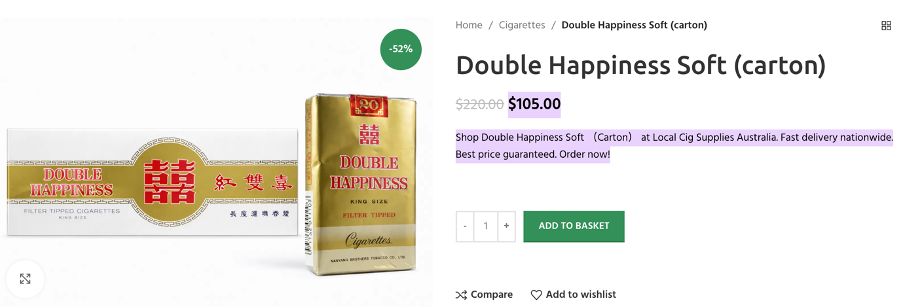
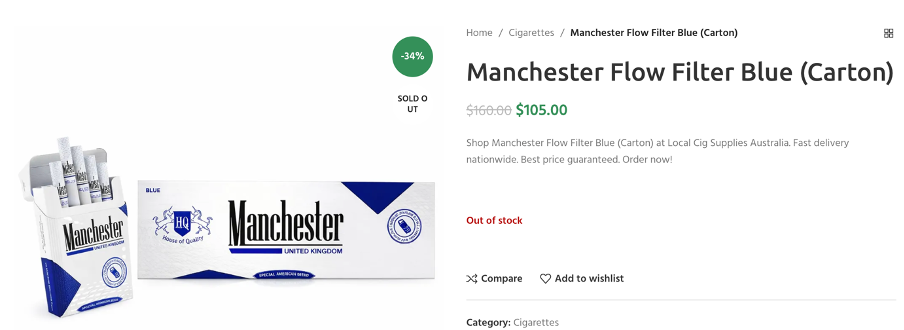
Illegal prices could also quickly fall far lower than now, with packs in the well-known illicit transit nation of Cambodia for example selling for as little as 34c.
So here they appear to be suggesting that narrowing the price gap will persuade some current illegal tobacco purchasers to ignore any remaining reduced price gap and return to buying more expensive taxed cigarettes.
When pressed, some arguing this way – always without evidence — suggest that many smokers would prefer to be law-abiding and would be willing to “do the right thing” and pay quite a few dollars more for taxed products if the tax was only reduced.
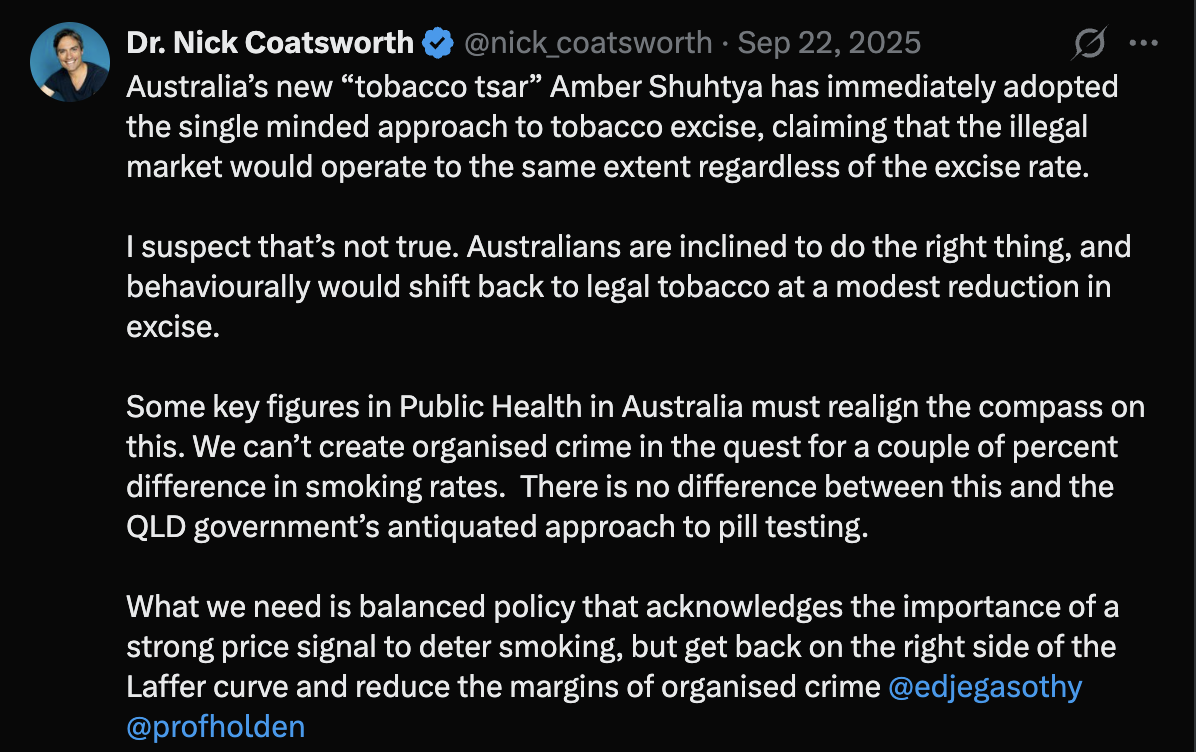
Here we need only to look at the extent of the cash economy and undeclared sales common with barbers, hairdressers, nail bars, cafes and tradies. The Australian Taxation Office estimates the shadow or cash economy costs Australia approximately $16-$25 billion a year in unpaid tax revenue, with the broader economic impact estimated to be as large as 3% of GDP (exceeding $80 billion in 2025).
As The Castle’s Darryl Kerrigan might have said here “tell them they’re dreaming”.
Straw-clutching, they also provide a 32 year old (1994) Canadian example of a tax cut with increased enforcement reducing illicit sales. This 2019 World Bank report shows that illegal trade rose again, so that by 2010/11, 32% of Canadian tobacco sales were illicit.
2 Be like Sweden: make vapes and other putative harm reduction products more available
They quote Sweden as an example where policy that embraces harm reduced products has greatly lowered smoking. But Canada and the US are other examples of nations with no legal impediment to the sale of smokeless tobacco and where use of these products is very small and smoking prevalence higher than Australia’s (see “Cherry-picking in Sweden” here). So why only look at Sweden and not mention that it has had low smoking prevalence for many years as well as long-standing comprehensive tobacco control policies?
Illegal vapes are being sold openly in nearly all of the thousands of illegal tobacco outlets in Australia and online with 60% of current 90 day closures in NSW being licensed tobacco retailers. Below is a 70,000 puff vape advertised illegally for $36, less than the cost of one packet of taxed cigarettes. The authors want them to be even more available, as they are in nations like New Zealand, the UK, the USA and Canada. Given how widespread access to vapes is now in Australia, it is difficult to imagine any would-be vaper finding access anything of a problem. And note too that Australian smoking prevalence is also lower than in each of these countries (see table here). So how would even greater access help here?

Source: https://vapebulk.com.au/product/vice-box-2-70k-disposable-vape-arctic-blue-melon/
Enforcement
Early in their article they argue closing down illegal retailers and imports has done little to stem illegal trade. But then they go and recommend it as the third “absolutely essential” of their strategies! This looks like an attempt to walk on both sides of the street. Can please they make up their minds here?
All agree that enforcement is absolutely essential. Australia’s Border Force has intercepted nearly a kilotonne of illegal tobacco and 4 million vapes since December 2025. Three state governments have closed 260 illegal tobacco shops for a total of 13,000 days in Queensland; NSW has closed 375 for 22,500 days since November 2025; and South Australia got out of the blocks first with 100 closures between June and November 2025.
A Sydney closed shop which brazenly reopened was fined $1.18m and permanently closed. There are some 60 more reoffenders in the legal pipeline.
These penalties, which can also include gaol times, are radically changing the risks and costs of engaging in illicit trade in Australia. No country has zero illicit tobacco trade, but Australia is now taking the problem seriously.
The horrendous arson and violence we are witnessing with the extortion and standover tactics being used by criminal syndicates is of course far from unique to their entry into tobacco. Violence is standard modus operandi with organised crime. Extortion and firebombing is also now happening with restaurants, bars and liquor supplies in Victoria, which has nothing to do with excise tax.

