• Home
  • About/CV
  • Blog
  • Vaping Research Alerts
  • Blog archive
  • My books
  • Memoirs
  • Music, bands, films
  • Contact

Simon Chapman AO

~ Public health, memoirs, music

Simon Chapman AO

Tag Archives: illegal-tobacco

Could supermarkets-only tobacco sales be Australia’s next giant step in making smoking history?

06 Friday Nov 2026

Posted by Simon Chapman AO in Blog

≈ 3 Comments

Tags

illegal-tobacco, politics, smoking, supermarkets, vaping

Despite illegal untaxed, cheap tobacco retailing in plain sight across Australia, smoking rates have never been lower and are dropping at a faster rate than ever before. Australia’s latest (2025) national smoking prevalence data show just 5.6% of those aged 14 and over are smoking daily, with another 2.2% smoking less than daily – a total of 7.8% who ‘currently’ smoke.

Note here too, that these data report any smoking, regardless of whether the tobacco being smoked is legal or illegal. The estimated 80% of tobacco and nicotine products being bought from illegal retailers represents a mass exodus from high priced taxed tobacco to more easily affordable products. But despite this, smoking prevalence is rapidly declining: the lure tax-free cigarettes is not potent enough to overwhelm all the other pull factors which have seen smoking declining almost continually for over 40 years.
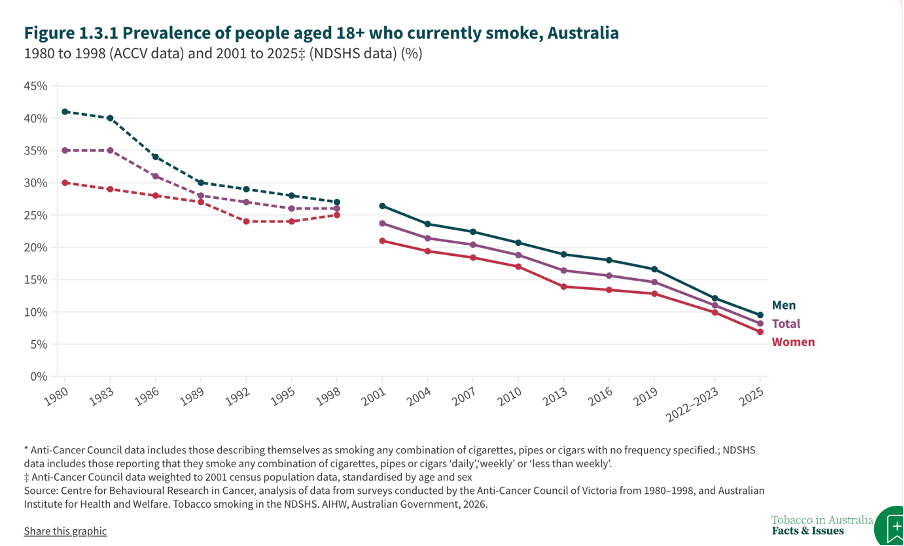
Source: Tobacco in Australia: Facts and Issues

With some 90% of smokers regretting they ever started, 90% of 7.8% leaves less than one percent of all Australians over 14 who are smokers and happy to be so. In Australia, some 76% of smokers try quit or reduce their smoking each year, with two-thirds planning to eventually quit, driven mostly by financial cost (48%) and health concerns (45%).

So tobacco is a product in a fatal death spiral. In 2022-23 – the last time the national survey was undertaken, the daily smoking rate for those aged 14+ was 8.3%. The current 5.6% rate is an unprecedented absolute fall of 2.7% (and a whopping relative fall of 32.5%).

Smoking rates by children aged 12-17  are also lower than they have ever been (grapoh below)
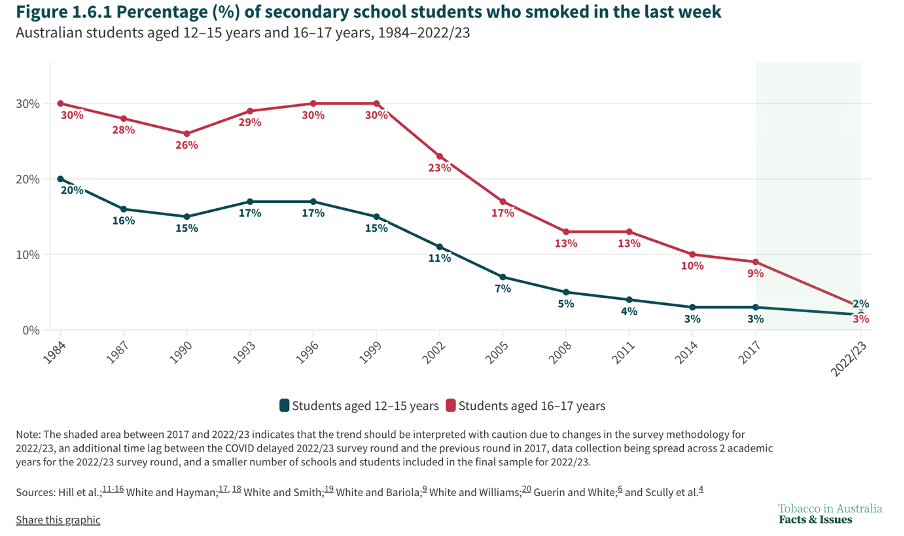
Source: Tobacco in Australia: Facts and Issues

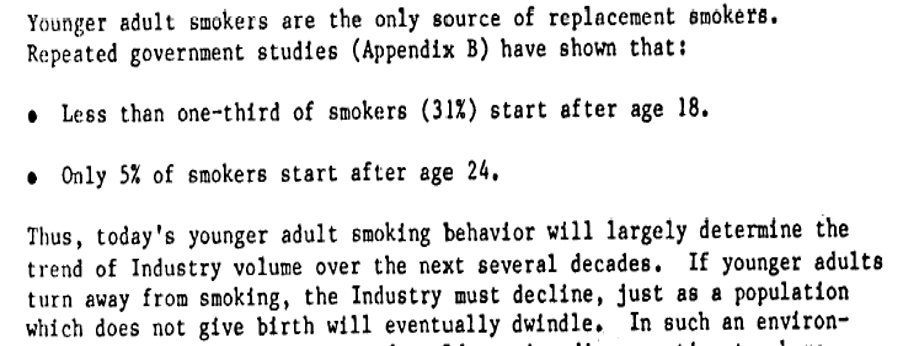
As a 1984 tobacco industry memo put it bluntly (at page 10): “If younger adults turn away from smoking, the industry must decline, just as a population which does not give birth will eventually dwindle.”
Rampant over-supply of tobacco

Australia has between 6500-7800 petrol stations providing fuel for 22.3 million registered motor vehicles; 6100 pharmacies serving 28 million Australians who make 440 million annual visits; In NSW, as at June 2022, there were some 300 businesses licenced to sell firearms to  261,000 licensed gun owners (as at Dec 2025). There are 2,158 shops licensed to sell alcohol in NSW to the 73% of 6.9 million people aged 18 and over who drink alcohol (5.037m drinkers). These are commercial environments where regulators constrain proliferation and strictly enforce regulations and standards on the good sold because of health, safety and social considerations.

The true number of retail outlets selling tobacco and vaping products is challenging to calculate because of widespread illegal retailing not listed on any databases. A 2016 Queensland government report on tobacco retail licensing quoted a British American Tobacco Australia estimate of 40,000 tobacco retailers in Australia. The tobacco industry has long been in the habit of exaggerating data that suit its various public arguments. But let’s take them at their word here and  compare 40,000 outlets serving 1.3m daily smokers plus 500,000 less-than-daily smokers (1.8m) from a total population aged 14+ 15.9m  to other widely used regulated products (see table).
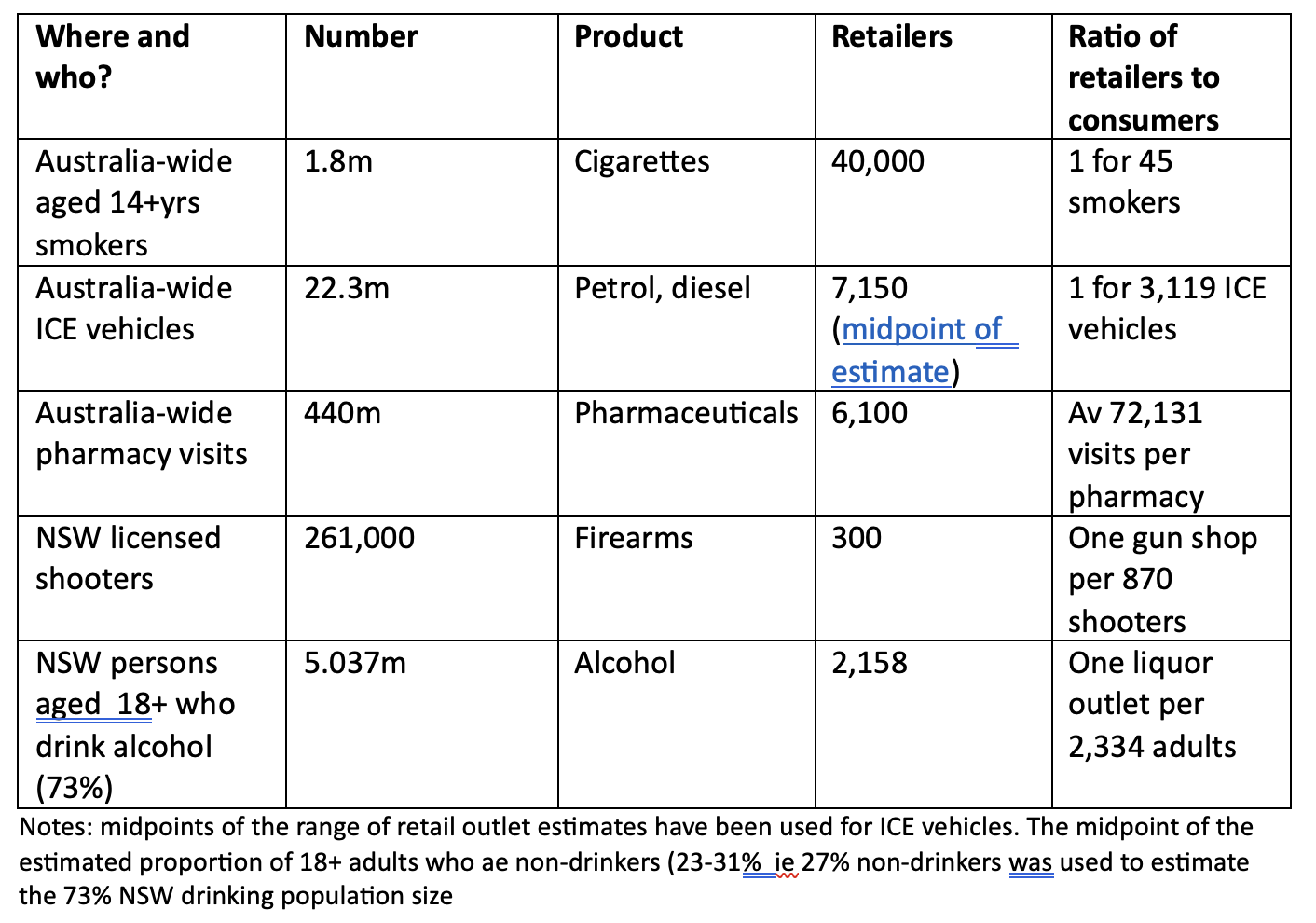
By any of these retailing comparisons, Australia’s 1.8 million smokers are being massively over-serviced. The ever-declining proportion of smokers would not be significantly inconvenienced by large-scale reductions in tobacco retailers.

Such reductions would send yet another powerful message that tobacco products are not benign grocery items like food, confectionary or household cleaning products.

But large-scale reductions would also make it far easier for health authorities and police to do spot checks for illegal retailing. In NSW, for example, there have been 523 illegal shop closures in the 367 days since Nov 3, 2025. The number of checks are not published, but industry sources suggest there are up to 19,000 retailers in NSW so lots are likely to have never had the knock on the door.

These data send a message to all illegally trading that the odds of being checked is remote, as anyone noting the enduring slew of illegal shops in their own suburb can easily deduce.

Which retailers should be allowed to sell tobacco?

The on-going 90 day closures of illegal traders is something of a whack-a-mole exercise: for every shop being temporarily closed, there are many, many more which continue openly trading including new players opening up. There has never been widespread legal compliance in tobacco retailing. NSW Health data show that both retailers with tobacco licenses and those which are unlicensed are both selling tobacco. So licensing alone is far from an antidote to illegal selling.

A regime is needed which would see a major radical reduction in the number of retailers selling tobacco in Australia, while still allowing convenient access to smokers to legal tobacco.

Supermarkets least likely to sell illicits and to kids

Tobacco retailers have long sold cigarettes to children, often explicitly encouraged by the tobacco industry. Early in my career, compliance monitoring stings were often conducted to see if shops would sell to children . For example,  in 1994, 39% of  255 western Sydney shops sold to 12 and 13 year olds asking for cigarettes. In Western Australia in 2005, a compliance study found children were able to buy cigarettes at 88% of retailers in Augusta, 79% in Esperance, 77% in Manjimup and 66% in Margaret River.

Each state has found dedicated tobacconists, whether individual independents, chains or franchises, selling illegal cigarettes and vapes.

By contrast, major supermarkets have been found to rarely sell to children and have never to my knowledge been found stocking illegal cigarettes or vapes. In NSW they voluntarily introduced display bans before the government legislated them. They are obvious easily accesible candidates to be allowed to continue to sell excise-paid cigarettes. Aldi in Australia does not sell tobacco products, which leaves Coles (1,874 stores), Woolworths (1,142) and IGA (1,285) for a total of  4,301 outlets nationally. Far less than the 40,000 some current total outlets.

These chains have established histories of commercial governance, boards, legal compliance and brand reputation management which would be badly damaged by illegal trade or selling to children if severe penalties including permanent loss of tobacco license was involved.

These supermarkets are widespread in cities and large towns, but small towns – often large distances from cities or major towns – often have only small grocery stores or mini-markets, which typically sell tobacco. Smokers in these small communities would understandably raise equity concerns if they could not buy tobacco without driving long distances to buy it. Politicians are likely to have zero appetite for denying such access while having zero tolerance for those which continued to sell illicits and to kids.

Such a proposal would obviously need serious a national feasibility study, with affected retailers given an opportunity to argue why they should be allowed to sell. Many who have never been closed or prosecuted for illegal sales will line up to strenuously argue that they have an exemplary record. A national feasibility study perhaps within a parliamentary enquiry should explore options for licensing in such small communities.

Cynics will argue that, as now, many illegal retailers in large numbers will take their chances and simply remain open regardless of any new licensing scheme.   As now, these should continue to be actively closed, stock seized and prosecuted. But a widely publicised implementation day should be announced when thereafter any unlicensed tobacco retailer would be closed permanently and landlords fined severely.

Hands will go out all over the country asking for compensation. No compensation was ever offered to either tobacco manufacturers nor retailers across decades when potent policies were introduced that saw sales fall. Those taking their chances selling tobacco have known since the 1950s that they were selling a deadly product that saw millions of their best customers die or quit without governments sugaring this slide with compensation. Now is not the time to forget this.

Tobacco control advances like total advertising and sponsorship bans, smokefree airlines, workplaces, restaurants and bars, retail bans on displaying tobacco products, graphic health warnings  on packs, governments suing the tobacco industry for billions, plain packaging and pharmacy-only legal access to vapes were all said to be ludicrous and impossible political goals. But all have been legislated or prosecured in a growing number of nations.

Greatly reducing the number of outlets able to sell a product which kills 2 in 3 long term users needs to be the next bold step.
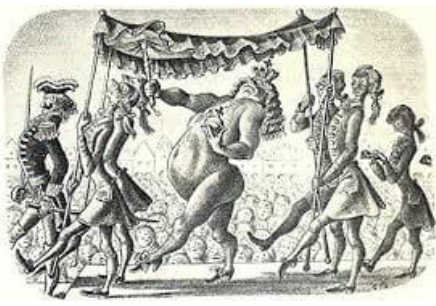
Why the “lower tobacco tax” emperor has no clothes

18 Monday May 2026

Posted by Simon Chapman AO in Blog

≈ Leave a comment

Tags

economy, finance, illegal-tobacco, politics, tobacco-tax

[updated 23 May & 23 Jun 2026. See tailpieces]

Not for the first time, NSW Premier Chris Minns has again called for the Albanese government to make significant cuts to tobacco excise tax. He’s now been joined by Nick Coatsworth, someone whose previous contributions to tobacco control policy are elusive. Cutting tobacco tax has now become an established factoid: a prescription repeated so often by lazy journalists who’ve not done the calculations, opposition commentators and callers to radio stations that it is obviously the solution to Australia’s rampant illegal tobacco trade.

Anyone can see, right, that if the price of tax-paid cigarettes could be reduced to make them competitive with untaxed illegal cigarettes, smokers would walk away from the untaxed cheapies and drive them out of the market.

Chris Minns and other politicians in this chorus are used to overseeing multi-billion dollar state financing involving eye-watering elaborate forecasting and modelling. But when it comes to tobacco tax, basic primary school arithmetic appears beyond them.

When those calling for excise reduction move to the next obvious question of the size of their sensible tax cut, a common level proposed is the 2020 rate, a so-called “sweet spot” which preceded the explosion in illegal selling that commenced shortly after. So if we dropped it to there, that would fix the problem, right?

Let’s do the maths.

Australia’s tobacco tax since March 3 this year has been $1.52829 per stick, so  $30.57 in tax per pack of 20.  In March 2020, excise was $0.94964 or $18.99 per pack. If we take a common fully taxed budget brand now costing $42, this would mean the taxed price would drop by $11.58, the difference between $30.57 and $18.99. So our currently $42 retailed pack would cost $30.42 under this tax-slashed proposal.

Deakin University criminologist James Martin has gone a step further, telling the Singapore Straits Times that Australia should consider ditching tobacco tax altogether. This interesting proposal would place Australia uniquely in the world where no nation or state has zero tobacco tax. Two US tobacco growing states, Kentucky and West Virginia, have very low taxes ($1.10 and $1.20 per pack respectively) and smoking prevalences of 23.6% and 23.8%, levels we’ve not seen in Australia for 35 years.

if the government was to heed Martin’s  tax nostrum tomorrow, a typical taxed budget brand costing $42 would then cost $11.43. So would that do the trick and drive illicits out of business?

In Australia, the price today of an illegal, untaxed pack can be as low as $7 if bought by the carton. So a tax drop to 2020 levels would mean a smoker would fork out $30.57, $23.57 or 3.4 times more than they could buy a cheap $7 illegal pack across the road at their nearest illegal tobacconist.

If the government changed Australia’s name to La La Land and axed all tobacco tax, an illegal untaxed $7 pack would still cost $4.43 less per pack than a legal untaxed pack at $11.43.

On either scenario, no budget conscious smoker would ever consider such reductions remotely attractive while illicit cigarettes were still readily available at far less cost.

And let’s remember that a $7 illegal pack includes margins for retailers, transportation from overseas, warehousing and distribution to the retailers, but clearly packs could sell for even less and still remain highly profitable to the criminal syndicates bringing them in. 

So how much lower could the illegal  price fall? Cambodia is a well-known transit hub for illegal tobacco smuggling. A pack of cigarettes, including local taxes, can be bought there for just 34c. Add margins for illegal retailers, transportation from overseas, warehousing and distribution to the retailers, and there will still be plenty of fat that will allow packs prices to fall far lower than $7.

Globally, there are many examples of nations with very low tobacco tax and very high levels of illicit trade. So if high tobacco tax explains high illicit trade, how is it that so many low taxing countries are awash with black market cigarettes too? Simplistic causal attributions about high tobacco tax clearly hold low generalisable explanatory power about what is a global problem which has often seen the major involvement of established tobacco transnationals.

For decades there have been huge global gaps between official tobacco export and import data. The gaps are explained by large volumes of exports arriving in transit countries where corruption facilitates re-export via illicit trade without any tax being levied.

Australia’s Border Force has intercepted nearly a kilotonne of illegal tobacco  and 4 million vapes since December 2025. Three state governments have closed 260 illegal tobacco shops for a total of 13,000 days in Queensland, NSW has closed 250 for 22,500 days since November 2025, including 10 in Sydney’s Haymarket just last week and South Australia got out of the blocks first with 100 closures between June and November 2025.

These penalties, which can also include massive fines and gaol times, are radically changing the risks and costs of engaging in illicit trade in Australia. No country has zero illicit tobacco trade, but those calling for reduced tax are in knowing or gormless lockstep with Big Tobacco which has routinely lobbied government to lower the tax for years to increase their own margins.

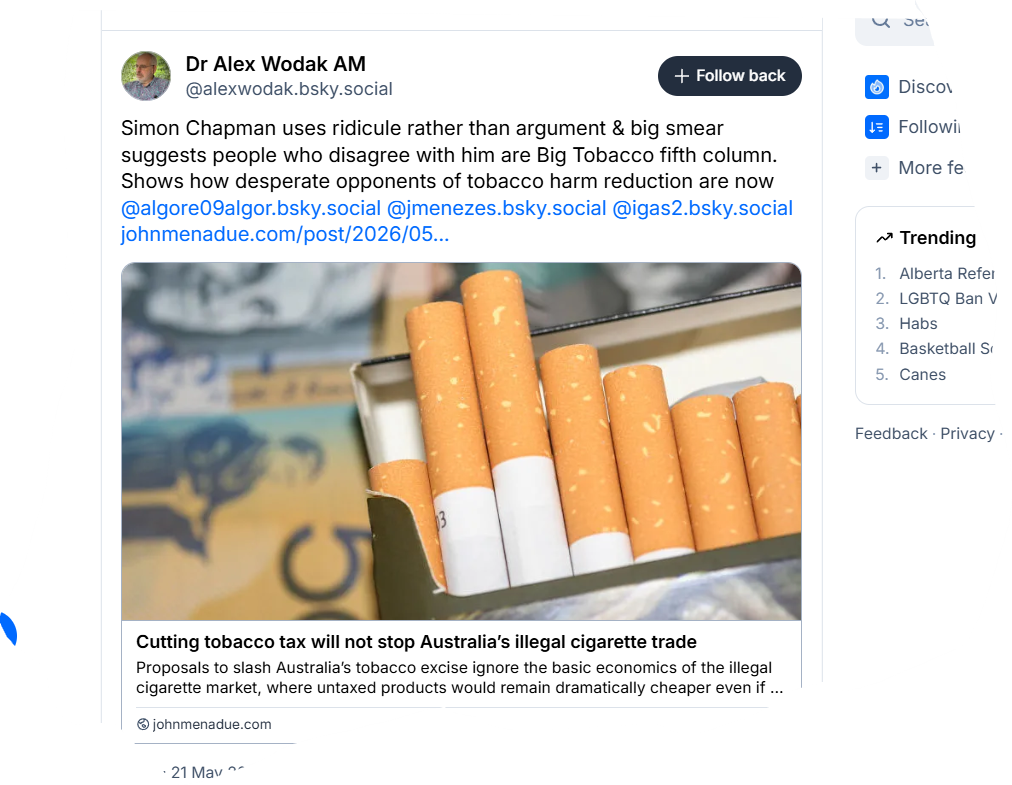
Tailpiece #1 John Menadue’s blog, Pearls and Irritations, republished this blog here on May 19. It caught the eye of the lugubrious vape promoter Dr Alex Wodak who reached into his deep lexicon of nastiness (see an earlier blog here), declaring on his BlueSky feed this garbled rubbish (“rather than argument and big smear” …what???) :

Fresh from a 2025 invited tour of British American Tobacco’s “innovation centre” in Southampton, Wodak recently made a doorstopper submission to the recent Australian Senate Enquiry into illicit tobacco.

Across 21 pages, he helpfully included no less than 17 screenshots from Philip Morris and Altria reports to make his argument that reduced harm products like vapes would lead nations away from smoking, a position identical to that of Big Tobacco companies. You could almost feel the love. Invited study tours of Philip Morris innovation centres can surely not be far off.

Odd then indeed that many nations awash with vaping thanks to liberal access policies have not seen them sweep past Australia’s smoking prevalence rate, as I argued with colleagues here.

Odd then too, that with all the years of all this innovation, British American Tobacco still rakes in 82% of its revenue from combustible tobacco. And no tobacco company – unlike car manfacturers transitioning from fossil fuel powered cars to electric vehicles – has yet to name a date whe they will stop making cigarettes.

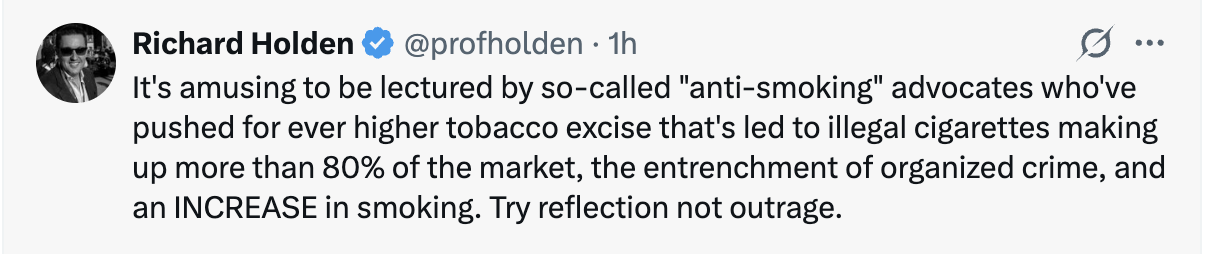
Tailpiece #2 On Jun 22, 2026 economist Prof Richard Holden who is the UNSW Vice-Chancellor’s Professor Chief Societal Economist and Director of the Manos Institute for Cognitive Economics wrote in his Financial Review column that “a small cut in [tobacco] excise won’t reverse this trend now that the illicit market is entrenched. Marginal changes to relative prices won’t do the trick. We have to shift the entire equilibrium by rewinding the clock to 2016. The way to do this is to cut the excise to zero.”

This was very odd, because in 2016 tobacco excise was 61 cents per stick or $12.20 a pack — certainly not a zero tax time (we’d need to go back to 1901 for that).

So I emailed, asking him:  

“If all tax was axed, you could buy a pack of (formerly) taxed cigarettes for just over $11. Right now you can buy an illegal pack for $7 if you buy by the carton  (which many do). Do you really think that budget conscious smokers would be happy to pay $4 a pack more? If you look at the prices in supermarkets, competition is seldom more than $1.50/pack between budget brands. But cigarettes sell in Cambodia, a major illicit transit country, for as low as 34c/pack. So criminals have massive wriggle room to drop their local prices here far lower and still remain profitable.”

He replied “In my view, cutting the excise to zero would make legal cigarettes cheaper (in equilibrium) than illicit cigarettes and would thus drive the illicit providers out of the market”. Well that’s easy to say, but how given the large price differential that would still remain, would legal untaxed cigarettes compete with illegal cigarettes?. Trying to understand his reasoning here was why I wrote to him. Simply asserting that it would happen is not good enough if you are trying to make a serious case.

We had further email exchanges in which he avoided addressing my question. When I wrote “Please take a look at what has happened to smoking rates in Australia in the last decade. Prevalence in both adults and kids has never been lower … Australia is on the cusp of ending tobacco use by children” he replied “Consumption is up 40% since 2017. That’s just a fact. How can you say we’re on the cusp of ending smoking?” (I had said that we are on the cusp of ending smoking in children).

I then asked him if he was relying on the recent Australian Bureau of Statistics report on nicotine in wastewater for his 40% statement. I wrote: “Are you talking about wastewater data in saying that?   If so, you do realise that wastewater measures nicotine, not “smoking” and that the surge in vaping, its massive nicotine delivery (you can get 10,000- 50,000 puff vapes) has likely hugely distorted  the picture. There’s also NRT in wastewater. I later discovered on his X account he had made it plain that he thought the wastewater report measured smoking, not nicotine.

The wastewater report states explicitly “it is not possible to discern whether the rise in per capita consumption [of nicotine] reflects a rise in the number of people consuming tobacco and/or existing smokers consuming more.”

He then parried further, asking “You seriously rely on survey data?” and then “I don’t think this is productive. I wish you the best. Please don’t correspond with me any further.” To which I replied “Come on Richard, have a go. You went out on a public limb and I suspect now know you did not think it through. It’s an obvious question I’ve asked you, so what’s the problem in answering or graciously admitting you made a mistake?”

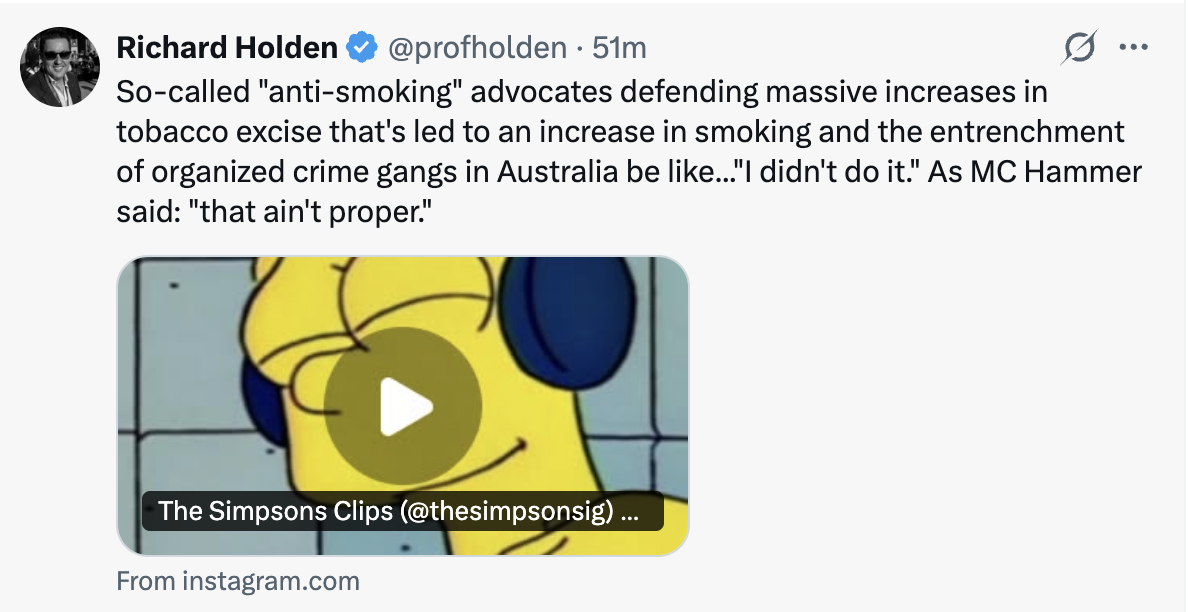
After he closed down our email interaction, I returned to his X account to get some screen shots of my posts to him for this tailpiece, only to find:

I’d made two posts (now removed by his blocking). One was a link to this blog, politely inviting him to explain why he knew better. The second simply noted that the waste water report measured nicotine, not smoking, and that nicotine included tobacco, vapes and nicotine replacement therapy.

But I was “lecturing” him, not questioning him. I am one of those “so-called anti-smoking advocates”, not a researcher for 50 years across a wide range of public health topics.

Prof Holden seems a little thin-skinned.

Blog Stats

  • 187,960 hits

Top Posts & Pages

  • Indelibly sear this into the national public and political DNA: evidence-based prevention saves many lives. So let’s all honour our COVID-19 heroes.
  • Vaping theology: 9 “Won't someone please think of the children!”
  • “Man the lifeboats! Australian smoking has stopped falling” … or has it?
  • Vaping theology: 2 Tobacco control advocates help Big Tobacco
  • How inexperienced are you? a game that might tell you
  • Vaping theology: 6 There’s nicotine in potatoes and tomatoes, so should we restrict or ban them too?
  • How good are ecigarettes at helping smokers quit?
  • Has Sydney's Inner West Council really caused a tree-mageddon?
  • What are the limitations of the randomised controlled trial of ecigs v NRT, just published in NEJM?
  • The relentless commodification of quitting

Comment Policy: No anonymous or pseudonymous posts will be published

Recent Posts

  • Pictures say a 1000 words: visual commentary on mobile phone addiction
  • Could supermarkets-only tobacco sales be Australia’s next giant step in making smoking history?
  • In praise of smoking rooms at airports
  • Tattoo regret: should there be a mandatory cooling-off period?
  • NSW Opposition leader Kellie Sloane claims “farmers and sporting shooters” not risks for committing gun violence.

Recent Comments

unknownbravelyf6160d72bd's avatarunknownbravelyf6160d… on Could supermarkets-only tobacc…
Stephen Leeder's avatarStephen Leeder on Could supermarkets-only tobacc…
malonere's avatarmalonere on Could supermarkets-only tobacc…
tahirturk1's avatartahirturk1 on In praise of smoking rooms at…
Simon Chapman AO's avatarSimon Chapman AO on This cat’s nine lives 

Archives

  • November 2026
  • October 2026
  • September 2026
  • August 2026
  • July 2026
  • June 2026
  • May 2026
  • April 2026
  • March 2026
  • February 2026
  • January 2026
  • December 2025
  • August 2025
  • July 2025
  • June 2025
  • May 2025
  • March 2025
  • January 2025
  • November 2024
  • October 2024
  • September 2024
  • July 2024
  • May 2024
  • April 2024
  • March 2024
  • February 2024
  • January 2024
  • December 2023
  • November 2023
  • October 2023
  • September 2023
  • August 2023
  • July 2023
  • June 2023
  • May 2023
  • March 2023
  • February 2023
  • January 2023
  • December 2022
  • November 2022
  • October 2022
  • August 2022
  • June 2022
  • April 2022
  • March 2022
  • February 2022
  • January 2022
  • December 2021
  • October 2021
  • September 2021
  • August 2021
  • June 2021
  • May 2021
  • April 2021
  • March 2021
  • February 2021
  • January 2021
  • December 2020
  • November 2020
  • October 2020
  • September 2020
  • August 2020
  • July 2020
  • June 2020
  • May 2020
  • April 2020
  • March 2020
  • February 2020
  • January 2020
  • December 2019
  • November 2019
  • October 2019
  • September 2019
  • August 2019
  • July 2019
  • June 2019
  • May 2019
  • April 2019
  • March 2019
  • February 2019
  • January 2019
  • December 2018
  • November 2018
  • October 2018
  • September 2018
  • August 2018

Categories

  • Blog

Meta

  • Create account
  • Log in
  • Entries feed
  • Comments feed
  • WordPress.com

Blog at WordPress.com.

  • Subscribe Subscribed
    Simon Chapman AO
    Join 180 other subscribers

    Have a WordPress.com account? Log in now.

  • Simon Chapman AO
    View site in Reader
    Manage subscriptionsSign upLog in
    Report this content
    Collapse this bar
Loading Comments...