
Tags
Sydney has just opened a new second airport, the Western Sydney International Airport: the Nancy Bird Walton Airport. Like Sydney’s main international airport, Kingsford Smith, the new airport has no internal smoking rooms. Outside, a common sight is desultory smokers on the designated smoking zones on pavement away from the terminal doors frantically dosing themselves with nicotine before smoking or vaping deprivations that can last as long as 17 hours 30 minutes (14,498 km) from Perth to London, the scene in cold or rainy weather is not a happy one.
There are some 178 airports worldwide with smoking areas, rooms or outdoor terraces past security. United Airlines introduced the first designated smoking area inside aircraft in 1971. The first airline to ban smoking completely was Guernsey’s Aurigny Air Services in 1977 for its minutes long flights to the UK. Today, no airline anywhere in the world allows smoking, after these bans accelerated from the 1980s. This has now extended to vaping.
My most memorable flight here was in 1983 when I flew from Karachi to Islamabad in Pakistan. At check-in, I was asked if I wanted a smoking or non-smoking seat. Non-smoking, please. After take-off, the no smoking lights turned off and the man next to me immediately lit up. I buzzed the steward and explained I had booked a non-smoking seat. He returned with the flight manifest and pointing to the seats said “You are in the non-smoking seat, sir”.
I well recall the later momentum to introduce designated smoking “lounges” in airports. I’d seen these in Europe and Asia. Among these were at Frankfurt airport where individual one-person smoking booths were dotted throughout the airport. Smokers sat in a cloud of their own smoke in a 360o goldfish bowl spectacle to the crowds moving around them.
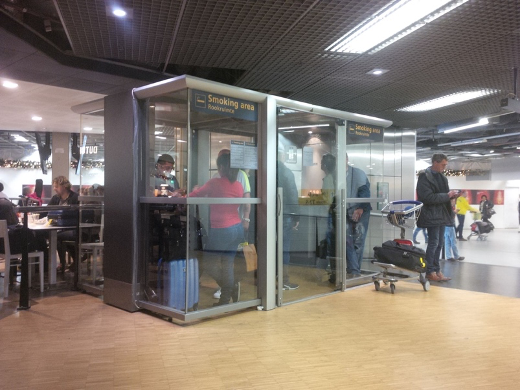
Frankfurt airport individual smoking booths
When I was often asked for comment on whether smoking rooms were a fair, reasonable and compassionate concession to smokers’ rights, I always supported the idea, much to the chagrin of some of my more fundamentalist colleagues. Some of these argued that these rooms might encourage smoking by a step to re-normalising it. To them, anything that might have even homeopathically tiny potential to promote smoking, needed to be stopped.
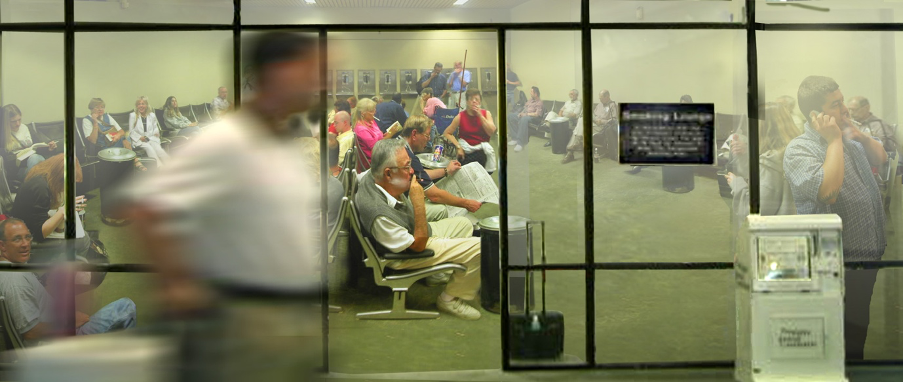
With all the time you have at airports waiting to board, I often looked – rivetted — at these rooms and those inside them. They looked nothing but miserable, dire places. If you needed to go into one, you needed far more to get out of it as quickly as possible once you’d rapidly banged your lungs full of smoke. To me, these rooms, particularly if they were located in common, high traffic areas of airports, were enormously powerful reminders to non-smokers about why they were very glad they didn’t smoke. And to kids, the very last place they’d aspire to be.
Smokers’ regret: social disapproval, embarrassment and denormalisation
International surveys have long shown that some 90% of smokers regret ever having started.
Australian research has found 64% of smokers perceive disapproval from family and friends and 31% feel embarrassed to be a smoker. ‘These norms are associated with having set a firm date to quit in the next month and with engaging in smoking limiting behaviours. Embarrassment was also associated with an increased likelihood of talking about quitting and with making a quit attempt. Associations were mostly comparable for lower and higher SES smokers, with no significant negative rebound effects overall or among subgroups.”
Smoking rooms are almost peerlessly powerful reminders to smokers of their ever-diminishing prevalence in many nations, and indelible reminders of why smokefree public indoor spaces are near to universal in some nations. These rooms are the zenith of how far smoking has been denormalised. They are seen by hundreds of millions of travellers globally every year. It is almost unimaginable that any of those looking at the smokers would think “I might take up smoking so I can join those inside. This is my new future.”
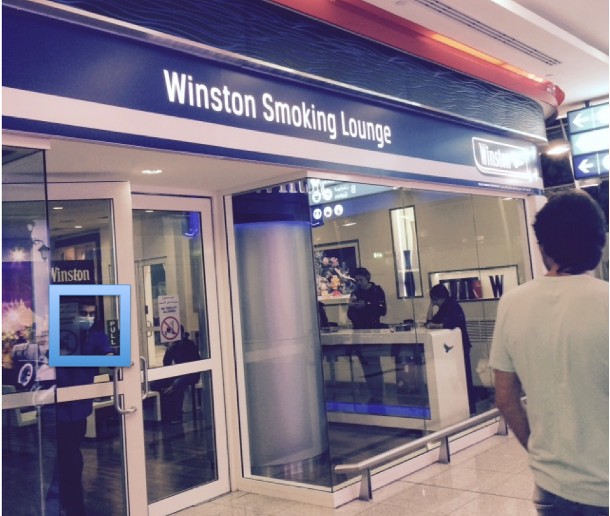
Dubai smokers’ room 2015. Note health-conscious smoker with mask inside
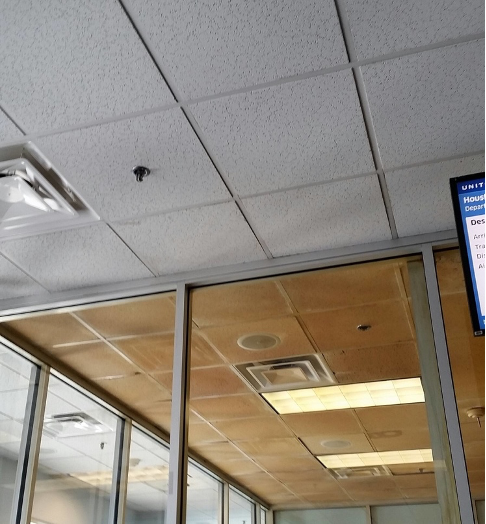
Cigarette smoke tar on the ceiling of a smoking room, compared to that immediately outside, Dulles Airport, Washington DC
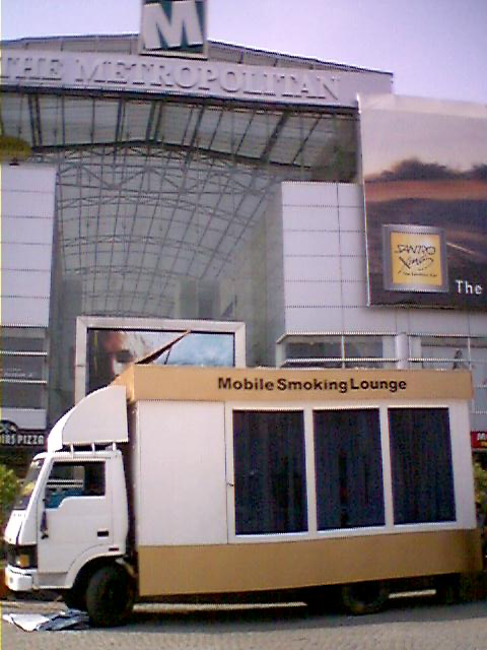
Step right inside! A mobile smokers’ lounge, Mumbai India, outside a shopping centre
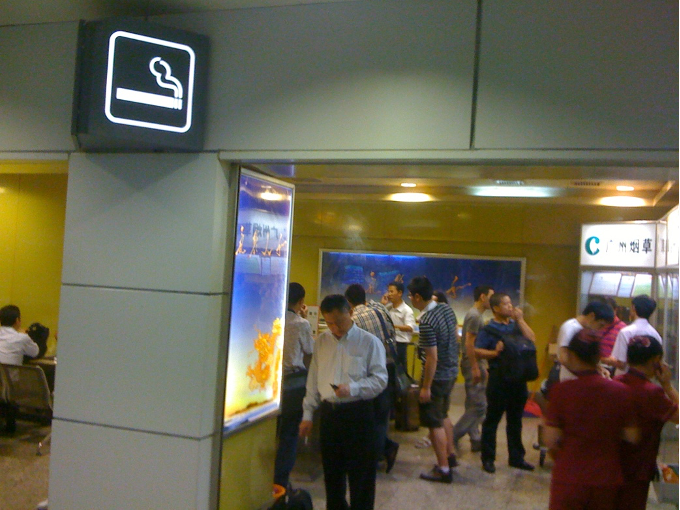
]Shanghai airport smokers’ room


Can’t say I agree with you on this one, Simon. When I was at Frankfurt Airport, the smoking lounges struck me as part of the problem rather than part of the solution. The doors were frequently left open and security appeared unconcerned about it.
I also question whether dedicated smoking lounges, particularly those carrying tobacco branding or sponsorship, simply reinforce smoking by providing constant visual reminders and convenient places to smoke. From a behavioural standpoint, removing them would further denormalise smoking and reduce opportunities for smokers to light up while travelling.
LikeLike