
Tags

Despite illegal untaxed, cheap tobacco retailing in plain sight across Australia, smoking rates have never been lower and are dropping at a faster rate than ever before. Australia’s latest (2025) national smoking prevalence data show just 5.6% of those aged 14 and over are smoking daily, with another 2.2% smoking less than daily – a total of 7.8% who ‘currently’ smoke.
Note here too, that these data report any smoking, regardless of whether the tobacco being smoked is legal or illegal. The estimated 80% of tobacco and nicotine products being bought from illegal retailers represents a mass exodus from high priced taxed tobacco to more easily affordable products. But despite this, smoking prevalence is rapidly declining: the lure tax-free cigarettes is not potent enough to overwhelm all the other pull factors which have seen smoking declining almost continually for over 40 years.
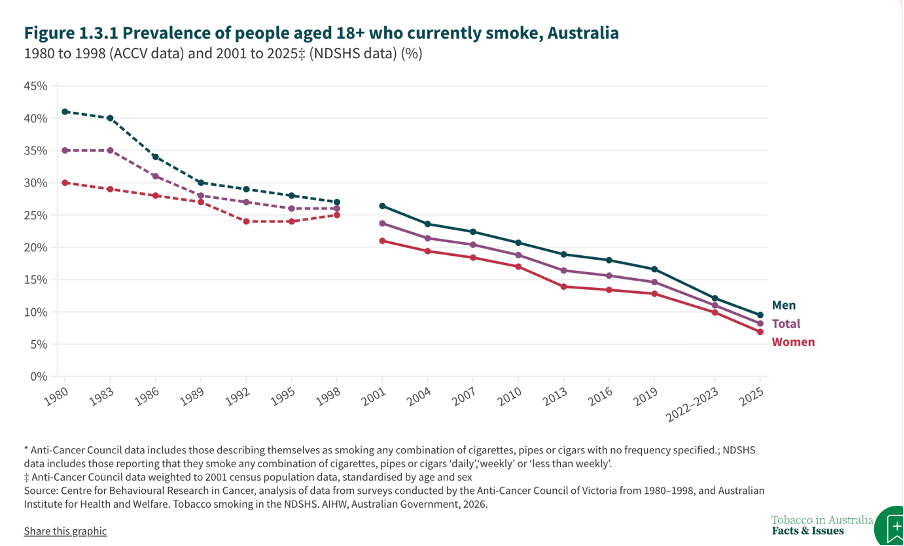
Source: Tobacco in Australia: Facts and Issues
With some 90% of smokers regretting they ever started, 90% of 7.8% leaves less than one percent of all Australians over 14 who are smokers and happy to be so. In Australia, some 76% of smokers try quit or reduce their smoking each year, with two-thirds planning to eventually quit, driven mostly by financial cost (48%) and health concerns (45%).
So tobacco is a product in a fatal death spiral. In 2022-23 – the last time the national survey was undertaken, the daily smoking rate for those aged 14+ was 8.3%. The current 5.6% rate is an unprecedented absolute fall of 2.7% (and a whopping relative fall of 32.5%).
Smoking rates by children aged 12-17 are also lower than they have ever been (grapoh below)
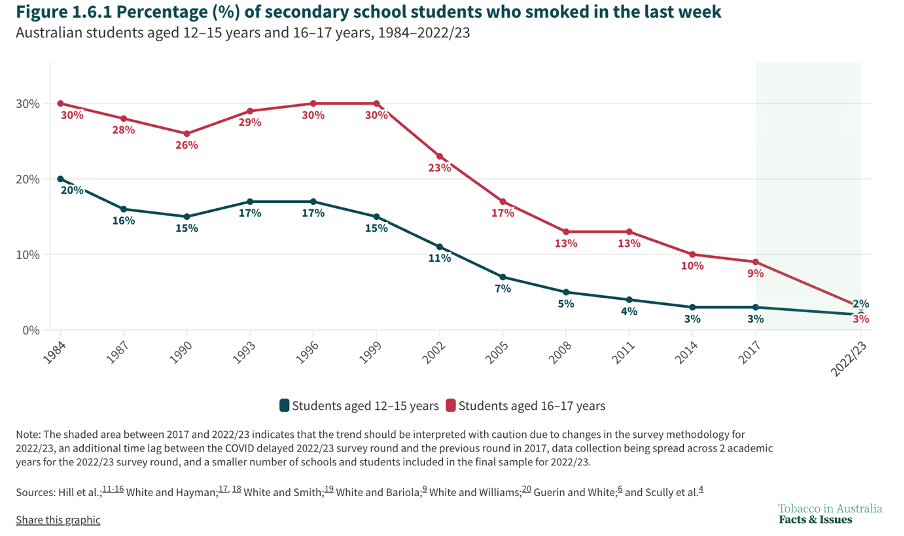
Source: Tobacco in Australia: Facts and Issues
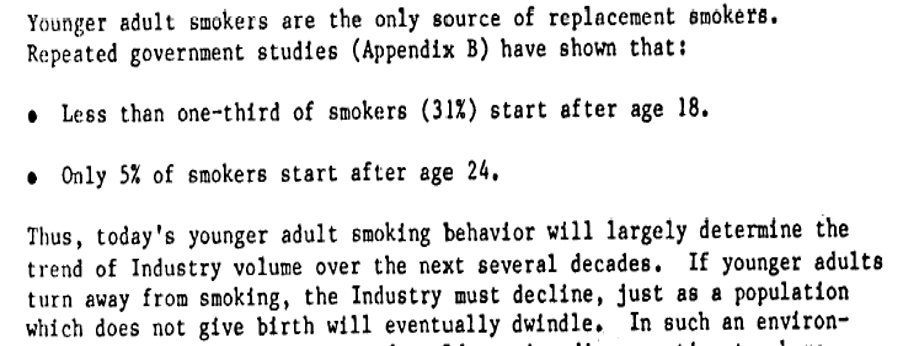
As a 1984 tobacco industry memo put it bluntly (at page 10): “If younger adults turn away from smoking, the industry must decline, just as a population which does not give birth will eventually dwindle.”
Rampant over-supply of tobacco
Australia has between 6500-7800 petrol stations providing fuel for 22.3 million registered motor vehicles; 6100 pharmacies serving 28 million Australians who make 440 million annual visits; In NSW, as at June 2022, there were some 300 businesses licenced to sell firearms to 261,000 licensed gun owners (as at Dec 2025). There are 2,158 shops licensed to sell alcohol in NSW to the 73% of 6.9 million people aged 18 and over who drink alcohol (5.037m drinkers). These are commercial environments where regulators constrain proliferation and strictly enforce regulations and standards on the good sold because of health, safety and social considerations.
The true number of retail outlets selling tobacco and vaping products is challenging to calculate because of widespread illegal retailing not listed on any databases. A 2016 Queensland government report on tobacco retail licensing quoted a British American Tobacco Australia estimate of 40,000 tobacco retailers in Australia. The tobacco industry has long been in the habit of exaggerating data that suit its various public arguments. But let’s take them at their word here and compare 40,000 outlets serving 1.3m daily smokers plus 500,000 less-than-daily smokers (1.8m) from a total population aged 14+ 15.9m to other widely used regulated products (see table).
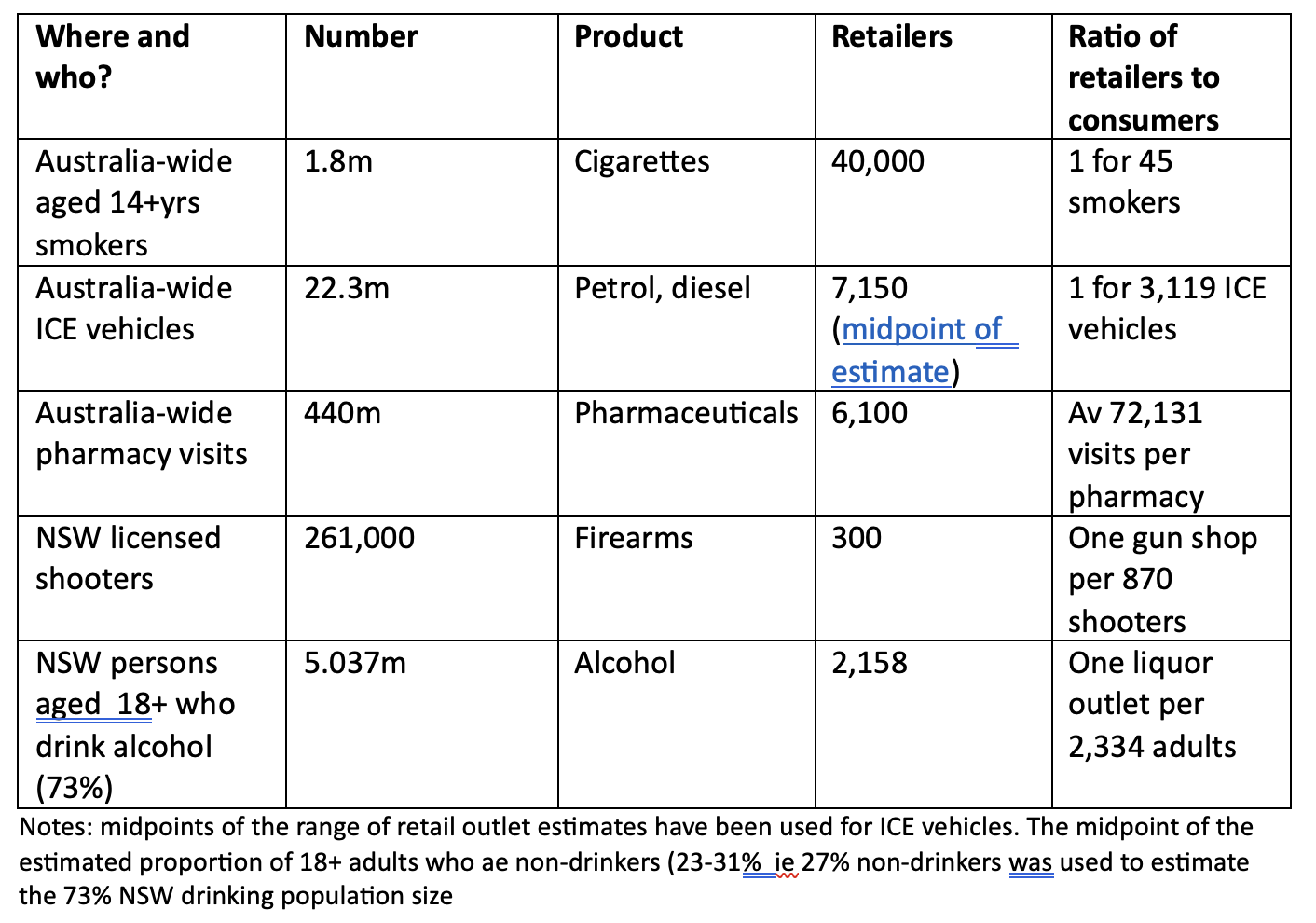
By any of these retailing comparisons, Australia’s 1.8 million smokers are being massively over-serviced. The ever-declining proportion of smokers would not be significantly inconvenienced by large-scale reductions in tobacco retailers.
Such reductions would send yet another powerful message that tobacco products are not benign grocery items like food, confectionary or household cleaning products.
But large-scale reductions would also make it far easier for health authorities and police to do spot checks for illegal retailing. In NSW, for example, there have been 523 illegal shop closures in the 367 days since Nov 3, 2025. The number of checks are not published, but industry sources suggest there are up to 19,000 retailers in NSW so lots are likely to have never had the knock on the door.
These data send a message to all illegally trading that the odds of being checked is remote, as anyone noting the enduring slew of illegal shops in their own suburb can easily deduce.
Which retailers should be allowed to sell tobacco?
The on-going 90 day closures of illegal traders is something of a whack-a-mole exercise: for every shop being temporarily closed, there are many, many more which continue openly trading including new players opening up. There has never been widespread legal compliance in tobacco retailing. NSW Health data show that both retailers with tobacco licenses and those which are unlicensed are both selling tobacco. So licensing alone is far from an antidote to illegal selling.
A regime is needed which would see a major radical reduction in the number of retailers selling tobacco in Australia, while still allowing convenient access to smokers to legal tobacco.
Supermarkets least likely to sell illicits and to kids
Tobacco retailers have long sold cigarettes to children, often explicitly encouraged by the tobacco industry. Early in my career, compliance monitoring stings were often conducted to see if shops would sell to children . For example, in 1994, 39% of 255 western Sydney shops sold to 12 and 13 year olds asking for cigarettes. In Western Australia in 2005, a compliance study found children were able to buy cigarettes at 88% of retailers in Augusta, 79% in Esperance, 77% in Manjimup and 66% in Margaret River.
Each state has found dedicated tobacconists, whether individual independents, chains or franchises, selling illegal cigarettes and vapes.
By contrast, major supermarkets have been found to rarely sell to children and have never to my knowledge been found stocking illegal cigarettes or vapes. In NSW they voluntarily introduced display bans before the government legislated them. They are obvious easily accesible candidates to be allowed to continue to sell excise-paid cigarettes. Aldi in Australia does not sell tobacco products, which leaves Coles (1,874 stores), Woolworths (1,142) and IGA (1,285) for a total of 4,301 outlets nationally. Far less than the 40,000 some current total outlets.
These chains have established histories of commercial governance, boards, legal compliance and brand reputation management which would be badly damaged by illegal trade or selling to children if severe penalties including permanent loss of tobacco license was involved.
These supermarkets are widespread in cities and large towns, but small towns – often large distances from cities or major towns – often have only small grocery stores or mini-markets, which typically sell tobacco. Smokers in these small communities would understandably raise equity concerns if they could not buy tobacco without driving long distances to buy it. Politicians are likely to have zero appetite for denying such access while having zero tolerance for those which continued to sell illicits and to kids.
Such a proposal would obviously need serious a national feasibility study, with affected retailers given an opportunity to argue why they should be allowed to sell. Many who have never been closed or prosecuted for illegal sales will line up to strenuously argue that they have an exemplary record. A national feasibility study perhaps within a parliamentary enquiry should explore options for licensing in such small communities.
Cynics will argue that, as now, many illegal retailers in large numbers will take their chances and simply remain open regardless of any new licensing scheme. As now, these should continue to be actively closed, stock seized and prosecuted. But a widely publicised implementation day should be announced when thereafter any unlicensed tobacco retailer would be closed permanently and landlords fined severely.
Hands will go out all over the country asking for compensation. No compensation was ever offered to either tobacco manufacturers nor retailers across decades when potent policies were introduced that saw sales fall. Those taking their chances selling tobacco have known since the 1950s that they were selling a deadly product that saw millions of their best customers die or quit without governments sugaring this slide with compensation. Now is not the time to forget this.
Tobacco control advances like total advertising and sponsorship bans, smokefree airlines, workplaces, restaurants and bars, retail bans on displaying tobacco products, graphic health warnings on packs, governments suing the tobacco industry for billions, plain packaging and pharmacy-only legal access to vapes were all said to be ludicrous and impossible political goals. But all have been legislated or prosecured in a growing number of nations.
Greatly reducing the number of outlets able to sell a product which kills 2 in 3 long term users needs to be the next bold step.

