In 2006, we lived in Lyon in a 17th century apartment, just up Montée de Chemin Neuf about 300m from the old town, Vieux Lyon, with its cobbled narrow streets, subterranean traboules and gastronomic restaurants. I was on the first sabbatical I had ever taken in more than 25 years as an academic. I had a desk at the WHO’s International Agency for Research in Cancer and wrote a textbook on public health advocacy across 8 months of one of the best years of my life.
We became great friends with some neighbours, Claire-Marie and Phillipe. Two years after returning home, we returned to Europe on a holiday and decided to fly first to Lyon and spend time with them again.
We decided to take them a really good Australian wine. I bought a Penfolds St Henri. I fretted about it being smashed in the stowed luggage, even if packed in rolls of clothing in the centre of the suitcase. So I packed in it in my hand luggage.
The luggage scanning camera picked it up as we went through customs, just after immigration and of course it was confiscated. In the excitement of the departure, I’d totally forgotten about the liquids ban. “Are you some kind of moron, Simon?” Trish said to me loudly as the uniformed customs man placed it in the box where all the confiscated perfumes, cosmetics, and nail files so often used by terrorists to hijack aircraft were stored for destruction each day. I had visions of the loud guffawing in the customs officers’ staff room and scissors-paper-rock rounds being played to find which one would take my bottle home.
“Well, you idiot, we’re now going to have to buy a replacement in the duty-free area here and so pay all that money all over again” my sanctimonious wife delighted in telling me. “And don’t think you’re going to get away with buying something cheap. I know you!”
So, a second St Henri in hand, ensconced in its sealed thick plastic see-through duty-free bag, we set off for Frankfurt, where we’d change planes for the flight south to Lyon–Saint Exupéry Airport airport.
Yes, dear readers … I think you can see what is coming …
At Frankfurt we had to collect our stowed bags and go through customs to board the internal EU flight to Lyon. So of course, with my luck, the second St. Henri was confiscated again.
My empathic wife this time unloaded audibly and unmercifully “Don’t you ever think anything through? I can’t believe your stupidity!” I gently reminded her that it was she who had insisted I buy the new bottle at Sydney. “So aren’t you the one who travels all the time for work? Didn’t you stop for a second and think that this might happen?” she continued.
Never her fault.
“We just can’t arrive bare-handed. You’re just going to have to buy them another bottle. And DO NOT be mean – get them something really good.” I knew I had to do this. Third time lucky.
But of course, the world famous Australian wine section in Frankfurt’s duty-free section with queues around the airport was nowhere to be found. If I wanted a French grand cru or an Italian Brunello, there were row upon row to choose from. But I couldn’t take coal to Newcastle, so settled on an aged litre of single malt, which almost melted my credit card.
So we made our way toward the gate to board our flight to Lyon. Not 20 metres from the duty-free cash register, the bag holding the whiskey split and with an almighty crash, Scotland’s finest pooled all over the hard tiled floor. I took the sodden split bag back to the cash register protesting the bag I had been given and wanting a refund. There was talk about me waiting for the duty manager to get back from some far flung part of the airport to make a decision. But our flight was leaving in 20 minutes.
We flew to Lyon empty-handed. Claire-Marie and Phillipe laughed and laughed and said they didn’t ever really drink whiskey anyway. They opened some superb Condrieu and Haut Medoc.
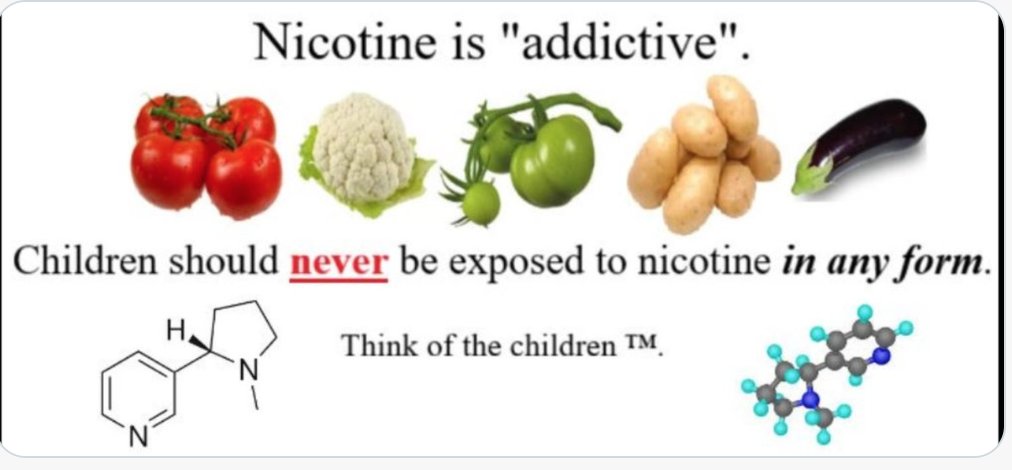
In 1989, the now long defunct Tobacco Institute of Australia’s West Australian spokesman Ron Berryman advised us all to relax and simmer down on nicotine, saying:
Ron’s excitement was all about the fact that the tobacco plant is related to other members of the solanaceae (nightshade) family. These include tomatoes, aubergines (eggplants) and potatoes. Nicotine alkaloids occur naturally in all of these, but in … shall we say … rather different concentrations.
Thirty two years on, this week Alex Wodak, the gift who keeps on giving to my series on Vaping theology (see here and here), did not disappoint, posting this reprise of an old tobacco industry meme.
And boy, did he show us how profoundly ignorant and inconsistent all those health agencies and experts are who are expressing caution about nicotine being not quite the almost vitamin-like wonder chemical that many vapers claim it to be. As we’ll see, it’s blindingly “obvious” that with nicotine being in both vape and solanceous vegetables, policy toward both demands to be aligned.
So let’s run through how nicotine in cigarettes and e-cigarettes compare to that in vegetables.
Both cigarettes and e-cigarettes contain a wide range of nicotine, depending on the brand and concentration of nicotine found in different vaping delivery systems. But when you smoke 20 cigarettes, you’ll inhale somewhere between 22-36mg of nicotine, so a midpoint of say 30mg a day. This study found that across different e-cigarettes, 15 puffs delivered between 0.5 to 15.4 mg of nicotine. The average vaper pulls on their e-cig 172 times a day, meaning that across a day they inhale between 5.7 to 176.6mg of nicotine. Let’s take the midpoint of that range (85.5mg) as an average.
Now let’s look at what sort of dose you get from eating vegetables containing nicotine alkaloids. Let’s first pause to emphasise that nicotine in cigarettes and e-cigarettes is measured in milligrams (mg), but in vegetables nicotine alkaloids are much, much less concentrated and are measured in nanograms (ng).
Now let’s work this through for the potato option to see how many potatoes a 172 puff-a-day vaper would need to eat to consume the same amount of nicotine from vaping.
Remember what we learned in first year high school science?
1000 nanograms (ng) = 1 microgram (mcg or µg)
1000 mcg = 1 milligram (mg) or 1,000,000ng
1000 mg = 1 gram (g) or 1 billion ng
1000g – 1 kilogram (kg) or 1000 billion ng
1000kg = 1 tonne
A typical potato weighs 150g and therefore contains 2,250 nanograms or 2.25 micrograms of nicotine. So if your daily potato-sourced nicotine target equivalent is the 85.5 milligrams a vaper inhales each day, a ballpark of a mere 13,000 potatoes per day will get you there. So your Hello Fresh daily delivery order will be for a paltry 2,000 kg, every day. Two tonnes.
After that feast, if a vaper was to go for a swim in Sydney harbour and let go a fart, teh blast zone would devastate greater Sydney with the subsequent tsunami.
Keep ‘em coming Alex!
See also in this series:
Vaping theology: 1 The Cancer Council Australia takes huge donations from cigarette retailers. WordPress 30 Jul, 2020
Vaping theology: 2 Tobacco control advocates help Big Tobacco. WordPress 12 Aug, 2020
Vaping theology: 3 Australia’s prescribed vaping model “privileges” Big Tobacco WordPress Feb 15, 2020
Vaping theology: 4 Many in tobacco control do not support open access to vapes because they are just protecting their jobs. WordPress 27 Feb 2021
Vaping theology: 5 I take money from China and Bloomberg to conduct bogus studies. WordPress 6 Mar, 2021
Vaping theology: 6 There’s nicotine in potatoes and tomatoes so should we restrict or ban them too? WordPress 9 Mar, 2021
Vaping theology: 7 Vaping prohibitionists have been punished, hurt, suffered and damaged by Big Tobacco WordPress 2 Jun, 2021
Vaping theology: 9 “Won’t somebody please think of the children”. WordPress 6 Sep, 2021
Vaping theology: 10: Almost all young people who vape regularly are already smokers before they tried vaping. WordPress 10 Sep, 2021
Vaping theology: 11 The sky is about to fall in as nicotine vaping starts to require a prescription in Australia. WordPress 28 Sep, 2021
Vaping theology: 12 Nicotine is not very addictive WordPress 3 Jan 2022
Vaping theology 13: Kids who try vaping and then start smoking,would have started smoking regardless. WordPress 20 Jan, 2023
Vaping theology 14: Policies that strictly regulate vaping will drive huge numbers of vapers back to smoking, causing many deaths. WordPress 13 Feb, 2023
Vaping theology 15: The government’s prescription vape access scheme has failed, so let’s regulate and reward illegal sellers for what they’ve been doing. WordPress 27 Mar 2023
Vaping theology 16: “Humans are not rats, so everybody calm down about nicotine being harmful to teenage brains”. WordPress 13 Jul, 2023
Vaping theology 17: “Vaping advocates need to be civil, polite and respectful” … oh wait. WordPress 3 Oct, 2023
Vaping theology 18: Vaping is a fatally disruptive “Kodak moment” for smoking. WordPress Oct 30, 2023
Vaping theology 19: Vaping explosions are rare and those who mention them are hypocrites. WordPress 17 Nov, 2023
Vaping theology 20 : Today’s smokers are hard core nicotine dependent who’ve tried everything and failed – so they need vapes. WordPress 14 Dec, 2023
Vaping theology 21: Australia’s prescription vapes policy failed and saw rises in underage vaping and smoking. WordPress 10 Jan, 2024
Vaping theology 22: “Prohibition has never worked at any point for any other illicit substance”. WordPress 17 Mar 2024
Vaping theology 23: “84% of the Australian public are opposed to the way the government will regulate vapes” WordPress 2 Apr, 2024
Vaping Theology 24: “Tobacco control advocates are responsible for vape retail store fire bombings and murders. WordPress 27 May, 2024
I’ve written before on this blog about the efforts of Alex Wodak, a director of the Australian Tobacco Harm Reduction Association, to smear the Cancer Council by alleging, completely falsely, that they receive money from tobacco retailers and are therefore hypocrites.
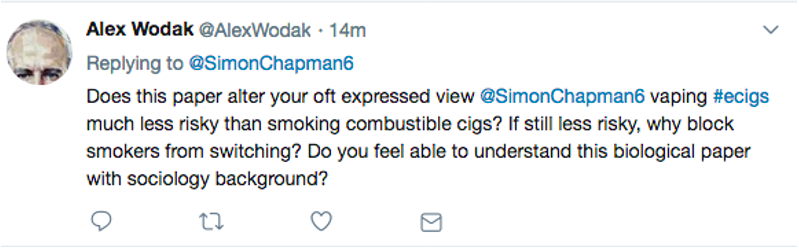
I block many trolls and obsessives on Twitter for a variety of reasons. I block Wodak because I don’t give the time of day to those who post unabashed “doctor knows best” arrogant tweets like these:
# at the end of the blog, see a list of prominent non-clinical supporters of vaping who despite their great handicap of not having a medical undergraduate degree, are apparently able to comprehend biological publications.
Wodak often tweets with unctuous certitude about the importance of politeness
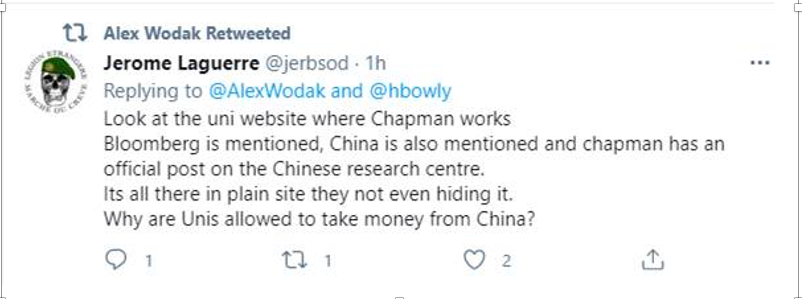
Yet Wodak has now joined with some semi-literate vaping troll, “Jerome Laguerre” (“Its all there in plain site … they not even hiding it”) whom I block on Twitter, in trying to imply that I am funded by “China”.
So let’s look at how they arrive at all this. Laguerre probably googled my name, perhaps with “Sydney University” in the hope of hitting paydirt on some nefarious, scandalous, secret information about my shameful connections. He may have found this:
If he had bothered to then click “China Studies Centre” he might have noticed that the CSC is entirely funded by Sydney University and that 300 scholars at the University, including me, are “members” of the CSC. But Lageurre knows that I have “an official post”.
What does “membership” mean? When the CSC was established at the University of Sydney in 2011, all staff with any research interest in China (in any field) were invited to register their interest with the CSC. This would facilitate communication and perhaps shared projects between staff, students and those external to the University sharing information and collaborating. All those with such interests are listed as “members”.
I had long had research and teaching collaborations in tobacco control with Fudan and Zhejiang Universities. I’d also edited a supplement on China for the BMJ’s Tobacco Control journal. I had guest lectured at Zhejiang University once in 2010, and been to Fudan in Shanghai several times, to lecture and work with colleagues there on projects that eventually produced six publications (all listed in my CV here). Chinese universities often confer honorary roles on international staff who assist them with teaching and research. That happened to me with both of these universities.
In none of these collaborations was I paid anything. My air travel was paid for from $50,000 prize money I was awarded in 2008 for being NSW Cancer Researcher of the Year. I think it’s likely, although I don’t recall, that my hotel costs were paid for by the two Chinese universities. This is of course always customary when guest lecturers need to travel away from home.
So from that reality, Laguerre tweets, and Wodak retweets and responds (thus republishing the same utterly false tripe) that I “take money from China and Bloomberg through the Uni he is working for” to “produce bogus studies”. And predictably, this false news causes the intended reaction
Wodak has also recently published tweets stating that Maurice Swanson, the CEO of the Australian Council on Smoking and Health, is somehow being funded indirectly by “Bloomberg” (by which he presumably means Bloomberg Philanthropies).
But ACOSH has never received any funding or support of any kind from Bloomberg. It has long been funded the West Australian government’s Health Promotion Foundation, Healthway, something that basic searching could have established.
Wodak’s on-going attempts to smear Australian tobacco control agencies, charities and individuals and to insinuate that they are being secretive about who is funding their work in relation to efforts to have governments seriously regulate e-cigarettes, are just disgraceful.
#some prominent non-medical researchers and advocates who are pro-vaping:Linda Bauld, Ron Borland, Jamie Brown, Coral Gartner, Marewa Glover, Peter Hajek, Wayne Hall, Ann McNeill, David Sweanor, Ken Warner, Robert West
Other blogs in this series:
Vaping theology: 1 The Cancer Council Australia takes huge donations from cigarette retailers. WordPress 30 Jul, 2020
Vaping theology: 2 Tobacco control advocates help Big Tobacco. WordPress 12 Aug, 2020
Vaping theology: 3 Australia’s prescribed vaping model “privileges” Big Tobacco WordPress Feb 15, 2020
Vaping theology: 4 Many in tobacco control do not support open access to vapes because they are just protecting their jobs. WordPress 27 Feb 2021
Vaping theology: 5 I take money from China and Bloomberg to conduct bogus studies. WordPress 6 Mar, 2021
Vaping theology: 6 There’s nicotine in potatoes and tomatoes so should we restrict or ban them too? WordPress 9 Mar, 2021
Vaping theology: 7 Vaping prohibitionists have been punished, hurt, suffered and damaged by Big Tobacco WordPress 2 Jun, 2021
Vaping theology: 9 “Won’t somebody please think of the children”. WordPress 6 Sep, 2021
Vaping theology: 10: Almost all young people who vape regularly are already smokers before they tried vaping. WordPress 10 Sep, 2021
Vaping theology: 11 The sky is about to fall in as nicotine vaping starts to require a prescription in Australia. WordPress 28 Sep, 2021
Vaping theology: 12 Nicotine is not very addictive WordPress 3 Jan 2022
Vaping theology 13: Kids who try vaping and then start smoking,would have started smoking regardless. WordPress 20 Jan, 2023
Vaping theology 14: Policies that strictly regulate vaping will drive huge numbers of vapers back to smoking, causing many deaths. WordPress 13 Feb, 2023
Vaping theology 15: The government’s prescription vape access scheme has failed, so let’s regulate and reward illegal sellers for what they’ve been doing. WordPress 27 Mar 2023
Vaping theology 16: “Humans are not rats, so everybody calm down about nicotine being harmful to teenage brains”. WordPress 13 Jul, 2023
Vaping theology 17: “Vaping advocates need to be civil, polite and respectful” … oh wait. WordPress 3 Oct, 2023
Vaping theology 18: Vaping is a fatally disruptive “Kodak moment” for smoking. WordPress Oct 30, 2023
Vaping theology 19: Vaping explosions are rare and those who mention them are hypocrites. WordPress 17 Nov, 2023
Vaping theology 20 : Today’s smokers are hard core nicotine dependent who’ve tried everything and failed – so they need vapes. WordPress 14 Dec, 2023
Vaping theology 21: Australia’s prescription vapes policy failed and saw rises in underage vaping and smoking. WordPress 10 Jan, 2024
Vaping theology 22: “Prohibition has never worked at any point for any other illicit substance”. WordPress 17 Mar 2024
Vaping theology 23: “84% of the Australian public are opposed to the way the government will regulate vapes” WordPress 2 Apr, 2024
Vaping Theology 24: “Tobacco control advocates are responsible for vape retail store fire bombings and murders. WordPress 27 May, 2024
Just when you think you’ve met peak stupidity in the vaping debate, you find a new verse in vaping advocacy theology that makes you spray your coffee.
Here’s a proper doozie that often gets an outing from those with a taste for conspiracy theories. It runs like this.
“The obvious reason why there’s so much opposition among people in public health to all the regulatory reforms being advocated, is that these people are just trying to protect their jobs. Vaping is driving smoking down so fast that tobacco control people can see the writing on the wall. If there are no smokers left, they won’t have any problem left to deal with. So no wonder they are desperate to try slow down the inevitable.”
It’s an argument that some have used for many years
The deranged fraternal twin to this argument invariably then pipes up with “And those working in tobacco control are paid absolute fortunes and massive grants by governments, so they have huge incentives to attack anything which might really drive down smoking.” This recent blog by a Queensland vaper with recent form in getting things completely wrong (see below) ticks both these boxes, and plenty more besides.
I recommend you try to read the blog right through to get a feeling for the depths of claptrap these people can plumb when they let their fantasies off the leash. But let’s here focus on a few passages.
Where to begin with this batty nonsense? First up, if public health workers really didn’t want smoking rates to fall, why have they kept successfully advocating ever since the late 1960s for policies and programs that have caused the brakeless train to head south almost continually for 40 years? Here’s a graph of falling smoking prevalence in Australian adults, from results from two different survey series.
So what’s driving this disaster for the tobacco industry? Chance? Luck? How about synergies between the full suite of tobacco control policies and campaigns that’s made Big Tobacco long describe Australia as “one of the darkest markets in the world”? Mass reach public awareness campaigns (with beautiful irony, the very same ones that motivated many vapers to try ecigs); tax rises; total advertising and promotion bans; smokefree public spaces, public transport, bars, clubs and stadiums; retail display bans; graphic health warnings on packs; and plain packaging?
The massive Tobacco in Australia website documents the research evidence for all of these across hundreds of pages here.
So the fruitcake wing of vaping advocacy would have you believe that those of us who across 40+ years have worked to hold high success in achieving every policy and law reform we ever fought for; who saw millions of smokers quit and still more never take it up including record numbers of Australians today who have never smoked ; and who caused smoking to be utterly denormalised from an aspirational, glamourous thing that happened in every setting you ever entered to one where 90% of smokers today regret ever starting; who saw smoking rates fall to where they have never been lower; and who drove lung cancer incidence rates down to a level last seen in the early 1960s …. well, of course anyone can appreciate that we were making all this happen because secretly, we really didn’t want smoking to keep falling.
Secretly, we wanted everything we did to fail because in the words of our incisive, shrewd commentator cited earlier “You see as any shrewd person would realise, if you are getting paid big money for eliminating a problem and you eliminate it entirely, then the job is over, it’s done and therefore you have nothing to justify putting your hand out for.”
Presumably it’s just the same for COVID-19 specialists, those trying to reduce domestic violence, skin cancer, road deaths … in fact anyone trying to solve any problem. We need to understand that none of these problems have ever been eliminated because all involved are busy stomping on the brakes so they can keep their jobs.
Perhaps it’s more subtle than that. Perhaps we all secretly agree that the galloping uptake of vaping will be so furious and so amazingly successful in slashing smoking rates, that the bottom will fall out of all remaining smoking. Conversion to vaping will be all but total. When the miracle of vaping came along, the penny finally dropped and we all suddenly decided that enough was enough, saw the looming unemployment we all faced and called for e-cigarettes to be seriously regulated into prescription status.
But hang on. Neither of those assumptions are true: nowhere has vaping caused major declines in smoking prevalence, and vaping is quite dismal in its effectiveness in smoking cessation. In England, where vape shops wallpaper high streets and vaping theologists dominate policy forums, the proportion of smokers who vape, according to the latest data summary from Robert West’s Smoking In England project, e-cigarette use in adults has been stable since 2013, plateaued in smokers and recent ex-smokers, and the majority of e-cigarettes users are still smoking (dual users).Vaping may well be holding far more in smoking than it tips out of it.
Smoking seems to have even kicked up a little in the very latest English survey.
“Millions upon millions of dollars of grants via the federal department of health”
According to our Queensland blogger, those whose assessment of the evidence on e-cigarettes the government trusts have been rewarded with lavish grants from the Department of Health. This is curious, because it’s the NHMRC which awards research grants to successful applicants each year, not the Department. I stopped applying for grants well before I retired in 2016. And neither of my co-authors (Mike Daube and Matthew Peters) of the submission to the recent Senate committee on harm reduction which was frequently cited in the published majority report have any recent grants either. Perhaps I should go and check my letterbox or one of my many Swiss and Caribbean secret bank accounts?
But, interestingly, look who have recently been awarded a very large ($2.5m) grant to look at tobacco endgames. Why, it’s a list of excellent researchers which includes several who have often been praised by vaping advocates. So something seems to be not quite right here with the claim that vaping skeptics are being duchessed by the government.
But oh, I forgot. As our Queensland blogger told us, it’s also New York billionaire Michael Bloomberg’s small change via Bloomberg Philanthropies which is secretly showering Australian vaping skeptics with funds.
ATHRA director Alex Wodak seems to know this too, tweeting this week that the Australian Council on Smoking and Health in Perth (directed by Maurice Swanson) is funded via Bloomberg money apparently routed through “a few [of course nameless] organisations”. Very odd indeed, that neither Maurice nor Bloomberg know anything about this.
Vaping theology: 9 “Won’t somebody please think of the children”. WordPress 6 Sep, 2021
Vaping theology: 10: Almost all young people who vape regularly are already smokers before they tried vaping. WordPress 10 Sep, 2021
Vaping theology: 11 The sky is about to fall in as nicotine vaping starts to require a prescription in Australia. WordPress 28 Sep, 2021
Vaping theology: 12 Nicotine is not very addictive WordPress 3 Jan 2022
Vaping theology 13: Kids who try vaping and then start smoking,would have started smoking regardless. WordPress 20 Jan, 2023
Vaping theology 14: Policies that strictly regulate vaping will drive huge numbers of vapers back to smoking, causing many deaths. WordPress 13 Feb, 2023
Vaping theology 15: The government’s prescription vape access scheme has failed, so let’s regulate and reward illegal sellers for what they’ve been doing. WordPress 27 Mar 2023
Vaping theology 16: “Humans are not rats, so everybody calm down about nicotine being harmful to teenage brains”. WordPress 13 Jul, 2023
Vaping theology 17: “Vaping advocates need to be civil, polite and respectful” … oh wait. WordPress 3 Oct, 2023
Vaping theology 18: Vaping is a fatally disruptive “Kodak moment” for smoking. WordPress Oct 30, 2023
Vaping theology 19: Vaping explosions are rare and those who mention them are hypocrites. WordPress 17 Nov, 2023
Vaping theology 20 : Today’s smokers are hard core nicotine dependent who’ve tried everything and failed – so they need vapes. WordPress 14 Dec, 2023
Vaping theology 21: Australia’s prescription vapes policy failed and saw rises in underage vaping and smoking. WordPress 10 Jan, 2024
Vaping theology 22: “Prohibition has never worked at any point for any other illicit substance”. WordPress 17 Mar 2024
Vaping theology 23: “84% of the Australian public are opposed to the way the government will regulate vapes” WordPress 2 Apr, 2024
Vaping Theology 24: “Tobacco control advocates are responsible for vape retail store fire bombings and murders. WordPress 27 May, 2024
In November 2020, I was lead author with Emeritus Professor Mike Daube AO and Professor Matthew Peters AM of a 32 page submission to the Australian Senate Committee on Tobacco Harm Reduction. Our submission was cited many times in the final majority report of the Committee. I’ve since received many requests for a copy of the submission which are continuing, so am re-publishing it here for ease of access.
Robert Beaglehole is a veteran public health leader from New Zealand. He was professor of public health at the University of Auckland between 1988-1999, before joining the World Health Organisation in Geneva in 2000, heading its chronic disease prevention and health promotion division until 2007. He started New Zealand’s Action on Smoking and Health in 1982 and chairs its board today.
I’ve known and admired Robert’s work for many years, and have spent some very pleasant time in his company.
But lately, he has become an advocate for vaping and is showing signs of having drunk the movement’s kool aid rather deeply.
One of the most persistent memes in vaping advocates’ creed is the profoundly silly argument that anyone who expresses any scepticism about any of the pillars of the case for vaping is helping Big Tobacco. I explored this argument in an earlier blog here.
Recently, Beaglehole was interviewed for a short video produced by CAPHRA (the Coalition of Asia Pacific Harm Reduction Advocates).
Australia’s Therapeutic Goods Administration has ruled that from October 1, 2021 anyone wanting to import or purchase nicotine for vaping will be required to have a doctor’s prescription – see here. This is in effect a quasi “license to vape”, that has some of the reasoning in common with that I set out in a paper in 2012 on the idea of a “smokers’ licence”, later adapted by Coral Gartner and Wayne Hall in a paper on a “vaping licence”. The prescription route is now causing apoplexy among those who want to see e-cigarettes containing nicotine sold in almost every conceivable retail outlet (I’ve not yet seen this include crèches, tuck shops or back-to-school sections of stationery shops … but nothing would surprise me here).
Asked to comment on this recent decision to implement what the interviewer calls “a medical model” for vapouriser access, Beaglehole says at 2m35s:
Well, basically going that route privileges the tobacco industry. By making vaping less accessible and more difficult for smokers who smoke cigarettes and want to quit, making it more difficult for them to access nicotine is privileging Big Tobacco. That’s the last thing we want to do. We should be treating nicotine as a consumer product. Let the market innovate. Let people make their own choices as to what they do.
So, what do the main tobacco companies selling tobacco in Australia and hoping to be able to sell their vapourised and heated nicotine products here have to say about their impending “privileged” position said to arise from prescribed access?
Imperial Tobacco told the 2020 Australian Senate enquiry into harm reduction:
We are discouraged by recent moves from the Department of Health to ban the import of nicotine containing EVPs [electronic vaping products]… We believe NGPs [next generation products] are more likely to succeed at transitioning adult smokers if they aren’t perceived to be medical treatments for smoking, unlike NRTs [nicotine replacement therapies].
A practical and regulated solution that allows Australian smokers ready access to nicotine containing e-liquids (along with other potentially reduced risk alternative products to cigarettes) without the need for a prescription, is urgently required.
And Philip Morris International? PMI applied unsuccessfully to have the poisons schedule amended to allow its IQoS heated tobacco product to be openly sold in Australia. But has not submitted an application to the Therapeutic Goods Administration to have it scheduled as a therapeutic good (as has long been the case with nicotine replacement therapy). So it too, does apparently not share Beaglehole’s understanding of how prescribed access would privilege it.
So all three Big Tobacco companies operating in Australia, which are all hoping to market their so-called harm reduced products here, are not exactly popping champagne corks at the thought of how privileged they will become in 2021. In fact just the opposite: they are all implacably opposed to access via a doctor’s prescription.
And what should that tell us?
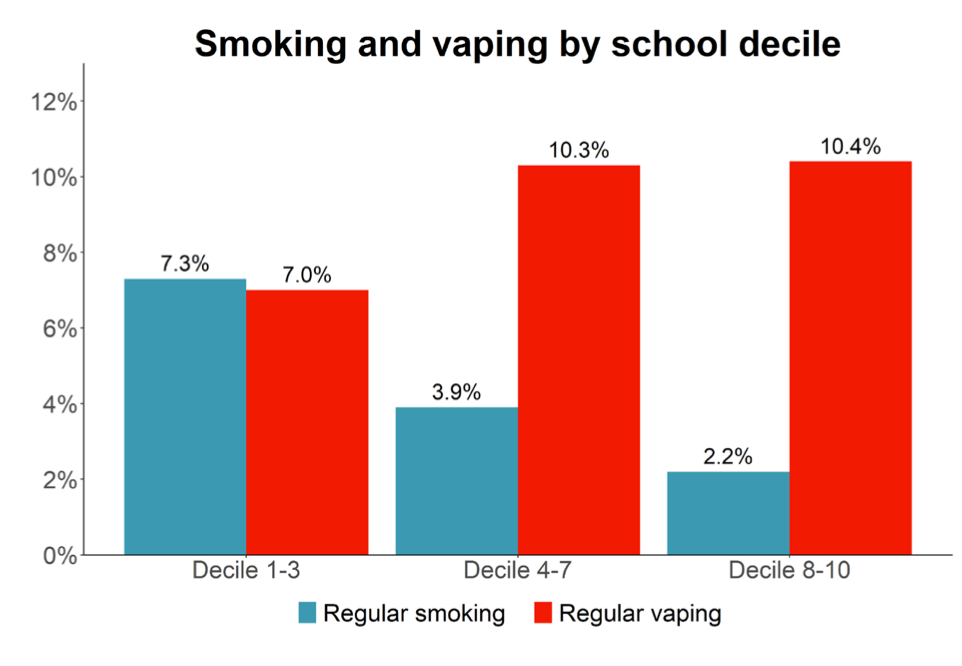
It tells us that they all know that the “consumer product” classification that Robert Beaglehole supports will see the companies able to avoid any of the controls that therapeutic regulation would bring. For example, very, very few doctors would be willing to issue a nicotine vaping license to a child, while 45% of US vaping retailers and 39% of English shops operating under a “consumer product” model sell to underage customers. In New Zealand, vaping by kids is booming. And no tobacco company would ever want to see that happen …
Source: Youth19 survey 2019 of 7891 young people. Funded by Health Research Council of New Zealand
Quite amazingly, at 7m26s into the video, Beaglehole picks up two nicotine delivery systems strategically placed on a coffee table in front of him. One at a time, he carefully inspects them, with the brand names clearly visible. Irony of ironies, the two brands are BAT’s Vype and PMI’s IQoS: the two flagship new generation nicotine products of two of the biggest Big Tobacco companies in the world. You know, the ones that he thinks it’s a bad idea to “privilege”.
He also says that access via prescription will make it “more difficult” for smokers wanting to get vapable nicotine than if these products were sold in shops with open access.
And how enormously difficult is it in Australia for people to access prescribed medications? In 2018-19, in a population of some 25 million, 205.1 million prescriptions for 900 subsidised drugs in 5,455 brands were dispensed via Australia’s Pharmaceutical Benefits Scheme. There can be few people in Australia who, in any year, are never handed a prescription by a doctor.
“All of it is incorrect”
Beaglehole also has some choice words about those who have drawn attention to emerging evidence about harms of vaping. At one point he refers to “the supposed harm of nicotine and vaping”, theatrically gesturing quotation marks around “supposed harm”. He then says “A lot of that information is incorrect. All of it is incorrect. And based on very poor science and vested interests.” (my emphasis)
All of it is incorrect? All of it? So any published evidence that has concluded that there are any concerns about vaping being harmful or not very effective in helping smokers quit is all wrong? In our submission to the 2020 Senate enquiry, we referenced 11 expert reports and meta-analyses of smoking cessation via vaping published since 2017 which all concluded there was weak evidence that e–cigarettes are useful ways of quitting smoking. We also listed (on pp 23-24 of our submission) a small selection from many recent papers on harms from vaping.
Such categorically dismissive language from a person with a seriously impressive public health background is quite remarkable.
He continues “The misinformation which is coming from a rather limited number of people with strong vested interests in traditional tobacco control approaches”.
A limited number of people? With “traditional tobacco control approaches?” Perhaps by this Robert means those approaches which no less than 188 nations have signed to support the World Health Organization’s Framework Convention on Tobacco Control – a blueprint for reducing smoking. The only nations that have not signed are Andorra, Dominican Republic, Eritrea, Indonesia, Liechtenstein, Malawi, Monaco, Somalia and South Sudan. Here’s a 2019 blog from me showing a very long list of national and international health agencies who have expressed strong reservations about e-cigarettes.
My scepticism of the turbo-hyped claims for vaping is shared by many of the world’s peak health agencies. Here’s how Australian agencies line-up. Notice a pattern?
If there is anyone helping Big Tobacco in the vaping policy debate, it is of course all those who are doing all they can to enable its ambitions to see a repeat with vaping of the disastrous historical failure to regulate tobacco and cigarettes. I’ve never met anyone in health or medicine who thinks it is wonderful for public health that cigarettes can be sold anywhere. Australia’s decision to require a prescription will put a significant barrier between kids and vapes, but will not constitute a barrier for adults who smoke to access vapourised nicotine under the care of a GP.
Update 20 Feb 2021: two excellent investigative pieces published this morning in the Australian Financial Review, on how two tobacco companies (BATA and Philip Morris) have been lobbying to stop the “prescription” regulatory model.
Vaping theology: 9 “Won’t somebody please think of the children”. WordPress 6 Sep, 2021
Vaping theology: 10: Almost all young people who vape regularly are already smokers before they tried vaping. WordPress 10 Sep, 2021
Vaping theology: 11 The sky is about to fall in as nicotine vaping starts to require a prescription in Australia. WordPress 28 Sep, 2021
Vaping theology: 12 Nicotine is not very addictive WordPress 3 Jan 2022
Vaping theology 13: Kids who try vaping and then start smoking,would have started smoking regardless. WordPress 20 Jan, 2023
Vaping theology 14: Policies that strictly regulate vaping will drive huge numbers of vapers back to smoking, causing many deaths. WordPress 13 Feb, 2023
Vaping theology 15: The government’s prescription vape access scheme has failed, so let’s regulate and reward illegal sellers for what they’ve been doing. WordPress 27 Mar 2023
Vaping theology 16: “Humans are not rats, so everybody calm down about nicotine being harmful to teenage brains”. WordPress 13 Jul, 2023
Vaping theology 17: “Vaping advocates need to be civil, polite and respectful” … oh wait. WordPress 3 Oct, 2023
Vaping theology 18: Vaping is a fatally disruptive “Kodak moment” for smoking. WordPress Oct 30, 2023
Vaping theology 19: Vaping explosions are rare and those who mention them are hypocrites. WordPress 17 Nov, 2023
Vaping theology 20 : Today’s smokers are hard core nicotine dependent who’ve tried everything and failed – so they need vapes. WordPress 14 Dec, 2023
Vaping theology 21: Australia’s prescription vapes policy failed and saw rises in underage vaping and smoking. WordPress 10 Jan, 2024
Vaping theology 22: “Prohibition has never worked at any point for any other illicit substance”. WordPress 17 Mar 2024
Vaping theology 23: “84% of the Australian public are opposed to the way the government will regulate vapes” WordPress 2 Apr, 2024
Vaping Theology 24: “Tobacco control advocates are responsible for vape retail store fire bombings and murders. WordPress 27 May, 2024
Offer of reply: I offered Robert Beaglehole an opportunity to respond to the points made in this blog on 16 Feb 2021. He replied on 19 Feb accepting the offer. As at 24 Oct, 2021 he has not submitted a response.
Following the development of a cluster of COVID-19 cases in late December 2020 in Sydney’s northern beaches region, the NSW government introduced a requirement for mandatory mask use on all public transport, retail shops, cinemas and theatres from midnight on January 2, 2012. Fines ranged from $200 for individuals, $1000 for small businesses and $5000 for corporations.
With the ebbing of cases, this requirement was narrowed a few weeks later, with masks remaining mandatory on public transport and in close-contact occupational settings like hair salons, barbers, massage parlours and nail bars.
Throughout 2020, the government had resisted extensive and often impassioned calls from many public health experts, the state political opposition and many members of the public for masks use to be mandatory in public indoor settings and public transport.
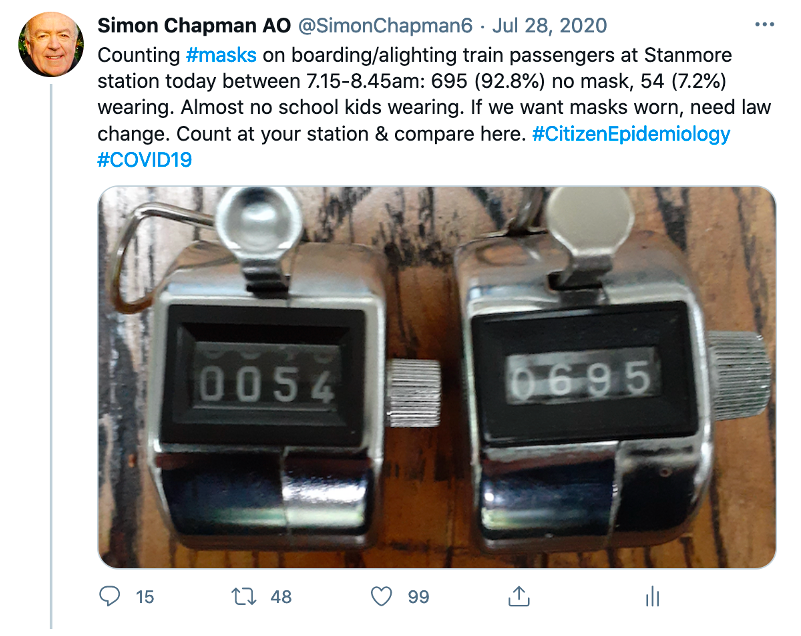
Well before masks were mandated, on July 28, 2020 I spent 90 minutes on the platform of my local railway station between 7.15am-8.45am observing the prevalence of mask use. I used two mechanical thumb tally clickers to count both use and non-use on people on the platforms both waiting to board and alighting. With mask use being voluntary, I found 54 (7.2%) wearing masks and 695 (92.8%) not.
On February 3, 2021 after 17 consecutive days in NSW without a locally acquired COVID case and when the law still required those aged 12 years and older to wear masks on platforms and in trains, I repeated these observations for two and a half hours between 7.00am-9.30am on a platform of Town Hall station, one of Sydney’s busiest stations located in the downtown central shopping district. From an unobtrusive seated observation point, I counted all use and non-use in those on three clearly visible railway platforms, those visible in the stopped carriages immediately adjacent to my observation point and on two stairwells leading onto the platforms. I did not count any children in school uniform as discerning their age was likely to be unreliable.
Across the two hours, I counted 2758 people with masks (96.6%) and 96 without (3.4%).
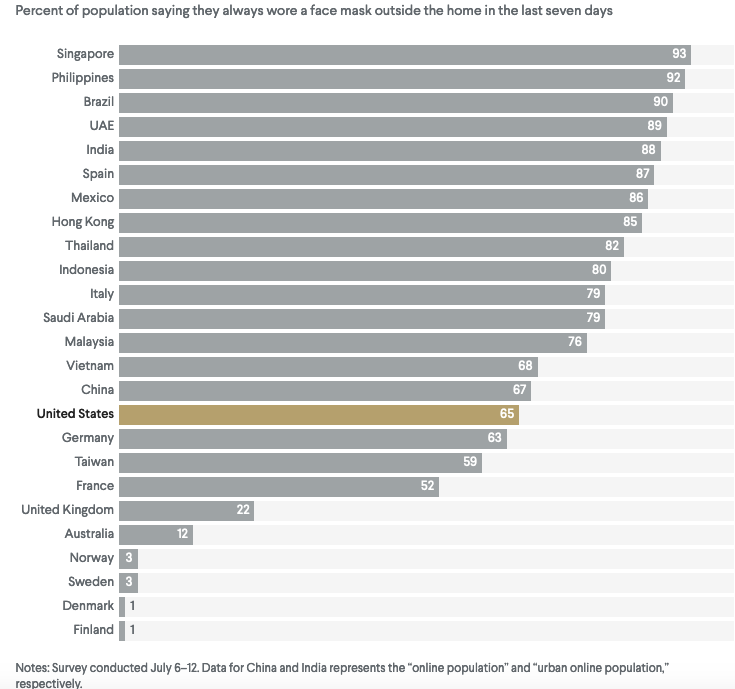
The Council on Foreign Relations reported in August 2020 that “more than half” the world’s nations had mandated either total public space mask use or use in certain areas or circumstances. In view of this, I searched PubMed and remarkably, was unable to find a single observational report of mask use prevalence for any nation or region, post the advent COVID-19, with usage data reports being based on self-report (for example here). Given the volatility of the debate about mandatory mask use in some nations, social desirability bias is likely to cause reliability problems in self-reports of mask use.
These “citizen epidemiological” easily conducted and unambiguous observations of mask use are possibly the first time the impact of legislation on mask use has been reported by actual counting of mask use. Masks are accessible, cheap and most critically, a vital component on COVID-19 risk reduction recommended by the World Health Organization. The data in this small observational study should encourage those advocating for masks to be made mandatory in relevant crowded circumstances.
Having traveled often on public transport during January, the counts I tallied are consonant with my experiences of seeing almost everyone masked during this time. Future research could examine whether my tallies are also occurring across the greater Sydney rail network at different times and days of the week.
At different times during the COVID-19 pandemic, Australian states and territories have mandated mask wearing in various public settings. As I write this on Feb 1 2021, my own state of NSW currently mandates masks in the Greater Sydney region (including the Blue Mountains and Northern Beaches), the Central Coast and Wollongong). Masks must be worn on public transport, for staff in hospitality settings (bars, restaurants, cafes), in hairdressing salons and barbers, beauty parlours and nail bars, massage parlours, tanning salons, on planes and in airports, and at places of indoor worship, weddings and funerals.
Those breaching these rules can be fined $200 (individuals), $1000 for small business owners not enforcing mask use and $5000 for corporations.
During most of January, this list also included all shops. The future may see changes to these rules, depending on infection rates and locations.
Health workers and many citizens were vociferous advocates for masks to be made mandatory from the early days of the pandemic. But without their use being mandatory, voluntary rates of adoption were depressingly low. In late July 2020, out of curiosity I took myself off to my local railway station for 90 minutes in the morning commute period with two hand counters, clicking with one hand all those boarding or alighting wearing masks, and with the other, those not wearing masks. Nearly 93% were maskless.
When Sydney’s northern beaches experienced a significant cluster which threatened to spread beyond the locked down peninsula, the state government relented and rapidly mandated masks in all indoor settings and on public transport from midnight on January 2, 2021.
It was obvious to all that there was an immediate, almost 100% compliance that lasted until the relaxation announced several weeks later.
As I blogged earlier, this was almost entirely predictable, mirroring the 100% compliance with a restaurant indoor smoking ban when it was first introduced in time for the Sydney Olympics in 2000, compared with the situation in Melbourne which at time still allowed smoking in restaurants.
There is a huge, unassailable lesson in this. Public information and persuasion campaigns designed to motivate people, manufacturers and the service sector to voluntarily adopt behaviours or changes in the way they manufacture or provide good and services will get you only so far.
When you face deadly serious threats to large numbers of people, and voluntary appeals are not translating into widespread adoption, legislation backed with fines can make a huge, sometimes instant difference. Harvard University’s David Hemenway documented many examples of this in the injury and violence prevention in his 2009 book While we were sleeping: success stories in injury and violence prevention.
I could scarcely believe what I was reading as I made my way through their painstaking analysis and synthesis conducted between July-December 2020. They gathered studies examining how “interventions” affected changes in hand hygiene, avoiding touching the ‘T-Zone’, catching droplets in tissues face mask use disinfecting surfaces and maintaining physical distancing.
Here, I’ll just focus on their mask wearing results. They located just 12 studies examining what happened when people are exposed to interventions intended to increase mask use. Their conclusions? “mixed results, with three studies reporting positive effects, two studies reporting no difference, one study reporting negative effects and six studies with indeterminate results.”
And their concluding implications? The few and often low quality of the studies suggest “a missed opportunity for harnessing techniques indicated by relevant behaviour change theory and evidence. We encourage policymakers and healthcare practitioners to work collaboratively with behavioural scientists to incorporate techniques that theory or evidence predicts are effective for enabling personal protective behaviours, such as techniques targeting motivational or self-regulatory processes.”
So all clear, are we, about what behavioural change research offers policy makers hungry for information about how to increase mask use?
It appears that the authors made a rod for their own back by limiting what “interventions” they should include in their review. Call me picky, but to my mind a law requiring everyone to wear a mask at risk of a fine, combined with the massive news reportage that invariably accompanies the introduction of such laws, ubiquitous posters reminding people about masks and frequent railway station platform announcements, might just count as an intervention a tad more important than some little study of what happens when some university students were sent free masks to prevent acquiring influenza.
In an August 2020 publication by the Council on Foreign Relations, “more than half” the world’s nations had mandated either total public space mask use or use in certain areas or circumstances. A graph in the report (below) showed very wide differences across nations in those self-reporting that they had worn a mask outside the home on the last seven days. Self-reported data on an issue like masks that attracts sometimes significant opposition is unlikely to have high reliability, compared with direct observation of mask wearing rates.
It is likely that there are widespread cultural differences that are highly relevant to mask use, which go beyond simple questions of whether masks are mandatory or not. Many Asian cultures have a long standing tradition for those with respiratory symptoms to wear masks. Differences in enforcement rates will also be important, as will those in a nation’s overall tendency in its citizenry to obey public laws.
This law in NSW produced a blindingly obvious, nearly universal uptake in mask wearing in all areas which required it. So the absence in this review of even a mention of such massive impacts on mask use was startling.
I searched PubMed for studies on the prevalence of mask wearing during COVID. I found many papers reporting and reviewing experimental evidence on the reduction of aerosol from mask wearers, and some papers comparing COVID 19 incidence rates in states and districts which mandated masks compared with those which didn’t (see here for example). But I found no papers showing time-series data comparing the prevalence of mask wearing before and after the introduction of mask laws.
Observational data like this are commonly collected and published in the monitoring and evaluation of the impact of a wide variety of public health laws and regulations like restaurant smoking, car roadworthiness, seat belt and infant restraint use in cars, blood alcohol and cannabis levels in drivers, helmet wearing by motorcyclists and cyclists, cockroach and rodent infestation in restaurant kitchens, and indoor air quality in workplaces. These are just a few examples.
If I’m right that there are few or no studies of mask uptake after the passage of laws mandating this, the researchers whose paper I described above could be forgiven for not including any in their review. COVID-19 is the largest health threat that all alive today have ever faced. All governments urge their citizens to wear masks, yet many still do not mandate it. Data clearly in plain sight for all of us to see that mandatory masks massively increase mask use could very easily be “upgraded” in evidence status by properly conducted surveillance studies. Such data would be invaluable in levering tardy governments into mandating their use.
In January 2021, the creepy murderer and legendary wall-of-sound record producer Phil Spector died in jail. I have a much-played boxed set of his best productions, which includes the Ronettes, the Righteous Brothers and Ike and Tina Turner’s incomparable River Deep, Mountain High. I cannot imagine ever disliking those songs, despite Spector’s odious crimes.
Then there’s good old Van and Eric. With 1 in 30 London residents currently diagnosed with COVID-19, 1700 deaths a day and British and Irish frontline hospital and ambulance staff pleading for people to obey COVID-19 control protocols, what are we all to make of these musical icons releasing a song protesting lockdowns? I saw Morrison in London in the early 1980s, and along with about a quarter of the audience, walked out well ahead of the end when he obviously didn’t want to be there either. But now I’m wondering if I should walk away from even listening to his music.
Morrison, who gave us the languid classic Into the Mystic, the soundtrack to Kenneth Branagh’s masterpiece Belfast and many, many more wonderful songs has released three tracks protesting the British lockdown: “Born to Be Free,” “As I Walked Out” and “No More Lockdown.” The hope is that these songs will be bought and downloaded, providing funds for out-of-work musicians. Morrison and Clapton also presumably also hope that their views will become as contagious as COVID-19 and people will ignore directives.
Fantastic that they care about musicians’ livelihoods. But how to describe their concerns for the whole population?
The other night at a family dinner, a Ryan Adams track I love came on in a playlist I had running. One of my kids said “what are you playing that guy for? Don’t you know that he’s been accused of multiple counts of sexual misconduct?”## I didn’t and my heart sank. I discovered him only relatively recently and have 10 or so of his songs like this one on high rotation playlists. [##Note: Adams has apologised for his behaviour]
But, as happens when I play favourite Clapton, Morrison and Adams tracks, I experience nothing of this in his paintings, and think I’ll always appreciate them.
Joe Jackson is another who rails against restrictions on smoking. The insipid nihilist lyrics to his 1982 track Cancer, (“everything gives you cancer”) could come straight from the tobacco industry’s historic playbook of trivializing the risks of smoking. They’d sit comfortably with one of today’s MAGA Trump supporters, applauding his efforts to shred environmental health standards.
I’ve watched Roman Polanski’s movies like Chinatown, Repulsion and Cul de Sac many times. But wait, there’s the problem of Polanski’s alleged sexual abuse of women. So, do we all just relax, sit back and enjoy his cinematic artistry?
Of course these recent examples are not the first time and certainly won’t be the last that musicians, artists, writers and public figures whose work we love, will go and display weapons-grade fuck-wittery or be exposed for their reprehensible behaviour. But what are we to do when we learn this, beyond talking about how here’s yet another public figure who’s gone down the plughole?
Then there’s travel. A few years ago I decided I wouldn’t attend a world conference in my field that was being held in a Gulf state. I had no appetite for living for a few days in the gilded cage of a luxury hotel while outside, the government quietly facilitated the exploitation of guest workers from impoverished countries, jailed people for adultery and did nothing to redress basic women’s rights.
I worked a lot with research colleagues in Shanghai, and loved going up there. But I became increasingly appalled by China’s treatment of minorities, evidence of organ harvesting from prisoners and its conduct in crushing dissent in Hong Kong. So sadly, no more China for me I decided.
But I’ve also been to many other countries where widescale human rights abuses, capital punishment, rapacious environmental policies, the jailing of dissidents and blind-eyes turned to Dickensian labour conditions in sweat shops abound. At different times, these have included the US, Turkey, Pakistan, India, Uganda, Iran and Afghanistan. Should we all feel obliged to stay away from any country which implements any egregious policies and practices? Are there any such places where none of this happens? Or if we’re to be consistent in the application of consumer and traveler “woke” principles, can we ever again travel anywhere?
And then of course, I live in Australia where our government keeps asylum seekers in prison-like indefinite detention, shrugs its smug shoulders over scandals like Robodebt, Aboriginal deaths in custody, Barrier Reef die-off, land clearing, and tries to endlessly polish the turd coal to try and make it seem clean.
Cartoon by Lindsay Foyle
Many of us put a lot of effort into choosing products and manufacturers which tick lots of boxes on exemplary environmental, labour and human rights records. In our house we use Choice magazine’s Cluckar app to help us buy truly free range eggs. We buy “naked”, unpackaged fruit and vegetables. But I don’t check the carbon footprint and labour practices of every single grocery item I put in my trolley. Each trip to the supermarket would take all day if I did that.
The perennial debate about whether we can and should separate our appreciation for someone’s creativity from their loathsome and sometimes dangerous behaviours, attitudes and beliefs seems destined to never be resolved. All of us show inconsistencies in what we make a fuss about and what we let through.
The sense of loss I feel is palpable when I learn that an artist, musician or writer whose works I loved is another depressing cockwomble. But I haven’t and don’t intend to purge my Spotify playlists of anyone in that club. We often associate music we love with the context and times when we first heard it. What we might learn later about those who perform it seldom totally extinguishes any love for that music. Moreover, with the great majority of musicians, I’d have no idea about their politics. Is anyone saying that we should do this?
These people are diminished for me and I imagine many millions of others when we learn about their feet of clay. Knowing what they stand for has certainly inspired me to look elsewhere more and actively seek out musicians, artists and writers who I’ve found out share my values.
Every researcher has received rejections from journals. I edited Tobacco Control for 17 years (7 as deputy editor, and 10 as editor). Across that time I and the other senior editors had to reject 1000s of papers. All of these were written by authors who thought their papers were important and sometimes brilliant.
There are many reasons why papers get rejected, including many which are of an acceptable methodological and analytic standard. Here are ten of the most important:
Space limits
Journal editors are given page limits for their print editions by their publishers. Editors then need to decide word limits to optimize the number of papers they can publish in each edition. If there is only room for 70 papers a year, and 700 are submitted, it’s obvious 90% will be rejected. Editors may vary the word limits for different sorts of papers (reviews are often longer, and many submitted papers really have only one or two findings that are of any interest, and so authors are often offered brief reports or letters).
Many seem to believe that on-line only journals, not having the constraint of page limits that printed issues have, should be able to accept many more papers and not be fussed about length. But this is a misunderstanding and brings us to the next reason for rejection.
2. Budget limits
Publishers set annual budgets for journals. When I was at Tobacco Control we paid our senior editors a fee of $US50 per allocated paper. They got this regardless of the fate of the paper. So they got the same amount if, after reading the paper (and sometimes only the abstract—see below), they rejected it without review; if it went out for review and was then rejected without offer of revision; and also if it went through review and sometimes several revisions. Finding reviewers willing to review papers is a particularly onerous task that falls to senior editors. Refusal-to-review rates run at about 1 in 3. My own personal record in soliciting reviews runs at 12 consecutive refusals. Papers from nations where English is not the first language, sometimes have many problems with expression that need many hours of editorial attention.
Senior editors generally do not attend to the numerous problems of expression, inadequate referencing and failure of authors to follow journal guidelines. Neither do they do mark up papers for publication and fix table layouts. These tasks all take lots of time and are handled either by in-house technical editors or by out-sourced editors, often in big technical editing firms overseas. On-line publishing is also often hosted by out-sourced companies, which charge by the volume of material they publish.
All this of course costs money, and so publishers insist that editors are very judicious in the volume of acceptances.
cartoon credit: Lindsay Foyle (Sydney)
3. Rapid processing
Across the 17 years I edited, there were few days when new papers, revisions or questions from authors did not arrive. If these banked up, the backlog was bad for editors’ workload, authors wanting to know the fate of a paper quickly and a journal’s reputation as a deep hole. My own worst case experience as an author myself is laid out here in its full, sorry detail.
So I encouraged all our senior editors to reject without review any papers that clearly had a snowball’s chance in hell of being accepted and which would waste everyone’s time if sent out for review. Some of the submissions that came in were unbelievable: entire theses, rants from conspiracists and crazies, papers where the authors had clearly never read the journal, and from those with near to zero familiarity with scholarly writing. If an editor leaned strongly toward reject without review, but wanted to run the reasons by others at our fortnightly editorial on-line conferences, they could bring it up there.
We used a stock email that attempted to explain our dilemma to authors: we had far, far more submissions than we could ever publish even if they were to be reviewed favourably, and so it was necessary to cull. We hoped authors would appreciate our rapid decision so they could place their work elsewhere.
One paper, in the early days of the internet, was submitted by a doctor who encouraged his patients to visit his website about smoking. He’d gone through the back-end data and written up a paper with numerous tables detailing such riveting details as the time his very modest number of patients visited his site and how many times they’d clicked through to its different pages. The assigned editor rejected it during our editorial conference. I saw the rejection come through on my email and replied to the handling editor “Congratulations! The fastest reject in the history of the journal!”. But I accidentally hit “reply all”, so my attempt at congratulating an efficient editor also went to the author who immediately replied with a white hot, incendiary blast about the arrogance of editors.
4. Impact factors
Not inciting the wrath of publishers for over-budget runs is always in the background. But there are also of course, important academic and impact considerations involved in rejection. I’ve never met a journal editor who was not intensely keen to see their journal’s impact factor rise and rise. Those who have low to homeopathic level IFs will often drone on about how unimportant these are. But those up near the top of the IF tables want everyone to know, particularly authors because many factor in IFs when submitting their most important work.
Experienced editors develop an instinct for submissions which are likely to be highly cited by other authors after publication. One of the most common things editors on a journal say to each other in editorial conferences is “I think this paper will really attract a lot of citations”. Or the reverse. I’ll come to tell-tale signs of this below.
5. No “wow” factor
The decision to send a paper out for review rather than to reject it outright is primarily governed by judgements that a paper will attract lots of interest. Editors are chosen because they typically have a breadth of experience in the area in which a journal focuses. Their own instincts about whether a paper is important are therefore often shared by other editors in the regular editorial conferences where decisions are made on the fate of most papers. Editors often note published papers which are being deluged with on-line clicks and being well cited. The obverse of this is that there are also categories of papers which are sleep-inducing and likely to be loved mainly by their authors.
6. Failing to “sell” your paper
I once sat next to Richard Smith, a long-time editor of the BMJ, on a train going from London to France. He had a large box-like piece of hand-luggage which was filled with paper copies of submitted papers. I watched him out of the corner of my eye as he triaged them into what I recall as three piles: instant reject, instant send out for review, and “read further later and think about it more”.
He motored through dozens of papers in the time it took us to get to our destination. With the great majority, he read the authors’ cover letter first. Sometimes it was the only thing he seemed to read. For others, he read the abstract as well. And with the reminder, he skimmed particular sections before deciding their fate.
We talked about this and agreed that many authors give very cursory attention to their abstracts and especially to the cover letter. The cover letter is critical to piquing the editor’s interest and telling the story about why the paper is important, how it advances understanding of something that passes the “so what?” litmus test and ultimately of whether a paper might hold promise of attracting a lot of scholarly and hopefully public interest too.
Similarly, abstracts are often dashed off at the end of a paper’s construction by fatigued authors wanting to just get it out to a journal. Amid a plethora of findings, sometimes the most important or interesting findings are left out of an abstract, because authors have failed to view their paper as editors might view it, killing a paper’s interest.
My own way of approaching this was to rehearse how I would try to briefly describe a paper of mine when pitching it to a specialized health or medical journalist writing for a newspaper. If it was a struggle, I’d often come down to earth about where to pitch the paper.
7. International or local interest?
With international journals (as opposed to those with clear national foci), editors are keen to publish papers that will interest global readers. In the tobacco control research space, a competent study of smoking prevalence among medical students in a single university in Calathumpia will be of far less interest than one that compares the same phenomenon in a large number of countries using a standard protocol. However, if a local prevalence study is contextualized against particular policies or practices that allow consideration of what might be explaining changing prevalence, that might well interest international readers.
8. Tell-tale signs of slap-dash preparation
A paper which has been rejected, perhaps often, by other journals often has signs that do not require a degree in forensic investigation to discern. Wrong referencing styles, not using the required headings or abstract style, dated data and a focus on water-under-the-bridge events, policies etc are all often give-aways. Under the weight of abundant choices, editors can take the attitude that they will give about the same time to such pass-the-parcel submissions as the authors have given to a journal’s requirements.
9. Come clean: attach previous reviews and changes
Many papers are rejected after review. Rejection here is often not because of irreparable problems, but simply because it’s been decided that your paper does not rank highly enough against others lined up in the “potential” marshalling yard. If yours has been rejected for other than fatal flaws, do not simply submit the same, unrevised paper to the next journal down the food-chain. Instead, address those changes that the previous journal’s reviewers suggested, and send the next journal a covering letter explaining that you had it reviewed by another journal, didn’t make the cut and include the reviews as well as a point-by-point explanation of how you addressed criticisms in your revision, now being submitted to the new journal.
I used to very much appreciate that when it happened and sometimes just used one new reviewer to assess the adequacy of the revision. I have also (quite a few times) received a paper I reviewed for one journal, from another. It has just knocked on the next door still all disheveled, looking for a bed. When authors have made no attempt to make any changes, I always advise the editor of the second journal of this and attach my old review.
10. Nominate likely reviewers
Many journals invite authors to suggest possible suitable reviewers (provided that these people have no competing interests with the authors). A surprising number of authors fail to nominate anyone. Those who do are off to a good start with editors who have decided a paper is good enough to review. It saves them time, and in my experience is usually more likely to result in a reviewer agreeing to review as the authors may know of their interest in the focus of the paper. My usual practice was to pick 1 or 2 of the 3 required reviewers from those suggested by the authors.