
Tags
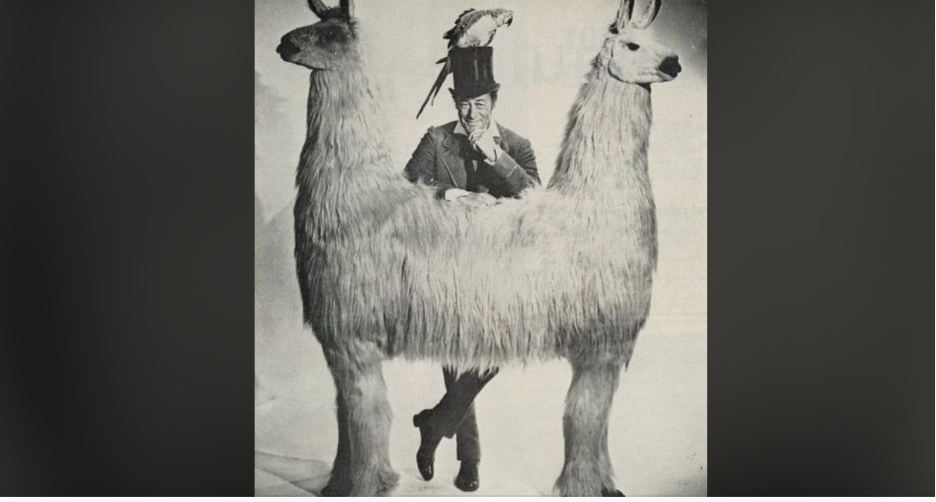
Dr Doolittle’s PushmiPullyou animal which tried to go in two directions at once
In July this year the boss of the convenience store lobby in Australia, Theo Foukkare, leapt out of the blocks to denigrate the Australian Institute of Health and Welfare’s (AIHW) latest data on smoking which showed record falls to the lowest rates ever reported. The Australian Association of Convenience Stores (AACS) is a loyal but sometimes shy supporter of its tobacco company members who pay premium corporate membership fees.
Big Tobacco lobbies for drastically reduced tobacco tax, and often right on cue, so does Foukkare who is like a cracked record on the topic.
In July Foukkare told Convenience & Impulse Retailing “anyone in their right mind would right [sic] question the validity of [the AIHW survey data], given the conflicting ABS [wastewater] data and the spin that’s being pedalled from a ‘survey’ that shows more favourable numbers for the Albanese Government to spin”. See that? ‘Survey’ put in inverted commas to let readers know the AIHW data is as dodgy as.
Theo got excited when an ABS wastewater report on nicotine in sewage found a 40% rise in nicotine stating “The quantity of nicotine consumed in Australia increased by almost 40% from 2017 to 2025, with most of the increase occurring since 2021. Population growth over the period 2017-25 was 14%.”
The AIHW data show both smoking and vaping were down in 2025, so how can we reconcile this with the rising ABS nicotine wastewater data?
Theo just knows it is all down to increased smoking of cheap illicit cigarettes. But what he seems to have missed in the body of the ABS wastewater report was this:
“While wastewater data provide reliable estimates of total nicotine consumption, they do not identify which products the nicotine came from.” (my emphasis) And importantly, “It is not possible to discern whether the rise in per capita consumption reflects a rise in the number of people consuming tobacco and/or existing smokers consuming more.”
Rather important caveats, yes?
The AIHW’s National Drug Strategy Household Survey (NDSHS) reports on smoking prevalence, not on nicotine consumption. But the possibility that smokers (which include many dual- and multi- nicotine product using smokers) have been recently consuming more nicotine, is highly plausible. Illegal nicotine pouches are also proliferating, with 8.4% of 18-24 year olds reporting use in the past year. And not to mention the massive growth in recent years of vaping devices that deliver humungous amounts of nicotine.
Here are examples from a Google search on “180,000 puff vapes”. It’s highly likely that these nicotine geysers are making a substantial contribution to wastewater even among a diminishing number of people who vape and smoke, as shown in the 2025 NDSHS data.

Theo’s correction: the NDSHS survey data are all good now!
But four months down the track from his spray, Foukkare is, by his own July description, apparently not in his right mind, and putting out the box seat candidate for 2026’s winner of the biggest volte face in Australian tobacco data analysis. Walking back his contempt for the AIHW survey, old mate Theo thinks he’s found proof in the very same survey — you know, the same one that he bagged in July — of some really excellent data that proves the government’s tobacco control policies are failing.
Here, for your edification, is his full press release.
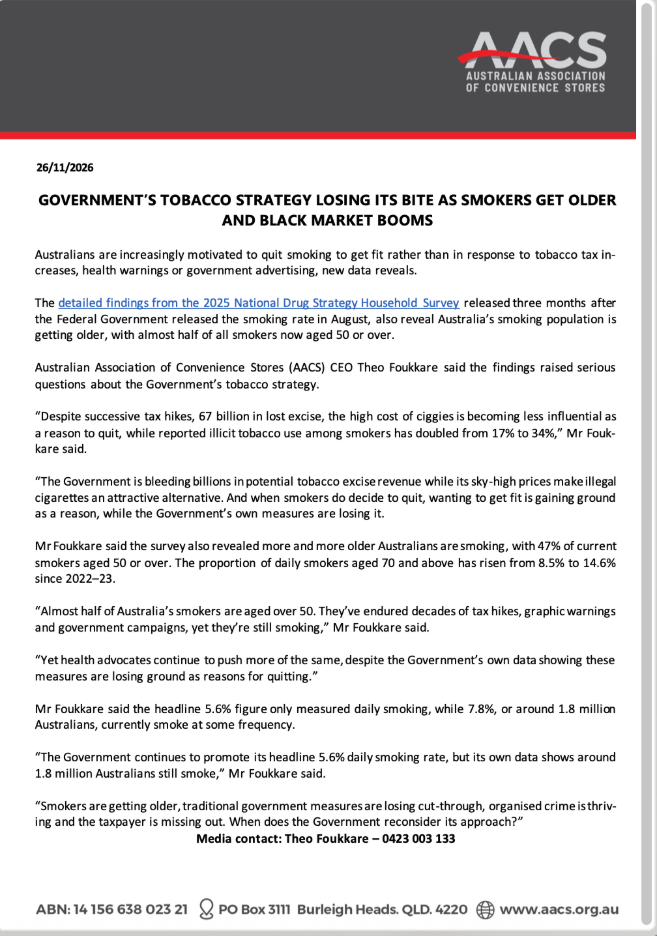
The headline screams that Australian smokers are “getting older”. His press release tells us that “more and more older Australians are smoking”. His evidence? In 2025, 47% of current smokers were aged 50 or over. He then cites a rise in the share of daily smokers aged 70 and over, from 8.5% in 2022–23 to 14.6% in 2025. All three percentages describe the age mix of smokers, but not the proportion of people in each age group who smoke.
To find out how common smoking is among people aged 50 and over, you divide the number in that age group who currently smoke by the total number of people in that age group. Theo’s 47% divides by the number of current smokers of all ages. A small detail, if you’re writing a press release that will mainly be read by journalists with no training in even basic epidemiology. But a rather large one if you’re trying to work out whether smoking is becoming more common among older Australians.
In the latest two surveys, current smoking among people in their 50s fell from 13.8% in 2022–23 to 10.2% in 2025. The AIHW describes current smoking among people aged 60 and over as broadly stable over this period. It also describes daily smoking among people aged 70 and over as stable, at 4.9% and 5.4% in the two surveys.
In fact, across six AIHW surveys from 2010 to 2025, current smoking fell from 24.9% to 7.2% among people aged 25–29, from 19.3% to 10.2% among people in their 50s, and from 13.9% to 10.0% among people in their 60s. Among people aged 70 and over, it was 6.2% in both 2010 and 2025.
Foukkare’s statistical sleight-of-hand makes the ageing of Australia’s smoking population sound like an increase in smoking among older Australians. In a 2017 editorial responding to Pelosof and colleagues, renowned epidemiologist Jonathan Samet explained the problem with that inference. Their study found that the share of patients with a common type of lung cancer who had never smoked rose from 8% to 15%. The authors suggested that lung cancer might be becoming more common among people who had never smoked. Samet pointed out that the share could rise simply because lung cancer was becoming less common among people who had smoked.
To see whether the cancer was becoming more common among people who had never smoked, you’d need to measure how often it occurred in that population. Foukkare makes the same leap from the make-up of a group to how common something (here smoking) is in the population.
When smoking falls faster among younger people, older people can make up a bigger share of those who still smoke even if their own smoking rate does not rise. It takes a special kind of arithmetic to turn that into bad news. Would Foukkare put out a press release celebrating a fall in the share of older smokers if it happened because more young people took up smoking?
Please don’t keep saying 5.6% smoke .. it’s 7.8%!
Foukkare is clearly spooked by the 5.6% daily smoking prevalence reported in the NDSHS survey. It’s the lowest figure in comparable countries to Australia. He wants the government to stop always talking about the daily smoking figure and use the higher 7.8% figure for current (ie any) smoking, which sounds a whole lot less flattering to Australia’s tobacco control policy, he insists.
Foukkare’s retailers and tobacco manufacturing supporters know full well that their bread is buttered far more thickly by daily smokers than by occasional smokers swept up in the 7.8% figure, which includes people who smoke as infrequently as once a month and whose health risks are considerably less than long term daily smokers.
Fitness is motivating quitting
And then there’s his straw-grasping exhilaration that quitters are increasingly naming concern about “fitness” as a reason for quitting. Foukkare interprets this as evidence that smokers are not being motivated to quit because of price (and tax). But in the survey, current smokers who reported changing their smoking could select more than one reason. Theo doesn’t mention this, but cost was still the most cited reason (48.4%). ‘I wanted to get fit’ rose from 26.9% to 31.1%, well behind price, and a change AIHW did not, unlike Theo, mark as statistically significant.
Here’s an old Australian TV ad about smoking and emphysema which was reprised in 2024. The guy in the ad is not exactly a glowing ad for fitness, so many smoking views might identify and feat they might go the same way.
Foukkare’s puerile release reflects the desperation of those witnessing their tobacco profits evaporating as smoking declines to its lowest levels ever recorded in Australia and the prospect of smoking by children becoming extinct in the next few years. Thank you for the back-handed compliment, Theo. My colleagues and a large majority of Australians are delighted that smoking is being made history.

